Local News & Commentary Since 1890.

Posts Tagged ‘Ohio’

Square Kids, Round Desks

In Children and Family, Education, Health, Opinion on February 22, 2026 at 6:11 am

Deer In Headlines

By Gery Deer

For decades, we have told ourselves a comforting story about education. If we standardize it, measure it, test it, rank it, and repeat it often enough, we will somehow produce better students and, by extension, better adults. It sounds reasonable. It feels orderly. It also happens to be deeply flawed.

If the system worked as advertised, we would be surrounded by confident graduates who understand their strengths, know how they learn, and are excited to apply their talents to the world. Instead, many students leave school disengaged, uncertain, and convinced they are “bad at learning,” when the real problem is that learning was never designed with them in mind.

Somewhere along the way, we stopped teaching the A, B, C’s and started teaching to a test. Those tests promise clarity and accountability, but their ability to predict a student’s future success is questionable at best. Believing a standardized exam can forecast a child’s career potential is like believing the tea leaves at the bottom of your cup can tell you who will win the next Super Bowl. The charts look official. The conclusions feel authoritative. The accuracy is another matter entirely.

What these measurements consistently ignore is the single most important factor in learning: individuality. Every student arrives with a unique mix of curiosity, aptitude, temperament, and interest. Some think spatially. Some think musically. Some learn best by doing, failing, and doing again. Others need time, reflection, and quiet focus. These differences are not inconveniences. They are early indicators of where a student might thrive.

This is why education models that emphasize science, technology, engineering, arts, and math point in the right direction. When done well, they recognize that creativity and logic coexist, that problem-solving is rarely linear, and that imagination is not the enemy of rigor. Hands-on experimentation, design challenges, and interdisciplinary projects allow students to see relevance in what they are learning, not just requirements.

Still, even these programs can fall into the same trap if they are forced into rigid pacing guides and uniform assessments. When curiosity is scheduled and creativity is graded into submission, engagement disappears. Students become compliant rather than curious, efficient rather than inventive.

Traditional public school systems were not designed around individual learning styles. They were built for efficiency and uniform outcomes. That made sense in an industrial era that valued standardization. It makes far less sense in a world that rewards adaptability, specialization, and original thinking. We continue asking students to sit still, move together, and absorb information the same way, then wonder why so many tune out.

There are alternatives, and they are no longer fringe ideas. Some learning environments emphasize individualized study plans that allow students to move at their own pace, diving deeper into subjects that capture their interest. Others use project-based education, where students learn math, science, communication, and critical thinking by solving real problems and building tangible outcomes. In these settings, a student’s natural curiosity is not a distraction; it is the engine.

Non-traditional environments often replace rows of desks with collaborative spaces, mentorship with lectures, and progress portfolios with letter grades. Students learn how to manage time, pursue questions, and reflect on their work. They fail safely, revise often, and understand why their learning matters. These experiences mirror the real world far more closely than memorization ever could.

The goal is not to eliminate traditional schools or abandon standards. The goal is to expand the definition of what school can be. Public education should adapt by offering flexible pathways alongside conventional ones, giving families and students real options instead of one-size-fits-all solutions.

When we stop forcing square kids into round desks and start honoring natural gifts, education becomes preparation instead of endurance. That shift does not weaken schools. It strengthens students. And that is the outcome worth measuring.

Adapting these options requires courage, policy support, and a willingness to trust educators and students alike. It means valuing progress over uniformity and recognizing that success can look different without being lesser. When schools evolve to meet students where they are, learning stops being something done to them and becomes something they actively claim as their own. That shift benefits communities, employers, families, and democracy itself long term.


Victory Project Announces Expansion to Girls Campus, Advancing Mission to Break the Pillars of Poverty

In Local News, sociology, Uncategorized on February 6, 2026 at 12:56 pm

Dayton, OH— Victory Project is proud to announce its expansion to a new Girls Campus in the Twin Towers Neighborhood dedicated to serving young women in Montgomery County. This expansion is made possible through a generous gift from Christian Life Center, whose partnership represents a shared commitment to restoring hope, opportunity, and purpose for young women in the Dayton community. This strategic growth marks a significant milestone in the organization’s mission to combat the “Pillars of Poverty” by mentoring disengaged students through tutoring, faith-based life skills, and workforce development training. Victory Project exists to help students graduate, grow in Christ, and build stable, purpose-filled futures.

Angie Jackson, Senior Program Director
Jessica Watkins, Operation’s Director

The Girls Campus, led by Operations Director Jessica Watkins and Program Director Angie Jackson, will extend Victory Project’s proven model—centered on the 3 E’s: Education, Entrepreneurship, and Enlightenment—to young women who face fundamental barriers to success. Through structured programming, mentorship, and holistic support, Victory Project addresses the root causes of poverty while fostering resilience, responsibility, and long-term stability.

“We are beyond excited to bring the vision of the Girls Division to life in August,” said Watkins. “While we will be serving young women, our mission, philosophy, and core values remain the same. We are undoing hopelessness with Godly purpose, modeling work as the reward, offering love and accountability, and providing a safe and consistent environment.”

The expansion is a key component of the organization’s Victory Over Poverty Capital Campaign, a multi-year effort designed to strengthen operational sustainability, expand program reach, and secure long-term impact across multiple campuses. Funds raised through the campaign will support program development, staffing, facilities, and an endowment to ensure continued services for students and alumni for years to come.

In addition to financial support, Victory Project is actively seeking volunteers to help bring the Girls Campus to life. Volunteers play a vital role in building trusted relationships and modeling the consistency and commitment that are central to Victory Project’s approach. Victory Project invites community members, donors, and prospective volunteers to learn more about the Girls Campus, the Victory Over Poverty Capital Campaign, and ways to get involved by visiting www.victoryproject.org.

“This expansion is an answer to prayer and to the most common question I’ve heard for 17 years: ‘When will Victory Project have a girls program?’ The board and I have full confidence in Jessica’s and Angie’s ability to mirror VP’s culture of success and to live out our faith in action through this new program,” said Monnie Bush, Founder & C.E.O.

Snow Drifts

In Environment, Local News, Opinion, Uncategorized, weather on February 1, 2026 at 1:34 pm

Deer In Headlines

By Gery Deer

I was 10 when the Blizzard of ’78 hit our small farm in southwestern Ohio. Holed up in an 8 by 10-foot room of our tiny farmhouse, with no power and only a small, very 1970s cone-shaped fireplace for heat, the five of us survived because of the experience and fortitude of my parents. 

It was 36 degrees in our kitchen that first morning and, without electricity, we had no water, and no other heat source. Plus, we had to figure out how to mix formula for 14 bottle-fed feeder calves in the barn. The temperature continued to drop, the wind was relentless, and a seven-foot snow drift sealed our back door. 

My father and brother tunneled like gofers from our basement walkout, creating a passable though treacherous path to the barn. Diesel fuel siphoned from a tractor filled nearly every one of our 15 or so antique kerosene lamps. Some provided light while others were placed next to open cabinet doors to warm water pipes. As it turned out, those weren’t the only family antiques that were called into service.

Me, my mother, and my brother’s very pregnant wife, melted snow in large canning pots and used the water to feed the calves – one bottle at a time. It took hours. Oddly, the barn was warmer than you might expect since the walls of stacked hay provided good insulation. Mom also found a way to feed us too. She cobbled together foil packs of vegetables and beef and cooked them in the little fireplace.

On day two, the national guard plowed our quarter mile-long driveway, and my father and brother took one of our farm trucks into the village to get supplies for us and the elderly couple who lived at the orchard across the road. It took them almost eight hours to make the seven-mile round trip. Once they made it back, they didn’t go out again. We had enough challenges at home.

Our electricity was out for almost four days. Over the next year, my father gutted our home’s heating system, replacing the electric oil furnace with a wood-burning version he designed. They also added generators, and a 1905 wood-burning cook stove. They were determined we’d never be so crippled again. 

I still use the lessons I learned during that very cold week and the events that followed. Our electricity was knocked out on a more than regular basis, but we were well prepared for most situations, thanks to my family’s know-how and tenacity. As a different kind of pioneer once said, “Failure is not an option.”

This past week, our small part of the world, as well as most of the Midwest and northeastern United States, experienced a similar winter event. As I prepared our home for the coming snow and cold, I was reminded of every moment during that frigid week on our farm all those years ago. For me, it was like my folks were still here because I could hear their words and see their actions in my mind – the lessons of growing up in a remarkable place with uncommon people. 

Sadly, it seems to me that such self-sufficiency is less common than years gone by. Instead of a calm thoughtful response to something like a snowstorm, people today seem more likely to overreact. Not even those who take preparedness to an extreme level can be ready for everything. But for situations like this, we have more resources, better access to information, and more reliable infrastructure than anything available a half century ago. Still, most people panic, clearing store shelves of bread and milk, while doing little to adequately prepare.  

I’m incredibly fortunate to have grown up at a time and with a family who gave me the knowledge and resourcefulness to look after myself in most situations. Probably like many of those reading this, I take whatever steps I can to manage a situation and try to help others whenever possible. General observers might see my heightened sense of urgency as anxiety, but I’m generally the calm one. Even so, there’s always that thing you didn’t plan on. That’s when improvisation, fueled by experience and common sense, can literally save your life.

Slow Down

In Children and Family, Opinion, Uncategorized on January 27, 2026 at 8:42 am

Deer In Headlines

By Gery Deer

Every day I hear people comment about the exhausting pace of modern life. Most of us have felt that strange acceleration where time seems to pick up speed as birthdays pile on. It’s the moment you’re pulling holiday decorations from the attic and swear you just put them away. Of course you didn’t. A full year passed while you were looking at your phone.

Some of that is age, sure, but some of it is engineered. Modern life has a way of nudging us forward faster than we’re built to move, and the most persistent nudge lives in our pockets. The internet, and especially social media, has turned time into a moving sidewalk that never stops. You can stand still, but you’re still being carried somewhere.

I remember my first cell phone that could send text messages and, if memory serves, receive email. At the time it felt revolutionary. I worked outside an office most days, and suddenly important updates could find me without firing up a laptop. It was convenient, efficient, and undeniably useful. This is usually the part of the story where someone asks, “What could possibly go wrong?”

Then the iPhone arrived and the rock started rolling downhill, with all of us sprinting after it. Today we’re permanently connected. Texts, emails, alerts, pings, buzzes, banners, and badges stack up like unread magazines on a coffee table. Studies now link constant device use to anxiety, high blood pressure, and other ailments. The bigger question is why we tolerate it. The answer is uncomfortable. We asked for it.

The more we demand speed and convenience, the more manufacturers and app developers provide. They’re not just selling phones. They’re selling attention, collecting data, and turning it into a high return product. That data fuels more selling, more targeting, and more noise aimed right back at us. This isn’t a conspiracy theory. It’s the business model, printed in very small type.

The byproduct is a permanent state of urgency. Time no longer feels as it once did. Information arrives in six second micro bites, and our brains are expected to digest it like a full meal. But they can’t. We skim, react, and move on. We mistake motion for understanding and speed for knowledge.

We’re all worried about so much – insane politics, societal division, jobs, kids, and the high cost of – well everything. The pressure never lets up. Instead of slowing down to understand what’s happening, we consume only fragments of information and make decisions about our lives with incomplete – or false – information. We don’t reflect. We react, often loudly, and too quickly.

As technology grows more invasive and we become more dependent on it, our reaction time decreases. Important decisions are made without context, sometimes without consideration. That should worry us. I’m convinced it’s one of many contributors to the unsettled mood of the country right now.

So, what do you do? I wish I had a good answer for you. Personally, I’ve been increasingly drawn to the analog and just setting the phone aside whenever I can. Unfortunately, the demands of my work prevent a complete disconnection from social or other digital media. But I write on a manual typewriter at some point in my workday, listen to vinyl on a turntable in my office, and just try to be aware of it all.

Occasionally, I’ll buy a print newspaper and spend several days reading every article. Cover to cover. It’s my way of appreciating the work the writers put into it while absorbing each story. It might seem a bit excentric, but I get the complete picture – without the anxiety that comes with doomscrolling. Plus, I can put it down, then go back to it whenever I want without feeling like I am missing something.

This isn’t about technology, but our resignation to life at a fever pace. Our techno-crutches are just symptoms of a more pervasive problem. We need to slow down. When everything is urgent, nothing is important. And slowing down isn’t quitting. It’s a choice about when to move, listen, or think. That small choice can quietly change the tone of a day, and sometimes an entire life if you let it.

Gery Deer is the editor and publisher of The Jamestown Comet.com and a regional columnist for several other publications.

When Snow Is in the Forecast, Calm Should Be Too

In Local News, Uncategorized, weather on January 23, 2026 at 8:43 am

By Gery Deer

Editor

By now, you’ve probably heard it. A winter storm is headed our way this weekend, with forecasts calling for up to 12 inches of snow across Jamestown, Greene County, and other parts of the Miami Valley. Cue the dramatic music, the urgent weather graphics, and—if history is any guide—the sudden disappearance of milk, bread, and eggs from grocery store shelves. Not to mention the appearance of the all too familiar grocery store meme of the panicked little kid running with milk and bread in tow.

How about we all just calm down for a minute? A dose of common sense would be great right about now.

Yes, 12 inches of snow is nothing to shrug off. It deserves respect and preparation. But it does not require panic, hoarding, or acting like we’re about to be snowed in until spring. Around here, heavy snow is usually cleared from main roads within a day or two. Life slows down briefly, then it gets back to normal. That’s how it’s gone for decades.

The problem is that winter storm coverage often turns preparation into panic. Words like crippling, paralyzing, and historic get thrown around, and suddenly people are fighting over the last loaf of white bread as if it’s the final one on Earth. We’ve all seen it. We’ve all laughed about it later. And yet, here we are again.

So, let’s try something different this time: calm, common sense.

Here’s what actually makes sense to do.

First, stock enough essentials for about three days. Not three weeks. Three days. Food you already eat, medications you need, pet supplies, and a little extra drinking water. If the power stays on, great. If it doesn’t, you’ll still be fine for a short stretch.

Second, be ready for possible power outages. Heavy snow combined with wind can bring down tree limbs and power lines. Have flashlights with fresh batteries, or candles if you use them safely and responsibly. If you rely on fuel-burning space heaters, make sure they are properly vented. This is important enough to repeat: never run generators, grills, or fuel-burning heaters inside your home or garage. Carbon monoxide is silent, invisible, and deadly.

Third, think about warmth. Extra blankets, warm clothing, and closing off unused rooms can help conserve heat. Even if your home cools down, layers and common sense go a long way.

Fourth, limit travel. If you don’t absolutely have to be on the roads, stay home. Snow-covered roads, reduced visibility, and impatient drivers are not a great combination. Staying put helps snow crews do their jobs faster and safer, which gets everyone back on the move sooner.

Fifth, charge your devices. Phones, tablets, battery packs—anything that keeps you connected. Reliable communication matters in an emergency, and it’s a lot easier to top off batteries before the lights go out.

A few other smart reminders:

• Park cars away from trees if possible.

• Keep your gas tank at least half full.

• Check on elderly neighbors or those who might need assistance—by phone if travel isn’t safe.

• If you shovel, take it slow. Snow shoveling is more dangerous than the snow itself for many people.

And finally—this is the most important advice of all— don’t panic. Not because the news says everything will be fine. Not because someone on social media claims this storm is “nothing.” But because panic doesn’t help anyone.

Be informed. Be prepared. Be smart.

Winter happens in Ohio. It always has. We get snow, we deal with it, and we move on. A calm, level-headed community handles storms far better than a frantic one. So, skip the panic buying, ignore the hype, and focus on what actually matters: keeping yourself, your family, and your neighbors safe.

The snow will fall. The plows will roll. And in a day or two, we’ll all be talking about how it really wasn’t as bad as everyone thought—again.

Park National Bank names Pat Rastatter Market President

In Business, Local News, Uncategorized on January 22, 2026 at 2:30 pm

NEWARK, Ohio – January 21, 2026. Park National Bank (Park) announced today that Pat Rastatter has been named Market President of the bank’s West Region. He steps into the role previously held by John Brown, who was recently named Chief Retail Banking Officer and Market President of the bank’s Central Region.

“Pat has served our West Region since 2005 and provides exceptional expertise and strong, reliable leadership,” said Park CEO and President Matt Miller. “His dedication to serving customers and communities embodies the values that define Park. I’m confident he will continue to deliver exceptional service and further strengthen our impact.”

Pat Rastatter has been named Market President of Park National Bank’s West Region

Rastatter joined Park in 2005 and has held key roles on the bank’s commercial lending teams, including serving as senior lender for the West Region. In addition to his new responsibilities, he will continue to lead the West Region’s commercial lending team.

“I’m honored to step into the market president role,” Rastatter said. “At Park, our strength comes from the relationships we build with our customers, communities and each other. My focus is on empowering our teams to provide personalized solutions and exceptional care, so we remain the trusted financial partner our neighbors count on.”

Rastatter is actively engaged in Clark County, serving as an elder at Fellowship Christian Church and on the boards of the Friends of the Rocking Horse and the Greater Springfield Partnership. He also previously served on the boards of the Small Business Development Center, Clark State College Foundation and Children’s Rescue Center.

Rastatter earned a bachelor’s degree in finance from Wright State University. He’s also a graduate of the Graduate School of Banking in Madison, WI, and received a Certificate of Executive Leadership from the University of Wisconsin-Madison.

Headquartered in Newark, Ohio, Park National Bank has $9.9 billion in total assets (as of September 30, 2025). Founded in 1908, Park has offices and ATMs in Ohio, Kentucky, and the Carolinas. The bank consistently earns high marks and awards for its service, community leadership, and financial performance. For further information, contact Michelle Hamilton, 740-349-6014, media@parknationalbank.com

Submitted Content

Sweeping our little corner

In Opinion, psychology, Uncategorized on January 18, 2026 at 8:00 am

Deer in Headlines

By Gery Deer

I was sitting at a traffic light recently in a quiet residential neighborhood when I noticed an older gentleman standing at the end of his sidewalk near the curb. At first, I didn’t pay him much attention. Traffic lights have a way of training us to stare straight ahead and think about the next thing on our to-do list. But then I realized what he was doing, and the scene quietly grabbed hold of me.

He had a broom in his hands and a small container at his feet. He was sweeping bits of debris from the sidewalk—tiny twigs, leaves, whatever had found its way there—carefully guiding them toward that container. In that moment, this task was the single most important thing in his world. Not emails. Not headlines. Not the state of the economy. Just the sidewalk.

The light was at a busy intersection with a turn lane, which meant I had time to observe without feeling rushed. He swept. He bent down. He nudged the container closer. He swept some more. Over and over again. I couldn’t tell exactly which stubborn leaf or twig was refusing to cooperate, but it was clearly holding his full attention. I found myself wondering if it ever crossed his mind how little this probably mattered in the grand scheme of existence.

Did it occur to him, even briefly, that the universe was unlikely to notice whether that last fragment made it into the container? That galaxies would continue spinning regardless of the condition of his sidewalk. Probably not. And even if it did, it didn’t seem to change his focus. The job at hand was the job at hand.

That’s the part that stuck with me. We spend so much time thinking about big goals, big wins, and big moments that we often overlook how much of life is actually made up of very small things. The daily, repetitive, seemingly insignificant tasks that quietly fill our hours rarely make for good stories. They don’t earn applause or awards. Yet they are the substance of our days.

It can feel almost overwhelming to realize that many of the things we work so hard to accomplish have little to no bearing on the cosmos. The email you send. The floor you mop. The weeds you pull. In a broader context, these actions barely register. And yet, to us, in that moment, they matter deeply. They demand our attention. They give us balance and structure.

That thought followed me long after the light turned green. I’ve caught myself thinking about that man while vacuuming my office, cleaning out the basement, reorganizing the garage, or even sitting here writing this column. From a certain angle, all of it could be dismissed as trivial. None of it is likely to make history.

But the more I thought about it, the more I disagreed with that idea. I don’t think these things are insignificant at all. In fact, I think they’re essential. Who we are is shaped far less by our rare, headline-worthy achievements than small actions. And often they matter more than we think.

Sweeping leaves into a trash can isn’t going to change the world. But it might make a sidewalk safer for someone taking a walk. Those leaves might become compost, eventually nourishing the growth of new trees that provide shade, oxygen, and homes for wildlife. The act itself might be therapeutic—a reason to get outside, to move with intention, to feel useful without needing a gym membership or an app to track progress.

There’s a quiet dignity in doing small things well, especially when no one’s watching and no social media attention or commentary. These moments don’t announce themselves. They don’t demand recognition. They simply exist, quietly stitching meaning into the fabric of everyday life. That, I think, is worth noticing.

The point is that we shouldn’t take these tiny accomplishments so lightly. They will never create world peace or settle down our political divisiveness. But, regardless how small, in a sort of butterfly effect, I suppose, each of our actions having a purpose and an influence – we just may never see what that is outside of our little corner of the world.

Rogue nation: USA

In National News, Opinion, Politics, Uncategorized, World News on January 11, 2026 at 11:24 pm

Deer In Headlines

By Gery Deer

I’ve avoided direct political commentary but, on this subject, it’s hard to remain silent. I’m sickened by the recent behavior of our federal government – all three branches. Whatever your political affiliation, it is impossible to look at the behavior of the current American administration and call it normal. 

What we are witnessing is not tough diplomacy or considered leadership, but a pattern of outlandish conduct that mocks international law and the values the United States claims to champion. When power is exercised without restraint, justification becomes propaganda and accountability disappears.

First, there’s the kidnapping and prosecution of a sitting president of Venezuela. Nicolás Maduro may be a corrupt, authoritarian, drug-trafficking criminal. But none of that gives the U.S. Government legal or moral authority to invade a sovereign nation, seize its head of state, and drag him into an American courtroom without extradition or due process.

Defenders argue that Venezuela’s constitution explicitly prohibits extraditing its own citizens, and the bilateral extradition treaty has long been shaky, suspended in practice by Caracas itself. However, that does not excuse abduction. When lawful avenues are blocked, the answer is not to ignore law altogether. The absence of a workable treaty is not permission to kidnap; it is proof that diplomacy and international pressure, however slow, are the legitimate tools.

This is not how a nation behaves that claims to respect due process. When the world’s most powerful democracy discards extradition treaties and international courts, it signals that rules apply only to the weak. History demonstrates that such a precedent will not protect Americans when the balance of power shifts.

We have been down a similar road before. In 2003, the United States invaded Iraq and removed its leader under the banner of national security. In hindsight, no weapons of mass destruction were found – the years-long operation failed. Hundreds of thousands died. A region was destabilized. Extremism flourished. American credibility was deeply damaged. The lesson should have been clear: removing leaders by force creates chaos, not democracy. Yet here we are again, acting as though power excuses everything.

As if that were not reckless enough, the same administration now speaks openly about literally stealing Greenland from Denmark, as though the territory were merely a trinket to be bought, bullied, or taken by force. Denmark is a NATO ally and Greenland’s people have repeatedly said, “no thanks.” The insanity of a United States military invasion and seizure is unprecedented. It’s forced occupation and shatters trust with allies.

We are told these actions keep us safe and project strength. Instead, they isolate us, invite retaliation, and encourage other nations to discard restraint. When America behaves like regimes it once condemned, the moral high ground collapses beneath our feet.

What is perhaps most alarming is the resistant silence. Congress, entrusted by the Constitution with oversight, war powers, and the duty to restrain executive excess, appears paralyzed. Some lawmakers mutter concerns and look away. Too many say nothing, whether from fear or calculation. This is not how a functioning republic responds to dangerous overreach.

The Democratic Party looks toothless. Republicans who should speak out remain complicit. Checks and balances mean nothing if not exercised. History will not be kind to those who watched democracy collapse and did nothing to prevent it.

Once respected because it claimed to stand for something great and honorable, the U.S. now risks becoming a cautionary tale. Feared and mocked rather than trusted and admired. 

And all of this would be just as wrong if the other party did it and none of it is patriotic. Patriotism is not blind loyalty to a leader or party. Patriotism is fidelity to principles: the rule of law, respect for sovereignty, restraint in the use of force, and accountability at home. Plus, when billions are spent on coercion while vulnerable children, seniors, and veterans lose essential services, moral priorities have evaporated. 

If this behavior continues unchecked, the damage will outlast any presidency. Democracy demands courage from lawmakers who will resist, and citizens unwilling to excuse abuses of power perpetrated in their name. Laws can be repaired, and alliances restored, but only if someone is finally willing to draw a line and Congress acts with courage, and constitutional responsibility.

Barnes & Noble Turns the Page: 60-Store Expansion Signals Printed Book Renaissance

In Business, Entertainment, Local News, Print Media, State News, Uncategorized on December 22, 2025 at 6:51 pm

By Gery Deer

After years of contraction and store closures, Barnes & Noble in is writing a new chapter in its history. The nation’s largest bookseller has announced plans to open more than 60 new stores in 2026, a striking vote of confidence in brick-and-mortar retail and a clear sign that printed materials are enjoying a cultural comeback.

Barnes & Noble has announced it will open more than 60 new stores around the country. One of the most recent open in November in Hamilton, Ohio.

Once viewed as a casualty of e-commerce and e-readers, Barnes & Noble has steadily regained its footing under CEO James Daunt, who has emphasized locally curated stores, knowledgeable booksellers and community engagement. The company now operates roughly 600 locations nationwide and reports strong performance at recently opened stores.

“We’ve seen a real resurgence in interest in physical bookstores,” Daunt has said in recent interviews. “Readers want places that feel human again — where they can browse, discover and spend time. A bookstore should be a cultural space, not just a transaction.”

Industry analysts say the expansion reflects a broader shift in consumer behavior. After years of constant connectivity, many Americans are experiencing digital fatigue — exhaustion from endless screen time, notifications and scrolling. Printed books offer an antidote: no alerts, no blue light and a more immersive reading experience.

“People are deliberately stepping away from screens,” said Dr. Laura Mitchell, a media and consumer-behavior analyst. “Books provide focus and calm in a way digital content doesn’t. There’s something grounding about holding a physical object and engaging with it on your own terms.”

Younger readers are also fueling the trend. Social media platforms, particularly TikTok’s influential #BookTok community, have driven bestseller lists and encouraged a new generation to buy — and collect — physical books. Rather than replacing print, digital platforms are now helping revive it.

The expansion is expected to have a noticeable impact in Ohio, where Barnes & Noble has already opened new locations in recent years and is widely expected to continue growing its footprint. Ohio’s mix of suburban growth, college towns and strong library and reading culture makes it fertile ground for bookstores that double as community gathering places.

While independent bookstores remain cautious about competition, many observers note that Barnes & Noble’s new model relies less on uniformity and more on regional identity, allowing stores to tailor selections and events to local tastes.

For an industry once declared obsolete, the message is clear: the printed page still matters. As Barnes & Noble prepares to open dozens of new stores, it is betting that readers are ready to turn down the screen — and turn the page instead.

Family-first is Butterbee’s philosophy

In Food, Local News, Uncategorized on December 19, 2025 at 8:05 am

By Gery Deer

(Courtesy of our partners at the Xenia Daily Gazette.)

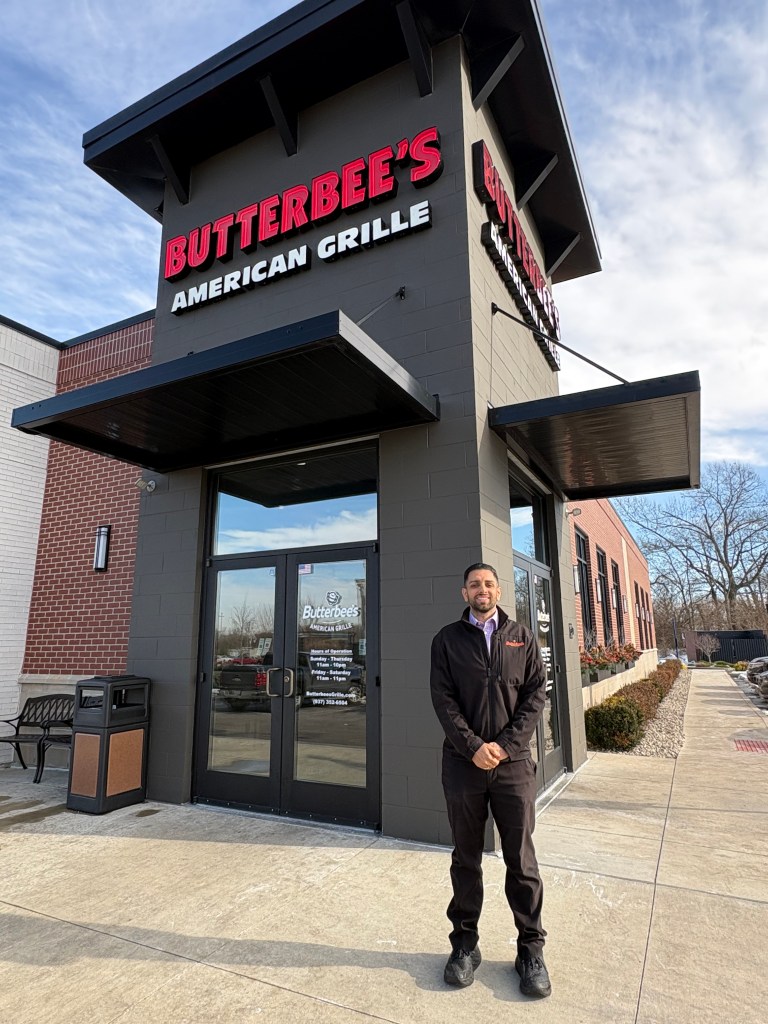
A notable and relative newcomer to Xenia’s dining scene is Butterbee’s American Grille, located at 217 Progress Drive, directly across from the Hampton Inn. The restaurant opened in August 2024, and while it may be new to the area, its management is anything but inexperienced.

Nabih David brings decades of family-owned restaurant expertise as CEO of the David Restaurant Group, which operates 13 locations throughout the Cincinnati and Mount Orab areas — including the Skyline Chili right next door.

Nabih David, general manager of Xenia’s “Butterbee’s American Grille” restaurant on Progress Dr.

Butterbee’s American Grille officially opened its Xenia doors in August 2024. Often referred to simply as Butterbee’s, the location is one of just four under the brand. Designed as a family-friendly restaurant, it also serves double duty as a sports bar and gathering place for parties and celebrations.

The David Restaurant Group was founded in 1986 by Nabih’s father, Nader David, and today employs roughly 600 full- and part-time workers. Seventy of those employees work at the Xenia Butterbee’s alone. David said the decision to open in Xenia was intentional, noting strong similarities to Mount Orab — a community known for its family-oriented values.

“We saw a lot of potential in Xenia, and we felt the area was underserved by our brands,” David said. “When we purchased the property, the original vision was always to have two restaurants here — Skyline and, eventually, Butterbee’s.”

From the atmosphere to the menu, David said the restaurant was designed with purpose. “We have a hand-scratch kitchen, and everything is made right here in the building,” he said. While quality is consistent across the menu, two items stand out as guest favorites.

“Our signature dishes are our hand-breaded chicken tenders and our fall-off-the-bone baby back ribs,” David said.

For those who may assume the restaurant is too crowded or difficult to access based on its front-facing appearance, David offered some reassurance. “Our building can seat more than 240 people,” he said. “We’re very party-friendly and cater to the masses, whether you’re coming in for a quick lunch, watching a game, or hosting a birthday celebration.”

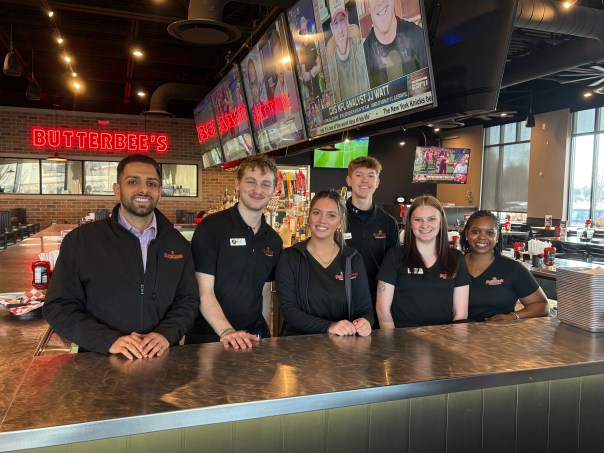
David Restaurant Group CEO, David Nabih, with the crew at Xenia Butterbee’s American Grille.

He added that additional parking is available behind the building, and guests can always call ahead or order online at http://www.butterbeesgrille.com.

Looking ahead, the Xenia location is expected to play a key role in the future growth of the Butterbee’s brand throughout Greene County. Increasing awareness and foot traffic is a major part of that strategy, and the restaurant is currently offering a holiday gift card promotion to help drive that momentum.

“Right now, when you purchase $50 in gift cards, you receive $20 in bonus gift cards,” David said.

More than promotions or menu items, David emphasized what he hopes the community takes away most from Butterbee’s.

“From ownership to staff to the overall guest experience,” he said, “we put family first.”