Local News & Commentary Since 1890.

Posts Tagged ‘Jamestown’

Food allergies are no yolk!

In Children and Family, Food, Health, Opinion, sociology, Uncategorized on January 7, 2024 at 12:46 pm

Deer In Headlines II

By Gery Deer

“Then the Whos, young and old, would sit down to a feast. And they’d feast! And they’d feast! And they’d FEAST! FEAST! FEAST! FEAST! They would feast on Who-pudding, and rare Who-roast beast.” – Dr. Seuss’s “How the Grinch Stole Christmas”

Admit it. You just read that in Boris Karloff’s voice, didn’t you? But what if you’re the one Who, for whom a feast could be a culinary minefield? What if you’re the Who who’s allergic to the Who-pudding and rare Who-roast beast?

If you’re like me and the other 26 million Americans who suffer from food allergies, holiday buffets can be a dangerous foray into the unknown. Food allergies might be lampooned on your favorite sitcom, but there’s nothing funny about them. It’s true that most result in mild skin irritation or digestive discomfort, but many are life-threatening.

Within seconds, an exposed victim can experience severe swelling of the throat and larynx, constricting their airway, and even suffer anaphylactic shock. In these situations, quick medical attention is vital.

Whether you’re a member of the allergy club or not, it’s probably a good idea to learn about food allergy causes, symptoms, and first aid. Some of the most common foods people are allergic to include cow’s milk, eggs, fish, shellfish, tree nuts, peanuts, strawberries, wheat, soybeans, and sesame. These are certainly not the only ones, and you might not even know you’re allergic to anything until it hits you.

Just because you weren’t allergic to something as a kid doesn’t mean you won’t be as a grownup. For about half of food allergy sufferers, the affliction didn’t develop until adulthood. I only recently discovered my own allergy to kiwi fruit and cantaloupe. For years, I thought cantaloupe was supposed to burn the inside of your mouth. You know, like a spice or something? Idiot.

Processed food contains a plethora of dangerous ingredients, and most allergens are printed on pre-packaged food labels. Unfortunately, depending on the amount, some ingredients might not be listed. For example, it’s still common for some labels to omit sesame among potential allergens. A Google search might show detailed ingredient lists or allergy warnings for specific products. Otherwise, steer clear altogether.

If you or someone in your family suffers from food allergies, I can offer a few tips to help navigate the holidays, and the first one is a no-brainer. Since many holiday gatherings are potlucks, you can bring your own safe food and avoid everything else. Or you could host the event yourself for peace of mind. If you do host, label the dishes, and maybe, if you want to be an allergy-safe superhero, provide a full list of ingredients.

For children, carry safe food, or see to their plate for them. Kids also seem especially sensitive to nuts, and holiday goodies are full of them, so keep an eye out. To avoid cross-contamination, use disposable utensils to serve yourself or carry your own flatware. Trust me, it’s worth the trouble.

Incidentally, some people are quite sensitive about publicly outing their allergies. For instance, I am allergic to eggs. But I’d rather not discuss it because I feel like a freak. If it comes up, I get bombarded with questions like, “Can you have cookies? Bread? Pancakes? What do you eat for breakfast?” And on and on. People just can’t leave it alone.

I understand they’re curious and trying to be helpful. But the nature of the allergy can be difficult to explain (although I really shouldn’t have to), and it doesn’t affect anyone but me. I never ask hosts to alter their menu or anything they’ve planned. I simply avoid those foods that might be dangerous or questionable.

For the food-allergic out there or their caregivers, you might want to ask your primary care physician if you should carry a preloaded epinephrine injector (otherwise known as an “EpiPen”). If your allergic reaction were to cause respiratory distress, it might be a good idea to be prepared. A food sensitivity test might also help.

Food allergies don’t have to wreck the halls – or any other occasion. All you need is a little preplanning so that no one turns as green as the Grinch after a helping of your famous Who hash.

Deer in … headlights.

In Business, Health, Local News, Opinion, State News, Uncategorized on December 29, 2023 at 9:10 am

Deer In Headlines II

By Gery Deer

A few weeks ago, I was driving along minding my own business when a deer decided it would be a great time to remodel the front end of my pickup truck. It was dark but I was neither sleepy nor distracted yet saw nothing in advance of the collision. The animal seemed to come from out of nowhere. There was a loud, metallic bang, a hard shudder, and the hood of my truck popped straight up in front of the windshield.

Fortunately, I could see well enough around the hood to get the vehicle to the side of the road. Once I stopped and the dust had settled, the first words that entered my mind were, “So that happened.”

I called 911 to report the accident, and no irony was lost on either me or the dispatcher about a guy named Deer hitting a deer. Not to worry, she was great and sent an officer right away. If you have followed my column, you know this was certainly not my first traffic accident, nor was it the most serious. It was, however, my second deer strike in about four years. Enough, already. I’ve met my quota now, right?

Here’s a photo of Gery’s Ford F-150 truck from this article. It was totaled.

I think I was most upset because I had recently paid off the loan on the truck and, just that morning, even ordered new tires. Ever the optimist, I remember I laughed out loud and said to nobody, “Well, at least I don’t have to buy the tires now.” Like they say, onward and upward, right?

Hitting a deer on an Ohio roadway is almost a rite of passage. I’m surprised our driver’s education classes don’t include a section detailing what to do after a deer strike. I can hear it now, in the best 1970s filmstrip narrator’s voice. “After you have hit the animal, get out to see if it’s still alive. Oh, it’s a six-pointer! Be careful. Those antlers are sharp!” Then, it would go on to tell you to call the police and decide what to do with the carcass.

Here in the Buckeye state, if you hit a deer with your car, you’re entitled to keep it. What you do with it after that is entirely up to you. The first time it happened to me, the responding police officer asked if I wanted the carcass, and I said no. Then she said, “Well, you’ll need to decide which of the guys arguing over it gets to take it home.” Seriously? I told her to flip a coin. In hindsight, I should have sold it to one of them. After all, I was out a truck, and they got free venison.

Between hunters flushing them out of the woods into the road and people feeding them on the back porch, deer strikes are becoming more problematic every year. I read an Ohio highway statistic that vehicles had hit more than 13,000 deer in 2022. I can believe that. The day the body shop picked up my truck, the flatbed driver told me he’d hauled four other deer-damaged vehicles just that afternoon. With an overall deer population in the state just under 800,000, I’m surprised the accident tally is so low.

What can you do to avoid hitting a deer? Unfortunately, there’s no easy answer. The problem with deer is that they’re jittery, indecisive, and never travel alone. Trying to outguess them will get you hurt or worse.

The best things you can do are buckle up, drive with your bright beams on in rural or wooded areas, and always remember when you see one, there are always others. By the way, those deer whistles that you stick to the grill don’t work — a siren, maybe, but not those.

Above all, avoid distractions while driving, especially at night. No text, call, or cigarette is that important. Put that stuff down and pay attention to the road. Trust me, it takes only an instant for everything to change.

Although my truck was totaled, it was at least large enough to protect me. I have seen deer go up the hood and crash through the windshield, seriously injuring the driver and passengers. So, please watch out for those… deer in headlights.

Publication Notices: Deer In Headlines and Deer In Headlines II are media properties of Gery L. Deer and GLD Enterprises Communications, Ltd., who is also the copyright holder. The product is distributed via The Jamestown Comet.com (A property of GLD Communications), and by Green County Newspapers / The Xenia Daily Gazette by special permission.

Good Morning Captain

In Children and Family, Local News, Opinion, Uncategorized on December 3, 2023 at 8:21 am

Deer In Headlines II

By Gery Deer

In May of 1961, Newton Minow, the chairman of the Federal Communications Commission at the time, referred to television as, “a vast wasteland.” For the most part, he wasn’t wrong – and things got much worse. Thanks to unscripted television (reality shows), crashing standards, and a laughable rating system, Minow’s wasteland expanded. And, as bad as it was for adults, it became absolutely dismal for children.

Today, endless streaming channels offer even more kids’ TV, still overloaded with mindless nonsense, little to no educational value, and more product placement than you can shake your debit card at. Yes, there are a few exceptions out there, but very few. But, in the early days of television, one man set an unparalleled standard for children’s programming, and it has yet to be replicated.

In the 1950s, networks were new, most TV for kids was locally produced, and much of it centered around some form of live host or clown, surrounded with an array of puppets, cheap props, and goofy slapstick. All of this was thought necessary to keep little Junior occupied and attentive.

But on October 3, 1955, a new program hit the CBS television network’s morning airwaves. A wizened, mustached man in a long, long coat with huge pockets took over TV screens around the country and welcomed children into his Treasure House. From that day on, “Captain Kangaroo,” whose title character was played by Bob Keeshan, would remain a staple of children’s programming for 29 original seasons.

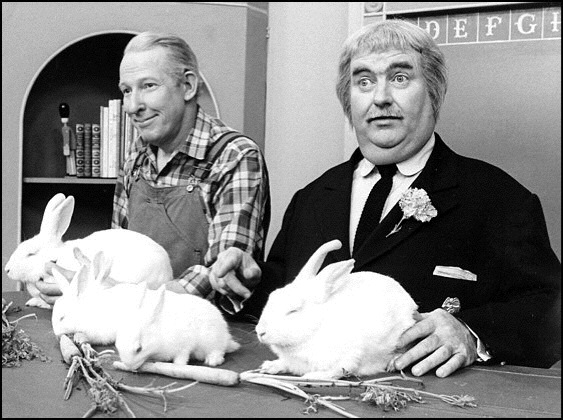
Bob “Captain Kangaroo” Keeshan (right) with Hugh “Mr. Green Jeans” Brannum in a 1960s episode.

His work in local television as a character actor gave him a first-hand look at the burgeoning children’s programming industry that, in his view, often insulted the intelligence of children. The Captain’s kindly soft-voiced approach was markedly different from other contemporaries, like Howdy Doody, and The Mickey Mouse Club.

Keeshan’s character, Captain Kangaroo, was based on the relationship generally enjoyed between children and grandparents. Just 25 years of age, he adopted a low, quiet voice, and wig that made him appear as a kindly old grandfather. That’s why, to many of us, the Captain never seemed to age as we grew up.

Keeshan always engaged young viewers directly through the TV camera, one-on-one. He had no live studio audience, often referred to as a gallery, because he felt it detracted from his connection with the children at home. In his view, it was impossible to make each child feel special if the cast was focused on a group of kids on the set.

Captain Kangaroo opened his show every morning jingling a large ring of keys to an upbeat theme song as he opened his Treasure House. Then he spent the next hour educating his young viewers through play with the help of Mr. Green Jeans, Mr. Moose, Bunny Rabbit, and a host of other colorful characters. “Play is the work of children,” he said. “It’s serious stuff.”

About 13 years after the Captain’s debut, the neighborhood trolly brought Mister Rogers to PBS. The tone of “Mister Rogers’ Neighborhood” was like Keeshan’s and the two eventually became good friends.

Unfortunately, even retooling couldn’t save the Captain from sagging ratings and CBS’s need for a competitive morning news presence. It was finally canceled in 1984. But he found a new home in edited, half-hour reruns on PBS through 1993. Rogers’ show ran until 2001.

By the way, having been raised in southwest Ohio, I’d be remiss if I didn’t mention the “Uncle Al Show,” based at WCPO Channel 9 in Cincinnati from 1950 to 1985 – predating both Keeshan and Rogers. Al Lewis (Uncle Al) and his airborne sidekick, “Captain Windy,” played by his wife Wanda Lewis, offered music, colorful characters, and even a circus at the end of each show. He was probably a big reason I got into music.

Like millions of others who grew up between the 1950s and 1980s, I have fond memories of the Captain, Mr. Rogers, and Uncle Al, well into my teens. Each left an indelible mark on my personality. At the time, I was completely unaware of how much I was learning about character, kindness, self-confidence, and, of course, how to get someone to stand in the perfect spot to dump ping-pong balls on their head.

Those Were The Days

In Local News, Opinion, Uncategorized on November 17, 2023 at 6:03 pm

Deer In Headlines II

By Gery Deer

In 1951, my parents, Lois and Gary, were young newlyweds who left the small, hillside towns of southeastern Ohio, for the hustle and bustle of Dayton. Escaping a poor, rural life to join the newly minted middle class of post-war America was challenging. Eventually, the life they’d built for our family came full circle, returning them – and me – to their rural roots.

Dad told me stories of their early years in the city. He rode the bus downtown from their north Dayton duplex to work at the telephone company. Soon, thanks to pressure from my mother’s family, he went to work at National Cash Register. Dayton was brimming with factory jobs in those days at companies like NCR, Delco, and Frigidaire.

Gary Deer Sr., and Gary Deer Jr., around 1956.

Some of the factory complexes resembled small cities, with nearly everything a worker and his family could ever need. Many offered educational programs, free healthcare, recreational facilities, and extra pay for suggested improvements that saved the company money.

By the end of 1955, my parents already had two children, my brother Gary, Jr., and sister, Cathy. Before long, Dad managed to buy their first home and put a car in the driveway. A Cadillac, of course – my father’s favorite. My parents played cards with neighbors, participated in ballroom skating events at the local rink, and even hitched up the camping trailer for long weekend vacations.

Dad worked hard to make a life for us that was a total one-eighty from his Appalachian
upbringing. By the time I’d made my appearance in the late 1960s, he had created a very
“Leave it to Beaver” lifestyle for them. But soon, that idealized, if not completely artificial,
suburban world would fade into history. The world was changing and so was my family.

By the late 1970s, my brother and sister were adults with their own children, and Dad’s job situation had dramatically changed. He had long since left factory work behind for a teaching job. Thanks to an even more complex set of circumstances, we also relocated from suburbia to the farm where I would grow up which gave me a very different childhood than my siblings.

Money was tighter then, but I think there were greater rewards. Regardless of our circumstances, however, my parents managed to make us comfortable. My father used every skill he had to earn a living.

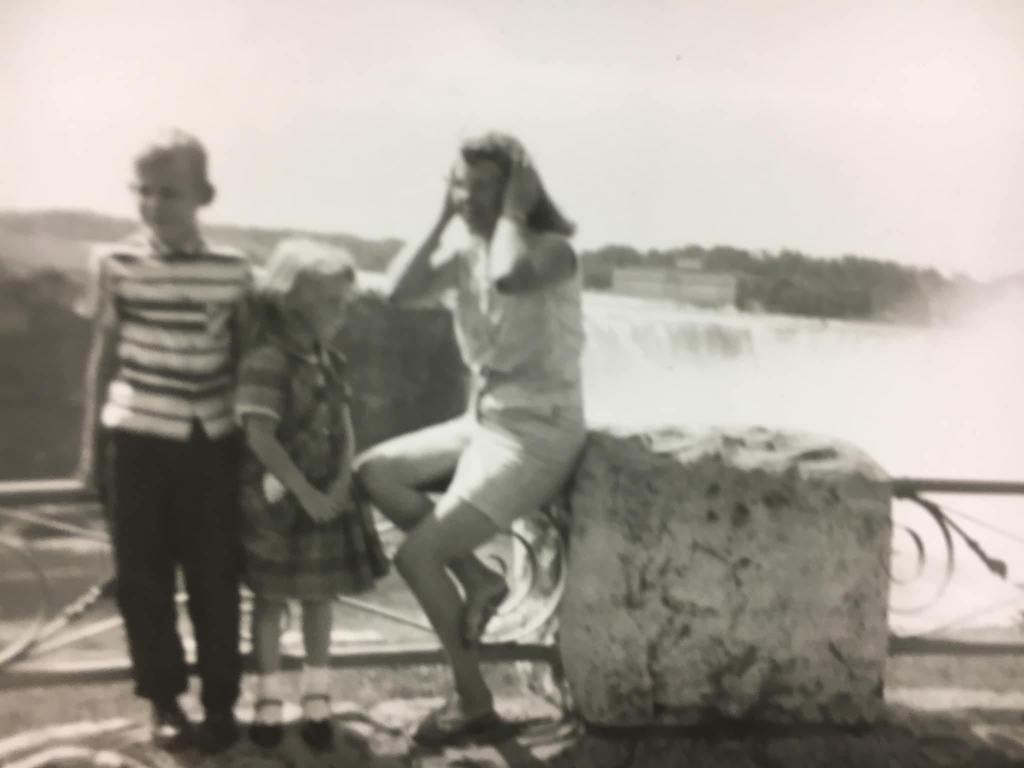
Gary Deer Jr., Cathy Deer, and Lois Deer at Niagra Falls in the early 1960s.

Over the years he did concrete and excavation work, operated a trucking business with my brother, became an agricultural mechanics teacher at the county vocational school, and ran our farm with my mother. Although she’d been a stay-at-home mom, she eventually took a job as a waitress to help make ends meet and grew vegetables and fruit that she sold at a stand on our farm. Looking back, I’m amazed at what they accomplished together.

I often think of how life probably turned out very differently than Mom and Dad might have envisioned, yet they never seemed unhappy. For them, as long as you had health and family, everything would be okay. Sadly, debilitating diseases slowly took each of them from us. But we were all right beside them for the journey, as they had been for us.

My parents were together for 59 years and 11 months. When my mother died, Dad was nearly inconsolable. He hadn’t known a day without her since he was 17 years old. Every day was a challenge, one they met head-on, with full force and commitment. I certainly hope that whenever they looked at their children and grandchildren all that struggle seemed worthwhile.

It’s easy to say, “Those were the days,” but I know things were often more difficult than I knew. Parents often shield kids from the more unpleasant parts of life. What we need to remember, is that you may start out a long way from where you end up, and there is no such thing as a perfect life.

I am incredibly thankful for how hard Mom and Dad worked to support us, and there are no words strong enough to convey my gratitude. We may have never been like the families on TV, but we were happy anyway. So, it’s just possible that those really were the days.

Intentional Living

In Opinion, psychology, Uncategorized on November 3, 2023 at 11:02 am

Deer In Headlines II

By Gery Deer

There is a line in the movie “Apollo 13,” when Tom Hanks, as astronaut Jim Lovell, asks his crew, “Gentlemen, what are your intentions?” The question comes just after their spacecraft is crippled, no moon landing is possible, and they will be lucky if they can make it home.

That has always been one of my favorite movie lines because of its depth of meaning. Hanks’s character is really asking, “Do you intend to survive this?” More importantly, he’s saying, “I want to survive, and I’m ready to do what it’s going to take to get us home safely – are you?” I don’t know if it’s something Lovell really said during that fateful flight, but it certainly seems a likely inquiry on his part.

Intent is an important part of day-to-day living. People often speak of a life with purpose, but rarely about the intent even though it carries great weight in our society. In the legal world, it refers to the mental objective of our actions, one for which we can ultimately be held responsible.

I recently met a young woman named Kimberly Brown who started an online clothing business during the pandemic which she refers to as, “fashion with a purpose.” As an African-American woman concerned with the social struggles of the day, she wanted to offer those who shared that anxiety a unique way to express it. Under the brand she created, “I Am Intentional,” each item offers a message that is, as her website explains, “deeply rooted in social impact, empowerment, and inspiration.”

As she told me about the motivation behind this work, her passion and energy were inspirational, and no passing fad. She intends to be successful, which is a challenge. She already has a lot on her plate. Kimberly is a caregiver to her ailing mother, holds down a full-time job, and as well as operating a second side business.

It was clear that intent was at the very essence of her nature. To have such a clear presence of mind and understanding of purpose are rare qualities. But isn’t it possible that each of us has the capacity for such intentional living?

There isn’t a day that goes by where I don’t look in the mirror and think, “What am I doing with my life and who am I helping?” Life shouldn’t be about mere survival, but neither must it have to be altruistic all the time either.

Personally, I believe intent requires conscious effort. According to the dictionary, the word means to be resolved or determined to do something. But I don’t think it’s that simple. Intention needs direction, purpose, and, above all, a plan.

To live intentionally I think you must first know where you’re coming from. What brought you to this point? Then you can identify your intentions and plan to carry them out.

If we go back to the “Apollo 13” quote, it’s clear that the character of Lovell was asking about the crew’s willingness to do what had to be done. But he was also making sure they understood their place in the plan that would ultimately save their lives. 

Nobody can tell you how to live intentionally. I believe that comes from within. It may spring from faith, morality, a sense of social justice, or whatever drives you. Everyone’s motivation will be different.

Needless to say, there is no amount of intent that will solve the world’s problems. But if your personal intention can be found and applied, you might change some things in your little corner of it. 

I will leave you to contemplate this story of Kimberly’s determination to make a statement in the world while giving others the opportunity to do the same with their own style and heart. Like her, we all face the day-to-day challenges of life, some good, others not so much. Sometimes simultaneously. Our intentions spring from how we deal with all those situations, our place in society, and our effect on the lives of others.

Like the crew of Apollo 13, sometimes we have to take a moment and ask the question before we can move forward. My question to you is, what are your intentions?

Perception is reality

In Entertainment, Health, Opinion, psychology on October 24, 2023 at 12:46 pm

Deer In Headlines II

By Gery Deer

British writer and theologian C.S. Lewis said, “What you see and what you hear depends a great deal on where you are standing. It also depends on what sort of person you are.” Put simply, reality is based, not on fact, but instead on our personal perception of what we see and hear.  That said, it’s been my experience that not everyone has the same perception of reality.

Generally, I would imagine most of us trust our senses to deliver an accurate view of the world around us and then depend on our cognitive reasoning to help us comprehend it. It’s commonly known as, “perception.” Whatever the term, it simply means our view of things depends on how we interpret our surroundings. For instance, if I see a blue sky with clouds drifting by, I assume everyone else sees it too, right? Colorblindness notwithstanding, that all stands to reason.

But we all know people who walk around in more of an oblique version of reality. Often their reality is negative, dark, and painful, not to mention staggeringly inaccurate. Here’s what I mean. We all have a friend or family member who always seems to have it worse than everyone else. Regardless of how bad your case of the flu was last week; his experience was near death. Of course, it wasn’t, but that’s how he relates it to you.

This is known as catastrophizing and tends to be associated with various personality disorders. It can mean that the person behaves and thinks in ways that would be considered different than normal. And yes, I get that normal is relative and subjective. But here, I’m referring to someone with a mental health issue who is exhibiting behavior contrary to acceptable – or safe – social standards.

Sometimes those thoughts and emotions are caused by traumatic experiences and manifest themselves in other ways. I’m not a psychologist, but I do know that borderline personality disorder, for example, might include a strong fear of abandonment. It can cause the individual to always assume the worst about others. Thus, their view of reality – and people – may be somewhat distorted, altered by the painful experience of being left behind.

But what if there is no medical diagnosis for these issues? What if the person’s sense of reality just seems to be completely “out there?” Is that really a thing? How does it happen and is it an indication of mental illness? Probably, but it may never be diagnosed, let alone treated.

In my opinion, someone with a warped sense of reality also seems to be absent any sort of empathy or understanding, instead feeling like the world revolves around them.

It’s possible they’re unaware of their own character, feelings, motives, and desires, each of which helps to define who we are, and has a great influence on how we perceive and cope with the world around us. If you’re unable to see your own attributes, good and bad, then your sense of reality might be drastically altered as well, especially if you have no support system.

Someone like that might seem incredibly self-centered, narcissistic, or even paranoid and probably suffers from a strong persecution complex. It’s doubtful they even know that their behavior hurts those around them, damaging relationships, and even reinforcing abandonment issues because they push people away.

I’ve dealt with people like this, on some level, all my life. Most are completely unaware of their behavior or lack of awareness. At times some exhibit symptoms of bipolar disorder, schizophrenia, and even factitious disorder (what they used to call Munchhausen syndrome) because they often fake or inflict illness to get attention.

Again, we are tiptoeing around various levels of mental illness and I reemphasize that I am not a psychologist. These are simply my personal observations based on some education and limited experience. Mental healthcare is incredibly lacking in the United States, horribly curtailed by ignorance, stigma, and decades-old misinformation.

So, if someone you know is exhibiting these behaviors, please discuss it with someone close to them or seek out a mental health professional to help. Your doctor, local behavioral health agency, or public health department can help find the right resource.

Don’t Panic!

In Books, Education, Entertainment, Health, Opinion, psychology, Uncategorized on October 17, 2023 at 7:50 am

Deer In Headlines II

By Gery Deer

Don’t panic! That’s rarely what you want to hear at those crazy moments when, odds are panicking is exactly the thing you should be doing. The dictionary defines “panic” as a sudden, uncontrollable fear or anxiety, often causing wildly unthinking behavior. Reactions vary widely, from a little nervousness to a full-on panic attack, complete with hyperventilation, rapid pulse, excessive perspiration, and much more.

Fortunately, I’ve never really been someone who panics. I’m generally calm in high-stress situations. Adrenaline probably creates a false sense of clarity and focus. I would say I’ve experienced anxiety, tension, and worry, but nothing I would call panic. It made me wonder, what makes you panic? It’s likely that you’re not alone in your apprehension. So, here are some things that commonly make people panic.

Number one on the list, meeting the potential in-laws for the first time. This is a great one. Symptoms include sweaty palms, a terrible sense of inadequacy, and the feeling that you just swallowed a lizard – and it desperately wants to come back up.

Next up is the dreaded job interview. You spend the days and hours ahead of the big moment researching, reading self-help blogs about how to prepare for interviews, and generally freak out. And talk about sweaty palms, you nearly break into a human sprinkler system just sitting in the lobby waiting for your turn. That bouncing knee, what even causes that?

What about being stuck in an elevator? Do you panic then? It might be comforting to know that fewer than 50 people die in elevator-related accidents every year in the United States. Fatalities range from falling cars to being caught in the doors between floors. Gruesome! But, what are the odds of you being one of those people? You have a better chance of being hit by lightning or winning the lottery, now that should bring on some panic.

You’re lazily riding your bicycle down the street and suddenly realize the neighbor’s Jack Russel is out and has slipped his tether. There is nothing more panic-inducing than a small dog chasing you on a bike. I never worry about the big dogs; they give up at the end of the driveway. But the little ones, oh dear! Just pedal faster and don’t turn around!

A first date. More sweaty palms, overthinking your clothes, and whether your car is cool enough to impress your date. Will you say the wrong thing, talk too much, or manage to seem interesting enough to get a second date? So much at stake and yet nothing at all.

Something I never thought of before – automatic flushers in public bathrooms. My niece shared with me that some people are afraid that the toilet will flush while they’re sitting on it. It’s the anticipation of when the flush happens that apparently induces the anxiety.

Oh, and remember the panic you felt back in grade school that accompanied report card day? (Yes, I’m old. Grade reports were once on paper.) Brow-soaking worry would set in about the grades the comments be, and, above all, will Mom or Dad sign it.

Vacation is supposed to be a relaxing, fun time with family and friends, a break from stress and worry. So, imagine you’re out on the open road and you just passed the first exit you’ve seen for hours and, suddenly, your car’s “low fuel” light comes on. The gas gage is bouncing on “E” and now you start to worry. Will you make it to the next exit? Your car isn’t fancy enough to have the estimated fuel and mileage indicator so you’re in the dark. How much gas do you have left? Can you make it to the next exit?

What else can induce panic? How do you combat those feelings? Sometimes you can avoid things, but often, you just have to face whatever it is, head on, and move forward. Panic is caused by feelings spun up by thoughts. When I feel anxious or worried, I do my best to try to alter my thoughts, which, hopefully, will change my feelings and I can remain calm. Maybe you can find some practice that will help you do the same.

A House Divided

In Dayton Ohio News, Education, finances, Food, Health, history, Local News, News Media, Opinion, Politics, psychology, Senior Lifestyle, Uncategorized on September 2, 2023 at 2:47 pm

Deer In Headlines II

By Gery Deer

When I restarted this series after a 5-year hiatus, I decided to steer away from politics, religion, and other hot-button topics in favor of more personal subjects. That said, I’ll dip a toe into that pool only enough to express my concern at the level of divisiveness now facing our country and who actually pays the price for it.

The political climate in America today is toxic, with no end in sight. Everything is viewed only from one side by an ill-informed, angry citizenry and uncompromising elected, uncivilized government officials. Over the long haul, we simply can’t function that way. Our legislators must work together in order to govern, even to manage the most basic issues. Unfortunately, that seems unlikely to change when the only people getting attention are the radical extremists.

Regardless of your ethnic background, or whether you’re conservative, liberal, or whatever, surely there are things we can all agree on, right? For instance, instead of spending hours on cable TV news bickering about who caused inflation, wouldn’t our collective energy be better spent on ways to help people get through it? Meanwhile, our dedicated elected officials spend taxpayer money riding around in limousines, secure in their healthcare, paychecks, and benefits, all guaranteed long after they’ve left office.

More absurd is that, in the most powerful and wealthiest country on Earth, there are still people who can’t get enough food, shelter, or other necessities – particularly the elderly, veterans, and children. No, it’s beyond absurd, it’s criminal. This problem affects everyone. The number of working poor continues to grow, most of my family included. Most people are only a paycheck or two from ruin. All it takes is one major catastrophe and boom, we’re on the street. Regardless, people from every side are too busy waving flags and hating each other’s politics to care or do anything about it.

Recently, I did some work at a food pantry and had the opportunity to learn more about the mission of these organizations. I am shocked about how necessary they are in so many communities. In just one year, the number of families served might double, so they must continually find new ways to meet the constantly growing demand.

You might be surprised to know that the people who most need services like this are not homeless or indigent. They are instead the working poor, single-parent families, and, sadly, veterans. No one should feel ashamed of taking help from those who offer it. But I can’t imagine how hard must be for someone who proudly served our country and then is forced to go to a food pantry just to have enough to eat.

The number of military families and veterans who need various types of assistance is also surprising. They include elderly or disabled veterans, military wives and husbands with young children trying to make ends meet while their spouses are deployed, families of all ages and backgrounds, and the kids, wow. Watching a child’s eyes light up over a book or something as simple as a Twinkie or a fresh piece of fruit can be simultaneously enlightening and heartbreaking.

Again, while the politicians ride around in limousines and kowtow to mindless followers during ridiculous cult-like rallies, the people they claim to be fighting for wait in lines at food pantries. They have no money, little healthcare, and a veteran affairs system that’s so broken it needs to be razed and rebuilt from the ground up.

These issues aren’t conservative or liberal, Muslim, Jewish, or Christian. We are so blinded by ridiculous ideologies and political divisiveness that we can’t see the real responsibilities facing our country – poverty, homelessness, substance abuse, an ever-changing job market, and so much more. Certainly, we could all get together on some of these things. Nope, it’s just not going to happen.

The people I meet in these situations don’t want handouts. They want to be understood and for their elected legislature to work for not against them. But until we put down the flags, turn off the news, and choose to be better human beings, nothing will change. So, all I have left to say is to quote my favorite president. “A house divided cannot stand.”

You’ve got this.

In Children and Family, Opinion, psychology, Uncategorized on August 28, 2023 at 10:25 pm

Deer In Headlines II

By Gery Deer

If you have followed my series for a while, you know that I dealt with a lot of health problems growing up. From birth, until I was about 21, I had around 200 different procedures and surgeries. Some were experiments, with unknown outcomes, and others were common procedures as some type of intermittent step from point A to point B. Some went perfectly, others did not. Something that I learned through all of that was a fierce sense of what I’m going to call determination.

That determination came from a confidence, not in myself, but in the physicians, my parents, and my family. Not for one second did I ever doubt I would make it through something, even with talk like, “This procedure may limit his ability to walk,“ or, “Recovery could take up to a year,” or my favorite, “This one’s pretty involved“ – like the others weren’t? Yeah, sometimes it didn’t sound too good, but everyone kept reassuring me and, to my kid brain and blind faith in those looking after me, I knew everything would be alright.

As a child, the only dependable sources for accurate information and support are the adults around you. It’s not like your playground friends could be much help. Most of mine didn’t even understand what was going on with me – and didn’t care. Such ignorance generated the incredible amount of bullying that I endured (kids are awful). The irony was, none of the hurtful things they said about me had any basis in fact. Actually, most were downright science fiction. But, through all that, I still believed all would eventually be OK. No, it was more than that. The truth is no other outcome ever crossed my mind. This was my world and I would get through it.

Today, I carry that same fortitude, grit, or determination; call it what you will. I’ve experienced my share of depression as an adult, mostly related to the deaths of my parents. But, for the most part, I am just not wired to perseverate on negatives. I realize the good in a problem may be pretty hard to find, but it’s there. It’s not about being a “glass half-full” kind of person, but rather I prefer to be a realist. I look at all the negatives and I’m firmly aware of everything that can go wrong (or already has). Dwelling on all of that will not change the outcome one bit, but it will keep me from having the energy to fight through it.

I’m afraid I don’t have your answers and positive thinking is simply not enough. We all have to try to find proof within ourselves that life is worth living. Even the bright spots are buried deep down you have to try to recognize them. I always say that some part of me fought to survive to this point, so I would just be letting myself down if I give up now.

The bad news is, I don’t know how to tell you to do any of that. And I have more bad news for you – neither do any of the self-help gurus. They’re all throwing out a bunch of dimestore psychobabble. They wrap it in rainbows and sunshine, drop it between the covers of a badly-written book, and advertise it to you on Amazon for $23.95. But, for all of that, they really have no answers. Here’s a secret, though – you may already have the answers you need. Yes, you will have to make the effort and take the time to find them.

That may be really, really hard, and anyone who says otherwise is full of crap. We all face things that we think we can’t get through, and some of them we don’t – the residuals of those events stay with us. Life is hard but it is not impossible. If you leave the gate thinking the race is lost, then what hope is there? So, for what it’s worth from me, whatever’s going on, I know you can handle it – and so do you. Hang in there. Find your bright spot, hold onto it, and don’t let anybody deter you. You’ve got this.

Fair Play

In Entertainment, history, Local News, Opinion, Uncategorized on August 5, 2023 at 7:27 am

Deer In Headlines II 

By Gery Deer

The onset of fall means fair season here in Ohio, and my visit to our county fair this year was simultaneously familiar and foreign. When I was a kid, the county fair was the grand finale of my summer. At the time, I was probably annoyed with how much work it was. But what I wouldn’t give to walk through the fair of my youth. I didn’t appreciate it then, but those were some of the best days of my childhood.

As a young 4-H’er, I always had multiple projects to exhibit each year. If you had livestock (I showed cattle) you generally camped on the grounds to tend to your animals and get show practice in the arena more easily. My Dad always brought our small motorhome for me, so I had a nice place to sleep and some privacy. But sometimes, just to be closer to it all, I tossed my sleeping bag on the bales of hay next to my calf’s stall in the cattle barn. At night, the summer heat gave way to a cool breeze that flowed through the open sides of the barn, and I’d fall asleep to the sounds of the fair all around me, and some occasional mooing.

In the morning, I’d feed and water my calf (I only ever showed one at a time). Then breakfast at my favorite food tent where a youth group sold Bob Evans sausage, biscuits, pancakes, and all the trimmings. A kid’s gotta eat, right? We didn’t have money for it every day, but it was really great on the days I was really busy. 

Later, it was exercise time, for me and the cattle. I walked a 900-pound steer as if I were strolling through a park with a poodle. Showing an animal at the fair meant a great deal of training – for them and me. So, my calves behaved more like someone’s pet than a half-ton farm animal.

I showed in the dairy beef class and on show days, I had to wear white. I know, right, white clothes in all that muck and dirt? But we weren’t allowed to be dirty and neither were the animals. After a bath came a good brushing and a polish of the hooves. Finally, I had to “bob” their tails. It was a weird practice of teasing the hair at the end of the calf’s tail until it fluffed out like a ball, then folding the ends under and rubber-banding it, upside down, to the tail. Believe me, even if there was a picture, it wouldn’t make sense. 

Along with all the work, there was plenty of play. Many of the kids stayed on the grounds without their parents and no one ever seemed to worry about us. In between chores, we were normal kids, playing games, eating cotton candy, and riding on those rickety carnival rides. Once there was even a woman in a cage who turned into a gorilla! How did we survive all that? For one week every summer, I was in my element, one place I didn’t feel like a misfit.

Amidst all the fun, however, I had responsibilities. So, every kid had to keep one ear tuned to the dreaded public address system because, in the middle of a ride on the Scrambler, a garbled announcement would echo across the entire fairground sounding something like this. “Gery Deer, meet your mother at the FFA tent, immediately. Gery Deer, go to the FFA tent.” You see, before mobile phones, if parents needed the kids to somewhere during the fair, we got paged – very publicly. Talk about embarrassing, I can still hear the other kids. “Ha ha, Gery, your mommy wants you!” Oh, the humiliation.

I still miss those days and even then, I had some appreciation for the role the experience played in my young life. One night, just as the fair was closing, I shut my eyes and just listened for a moment as if storing the sounds for later, maybe when I couldn’t go back there again. I remember every moment of my time there. It’ll always be a part who i am, and I will always be grateful.

Is this your new site? Log in to activate admin features and dismiss this message
Log In