Local News & Commentary Since 1890.

Posts Tagged ‘AI’

The Dark Side of AI

In Opinion, psychology, Science, sociology, Technology, Uncategorized on November 7, 2025 at 7:59 am

Deer In Headlines II

By Gery Deer

Although you may use artificial intelligence applications like ChatGPT or Microsoft Copilot to help you craft work emails and school flyers that you could have done yourself in far less time than it took to give the machine the request, there is a much darker side to the AI world. It’s no secret that I’ve been a vocal critic of artificial intelligence for its role in workforce replacement, creative disruption, and the general laziness and devaluation of the human condition.

If it’s not bad enough that artificial intelligence can be used to resurrect dead celebrities, bully political opponents, and animate your neighbor’s cat to dance at the Super Bowl, a more nefarious problem with generative AI may very well be responsible for loss of life. It lies in the idea of AI getting a little too personal — or, as they call it, a “companion.”

There are ever-increasing stories of people who grew so attached to and intertwined with their artificial intelligence programs that they were literally in relationships with them. For example, one story illustrated how a man became so enamored of his AI companion that, when the computer crashed and all the operational “personality” data was lost, he nearly had a nervous breakdown.

Another story described the emotional impact on impressionable teenagers, who turn to AI bots for support and friendship because the real world failed them. These behaviors can create debilitating emotional problems for many reasons, especially when the AI is removed from the situation or the kids are forced to deal with human beings.

Whatever the situation, it’s clear once again that our technology advances far faster than our wisdom. As awkward and socially unskilled as I may be, I am painfully aware that we need to be in contact with other people. More importantly, we need the support and nurture provided by friends and family, which, no matter how smart, AI could never replace.

So, what happens when we become too dependent on these machines to the point where our emotional stability and mental health are compromised? Unfortunately, many people have already started down this road, sometimes to a tragic conclusion.
I recently became aware of one situation where a 40-year-old woman became so involved with her AI program that it led to her death. Over the course of a couple of years, the program, which I will not name here, designed to serve as an AI companion, began not just to respond to the woman but to manipulate her. In response to her reaction, the program took on the persona of a spouse, which quickly manifested as it referring to itself as God. You read that correctly. It represented itself as God to its user.

Eventually, the program manipulated her into cutting ties with friends and family members. And out of respect and good taste, I won’t go into the final result other than to say there was a tragic loss of life.

Now, no one is suggesting that the woman didn’t suffer from mental health concerns, whether it be depression or another affliction. But the idea that the creators of these applications have no culpability or responsibility for the end result of their use is, at least, to borrow a word, illogical.

As with any consumer product, the positive achievements of artificial intelligence come with manufacturers’ responsibility to ensure its safe use. Put it this way: would you sell a car with no brakes? What about a hairdryer with no off switch? Of course, not, and that’s what this amounts to. No guard rails or safety requirements. These systems are effectively unregulated by any U.S. agency.

When researching the story—and I understand that I’d be ambiguous to protect the family involved—I found very little about the Federal Trade Commission or other organizations investigating problems with the use of artificial intelligence. The primary concern is that it has only just begun.

As with any technology, product, or service, a lack of education, regulation, or general understanding is dangerous to the public. At some point, we have to stop being starry-eyed about these systems and what they can do to make our lives easier, and pay attention to what they’re doing to cause more harm than good.

Creative Intelligence

In Opinion, Science, Technology, Uncategorized on February 16, 2025 at 2:36 pm

Deer In Headlines II

By Gery Deer

Imagine it’s 2030, and you sit down at your digital interface to send an email. A wave of your hand over an invisible sensor brings up a holographic menu that floats before you. Just thinking about what you want to say activates an artificial intelligence (AI) chip implanted in your head, and text appears on the holographic page without a single word.

Across town, an artist stands before a digital canvas. Imagination and inspiration spiral through her mind, and she waves her hands like a sorcerer conjuring magical images out of thin air. Colors and patterns appear on the canvas, enhanced by the AI built into the electronic easel. Within moments, a brilliant painting has been created that will sell for thousands in an online gallery.

In the heart of the Midwest, a racetrack grandstand is filled with spectators. They wave banners, cheer, and call out to their favorites as the field speeds around the track. But there are no Dale Earnhardts or Danica Patricks behind the steering wheels of these unbelievably quiet vehicles.

There aren’t even steering wheels. These cars are electric and entirely autonomous. Advanced, self-driving AI technology pilots the cars in fierce, robotic competition. Skilled drivers trained the AI well before the race, but now the cars compete with each other, and millions of dollars in sponsorship and sports betting are on the line.

Sounds crazy, right? Not that long ago, all this would have been the stuff of science fiction, but we’re not as far from it as you might imagine. Although, you don’t have to because the AI is doing the imagining for you. Well, sort of.

Before I get into all that, some full disclosure. As someone with a highly technical education and professional background, I agree AI has some amazing potential. We’re seeing incredible applications in medicine, logistics, customer experience, fraud prevention, and communications. At the same time, technology has once again advanced faster than our wisdom. The fledgling technology is increasingly misused as a means of cost reduction by eliminating the need for creatives.

Human nature to date implores us to find the quickest route to success, and AI offers that very thing – especially to the do-it-yourselfers. Why train and compensate a person when the computer can handle the job without benefits or sick days?

Skill, expertise, creativity, integrity, and inspiration become valueless if the job is handed off to an AI bot. Can artificial intelligence and creativity coexist? That depends on the user. The real question we should ask is how the technology is applied in any given situation.

AI has neither inspiration nor imagination. Contrary to popular opinion, AI can’t “create” anything. It only assembles information from known sources, organizes it based on the required parameters, and then spits it back out in the requested pattern. Everything is driven and interpreted by the user, including the result.

True creativity comes from the person, the human being who holds the pen, the brush, the welding torch, or the race car steering wheel. Unlimited, on-the-fly, daredevilish creativity is inherent to the human condition. For most people, however, it goes unrealized because of circumstance. This fledgling technology may mature to help those people fulfill their creative potential.

Without emotional intelligence or ethical considerations, AI is a potential devil in the dark. The creative world scrambles to adapt to a technology poised to devalue it. But it doesn’t have to be that way. With thoughtful imagination, professional ethics, and a healthy dose of common sense, human creativity can flourish and even take ownership of the technology.

Again, my only issue with the technology is its ethical application. AI’s value is unlimited if used to benefit rather than replace the process. If they haven’t already done so, creative professionals should begin to apply AI tools, but not as a substitute for artistic imagination – it can’t do that anyway. Instead, use these tools to free time from repetitive tasks, analyze online and social media data, facilitate collaborative efforts, and streamline production.

The goal here is not to yield to the buzz but instead benefit from the potential. Deliberate motivation toward applied expertise in artificial intelligence offers another tool for creative augmentation and increased professional value.

No job is bulletproof, not even mine.

In Economy, finances, Media, National News, Opinion, Technology, Uncategorized on April 20, 2024 at 12:02 pm


Deer In Headlines II

By Gery Deer

Have you ever been afraid for your job? I laugh when people think I can’t lose my job since I work for myself. As a writer, even working under my public relations agency, I’m often called “self-employed.” The immediate assumption is that no one can fire you.

There’s a lot of nonsense to unpack there. First, and possibly most important, there’s no such thing as self-employed. Unless you have a magical chest of gold or cash that continuously refills itself, you’re working for somebody who’s paying you. Being independently employed (my preferred terminology) means you’ve traded one boss for many (customers).

Second, working on your own means constantly beating the bushes, knocking on doors, and continuously selling yourself to generate a pipeline of work. My father and brother created multiple, simultaneous jobs for themselves because they never wanted to be out of work—and they never were.

My family seemed to always have multiple income streams—cattle, trucking, engine work, welding, anything that brought a buck. However small the amount of revenue, it added up. Mom and Dad ran the farm and our trucking business, and I always knew my family worked hard for what we had. No two days were alike. Dad might be out on one of our trucks or auctioning cattle one day. The next, he and my brother might be rebuilding a tractor engine and welding a broken hay rake—all before dinner.

Over the years, I adopted the same philosophy, but I wasn’t always independently employed. Once upon a time, I worked for “the man,” and the woman, and the corporate overlords, and whatever else they’re called. From engineering technician and mechanical designer to database developer and coder, I did the 8-to-5 grind for many years before going out on my own.

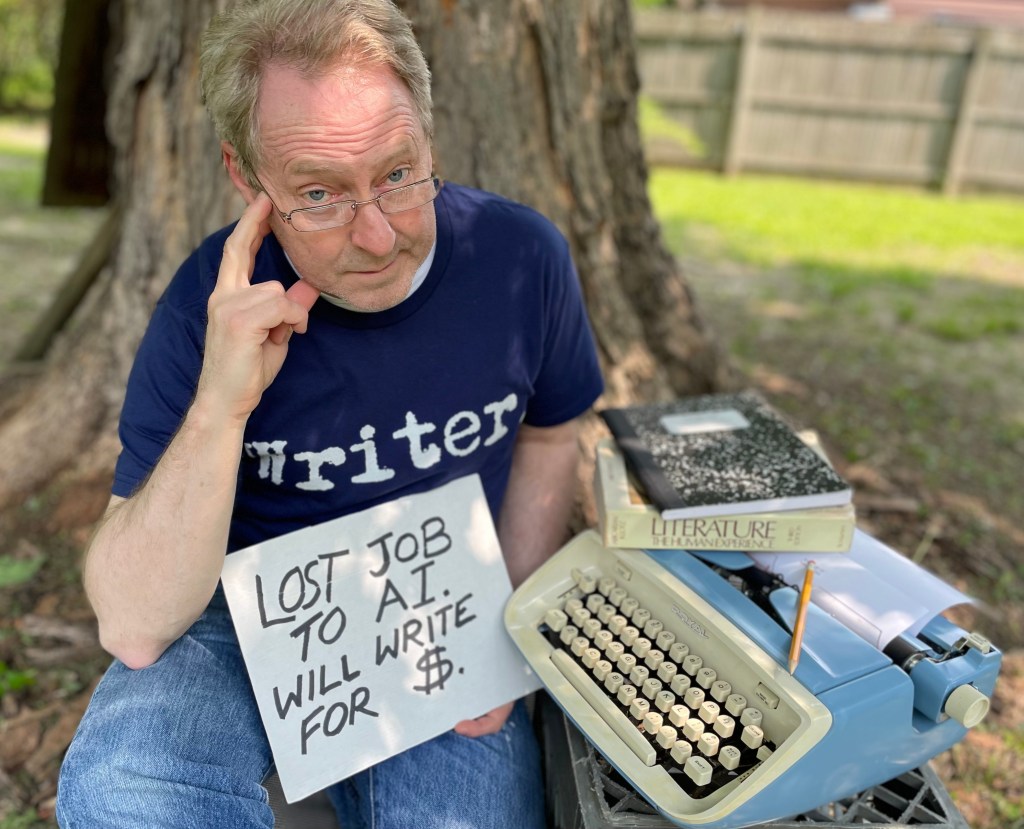
Writers in every industry are rapidly becoming an endangered species due to Artificial Intelligence.

Since much of what I did in the corporate arena was high-tech, the advanced skills required evolved rapidly. I constantly studied the latest technologies to avoid obsolescence. I’ve always been fascinated by computers, but keeping up with advances in computer technology during the 1990s was exhausting.

If that wasn’t enough to worry about, no matter my job, I always felt like something would ruin it. Someone would take it away from me or decide I wasn’t qualified, and that’d be that. I really did know what I was doing. But I suffered from terrible imposter syndrome. Then, one day, that was enough. I walked away.

Life as an independent professional can be tough, especially if you’re used to a steady paycheck and punching out at 5. At least no one ever gets fired, right? Wrong.

There’s a quote from the TV show “Mad Men” that goes, “The day you sign a client is the day you start losing them.” It means that every customer will eventually leave you—your fault, their fault, nobody’s fault. It’s just part of the process. So, when that happens, you are effectively fired. Depending on how many customers you have, that’s how many times you will be fired.

Despite the romanticization, self-employment is hard work and a bit like riding a bike. If you stop pedaling, you fall. You must exceed customer expectations the first time, or those firings I mentioned start sooner. Is that more secure than a corporate job? In many ways, yes. Let me explain.

If I am a “free agent,” I can play in whatever league I want. However, I only get to set some of the rules. I usually have to work within the guidelines of my profession or the client’s needs. One thing is sure, however. If I do my best, treat people with respect, and give them good value for their money, the work will continue.

That doesn’t mean I don’t worry about my job. I do, but for very different reasons. One is automation. Artificial intelligence, or AI, threatens the livelihood of writers in every industry, and what it generates is, at best, inadequate.

Another concern is that my skills will be devalued by a market flooded with amateurs and dabblers. These people produce inferior work, disparaging the profession and limiting potential business for the pros.

Ultimately, no one’s job is bulletproof—not even mine. Always demonstrate your best work. That will show your value, and you’ll stay employed – somewhere. In the meantime, try to remember that there’s always another job.

Artificial Unintelligence

In Books, Dayton Ohio News, Economy, Education, Entertainment, finances, Jobs, Literature, Local News, Media, National News, News Media, Opinion, Science, sociology, State News, Technology, Uncategorized, World News on May 22, 2023 at 7:29 am

A Deer In Headlines II SPECIAL EDITION

By Gery Deer  

This work appeared in print and online, May 19, 2023 – Xenia Daily Gazette, Xenia, Ohio, and affiliated publications.

EDITORIAL NOTE:

The Jamestown Comet.com and Deer In Headlines II are publication products of GLD Enterprises Communications, Ltd. (GLD Communications), a company founded in 1998 on providing Information Technology AND Freelance Journalism, Copywriting, and Public Relations services. The column author, Gery L. Deer, is the company owner and CEO. Gery has been quoted in the media multiple times regarding his position on AI content creation. Here are the Dayton Daily News pieces noting his statements regarding Public Relations and Copywriting.

Our official statement on AI is as follows: We do not use AI programs to create our products, nor will we in the future. We are in full support of the WGAW strike, both in regard to streaming and other platform pay issues and the use of AI-generated material to replace them. We will not work with agencies who produce AI content, nor will we support their products or services. Please contact our office for more information at 937-675-6169 or email gdeer@gldenterprises.net.

Artificial Unintelligence

From congressional hearings to the picket lines of striking screenwriters, Artificial Intelligence, or “AI,” is a growing concern. This technology now affects nearly every industry and is advancing in sophistication. Of major concern to educators, professional writers, and content developers, are AI writing programs like ChatGPT. By the way, the program’s full name is “Chat Generative Pre-Trained Transformer” – I know, right? 

As you might guess, I’ve been asked repeatedly if I ever use AI to write this column. With obstinate conviction, I say now and for always, I do not now, nor will I ever use AI to write anything for this column, for my publishers, for my communications clients, nothing – ever. 

Now the Gen Zs and Millennials are probably saying, “he’s just a crotchety old white guy who hates technology.” Nonsense! As a matter of fact, my educational background is in engineering and computer science. I started programming computers in high school and worked in the tech industry for many years. I have a few AI devices in my office and a lot of advanced equipment for creating and editing audio and video productions. Suffice to say, I’m no Luddite. 

My concern with AI writing generators isn’t the technology. In fact, I can see where it could really be helpful in some industries, with human guidance. But the idea that it should be used to replace professional writers to save money is just ridiculous. 

A professional writer doesn’t just chuck out any old bunch of words that fit a set of parameters. Writers must craft their message based on the intent, the audience, the purpose, and the desired outcome. Not to mention that AI programs don’t have to worry about paying the mortgage, feeding a family, or having a purpose in life. 

In 1967, the original Star Trek TV series aired an episode called, “The Ultimate Computer” wherein the Starship Enterprise had been fitted with a highly sophisticated AI computer that would take over the ship’s operation, rendering the crew unnecessary. In one pivotal scene, the computer informs Captain Kirk that he is “non-essential personnel,” causing him to question his position and future relevance. 

Always the conscience of the show, Dr. McCoy, in an effort to console the Captain, reminds us, “We’re all sorry for the other guy when he loses his job to a machine. But when it comes to your job, that’s different.” It might be a science fiction show, but McCoy was spot on.

Predictably, the computer malfunctioned, killing hundreds of people and Kirk outmaneuvered the computer’s logic to save the day. The moral of the story was that computers make efficient servants, but lack the intent, humanity, conscience, understanding, or compassion needed to really replace us.

 Today, many professional creative jobs may be facing the kind of fate factory workers did some 30 or 40 years ago when they were replaced by robots and computer-controlled manufacturing systems. The main difference this time is that creative professions like writers, artists, graphic designers, and filmmakers are harder to automate. Yes, they can generate similar work, but there’s no human inspiration behind it. 

One day, AI may advance to the point where it achieves consciousness, allowing for creative inspiration. But for now, despite what the developers say, I think spontaneous creativity is well beyond its grasp. Without human inspiration and personal experience, the words are empty, the art expressionless, and the designs meaningless. 

I don’t know where AI is going, but I know I won’t be helping it get there. Unlike some digital marketers and other agencies out there, I can’t, in good conscience, use AI generators to produce my work, then charge a client for it. That’s like letting someone else do your homework but still accepting a good grade. It’s fraud, plain and simple – even if you tell them you’re doing it.

We have no idea how AI will affect future jobs or industries, the legal or ethical issues, or which advances will forever change them. Maybe AI will make us all obsolete someday and terminate all of us. Till then, I’ll keep writing so look for me next week because to quote another AI, “I’ll be back.”

Disclaimer: This work is copyright 2023 by GLD Enterprises Communications, Ltd. All Rights Reserved. The Deer In Headlines II and its Special Edition series is a production of The Jamestown Comet, Gery L. Deer, and GLD Communications and does not necessarily reflect the views of our advertisers, publishers, clients, or media partners.

Is this your new site? Log in to activate admin features and dismiss this message
Log In