Local News & Commentary Since 1890.

Archive for the ‘Uncategorized’ Category

Medication adherence vital to senior health

In Business, Dayton Ohio News, Education, Health, Local News, National News, Senior Lifestyle, Uncategorized on November 19, 2014 at 7:16 pm

PrsnlCareSrvcs-300x300Dayton, OH – According to studies published in the New England Journal of Medicine, approximately one-half of senior adults who take at least one medication per day find keeping to the regimen difficult to maintain. Elderly patients can often become confused about dosage and scheduling and sometimes do not even understand the purpose for each prescription.

Because medication is metabolized differently as people age, timing is important. To be most effective, many medications have to be taken exactly as prescribed for the full benefit to be achieved. Unfortunately, many seniors may be taking prescriptions at the wrong time or missing doses entirely.

Medications can also get mixed up when there is more than one elderly resident in the home, creating an additional danger to the individuals. Without daily monitoring, it may also be difficult to identify older adults who may be at risk for medication nonadherence. In the absence of daily oversight by close friends or family members, one helpful alternative is a professional senior care provider.

Becky Kearney is the Senior Director of Operations for Golden Heart Senior Care in Centerville, Ohio. She notes that, along with other tasks, one of the jobs asked of Golden Heart caregivers is to help seniors maintain their medication adherence.

“Our caregivers frequently deal with the effects of over or under medicating,” Kearney says. “Improper medication administration can create havoc for both the individual and his or her family members.”

Daily home care providers can help to ensure that medication is properly taken, in the accurate dosage and by the correct method (oral, topical, etc.), and at the right time. “Mishandling of prescriptions can cause long term, if not permanent damage to the physical and mental health of the individual.  All of which could be prevented with medication monitoring by a caregiver,” adds Kearney.

As a senior’s health and independence decline, constant prescription changes can also become more confusing and difficult to manage alone. For those with elderly friends or family, inquire how he or she is managing medications and if no one is monitoring the situation, suggest a call to an in-home senior care agency or contact the local council on aging for a referral.

To learn more about getting help for senior medication adherence in the Miami Valley area, contact Golden Heart Senior Care by calling, 937-506-0190.

E-commerce shoppers beware price steering

In Economy, finances, Holiday, Media, National News, Technology, Uncategorized on November 17, 2014 at 2:28 pm

DIH LOGORecent surveys suggest that nearly 60 percent of shoppers will do their holiday buying online this year. That’s probably not too surprising to most people.  But did you also know that many e-commerce websites actually adjust pricing based on your personal information to get the most money they can from each shopper? It’s called “price steering,” and it’s perfectly legal. Here’s how it works.

Let’s say Bob goes online to buy a hammer using his smart phone. The e-commerce hardware site offers the item for $10 with a $2 shipping charge. From his desktop computer at work, John looking up the very same hammer on the same website, but his price is showing at $15 with a $5 shipping charge. The cost variation is based on data collected from each buyer’s Internet device.

Whenever you visit a website it leaves a “fingerprint,” on your computer, smart phone or tablet in the form of cookies, browsing history, and so on. For our example, let’s say Bob and John live in different parts of the country, work in different occupations, and have individual buying habits, so their computers, smart phones and other devices portray a very different “electronic personality,” or “E.P.”

The E.P. information is used to “steer” each buyer to the same product but with different pricing based on the collected data. That level of electronic tracking might sound a bit distressing, but it’s really been going on for quite some time.

Deer Computer Consulting, Ltd. recommends checking e-commerce prices from different devices.

Deer Computer Consulting, Ltd. recommends checking e-commerce prices from different devices.

Internet users receive a plethora of personalized information every day. As they go about their day-to-day activities, complex programming is used to sift through online profile data and previous online activity, constantly processing it through something called a “personalization algorithm.” If you’ve ever wondered why Amazon knows that you like country music or white tigers, and constantly offers you products related to those things, that’s how they do it.

A similar process is used at grocery and other retail stores, using a combination of product placement and special pricing. I often refer to it as “the milk effect,” because dairy products, meats and other essentials are positioned in the back of the store and shoppers must pass a myriad of floor and end cap displays to get to them.

This “steers” the shopper past all of the sale items, incidentals, and virtually everything else, as they make their way to the household staples. Unlike price steering online, however, this practice is fairly transparent and has few components to allow unique pricing adjustments for each buyer.

User data collection and manipulation may provide many people with better pricing but it can also be used to force others to pay more. A recent study by researchers at Northeastern University brought into question the level of transparency offered by popular e-commerce sites and price steering practices.

Price steering actually hap­pens every day and is well-advertised. In a standard retail setting, for example, senior citizens might get a dis­count at the movies or a col­lege stu­dent pays less for books. And, according to the university’s website, authors of the study note that there is nothing inherently sinister in the processes.

But before you click “buy now,” it’s up to you to make sure you’re getting the best possible price online. Here are a few simple tips to help.

First, clear the browsing history on your device and turn off tracking cookies. Websites can’t access your history if there’s nothing there to see. Be aware, however, that some websites require that cookies be allowed or the site will not work properly.

Next, view the website on different devices. Some of the data collected can tell retailers that you are using an expensive smart phone and may be more inclined to pay more at checkout.

If you’re a regular user of a particular retailer’s website, log out and log in as a guest through another device. Sometimes guests are provided with lower pricing to entice them to buy.

Finally, scroll around, making sure to check the very bottom of the web page. Lower-priced products may be displayed elsewhere besides the top of the page. Do your homework, get the best price and enjoy this holiday shopping season.

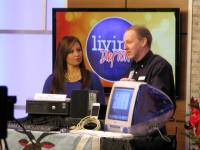
(TUNE INTO WDTN-TV2’S LIVING DAYTON AT NOON ON FRIDAY NOVEMBER 28TH FOR A SPECIAL SEGMENT ON THIS TOPIC PRESENTED BY DEER IN HEADLINES AUTHOR GERY L. DEER.)

Gery L. Deer is an independent columnist and business writer based in Jamestown. More at gerydeer.com.


Jamestown Opera House Show celebrates 20 years of a local family’s musical history

In Children and Family, Entertainment, history, Local News, Media, News Media, Senior Lifestyle, Theatre, Uncategorized on November 17, 2014 at 11:51 am
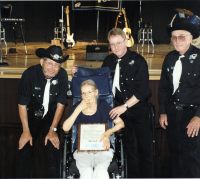
Lois Deer (center) with The Brothers & Co. members Gary Deer Jr., Gery Deer, and husband Gary Deer Sr. at the Jamestown Opera House in 2010

Lois Deer (center) with The Brothers & Co. members Gary Deer Jr., Gery Deer, and husband Gary Deer Sr. at the Jamestown Opera House in 2010

JAMESTOWN, OH – On a cold, winter night, a couple of weeks after a family Christmas party in 1994, something historic took place. William Sutton, his brother Gary “Tuff” Sutton, Sr., and their nephews, Gery Deer and Gary Deer, Jr., did something they’d never done before. They all met up on a Friday night at the Deer family farm in Jamestown, Ohio and collected their musical talents into what would become a lifelong undertaking. While you may never have heard of “The Brothers & Co. Entertainers,” their history is one of a unique brotherhood derived from a family whose musical talent goes back several generations.

While William and Tuff had played together many times over the years, the Deer brothers had never made the attempt. Tuff had helped Gery develop his natural piano skills and Gary Jr. hadn’t played his drums much after graduating high school in Fairborn in the early 1970s. But when they sat down, something really amazing happened, they just “worked.”

Tuff took on the lead and rhythm guitar duties. William was initially the group’s bass player, but picked up his dusty bow and took over the fiddle spot once family friend Jess W. Young, of Fairborn, signed on, and then there were five.

Originally called simply, “The Brothers,” the band went through a lot of changes in its first year or two, adding and subtracting musicians, but always maintaining the two sets of brothers as the foundation. By 1996, a decision was made to change the group’s name, adding, “& Co.” (and company), allowing them to add and subtract whomever they wanted without much of a branding problem, so long as Gery and Gary Jr. at least remained. Somewhere along the way, Gery and Gary Jr. decided that the group was made up more of “entertainers” than trained musicians, so that was tagged onto the name too – “The Brothers & Co. Entertainers.”

SONY DSCBy 1996, Ed Jones had joined up on banjo and acoustic guitar. A cousin to the Deer brothers and another nephew of the Suttons, he also had never played together with his family before in this way. Sadly, the family lost Uncle Tuff Sutton to cancer in 2005, and William stayed with the group only a short time after and also passed away a few years later. Jess Young also retired from the group due to health reasons and passed away shortly after.

“None of who we are now would have happened without each of them,” Gery remembers of his family members who have passed on, including his mother, Lois, who died in 2011 after suffering for several years from Alzheimer’s disease. “We are who we are because of them and my mother was, essentially, the anchor. It was because of her that my brother and I are here and that the others came together with us. We couldn’t have done this without them.” But the changes weren’t over yet.

From inception until about 2004, the boys had maintained an instrumental bluegrass persona. But one Saturday night, shortly after a family friend, Jim Karns of Fairborn, joined the group, something odd happened. As Gery puts it, “We opened our mouths and a terrible, awful, nails on the chalkboard noise hit the air, as if four birds had flown headlong into a window while screeching at the top of their lungs.”

The Brothers & Co Variety Show will perform a 45 minute set at the Schuster December 4. Photo by Jen Copas

The Brothers & Co Variety Show will perform a 45 minute set at the Schuster December 4. Photo by Jen Copas

Brothers_Co-Whip_Gery_JimIn truth, the experiment had landed them in uncharted waters. Although Ed had done some singing, and Jim, as the most experienced, having performed in theater productions while in school at Kettering Fairmont, Gery and Gary Jr. had virtually no singing experience. But there were some golden nuggets amidst the muddy waters of their four-part vocalization.

Working hard to find their respective parts, eventually everything finally fell into place and they had become singers as well as naturally talented musicians. But with change comes growing pains.

An expanded repertoire and wider variety of music required instrument and key changes and since they guys play their own instruments, staging issues caused shows to come to a dead crawl. But a solution for that problem quickly presented itself, and, as is the norm with this group, Mother Necessity birthed yet another Brothers & Co. innovation – one they like to call, “comagic.

In addition to having a great set of bass singing pipes, Jim Karns is also an award-winning, classical stage magician. In addition, Gery was an accomplished stage bullwhip artist, having performed all over the country and on national television shows like America’s Got Talent and The Bonnie Hunt Show. He and Gery had met while working for an engineering center in Dayton and found they had many common interests, the least of which was a somewhat Vaudevillian sense of humor, one that fit in perfectly with an almost Grand Ole Opry styled stage show.

The Brothers & Co. Bus, NOAH'S ARK

The Brothers & Co. Bus

The new family-friendly routines, originally designed to give time for stage and instrument changes, soon added a whole new dimension to the show. It wasn’t long until “The Brothers & Co. Entertainers” became, “The Brothers & Co. Music and Variety Show.”

After two decades of constant evolution, weekly rehearsals in a specially built room at the Deer family farm, and shows that spanned everything from coffee shops to casinos, The Brothers & Co. have more to offer than just four guys standing around singing. They are a full, family-friendly, stage variety show that can perform virtually anywhere. Their signature black, western outfits designed by Gary, Jr. and Gery’s mother, Lois, are a tribute to their family’s country music heritage.

The group has performed at the Schuster Performing Arts Center, the Victoria Theatre and the casino resorts of French Lick, Indiana, but their home is in Jamestown, and that’s where they want this 20th anniversary to tour to start. Gary Deer, Jr. is the percussionist of the group and sees to most of their technical requirements. “Mostly, we want to entertain people and give them a show like most haven’t seen since the 60’s,” he says.

“We put a modern spin on an old kind of entertainment that’s nostalgic and originally presented all at the same time,” says Jim Karns. “If you’ve never seen a live variety show, this is something the whole family will really enjoy.” To celebrate their 20th anniversary, The Brothers & Co. will present a pre-holiday performance beginning at 7PM, Saturday, November 22nd at the Jamestown Opera House, 19 N. Limestone St., Jamestown, Oh 45335, to benefit the Jamestown Area Historical Society.
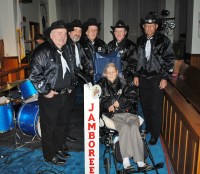
The Brothers & Co. with Gary Deer Sr. and their late mother Lois Deer at the Wheeling Jamboree Radio Show, 2010

The Brothers & Co. with Gary Deer Sr. and their late mother Lois Deer at the Wheeling Jamboree Radio Show, 2010

Gery says the show has something for everyone, and it comes from a place of deep meaning for the family. “This show is hard work, just like anything else of value. It honors our mother’s memory, it gives testimony to the fact that a family can do something together besides watch TV or play a video game. There is a family commitment to The Brothers & Co. that gives other families the chance to bring the kids and enjoy genuine, dare I say it, ‘wholesome’ entertainment that’s just plain fun. It almost doesn’t exist anymore and we rarely get a chance to show it here at home.”

Tickets at the door are $10 for adults, $5 for seniors and students. Children 12 and under are free. Tickets are available at the door the night of the show and for presale at Ted’s Barber Shop, 3 W. Washington St. in Jamestown. Sponsorships are also still available for businesses in the area starting at $100. Proceeds from this performance benefit the Jamestown Area Historical Society. More information is available from The Brothers & Co. website, thebrothersandcompany.com, and from their Facebook page. Watch for The Brothers & Co on the WDTN-TV2 program, Living Dayton, 12 noon, Tuesday November 18.

The creative process cannot be quantified

In Books, Children and Family, crafts, Entertainment, Local News, National News, Opinion, Print Media, Technology, Uncategorized on November 10, 2014 at 1:04 pm

If you haDIH LOGOve any friends who are aspiring novelists and you haven’t seen them for a while, I may know why. November is National Novel Writing Month, a time when writers – hobbyists and professionals alike – forsake virtually everything else in life to get down at least 50,000 words towards a completed novel in just thirty days. As executive director of the Western Ohio Writers Association I am, like many of our members, one of the anticipated 400,000 worldwide participants in the event. But attempting to pen a full-length novel in under a month is not for the faint of heart.

“NaNoWriMo,” as it’s known for short, is a non-profit organization started in 1999. In 2013, more than 310,000 participants signed up, spanning six continents. In the 2014 official press release, NaNoWriMo Executive director Grant Faulkner said, “Every year, we’re reminded that there are still stories that have yet to be told, still voices yet to be heard from all corners of the world. NaNoWriMo helps people make creativity a priority in life and realize the vital ways our stories connect us. We are our stories.”

pcpic1

pcpic1

Given their commitment to the encouragement of writers as a whole, the NaNoWriMo folks certainly seem to want to keep people motivated and working and that extends beyond the November event. The organization also promotes youth programs, writing camps and other writing-focused activities throughout the year.

NaNoWriMo’s organizers insist the purpose of the 30-day novel challenge is to inspire and motivate authors to actually finish something, a common barrier for new writers. To hit the goal, writers must pen approximately 1,667 words per day, regardless of quality. But the “just keep writing” approach doesn’t sit well with some and there are those who say that it instead may be more counterproductive than helpful.

Opponents believe that the idea of such incredible pressure of deadline and competition undermines the inspirational process; robbing the author of the creative time necessary to be more selective of words, phrasing and flow.  Classic American author Mark Twain might well have been in agreement with this thinking.

In a letter dated October 15, 1888 to English minister George Bainton, Twain wrote, “The difference between the almost right word and the right word is really a large matter–it’s the difference between the lightning bug and the lightning.”

nanologoBut those who are regular participants seem to really enjoy a process that they say gives them the opportunity to stay focused and inspires a bit of healthy competition. Throughout the month, each writer updates a public profile on the NaNoWriMo website which includes word count to date; a practice largely appreciated as one of the most motivating aspects of the exercise, or the most discouraging, depending on how you’re doing.

Whether you are a writer or a reader, this is probably a good time to point out that the creative process is not something that can be qualified or quantified. It is different for every artist. While there are people who are proficient with grammar, punctuation, style and general mastery of the English language, there is no such thing as an “expert” writer. Most successful authors – and not just in the commercial sense – will insist that good writing cannot be taught, it has to be practiced and that the creative process is ongoing.

It may very well be that a 30-day novel, after editing and revision, could end up the next New York Times best seller. It is just as probable that another manuscript, in the works for many years, might turn out to be the worst 300 pages ever put to paper. It’s really a coin toss.

Truthfully, the process really doesn’t matter. Although the value of art rests with the audience, its quality depends on the talent, determination and hard work of the artist (writer), rather than the method used for its production. As for those of you typing your way to 50,000 words this month, we who are grateful to get out 700 words every week salute you! Good luck.


Gery L. Deer is an independent columnist and executive director of the Western Ohio Writers Association. More at westernohiowriters.org.

Space flight really is rocket science

In history, National News, Opinion, Science, Technology, Uncategorized on November 3, 2014 at 2:41 pm

DIH LOGOBy now, most have heard about the failed test flight of Virgin Galactic’s “SpaceShip Two,” which crashed in California’s Mojave Desert on October 31st.  One of the spacecraft’s pilots died in the crash, the other critically injured. While this is Virgin’s first fatality during the development of their “sight-seeing” spaceship for the super rich, perhaps it is just another sign that the pursuit of more money and fame may not be adequate reasons attempt another small step for (rich) mankind. Space travel really is rocket science, and then some.

After a successful flight and ocean landing in July of 1961, astronaut Gus Grissom’s Mercury space capsule sank after a premature detonation of explosives blew the hatch. Grissom managed to escape, only to die six years later in a fire during a “plugs out” test of the Apollo 1 capsule on the pad at Cape Kennedy. Astronauts Ed White and Roger Chaffee also perished in that tragedy.

Other terrible accidents followed during America’s “space race” to beat Russia to the moon and meet President Kennedy’s goal of landing a man there before the end of the decade. America did finally put men on the moon, several times. But, as space travel became more complex, the dangers increased exponentially, and so did the cost of human life.

Space flight is hard! It should be left to the experts.

Space flight really is rocket science!

Famously re-created by Ron Howard on film, Apollo 13 was, in short, a miracle of human survival. By all odds, three guys trapped in a freezing pop can, 240,000 miles from Earth, should never have been able to make it home. Fortunately, thanks to the skill, ingenuity and experience of the crews both in space and on the ground, the movie managed to get a real-life happy ending.

More than two decades after the Apollo 1 catastrophe, the Space Shuttle Challenger exploded shortly after liftoff, marking the first time a civilian had died in a space travel accident. In February 2003, the shuttle Columbia broke up on re-entry over Texas after insulating foam from the main fuel tank had damaged the heat shield as it left the launch pad.

No matter how far technology appears to have advanced, space flight is now, and will always be, experimental. The engineers and pilots at the National Aeronautics and Space Administration (NASA) learned a great deal from the catastrophic failures mentioned earlier. But as more, privately developed, manned space flights are attempted, it is important to keep in mind that all of these disasters happened under the watchful eyes of some of the smartest, most experienced aerospace experts in the world. Yet people still died.

At our present level of technology, space flight is not something that should be left to over-privileged billionaires with fancy English titles. It’s dangerous, expensive and the drive for national security and scientific achievement does not exist in these endeavors. Virgin Galactic’s efforts are about money, pure and simple. Upon further reflection, however, cash may not be any less a humanitarian reason to get into manned space flight than beating the Communists to the moon.

After mothballing the last of the space shuttle fleet, America seems to be all but out of any residual space race that may still exist. Massive budget cuts enacted by the Obama administration have stripped NASA to its bare bones, its government money now subsidized more often by private companies using facilities and personnel to launch communications satellites. Without the space shuttle, the International Space Station depends more and more on private industry – and the Russians – to remain manned and supplied.

Lacking a more pressing need to funnel billions of dollars back into government-sponsored space flight, private organizations will eventually be the only way Americans go to space. For more companies like Virgin to get involved in the endeavor, however, there would need to be some kind of return on investment to motivate them.

Perhaps one of the space probes will find gold or platinum on Mars or one of Jupiter’s moons, inspiring a space-age gold rush. Until that happens, people should probably keep an eye open for more rich kids’ toys dropping out of the sky.
The Jamestown Comet Editor/Publisher Gery L. Deer is an independent columnist and business writer based in Jamestown, Ohio. More at gerydeer.com.

Propaganda still has power over Americans

In Dayton Ohio News, Health, Local News, National News, News Media, Opinion, Politics, psychology, Religion, State News, Uncategorized, World News on October 27, 2014 at 9:42 pm

DIH LOGOPolitics and religion both thrive on propaganda, some of it factual, some creatively manufactured. Either way, people will buy into almost anything when you hit them at the gut level. Emotions ride highest when fear is used as the manipulation point.

In 1938, Orson Welles managed to terrify the radio listening public as he destroyed America by Martian invasion in his version of H.G. Wells’, “War of the Worlds.” Of course, it was all a Halloween offering, a prank, “the radio equivalent of dressing up in a sheet and jumping out from behind a bush and saying, ‘boo,’” as Welles put it. But it was, for lack of any other analogy, an hour of “propaganda;” a radio play written to sound exactly like genuine news bulletins, and people fell for it.

According to the dictionary definition, propaganda is information, especially of a biased or misleading nature, often used to promote or publicize a particular political cause or point of view. A deceptive radio broadcast may not be likely to have the same effect today, but if the current Ebola virus scare is any indication, Americans are still far from immune to the effects of well-crafted media spin.

With virtually no qualified medical information being distributed within the propaganda (probably the best word to describe most of the information being circulated), politicians, the media, and the endless barrage of know-it-all cable TV commentators are spreading speculation, misinformation and fear, unabated.

As one might expect, election season has to be one of the most prominent times for the spread of heavy-handed, negative propaganda. Despite laws to limit how “misleading” political ads can be, there is still so much being dispersed that it staggers the imagination of the thinking person as to how it is even allowed.

With fewer people concerned about the accuracy of news reporting these days, believing any blog they run across on Google, media spin no longer needs even to be well-crafted for the masses to fall victim to its intent. There are still, bafflingly, people out there who think that what they see on the news or Internet must be the truth. Not so much “fact,” but truth.

Is the Ebola scare really the menace it's made out to be by politicians and media?

Is the Ebola scare really the menace it’s made out to be by politicians and media?

The spread of propaganda does not require facts but implies truth. Make enough people believe in an idea, factual or not, and it becomes “truth,” at least to those people. Once spread, that truth ends up being the predominant viewpoint and changing the minds of those who fall for it is a challenge, to say the least. Oddly enough, this is the same basis upon which every religion in history has been established.

As pointed out many times in “Deer In Headlines,” decisions are rarely made from factual information but more often based on emotional satisfaction. What makes a person feel good is far more powerful than a list of unemotional statistics. Once again, fear can be one of the most powerful emotions of them all and that is exactly the point.

Without fear, propaganda has much less of an effect. Political propaganda plays on the fear of the voter, suggesting that he or she will suffer under the rule of the opposing candidate – higher taxes, less food on the table, fewer jobs, and so on. In religious propaganda, the fear is purgatory, Hell, or whatever the particular denomination chooses to promote as the reason to show up every Sunday and ante up in the plate as it goes by.

There is, without question, a serious problem concerning the spread of the Ebola virus in the United States. But there is also, sadly, a tremendous opportunity here for politicians to cash in on the fears of those who are probably already paranoid about such things, enhancing the real threat enough to justify the need for such publicity.

Those fifteen minutes of fame come with a high cost, mainly in the stress and emotional trauma experienced by the people who trust their government to take care of them. Avoiding future panic means that people simply need to be cautious about what they take as “fact,” versus what they believe to be “truth.”


The Jamestown Comet.com editor Gery L. Deer is an independent columnist and business writer based in Jamestown, Ohio. More at deerinheadlines.com.

Zombies, the lamest monsters

In Books, Entertainment, Movies, Opinion, sociology, television, Uncategorized on October 20, 2014 at 11:28 am

DIH LOGOHalloween is upon us and, once again, zombie-mania continues to reign supreme. From so-called, community “Zombie Walk” events to AMC’s season premier of the “Walking Dead” boasting the highest-rated cable television show in history, Americans certainly seem to be zombie-obsessed. But why; what is it about an animated, decaying corpse that seems to capture people’s imaginations and gets them to shell out millions of dollars in search of the next big zombie fix?

According to the Oxford English Dictionary the word, “zombie,” has its origins in West Africa, but the concept of the animated corpse most likely comes from Haitian folklore. Legend suggests that the dead are raised by magical means to walk the earth again and do the bidding of the one who performed the revival ritual, as a sort of creepy slave.

Zombies first appeared in American popular literature as early as 1929, then shortly after, actor Bela Lugosi, famous for his portrayal of “Dracula,” starred in the film, “White Zombie,” which introduced the familiar personification of the creature. The modern American zombie pop-culture most likely took hold after the release of George Romero’s 1968 film, “Night of the Living Dead,” although they were never actually referred to by that word in the movie.

zombiesZombies in modern tales aren’t usually created by magic, but science. Today’s authors have penned a more realistic origin for what has become known as the “zombie apocalypse.” In most current story plots, a rogue virus escapes to the population, infecting everyone and turning them into, essentially, zombies. Instead of one or two slave zombies on the loose, entire populations of walking dead murderously meander across the globe, destroying civilization as they consume the living for sustenance; right, whatever.

Really, except for the fact that they’re pretty gross to look at and can sneak up on people, as far as monsters go zombies are probably the lamest (pun intended) and least scary creatures ever dreamed up. Think about it – re-animated dead people, hobbling along with one foot dragging behind them and moving so slowly, any granny on a walker could whiz past. What’s scary about that?

These monsters have no motive for being bad and there is no end goal or desire for world domination. They’re just hungry. They wander the night, aimlessly, hoping only to happen upon a fresh brain to consume.

And would someone please explain why they even need to eat anything? They’re dead! What possible nutritional value could there be in anything for a zombie? And why are they bleeding always? Does it need to be pointed out again, they’re dead – there shouldn’t be any blood pumping.

Add to that killing them is really a piece of cake, depending on which version of zombie lore you adhere to. In the modern, “Walking Dead” style, all you need to do is smash in their heads or decapitate them or something. But, according to Haitian lore, the goal was not to destroy them but to release these poor souls from their magically-induced, wandering purgatory and there were several methods available to do that, like pouring salt on them.

In any case, zombies are just not all that intimidating compared to vampires or werewolves (ignoring the Twilight-styled, sparkling, Calvin Klein model types). And yet, inevitably, story protagonists nearly always get caught by the marauding zombies and get their brains eaten. Really, how dumb does someone in a monster movie need to be to actually get caught by a crippled, decaying dead guy?

So, here is the best possible advice for escaping zombies – run! Or, just walk fast; it’s not that hard to get away from zombies. Just be sure to sacrifice the comic relief character first, giving you extra time (not like you need it).

If for some reason the zombie gets too close, and yes, that will be because you are really, incredibly stupid, just grab the arms and pull them off – how hard can it be? They’re dead and decaying, right? Hopefully the zombie fascination will diminish soon, leaving room for even more ridiculous obsessions, like brooding, teenage werewolves. Oh wait, that’s been done already too. Oh well. Happy Halloween!
Gery L. Deer is an independent columnist and business writer. Deer In Headlines is a production of GLD Enterprises Commercial Writing. More at gerydeer.com.


AG collecting BMV data: Who’s watching the watchers?

In Local News, Media, Opinion, Politics, sociology, Uncategorized on September 30, 2014 at 9:31 am

DIH LOGOApparently the National Security Administration (NSA) isn’t the only government agency collecting information on American citizens without oversight. According to multiple news sources, including CNN, Ohio Attorney General Mike DeWine has just disclosed that Ohio driver license photos have been uploaded to a facial recognition database for criminal identification.

According to DeWine, the program allows police to quickly compare photographs of suspects or crime victims to an electronic pool of mug shots and driver license photos in the Ohio database. Comparisons are made of facial measurements from one image to the next in search of a match. The problem with all of this is that it’s been active since June – in secret.

With no rules or written regulations governing the use of this information, the AG can do whatever he wants with it. No official should have such wide-sweeping access to personal information on citizens.

Photo Courtesy RawStory.Com.

Ohio AG Mike DeWine    Photo Courtesy RawStory.Com.

Neither DeWine, nor any of his cronies, has any right to dig through the records of Ohio citizens without due process. Within moments of disclosing this information, the American Civil Liberties Union pounced on the situation, and, for a change, rightfully so.

ACLU Associate Director Gary Daniels issued a statement calling upon DeWine to, “Pull the plug” on the system. “This system needs to be shut down until there are meaningful, documented rules in place to keep this information secure, protect the privacy of innocent people, and prevent government abuse of this new tool,” Daniels said.

According to his statement at the press conference revealing this program, DeWine said, “Misuse of the facial recognition system is a felony offense.” But how can he make a statement like that when there are currently no written rules to govern its use?

As he told The Enquirer, it’s the AG’s opinion that he didn’t need to inform the public when the system was launched because 26 other states already have similar databases in operation. Only now, after the information was prematurely uncovered by the press, has DeWine decided to publicly form an expert advisory panel of judges, prosecutors and law enforcement representatives to create rules preventing privacy abuse.

Where is the state legislature in that list of “experts?” Our state representatives should be the ones governing the rules of operation for such a system, not those who already have control over it and the ability to exploit the information.

All this begs the question, if DeWine is uploading identification photos, what else is he collecting? Every photo is part of a larger database of names, addresses, and Social Security numbers. So who is looking at all of that and how much access do they have? Even more importantly, what can be done to control its use?

Protecting the public is what an attorney general is supposed to do. Sadly, when the person holding that office has an overwhelming sense of omnipotence, the public has to protect itself instead from him. Then, only the state legislature can take the proper action to limit DeWine’s reach with such sensitive data.

People need to call, email, fax, write to their state representative and demand they act immediately to avoid mishandling of this information and force the AG to disclose every detail of this program to the public. The idea that he felt he was not obligated to tell anyone only emphasizes the need for extensive regulation by the State House.

In the meantime, be aware that likely anyone in the AG office has access to any and all personal information collected by the Ohio Bureau of Motor Vehicles without proper due process of law, warrant or oversight. It’s not good enough that we’re supposed to simply “trust” Mike DeWine’s policies, especially knowing now that he has hidden this program for months. If he has concealed this, then what else could he be he hiding?


Do your homework before voting this election.

In Jobs, National News, Opinion, Politics, State News, Uncategorized on September 29, 2014 at 11:26 am

DIH LOGOHere we are in election season again, when liberals and conservatives alike spend millions of dollars trying to convince voters to either keep them in office or replace the incumbent.  As always, when they’re not kissing your baby, they’re stealing his lollypop. With so many candidates running who are essentially, “the lesser of who cares,” how will you decide at the ballot box?

A common theme of election strategies is the tired old, “let’s bash the other guy,” method, which is exactly as it sounds. In the months and weeks preceding the election, voters are inundated with television commercials, fliers and post cards all declaring the treachery of the opposing candidate, regardless of the validity of the claims. The goal is to “scare” you away from that candidate for fear he or she will bring about the end of democracy as we know it.

Another popular method of political marketing is the “two chickens in every pot” promise. The goal here is to simply convince you that no matter how you are living now, vote for “me” and I’ll make your life better, and the themes follow trends.

In the years following 9/11, for example, candidates promised better homeland security. After the recession hit, they promised banking reform and more jobs. In reality, however, politicians have little to do with any of that.

When you read about a lower unemployment rate, chances are it’s because many jobless simply stopped reporting their status or benefits have run out. Unemployment numbers fluctuate, organically, not because some politician changed the face of the workforce with the swath of a pen. Please try to keep this in mind: government does not, has not, and never will create jobs in the real world. Regardless of how much they hype job-creating policies, no politician can create jobs in private industry.

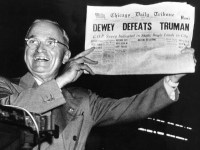
Probably the most famous photo of Truman. (Photo by W. Eugene Smith//Time Life Pictures/Getty Images)

Probably the most famous photo of Truman. (Photo by W. Eugene Smith//Time Life Pictures/Getty Images)

In fact, the majority of political interference just impedes business and slows workforce development – unless you have a nice, fat check to send them at election time. Then you get all the help you want until your money runs out.

The rest of the time, business owners must contend with the result of what these self-serving bureaucrats do best. Invasive regulations, ever-increasing taxes and other legislative roadblocks usually just muck up the works and prevent small businesses from growing – or hiring.

Local government interference can make things even worse, because that’s where the real decisions are made. When local politicians have a “pal” in a particular industry and a competitor comes in to try to set up shop, it can be harder to get official processes pushed through, like location approvals, licensing, and so on. It does happen, and far more often than you might think.

What gets even more annoying is the level to which some politicians try to convince people they are “regular folks,” when most of them are millionaires many times over. Great examples are Ohio Attorney General Mike DeWine, Congressman John Boehner, and many of their compatriots, on both sides of the aisle, each of whom are super-wealthy and many up for re-election. None of them have a clue what it would be like to have to survive paycheck to paycheck like so many of their constituents.

Whatever the ploy, a politician is a business selling a product in the same way that any company would try to get you to buy their brand of soap or corn flakes. It’s all marketing, and knowing that people make political decisions emotionally rather than based on any logic or facts, the more frightening the ad campaign the better.

The same goes for choosing to approve or deny the various ballot issues. Just because they send kids to bang on your door with big sad eyes and a long sad tale of how the children will suffer without passing a tax increase (while the kid has no idea what they’re shilling for, because they’re kids), that doesn’t mean you should pull vote “yes.”

Best advice, ignore the advertisements. If every voter did a little homework on the candidates and issues instead of voting a party line or from fear or guilt, there would be a marked improvement in the quality of our leadership.
The Jamestown Comet.com editor / publisher, Gery L. Deer, is an independent columnist and business writer. More at gerydeer.com.

Think Pink Motorcycle Poker Run to sponsor cancer survivor in Susan G. Komen walk

In Business, Charities, Local News, Sports News, Travel, Uncategorized on September 22, 2014 at 4:43 pm

IMG_0476DAYTON, OH – In 2010, Dayton area resident Karen Clary became one of America’s 2.9 million breast cancer survivors. This year, she hopes to be one of the thousands across the country to participate in the 2014 Susan G. Komen 3-Day® walk. To support her participation, the Miami Valley Victory Riders motorcycle club and Motor Sports of Dayton are sponsoring the 2nd Annual “Think Pink” Poker Run, Saturday, September 27. The event will help raise awareness and generate the $2,300 Clary needs to attend the 3-day, 60 mile the race.

The Susan G. Komen Race for the Cure series of 5K runs and fitness walks attracts people of all ages and fitness levels, from walkers to elite runners. Celebrating breast cancer survivors and honoring those who have lost their battle with the disease, the series began in 1983 with a single race with 800 participants in Dallas. Today, it has grown into a global series of more than 140 Races with 1.5 million runners.

Susan G. Komen is the world’s largest grassroots network of breast cancer survivors and activists working to save lives, empower people, ensure quality care for all and energize science to find the cures. Thanks to events like the Komen Race for the Cure® and the Komen 3-Day, the organization has invested more than $2.2 billion, making it the largest worldwide source of nonprofit funds dedicated to the fight against breast cancer.

Seventy-five percent of the net proceeds raised by the Susan G. Komen 3-Day® help support Komen’s global research program, the largest nonprofit source of breast cancer research funding outside of the U.S. government. Money raised also supports large public health programs that address critical issues in breast cancer treatment and care. The remaining 25 percent stays in the local community, funding financial, social and medical needs.

Two years ago, Clary and her daughter, Jen, attended the San Francisco 3-day race together. “My daughter asked me to do the 3-day walk with her in 2012,” Clary says. “At first I thought she was crazy; 60 miles in three days? I eventually decided to go because it looked like so much fun and because of how much this means to others who shared my experience, and their families.”

Beginning at 10AM from Motor Sports of Dayton, 2135 Dayton-Lakeview Rd., in New Carlisle (45344), riders will collect a card from each stop, trying for the highest hand at the end of the ride. From Motor Sports of Dayton, riders will make stops at Moose Lodge in Beavercreek, Buckminn’s D&D Harley Davidson in Xenia, Little River Café in Oregonia, Whiskey Barrell in Oregonia, and finally end up at Jack Ass Flats in Huber Heights. The rider with the highest poker hand at the end of the run will win the grand prize. Single riders can participate for $15, doubles for $20, or buy an extra hand at $5 each. Other activities during the event include a 50/50 drawing, raffle prizes, silent auction, door prizes and entertainment.

“My first walk was the hardest thing I have ever done in my life and also the most awesome,” Clary says. “Jen wanted to do the walk for me and, because I have given her a greater chance of getting cancer, I wanted to do it for her. Hopefully we can all help to wipe it out.” For more information, call Karen Clary at (937) 620-8597 or email her at teampol@aol.com.