Local News & Commentary Since 1890.

Archive for the ‘Technology’ Category

When did being nerdy become cool?

In Children and Family, Economy, Education, Opinion, sociology, Technology, Uncategorized on August 25, 2014 at 12:14 pm

DIH LOGOAm I to understand that, largely because of a television situation comedy, it is now cool to be awkward, socially inept, and very smart, all while being considered – dare I use the word – “nerdy?” When did this happen? In my day, we nerds were cast out from all the best tables in the school lunchroom or forced to get bad grades to avoid being picked on because we were smart  – that never worked, by the way. It’s just not fair that today’s geeks get a pass! But, it’s about time!

Yes, I was a nerd, of the ultimate type, though I never made much of an effort to show my smarts on my report card; the dreaded “permanent record.” Best part is, I’m still pretty nerdy, if not more so, except now, people think it’s much cooler. Ok, maybe not so much when you’re nearly 50 years old, but still, it’s better than the reverse.

It is highly unlikely, however, that the power struggle of lunchroom hierarchy has changed too much. Although I have learned that there are now “smart kid cliques,” like a “herd of nerd.” These gaggles of bespectacled hackers, techies, science geeks and math whizzes won’t let the cool kids – jocks, cheerleaders, etc. – sit at their tables. Oh my, how the lunch tables have turned! So what, exactly happened to cause this mirror universe effect (there’s a Star Trek reference for anyone who’s paying attention)?

GLD Enterprises Commercial Writing managing copywriter Gery L. Deer at his Jamestown office.

GLD Enterprises Commercial Writing managing copywriter Gery L. Deer at his Jamestown office. Nerd is in!

Were our Heisenberg compensators out of calibration? Was there a paradoxical overlap in the delicate fabric of space and time? Perhaps J.J. Abrams decided to re-imagine nerddom in his own image? However interesting these explanations may sound, the popularity shift albeit a smaller one than you might think has more to do with money than anything else, on several levels.

In the 1990s, the nerds of the 80s were rolling in the cash as the tech boom swept across the nation and rapidly spread worldwide. Billions of dollars were going into research and development as the Internet expanded and commerce took notice.

Suddenly, everyone was a hacker or web developer. Countless tech startups swamped Silicon Valley and the rest of the country as everybody with a modem tried to cash in on the boom.  In short, the nerds of yesterday are the successful business tycoons of today, at least some of the time.

Next, it would be hard to talk about this subject without at least a hat-tip to the TV nerds of CBS’s hit comedy, “The Big Bang Theory.” The quirky, discomfited antics of Sheldon, Leonard, Raj and Howard have become a sensation. The show seems to be broadcast every hour of the evening, primetime or in syndication. Watching people who seem far more awkward and unsure than ourselves has always been a pastime, but this is somehow even more engaging.

Most of us who have worked in the engineering or technical fields knew or knows someone like each of these guys, but with nowhere near the personality or likability of the four fictional personas. Speaking of real life, I’m fortunate that I don’t carry a grudge for all the harassment I endured growing up.

If anything, it’s been a source of great resolve and I’ve have written many times on the subjects of bullying, mean-spirited teasing and the like. Unfortunately, there are some of my nerd kin out there who just can’t let it go or, if they’re still in school, carry a sharp chip on their shoulders because they aren’t part even of the herd of nerd that as claimed a spot at one of the cool tables.

There is every possibility that the reason someone doesn’t socially advance has as much to do with the person than the environment. A bad attitude goes both ways. No one will be popular if he or she is always pointing out the mistakes of others, belittling someone’s intelligence or carries that chip on the shoulder that keeps others at bay.

I learned to embrace my inner (and outer) geek and like whom I’ve become. In the end, it’s far better to be smart and socially functional, than sit alone in the cafeteria.


Gery L. Deer is an independent columnist and contributor to WDTN-TV2’s program, Living Dayton. More at gerydeer.com.

Music shines light through darkness of dementia

In Health, Local News, Opinion, Senior Lifestyle, Technology, Uncategorized on August 18, 2014 at 12:20 pm

DIH LOGOAccording to statistics, one in three senior Americans now suffers from some type of dementia. My mother, Lois Deer, was one of those unfortunate millions who had an advanced type of Alzheimer’s disease. As it progressed, she lost the ability to communicate on anything more than a passive level, responding to very little, short of a head nod or facial response here and there. When she spoke, it was in whispers and then only gibberish.

One thing that did seem to register, however, was music. Each Saturday night we would move her wheelchair to the band room at my parents’ farm where our family band, “The Brothers & Co.,” would rehearse. We would feed her dinner – a manual task since she couldn’t do it on her own – and she’d spend most of the rest of the evening listening to us play and sing, surrounded by family in a room she created for us.

Gery Deer discusses Music and Dementia on WDTN-TV2's Living Dayton during a "Deer In Headlines" segment. Click to watch the video clip ...

Gery Deer discusses Music and Dementia on WDTN-TV2’s Living Dayton during a “Deer In Headlines” segment. Click to watch the video clip …

Music was an important part of my mother’s family growing up, with virtually ever member playing some kind of instrument, many of them without the aide of formal lessons. She even sang in an “Andrews Sisters” type quartet with her own sisters in the late 1950s.

By this time, however, Usually, she had a kind of empty, blank expression on her face, a typical Alzheimer’s manifestation. But one evening during our practice, she was sitting near my piano and I caught sight of a slight smile in her eyes and looked down to see her toe tapping on the footrest of her chair.

Since Mom needed 24-hour care, and because we had no intention of leaving her to rot in a nursing home, we cared for her at home and she came along with us to every performance. She had a specially-outfitted seat on our tour bus, complete with an oxygen tank and all of our portable medical supplies. My cousin sat with her in the audience and she would sing, “You are my sunshine,” with us at some point in every show. Music got through, when nothing else would, and I’m relieved to know that I’m not the only one who noticed.

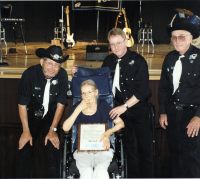
Lois Deer (center) with The Brothers & Co. members Gary Deer Jr., Gery Deer, and husband Gary Deer Sr. at the Jamestown Opera House in 2010

Lois Deer (center) with The Brothers & Co. members Gary Deer Jr., Gery Deer, and husband Gary Deer Sr. at the Jamestown Opera House in 2010

A friend recently told me about a National Public Radio news story related to this phenomenon. The piece focused on a documentary featuring social worker Dan Cohen and his creation of custom music playlists on iPods for elderly dementia patients. Titled, “Alive Inside,” the film explores Cohen’s exploration of the connection between music and long term memory.

“Even though Alzheimer’s and various forms of dementia will ravage many parts of the brain, long-term memory of music from when one was young remains very often,” Cohen told NPR’s Melissa Block. “So if you tap that, you really get that kind of awakening response. It’s pretty exciting to see.”

That all makes a lot of sense when you think about the kinds of music my family band plays and the relationship my mother had to it. There’s no question we were reaching an area of her mind that the Alzheimer’s hadn’t yet shorted out.

After I noticed my mother’s reactions, I paid more attention whenever we performed at nursing facilities where a great number of the residents were suffering from similar illnesses. I can’t tell you what a heart-wrenching experience it always is to see these poor people in such a state; doubled over in wheelchairs, closed off, withdrawn into the isolated torment of their own disease-ravaged minds. And then …

And then we start playing and something would happen, a toe would begin to tap here and there, or a silent face would begin to mouth words to a song. Although it might seem like there’s nothing left of the people they once were, here was a sign that they were still in there – somewhere – and we were reaching into that one place the disease couldn’t penetrate.

All I can imagine is that the music we were playing took my mother somewhere else within a mind that’s organization had long since scattered, as if someone rearranged all the drawers in a wardrobe chest.  She was in another place and another time, a better time.

Christina Corallo, North Shore LIJ Orzach Center for Rehabilitation, Valley Stream, N.Y., tells MusicandMemory.org, “Patients with anxiety and depression are less agitated and appear calmer. The music transports them to a happier place in their minds.”

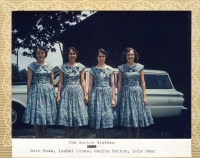
"The Sutton Sisters" singing family, Lois Deer (far right) and her sisters, (from left) Ruth Rowe, Isabel Jones, and Regina Marshall, ca. 1958

“The Sutton Sisters” singing family, Lois Deer (far right) and her sisters, (from left) Ruth Rowe, Isabel Jones, and Regina Marshall, ca. 1958

Cohen’s idea of customized iPod playlists for each patient is still plagued by one major hurtle – money. Nursing care, particularly long-term dementia care, is incredibly expensive and iPods aren’t cheap. It’s the same financial roadblock encountered by virtually every other progressive therapy for dementia ever proposed.

With that, I am challenging one member of the family of every dementia patient to buy an iPod for their loved one and load it with music from their life. Give them a moment to feel who they once were in the most personal, powerful way possible – through music.

 Learn More About Music and Memory…

Click here for a link to the full NPR story,”For elders with dementia, musical awakenings,” by Melissa Block.

Click here to watch the trailer, “Alive Inside: A Story of Music & Memory” featuring Dan Cohen.

Donate to Music & Memory: Monetary or iPods 


Back to school open house focuses on computer security

In Business, Children and Family, Dayton Ohio News, Education, Technology, Uncategorized on July 18, 2014 at 10:14 am

CT_BEAVERCREEK_TRUCKBEAVERCREEK, OH – On Saturday, July 26, Computer Troubleshooters of Beavercreek (CTB), located at 3792 Dayton-Xenia Rd. Beavercreek, Ohio 45432, will host a free open house from 10 a.m. until 3 p.m. to promote student computer security. The event is free, open to the public and will include refreshments, door prize drawings and special deals and information related to keeping student computers secure on campus this school year.

As part of an international network of independently owned franchises, Computer Troubleshooters provides complete information technology (IT) support for residential and commercial clients. Services range from basic, home computer repair and managed business services to cloud computing for advanced medical documentation.

Cliff Brust, president of Computer Troubleshooters in Beavercreek suggests that students are at some of the highest risk of technology theft and data loss. “We’ll be providing information and some free offers with purchase of new hardware,” Brust says. “But most importantly, we want to help parents and students understand how vulnerable their data is to loss and hardware to theft.” Brust offers a few tips in the meantime.

“First, lock up your laptops and smart phones, and don’t leave them unattended – anywhere.” he says. “Many laptops include a slot designed to accept a special cable lock. Wrap the cable around something big and hard to move, insert the lock into the laptop and turn the key or combination. A determined thief could still get the device loose but only by damaging the unit and diminishing its value. Remember, it’s generally the cash from resale of the unit that the thief is interested in, not the data.”

“Next, always use password protection,” Brust advises. “Yes, it is fast and convenient to turn on your computer and have it go right to the desktop, but it’s not safe. You have to password-protect your user account and disable the guest account. When you step away from your computer a quick press of the Windows Key and L will lock your user account. Be sure to manage your passwords also, and keep track of them. Don’t use the same one for everything.”

Brust also reminds students, “Protect your email, don’t share sensitive log-in information with anyone and always keep antivirus and anti-malware software up to date and running.” His final suggestion relates to the use of public wireless Internet hot spots.

“Whether you’re using the school’s network or a free Wi-Fi in a coffee shop your connection could be snooped. Using a VPN (Virtual Private Network) will protect your connection and let you surf anonymously. There are plenty of good free VPN clients to choose from so use one and protect yourself.”

Brust hopes the open house will give visitors the opportunity to learn more about keeping computers and smart phones safe and secure, on and off campus. “Planning and prevention are the keys to protecting your devices and your data,” he says. “Protection plans and keeping security software up to date can go a long way towards keeping important files from being lost. We can help people with the right solution for their needs.”

Computer Troubleshooters is located just west of N. Fairfield Rd., situated between Knollwood Garden Center and Capitol Dry Cleaners. For more information about computer security, call (937) 458-2000 or visit them online at http://www.ctbeavercreek.com.


Long-arm quilting services now available at Crafters Lodge in Sugarcreek Plaza

In Business, crafts, Education, Entertainment, Senior Lifestyle, Technology, Uncategorized on July 15, 2014 at 9:05 am

By Gery L. Deer

IMG_7258 Sugarcreek Twp. – A homemade quilt can be a treasured and very personal family heirloom. From the earliest American settlers, the craft of quilting has been passed down from one generation to the next, each adding a new creative style to the process. Once the top of a quilt is completed, it must be stitched to the back with batting in between – a detailed and painstaking process if done by hand. Fortunately, Crafters Lodge in Sugarcreek Township now offers long-arm quilting services and certification classes for those who wish to learn to do the work personally.

A long arm quilting machine is an industrial sewing machine similar to those used in the mattress industry.  It moves along a track or rails and sews the three parts of a quilt together. “We have the American Professional Quilting Systems (APQS) Millennium or Millie as it’s also known,” says Crafters Lodge co-owner, JoBeth Bryant. “The Millennium is the top of the line long arm quilting machine.”

JoBeth Bryant of Crafters Lodge demonstrates the Long Arm Quilting Machine nicknamed, "Millie"

JoBeth Bryant of Crafters Lodge demonstrates the Long Arm Quilting Machine nicknamed, “Millie”

Bryant says the store currently has two certified long-arm operators on staff and walk-ins are welcome. “When you bring your quilt top to us it will be measured and checked for any issues that may affect the quilting process.  Then you can choose the type of quilting you want done and the thread color.”A fifty-percent deposit and signed contract are required at time of drop-off.  Customers can also choose any additional services they may want, such as binding, a hanging sleeve, or a label.

To make the process go as smoothly as possible, Bryant notes that customers should properly prepare the work. “Make sure the backing is square, backing must be at least six inches wider than the top,” she says.  “There are some materials, particularly generic brands from chain stores, which may not be suitable for batting, and they must be clean and odor-free. Check with us for details on acceptable batting and backing materials, both are available in our store.”

Certification classes are also available for those who wish to learn to use the long arm machine and handle the IMG_7254quilting job personally.  Students are given expert instruction on how to load a quilt, threading the machine, wind and load bobbins, access the various features, use of the pantograph, and how to create basic “meander” quilting pattern.

Crafters Lodge is located at 6056 Wilmington Pike, just behind Fazoli’s in the Sugarcreek Plaza in Sugarcreek Township. Regular store hours are Tuesday through Saturday 11:00 am to 8:00pm, Sunday noon to 6:00 pm and closed on Monday. For more information and a schedule of classes, visit the store’s website, http://www.crafterslodge.com or call (937) 470-2649.

Improving American language skills: Reading and writing are fundamental

In Books, Children and Family, Education, Literature, Local News, Opinion, Technology, Uncategorized on June 30, 2014 at 3:53 pm

dih-logo-SENext to the United States Constitution, the Declaration of Independence may be the single most important document ever created in the history of America. It established our country’s formal separation from England and set in motion more than two centuries of global influence and an example of how a free republic can succeed.

But what would have happened if the men who founded our country lacked the basic language skills to create that first, all-important document? How would these men have properly and so effectively communicated the displeasure and intent of an entire people without such a firm grasp on the English language, not merely to speak it but to put it down in a document to be revered for centuries to come? In short, they couldn’t have.

On this 238th anniversary of the signing of the Declaration of Independence, we need to remember that it’s author had but two years of formal, college education. In those days, a man wishing to become a lawyer apprenticed under other attorneys, reading the law and learning to interpret and apply it for the good of the people for whom it was put in place. Jefferson eventually became a lawyer but not by obtaining any degree we might understand today.

Likewise, Benjamin Franklin went to school briefly but, because of financial issues, he had to stop to help support his family by going to work with his father. He furthered his own education, however, through reading and self-study, a practice that is, sadly, frowned upon today. Both of these men demonstrated the vast important of language and writing, and how the written word can change history. Some people, though, struggle with language skills or never learn to read at all.

One of my favorite books from childhood was called, “The Little Old Man Who Could Not Read,” by Irma Black. The book chronicles the story of a little, old toy maker who, despite his amazing craftsmanship for pleasing children, never learned to read. One day, his wife went to visit a sick friend and left him alone for what must have been the first time. He was forced to do the grocery shopping on his own, which turned out to be a very frustrating endeavor. Upon arriving home, he sadly discovered that what he thought was a spaghetti box turned out to be wax paper and the can of sauce, coffee instead. It was very disheartening. But it motivated him to learn and he did. The book was written many years before the technology age, but imagine what he would have to deal with today if he couldn’t read at all? It would be nearly debilitating in modern American culture.

little_old_manI have always been a writer, even back into childhood, but most of my language skills came from audio books and those children’s books that came with a 33 rpm record. I found later that I had been dealing with a learning disability that hindered my ability to retain what I had read. Over the years, I adjusted and coped, but was not diagnosed until my mid-30s. Today, I have new ways of dealing with the problem and read as much as I can. I learned to defy my disability because I wanted to read.

There’s no question that Jefferson and Franklin were above-average men, but we all have the ability to move past our limitations, just as Franklin taught himself what he needed to know and just as I worked past my reading issues. For those who want to improve their language skills across the board, here are a few tips and they work for pretty much all ages.

First, try to write as much by hand as possible. Using paper and pen will slow you down a bit and force you to think before you write. People were better writers in the old days because it took time to get thought to page. Today, technology has us whizzing through sentences without a thought to grammar and word usage.

Next, although it’s fallen out of favor with the public school set, use cursive writing as much as you can. As with the first point, handwriting something makes you think and use the right language. It even gives you the chance to look up a word before you use it.

Try to learn a new word every day. Vocabulary is the key to better language skills. Take the time to look up words you hear throughout your normal day. But if you don’t hear any that grab your attention, pick up a hard-bound dictionary, open it up, close your eyes, and point to a word on the page.  That’s your word for the day. One of those “word of the day” desk calendars is a great resource too. Of course, you need to put the word into use whenever possible to make it stick.

Read, read, read, read. And, did I mention, read? Newspapers, well-written blogs, congressional briefs, comic books, it doesn’t matter what you read, just make sure you read a lot. If you’re trying to improve your language skills, however, the more advanced the reading the better. It’s ok if it takes time, look up words you don’t know and charge ahead.

Finally, don’t write like you text. In fact, don’t text how you text, either. The wave of “texting shorthand” is maddening to those of us with good grammar and language skills. Use full words and sentences – even in texts. It’ll make a big difference in how you communicate in email and in other written documents as well. Take your time and say it right.

So this Fourth of July weekend, go out and enjoy the picnics and fireworks.  But remember, when you hear the words to the national anthem or the preamble to the constitution, think about the meaning of each word and be grateful that those guys were diligent enough to get every one of them right. Our very freedom depended on it.

UPDATE: CFL bulbs save money, but threaten safety

In Children and Family, Dayton Ohio News, Environment, Health, Home Improvement, Opinion, Politics, Science, Technology, Uncategorized on June 10, 2014 at 8:40 am

GLD_CFL_TV2_SCREENSHOTSpecial Update / Editor’s Note: This article was originally published in November of 2013 and updated in April 2014. Since that time, and investigative report by Pam Elliot at WDTN-TV, 2News in Dayton has yielded the following information on the dangers of CFL bulbs.

Deer In Headlines author and Jamestown Comet publisher, Gery L. Deer, was tapped as the initial interview source for the investigation based on the content of this edition of his column. Here for you is the video from that investigation which aired on Monday, May 19, 2014.

Click here for a link to the full 2News investigative story which includes suggestions for the safe use of CFL bulbs.


dih-logo-SEApril 7, 2014 – The incandescent light bulb was developed in 1876 by Thomas Edison, founder of General Electric. But as more energy efficient technology is introduced, even Edison’s greatest achievement has been all but extinguished forever. On September 24th, 2013, it was announced that the last of the incandescent light bulbs had rolled off the GE assembly line to be replaced by compact fluorescents, or “CFLs.” The spiral-twisted tube bulbs use low-energy, fluorescent technology and there is really nothing cutting-edge about them, except for their size and the potential fire risk when they go bad.

Fluorescent lighting has been around since the late 19th Century, but wasn’t developed for widespread use until the 1930s. Less expensive to operate than their incandescent counterparts, most of the bulbs last longer and are safe for everyday use. But as the environmentalist lobby pushes for more energy-efficient or, “green,” technology, has the heightened concern for the environment surpassed that for human safety? Recently I went into my kitchen and switched on the light over the sink, as I did countless times throughout the week. I left the room for a moment and when I returned it was dark, the familiar morning glow of the light fixture having just been replaced with the smell of burned ceramic and melted plastic. Upon investigation I discovered that the CFL bulb in the overhead light had quite literally burned out.

20W CFL Bulb from Gery Deer's kitchen.   Photo by Gery L. Deer

20W CFL Bulb from Gery Deer’s kitchen. Photo by Gery L. Deer

Just before it went dark, the 20-Watt, General Electric CFL bulb I had installed a few months earlier had gone so hot that it flamed through the plastic and ceramic base, causing it to melt and crack at the bottom of the glass tubing. The discovery of such a potential fire hazard was, to say the least, surprising, but apparently the problem is well-documented and manufacturers have been aware of it since the product’s release.

In a Snopes.com article John Drengenberg, consumer affairs manager at Underwriters Laboratories (UL), said about how CFLs expire, “People expect to see the bright flash and to hear the popping like a traditional incandescent bulb, but the burn out of a CFL is different. The light dims over time and might produce a more dramatic pop, emit a distinct odor, and maybe even release some smoke.” Drengenberg is referring to the Voltage Dependent Resistor (VDR). The CFL burns out when the ballast overheats, causing the VDR to open the circuit like a blown fuse and prevent any hazards.

Instead of resulting in a mild puff of smoke, however, the heat generated can, as in my case, burn through the base. As I dug deeper into this issue, I discovered countless articles, videos and online debates regarding the safety of CLF lighting and how there might be more to their compulsory introduction than simply reducing energy costs. It’s important to note here that Underwriters Laboratories is not a government agency but a private company paid by manufacturers to “certify” the safety of their products.

DP&L has a vested interest in getting these bulbs out to the public. It's unclear where that interest lies, but here is the proof - a Walmart display in Xenia, Ohio offers huge discounts.

DP&L has a vested interest in getting these bulbs out to the public. It’s unclear where that interest lies, but here is the proof – a Walmart display in Xenia, Ohio offers huge discounts.

In the early 1990s, I worked for a major appliance manufacturer as an engineering technologist following UL guidelines in operational and safety testing of ovens, ranges and cook-tops. In my experience, a bit of heat and smoke being released from a popping resister is, by itself, not enough to cause the kind of damage apparently so common with this product.

I am well aware of UL testing practices and it is beyond my comprehension how anything short of political pressure could be responsible for the approval of a consumer electronics product that literally lets flame out of its casing. From a consumer standpoint, it’s baffling to me how UL, or the Federal Trade Commission – the governmental agency responsible for consumer safety, can justify the approval of a device that clearly presents a fire safety hazard under “normal use” conditions. Incidentally, the CFLs also contain mercury, another potential environmental health hazard often conveniently overlooked.

It is entirely possible that these products were rushed to market, not so much to help reduce pollution or save money for the consumer, but to further a political agenda. Whatever the reason, the consumer should be aware of the inherent dangers and always be careful when using CFL lighting.  (End original story.)

Here are some detailed photos of the original, failed bulb. General Electric requested it be returned for investigation (we have complied).


UPDATE : June 6, 2014 – Today Gery L. Deer received several boxes of light bulbs from General Electric (Pictured below). The shipment included several packages of original, incandescent bulbs and several packages of LED bulbs. Once again, it is important to note that Gery insisted to GE’s representatives, by phone, he was not looking for any sort of restitution, but simply wanted to make the public aware of the dangers surrounding these bulbs. But, here they are anyway.

An assortment of incandescent and LED light bulbs sent to Gery L. Deer by General Electric on June 6.

An assortment of incandescent and LED light bulbs sent to Gery L. Deer by General Electric on June 6.


VIDEO UPDATE: June 10, 2014 – Hard to believe – ANOTHER shipment of LED light bulbs from General Electric. These are of a totally different style and are said to “distribute” light more efficiently. Watch the video for a complete follow up.


Jamestown Comet Editor Gery L. Deer is an independent columnist and business contributor to WDTN-TV2’s Living Dayton program. More at www.gerydeer.com.

Godzilla: King of the anti-nuclear message

In Entertainment, Environment, Movies, National News, Opinion, Politics, Science, Technology, Uncategorized, World News on May 12, 2014 at 12:00 pm


DIH LOGOIn 1955, the Japanese film company, Toho, Inc., introduced America to “Godzilla, King of the Monsters.” The bulky, green monster terrified audiences in the marginally familiar form of an enormous T-Rex, with notable size differences, muscular body and bigger arms and all brought to life by a puppeteer in a rubbery body suit. Originally called by the Japanese word, “Gojira,” meaning “gorilla whale,” the monster was so successful he’s been a worldwide star since his first black and white appearance in Tokyo.

Uncertain how a Japanese film would fare only a decade after the end of World War II, American exhibitors insisted an “American” element be added to make the dubbed, foreign monster flick more relatable to U.S. audiences. So, who better to report on the devastation than one of the most trusted faces on television at the time, Perry Mason himself, Raymond Burr. Not included in the Japanese version, Burr played an American journalist reporting on Godzilla’s attack into a tape recorder from the safety of a nearby office building.

During the 1960s and 70s Godzilla made his way into color features where his ominous appearance was softened a bit and his character reworked a bit from a menace to more of a hero as he battled other creatures threatening Tokyo from Monster Island. His gigantic, “30-story” upright posture, signature stomp, glowing dorsal plates and fiery breath were a hit with movie goers around the world.

Gozilla's original appearance in Japan, 1954. He appeared in America a year later.

Gozilla’s original appearance in Japan, 1954. He appeared in America a year later.

In 1985, Godzilla reappeared in a more serious, direct sequel to the original. Although the monster had made countless appearances in other, sillier films, like “Godzilla vs. King Kong,” and “Godzilla vs. Mothra,” this reprisal brought Godzilla back to his roots – as a devastating, uncontrollable statement on the increasing nuclear scare at the peak of the Cold War.

Although it was no longer necessary to smooth over American audiences, Raymond Burr reprised his role from the original film in a few scenes added to the U.S. release to provide continuity and attract a nostalgic audience. “Godzilla 1985,” did well at the box office and even better in the newly-minted home video market.

Fast forward a few years to 1998, when the monster was licensed by Tri-Star Pictures for an American, almost campy, version set in New York City. Studied by a worm biologist played by the likable Matthew Broderick (Ferris Bueller’s Day Off / The Producers), Godzilla takes up residence in Manhattan and is hunted by the US Military who manages to lay waste to everything except their target, even wrecking the iconic Chrysler Building. A liberally-preachy, anti-nuclear storyline and a totally computer-animated Godzilla, that didn’t look or act much like the original, completely failed to lure audiences.

Over the years, Godzilla appeared in 28 films and an American cartoon show. He even achieved the honor of a star on the Hollywood Walk of Fame. But the origins of the character are deep in Japan’s nuclear pain and far more serious than most people might know.

Godzilla as he will look in the 2014 version.

Godzilla as he will look in the 2014 version.

Like the newest American incarnation set for release in May 2014, Godzilla is portrayed as a mutation directly resulting from nuclear testing, emphasizing the need to do away with these weapons. He was, essentially, the symbol of everything that can go wrong with nuclear power and weaponry.

The underlying message in the more serious Godzilla story lines is that use of nuclear weapons and power has unimaginable consequences. A mutation that can cause a giant monster with nuclear powered breath is a pretty good personification.

In any case, the new film is sticking closer to the original concept, not just in story but in the look and actions of the monster himself. He’s a rampaging beast and the addition of Breaking Bad’s Bryan Cranston, adds another level of drama to a once-campy character.

In no loss of irony, Japan is the only country in the world whose people have experienced the horrible result of nuclear devastation and America is the only country who has ever inflicted it on anyone else. It’s somehow fitting that people from both countries come together to create a fictional character that personifies the horror that can result.
Gery L. Deer is an independent columnist and business contributor to the WDTN-TV2 program, Living Dayton. More at http://www.gerydeer.com.


E.T. game dig reveals start of Atari collapse

In Business, Economy, Entertainment, National News, Opinion, Technology, Uncategorized on April 28, 2014 at 11:36 am

DIH LOGOIn the nerd-infested world of video game lore, legend says that Atari was so embarrassed by the abject failure of its “E.T.: The Extra Terrestrial” video game cartridge, the company buried all remaining copies of the game in a secret, desert landfill. Following the phenomenal success of Steven Spielberg’s big-budget, heart-wrenching feature film of the same name, the E.T. game was released in 1982 for the classic Atari 2600 game console.

Recently, the legend of the secret cartridge burial was confirmed as a documentary filmmaker set out to unearth the long-lost Atari graveyard, located in a landfill outside Alamogordo, New Mexico, about 200 miles southeast of Albuquerque. Three hours and several layers of trash later, digging in a 150 by 150-foot area, workers uncovered the first signs that this was, in fact, the legendary Atari burial site.

The dig was undertaken by Microsoft Corp’s Xbox Entertainment Studios, the producers behind the documentary film reportedly to be focused on the early years and eventual collapse of the Atari video game empire. The story goes that Atari was saddled with most of the 5 million E.T. cartridges, which were a commercial failure, and buried them, secretly, under cover of night.

One of the VIP’s at the dig was Howard Scott Warshaw, the game’s original designer, who told the press that there could be as many as 750,000 game cartridges buried at the site. Warshaw also designed one of Atari’s biggest hits, “Yar’s Revenge.” Given the “archeological” nature of the Atari dig, there’s an irony in that the game maker also put out a “Raiders of the Lost Ark” video game, also listed with E.T. as one of the company’s worst releases.

ET_GAME_SCREENOn a personal note, and possibly stranger than this story to some, is the fact that I actually still have my original, 1982 Atari 2600 console and game cartridges, all in pristine, working order. Ah, I still marvel at the sleek, faux wood grain finish and the uncomplicated joystick with a single button; classic. I know weird, right? But I always loved my Atari set. It was one of the first “computer” games to which I was exposed and probably contributed to the years of work I spent as a programmer and computer specialist.

A couple of years ago, a friend gave me a modern knock-off of the classic console which is considerably smaller with wireless joysticks and 20 or so games already programmed into it – so no cartridges. Strangely, it loses something on the 46-inch, HD TV screen it’s plugged into. I kind of miss my little, 19-inch color Zenith. Incidentally, I still have my Atari E.T. cartridge and a book that tells you how to win the game. The newer version is just not the same.

In spite of the nostalgia experienced by those of us who grew up in the 80s, there’s a lot to be learned from the E.T. game story. In 1983, Atari was struggling to recover from a failed product and losing sales during a national recession. When a company like Atari creates a product based on a film franchise like “E.T.” or “Batman,” the expense of licensing alone can significantly increase the cost of production over an original title like “Pong” or “Missile Command.”

Because of the added expense, the licensed products must far outperform their counterparts just to be considered successful and add profit for the manufacturer. The E.T. game clearly started out in the red and, because people simply didn’t like the over-priced cartridge, Atari couldn’t recover from the financial blow.

Since Microsoft’s production division is funding the excavation of the Atari landfill site, it stands to reason there is finally money to be made from the demise of the game. My guess is that the dig is simply a film-length “advertisement” for the Xbox game consoles engaged primarily as what now appears to be a highly successful publicity stunt; something Atari could have used more of back in the day.

There’s probably a lot more to be gained from a study of Atari’s successes and failures, but I just don’t have the time. I have to go and see if I can get to the next level on my “Asteroids” cartridge. Good gaming!


Jamestown Comet Editor Gery L. Deer is an independent columnist and owner of Deer Computer Consulting, Ltd. in Jamestown, Ohio. More at www.deercomputerconsulting.com


Campaign educates drivers about distracted driving

In Children and Family, Education, Environment, Health, Local News, Technology, Uncategorized on April 2, 2014 at 7:19 pm

DDXENIA, OH – In an effort to make our roads safer, the Greene County Safe Communities Coalition announced today that it has joined the “One Text or Call Could Wreck It All” campaign to stop distracted driving.  April is National Distracted Driving Awareness Month and the Coalition has pledged its support to help spread the message that distracted drivers are not only a danger to themselves, but everyone else on the road.

“We all know that talking on our cell phones while driving is distracting, but that doesn’t stop most people from continuing to do it,” said Laurie Fox, Safe Communities Coordinator.  “This effort is intended to educate our community about the dangers of cell phone use and other distractions while driving.  We hope that once people see the statistics and realize the danger involved, they will change their driving habits to help protect themselves, their families, and others on the road.”

In 2012, 3,328 people were killed in crashes involving a distracted driver and an estimated additional 421,000 were injured in motor vehicle crashes involving a distracted driver. That same year, eleven percent of fatal crashes were reported as distraction-affected crashes.

While anything that takes your eyes off the road, hands off the wheel, or mind off the task of driving is a hazard, there is heightened concern about the risks of texting while driving because it combines all three types of distraction – visual, manual and cognitive.

The national distracted driving effort focuses on ways to change the behavior of drivers through legislation, enforcement, public awareness and education – the same activities that have curbed drunk driving and increased seat belt use.

“Every driver in Greene County has a role in this effort,” said Fox.  “However, we especially want to reach out to parents with teen drivers because we know that statistically, the under-20 age group had the highest proportion of distracted drivers involved in fatal crashes.”

The Coalition’s goal is simple – save lives by getting drivers to remember that “One Text or Call Could Wreck It All.”  All drivers are encouraged to put down the phone and arrive alive.

For more information about distracted driving, please visit www.distraction.gov, or you can contact Laurie Fox at 937-374-5669 or lfox@gcchd.org.  

Long-running BNI chapter to hold visitors day April 3

In Business, Dayton Ohio News, Economy, Local News, Media, Technology, Uncategorized on March 30, 2014 at 2:18 am
Greater Dayton Professionals BNI Chapter was originally established more than 14 years ago.

Greater Dayton Professionals BNI Chapter was originally established more than 14 years ago.

BEAVERCREEK, OH – The Greater Dayton Professionals Chapter of Business Network International (BNI), will hold a visitors day event from 7:30 am to 9:30 am on Thursday, April 3, at the Event Connections, 4140 Linden Avenue in Dayton. The free, no-obligation networking event is open to all entrepreneurs, business managers and sales professionals in the Dayton/Miami Valley region.

The Greater Dayton Professionals BNI Chapter is one of the oldest of 23 in the Miami Valley region, having been established early in 1999. Founded in 1985 by professional networking guru Dr. Ivan Misner, BNI has more than 6,400 chapters world-wide.  According to the leadership team of the Greater Dayton Professionals chapter, BNI’s purpose is to help members create a wide-reaching, profitable referral network free of internal competition, something unavailable from chamber organizations or service clubs.

Along with the open networking opportunity, each participant will have the chance to introduce themselves to the group and give a one-minute sales presentation. Many of the Greater Dayton Professionals BNI members will feature table displays and there will be a special presentation on referral-based marketing by BNI Executive Director Darrel Bender.

Greater Dayton Professionals Chapter Vice President and Public Relations Coordinator, Gery L. Deer.

Greater Dayton Professionals Chapter Vice President and Public Relations Coordinator, Gery L. Deer.

Gery L. Deer, of GLD Enterprises Commercial Writing, is the vice president and public relations coordinator for the chapter. “We are interested in meeting highly motivated, professional business leaders who want to increase their sales as much as 30-percent from referral marketing,” Deer says.

“This event provides our visitors with the opportunity to observe the process first-hand and see the success achieved by our members.” He also added that in 2013, his chapter members passed between them nearly a half-million dollars in closed business and just under $100,000 since January 1st of this year.

Using the organizational philosophy called “Givers Gain” members trade in fully-qualified, outside referrals rather than open-ended, unchecked leads. “In order to pass a referral to another member of our chapter, the giver is required to have already communicated with the subject beforehand,” Deer explains. “Qualifying the referral in this way before passing it, rather than giving random leads is what separates BNI from other organizations and nearly assures a closed sale.”

At present, the Greater Dayton Professionals BNI Chapter is looking for applicants to fill a host of classifications including electrician, printer, banker, health insurance provider, property title agency and more.  Visitors to the chapter are encouraged to bring plenty of business cards and invite others to accompany them to the event.

A brief visitor orientation will be held immediately following the business meeting. For more information go online to http://www.greaterdaytonpros.com or contact chapter public relations coordinator, Gery L. Deer, at (937) 902-4857 or email gdeer@gldenterprises.net.