Local News & Commentary Since 1890.

Archive for the ‘psychology’ Category

Let go of the past, focus on tomorrow

In Education, Holiday, Opinion, psychology, Uncategorized on January 1, 2015 at 1:48 am

DIH LOGOAs we come to the close of a tumultuous 2014, I am reminded that, as a society, we seem to be obsessed with looking over our shoulders with barely a single glance toward the road ahead. Using contemporary terms, our most common mistakes as a people might actually be labeled, “distracted living.” We are so focused on yesterday that we forget to prepare for tomorrow.

Someone much smarter than I once said that those who ignore history are doomed to repeat it. The statement generally refers to preventing the recurrence of negative events. But if something good happened, it’s only logical that you would want to repeat that success. To truly progress, however, we must learn from the past while at the same time keeping our attention focused on the future.

Unfortunately, we are often more affected by the negative in life than the positive; a death in the family, lost job, financial struggle, and so on. People and events from the past have us constantly looking over our shoulders, dwelling on our sadness, sense of loss and nostalgia. But while they may provide momentary comfort, these feelings also tend to hold us in place and keep us from advancing to a better future.

clock-2As 2014 comes to an end, I implore my readers to look to the horizon and make an effort to work towards better things in the coming year. Life is all about making the best choices possible based on personal experience, the current situation, consequences of your actions and your own needs going forward.

Writers are generally encouraged to omit anything – settings, objects, characters – that do not serve to keep the plot of a story moving forward. To keep life moving ahead we must do the same thing by eliminating anything that keeps us stagnant.

First, you need to focus on yourself more. It may sound selfish, but it’s necessary. As someone who has had to help care for aging parents, I have learned that in order to help them, I have to keep myself going. Maintaining your mental and physical health is vital if you are to be of any use to anyone else.

Dismiss negative people from your life and don’t get mixed up in the drama of others. Some people exist solely in their own world, completely unaware of how their behavior affects others. If someone is literally exhausting you from drama or they’re incredibly high-maintenance, it’s time to cut them loose. You can’t move ahead if someone like this is always dragging you down.

Stop repeating pointless behavior while expecting a different outcome. Very often, we can get stuck in a pattern of useless behavior, always doing the same thing and hoping that “this time,” it will come out differently. But it never does and it never will.

Stop procrastinating. Yes, this is probably the hardest piece of the puzzle. How to do today what you can very easily put off until tomorrow. But if you’re someone who constantly complains about your situation yet does little to change it, procrastination could be a big chunk of the problem.

Most people find excuses to cover procrastination; “they’ll never hire me for that new job,” “that’s too hard,” or, “she’ll never say yes.” Get over yourself – and your fear – and take that first step forward. And yes, most procrastination is the result of being afraid, not of failure but success.

Finally, I’ve never been a big believer that writing down a list of goals does anything more than make you feel inadequate. “Self-help” nonsense puts so much pressure on goals that if you don’t meet the ones you wrote down, then you must be a failure and that can result in its own devastating effect.

Forget goals, but at least have an idea of what a better, more successful tomorrow looks like to you. In the end, the future belongs to you, no one else. Get off your tail and do something about it and stop looking backward. Happy New Year! Now get out there and make this one your best ever!

Gery L. Deer is an independent columnist and business writer based in Jamestown, ohio. More at gerydeer.com.

Propaganda still has power over Americans

In Dayton Ohio News, Health, Local News, National News, News Media, Opinion, Politics, psychology, Religion, State News, Uncategorized, World News on October 27, 2014 at 9:42 pm

DIH LOGOPolitics and religion both thrive on propaganda, some of it factual, some creatively manufactured. Either way, people will buy into almost anything when you hit them at the gut level. Emotions ride highest when fear is used as the manipulation point.

In 1938, Orson Welles managed to terrify the radio listening public as he destroyed America by Martian invasion in his version of H.G. Wells’, “War of the Worlds.” Of course, it was all a Halloween offering, a prank, “the radio equivalent of dressing up in a sheet and jumping out from behind a bush and saying, ‘boo,’” as Welles put it. But it was, for lack of any other analogy, an hour of “propaganda;” a radio play written to sound exactly like genuine news bulletins, and people fell for it.

According to the dictionary definition, propaganda is information, especially of a biased or misleading nature, often used to promote or publicize a particular political cause or point of view. A deceptive radio broadcast may not be likely to have the same effect today, but if the current Ebola virus scare is any indication, Americans are still far from immune to the effects of well-crafted media spin.

With virtually no qualified medical information being distributed within the propaganda (probably the best word to describe most of the information being circulated), politicians, the media, and the endless barrage of know-it-all cable TV commentators are spreading speculation, misinformation and fear, unabated.

As one might expect, election season has to be one of the most prominent times for the spread of heavy-handed, negative propaganda. Despite laws to limit how “misleading” political ads can be, there is still so much being dispersed that it staggers the imagination of the thinking person as to how it is even allowed.

With fewer people concerned about the accuracy of news reporting these days, believing any blog they run across on Google, media spin no longer needs even to be well-crafted for the masses to fall victim to its intent. There are still, bafflingly, people out there who think that what they see on the news or Internet must be the truth. Not so much “fact,” but truth.

Is the Ebola scare really the menace it's made out to be by politicians and media?

Is the Ebola scare really the menace it’s made out to be by politicians and media?

The spread of propaganda does not require facts but implies truth. Make enough people believe in an idea, factual or not, and it becomes “truth,” at least to those people. Once spread, that truth ends up being the predominant viewpoint and changing the minds of those who fall for it is a challenge, to say the least. Oddly enough, this is the same basis upon which every religion in history has been established.

As pointed out many times in “Deer In Headlines,” decisions are rarely made from factual information but more often based on emotional satisfaction. What makes a person feel good is far more powerful than a list of unemotional statistics. Once again, fear can be one of the most powerful emotions of them all and that is exactly the point.

Without fear, propaganda has much less of an effect. Political propaganda plays on the fear of the voter, suggesting that he or she will suffer under the rule of the opposing candidate – higher taxes, less food on the table, fewer jobs, and so on. In religious propaganda, the fear is purgatory, Hell, or whatever the particular denomination chooses to promote as the reason to show up every Sunday and ante up in the plate as it goes by.

There is, without question, a serious problem concerning the spread of the Ebola virus in the United States. But there is also, sadly, a tremendous opportunity here for politicians to cash in on the fears of those who are probably already paranoid about such things, enhancing the real threat enough to justify the need for such publicity.

Those fifteen minutes of fame come with a high cost, mainly in the stress and emotional trauma experienced by the people who trust their government to take care of them. Avoiding future panic means that people simply need to be cautious about what they take as “fact,” versus what they believe to be “truth.”


The Jamestown Comet.com editor Gery L. Deer is an independent columnist and business writer based in Jamestown, Ohio. More at deerinheadlines.com.

Support religious freedom by defending rights of atheists

In Education, history, Local News, Media, National News, Opinion, Politics, psychology, Religion, sociology, Uncategorized on September 3, 2014 at 11:24 pm

dih-logo-SEFor what is apparently the first time ever, an openly atheist candidate is running for United States Congress this fall. James Woods, an atheist Democrat, is seeking election in the Arizona 5th Congressional District, a region well known as strictly Republican. According to a CNN op-ed piece by columnist Carlos S. Moreno, Woods will be the only congressional candidate to ever run after outing himself as a non-believer.

As it turns out, under the constitutions of eight American states, atheists are banned from holding public office: Arkansas, Maryland, Mississippi, North Carolina, Pennsylvania, South Carolina, Tennessee, and Texas (Source: The Washington Post). More accurately, the restriction applies to those who deny the existence of, “a Supreme Being,” or “Almighty God,” the wording varies.

Regardless of whether people agree with it, such bans would seem to violate Article VI of the U.S. Constitution, which states, “no religious test shall ever be required as a qualification to any office or public trust under the United States.” It’s probable that any related civil suit would eventually land at the feet of the United States Supreme Court which would undoubtedly have to rule these laws unconstitutional.

Even so, most atheists stay, “in the closet,” so to speak, to avoid social repercussions and public scrutiny and rarely do they attempt to run for political positions. It might be assumed that the anti-atheist rules were originally established to ensure that public servants would have a predictable moral fiber.

But, the very idea that the religious are inherently “moral,” is, in a word, ridiculous. History is full of religiously-sanctioned violations of God’s moral commandments, from centuries of open warfare to decades of child abuse. As usual, many of the devout try to pretend none of it ever happened. So, in a completely predictable act of contradiction, violations of God’s laws are fine so long as they serve a “higher purpose.”

Likewise, the moral character of a politician is supposed to be part of the reason why people choose to elect him or her to office. Sadly, a disturbing lack of morality is evident in many high-ranking politicians, who spend much of their time lying, cheating and stealing. These are the same men and women who, at some point, stood up in front of their God and everyone else and swore to their personal integrity and commitment.

Easy examples come to mind like John F. Kennedy and Bill Clinton, who were known to be serial adulterers, and it could be argued that the very definition of politician should include, “liar.” In any case, one needn’t be a Christian, nor a member of any other religion, to have a well-aligned moral compass.

Put simply, being frightened into morality by the threat of fire and brimstone only goes so far in keeping people on the straight and narrow, particularly those who crave power and believe themselves at some point to be above retribution. It seems like it would be better to have a public servant who has found his or her own moral direction rather than having it lorded over them by fear of suffering in the hereafter.

Regardless of how the devout are behaving when no one is looking, however, what Americans need to understand from all of this is that freedom from religion must be protected in order to preserve its uninhibited practice. The fine balance between freedom “from” and “of” religion is necessary to ensure every citizen can practice his or her faith openly, all while any other may enjoy none at all. It goes both ways.

Put another way, no one likes to have religious groups going door to door pedaling their ideology. So why is it alright for anyone else to do the same thing simply using more socially acceptable methods, such as being coerced into declaring a religion before qualifying for political office?

Up until now a great many public servants who have affirmed a religious affiliation and filled speeches with thanks to God for their success have managed to shame both their religion and their office with shaky morality. In the end, the most devout Christian can take the same oath as their atheist counterpart and guarantee no greater a moral platform. If history is any indicator, it might even be less.

 
Gery L. Deer is the editor and publisher of The Jamestown Comet.com and a syndicated independent columnist.


More family advocacy needed for elder care

In Children and Family, Health, Opinion, psychology, Religion, Senior Lifestyle, sociology, Uncategorized on April 16, 2014 at 1:31 pm

DIH LOGOCaring for an aging parent is, in my opinion, one of the most difficult and often painful experiences life throws our way. Providing a safe, healthy environment for an elderly family member is just as taxing as doing the same for a child.

What makes this process even harder is when the parent is resistant to help or simply won’t accept that they are no longer in a position to take care of themselves. Poor decisions, an inability to recognize when driving has become hazardous and, worst of all, when they will listen to anyone’s advice but that of their children, complicates the care process and causes serious damage to the parent/child relationship.

It’s hard to watch parents age and knowing you’re headed the same direction only solidifies the reality of it all. It’s harder still when they resist every attempt to maintain their health and sometimes doctors undermine your efforts by telling them they don’t have to do anything they don’t want to.

I understand that people need to make their own choices, but some shrink in a hospital cannot possibly know an individual’s mental status by talking to them once for three minutes and asking a half dozen pointless questions. “Do you know where you are? Do you know what day it is? Can you draw this box? Write your name.” “Draw this box,” are they kidding?

How about we ask them what their checking account number is, or the name of their insurance company? How about asking when they last paid their phone bill? These are vital questions to someone who is supposedly “competent” and yet this is not what is included in a psychiatric evaluation for a senior’s ability to make his or her own decisions.

Then there are those who are intent on taking advantage of the elderly person’s desire to feel “needed” and useful. These individuals worm their way into the lives of the elderly, showering them with compliments and creating a rift between the senior and his or her family. These unscrupulous people are trying to get money and property away from the senior and alienate children and others who are trying to protect their interests.

Deer In Headlines author Gery Deer is helping his brother Gary Jr and sister Cathy to take care of their father, Gary Sr. and it's rarely easy work.

Deer In Headlines author Gery Deer is helping his brother Gary Jr and sister Cathy to take care of their father, Gary Sr. and it’s rarely easy work.

Laws addressing the rights of seniors, as well as those regarding patient rights, seem to take no account to dementia and speak only to protecting them from family members bent on securing money or locking them away in a nursing home. What about those of us who are trying to protect our parents and provide a safe, secure life for them in their own home as long as possible? Where is our protection and support? There is none.

Preserving a person’s dignity is difficult enough without being able to handle even the most basic decisions absent a mile of legal documents in place only to provide more money for lawyers. Power of attorney documents are meaningless unless the person is thoroughly incapacitated and no one will help without signing over deeds and financial statements.

Believe it or not, sometimes money has nothing to do with it! There are actually situations when families are trying to preserve an aging parent’s lifestyle, dignity and financial security. Someone should be out there advocating for us, not making it harder. Unless you’re loaded with money, there is just no support for people dealing with this kind of problem.

So what is to be done? Good question. I am all for protecting the rights of the elderly and maintaining their ability to make decisions, but there are many degrees of incompetence between fully cognizant and Alzheimer’s dementia and that should be taken into account.

My mother lost all of her reasoning ability as Alzheimer’s set in and it nearly bankrupted my family to get her under a guardianship so we could keep her safe and well-cared for. But when a senior has some competence but not all, that needs to be addressed and the family should be able to have some advocacy for protecting the interest of that individual without so many roadblocks.

Legislation should be put into place for the varying degrees of dementia and stop relying on the ‘one size fits all’ psychiatric evaluations that prove nothing more than the person can read a calendar.


Gery L. Deer is the editor and publisher of The Jamestown Comet.com an independent columnist and business writer based in Jamestown, Ohio. More at http://www.gerydeer.com.


It takes a maverick to make a difference

In Education, National News, Opinion, Politics, psychology, Religion, Science, sociology, State News, Uncategorized, World News on March 24, 2014 at 7:59 am

DIH LOGOAccording to one definition, a maverick is, “an unorthodox or independent-minded person.” But a maverick is also someone who chooses not to give in to the pressures of society, breaking ranks, not for personal gain, but in an effort to improve conditions or expand knowledge for everyone.

In the 16th Century, the now revered scientist Galileo Galilei would certainly have fit the definition of maverick. At a time when the church kept tight control over the public’s understanding of the world around them, Galileo’s challenge that the earth was not actually the center of the universe but instead part of a solar system with our sun at its center was controversial.

Of course he was eventually proven right, but standing against such a powerful entity as the Catholic Church sent Galileo to be tried for heresy. There are countless cases like this throughout history, most related to individuals who chose to challenge long-standing beliefs in politics or religion.

Today, as in Galileo’s time, society is taught and expected, from an early age, to keep quiet; never to upset the status quo for fear of retribution. Those willing to stand up and be heard shape the most change in the world, but often pay a high price for their contribution to progress. Much of what society deems acceptable is dependent on one’s position and the sphere of influence there encompassed.

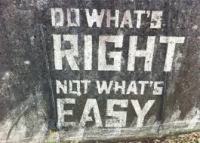
whatsrightFor example, it is unacceptable in many religious groups for a married couple to divorce. They are expected to remain together indefinitely for the good of the church, their families and so on, regardless of the situation, even in cases of physical abuse. It stands to reason, therefore, that the first few individuals who challenged these rules were certainly dealt with harshly. Fortunately, over time, this type of censure has eased somewhat, at least publically.

On the whole, it is difficult to greatly influence public perception and alter the behavior of a society or to get people to remove the blinders of ideology and accept the possibility that there are other ways of thinking. Ignorance, prejudice and misunderstanding usually lead to fear and resistance.

It should also be made clear that religious groups are certainly not alone in such ridiculously judgmental behavior. Anyone who challenges established norms can find themselves on the receiving end of some pretty unpleasant retribution, particularly in the workplace.

Often employees are never to question authority or decisions made by their superiors, otherwise face reprisal. But what does one do when superiors are actually breaking the law? In 1989, Congress passed the Whistleblower Protection Act. The law is designed to shield workers against retaliatory personnel action – meaning, essentially, it keeps them from being fired – for “blowing the whistle” on illegal activities perpetrated by their employers.

Unfortunately, there is no such protection for the everyday person who simply wants to do the right thing. From Moses and Lady Godiva to Rosa Parks and Martin Luther King, taking a stand to alter deeply engrained social beliefs has never been a task for the weak-hearted.

Most people are discouraged by how much retribution might be taken out on them for going against the grain. Sometimes, however, just standing up for the little things can help to affect larger changes. Making a difference in the boardroom, at school or even in the hallowed halls of church might ruffle some feathers, but if the purpose is worthwhile, it would be wrong not to do something.

So, what about those by-standers who agree with the maverick but are afraid to stand with her? If only one other person supported the cause then another would as well, then another, and another. That’s how revolutions are started in the face of resistance. So the next time you see an injustice being done and you have the opportunity to act, what will it be: Maverick or conformist?  Ω

Gery L. Deer is an independent columnist and business contributor to the WDTN-TV2 program, “Living Dayton.” More at www.gerydeer.com.

Are you happy, or just think so?

In Education, Opinion, psychology, sociology on January 15, 2014 at 9:22 am

DIH LOGOThey say … and I admit I’m not totally certain who “they” are in this context. But they say, happiness is just a state of mind. In fact, the same, “they” also believe all reality is just in your head; that your own thoughts create the authenticity of the world around you. Yes, I know, that’s too much heavy thought for such a short column, but it offers an interesting concept.

If everything we know as reality is determined, not by the people and things around us, but, instead, from our own thoughts then how real is it, really? OK, that’s a bit much to take in, even for me. But suffice to say emotions are created and altered by thoughts. So, are you happy? Or, do you just think you are? In the end, if “they” are correct, it doesn’t even matter.

Most people can change how they feel simply by altering their thoughts or, at least, their perception of a situation. That is, unless you suffer from some type of chemical issue in the brain that causes your feelings to spin out of control no matter what you’re thinking. And we’re not going to get into any of that because I am simply not qualified to talk about the subject.

But for most, it is entirely possible to alter your state of emotion and change how you react to outside influences just by shifting your thoughts. For example, many people get upset when a child breaks or spills something. Unless someone is done physical harm, what is there to get upset about? Have you ever heard the saying, “don’t cry over spilt milk?” It’s a bit of good advice telling you not to whine about the accident, just clean it up and move on.

GDEER-BLUE_SHIRT_FROM_ABOVEIn my opinion, sometimes it’s really hard to get that one, nagging negative thought out of your head. So, I think that altering your way of thinking is more about prioritizing than anything else. In other words, pick your battles.

If you drop a dish or your child dumps Kool-Aid all over that new white rug, does it, in the grand scheme, really matter? Assuming, of course, there is no malicious intent involved. After all, regardless of the political incorrectness of the idea, kids really are just bad sometimes. Either way, getting angry and blowing your top at yourself or the child isn’t going to put the dish back together or “unspill” the drink.

Now what if your husband decided to fire up the new grill he got for Christmas inside the garage? No, I don’t know why someone would even … never mind, just go with me here. In this situation, there is a potential danger to your family so it’s worth getting a bit more upset, but you have to control your thoughts to keep from becoming hysterical.

It will serve you better and help you remain calm if you focus on preventing a potentially devastating situation than to immediately punish your idiot husband. Take the proper steps, ensure everyone’s safety and solve the problem. That’s what I mean by changing the way you think.

Needless to say, altering lifelong behavior, good or bad, doesn’t happen overnight and it’s certainly not easy. It takes practice and diligence. Whenever something happens that throws your day into an uproar, try not to get upset. Try hard to focus on a solution to whatever’s gone wrong and look forward to the positive outcome.

I’ve often argued that people make some of the most important decisions in life based solely on emotion rather than rational thought. Even the faithful are guided almost entirely by pure emotion. Making decisions actually becomes easier, and more productive when done from a logical perspective.

Gery L. Deer is an independent columnist and business writer based in Jamestown, Ohio. More at www.gerydeer.com.

What was the “crucible event” that changed your life?

In Opinion, psychology, Religion, sociology, Uncategorized on October 30, 2013 at 9:15 am

DEER IN HEADLINES

By Gery L. Deer

GDEERDIH3Some people believe one is destined to become whatever is predetermined by their god, with all of life’s events planned in advance by some divine manifest destiny. For others, that destiny is in a constant state of change, altered by the ebb and flow of cause and effect, guided not by the hand of a supreme being but by our own choices.

Generally, however, there are some events in life that we can pinpoint as our time of transformation; a crucible, if you will. Within it, parts of us are burned away leaving a changed, newly-formed person, sometimes for the better, sometimes not.

Divorce, extended health problems, the loss of a home, personal income or a job, can all bring about emotions and primal reactions for which we are rarely well prepared. Perhaps the most powerful events that permanently change us are related to the death of someone close such as a family member, mentor or good friend.

For many the death of a loved one can be a crucible, forcing to the surface thoughts and emotions perhaps long buried, or never before experienced. How we deal with death is at least as important as how we deal with life, but we seldom take that concept to heart.

Even as a topic of conversation, death is to be avoided. Its unmistakable finality has so marked humanity that coping with the end of life has served as a catalyst for the formation of enduring religious beliefs, some of which comfort, others frighten.

What may be surprising is that a ‘crucible event’ does not necessarily have to be a negative or unhappy experience. The same kinds of life-changing occurrence can come from positive influences as well such as the birth of a child, a marriage or sudden financial windfall.

The events themselves, however, aren’t what change us; we do that on our own. Most people don’t realize they have the power, for the most part, to alter how they react to outside influence. Feelings are generated by thoughts, so if we control our thoughts, we can better manage our feelings and make more productive decisions during difficult times. That’s a tall order though when it feels like the world is collapsing around you.

I’ve had many challenges in life, from an early age, but the most influential times were during my mother’s long struggle with Alzheimer’s disease. The role reversal (the child becomes the parent), watching helplessly as the illness ravaged her mind and body, and helping to do everything from administer medication to hand-feeding her took a toll on me emotionally that I probably have yet to fully realize. But it did change me; in ways I can’t even imagine yet.

I look at the world a little differently now, having experienced for myself, largely for the first time, the fragility of life. But it was the experience of caring for my mom over the course of a couple of years that slowly burned away layers of my rigid exterior, making me “feel” more than I had previously been accustomed.

It’s really what we do with those feelings that make the difference in the long run. While an experience like I had with my mother could have left me bitter and resentful, I ended up taking to heart a more positive side and a greater appreciation for my family as a whole. Others aren’t so lucky.

Many people emerge from crucible events in a much darker place, filled with resentment or guilt or other emotions that eat away at their core, keeping them from seeing the good that came out of whatever had happened. And, there is always some good – sometimes it’s just very hard to see. Either way, we are changed, different, but it’s up to each of us to decide how those events ultimately affect our lives.


Watch independent columnist Gery L. Deer monthly on WDTN-TV2’s Living Dayton. More at http://www.gerydeer.com.

Over-medicated and under-educated

In Children and Family, Education, Health, Media, National News, Opinion, psychology, Science, Senior Lifestyle, Technology, Uncategorized on September 18, 2013 at 9:18 am

DIH LOGOA recent report by the Centers for Disease Control and Prevention (C.D.C.) noted that at as many as two-million Americans become ill from antibiotic-resistant infections annually, killing at least 23,000. The report notes that less than half of the antibiotics prescribed for patients are unnecessary or incorrectly used increasing the potential for more drug-resistant germs to evolve, exacerbating the problem.

Over time, the use of broad-spectrum antibiotics rather than ones targeting specific infections can cause various strains of bacteria to become immune and render conventional treatment ineffective. According to C.D.C. Director, Thomas Frieden, as the trend towards overuse of antibiotics continues, “The medicine cabinet may be empty for patients with life-threatening infections in the coming years.” Additionally, the overuse of antibiotics on farms as preventative medicine in healthy animals is also a contributing factor.

All of that said, these drugs are not prescribing themselves. Doctors know better than to continually prescribe broad-spectrum antibiotics unnecessarily or to treat viral infections, for which the drug is completely ineffective. But, many still do both, either at the insistence of the patient or as a preventative measure. Beyond the issue of nagging patients who want a prescription every time they have a sniffle is the point where the medical professional should say, “no.”

medsIn addition to antibiotics, it seems as though doctors are passing out a pill for everything and never seem to try to dig deep enough to address the real cause of various health problems.  For people with chronic illness it seems like that would be extremely frustrating. Apart from something like long-term, degenerative diseases like Parkinson’s or Multiple Sclerosis, there should be a way to find the cause to a problem and treat that, rather than just trying to drown the symptoms in medication.

More often than not, patients get, maybe, 10 minutes with their doctor after a two-hour office wait only to be handed a prescription and shuffled out the door. People spend far more time filling out forms and waiting to be seen than ever actually getting attention from a person who bills hundreds of dollars an hour for a few minutes work per patient.

An additional problem arises when the drug manufacturers spend far more time and money marketing to the patient than educating the physician about the proper use and potential hazards of a medication. However unethical it should be, doctors are given trial samples and kick-backs for going with one drug-over another. All the while, patients are inundated by drug ads on television, the Internet and in periodicals with no understanding of the treatment process.

Which actually contributes to another step in the downfall of health care is the all-knowing, internet-browsing patient himself. These home-spun experts come in with a fist-full of self-diagnosis printouts from Web MD and a stack of drug ads from Cosmo.  They demand medication for what they are certain is their particular ailment and there is no swaying their shade tree expertise. Except that’s exactly what the doctors should be doing – dissuading them and refusing to prescribe medicine without a thorough examination of the problem.

So what is to be done? Unfortunately, not much can be done. Unless healthcare providers are going to be more proactive and limit use of antibiotics except for targeted need, and other drugs are prescribed only after the cause of the symptoms is determined, it’s unlikely that anything will change soon.

It just seems as if everyone is sick all the time. Chronic illness like fibromyalgia (long-term, body wide tenderness and pain) seem to be affecting more and more people and early-onset dementia appears to be far more common than it once was. Could these diseases the result of long-term misuse of various drugs, including antibiotics?

The truth is, no one really knows for sure. Many of these drugs are relatively new and scientists are only now learning how the long-term use of previous medications is affecting second and third generations. From birth defects to chronic disease, overuse of drugs and under-education of patients definitely has the potential for some serious side effects.


Be considerate of those around you

In Food, Health, Opinion, psychology, Senior Lifestyle, sociology, Uncategorized on September 10, 2013 at 9:20 am

DIH LOGODid you ever see someone behaving a certain way at work or in the grocery store and it made you just want to walk up and say to them, “What is wrong with you?” I have; more times than I can remember. On the whole, people annoy me. Maybe it’s because as I get older, I have less patience for “stupid.” It could also be that people are becoming less thoughtful and far more self-centered than ever.

Here’s an example. One afternoon, I had stopped in at on of the big-box, discount megastores to get some orange juice and aspirin. As I stood patiently in the “20 Items or Less” lane, a middle-aged woman in a leopard-print blouse and hair curlers motored past me on one of those electric shopping cart scooters. She was steering the scooter with one hand and with the other she dragged another full sized cart behind her like a trailer.

STORELINEBoth carts were filled to capacity with loads of healthy foods like barrels of cheese balls, cases of beer and soda and, of course, spray cheese. Although there were other check-out lanes open for larger purchases, the woman obliviously whizzed by everyone in the line and parked her rig right in front of me. All of the adjacent lanes were equally full and what was going to be a 5 minute wait was now bordering on a half hour because either she couldn’t read or didn’t understand the meaning of the words, “express lane.”

For a few minutes, I just stood there; a bit stunned at the woman’s total ignorance that she’d completely jumped over at least four others in line ahead of her. I debated whether to say anything but kept quiet. After all, no matter how rude she had been, I would just end up being the mean guy who scolded an apparently disabled older woman on a scooter. It’s a no win. So, I bit my tongue, opened my aspirin bottle, downed two tablets with some of the juice, and waited.

We all have moments when we’re in a hurry, totally consumed by our own interests and feeling like whatever we’re doing should be just as urgent to those around us. But, short of a natural disaster, that’s almost never the case. In fact, most people have absolutely no concern for your interests because they, themselves, are too wrapped up in their own issues. That doesn’t excuse a complete lack of common courtesy, however.

Lately, I’ve noticed it more often in younger people, walking along, even in a store or down the street, with their noses buried in their cell phones, unconscious to the world around them. No one looks up anymore. No one smiles. No one says, “Hello.” People act as if they are traveling in a bubble, where it’s unnecessary or at least undesirable to interact with anyone else in the real world.

I’d like to be able to blame social media and technology for all of this, and it definitely has altered how we behave towards one another. But, ultimately, it’s our own fault. We choose how to act and interact. If all of your interpersonal relations come through Facebook or by text, you might want to consider taking a class or getting a hobby that requires you to intermingle with other people outside of cyberspace.

As for those like my scooter-riding line jumper, I doubt anything will alter their way of thinking. Society will always have its share of self-centered people who have little regard for common sense or good manners. How the rest of us react to their behavior is really what will make the difference.

Maybe if I had complained to the woman in some polite, diplomatic manner, I could have quietly helped her to another line. But, given that she didn’t seem to notice there were other people around her, it’s unlikely she would have responded to reason.

In the end, it was best to keep the peace and let each of my fellow shoppers decide on their own alternate course of action. But to those of you with no regard for others, keep in mind that I may not be so polite next time. Be nice to people. When all is said and done, all we have is each other.


We see the 1950s with rose-colored glasses

In Entertainment, Opinion, psychology, sociology, Uncategorized on August 20, 2013 at 6:31 pm

DIH LOGOI recently read a CBS News poll asking people to choose a decade back to which they’d like to time travel. Overwhelmingly, the leading answer was the 1950s. What I can’t wrap my head around is, why?

Some people see those times as simpler, easier to manage, with fewer concerns and more security. Gas was 23-cents per gallon and you could get a really nice home for $22,000. A good price when you consider the average annual salary – hold onto your hats – just over $4,100.

So, yes, things were cheaper but only when compared to today’s prices. Actually, I think we have a fairly tainted view of the 1950s, America’s so-called, “Golden Age.” The “Leave it to Beaver” family unit and less-complicated lifestyles of those days simply wouldn’t work in modern society, for a number of reasons.

First, we had all the same problems back then that we have today, but we perceived and dealt with them differently. The country probably wasn’t as politically fractured as it is today, only because we were all riding a bit of a patriotic “high” after the end of World War II.

Technology or the lack thereof made a difference to our perceptions in those days too. There was the radio, a morning newspaper, an evening newspaper, sometimes an “extra” mid-day edition, and an evening television newscast. We didn’t get all the bad news of the world every moment it was happening. If we were going to tell people how our vacation was going, we had to mail out post cards.

According to the 1955 United States Census, America’s population was 166 million and the average unemployment rate was 4.9 percent, or about 81 million people. Today it’s about 314 million with a 7.4 percent unemployment factor, around 23 million.

So, barring some kind of economic cataclysm, as the population doubled, the unemployment rate followed suit. From a ratio standpoint, there were actually more people out of work 60 years ago than there are now. That’s good news, right? Sort of, yes.

What makes this a steeper hill to climb today is, once again, technology related. Labor-intensive, blue collar jobs like those at GM, NCR and other big manufacturers just don’t exist anymore. Many have been eliminated or sent overseas to take advantage of cheaper labor costs.

Additionally, many people – myself included – believe Americans to be lazier than ever and a good number of us simply don’t want to work. People are especially hard to motivate when employee benefits and pensions are a thing of the past and there is no longer any sort of job security.

Speaking of security, remember the “duck and cover” drills of the 50s and 60s? How much of a pointless endeavor was that? “Here, little Johnny, get under this desk so the Russian atomic bomb won’t hurt you.” Really, I mean, how dumb were we?

I suppose at least it gave us all something to do in the face of the unthinkable. In reality, there was nothing secure about the 50s, especially considering we were always on the brink of war with Russia and it only got worse as 1960 approached.

Personally, I think we spend far too much time looking back and not nearly enough looking forward. The past is done and you can plan for the future to some degree, but, reasonably, all we have is the here and now. Focus on making your present more fruitful and your future will follow along.


Is this your new site? Log in to activate admin features and dismiss this message
Log In