Local News & Commentary Since 1890.

Archive for the ‘Politics’ Category

Support religious freedom by defending rights of atheists

In Education, history, Local News, Media, National News, Opinion, Politics, psychology, Religion, sociology, Uncategorized on September 3, 2014 at 11:24 pm

dih-logo-SEFor what is apparently the first time ever, an openly atheist candidate is running for United States Congress this fall. James Woods, an atheist Democrat, is seeking election in the Arizona 5th Congressional District, a region well known as strictly Republican. According to a CNN op-ed piece by columnist Carlos S. Moreno, Woods will be the only congressional candidate to ever run after outing himself as a non-believer.

As it turns out, under the constitutions of eight American states, atheists are banned from holding public office: Arkansas, Maryland, Mississippi, North Carolina, Pennsylvania, South Carolina, Tennessee, and Texas (Source: The Washington Post). More accurately, the restriction applies to those who deny the existence of, “a Supreme Being,” or “Almighty God,” the wording varies.

Regardless of whether people agree with it, such bans would seem to violate Article VI of the U.S. Constitution, which states, “no religious test shall ever be required as a qualification to any office or public trust under the United States.” It’s probable that any related civil suit would eventually land at the feet of the United States Supreme Court which would undoubtedly have to rule these laws unconstitutional.

Even so, most atheists stay, “in the closet,” so to speak, to avoid social repercussions and public scrutiny and rarely do they attempt to run for political positions. It might be assumed that the anti-atheist rules were originally established to ensure that public servants would have a predictable moral fiber.

But, the very idea that the religious are inherently “moral,” is, in a word, ridiculous. History is full of religiously-sanctioned violations of God’s moral commandments, from centuries of open warfare to decades of child abuse. As usual, many of the devout try to pretend none of it ever happened. So, in a completely predictable act of contradiction, violations of God’s laws are fine so long as they serve a “higher purpose.”

Likewise, the moral character of a politician is supposed to be part of the reason why people choose to elect him or her to office. Sadly, a disturbing lack of morality is evident in many high-ranking politicians, who spend much of their time lying, cheating and stealing. These are the same men and women who, at some point, stood up in front of their God and everyone else and swore to their personal integrity and commitment.

Easy examples come to mind like John F. Kennedy and Bill Clinton, who were known to be serial adulterers, and it could be argued that the very definition of politician should include, “liar.” In any case, one needn’t be a Christian, nor a member of any other religion, to have a well-aligned moral compass.

Put simply, being frightened into morality by the threat of fire and brimstone only goes so far in keeping people on the straight and narrow, particularly those who crave power and believe themselves at some point to be above retribution. It seems like it would be better to have a public servant who has found his or her own moral direction rather than having it lorded over them by fear of suffering in the hereafter.

Regardless of how the devout are behaving when no one is looking, however, what Americans need to understand from all of this is that freedom from religion must be protected in order to preserve its uninhibited practice. The fine balance between freedom “from” and “of” religion is necessary to ensure every citizen can practice his or her faith openly, all while any other may enjoy none at all. It goes both ways.

Put another way, no one likes to have religious groups going door to door pedaling their ideology. So why is it alright for anyone else to do the same thing simply using more socially acceptable methods, such as being coerced into declaring a religion before qualifying for political office?

Up until now a great many public servants who have affirmed a religious affiliation and filled speeches with thanks to God for their success have managed to shame both their religion and their office with shaky morality. In the end, the most devout Christian can take the same oath as their atheist counterpart and guarantee no greater a moral platform. If history is any indicator, it might even be less.

 
Gery L. Deer is the editor and publisher of The Jamestown Comet.com and a syndicated independent columnist.


Gainsay of Gaza school bombing not anti-Semitic

In history, National News, Opinion, Politics, sociology, Uncategorized, World News on August 9, 2014 at 2:50 pm

DIH LOGOThere’s an inherent problem with “political correctness” when it extends to speaking out against bad policy or horrific acts against the innocent. When the super-sensitive “left” can’t accept that people can dislike someone’s opinion without literally hating them, any hope of long-term, productive dialogue or constructive discourse is totally squelched.

When President Obama was elected, people became so obsessed about his being our first African American president, that to even mention a disagreement with his policies labeled one a racist. Naturally, that’s ridiculous. But, for the majority of his first term anyone who argued against him was considered to simply be hateful and bigoted.

We’re in a similar, uncomfortable, situation now with the problems going on in Gaza and the alleged bombing of civilian targets by both Israel and Hamas. There is no question that what’s going on there is terrible and it’s a given that Israel has suffered its share of problems in its short existence as a nation. But, criticism of their tactics in the current conflict does not make one anti-Semitic.

Because Hamas is seen by many as a “terrorist” organization, it is therefore more acceptable to criticize them publicly, but that’s not the debate. It’s not anti-Semitic to state, “It’s wrong for Israel to bomb civilian targets and kill innocent people, including children.” Anyone who thinks that it’s ok to bomb kids regardless of the purpose may be hinging on sociopathic mentality.

Many United Nations officials condemned the bombing of a UN-run school in Gaza, including  Secretary-General Ban Ki-moon, seen here.

Many United Nations officials condemned the bombing of a UN-run school in Gaza, including Secretary-General Ban Ki-moon, seen here.

After a United Nations-operated school was bombed in Gaza City last week, killing 20 and wounding dozens, including children, The Washington Post reported that the U.N. officially condemned Israel for the bombing with UNRWA Commissioner-General Pierre Krähenbühl saying, “I condemn in the strongest possible terms this serious violation of international law by Israeli forces. This is an affront to all of us, a source of universal shame. Today the world stands disgraced.”

There are, of course, those who have accused the U.N., as an organization, of being anti-Semitic since its inception, but this is not an indication of that. This is a statement from the commissioner-general communicating that the world group disagrees with the Israeli tactic and would prefer they try to find a peaceful solution.

Considering that the GPS coordinates of the school had been reportedly sent to Israel at least 17 times, at this point it’s Israel’s own actions drawing negative opinion and squelching sympathy for their cause. Still, it’s seen as distasteful to speak against the Jewish nation without being labeled racist and therein lays the problem.

Will it always be that with any minority or historically trodden-down group, negative opinion or public critique will draw for the speaker undo hatred or have them forever labeled racist, anti-Semitic or worse? Is political correctness always this blind, even in the court room? Yes. It always will be. Take, for instance, mandatory minimum sentences for drug crimes here in America.

Statistics suggest that the vast majority of drug criminals in the U.S. are African American. Since there are often mandatory minimum prison sentences on the books for various levels of possession, sale and use of street narcotics, by the logic of some, which makes mandatory minimums racist. Are they? That’s a debate for another time, but the same logic is at work here as well.

There seems to be a belief among modern liberals and conservatives alike that freedom of speech is a wonderful thing, so long as you only say what they want to hear. Anything that goes against the grain on either side of the aisle will earn a swift retribution for the originator of the message. Oddly, it’s always been that way, but now, with social media, the Internet and an instant news cycle, there’s just more of a platform for argument.

Speaking one’s mind about an atrocity is the purview of any conscientious observer. Whether someone is doing so from a racial bias is another matter entirely. However, if those committing the atrocity expect sympathy in some way, it’s unlikely that they will achieve any of their goals by fueling the fires of hate through horrific actions, regardless of whether they believe it to be the means to the end.
Gery L. Deer is an independent columnist and business writer syndicated by GLD Enterprises Commercial Writing. More at gerydeer.com.


Hobby Lobby ruling sets religious freedom in business

In Business, Charities, history, Media, National News, Opinion, Politics, Religion, sociology, Uncategorized on June 30, 2014 at 11:59 am

DIH LOGOOn June 30th, the United States Supreme Court ruled in favor of Hobby Lobby’s suit to be exempted from the ObamaCare mandate forcing companies to provide contraceptive coverage to employees, including the controversial Plan B, or “morning after,” drugs. Many conservative business owners equate these drugs to abortion since they’re designed to terminate a pregnancy within hours of conception.

The primary argument to the court is whether the owners or management of a corporation has the same rights to freedom of religion as an individual. The Obama administration has already set exceptions for various religious non-profit organizations, which, other than their non-profit status, are structured similarly to their for-profit counterparts.

In March of this year, according to TheHill.com, the U.S. House of Representatives, “Approved the Equitable Access to Care and Health (EACH) Act, H.R. 1814. The bill allowed people avoid buying health insurance under ObamaCare if they could cite a religious reason. People seeking an exemption would have to include sworn statements in their tax returns explaining their objection to health insurance.” In effect, all they needed to get out of paying the federal healthcare mandate (tax) was a note from home.

A further question is whether there is a fundamental business difference between a non-profit corporation and a for-profit corporation? The practical answer is, no. Charity or not, a corporation is created to protect the individual operators from legal responsibility with regard to the business. Most non-profit filings are for tax and donation purposes, a process that seems outdated and inefficient with the advent of mega churches and multi-billion-dollar evangelical organizations.

uscourtIn America, there are countless religiously-focused, non-profit corporations worth millions more than some of the largest for-profit businesses. The Christian television network, Daystar, for example has been approved by the Internal Revenue Service as a “church,” according to NPR.com news. Celebrity, sometimes politician evangelist Pat Robertson and the late Billy Graham registered with the IRS as “religious organizations,” making them exempt from most taxes. All they had to do was file disclosure papers.

According to available records, NPR.com reports that the top three evangelical television broadcasters – Christian Broadcast Network, Trinity Broadcasting Network and Daystar Television — have a combined net worth of more than a quarter of a billion dollars. It is unknown whether the corporations that operate these broadcasters have filed for religious exemption under the healthcare reform laws.

The question persists, however, that if the only difference between a for-profit corporation and these mega non-profits is an earnings disclosure, why have the distinction at all? Certainly there are for-profit companies that give away millions of dollars in charitable funds each year but still have to comply with the law in every respect. Why then are religious non-profit organizations exempt from anything, much less a controversial healthcare mandate that has American small business struggling to comply or face bankrupting penalties?

The court’s latest decision with regard to religious exemption could have long-reaching implications, and not just in the healthcare arena. Giving a for-profit entity the same constitutional protections provided to non-profit religious groups could cause a flood of lawsuits ranging from tax law to equal employment regulations. Once again, major non-profits have million-dollar earners at the top, private jets, limousines and pretty much every other extravagance thought only to exist in for-profit American business.

If a church – any church – can make a case for religious freedom from legal mandates, why can’t a business owner cite his or her – or their – own religious beliefs for the same purposes? Is the constitution not written for everyone or does it exist specifically to meet the needs of religious groups so they can avoid taxes and dodge the law at their convenience?

This argument poses a great many questions and there will likely be countless more as ObamaCare reaches further corners of commerce. But, if that’s not enough to chew on, here’s another one. What happens if a Muslim, Jewish or non-Christian group requests exemption as well? Will the Christian right fight against their having the same protections?


Gery L. Deer is an independent columnist and business writer and contributor for WDTN-TV2’s LIVING DAYTON program. More at www.gerydeer.com.


UPDATE: CFL bulbs save money, but threaten safety

In Children and Family, Dayton Ohio News, Environment, Health, Home Improvement, Opinion, Politics, Science, Technology, Uncategorized on June 10, 2014 at 8:40 am

GLD_CFL_TV2_SCREENSHOTSpecial Update / Editor’s Note: This article was originally published in November of 2013 and updated in April 2014. Since that time, and investigative report by Pam Elliot at WDTN-TV, 2News in Dayton has yielded the following information on the dangers of CFL bulbs.

Deer In Headlines author and Jamestown Comet publisher, Gery L. Deer, was tapped as the initial interview source for the investigation based on the content of this edition of his column. Here for you is the video from that investigation which aired on Monday, May 19, 2014.

Click here for a link to the full 2News investigative story which includes suggestions for the safe use of CFL bulbs.


dih-logo-SEApril 7, 2014 – The incandescent light bulb was developed in 1876 by Thomas Edison, founder of General Electric. But as more energy efficient technology is introduced, even Edison’s greatest achievement has been all but extinguished forever. On September 24th, 2013, it was announced that the last of the incandescent light bulbs had rolled off the GE assembly line to be replaced by compact fluorescents, or “CFLs.” The spiral-twisted tube bulbs use low-energy, fluorescent technology and there is really nothing cutting-edge about them, except for their size and the potential fire risk when they go bad.

Fluorescent lighting has been around since the late 19th Century, but wasn’t developed for widespread use until the 1930s. Less expensive to operate than their incandescent counterparts, most of the bulbs last longer and are safe for everyday use. But as the environmentalist lobby pushes for more energy-efficient or, “green,” technology, has the heightened concern for the environment surpassed that for human safety? Recently I went into my kitchen and switched on the light over the sink, as I did countless times throughout the week. I left the room for a moment and when I returned it was dark, the familiar morning glow of the light fixture having just been replaced with the smell of burned ceramic and melted plastic. Upon investigation I discovered that the CFL bulb in the overhead light had quite literally burned out.

20W CFL Bulb from Gery Deer's kitchen.   Photo by Gery L. Deer

20W CFL Bulb from Gery Deer’s kitchen. Photo by Gery L. Deer

Just before it went dark, the 20-Watt, General Electric CFL bulb I had installed a few months earlier had gone so hot that it flamed through the plastic and ceramic base, causing it to melt and crack at the bottom of the glass tubing. The discovery of such a potential fire hazard was, to say the least, surprising, but apparently the problem is well-documented and manufacturers have been aware of it since the product’s release.

In a Snopes.com article John Drengenberg, consumer affairs manager at Underwriters Laboratories (UL), said about how CFLs expire, “People expect to see the bright flash and to hear the popping like a traditional incandescent bulb, but the burn out of a CFL is different. The light dims over time and might produce a more dramatic pop, emit a distinct odor, and maybe even release some smoke.” Drengenberg is referring to the Voltage Dependent Resistor (VDR). The CFL burns out when the ballast overheats, causing the VDR to open the circuit like a blown fuse and prevent any hazards.

Instead of resulting in a mild puff of smoke, however, the heat generated can, as in my case, burn through the base. As I dug deeper into this issue, I discovered countless articles, videos and online debates regarding the safety of CLF lighting and how there might be more to their compulsory introduction than simply reducing energy costs. It’s important to note here that Underwriters Laboratories is not a government agency but a private company paid by manufacturers to “certify” the safety of their products.

DP&L has a vested interest in getting these bulbs out to the public. It's unclear where that interest lies, but here is the proof - a Walmart display in Xenia, Ohio offers huge discounts.

DP&L has a vested interest in getting these bulbs out to the public. It’s unclear where that interest lies, but here is the proof – a Walmart display in Xenia, Ohio offers huge discounts.

In the early 1990s, I worked for a major appliance manufacturer as an engineering technologist following UL guidelines in operational and safety testing of ovens, ranges and cook-tops. In my experience, a bit of heat and smoke being released from a popping resister is, by itself, not enough to cause the kind of damage apparently so common with this product.

I am well aware of UL testing practices and it is beyond my comprehension how anything short of political pressure could be responsible for the approval of a consumer electronics product that literally lets flame out of its casing. From a consumer standpoint, it’s baffling to me how UL, or the Federal Trade Commission – the governmental agency responsible for consumer safety, can justify the approval of a device that clearly presents a fire safety hazard under “normal use” conditions. Incidentally, the CFLs also contain mercury, another potential environmental health hazard often conveniently overlooked.

It is entirely possible that these products were rushed to market, not so much to help reduce pollution or save money for the consumer, but to further a political agenda. Whatever the reason, the consumer should be aware of the inherent dangers and always be careful when using CFL lighting.  (End original story.)

Here are some detailed photos of the original, failed bulb. General Electric requested it be returned for investigation (we have complied).


UPDATE : June 6, 2014 – Today Gery L. Deer received several boxes of light bulbs from General Electric (Pictured below). The shipment included several packages of original, incandescent bulbs and several packages of LED bulbs. Once again, it is important to note that Gery insisted to GE’s representatives, by phone, he was not looking for any sort of restitution, but simply wanted to make the public aware of the dangers surrounding these bulbs. But, here they are anyway.

An assortment of incandescent and LED light bulbs sent to Gery L. Deer by General Electric on June 6.

An assortment of incandescent and LED light bulbs sent to Gery L. Deer by General Electric on June 6.


VIDEO UPDATE: June 10, 2014 – Hard to believe – ANOTHER shipment of LED light bulbs from General Electric. These are of a totally different style and are said to “distribute” light more efficiently. Watch the video for a complete follow up.


Jamestown Comet Editor Gery L. Deer is an independent columnist and business contributor to WDTN-TV2’s Living Dayton program. More at www.gerydeer.com.

V.A. health care debacle is nothing new

In Health, National News, News Media, Opinion, Politics, Senior Lifestyle, Uncategorized on May 27, 2014 at 8:06 am

DIH LOGOAs an organization that serves more than 9 million, it would be difficult to imagine a more complicated system than the United States office of Veterans Affairs (V.A.). Recent allegations of wrong doing within the V.A. health care system has erupted in congressional investigations and strong admonishment from President Obama, one of a half-dozen occupants of the Oval Office under whom this system has thoroughly failed its distinguished beneficiaries.

Naturally, the White House spin doctors tried to express the president’s astonishment and outrage over this issue with their typical press room song and dance. When he finally spoke about the matter publically last Wednesday, Mr. Obama said, “I will not stand for it. There must be consequences.”

Of course there was absolutely no mention of exactly what kinds of consequences.  Even more insulting was the way the administration has fained ignorance about one of the worst kept secrets in America – that there is a mind-blowing level of back-door politics and bureaucracy grinding away below the V.A.’s spit and polished façade.

In the 1992 movie, "Article 99," Kiefer Sutherland struggles to adapt to a broken V.A. system.

In the 1992 movie, “Article 99,” Kiefer Sutherland struggles to adapt to a broken V.A. system.

Critics of the administration are also using this crisis to, once again, lambaste Democrats over Obamacare, to which they compare the crippled V.A. medical system. Some of them have even suggested that the problems deep in the core of the V.A. health care system will eventually overwhelm Obamacare in a similar manner.

Plagued with technical issues and lackluster participation, the “Affordable Care Act” has not been the overwhelming success once envisioned. Legislating mandated health care coverage for all is one thing, but managing patient care based on politics is quite another.

But if you think it’s a stretch to compare the V.A. problems with eventual Obamacare snags, consider this.  Once the Affordable Care Act became law, the U.S. Government suddenly turned into a middle man for selling health insurance and controlling the care received by the patients. Keep in mind this isn’t a “Conservative vs. Liberal” problem. The simple lesson to be learned here is that the government should stay out of the health care business.

As for the existing V.A. problems, the congressional hearings so far have managed to do little more than humiliate the head honcho, Veterans Affairs Secretary Eric Shinseki, a guy who, while maybe turning a blind eye to these concerns, most certainly inherited the majority of them.

Way back in 1992 director Howard Deutch released a dramatic comedy  called, “Article 99,” which followed a V.A. hospital intern played by Kiefer Sutherland who struggled to acclimate in ridiculously bureaucratic and money-driven system where patients are either denied treatment or made to wait months for life-saving procedures until it’s too late. In a style similar to Robert Altman’s original 1970 film, “MASH,” the main characters are dedicated doctors who regularly defy government rules to help get their veteran patients urgently needed care.

Set in present day – 1992, during the Clinton administration – “Article 99” exposes only a few known problems within the veterans’ health care system. Apparently, things grew increasingly worse.

Oddly enough, government’s treatment of veterans (of all ages) can often mirror the way in which American society deals with the elderly; by putting them off a few more times until they eventually die and the problem solves itself. Shameful.

Perhaps it’s time for the V.A.’s executives, congress and the president, maybe even Supreme Court justices, to be forced to wait a ridiculous amount of time for care. It’s a foregone conclusion that a solution would rapidly appear if the Obama daughters had to wait six months to get their tonsils out, or if John Boehner knew that coverage for some future tanning-induced skin cancer would be denied because it wasn’t a work-related condition. Instead, they enjoy free, top-of-the-line medical care, all on the dime of hard-working Americans, including veterans.

So what to do? Well making a blustering speech on TV is a start, but it’s also an overture to a lack of any real action. Firing the head guy is a gesture to appease the public but it’ll last about 12 seconds. Instead, the entire system needs a full shakedown. That’ll take time and money. Meanwhile, more veterans are waiting for treatment. Drop the bureaucracy and treat the patients, regardless of the paperwork and expense.


The Jamestown Comet editor, Gery L. Deer, is an independent columnist and business writer based in Jamestown, Ohio. More at http://www.gerydeer.com.


Godzilla: King of the anti-nuclear message

In Entertainment, Environment, Movies, National News, Opinion, Politics, Science, Technology, Uncategorized, World News on May 12, 2014 at 12:00 pm


DIH LOGOIn 1955, the Japanese film company, Toho, Inc., introduced America to “Godzilla, King of the Monsters.” The bulky, green monster terrified audiences in the marginally familiar form of an enormous T-Rex, with notable size differences, muscular body and bigger arms and all brought to life by a puppeteer in a rubbery body suit. Originally called by the Japanese word, “Gojira,” meaning “gorilla whale,” the monster was so successful he’s been a worldwide star since his first black and white appearance in Tokyo.

Uncertain how a Japanese film would fare only a decade after the end of World War II, American exhibitors insisted an “American” element be added to make the dubbed, foreign monster flick more relatable to U.S. audiences. So, who better to report on the devastation than one of the most trusted faces on television at the time, Perry Mason himself, Raymond Burr. Not included in the Japanese version, Burr played an American journalist reporting on Godzilla’s attack into a tape recorder from the safety of a nearby office building.

During the 1960s and 70s Godzilla made his way into color features where his ominous appearance was softened a bit and his character reworked a bit from a menace to more of a hero as he battled other creatures threatening Tokyo from Monster Island. His gigantic, “30-story” upright posture, signature stomp, glowing dorsal plates and fiery breath were a hit with movie goers around the world.

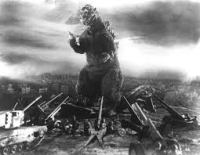
Gozilla's original appearance in Japan, 1954. He appeared in America a year later.

Gozilla’s original appearance in Japan, 1954. He appeared in America a year later.

In 1985, Godzilla reappeared in a more serious, direct sequel to the original. Although the monster had made countless appearances in other, sillier films, like “Godzilla vs. King Kong,” and “Godzilla vs. Mothra,” this reprisal brought Godzilla back to his roots – as a devastating, uncontrollable statement on the increasing nuclear scare at the peak of the Cold War.

Although it was no longer necessary to smooth over American audiences, Raymond Burr reprised his role from the original film in a few scenes added to the U.S. release to provide continuity and attract a nostalgic audience. “Godzilla 1985,” did well at the box office and even better in the newly-minted home video market.

Fast forward a few years to 1998, when the monster was licensed by Tri-Star Pictures for an American, almost campy, version set in New York City. Studied by a worm biologist played by the likable Matthew Broderick (Ferris Bueller’s Day Off / The Producers), Godzilla takes up residence in Manhattan and is hunted by the US Military who manages to lay waste to everything except their target, even wrecking the iconic Chrysler Building. A liberally-preachy, anti-nuclear storyline and a totally computer-animated Godzilla, that didn’t look or act much like the original, completely failed to lure audiences.

Over the years, Godzilla appeared in 28 films and an American cartoon show. He even achieved the honor of a star on the Hollywood Walk of Fame. But the origins of the character are deep in Japan’s nuclear pain and far more serious than most people might know.

Godzilla as he will look in the 2014 version.

Godzilla as he will look in the 2014 version.

Like the newest American incarnation set for release in May 2014, Godzilla is portrayed as a mutation directly resulting from nuclear testing, emphasizing the need to do away with these weapons. He was, essentially, the symbol of everything that can go wrong with nuclear power and weaponry.

The underlying message in the more serious Godzilla story lines is that use of nuclear weapons and power has unimaginable consequences. A mutation that can cause a giant monster with nuclear powered breath is a pretty good personification.

In any case, the new film is sticking closer to the original concept, not just in story but in the look and actions of the monster himself. He’s a rampaging beast and the addition of Breaking Bad’s Bryan Cranston, adds another level of drama to a once-campy character.

In no loss of irony, Japan is the only country in the world whose people have experienced the horrible result of nuclear devastation and America is the only country who has ever inflicted it on anyone else. It’s somehow fitting that people from both countries come together to create a fictional character that personifies the horror that can result.
Gery L. Deer is an independent columnist and business contributor to the WDTN-TV2 program, Living Dayton. More at http://www.gerydeer.com.


Criminalizing rhetorical hyperbole in political ads

In Local News, National News, News Media, Opinion, Politics, Uncategorized on May 7, 2014 at 12:36 pm

DIH LOGOThere is an Ohio law on the books that prohibits politicians from making false claims against an opponent in election campaign ads. Recently, however, the United States Supreme Court took up the question as to whether the legislation infringes on free speech.

Although a dozen other states have similar laws in place, Ohio’s version has come under fire by a conservative group, called the Susan B. Anthony List, who claimed discouraged them from running advertisements against a pro-choice Democratic congressman. It’s likely the case will be kicked back to a lower court, but the implication of the argument leaves room for the exploitation of loopholes, like rhetorical hyperbole.

In general, the law makes it illegal to lie about a political candidate or ballot initiative. What’s left somewhat to interpretation is whether rhetorical hyperbole is permitted. That is, can statements be exaggerated to the edge of falsehood without actually crossing the line? Hyperbole would still stretch the truth, making hours seem like days.

For those who slept through sixth grade English, like me (I know, ironic, huh?), an hyperbole is an exaggerated statement or claim not meant to be taken literally. It comes from a Greek work meaning, “over-casting.” For example, you’re standing in line at the bureau of motor vehicles and you say, “This is taking forever!” Your ordeal in line is not literally going to be indefinite, but you express your irritation and impatience in hyperbole to punctuate your displeasure.

Politicians (and most other advertisers) use hyperbole in many ways. In an extreme example, imagine seeing a political ad where a pro-choice candidate is being attacked by a conservative group. The ad might say, “Congressman Bob hates babies.” Bob may be pro-choice, but no evidence is offered in the ad that he actually hates babies.

What about a conservative senatorial candidate painted as if she is, “going to overturn years of gun control” because she was photographed at a shooting range for a stump speech? In both cases, there’s no evidence given to support the claims but it could be argued that these statements are simple hyperbole and cleverly dodge the “no lying” clause of the Ohio law.

Until this kind of legislation was enacted, only commercial advertisers had to follow rules guarding the consumer against false advertising. Advertising agencies and marketing representatives sometimes find loopholes in the law, but generally color within the lines or risk paying severe (even criminal) penalties to the Federal Communications Commission and the Federal Trade Commission.

So why shouldn’t politicians have to follow the same rules as any other advertiser? Really, they should. A politician has no more right to lie, or even grossly exaggerate, to the consumer than a toothpaste or fast food company. If anything, they should be held to an even tougher standard than someone selling milkshakes – but that’s not likely to happen.

President Richard Nixon has remained one of the poster children for lying politicians. But they ALL do it.

President Richard Nixon has remained one of the poster children for lying politicians. But they ALL do it.

Is it a violation of free speech for a fast food chain to be restricted from promoting their food as “healthy” because a burger contains less special sauce than the competition? No, it’s not; plain and simple. If legislation can be enforced to protect the public from losing $3 to a misrepresented health claim for a hamburger, why shouldn’t the law prevent the potential loss of millions of taxpayer dollars to a dishonest politician?

Then again, most people, if asked off the record, tend to believe all politicians are dishonest. But, dishonest or not, misleading the public in an advertisement is fraud and probably should be criminalized.

The idea of rhetorical hyperbole being some kind of back door to the law should also be addressed. Exaggeration is still misrepresentation because more often than not, the jelly-brained voter out there tends to take things more literally than they probably should.

Regardless of advertising content, the final decision about the truthful nature of our politics is made at the polls. Voters must be proactive and learn as much as possible about the candidates and issues before dropping their choice into the ballot box. In a democracy, you have the power, use it wisely.


Alas, the plight of the plastic shopping bag

In Business, Economy, Education, Environment, Health, history, National News, Opinion, Politics, Science, Uncategorized on March 31, 2014 at 8:42 am

Deer In Headlines
By Gery L. Deer
The Jamestown Comet Editor

bag_blowingTake a look around outside after a storm and you’ll see them, clinging to the lathe of a garden fence like barnacles to a ship’s hull – those sad, indigent, plastic shopping bags. They’re everywhere, bouncing along the roadside, hung up in the branches of your backyard tree, even melted and tangled around the undercarriage of your car. Once revered for their strength and amazingly useful handles, these marvels of modern shopping are now the scourge of environmental political correctness.

With humble beginnings in 1950s Sweden, the modern plastic shopping bag was the creation of engineer Sten Gustaf Thulin who developed the simple, one-piece bag for Celloplast, the company which patented the design in 1965. Popularity of the product grew rapidly, for a time even knocking paper bags into relative obscurity.

Never again would husbands need worry about earning a night in the doghouse after losing a gallon of milk to the pavement when it crashed through the bottom of a wet paper sack. But, it was that set of wonderfully brilliant handles that really endeared the bags to shoppers. Since the dawn of time, mothers everywhere have struggled on shopping trips to juggle groceries and family.

With plastic bags, Mom now had the ability to carry half a dozen fully loaded bags on her arms while clutching Junior in one hand and the dog’s leash in the other. Her world now under complete control, at least for one brief moment, thanks to a simple pair of parallel holes in a plastic tube. Once the groceries were put away, she could even re-use them to line the bathroom wastebasket with a water-proof bag that fit both the can and her household budget.

PBThere was no doubt the plastic shopping bag was truly a miracle of modern commerce. By 1982, most major grocery chains, including Kroger, began replacing paper shopping bags with plastic citing cost savings and customer preference. Sadly, however, as with most other success stories, rival jealousy led to ridicule and scrutiny, mostly from operatives of the paper bag industry determined to unseat the plastic bag from its world-wide fame.

By the 1990s, world ecologists became increasingly vocal about plastic’s potentially destructive effects on the environment. Soon, the plastic shopping bag became an innocent by-stander, caught up in the ever increasing fight between good and evil, liberal and conservative, environmentalist and capitalist – or whoever was paying the most lobbyists. More than ever, environmental groups were touting the need for more extensive use of recyclable materials in consumer goods.

Almost overnight, the plastic shopping bag became the poster child for everything wrong with the environment as pundits heatedly debated their recyclability on cable news and in fiercely negative op-eds.  As usual, the critics had it all wrong because plastic shopping bags were every bit as recyclable as their paper counterparts, but were, in a way, victims of their own success.

As it turned out, the very innovations that made plastic shopping bags so powerful in the supermarket were like Kryptonite to the sorting machines used in recycling. When put through, they bound up the machinery and left it jammed and inert, and the cost to overcome that problem outweighed the benefits.

For years, rumors of a plastic bag uprising have permeated the media, suggesting that millions of these poor, trodden-down bags were massing a resistance in landfills all over America. There, they waited silently, collectively preparing to strike back against their opposition by refusing to decompose, even over thousands of years.

Sadly, an empty threat, since the structure of a landfill is meant to keep the refuse dry and stable, limiting degradation. Nothing is intended to fully decompose; not paper, not food, not plastic … nothing. In fact, newspapers buried in the 1960s have recently been exhumed intact and readable.

Perhaps one day, the full truth of their story will be exposed and plastic shopping bags will regain their once proud position at the end of the checkout. But for now, these bags exist as second-class totes, drifting like tumbleweeds on the wind, dancing their lament of a time when they were kings of the market.
Deer In Headlines is available for syndication. Contact GLD Enterprises Commercial Writing – http://www.gldenterprises.net.

It takes a maverick to make a difference

In Education, National News, Opinion, Politics, psychology, Religion, Science, sociology, State News, Uncategorized, World News on March 24, 2014 at 7:59 am

DIH LOGOAccording to one definition, a maverick is, “an unorthodox or independent-minded person.” But a maverick is also someone who chooses not to give in to the pressures of society, breaking ranks, not for personal gain, but in an effort to improve conditions or expand knowledge for everyone.

In the 16th Century, the now revered scientist Galileo Galilei would certainly have fit the definition of maverick. At a time when the church kept tight control over the public’s understanding of the world around them, Galileo’s challenge that the earth was not actually the center of the universe but instead part of a solar system with our sun at its center was controversial.

Of course he was eventually proven right, but standing against such a powerful entity as the Catholic Church sent Galileo to be tried for heresy. There are countless cases like this throughout history, most related to individuals who chose to challenge long-standing beliefs in politics or religion.

Today, as in Galileo’s time, society is taught and expected, from an early age, to keep quiet; never to upset the status quo for fear of retribution. Those willing to stand up and be heard shape the most change in the world, but often pay a high price for their contribution to progress. Much of what society deems acceptable is dependent on one’s position and the sphere of influence there encompassed.

whatsrightFor example, it is unacceptable in many religious groups for a married couple to divorce. They are expected to remain together indefinitely for the good of the church, their families and so on, regardless of the situation, even in cases of physical abuse. It stands to reason, therefore, that the first few individuals who challenged these rules were certainly dealt with harshly. Fortunately, over time, this type of censure has eased somewhat, at least publically.

On the whole, it is difficult to greatly influence public perception and alter the behavior of a society or to get people to remove the blinders of ideology and accept the possibility that there are other ways of thinking. Ignorance, prejudice and misunderstanding usually lead to fear and resistance.

It should also be made clear that religious groups are certainly not alone in such ridiculously judgmental behavior. Anyone who challenges established norms can find themselves on the receiving end of some pretty unpleasant retribution, particularly in the workplace.

Often employees are never to question authority or decisions made by their superiors, otherwise face reprisal. But what does one do when superiors are actually breaking the law? In 1989, Congress passed the Whistleblower Protection Act. The law is designed to shield workers against retaliatory personnel action – meaning, essentially, it keeps them from being fired – for “blowing the whistle” on illegal activities perpetrated by their employers.

Unfortunately, there is no such protection for the everyday person who simply wants to do the right thing. From Moses and Lady Godiva to Rosa Parks and Martin Luther King, taking a stand to alter deeply engrained social beliefs has never been a task for the weak-hearted.

Most people are discouraged by how much retribution might be taken out on them for going against the grain. Sometimes, however, just standing up for the little things can help to affect larger changes. Making a difference in the boardroom, at school or even in the hallowed halls of church might ruffle some feathers, but if the purpose is worthwhile, it would be wrong not to do something.

So, what about those by-standers who agree with the maverick but are afraid to stand with her? If only one other person supported the cause then another would as well, then another, and another. That’s how revolutions are started in the face of resistance. So the next time you see an injustice being done and you have the opportunity to act, what will it be: Maverick or conformist?  Ω

Gery L. Deer is an independent columnist and business contributor to the WDTN-TV2 program, “Living Dayton.” More at www.gerydeer.com.

Liberals and corporate America must co-exist

In Business, Charities, Economy, Local News, Media, Opinion, Politics, Uncategorized on January 22, 2014 at 11:52 am

DIH LOGOIt wouldn’t be inaccurate to say that most liberals with a severe opinion of corporate America are primarily on the left-wing extremist end of things. But their voices are heard, nonetheless, and help to further expand the gap between left and right.

I recently posted to my social media page a paraphrased quote from a conservative business owner expressing her outrage over a liberal commentary on how businesses shamelessly promote themselves to generate sales. Her response was as follows, “Liberal bleeding hearts always seem to hate corporate America, right up until they want money for something.” Needless to say, the woman’s comment was not taken well by some of my liberal Facebook friends.

Regardless of how they want to think of themselves, liberal-based non-profits are, in fact, corporations in business. Although the term “non-profit” could be debated in many respects, they are still in business to create a product that generates revenue and pays salaries. In fact, they pay employees very well. The current CEO of National Public Radio pulls in about $1.4 million a year, a number that the network’s news commentators would likely find deplorable were it related to a commercial business chief.

So, how does one respond to a conservative business person who remarks, “If I advertise my business then the liberals call me vulgar? But it’s perfectly acceptable for them to go on TV and beg for money to keep their non-profit going. Why is that ok?” Seems like a simple question, but the answer is a bit more complex.

Corporate advertisers are regularly accused of manipulating consumers into buying. At the same time, non-profits (typically liberal causes or organizations) are just as manipulative when asking for “member support,” or however they decide to word it. Is there a difference? Not really. It’s actually more about perspective.

debt calamityLiberal non-profit heads will argue that what they do is for a greater good; people helping people, and so on. At the same time, they will accuse the conservative business owner of being interested only in turning a profit and getting rich. He, in turn, will refute the charge, saying that he’s offering a quality product for a premium price and doesn’t need to “guilt” anyone into handing over their money, all while employing people and keeping the economy going.

Mr. Conservative Business Man will also add to his statement that several times a year some non-profit knocks on his door wanting a handout, to which he responds with a nice, fat check. No one loses. People are employed, consumers get what they want – and if they didn’t want it, there’d be no product – all while the non-profit gets to keep its doors open.

The truth is, non-profits could not exist without big business. It just can’t be done. The majority of money given to public charities and social causes, as well as larger efforts like PBS, all comes from big business or charitable trusts created from successful corporate endeavors. To argue that people in corporate America make “too much money,” is also ridiculous, since the majority of U.S. companies are classified as small business, owned by middle-class people.

Several of the arguments against the Facebook quote I noted earlier focused on what one poster called, “a certain political persuasion speaking in absolutes,” and she couldn’t have been more accurate. This entire concept is based on black and white vision with no gray areas of mutual understanding. Fortunately, most people who are successful, either in business or non-profit management, understand that both have to co-exist to survive.

Corporate America has the responsibility to help those less fortunate but to do that they first have to be successful and self-sufficient. Simultaneously, non-profits have a responsibility to balance needs with wants and manage both budgets accordingly. We all have to do the best we can and work together so there will be good jobs, sustainable social programs and a strong economy.

Gery L. Deer is an independent columnist and business contributor to WDTN-TV2’s Living Dayton program. More at http://www.gerydeer.com.