Local News & Commentary Since 1890.

Archive for the ‘Politics’ Category

Rogue nation: USA

In National News, Opinion, Politics, Uncategorized, World News on January 11, 2026 at 11:24 pm

Deer In Headlines

By Gery Deer

I’ve avoided direct political commentary but, on this subject, it’s hard to remain silent. I’m sickened by the recent behavior of our federal government – all three branches. Whatever your political affiliation, it is impossible to look at the behavior of the current American administration and call it normal. 

What we are witnessing is not tough diplomacy or considered leadership, but a pattern of outlandish conduct that mocks international law and the values the United States claims to champion. When power is exercised without restraint, justification becomes propaganda and accountability disappears.

First, there’s the kidnapping and prosecution of a sitting president of Venezuela. Nicolás Maduro may be a corrupt, authoritarian, drug-trafficking criminal. But none of that gives the U.S. Government legal or moral authority to invade a sovereign nation, seize its head of state, and drag him into an American courtroom without extradition or due process.

Defenders argue that Venezuela’s constitution explicitly prohibits extraditing its own citizens, and the bilateral extradition treaty has long been shaky, suspended in practice by Caracas itself. However, that does not excuse abduction. When lawful avenues are blocked, the answer is not to ignore law altogether. The absence of a workable treaty is not permission to kidnap; it is proof that diplomacy and international pressure, however slow, are the legitimate tools.

This is not how a nation behaves that claims to respect due process. When the world’s most powerful democracy discards extradition treaties and international courts, it signals that rules apply only to the weak. History demonstrates that such a precedent will not protect Americans when the balance of power shifts.

We have been down a similar road before. In 2003, the United States invaded Iraq and removed its leader under the banner of national security. In hindsight, no weapons of mass destruction were found – the years-long operation failed. Hundreds of thousands died. A region was destabilized. Extremism flourished. American credibility was deeply damaged. The lesson should have been clear: removing leaders by force creates chaos, not democracy. Yet here we are again, acting as though power excuses everything.

As if that were not reckless enough, the same administration now speaks openly about literally stealing Greenland from Denmark, as though the territory were merely a trinket to be bought, bullied, or taken by force. Denmark is a NATO ally and Greenland’s people have repeatedly said, “no thanks.” The insanity of a United States military invasion and seizure is unprecedented. It’s forced occupation and shatters trust with allies.

We are told these actions keep us safe and project strength. Instead, they isolate us, invite retaliation, and encourage other nations to discard restraint. When America behaves like regimes it once condemned, the moral high ground collapses beneath our feet.

What is perhaps most alarming is the resistant silence. Congress, entrusted by the Constitution with oversight, war powers, and the duty to restrain executive excess, appears paralyzed. Some lawmakers mutter concerns and look away. Too many say nothing, whether from fear or calculation. This is not how a functioning republic responds to dangerous overreach.

The Democratic Party looks toothless. Republicans who should speak out remain complicit. Checks and balances mean nothing if not exercised. History will not be kind to those who watched democracy collapse and did nothing to prevent it.

Once respected because it claimed to stand for something great and honorable, the U.S. now risks becoming a cautionary tale. Feared and mocked rather than trusted and admired. 

And all of this would be just as wrong if the other party did it and none of it is patriotic. Patriotism is not blind loyalty to a leader or party. Patriotism is fidelity to principles: the rule of law, respect for sovereignty, restraint in the use of force, and accountability at home. Plus, when billions are spent on coercion while vulnerable children, seniors, and veterans lose essential services, moral priorities have evaporated. 

If this behavior continues unchecked, the damage will outlast any presidency. Democracy demands courage from lawmakers who will resist, and citizens unwilling to excuse abuses of power perpetrated in their name. Laws can be repaired, and alliances restored, but only if someone is finally willing to draw a line and Congress acts with courage, and constitutional responsibility.

Share your concerns about ODOT-owned/maintained roads.

In Dayton Ohio News, finances, Local News, Politics, Technology, Uncategorized on September 24, 2025 at 11:31 am

Provided by the Greene County Engineer:

The Ohio Department of Transportation (ODOT) is developing a multi-modal, long-range transportation plan that will shape the state’s transportation policies and investments over the next 25 years. Access Ohio 2050 outlines 10 objectives designed to achieve four key goals: safety, preservation, efficiency, and mobility.

ODOT oversees projects on major roadways, including highways and interstates across the state and here locally of 675, 68, 235, 35 , 444, 4, 70, 73, 42, 380, and 725.

Now is your opportunity to share your input with ODOT at locations we hear concerns about from you on ODOT owned/maintained roads, like I 675 at Wilmington Pike, I 675 at Grange Hall, I 675 at WPAFB Gate, US 35 Superstreet in Beavercreek, US 68 at Hyde Road, SR 235 at Trebein Road, SR 235 at Bryon Road, SR 235 at Hilltop Road, US 68 at Brush Road, Spring Valley Paintersville Rd at SR 380, etc This is your opportunity to share input on future projects in the Greater Miami Valley and across the state!

(DIRECT PUBLIC SURVEY LINK)

These concerns can be intersection safety related, corridor safety related, traffic congestion related, pedestrian safety related, bike crossing safety related, road condition related, etc.

Attend the Public Open House on Oct 8!

Complete the online survey!

Click the link to take the survey: https://publicinput.com/v54281

While the survey uses a rating scale, additional comments and feedback are welcome and can be sent directly to:

• Casey Clark, Project Manager: Casey.Clark@dot.ohio.gov

• Randy Lane, Statewide Planning Manager: Randy.Lane@dot.ohio.gov

Learn more here https://www.transportation.ohio.gov/programs/accessohio

Note : Comments posted on this post are NOT collected as part of the survey so please go to their page and complete the survey and submit your feedback there, attend the open house and/or email them directly.

On Facebook:

Ohio Department of Transportation – Cincinnati District 8

Ohio Department of Transportation

Greene County Sheriff’s Office

Ohio State Highway Patrol

Operation Crowdfunded

In Health, Opinion, Politics, Uncategorized on September 23, 2025 at 2:58 pm

Deer In Headlines II

By Gery Deer

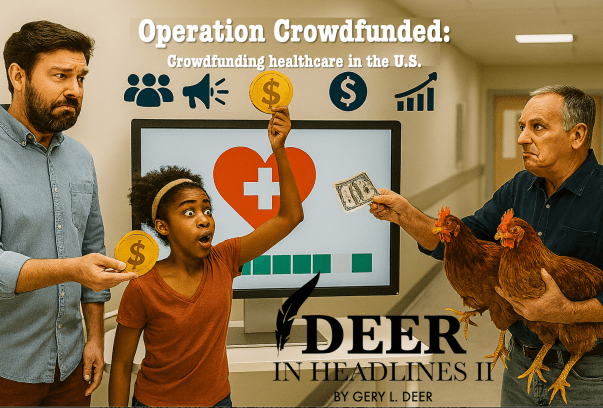
The United States of America: the land of innovation and opportunity, where billionaires launch rockets for sport and algorithms decide your mortgage rate. So, it shouldn’t surprise anyone that Americans now turn to crowdfunding to pay for basic healthcare. Not as a quirky side hustle, mind you, but as a legitimate strategy for survival.

This year, roughly 1.8 million Americans will be diagnosed with cancer. The average cost of treatment? A cool $183 billion. That’s not per person, of course—just the collective tab. But when you break it down, individual patients often face six-figure bills, even with insurance. Meanwhile, nearly 70% of seniors will require long-term care, either at home or in a facility. And with government assistance programs shrinking faster than a hospital gown in the dryer, many are left to fend for themselves. Each year, more and more are turning to crowdfunding.

According to statistics published by Astute Analytica, Americans raise more than $3 billion annually through platforms like GoFundMe, GiveSendGo, and others—most of it for medical expenses. While that might seem a heartwarming testament to community spirit, it’s simultaneously a tragic commentary on our national priorities.

When you live in the “richest” country on Earth and someone in a white coat says the words, “You have cancer,” but your best hope for affording chemotherapy is a well-written plea and a viral social media post, something’s gone horribly awry.

Let’s compare this to the more “official” solution: Health Savings Accounts (HSAs), tax-advantaged accounts tied to high-deductible insurance plans. In theory, they help you save for medical expenses. But their nature pretty much excludes the people who actually need the money.

HSAs require disposable income to fund. Plus, they’re capped at a few thousand dollars per year. That’s great if you’re buying allergy meds or paying for a routine checkup. But without some serious money tucked away, you could still be in trouble if you need something like an appendectomy, for example, which averages around $13,000.

Crowdfunding, on the other hand, offers flexibility. You don’t need to qualify for a high-deductible plan. You don’t need to navigate IRS rules. You just need a compelling story, a few sympathetic friends, and the ability to market your misfortune.

Imagine a future where every citizen maintains a personal healthcare fund online. You could even petition the IRS to classify seniors and disabled individuals as not-for-profit entities. That way, when a billionaire donates to your cancer treatment, they get a tax write-off. It’s a win-win. You get a shot at survival, and they get to feel philanthropic without disrupting their yacht schedule.

Of course, this would also stimulate the tech economy. Crowdfunding platforms would flourish, transaction fees would soar, and a new generation of entrepreneurs would emerge to optimize the monetization of the already bloated medical crises. But there are challenges – big ones.

If everyone’s running a campaign, how do you stand out? Do you offer donor perks? “Contribute $100 and receive a personalized thank-you video from my hospital bed.” Do you hire a public relations firm to promote your gallbladder surgery? “Compassion competition” can become fierce. Those without strong social networks or digital savvy would likely struggle to raise anything at all.

With so many medical coverage decisions being made in the board room rather than at the bedside, this model has its appeal. It’s more transparent than insurance billing, more immediate than government aid, and more democratic than corporate healthcare.

Some say healthcare should be a right, not a raffle – I tend to agree. It’s absurd that anyone should have to beg for insulin or auction off their belongings to afford a colonoscopy. But in a country where tax breaks for billionaires are considered sacred and universal healthcare is viewed as some kind of socialist takeover, absurdity might just be the most realistic and successful option.

So sure, let’s embrace the irony of a system where survival depends on storytelling and digital advertising prowess and crowdfund our medical care. We will just have to hope that, someday, we’ll look back on this era not as a failure of policy, but as a resourceful bureaucratic bypass—when Americans took their health into their own hands, one donation at a time.

Corruption fears the press

In history, National News, News Media, Opinion, Politics, Uncategorized on June 22, 2025 at 10:47 am

Deer In Headlines II

By Gery Deer

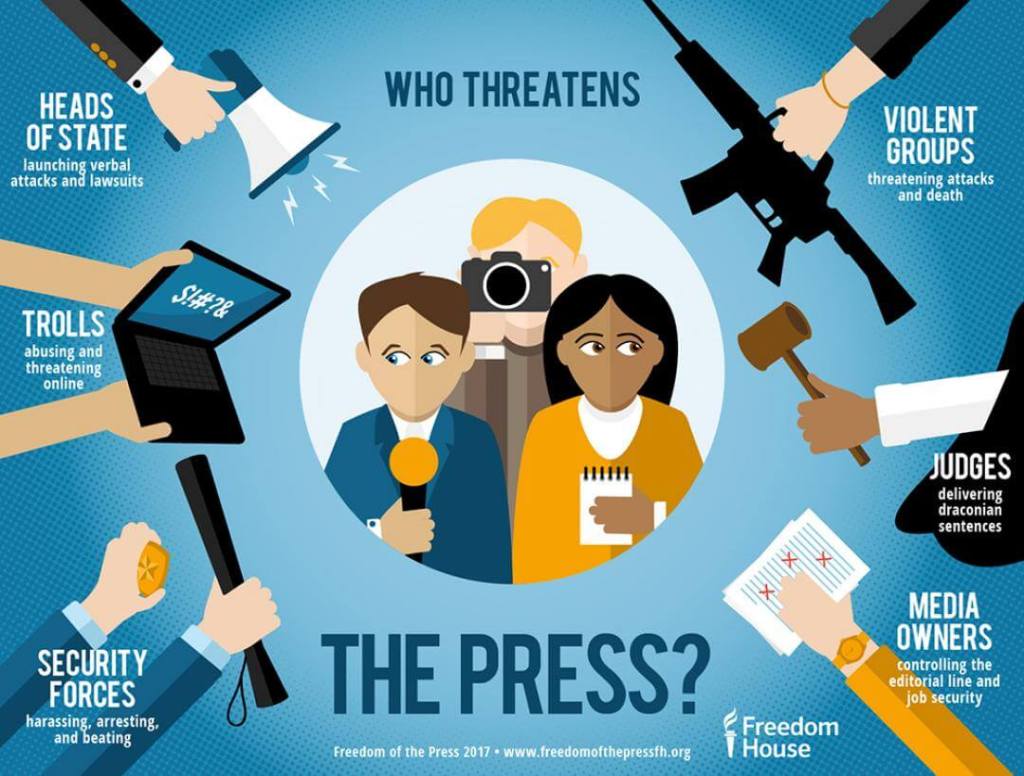
It’s one thing to feel your job is in danger—industries evolve, businesses close, and livelihoods shift. It’s another thing to fear that your work and profession could be criminalized. For those of us in the press, in my opinion, that moment has arrived.

Not long ago, journalists were considered the fourth estate, so-called because the press was seen as the fourth, unofficial, branch of government – the public’s eyes and ears, so to speak. A free press is a necessary check on power, the watchdogs of democracy. Today, Trump and company would rather call any of us who dare question them troublemakers, agitators—enemies of the people. And now, with the Supreme Court’s recent decision to uphold the White House’s ban on the Associated Press (AP), we stand on the edge of something far more dangerous than a bruised ego or a contentious press conference.

The justification? National security – as always. A vague, malleable excuse that’s nearly impossible to challenge or verify. Too convenient to ignore, too broad to oppose. It sets a precedent with sharp teeth. If AP can be barred, who’s next? The Washington PostReuters, or maybe any reporter who dares ask uncomfortable questions?

When a government moves to silence journalism, it isn’t just about limiting press access—it’s about controlling the public’s perception of facts. A free press must do more than inform; it should hold power accountable on behalf of the citizenry. That accountability is inconvenient, even infuriating, for those who prefer not to be held accountable for their actions.

We don’t have to delve deeply into history to see what happens when dissenting voices are silenced. Totalitarian regimes have long understood the value of controlling the narrative. In Nazi Germany, Joseph Goebbels, the minister of propaganda, ensured that only state-approved messaging reached the public. In Stalinist Russia, independent journalism became synonymous with treason. And now, in a supposed beacon of freedom, we find ourselves edging toward a similar state.

Perhaps some believe these measures are justified—that journalism has gone too far and biased reporting warrants a firm correction. Some might even argue that disinformation (a great deal of which originates with the White House) has muddied the waters so thoroughly that restricting the press helps protect the public from chaos. The question we must ask ourselves is not whether we like the press—it’s whether we need it. And if those in charge are willing to erase dissent under the guise of security, we may not have much time left to answer.

The implications go well beyond a single news outlet losing access or presidential attempts to discredit them. If a major institution like the Associated Press can be barred from the White House, and with Supreme Court approval, every journalist in America faces the same risk.

What happens when smaller, independent outlets push too hard? What happens when investigative reporters publicize facts surrounding corruption at the highest levels? This is how truth becomes dictated rather than discovered. This is how governments rewrite history while the present unfolds in silence.

The press has never been perfect—it has biases, it makes mistakes, and yes, sometimes it gets the story wrong. But journalism, at its core, is a profession based on the pursuit of facts. A reporter’s job is not to flatter or cater to power, but to question, to dig, to expose injustice and demand answers.

Our democracy was built on the idea that those in power answer to the people, not the other way around. That principle is maintained through open discourse, through transparency, through a press that is free to ask uncomfortable questions and uncover uncomfortable truths. Of course, that’s not how Trump sees it. He doesn’t answer to you or me – only to his donors.

Still, the president can boot them out of the West Wing, but he can’t stop them from reporting – yet. If we allow this moment to pass unchallenged, accepting that barring journalists is just another policy decision, we lose the foundation of informed democracy set in place under the First Amendment of the United States Constitution. Once the press is muzzled, once silence replaces scrutiny, and propaganda overshadows fact, there’s no telling what comes next.

Supplemental Information:

(Courtesy https://www.carnegielibrary.org/the-first-amendment-and-censorship/)

The First Amendment Defined

The First Amendment to the U.S. Constitution protects what are commonly known as The Five Freedoms: freedom of religion, freedom of the press, freedom of speech, freedom of assembly, and freedom of petition. The amendment is one of the first ten amendments to the Constitution, known as the Bill of Rights, which was adopted in 1791. 

The First Amendment Reads:

“Congress shall make no law respecting an establishment of religion, or prohibiting the free exercise thereof; or abridging the freedom of speech, or of the press; or the right of the people peaceably to assemble, and to petition the Government for a redress of grievances.” (Source: National Archives

This amendment gives Americans the right to express themselves verbally and through publication without government interference. It also prevents the government from establishing a “state” religion and from favoring one religion over others. And finally, it protects Americans’ rights to gather in groups for social, economic, political, or religious purposes; sign petitions; and even file a lawsuit against the government. (Source: History.com)
Suspect captured in Minnesota shootings

In National News, Politics, Uncategorized on June 16, 2025 at 8:09 am
By Sarah Naffa June 16, 2025
 In the news today: A suspect in the Minnesota lawmaker shootings is charged with two counts of murder; Donald Trump directs ICE to expand deportations in Democratic-run cities; and Israel claims it now has air superiority over Tehran. Also, the next head of the U.K.’s foreign intelligence agency is currently the agency’s head of technology and innovation — the real-world equivalent of the James Bond gadget-master Q. Vance Luther Boelter, the man accused of assassinating the top Democrat in the Minnesota House, as he was arrested late Sunday.Vance Luther Boelter, the man accused of assassinating the top Democrat in the Minnesota House, as he was arrested late Sunday. (Ramsey County Sheriff’s Office via AP)

U.S. NEWSMan suspected of shooting 2 Minnesota lawmakers is in custody
The man suspected of killing a Minnesota lawmaker and wounding another crawled to officers in surrender Sunday after they located him in the woods near his home, bringing an end to a massive, nearly two-day search. Read more.
What to know:Vance Boelter was arrested and charged with two counts of murder and two of attempted murder. He is accused of posing as a police officer and fatally shooting former Democratic House Speaker Melissa Hortman and her husband, Mark, in their home early Saturday in the northern Minneapolis suburbs. Authorities say he also shot Sen. John Hoffman, a Democrat, and his wife, Yvette.

Brooklyn Park police officers arrived early Saturday just in time to see Boelter shoot Mark Hortman through the open door of the home, the criminal complaint says. It says they exchanged gunfire with Boelter, who fled inside the home before escaping the scene.

A list of about 70 names was found in writings recovered from the fake police vehicle that was left at the crime scene, said two law enforcement officials who spoke to The Associated Press on condition of anonymity.
RELATED COVERAGE ➤Minnesota’s slain Democratic leader lived the political divisions in the US every day

Friends say Minnesota shooting suspect was deeply religious and conservative

WATCH: Officials announce suspect in shootings of Minnesota lawmakers is caught

Courtesy Associated Press – All rights reserved.

Library Fines

In Books, Children and Family, Education, Local News, Opinion, Politics, Uncategorized on May 2, 2025 at 10:24 am

Deer In Headlines II

By Gery Deer

(Editor’s note: This edition also appears in other publications under the title “Checked Out.”)

As a kid, the local branch of the public library was in the old opera house near the center of our small farm town. It was cramped and dimly lit, and the reference desk was under the boarded-up grand staircase, giving it a sort of cubby-hole feel. I spent a good bit of time there. After school, I’d do my homework and wait for my mom to get off work. In the decades before the Internet, our library was the window to the world. But now, that window may be closing.

Ohio public libraries are funded, in part, by the Public Library Fund (PLF), which provides 1.7% of the state’s General Revenue Fund (GRF) as of this writing. However, the Republican-sponsored Ohio House Bill 96, proposed in early April of this year, would cut library funding by more than $100 million across the state. Why?

Governments have historically manipulated populations by controlling education and the media. They ban books that don’t align with their values, use defunding threats to force public and school libraries to cultivate materials for their purposes, and limit access to information. That way, voters remain ignorant, subjugated, out of touch, and pliable.

And before anyone says, “you just hate republicans,” they’re not the only ones to try this. Ohio Governor Ted Strickland, a democrat, proposed the same budget cuts a dozen years ago, and the republicans cried foul. Remember, the liberal left still regularly tries to “rewrite” some books to remove language and ideas they find offensive. So, it has gone both ways. This time, however, the danger is more palpable.

Over the last decade, public libraries have become frequent targets for budget cuts, with some policymakers arguing that digital access negates their necessity. But here’s the truth: libraries remain vital to the well-being of communities, and continued funding by federal and state governments is not just important—it’s essential. Without it, we risk depriving countless individuals of educational opportunities, civic engagement, and economic mobility.

Public libraries provide free access to knowledge for everyone (so long as their contents are not censored), regardless of socioeconomic status. Whether it’s a student researching for school, a small business owner seeking resources, or a job seeker brushing up on interview skills, libraries level the playing field in ways no digital paywall ever could. Eliminate government funding, and these services vanish, disproportionately affecting low-income communities. Instead of fostering informed citizens, we create a deeper knowledge divide, where only those who can afford education can access it.

A democratic society thrives when its citizens are informed, and libraries serve as safe spaces where people can access unbiased, factual information. They offer literacy programs, historical archives, and meeting spaces for community discussions—all of which help create engaged and empowered citizens. Where do people go for credible information when libraries close because of defunding? Unfortunately, they turn to the Internet and social media – the global misinformation machines. That’s a terrifying thought.

Libraries don’t just provide books—many offer essential services that help individuals improve their financial stability. They provide free internet access for job searches, resume-building workshops, business mentorship programs, and resources to help entrepreneurs. Government officials profess at nauseum about supporting small businesses and the workforce. Then they gut library funding and undermine those initiatives directly. If libraries disappear, so do these essential services, making it much harder for people to improve their situations.

Defunding libraries erodes the foundation of an educated, informed, and economically mobile society, which is exactly what this administration hopes to achieve. Without them, misinformation flourishes, the digital divide widens, and people lose access to critical resources for success. Libraries are not relics of the past—they are the lifeblood of communities, supporting everything from literacy to local economies.

So, before cutting another dollar from public libraries, policymakers should ask themselves: Do they really want a future where only the privileged have access to knowledge? Without funding, that’s exactly where we’re headed.

Good people on both sides of the aisle must speak out against this kind of censorship and ignorance. In Ohio, you can contact your state representative or State Representative Matt Huffman, currently Speaker of the Ohio House of Representatives: email rep78@ohiohouse.gov or call 614-466-6344.

Booker: Truth to Power

In history, National News, News Media, Opinion, Politics, sociology, Uncategorized, World News on April 11, 2025 at 1:57 pm

Deer In Headlines II

By Gery Deer

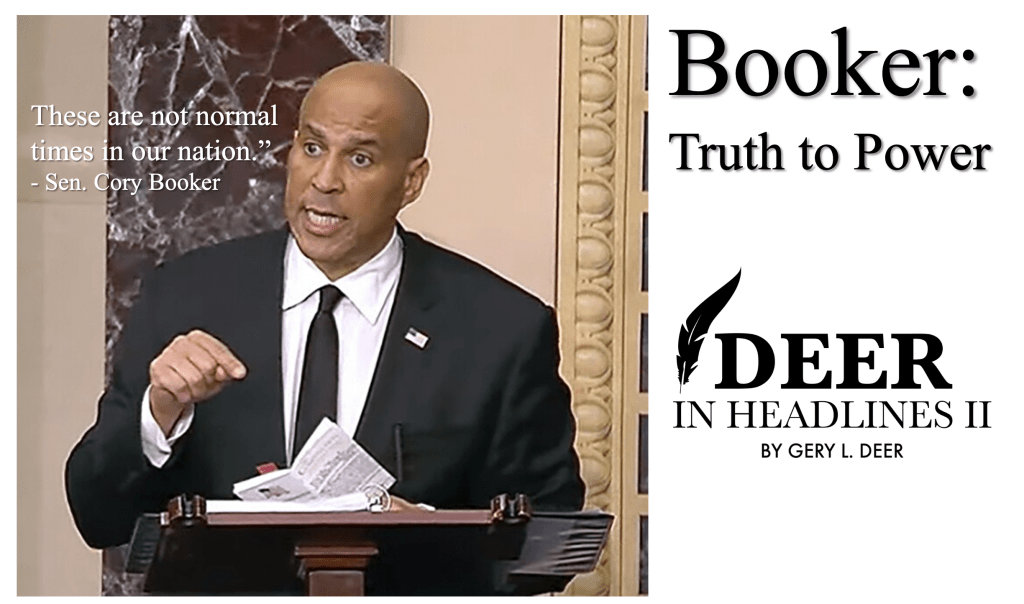
Last week, we saw an incredible example of unmitigated patriotism to provide a voice for those who have none in the face of a president who runs roughshod over anyone who dares oppose him. Cory Anthony Booker, the senior senator from New Jersey, took and held the Senate floor for 25 hours and 5 minutes in a marathon speech in opposition to President Trump’s haphazard and potentially illegal actions during the first three months of his term.

Until now, congressional resistance toward the president has been lackluster, to say the least. This is understandable considering the GOP’s control in both houses and the way this administration has reacted to any opposition, as a petulant child would on a playground when denied an ice cream cone. It’s embarrassing and troubling. Congressional town hall meetings across the country have been disrupted by constituents demanding that Trump be held accountable for the repercussions of his actions.

Most disruptors are ushered out or jailed for the disturbances, but their point is well taken. This president has been actively, deliberately, and defiantly testing the limits of his office and the ability of the other branches of government to keep him in check as designed.

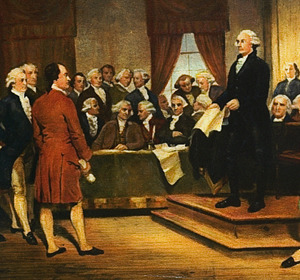
In 1787, the men governing the 13 original American colonies had been through a great deal. They’d declared independence from the most powerful country in the world, fought them in a bloody revolution, won, and finally managed to cobble together a set of laws to live by, unlike anything seen before. The newly minted Constitution was the single most important document ever drawn up to that point – and still is today. The Preamble and Bill of Rights (the first 10 amendments for those who slept through fourth grade) are the gold standard for governing a democratic republic.

It’s doubtful the Founding Fathers ever imagined their fledgling country, still in its infancy today by European standards, would end up being tested, not by a foreign enemy, but by a power-mad oligarch occupying the president’s office. And, until today, very few have had the courage or opportunity to openly stand up to him.

Monday, March 31st, Booker took to the Senate floor and stated he’d remain there as long as he was “physically able,” and that he did – and it was no small feat, even for a former football tight-end. To hold the floor, whoever is speaking must keep talking and can’t stop, sit, lean on anything, or leave the floor for any reason. Fellow Democrats helped out, though, per Senate rules, allowing them to interrupt and ask him questions.

Over a day later, the 55-year-old senator finished speaking and limped off the floor. But, during his time, he held nothing back, walloping Trump on everything from his sweeping cuts to social services to what he called the impending “constitutional crisis” created by the president’s authoritarian actions.

To be clear, several Republicans have taken the same long-winded action on various issues over the last few years, most unsuccessfully. Such a speech isn’t a liberal or conservative move but that of a legislator committed to being heard on behalf of their constituents or the country.

Booker’s record-breaking speech was patriotic because he spoke for more than just those in his voting district. He voiced the fears not just of New Jerseyans but Americans nationwide. His words begged for compassion, kindness, and common sense – from those on both sides of the aisle. After all, when Trump’s own party doesn’t stand up to him, knowing his actions are questionable at best, someone else must.

The real question is, will Booker’s speech fuel a more dauntless anti-Trump resistance? Possibly. For more than a day, the New Jersey senator knocked the president’s agenda off the front page of every news outlet website, here and abroad. Not to mention the 350 million “likes” during the live stream on TikTok.

One thing is sure. Democrat or Republican, people must realize that Trump’s actions prove his agenda is to serve himself and his billionaire friends, not the country. So, to quote Senator Booker, “These are not normal times in America,” he said. “And they should not be treated as such in the United States Senate” or anywhere else.

Absolute Power

In history, Opinion, Politics, psychology, Uncategorized, World News on March 26, 2025 at 1:58 pm

Deer In Headlines II

By Gery Deer

Power, like money, is nothing if you have enough, but everything if you don’t. But what is it? Who has it, and what are those without it supposed to do when faced off by those who do? I’m not sure I’m smart enough to answer any of those questions. If you’ll indulge me, however, I’ll make an attempt to do so and put it into a contemporary context. First, a little history – the kind we should learn from or be doomed to repeat.

It was 1887 England. In a series of letters to Bishop Creighton concerning the issue of writing history about the Inquisition, John Dalberg-Acton, the 1st Baron Acton, or better known as Lord Acton, wrote, “Power tends to corrupt, and absolute power corrupts absolutely.” Most people are familiar with the quote, but few know the preceding passage, which gives it perspective.

“I cannot accept your canon that we are to judge Pope and King unlike other men, with a favourable presumption that they did no wrong,” Acton wrote. “If there is any presumption it is the other way against holders of power, increasing as the power increases. Historic responsibility has to make up for the want of legal responsibility.”

That’s some pretty fancy, but important language. Put more simply, Lord Acton was saying that the same moral standards should apply to everyone, including political and religious leaders. Throughout history, kings and popes were permitted, essentially, to wield their authority unchecked.

America’s Founding Fathers shared the same concern. So much so that when they created a constitution for their new country, coincidentally ratified the same year as Acton’s historic correspondence, it established three separate but equal branches of government to prevent such authoritarian power.

Power is a dangerous thing, especially in the hands of two kinds of people – those who want it, and those who want to keep it from others. The first is driven by greed, the second by fear. Lord Acton was commenting on accountability, something the Constitution ensures by setting equal the Executive, Legislative, and Judicial branches of government. Should some power-hungry tyrant manage to occupy the White House, the other branches would be able to keep him or her in check.

If that individual managed to wield enough control over two of the three branches, the third would be able to mitigate some of the potential danger. But if all three branches were heavily influenced, even manipulated by one individual, then we have a problem. That lands our country in Lord Acton’s absolute power corrupting absolutely territory, and on a much larger scale.

Let’s not forget the second kind of power broker (to borrow a term from one of my favorite authors, Robert A. Caro), the kind who want power out of fear. This individual, or group, is afraid that someone else will gain the power to control them or do things they don’t like.

These people tend to be all-or-nothing types. In other words, if they can’t have it, they don’t want anyone else to because they fear it will weaken their position. Those who are afraid of minority advancement fit this category. 

But what if you’re on the receiving end of all this – the powerless. Powerless people are led to believe, by a government or other authoritative body, that they don’t deserve power. Classism, racism, ageism, and most other “isms” are examples of one group trying to maintain power over another. To quote a great role model of the late 1980s, Ferris Bueller, “Isms, in my opinion, are not good. A person should not believe in an -ism, he should believe in himself.”

When the people lose the power over government, when their elected representatives act in blind service to one policy or individual rather than the best interest of their constituents, when power begins to corrupt absolutely, freedom no longer exists. The trouble is, corrupted power often goes unrecognized until it’s too late.

Corruption dons the cloak of misdirection, intended to fool those who are unwilling to see the danger. Try to remember that power can also be a good thing that benefits all instead of one person or ideology. Unfortunately, that doesn’t make for very good reality television, now does it?

News Incredulity

In Economy, Local News, News Media, Opinion, Politics, Print Media, Technology, Uncategorized on March 15, 2025 at 3:38 pm

Deer In Headlines II

By Gery Deer

I’ve been a freelance journalist for most of my adult life, going back to my days as a staff writer on a college newspaper. Since then, I’ve been published hundreds of times in everything from weekly newspapers to regional trade magazines. Much of my work consists of feature stories, opinion columns, and a few hard news pieces.

I was trained by an old-school newspaper editor who demonstrated consistent ethics and integrity. I was taught never to take a story to press without three primary sources and on-the-record statements from those directly involved to back up the information.

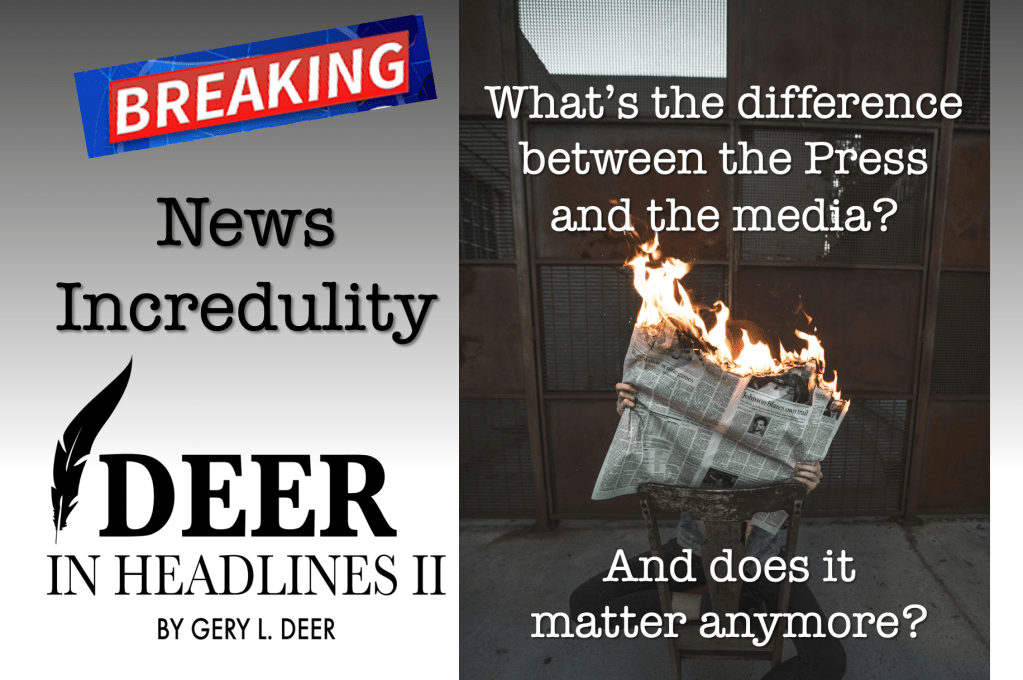
As the Internet became an easy way for the citizen journalist to publish news and information, credibility and fact gave way to sensationalism and uninformed opinion. Click bait replaced proper headlines. Soon, what was once referred to as “the press,” was suddenly renamed, “the media.” In this reporter’s humble opinion, they are not the same.

Webster’s Dictionary defines media (plural of the word medium) as a means of communication, such as radio, TV, newspapers, social, the internet, and so on. In other words, it refers to the delivery system rather than the content or its source.

For example, social media is a primary source of news for many Americans. Unless the information originates from a reputable news source, the content may have no oversight, no editorial integrity, no fact-checking, nothing.

You may have no idea where the information came from or how it may have changed. Think of it as a game of telephone. The more the word spreads, the less accurate it becomes. To reiterate, the social media platform (or app), such as Facebook, X, or Instagram, is just the vehicle – the medium. Reputable or not, the message originates elsewhere.

“The Press,” on the other hand, is guaranteed by the First Amendment of the U.S. Constitution. Like the three branches of government, it’s literally set up right there in black and white – which is why it’s called the Fourth Estate.

The Press should serve as a watchdog to help hold those in power accountable and provide the public with the information they need to make informed decisions. Trained Press journalists gather facts, verify information, and present it objectively across a variety of media.

A functional and qualified Press works within the realm of fact – not truth (that’s for philosophers). It should present information without bias or commentary (there’s a page for that and you’re looking at it now) and demonstrate integrity in the process.

Before I have people shouting at the screen or tearing up the paper, I agree the problem of misinformation spread by so-called news outlets is in epidemic proportions. Unfortunately, many news agencies have traded integrity for revenue, to say nothing about a complete disregard for journalistic expertise.

Cable news programs often fall into this category. They base their content on current news stories, targeting the biases and interests of a single segment of audience to grow advertising revenue. This is not news – it’s entertainment.

Even worse is when a news outlet censors content to favor the business or political interests of their owners. For example, once a paragon of investigative journalism, “The Washington Post is rapidly losing credibility because of interference with its newsroom by its owner, Amazon founder Jeff Bezos.

Between social media, so-called citizen journalists, bloggers, and whatever else is out there, unvetted, unqualified, and often false content is cranked at an alarming rate. Their goal is to spread as much click bait as possible and deliver customers to advertisers – it’s all about money. That makes it hard to sift through the noise for qualified, factual news.

In the end, the Press should be rooted in ethics and accuracy. Sadly, many news outlets now prioritize profit, sensationalizing content to stay competitive in digital media. That’s muddied the journalistic waters, making it harder for the public to distinguish between fact and opinion.

My only advice is to check the source and remember that perspective isn’t the same as bias. News should be factual and accurate, not “fair.” There is no such thing as “fair and balanced” news. Fairness suggests compromise, whereas facts stand alone. The standard should be: is it factual, or not?

CDC rescinds some termination notices

In Health, National News, Politics, Uncategorized on March 6, 2025 at 8:42 am

By Sarah Naffa

Associated PressMorning Wire – March 6, 2025

In the news today: The top public health agency in the United States says some employees who were laid off can come back to work; the Trump administration drops a high-profile abortion case in Idaho; and France’s Macron and allies will discuss protecting Europe with French nuclear deterrence. Also, how healthy eating could be tied to good sleep. Supporters of Centers for Disease Control and Prevention employees protest CDC layoffs, in Atlanta,.
Supporters of Centers for Disease Control and Prevention employees protest CDC layoffs, in Atlanta, Feb. 18. (Arvin Temkar/Atlanta Journal-Constitution via AP)

POLITICS
CDC rescinds termination notice, calls about 180 fired employees back
The nation’s top public health agency says about 180 employees who were laid off two weeks ago can come back to work. Emails went out Tuesday to some Centers for Disease Control and Prevention probationary employees who got termination notices last month, according to current and former CDC employees. Read more.
What to know:A message seen by the AP was sent with the subject line, “Read this e-mail immediately.” It said that “after further review and consideration,” a Feb. 15 termination notice has been rescinded and the employee was cleared to return to work on Wednesday. “You should return to duty under your previous work schedule,” it said.

Health and Human Services Secretary Robert F. Kennedy Jr. last month pledged “radical transparency” at the department, but HHS officials have not provided details about CDC staff changes and did not respond to emailed requests on Tuesday and Wednesday.

How many of the reinstated employees returned to work Wednesday is unclear. It’s also unclear whether the employees will be spared from widespread job cuts that are expected soon across government agencies.

More on this topic…

‘Read this e-mail immediately’: CDC tells about 180 fired employees to come back to work

Is this your new site? Log in to activate admin features and dismiss this message
Log In