Local News & Commentary Since 1890.

Archive for the ‘Media’ Category

Think Pink Motorcycle Poker Run to sponsor cancer survivor in Susan G. Komen walk

In Business, Charities, Local News, Sports News, Travel, Uncategorized on September 22, 2014 at 4:43 pm

IMG_0476DAYTON, OH – In 2010, Dayton area resident Karen Clary became one of America’s 2.9 million breast cancer survivors. This year, she hopes to be one of the thousands across the country to participate in the 2014 Susan G. Komen 3-Day® walk. To support her participation, the Miami Valley Victory Riders motorcycle club and Motor Sports of Dayton are sponsoring the 2nd Annual “Think Pink” Poker Run, Saturday, September 27. The event will help raise awareness and generate the $2,300 Clary needs to attend the 3-day, 60 mile the race.

The Susan G. Komen Race for the Cure series of 5K runs and fitness walks attracts people of all ages and fitness levels, from walkers to elite runners. Celebrating breast cancer survivors and honoring those who have lost their battle with the disease, the series began in 1983 with a single race with 800 participants in Dallas. Today, it has grown into a global series of more than 140 Races with 1.5 million runners.

Susan G. Komen is the world’s largest grassroots network of breast cancer survivors and activists working to save lives, empower people, ensure quality care for all and energize science to find the cures. Thanks to events like the Komen Race for the Cure® and the Komen 3-Day, the organization has invested more than $2.2 billion, making it the largest worldwide source of nonprofit funds dedicated to the fight against breast cancer.

Seventy-five percent of the net proceeds raised by the Susan G. Komen 3-Day® help support Komen’s global research program, the largest nonprofit source of breast cancer research funding outside of the U.S. government. Money raised also supports large public health programs that address critical issues in breast cancer treatment and care. The remaining 25 percent stays in the local community, funding financial, social and medical needs.

Two years ago, Clary and her daughter, Jen, attended the San Francisco 3-day race together. “My daughter asked me to do the 3-day walk with her in 2012,” Clary says. “At first I thought she was crazy; 60 miles in three days? I eventually decided to go because it looked like so much fun and because of how much this means to others who shared my experience, and their families.”

Beginning at 10AM from Motor Sports of Dayton, 2135 Dayton-Lakeview Rd., in New Carlisle (45344), riders will collect a card from each stop, trying for the highest hand at the end of the ride. From Motor Sports of Dayton, riders will make stops at Moose Lodge in Beavercreek, Buckminn’s D&D Harley Davidson in Xenia, Little River Café in Oregonia, Whiskey Barrell in Oregonia, and finally end up at Jack Ass Flats in Huber Heights. The rider with the highest poker hand at the end of the run will win the grand prize. Single riders can participate for $15, doubles for $20, or buy an extra hand at $5 each. Other activities during the event include a 50/50 drawing, raffle prizes, silent auction, door prizes and entertainment.

“My first walk was the hardest thing I have ever done in my life and also the most awesome,” Clary says. “Jen wanted to do the walk for me and, because I have given her a greater chance of getting cancer, I wanted to do it for her. Hopefully we can all help to wipe it out.” For more information, call Karen Clary at (937) 620-8597 or email her at teampol@aol.com.


 

Local festivals must evolve to continue.

In Charities, Economy, Entertainment, Holiday, Local News, Media, Opinion on September 22, 2014 at 12:05 pm

DIH LOGOVirtually every community festival I’ve been involved with around Ohio this season has reported steadily decreasing attendance. Some of them have run for more than a half-century, others only a few years, but regardless of their endurance, the people just aren’t coming like they used to. Could it be time to mothball the town festival and pool resources into larger, joint events like county fairs?

Over the course of the last couple of decades I have participated annually in more than a dozen different festivals and similar community events. Since 2002, I’ve produced the Western Arts Showcase performances at the Annie Oakley Festival in Greenville, Ohio, an event that’s been running for more than 50 years. Sadly, I’ve watched the attendance at these events dwindle year after year to the point where even the vendors aren’t coming.

I hate the idea of our local festivals shutting down, but it’s not possible to perpetuate an event on good intentions. It must evolve with the times. With that in mind, and for those interested in trying to breathe new life into a long-running festival, here are a few ideas to consider.

First, whether you want to think of it this way or not, a town festival is like any other product you’re trying to sell to the public, from toothpaste to breakfast cereal. Consumers have options and getting them to choose your event over another takes effort and money.

Poor marketing on the part of festival organizers is common and usually the result of inadequate funding. It’s simply not enough to pin up cookie-cutter fliers that look the same year after year. Like any business venture, it takes real advertising and legwork to get the word out.

Could deteriorating attendance kill local festivals?

Could deteriorating attendance kill local festivals?

Community organizers should consider another question too, “What is the purpose of the festival?” If the reason is just to have one, then maybe that’s part of the problem. Every event should have an end goal, whether it’s charitable fundraising or increased awareness of what the community has to offer.

Successful events tend to seek out corporate sponsorships; not from local merchants but larger resources. For example, instead of going to the local Pepsi retailer, contact Pepsi’s corporate office and ask to speak to regional marketing reps or district managers. Tell them what you need and they can often direct you to the right department.

Those advanced funds should go toward better marketing and, most importantly, high-end feature entertainment, the real draw to any community event. Organizers should strongly resist the trend toward using the local bluegrass garage band.  Grants are also a potential funding option, but carry oversight burdens and restrictions on festival content.

Financially, local residents don’t provide enough of a revenue base to sustain an event year after year. To keep people coming in, you have to reach outside the area to draw attendees to your event with something to set it apart from all of the others – feature entertainment, unique exhibits, something. Let’s face the facts, there’s no difference between the funnel cakes at your event and those at any other.

Finally, one organizer I spoke to recently suggested that the major roadblock to growing his local festival was the old guard’s resistance to fresh ideas, complicated by an unbreakable, well-established good old boy system – a common problem in small communities. Organization committees are generally manned by those who show up or others who need to feel powerful. If that’s the case, and the argument given against change is often something like, “We’ve done it this way for 20 years and …” and nothing has improved! It’s probably time for new blood.

If no one is willing to change, it may be hard to maintain an event and people will just stop coming. If you belong to an organization that’s trying to decide whether to keep an event running, and few are open to change, ask this simple question. After the bills are paid this year, is there enough money left over from the event to cover start up costs on next year’s festival? If the answer is no, it may be time to hang it up. Remember, nostalgia won’t pay the bills.
The Jamestown Comet.com Editor / Publisher Gery L. Deer is an independent columnist and business writer based in Jamestown, Ohio. More at gerydeer.com

Support religious freedom by defending rights of atheists

In Education, history, Local News, Media, National News, Opinion, Politics, psychology, Religion, sociology, Uncategorized on September 3, 2014 at 11:24 pm

dih-logo-SEFor what is apparently the first time ever, an openly atheist candidate is running for United States Congress this fall. James Woods, an atheist Democrat, is seeking election in the Arizona 5th Congressional District, a region well known as strictly Republican. According to a CNN op-ed piece by columnist Carlos S. Moreno, Woods will be the only congressional candidate to ever run after outing himself as a non-believer.

As it turns out, under the constitutions of eight American states, atheists are banned from holding public office: Arkansas, Maryland, Mississippi, North Carolina, Pennsylvania, South Carolina, Tennessee, and Texas (Source: The Washington Post). More accurately, the restriction applies to those who deny the existence of, “a Supreme Being,” or “Almighty God,” the wording varies.

Regardless of whether people agree with it, such bans would seem to violate Article VI of the U.S. Constitution, which states, “no religious test shall ever be required as a qualification to any office or public trust under the United States.” It’s probable that any related civil suit would eventually land at the feet of the United States Supreme Court which would undoubtedly have to rule these laws unconstitutional.

Even so, most atheists stay, “in the closet,” so to speak, to avoid social repercussions and public scrutiny and rarely do they attempt to run for political positions. It might be assumed that the anti-atheist rules were originally established to ensure that public servants would have a predictable moral fiber.

But, the very idea that the religious are inherently “moral,” is, in a word, ridiculous. History is full of religiously-sanctioned violations of God’s moral commandments, from centuries of open warfare to decades of child abuse. As usual, many of the devout try to pretend none of it ever happened. So, in a completely predictable act of contradiction, violations of God’s laws are fine so long as they serve a “higher purpose.”

Likewise, the moral character of a politician is supposed to be part of the reason why people choose to elect him or her to office. Sadly, a disturbing lack of morality is evident in many high-ranking politicians, who spend much of their time lying, cheating and stealing. These are the same men and women who, at some point, stood up in front of their God and everyone else and swore to their personal integrity and commitment.

Easy examples come to mind like John F. Kennedy and Bill Clinton, who were known to be serial adulterers, and it could be argued that the very definition of politician should include, “liar.” In any case, one needn’t be a Christian, nor a member of any other religion, to have a well-aligned moral compass.

Put simply, being frightened into morality by the threat of fire and brimstone only goes so far in keeping people on the straight and narrow, particularly those who crave power and believe themselves at some point to be above retribution. It seems like it would be better to have a public servant who has found his or her own moral direction rather than having it lorded over them by fear of suffering in the hereafter.

Regardless of how the devout are behaving when no one is looking, however, what Americans need to understand from all of this is that freedom from religion must be protected in order to preserve its uninhibited practice. The fine balance between freedom “from” and “of” religion is necessary to ensure every citizen can practice his or her faith openly, all while any other may enjoy none at all. It goes both ways.

Put another way, no one likes to have religious groups going door to door pedaling their ideology. So why is it alright for anyone else to do the same thing simply using more socially acceptable methods, such as being coerced into declaring a religion before qualifying for political office?

Up until now a great many public servants who have affirmed a religious affiliation and filled speeches with thanks to God for their success have managed to shame both their religion and their office with shaky morality. In the end, the most devout Christian can take the same oath as their atheist counterpart and guarantee no greater a moral platform. If history is any indicator, it might even be less.

 
Gery L. Deer is the editor and publisher of The Jamestown Comet.com and a syndicated independent columnist.


Amateur radio classes offered September 7

In Dayton Ohio News, Education, Entertainment, Media, News Media, Science, Technology, Uncategorized on September 2, 2014 at 8:43 am

The number of amateur radio operators continues to grow as more people realize the role that ham radio can play in providing emergency communication during natural disasters. To help those interested in obtaining a ham radio license, the Greene County Amateur Radio Emergency Service (GCARES) is offering three free Amateur Radio license courses. In addition to GCARES, the courses are supported by the Bellbrook  Amateur Radio Club (BARC), the Upper Valley Amateur Radio Club (UVARC) and the Xenia Weather Amateur Radio Network (XWARN).

radios     The nine week courses will prepare students to take the FCC test for the entry-level technician, the intermediate level general, or the top level extra class licenses. Classes will meet from 7–9 p.m. Sundays beginning Sept. 7.  The exams for all three licenses will be given at 6 p.m. Sunday, Nov. 9. There is no charge for the courses or the test.

   The entry level technician class course will be held in the TrainingCenter at the Bellbrook Amateur Radio Club Clubhouse, Room 1 Sugarcreek Elementary School, 51 South East Street in Bellbrook.  No experience is required and there is no minimum age required to earn a technician class license.  Morse code no longer is required for any amateur radio license.

    The general class course and the test session will be held in the training room at Beavercreek Township Fire Station 61 located at 1298 Dayton-Xenia Road just west of Orchard Lane.

     The extra class course will be held in the training room at Fairborn Fire Station 2 located at 2200 Commerce Center Blvd just south of Dayton-Yellow Springs Road.

      Students are encouraged to have a copy of the respective ARRL License Manual. For more information about obtaining a manual go to gcares.febo.com.

     To register for one of the courses or for more information, please contact Bill Watson, K8WEW,  by email at wwatson4@att.net or by phone between 10 a.m. and 9 p.m. at (937) 426-2166.

Music shines light through darkness of dementia

In Health, Local News, Opinion, Senior Lifestyle, Technology, Uncategorized on August 18, 2014 at 12:20 pm

DIH LOGOAccording to statistics, one in three senior Americans now suffers from some type of dementia. My mother, Lois Deer, was one of those unfortunate millions who had an advanced type of Alzheimer’s disease. As it progressed, she lost the ability to communicate on anything more than a passive level, responding to very little, short of a head nod or facial response here and there. When she spoke, it was in whispers and then only gibberish.

One thing that did seem to register, however, was music. Each Saturday night we would move her wheelchair to the band room at my parents’ farm where our family band, “The Brothers & Co.,” would rehearse. We would feed her dinner – a manual task since she couldn’t do it on her own – and she’d spend most of the rest of the evening listening to us play and sing, surrounded by family in a room she created for us.

Gery Deer discusses Music and Dementia on WDTN-TV2's Living Dayton during a "Deer In Headlines" segment. Click to watch the video clip ...

Gery Deer discusses Music and Dementia on WDTN-TV2’s Living Dayton during a “Deer In Headlines” segment. Click to watch the video clip …

Music was an important part of my mother’s family growing up, with virtually ever member playing some kind of instrument, many of them without the aide of formal lessons. She even sang in an “Andrews Sisters” type quartet with her own sisters in the late 1950s.

By this time, however, Usually, she had a kind of empty, blank expression on her face, a typical Alzheimer’s manifestation. But one evening during our practice, she was sitting near my piano and I caught sight of a slight smile in her eyes and looked down to see her toe tapping on the footrest of her chair.

Since Mom needed 24-hour care, and because we had no intention of leaving her to rot in a nursing home, we cared for her at home and she came along with us to every performance. She had a specially-outfitted seat on our tour bus, complete with an oxygen tank and all of our portable medical supplies. My cousin sat with her in the audience and she would sing, “You are my sunshine,” with us at some point in every show. Music got through, when nothing else would, and I’m relieved to know that I’m not the only one who noticed.

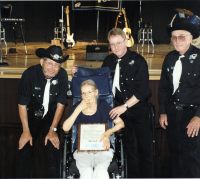
Lois Deer (center) with The Brothers & Co. members Gary Deer Jr., Gery Deer, and husband Gary Deer Sr. at the Jamestown Opera House in 2010

Lois Deer (center) with The Brothers & Co. members Gary Deer Jr., Gery Deer, and husband Gary Deer Sr. at the Jamestown Opera House in 2010

A friend recently told me about a National Public Radio news story related to this phenomenon. The piece focused on a documentary featuring social worker Dan Cohen and his creation of custom music playlists on iPods for elderly dementia patients. Titled, “Alive Inside,” the film explores Cohen’s exploration of the connection between music and long term memory.

“Even though Alzheimer’s and various forms of dementia will ravage many parts of the brain, long-term memory of music from when one was young remains very often,” Cohen told NPR’s Melissa Block. “So if you tap that, you really get that kind of awakening response. It’s pretty exciting to see.”

That all makes a lot of sense when you think about the kinds of music my family band plays and the relationship my mother had to it. There’s no question we were reaching an area of her mind that the Alzheimer’s hadn’t yet shorted out.

After I noticed my mother’s reactions, I paid more attention whenever we performed at nursing facilities where a great number of the residents were suffering from similar illnesses. I can’t tell you what a heart-wrenching experience it always is to see these poor people in such a state; doubled over in wheelchairs, closed off, withdrawn into the isolated torment of their own disease-ravaged minds. And then …

And then we start playing and something would happen, a toe would begin to tap here and there, or a silent face would begin to mouth words to a song. Although it might seem like there’s nothing left of the people they once were, here was a sign that they were still in there – somewhere – and we were reaching into that one place the disease couldn’t penetrate.

All I can imagine is that the music we were playing took my mother somewhere else within a mind that’s organization had long since scattered, as if someone rearranged all the drawers in a wardrobe chest.  She was in another place and another time, a better time.

Christina Corallo, North Shore LIJ Orzach Center for Rehabilitation, Valley Stream, N.Y., tells MusicandMemory.org, “Patients with anxiety and depression are less agitated and appear calmer. The music transports them to a happier place in their minds.”

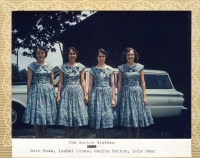
"The Sutton Sisters" singing family, Lois Deer (far right) and her sisters, (from left) Ruth Rowe, Isabel Jones, and Regina Marshall, ca. 1958

“The Sutton Sisters” singing family, Lois Deer (far right) and her sisters, (from left) Ruth Rowe, Isabel Jones, and Regina Marshall, ca. 1958

Cohen’s idea of customized iPod playlists for each patient is still plagued by one major hurtle – money. Nursing care, particularly long-term dementia care, is incredibly expensive and iPods aren’t cheap. It’s the same financial roadblock encountered by virtually every other progressive therapy for dementia ever proposed.

With that, I am challenging one member of the family of every dementia patient to buy an iPod for their loved one and load it with music from their life. Give them a moment to feel who they once were in the most personal, powerful way possible – through music.

 Learn More About Music and Memory…

Click here for a link to the full NPR story,”For elders with dementia, musical awakenings,” by Melissa Block.

Click here to watch the trailer, “Alive Inside: A Story of Music & Memory” featuring Dan Cohen.

Donate to Music & Memory: Monetary or iPods 


Border crisis will become a local issue

In Charities, Children and Family, Dayton Ohio News, Local News, National News, Opinion, sociology, Uncategorized on July 28, 2014 at 11:33 am

DIH LOGOUnless someone is a true bigot, it’s hard to imagine why people don’t want to help the immigrant Mexican children being sent across the border without family, without supervision. But wanting to help is not the same thing as having the resources and infrastructure to do so properly, in a way that meets the ultimate goal which should be to see that the children have better life in America than they had in Mexico.

Unfortunately, people are so focused on the problem of the immigration process, they forget about what will happen once the kids get into the United States. Without a plan, infrastructure, money and personnel, it’s unlikely that these children will be living in anything less than squalor once they arrive and are processed.

Our government should do everything they can to help these kids, even if that means the best thing to do is to send them back home. Why? Because there are some vital questions still as yet unanswered. For example: Where will they live? Who will pay to feed and clothe them? Who will pay to educate them?

Each night in the United States, an estimated 611,000 people are sleeping homeless and nearly 50 million go hungry, according to the charity groups National Alliance to End Homelessness, and Feeding America. As unbelievable as it may seem in the most powerful country in the world, organizations such as these struggle each year to find the millions of dollars needed to provide food and shelter for people already living here, a great many of which are children.

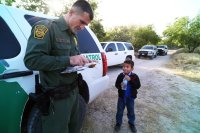
(Photo NY TIMES)

(Photo NY TIMES)

When hundreds of immigrant children become thousands, they become refugees, not immigrants and caring for the kids will eventually land squarely on the shoulders of local government. The White House and congress might clear the way for an easier method of entry or grant them all amnesty once here, but then it’s the problem of Main Street U.S.A. to care for them.

Sure, there will be federal money – probably from new taxes that will overburden a still recovering Middle America – but it will be pennies per child, per day, leaving the remainder to be covered at the local and state levels. The current welfare system cannot handle such a fast influx of need, especially while still recovering from the stress of the recession.

Some local leaders, however, are welcoming the immigrants with open arms. Dayton, Ohio Mayor Nan Whaley recently stated that she would welcome the immigrant children to the area. It’s clear that Mayor Whaley, who previously served on the Dayton city commission, does not realize that what happens in Dayton affects the outlying communities of the Miami Valley region, both socially and economically. None of these suburban areas have the kinds of resources necessary to handle such a massive issue.

As expected, the democratic mayor’s comments drew a firm response from area republicans, led by Congressman Mike Turner. Turner sent a letter to President Obama signed by him and six local area leaders which states, “We are writing to express that our community does not support Mayor Whaley’s proposal and to further express that our community does not have the available resources to support such a proposal.” It goes on to point out that, while they are sympathetic to the issues related to the border crisis, the community is simply not in a position to offer assistance.

There is speculation that Whaley’s comments were little more than a publicity stunt, aimed at getting a sound bite on national news, which she accomplished without question. Others believe her intention was to gain more favor with Dayton’s large and ever-expanding Hispanic population. Only the mayor knows why she really made such a sweeping statement without discussing the concept with other local leaders.

These sentiments are playing out across the country in a constant battle. While there is an overwhelming feeling of obligation by most to help children and families fleeing poverty and abuse, there must first be resources in place to properly handle the situation without making it worse.


Jamestown Comet Editor Gery L. Deer is an independent columnist and business writer. More at gerydeer.com.


Fire House Poker Run to benefit child victims of domestic violence

In Charities, Children and Family, Entertainment, Local News, State News, Uncategorized on July 15, 2014 at 7:23 pm

IMG_7297On Saturday, July 19, motorcyclists will have the opportunity to participate in the first annual Fire House Poker Run to benefit the “Shoe Barn Project,” a fundraising effort to provide new shoes for children who come through the Greene County Children Services or The Family Violence Prevention Center. Registration begins at 10:30 AM for $15 per bike at Buckminn’s D and D Harley Davidson at 1213 Cincinnati Avenue in Xenia.

With kickstands up at noon from Buckminn’s, participants will ride from one fire house to the next, enjoying the unique look and atmosphere of each and actually driving through several of them as if they were covered bridges.  After a long, scenic tour along the Greene County countryside, including Cedarville, New Jasper, Silvercreek, Jefferson, Xenia and Spring Valley Township fire departments, the ride will conclude at Willie’s Bar in the Xenia Towne Square with an after party featuring gift raffles and entertainment by the Just-N-Time band. Willie’s will be donating 10 percent of sales to the fundraiser.

The first annual Fire House Poker Run is an event organized by First Responders And Bikers Advocating Against Abuse (FRABAAA). According the FRABAAA’s mission statement, the group is, “committed to empowering, educating, advocating, as well as facilitating victims of abuse and violence to become survivor, one HERO at a time.”

IMG_7293Shella Baker is the organizer of FRABAAA. “After helping kids and families who lived in The Family Violence Prevention Center of Greene County (FVPC) what we noticed each year was that, even above toys, children were asking for shoes,” she says. “This really struck me as such a basic need; it was surprising that a lot of children would even think about asking for shoes at Christmas.”

“This past April, during child abuse awareness month, we had a shoe drive with local hospitals and fire departments as well as Samaritan Crisis center and Xenia Walmart,” she says. “We collected shoes to start what has become known as the Shoe Barn Project to benefit the kids housed at the center.”

Supporting the FVPC is a personal mission for Baker, a nurse and paramedic who sees, first hand, the devastating toll domestic violence can take on a family. But Baker’s actions are driven from a much more personal experience – as a survivor of domestic violence. Twenty-five years ago, she and her son took refuge at the FVPC to escape an abuser and now she wants to give back. Today, she has joined with fellow first responders to advocate for victims and promote awareness and prevention, the poker run will help support that cause.

The FVPC began in 1979 as a project of the Greene County Welfare Department known as the Greene County Domestic Violence Project. It started out as a simple, two-bedroom apartment in Yellow Springs but the agency has evolved to provide support and education through services such as a 24-hour crisis hotline and safe housing as well as prevention and outreach programs.

Today the agency is located at 380 Bellbrook Avenue in Xenia and is certified by the Council on Accreditation. It was also recently renamed, The Kathryn K. Hagler Family Violence Prevention Center, to honor the late Greene County leader’s service in advocacy of families and children.

“When FRABAAA started the Shoe Barn Project we wanted to reach out even further to help all kids in the system that have been victims of abuse,” Baker notes. “We hope to one day have a huge operation to help not only Greene County but counties across the state and Country. To make that happen, we need to get more communities on board.”

FIRE_HOUSE_POKER_RUN_1Riders in the poker run will get to actually drive through the fire stations at Cedarville, Xenia and Spring Valley, with a snack stop at the Jefferson Township station in Bowersville. Awards will be given for first, second and third place hands and a Fire House award for the worst hand. For more information about the poker run, visit the group website at http://www.frabaaa.com or call Shella Baker at (937) 789-7262. If you are in immediate need of help in a domestic violence situation, call the center’s crisis line at 937-372-4552 or 937-426-2334.

“When FRABAAA started the Shoe Barn Project we wanted out  reach out even further to help all kids in the system that have been victims of abuse,” Baker notes. “We hope to one day have a huge operation to help not only Greene County but counties across the state and Country. To make that happen, we need to get more communities on board.”

Riders in the poker run will get to actually drive through the fire stations at Cedarville, Xenia and Spring Valley, with a snack stop at the Jefferson Township station in Bowersville. Awards will be given for first, second and third place hands and a Fire House award for the worst hand. For more information about the poker run, visit the group website at www.frabaaa.com or call Shella Baker at (937) 789-7262. If you are in immediate need of help in a domestic violence situation, call the center’s crisis line at 937-372-4552 or 937-426-2334.

Watch the full video interview on WDTN-TV2’s Living Dayton.

IMG_7290


ATVs are not toys for young children

In Children and Family, Dayton Ohio News, Health, Local News, Opinion, Sports News, State News, Uncategorized on July 14, 2014 at 9:30 am

DIH LOGOSince 1982, there have been nearly 400 Ohio deaths related to the operation of ATVs, short for “all terrain vehicles.” Like any other power machine, the ATV is a safe, versatile vehicle when handled properly by responsible adults, yet their operation is far too often given over to small children.

According to statistics collected between 1982 and 2012 by the United States Consumer Products Safety Commission (CPSC), there have been, nationally, 2,944 ATV-related fatalities of children younger than 16 years of age and 43 percent of them were younger than 12. The CPSC also states that children 16 and under comprised 24 percent of the total number of ATV related deaths.

Unfortunately, these machines are not being treated like the dangerous power equipment they are but instead as if they are children’s toys. It’s not uncommon to see very small children riding these powerful four-wheelers (and there are still a few three-wheelers out there). Any responsibility for accidents must be laid firmly on the shoulders of the parents as well as those legislators who can’t be bothered with increasing safety regulations on these devices.

Currently, age restrictions on ATV operations in Ohio are, in this commentator’s opinion, far too lenient, and logically inconsistent. For example, as of 2014, the Ohio law states that, “to operate an ATV on public lands, one must have a driver’s license or motorcycle endorsement. The Department of Natural Resources may permit a person at least 12 (years of age) to operate on Department land if accompanied by a parent.”

In the next section the regulations state, “No one under 16 may operate an ATV unless on land owned by a parent or accompanied by an adult 18 or older.” It’s as if, in one regulation, the legislators acknowledge the dangers involved in operating these machines and that people should be qualified, licensed drivers. But in the other, just having a parent there qualifies the kid to be behind the handlebars.

When children operate these machines there are two issues to consider: Experience and size. A licensed driver will have had some training and experience behind the wheel and be at least somewhat more experienced than someone who has never operated a motor vehicle. Arguing also that a farm kid can handle it because of tractors and other equipment is ridiculous too. There is a big difference between disking a field and popping wheelies down a hillside on an ATV.

Additionally, as stable as they may seem, to keep all four wheels on the ground, an ATV requires a certain amount of bulk in the form of the rider. Shifting the weight from side to side, similar to riding a bike, is necessary and aids in steering and stability.

A small child of 6 or 7 years old, and maybe 60 pounds on the outside, simply does not have enough mass or strength to control the machine, regardless of its size. Even the smallest of these vehicles is powerful enough to cause a serious accident if not properly controlled and no safety switch or oversized helmet can outmatch the common sense of not letting a little kid ride it in the first place.

The overturned ATV in the Crooked River.Liability is another major consideration. Without getting into the legal issues, it goes without saying that America is a litigious society and special endorsements are required on insurance policies to cover liability issues related to ATV operation. Even if there is insurance, the parents of an injured child can still sue the owner of the ATV or the property where the accident took place.

In the end, the question must be asked, “Is a few minutes of joy riding on an ATV worth risking the safety or perhaps the very life of a child?” For more information, download a complete copy of Ohio’s current ATV laws: OhioATVLaw

Gery L. Deer is an independent columnist and business writer based in Jamestown, Ohio. More at www.gerydeer.com.

All In One from CMG Financial pays off mortage faster, builds equity

In Business, Economy, finances, Local News, Uncategorized on July 7, 2014 at 12:43 pm

By Gery L. Deer

Business Editor

With interest rates at historic lows, American homeowners are constantly on the lookout for the best way to pay off a mortgage loan at the lowest cost and in the shortest time. CMG Financial has a loan solution, just made available in Ohio, specifically designed to help borrowers put idle money to work reducing mortgage debt.

CMG Financial was established in 1993 as a privately held, mortgage-banking firm based in San Ramon, California. The company is widely known for responsible lending practices, industry and consumer advocacy, operational efficiency and market innovation.  Among those innovations is what the company refers to as the All in One mortgage.

Joseph P. Beach is the Ohio Operations manager at the firm’s Dayton area office, opened in 2011, and a thirteen-year veteran of the mortgage industry. “The All in One mortgage has been offered in California since 2005, but is now available in Ohio and seven other Midwest states exclusively from CMG,” Beach says. “It’s designed to benefit the disciplined borrower who is interested in paying off their mortgage and growing the equity funds available as fast as possible.

According to CMG Financial, this type of mortgage option has been available in England, Canada and Australia, where interest regulations are different. Essentially, the All in One mortgage, “Puts lazy money to work.” That is, money that would normally just sit in a checking account doing nothing is used to lower the balance of the mortgage loan until the cash is needed elsewhere.  The idea is to lower the total interest expense over the term of the loan by paying down the balance right from the beginning using the idle cash in checking, certificates of deposit and other low interest-earning accounts.

Beach notes that there are some specific advantages to the All in One mortgage, unavailable under other products. “A borrower can significantly cut the total interest expense over the life of the loan, pay off your mortgage in as little as seven years with no change to your spending habits, and still be able to access home equity 24 hours a day, seven days a week, without refinancing.

Stein_CMG-CapturePopular economist and author Ben Stein has personally endorsed the CMG loan stating in a promotional video now available on YouTube, “I think it’s the greatest invention in personal finance in my lifetime.”

Of course, the All in One is not for everyone and certainly not a product for those in an upside down or problematic financial situation. Beach’s description of a “disciplined borrower” is very accurate. To qualify, borrowers require a credit score exceeding 700, are active savers and use funds that would normally be sitting in a checking account earning minimal interest.

For more information, contact Joe Beach at CMG Financial’s Dayton office by calling, (937) 937-723-8095 or email jbeach@cmgfi.com. The All in One was patent protected in 2009 and is a trademarked mortgage product of CMG Financial. Catch Joe Beach on WDTN-TV2’s “Living Dayton” program, 12-Noon, Thursday July 10.

Improving American language skills: Reading and writing are fundamental

In Books, Children and Family, Education, Literature, Local News, Opinion, Technology, Uncategorized on June 30, 2014 at 3:53 pm

dih-logo-SENext to the United States Constitution, the Declaration of Independence may be the single most important document ever created in the history of America. It established our country’s formal separation from England and set in motion more than two centuries of global influence and an example of how a free republic can succeed.

But what would have happened if the men who founded our country lacked the basic language skills to create that first, all-important document? How would these men have properly and so effectively communicated the displeasure and intent of an entire people without such a firm grasp on the English language, not merely to speak it but to put it down in a document to be revered for centuries to come? In short, they couldn’t have.

On this 238th anniversary of the signing of the Declaration of Independence, we need to remember that it’s author had but two years of formal, college education. In those days, a man wishing to become a lawyer apprenticed under other attorneys, reading the law and learning to interpret and apply it for the good of the people for whom it was put in place. Jefferson eventually became a lawyer but not by obtaining any degree we might understand today.

Likewise, Benjamin Franklin went to school briefly but, because of financial issues, he had to stop to help support his family by going to work with his father. He furthered his own education, however, through reading and self-study, a practice that is, sadly, frowned upon today. Both of these men demonstrated the vast important of language and writing, and how the written word can change history. Some people, though, struggle with language skills or never learn to read at all.

One of my favorite books from childhood was called, “The Little Old Man Who Could Not Read,” by Irma Black. The book chronicles the story of a little, old toy maker who, despite his amazing craftsmanship for pleasing children, never learned to read. One day, his wife went to visit a sick friend and left him alone for what must have been the first time. He was forced to do the grocery shopping on his own, which turned out to be a very frustrating endeavor. Upon arriving home, he sadly discovered that what he thought was a spaghetti box turned out to be wax paper and the can of sauce, coffee instead. It was very disheartening. But it motivated him to learn and he did. The book was written many years before the technology age, but imagine what he would have to deal with today if he couldn’t read at all? It would be nearly debilitating in modern American culture.

little_old_manI have always been a writer, even back into childhood, but most of my language skills came from audio books and those children’s books that came with a 33 rpm record. I found later that I had been dealing with a learning disability that hindered my ability to retain what I had read. Over the years, I adjusted and coped, but was not diagnosed until my mid-30s. Today, I have new ways of dealing with the problem and read as much as I can. I learned to defy my disability because I wanted to read.

There’s no question that Jefferson and Franklin were above-average men, but we all have the ability to move past our limitations, just as Franklin taught himself what he needed to know and just as I worked past my reading issues. For those who want to improve their language skills across the board, here are a few tips and they work for pretty much all ages.

First, try to write as much by hand as possible. Using paper and pen will slow you down a bit and force you to think before you write. People were better writers in the old days because it took time to get thought to page. Today, technology has us whizzing through sentences without a thought to grammar and word usage.

Next, although it’s fallen out of favor with the public school set, use cursive writing as much as you can. As with the first point, handwriting something makes you think and use the right language. It even gives you the chance to look up a word before you use it.

Try to learn a new word every day. Vocabulary is the key to better language skills. Take the time to look up words you hear throughout your normal day. But if you don’t hear any that grab your attention, pick up a hard-bound dictionary, open it up, close your eyes, and point to a word on the page.  That’s your word for the day. One of those “word of the day” desk calendars is a great resource too. Of course, you need to put the word into use whenever possible to make it stick.

Read, read, read, read. And, did I mention, read? Newspapers, well-written blogs, congressional briefs, comic books, it doesn’t matter what you read, just make sure you read a lot. If you’re trying to improve your language skills, however, the more advanced the reading the better. It’s ok if it takes time, look up words you don’t know and charge ahead.

Finally, don’t write like you text. In fact, don’t text how you text, either. The wave of “texting shorthand” is maddening to those of us with good grammar and language skills. Use full words and sentences – even in texts. It’ll make a big difference in how you communicate in email and in other written documents as well. Take your time and say it right.

So this Fourth of July weekend, go out and enjoy the picnics and fireworks.  But remember, when you hear the words to the national anthem or the preamble to the constitution, think about the meaning of each word and be grateful that those guys were diligent enough to get every one of them right. Our very freedom depended on it.