Local News & Commentary Since 1890.

Archive for the ‘Health’ Category

Celebrating the paramedic and EMS

In Health, history, Jobs, National News, Opinion, Science, television, Uncategorized on July 21, 2014 at 11:44 am

DIH LOGOWhen was the last time you felt the urge to run into a burning building? What about cutting your way into a mangled car to extract an injured child after a wreck? It takes a particularly kind of person to reject self-protective responses and dive in, head first, to help others. Fortunately, our first responders – firefighters, emergency medical services (EMS) and police officers – never hesitate to do exactly that.

Firefighters and police officers have been around for centuries, but can you remember a time when no one had ever heard of a “paramedic?” Actually, it wasn’t that long ago, only about 45 years. Although there’s no officially recorded origin, the word “paramedic” can be loosely broken down to two parts. The Latin prefix, “para,” means, in this context, “apart from, or beyond,” and “medic” referring to “physician.”

The first paramedic training began in California in the mid 1960s. But in January of 1972, television producers Jack Webb and R.A. Cinader (“Dragnet,” and “Adam 12,”) helped introduce the rest of the country to the concept in a new show called, simply, “Emergency!.”

Each week, viewers rode along with a pair of fictional, Los Angeles County Station 51 firefighter paramedics named Johnny Gage and Roy DeSoto, portrayed by actors Randolph Mantooth and Kevin Tighe. Back then, firefighters were skilled in only a minimum of first aid techniques. Paramedic training allowed more advanced medical treatment for victims at the scene, when time is critical, performed at the time under the direction of a hospital physician communicating by radio.
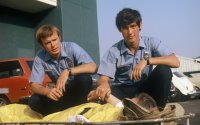
Emergency! aired on NBC for six seasons and introduced the country to the job of the paramedic. (Kevin Tighe as Roy DeSoto and Randolph Mantooth as John Gage).

Emergency! aired on NBC for six seasons and introduced the country to the job of the paramedic. (Kevin Tighe as Roy DeSoto and Randolph Mantooth as John Gage).

For six seasons, using real-life, contemporary techniques, the fictional team of “Squad 51” demonstrated how vital paramedics could be to accident survival rates. Additionally, by shining some Hollywood light on the subject, the show helped ease resistance by doctors who fought the adaptation of advanced medical field support, referring to it as, “remote controlled medicine.”

Paramedics are sometimes referred to inaccurately as EMTs (Emergency Medical Technicians), but there are differences between the two, although regulations and educational requirements can vary. According to the University of Southern California Los Angeles’s Center for Prehospital Care, “EMTs usually complete a course that is about 120-150 hours in length. Paramedic courses can be between 1,200 to 1,800 hours.” But that’s not where the difference ends.

Both fields of study include lectures, clinical and field internships and hands-on skills training such as CPR, administering oxygen, glucose for diabetics and helping to treat asthma attacks. “With very few exceptions, such as in the case of auto-injectors for allergic reactions,” UCLA’s website states, “EMTs are not allowed to provide treatments that require breaking the skin: that means no needles.”

At the time of the “Emergency!” TV series, Los Angeles County, had only about 36 paramedics. But after the show became a hit, applications came pouring in anywhere the programs were offered. As of 2012, StudentDoctor.net reports that there are an estimated 142,000 paramedics and 600,000 EMTs currently working in the United States and that number is growing. From big cities to rural communities, paramedics and EMTs are regularly in great demand.

On September 11, 2001, first responders took center stage, paramedics included, with hundreds giving their lives trying to save the victims of the World Trade Center attacks. Hopefully, our local fire and rescue personnel will never be required to perform such a dire duty, but you can rest assured that if the need would ever arise, they are ready and willing.

I can’t convey how grateful my family was to the men and women of our local EMS (New Jasper Township, in Greene County, Ohio) when I was helping to care for my mother who, in addition to Alzheimer’s disease, also suffered from heart disease. Our emergency medical responders see us at the most difficult, stressful moments of life. So, since we often forget at the time, “Thank You,” from a grateful public to our fire and EMS providers, for all you do to help keep us safe.


Gery L. Deer is an independent columnist and business writer based in Jamestown, Ohio. More at http://www.gerydeer.com


Ignorance: A leading cause of illness in America

In Children and Family, Education, Health, Opinion, Science, Uncategorized on July 14, 2014 at 6:00 pm

DIH LOGOAhead of heart disease and cancer, could ignorance be one of the leading causes of serious illness in the United States? It seems as though, regardless of the facts related to disease prevention, there are literally millions of people who simply choose to take no notice.

First, a definition of the word, “ignorance” as it is used here, so as not to intentionally offend anyone. Ignorance refers mainly to a lack of understanding, education or information. Most of the time, the deficiency of knowledge is unintentional, resulting from inexperience or an educational history lacking in a specific area. However, ignorance can also result from a choice, a conscious decision to disregard certain information, in this case regarding health.

Excessive alcohol consumption, for example, is the fourth leading preventable cause of death in the United States, according to the Centers for Disease Control and Prevention (CDC).  From 2006-2010, the agency reports, excessive alcohol use resulted in, “approximately 88,000 deaths and 2.5 million years of potential life lost annually during that period, costing an estimated $223.5 billion.”

The CDC also reports that nearly 20 percent of Americans smoke, that’s around 43 million people. With nearly one in five deaths now caused by smoking-related illness, why would anyone consciously choose to continue such a disgusting and polluting habit? Denial of the necessity of childhood vaccines may also contribute to preventable disease contraction.

Parents who refuse to vaccinate their children expose them, and those around them, to potentially life-altering illness ranging from measles to polio (poliomyelitis). Because of polio’s recurrence in several African countries, in May of 2014 the World Health Organization declared the resurging polio threat an international emergency stating that it is, “one of the world’s most serious vaccine preventable diseases.” Many experts fear that, if unchecked, it could be brought to the United States and make a devastating comeback due to a fall in newborn vaccinations.

Food is another contributing problem to preventable illness in the United States. Well-educated, intelligent people commonly turn a blind eye to the facts related to diabetes, obesity and cholesterol-related heart disease. More often, Americans tend to choose potato chips and soda pop over a fresh apple or glass of unsweetened fruit juice.

poor choicesIt is one thing when people don’t know about these issues, but it’s quite another if they simply refuse to pay attention or take action. Billions of dollars is spent every year caring for those who may never have become so ill had they taken some basic, precautionary steps.

Of course, regular contradictions between those giving advice on better health and their own behavior also inhibit the effectiveness of patient education. Many healthcare workers are just as guilty as the general public; perhaps even more so because they should, by profession, know better. Why should a patient listen to the recommendations of their healthcare provider if he or she ignores the same information?

How many nurses, doctors and staff are readily seen smoking outside a hospital or other healthcare facility? Logically, it’s hard to grasp how people can work daily around people suffering from diseases that might have either been prevented or mitigated and not take that knowledge to heart for their own health.

In some cases, moderation can help reduce a person’s risks; eating less fat, cutting back on sugar, and limited indulgence in junk food will certainly make a difference. But there is no safe amount of smoking or recreational drug use. It’s all deadly, one cigarette or 50, the body just wasn’t meant to have to process that kind of toxic material day in and day out.

The bottom line is that any reduction in positive health will compromise the body’s ability to fight off disease. When people become ill, they can no longer work, contribute to society or provide for their families. Quality of life suffers for the individual and all of those around them. Ignorance of facts and undisputed medical advice can take a terrible toll on a person – and everyone around them.


Gery L. Deer is an independent columnist and business writer based in Jamestown, Ohio. More at http://www.gerydeer.com.

ATVs are not toys for young children

In Children and Family, Dayton Ohio News, Health, Local News, Opinion, Sports News, State News, Uncategorized on July 14, 2014 at 9:30 am

DIH LOGOSince 1982, there have been nearly 400 Ohio deaths related to the operation of ATVs, short for “all terrain vehicles.” Like any other power machine, the ATV is a safe, versatile vehicle when handled properly by responsible adults, yet their operation is far too often given over to small children.

According to statistics collected between 1982 and 2012 by the United States Consumer Products Safety Commission (CPSC), there have been, nationally, 2,944 ATV-related fatalities of children younger than 16 years of age and 43 percent of them were younger than 12. The CPSC also states that children 16 and under comprised 24 percent of the total number of ATV related deaths.

Unfortunately, these machines are not being treated like the dangerous power equipment they are but instead as if they are children’s toys. It’s not uncommon to see very small children riding these powerful four-wheelers (and there are still a few three-wheelers out there). Any responsibility for accidents must be laid firmly on the shoulders of the parents as well as those legislators who can’t be bothered with increasing safety regulations on these devices.

Currently, age restrictions on ATV operations in Ohio are, in this commentator’s opinion, far too lenient, and logically inconsistent. For example, as of 2014, the Ohio law states that, “to operate an ATV on public lands, one must have a driver’s license or motorcycle endorsement. The Department of Natural Resources may permit a person at least 12 (years of age) to operate on Department land if accompanied by a parent.”

In the next section the regulations state, “No one under 16 may operate an ATV unless on land owned by a parent or accompanied by an adult 18 or older.” It’s as if, in one regulation, the legislators acknowledge the dangers involved in operating these machines and that people should be qualified, licensed drivers. But in the other, just having a parent there qualifies the kid to be behind the handlebars.

When children operate these machines there are two issues to consider: Experience and size. A licensed driver will have had some training and experience behind the wheel and be at least somewhat more experienced than someone who has never operated a motor vehicle. Arguing also that a farm kid can handle it because of tractors and other equipment is ridiculous too. There is a big difference between disking a field and popping wheelies down a hillside on an ATV.

Additionally, as stable as they may seem, to keep all four wheels on the ground, an ATV requires a certain amount of bulk in the form of the rider. Shifting the weight from side to side, similar to riding a bike, is necessary and aids in steering and stability.

A small child of 6 or 7 years old, and maybe 60 pounds on the outside, simply does not have enough mass or strength to control the machine, regardless of its size. Even the smallest of these vehicles is powerful enough to cause a serious accident if not properly controlled and no safety switch or oversized helmet can outmatch the common sense of not letting a little kid ride it in the first place.

The overturned ATV in the Crooked River.Liability is another major consideration. Without getting into the legal issues, it goes without saying that America is a litigious society and special endorsements are required on insurance policies to cover liability issues related to ATV operation. Even if there is insurance, the parents of an injured child can still sue the owner of the ATV or the property where the accident took place.

In the end, the question must be asked, “Is a few minutes of joy riding on an ATV worth risking the safety or perhaps the very life of a child?” For more information, download a complete copy of Ohio’s current ATV laws: OhioATVLaw

Gery L. Deer is an independent columnist and business writer based in Jamestown, Ohio. More at www.gerydeer.com.

Remember this July 4th: Buzzed Driving is Drunk Driving

In Children and Family, Education, Health, Holiday, National News, Uncategorized on July 1, 2014 at 7:02 pm

bottlekeysXenia – The Fourth of July is a favorite American holiday filled with fun, food, fireworks, friends and family. But celebrating can quickly turn to tragedy when people choose to drive after drinking. The Greene County Safe Communities Coalition is urging everyone to plan ahead this Independence Day. Designate a sober driver ahead of time.

“The Fourth of July festivities can be so much fun,” said Laurie Fox, Safe Communities Coordinator. “People make plans for the partying, but too many drivers don’t plan ahead to get home safely.” In all 50 States and the District of Columbia, it is illegal to drive with a blood alcohol concentration (BAC) of .08 grams per deciliter (g/dL) or higher. Even if you’ve had a couple of drinks, you shouldn’t drive. “We’ve seen that too many drivers around Greene County think that it’s OK to drive ‘buzzed.’ The truth is you don’t have to be completely wasted to get arrested for drunk driving. Remember: Buzzed Driving is Drunk Driving.”

Statistics from the National Highway Traffic Safety Administration (NHTSA) paint a grim picture of the effect drunk driving has on America. NHTSA reports that there were 10,322 fatalities involving drunk driving in 2012, accounting for 31 percent of the total motor vehicle traffic deaths for that year. That equals about one alcohol-impaired-driving death every 51 minutes.

Drunk driving fatalities are high year-round, but they typically spike during holidays like the Fourth of July. During the Independence Day holiday in 2012 (which ran from 6 p.m. July 3 to 5:59 p.m. July 5), 179 people were killed in motor vehicle crashes, and of these, 78 (44%) died in crashes involving at least one driver or motorcycle operator with a BAC of .08 or higher. Unfortunately 2012 wasn’t a fluke; from 2008-2012, among all crash fatalities around the Fourth of July, 40 percent—on average—involved drunk
drivers.

Certain drivers are more likely than others to drive drunk. Younger drivers (ages 18 to 34) are consistently over represented in fatal alcohol-impaired-driving crashes. In 2012, almost half (46%) of the young drivers killed in crashes had a BAC of .08 or higher.

Compared to car and truck drivers, motorcycle operators are also over represented in the disturbing statistics from NHTSA: in 2012 fatal crashes, 27 percent of motorcycle operators were impaired.

Nighttime (6pm to 5:59am) driving is particularly dangerous because of drunk drivers—and the July 4th holiday is no exception. During the July 4th holiday period in 2012, the rate of alcohol impairment among drivers involved in fatal crashes was almost 2.5 times higher at night than during the day.

“Here’s what we want people to understand,” said Fox. “Alcohol not only impairs your ability to drive, it impairs your judgment about whether you can or should drive. Sure, you may think you’re ‘fine’, but you’re not. The best thing to keep in mind is simply: Buzzed Driving is Drunk Driving.” Prevent drunk driving by only driving completely sober.

Follow these simple tips for a safe Fourth of July:

• Plan a safe way home before the fun begins;
• Before drinking, designate a sober driver;
• If you’re impaired, use a taxi, call a sober friend or family member, or use public transportation so you are sure to get home safely;
• If you see a drunk driver on the road, don’t hesitate to contact local law enforcement; and
• Remember, Buzzed Driving is Drunk Driving. If you know people who are about to drive or ride while impaired, take their keys and help them make other arrangements to get to where they are going safely.

The Greene County Combined Health District is a Safe Communities grantee of the Ohio Department of Public Safety Ohio State Highway Patrol-Traffic Safety Division. To contact Greene County Safe Communities, please call 937-374-5669 or email lfox@gcchd.org. More information on avoiding impaired driving can be found at www.trafficsafetymarketing.gov.

Cause and effect of drug advertisements

In Business, Education, Health, National News, Opinion, television, Uncategorized on June 26, 2014 at 10:37 am

DIH LOGOAccording to a 2008 study by the peer-reviewed medical journal, PLOS Medicine, pharmaceutical companies spend nearly twice as much on marketing than research. In a review of the study, the consumer advocacy website, Consumerist.com, indicates, “Drug companies pour $57.5 billion into marketing, dwarfing the comparably paltry $31.5 billion devoted to research.”

Pharmaceutical manufacturers have rigid guidelines for promoting their products, but the question lingers: should non-over-the-counter drugs be promoted to the general public at all? The short answer is, probably not. The longer answer is more complex. Since, as a rule, Deer In Headlines deals with “fact,” not “truth,” here are some facts about drug advertising. Incidentally, if it is truth you’re interested in, check out a philosophy column (thanks Dr. Jones).

The official website of the United States Food and Drug Administration states, “Prescription drug advertisements can provide useful information for consumers to work with their health care providers to make wise decisions about treatment.” Leading the pack of heavily-marketed drugs are prescription sleep aids, blood thinners, anti-depressants and erectile dysfunction remedies. Most of the television ads for these medications appear during the day, carefully targeting certain markets.

What the general public fails to realize, however, is that these ads are intended to plant an idea in the head of the consumer who, in all their medical wisdom, will take the information to a doctor and insist on a prescription. Mission accomplished; more drugs are sold and the company’s stock goes up a quarter of a point, not to mention the fact there is one more person who simply can’t live without the latest pill. Perhaps a better understanding of how these ads are structured might help.

pillsThe FDA’s Office of Prescription Drug Promotion classifies medication advertisements into three categories: Product Claims, Reminders, and Help-Seeking ads.  The product claim ad names the drug, the treated condition and lists the benefits and risks. A reminder ad shows the name of the drug, but not its use. Finally, the help-seeking advertisement is directed at people with a particular condition for which they are trying to find a remedy. There is, however, no guideline for how much money a drug company can spend on advertising and some consumer advocates argue that it’s wrong for them to be able to spend more on marketing than research.

The fact is that it’s really hard to say exactly how much any one drug company spends on research vs. marketing because reported advertising expenditures are mixed in with the accounting category which also includes other figures, such as executive salaries. Research money is usually accounted for in a separate line item (R&D), even though it technically could be in the same classification with general operation costs.

Another fact is that everyone is a medical expert – yes that’s sarcasm. From the neighbor with every ailment more painful than the last or the relative who insists his doctor is an idiot but goes back every time his prescription runs out, self-diagnosis and treatment are a real epidemic in America.

There is also the concern that these advertisements actually plant the idea of a particular illness in the mind of the viewer who then heads to the doctor with a new problem, and a new prescription demand. Studies show that about 40-percent of all doctor visits are with the intention of getting a prescription. Since people keep going back, it’s safe to assume there are plenty of doctors obliging, and that needs to change as well.

Prescription medication should be marketed to the experts who will be prescribing it to the patient. Drug companies already spend billions on advertising and on-site sales representatives who offer samples and various other motivators to get the doctors to push their products for various ailments. The patient has no business self-prescribing and doctors need to be more responsible.


Gery L. Deer is an independent columnist and business writer based in Jamestown, Ohio. Side effects of reading Deer In Headlines include a more open mind, alternative points of view and a better understanding of the world around you. No prescription necessary.


UPDATE: CFL bulbs save money, but threaten safety

In Children and Family, Dayton Ohio News, Environment, Health, Home Improvement, Opinion, Politics, Science, Technology, Uncategorized on June 10, 2014 at 8:40 am

GLD_CFL_TV2_SCREENSHOTSpecial Update / Editor’s Note: This article was originally published in November of 2013 and updated in April 2014. Since that time, and investigative report by Pam Elliot at WDTN-TV, 2News in Dayton has yielded the following information on the dangers of CFL bulbs.

Deer In Headlines author and Jamestown Comet publisher, Gery L. Deer, was tapped as the initial interview source for the investigation based on the content of this edition of his column. Here for you is the video from that investigation which aired on Monday, May 19, 2014.

Click here for a link to the full 2News investigative story which includes suggestions for the safe use of CFL bulbs.


dih-logo-SEApril 7, 2014 – The incandescent light bulb was developed in 1876 by Thomas Edison, founder of General Electric. But as more energy efficient technology is introduced, even Edison’s greatest achievement has been all but extinguished forever. On September 24th, 2013, it was announced that the last of the incandescent light bulbs had rolled off the GE assembly line to be replaced by compact fluorescents, or “CFLs.” The spiral-twisted tube bulbs use low-energy, fluorescent technology and there is really nothing cutting-edge about them, except for their size and the potential fire risk when they go bad.

Fluorescent lighting has been around since the late 19th Century, but wasn’t developed for widespread use until the 1930s. Less expensive to operate than their incandescent counterparts, most of the bulbs last longer and are safe for everyday use. But as the environmentalist lobby pushes for more energy-efficient or, “green,” technology, has the heightened concern for the environment surpassed that for human safety? Recently I went into my kitchen and switched on the light over the sink, as I did countless times throughout the week. I left the room for a moment and when I returned it was dark, the familiar morning glow of the light fixture having just been replaced with the smell of burned ceramic and melted plastic. Upon investigation I discovered that the CFL bulb in the overhead light had quite literally burned out.

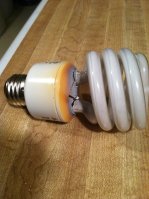
20W CFL Bulb from Gery Deer's kitchen.   Photo by Gery L. Deer

20W CFL Bulb from Gery Deer’s kitchen. Photo by Gery L. Deer

Just before it went dark, the 20-Watt, General Electric CFL bulb I had installed a few months earlier had gone so hot that it flamed through the plastic and ceramic base, causing it to melt and crack at the bottom of the glass tubing. The discovery of such a potential fire hazard was, to say the least, surprising, but apparently the problem is well-documented and manufacturers have been aware of it since the product’s release.

In a Snopes.com article John Drengenberg, consumer affairs manager at Underwriters Laboratories (UL), said about how CFLs expire, “People expect to see the bright flash and to hear the popping like a traditional incandescent bulb, but the burn out of a CFL is different. The light dims over time and might produce a more dramatic pop, emit a distinct odor, and maybe even release some smoke.” Drengenberg is referring to the Voltage Dependent Resistor (VDR). The CFL burns out when the ballast overheats, causing the VDR to open the circuit like a blown fuse and prevent any hazards.

Instead of resulting in a mild puff of smoke, however, the heat generated can, as in my case, burn through the base. As I dug deeper into this issue, I discovered countless articles, videos and online debates regarding the safety of CLF lighting and how there might be more to their compulsory introduction than simply reducing energy costs. It’s important to note here that Underwriters Laboratories is not a government agency but a private company paid by manufacturers to “certify” the safety of their products.

DP&L has a vested interest in getting these bulbs out to the public. It's unclear where that interest lies, but here is the proof - a Walmart display in Xenia, Ohio offers huge discounts.

DP&L has a vested interest in getting these bulbs out to the public. It’s unclear where that interest lies, but here is the proof – a Walmart display in Xenia, Ohio offers huge discounts.

In the early 1990s, I worked for a major appliance manufacturer as an engineering technologist following UL guidelines in operational and safety testing of ovens, ranges and cook-tops. In my experience, a bit of heat and smoke being released from a popping resister is, by itself, not enough to cause the kind of damage apparently so common with this product.

I am well aware of UL testing practices and it is beyond my comprehension how anything short of political pressure could be responsible for the approval of a consumer electronics product that literally lets flame out of its casing. From a consumer standpoint, it’s baffling to me how UL, or the Federal Trade Commission – the governmental agency responsible for consumer safety, can justify the approval of a device that clearly presents a fire safety hazard under “normal use” conditions. Incidentally, the CFLs also contain mercury, another potential environmental health hazard often conveniently overlooked.

It is entirely possible that these products were rushed to market, not so much to help reduce pollution or save money for the consumer, but to further a political agenda. Whatever the reason, the consumer should be aware of the inherent dangers and always be careful when using CFL lighting.  (End original story.)

Here are some detailed photos of the original, failed bulb. General Electric requested it be returned for investigation (we have complied).


UPDATE : June 6, 2014 – Today Gery L. Deer received several boxes of light bulbs from General Electric (Pictured below). The shipment included several packages of original, incandescent bulbs and several packages of LED bulbs. Once again, it is important to note that Gery insisted to GE’s representatives, by phone, he was not looking for any sort of restitution, but simply wanted to make the public aware of the dangers surrounding these bulbs. But, here they are anyway.

An assortment of incandescent and LED light bulbs sent to Gery L. Deer by General Electric on June 6.

An assortment of incandescent and LED light bulbs sent to Gery L. Deer by General Electric on June 6.


VIDEO UPDATE: June 10, 2014 – Hard to believe – ANOTHER shipment of LED light bulbs from General Electric. These are of a totally different style and are said to “distribute” light more efficiently. Watch the video for a complete follow up.


Jamestown Comet Editor Gery L. Deer is an independent columnist and business contributor to WDTN-TV2’s Living Dayton program. More at www.gerydeer.com.

V.A. health care debacle is nothing new

In Health, National News, News Media, Opinion, Politics, Senior Lifestyle, Uncategorized on May 27, 2014 at 8:06 am

DIH LOGOAs an organization that serves more than 9 million, it would be difficult to imagine a more complicated system than the United States office of Veterans Affairs (V.A.). Recent allegations of wrong doing within the V.A. health care system has erupted in congressional investigations and strong admonishment from President Obama, one of a half-dozen occupants of the Oval Office under whom this system has thoroughly failed its distinguished beneficiaries.

Naturally, the White House spin doctors tried to express the president’s astonishment and outrage over this issue with their typical press room song and dance. When he finally spoke about the matter publically last Wednesday, Mr. Obama said, “I will not stand for it. There must be consequences.”

Of course there was absolutely no mention of exactly what kinds of consequences.  Even more insulting was the way the administration has fained ignorance about one of the worst kept secrets in America – that there is a mind-blowing level of back-door politics and bureaucracy grinding away below the V.A.’s spit and polished façade.

In the 1992 movie, "Article 99," Kiefer Sutherland struggles to adapt to a broken V.A. system.

In the 1992 movie, “Article 99,” Kiefer Sutherland struggles to adapt to a broken V.A. system.

Critics of the administration are also using this crisis to, once again, lambaste Democrats over Obamacare, to which they compare the crippled V.A. medical system. Some of them have even suggested that the problems deep in the core of the V.A. health care system will eventually overwhelm Obamacare in a similar manner.

Plagued with technical issues and lackluster participation, the “Affordable Care Act” has not been the overwhelming success once envisioned. Legislating mandated health care coverage for all is one thing, but managing patient care based on politics is quite another.

But if you think it’s a stretch to compare the V.A. problems with eventual Obamacare snags, consider this.  Once the Affordable Care Act became law, the U.S. Government suddenly turned into a middle man for selling health insurance and controlling the care received by the patients. Keep in mind this isn’t a “Conservative vs. Liberal” problem. The simple lesson to be learned here is that the government should stay out of the health care business.

As for the existing V.A. problems, the congressional hearings so far have managed to do little more than humiliate the head honcho, Veterans Affairs Secretary Eric Shinseki, a guy who, while maybe turning a blind eye to these concerns, most certainly inherited the majority of them.

Way back in 1992 director Howard Deutch released a dramatic comedy  called, “Article 99,” which followed a V.A. hospital intern played by Kiefer Sutherland who struggled to acclimate in ridiculously bureaucratic and money-driven system where patients are either denied treatment or made to wait months for life-saving procedures until it’s too late. In a style similar to Robert Altman’s original 1970 film, “MASH,” the main characters are dedicated doctors who regularly defy government rules to help get their veteran patients urgently needed care.

Set in present day – 1992, during the Clinton administration – “Article 99” exposes only a few known problems within the veterans’ health care system. Apparently, things grew increasingly worse.

Oddly enough, government’s treatment of veterans (of all ages) can often mirror the way in which American society deals with the elderly; by putting them off a few more times until they eventually die and the problem solves itself. Shameful.

Perhaps it’s time for the V.A.’s executives, congress and the president, maybe even Supreme Court justices, to be forced to wait a ridiculous amount of time for care. It’s a foregone conclusion that a solution would rapidly appear if the Obama daughters had to wait six months to get their tonsils out, or if John Boehner knew that coverage for some future tanning-induced skin cancer would be denied because it wasn’t a work-related condition. Instead, they enjoy free, top-of-the-line medical care, all on the dime of hard-working Americans, including veterans.

So what to do? Well making a blustering speech on TV is a start, but it’s also an overture to a lack of any real action. Firing the head guy is a gesture to appease the public but it’ll last about 12 seconds. Instead, the entire system needs a full shakedown. That’ll take time and money. Meanwhile, more veterans are waiting for treatment. Drop the bureaucracy and treat the patients, regardless of the paperwork and expense.


The Jamestown Comet editor, Gery L. Deer, is an independent columnist and business writer based in Jamestown, Ohio. More at http://www.gerydeer.com.


More family advocacy needed for elder care

In Children and Family, Health, Opinion, psychology, Religion, Senior Lifestyle, sociology, Uncategorized on April 16, 2014 at 1:31 pm

DIH LOGOCaring for an aging parent is, in my opinion, one of the most difficult and often painful experiences life throws our way. Providing a safe, healthy environment for an elderly family member is just as taxing as doing the same for a child.

What makes this process even harder is when the parent is resistant to help or simply won’t accept that they are no longer in a position to take care of themselves. Poor decisions, an inability to recognize when driving has become hazardous and, worst of all, when they will listen to anyone’s advice but that of their children, complicates the care process and causes serious damage to the parent/child relationship.

It’s hard to watch parents age and knowing you’re headed the same direction only solidifies the reality of it all. It’s harder still when they resist every attempt to maintain their health and sometimes doctors undermine your efforts by telling them they don’t have to do anything they don’t want to.

I understand that people need to make their own choices, but some shrink in a hospital cannot possibly know an individual’s mental status by talking to them once for three minutes and asking a half dozen pointless questions. “Do you know where you are? Do you know what day it is? Can you draw this box? Write your name.” “Draw this box,” are they kidding?

How about we ask them what their checking account number is, or the name of their insurance company? How about asking when they last paid their phone bill? These are vital questions to someone who is supposedly “competent” and yet this is not what is included in a psychiatric evaluation for a senior’s ability to make his or her own decisions.

Then there are those who are intent on taking advantage of the elderly person’s desire to feel “needed” and useful. These individuals worm their way into the lives of the elderly, showering them with compliments and creating a rift between the senior and his or her family. These unscrupulous people are trying to get money and property away from the senior and alienate children and others who are trying to protect their interests.

Deer In Headlines author Gery Deer is helping his brother Gary Jr and sister Cathy to take care of their father, Gary Sr. and it's rarely easy work.

Deer In Headlines author Gery Deer is helping his brother Gary Jr and sister Cathy to take care of their father, Gary Sr. and it’s rarely easy work.

Laws addressing the rights of seniors, as well as those regarding patient rights, seem to take no account to dementia and speak only to protecting them from family members bent on securing money or locking them away in a nursing home. What about those of us who are trying to protect our parents and provide a safe, secure life for them in their own home as long as possible? Where is our protection and support? There is none.

Preserving a person’s dignity is difficult enough without being able to handle even the most basic decisions absent a mile of legal documents in place only to provide more money for lawyers. Power of attorney documents are meaningless unless the person is thoroughly incapacitated and no one will help without signing over deeds and financial statements.

Believe it or not, sometimes money has nothing to do with it! There are actually situations when families are trying to preserve an aging parent’s lifestyle, dignity and financial security. Someone should be out there advocating for us, not making it harder. Unless you’re loaded with money, there is just no support for people dealing with this kind of problem.

So what is to be done? Good question. I am all for protecting the rights of the elderly and maintaining their ability to make decisions, but there are many degrees of incompetence between fully cognizant and Alzheimer’s dementia and that should be taken into account.

My mother lost all of her reasoning ability as Alzheimer’s set in and it nearly bankrupted my family to get her under a guardianship so we could keep her safe and well-cared for. But when a senior has some competence but not all, that needs to be addressed and the family should be able to have some advocacy for protecting the interest of that individual without so many roadblocks.

Legislation should be put into place for the varying degrees of dementia and stop relying on the ‘one size fits all’ psychiatric evaluations that prove nothing more than the person can read a calendar.


Gery L. Deer is the editor and publisher of The Jamestown Comet.com an independent columnist and business writer based in Jamestown, Ohio. More at http://www.gerydeer.com.


Crafters Lodge to host two-day t-shirt quilt workshop

In Business, Children and Family, Education, Entertainment, Health, Holiday, Local News, Senior Lifestyle, Uncategorized on April 16, 2014 at 1:20 pm

CLLOGOSugarcreek Twp., OH – Nearly every event a student attends as he or she goes through school is commemorated by a t-shirt. Crafters Lodge in Sugarcreek Township, is providing a two-day course on transforming those keepsake tees into a cherished family heirloom – the t-shirt quilt.

On Sunday April 27th and Sunday May 4th, Crafters Lodge, located at 6056 Wilmington Pike, just behind Fazoli’s, will host a t-shirt quilting class. The two-day class will provide complete instruction, from start to finish, for a fee of $35 for both days, not including materials. Participants must purchase their own supplies and costs vary based on the materials chosen.

A t-shirt quilt is made up of the artwork from cherished t-shirts commemorating everything from a student’s first day of school or high school prom to concerts and extracurricular events. The artwork is cut from the fronts and backs of the shirts and sewn together to make a quilt. Jo Beth Bryant is co-owner of Crafters Lodge.

“Registered students should stop by the store at least two or three days prior to the first class for instruction on how to prep the T-shirts,” Bryant says. “Having the shirts prepped prior to class will allow the student to begin the layout and design process sooner and thus finish the quilt in a shorter amount of time.”

Teaching the upcoming class is life-long needleworker, Wendy Crawford. A veteran of 4-H and Girl Scout sewing competitions, Crawford started making baby quilts while in junior high school.  She turned to hand quilting after inheriting a quilter’s estate and is now a certified Gammill (Long Arm) operator with more than 350 quilts under her belt. Today, she enjoys sharing her knowledge with the local community after an absence from teaching.

Crafters Lodge opened in September of 2013 and offers high-end supplies and expertise to the serious crafter. In addition to the t-shirt quilting course, the store also offers classes in fiber arts (knitting, weaving, tatting, etc.), tole painting, stained glass and more.

Registration for the t-shirt quilting class is limited and participants are required to bring their own sewing machines. Crafters Lodge is open Tuesday through Saturday 11:00 am to 8:00pm, Sunday noon to 6:00 pm and closed on Monday. For more information and a schedule of classes, visit the store’s website, http://www.crafterslodge.com or call (937) 470-2649.


Campaign educates drivers about distracted driving

In Children and Family, Education, Environment, Health, Local News, Technology, Uncategorized on April 2, 2014 at 7:19 pm

DDXENIA, OH – In an effort to make our roads safer, the Greene County Safe Communities Coalition announced today that it has joined the “One Text or Call Could Wreck It All” campaign to stop distracted driving.  April is National Distracted Driving Awareness Month and the Coalition has pledged its support to help spread the message that distracted drivers are not only a danger to themselves, but everyone else on the road.

“We all know that talking on our cell phones while driving is distracting, but that doesn’t stop most people from continuing to do it,” said Laurie Fox, Safe Communities Coordinator.  “This effort is intended to educate our community about the dangers of cell phone use and other distractions while driving.  We hope that once people see the statistics and realize the danger involved, they will change their driving habits to help protect themselves, their families, and others on the road.”

In 2012, 3,328 people were killed in crashes involving a distracted driver and an estimated additional 421,000 were injured in motor vehicle crashes involving a distracted driver. That same year, eleven percent of fatal crashes were reported as distraction-affected crashes.

While anything that takes your eyes off the road, hands off the wheel, or mind off the task of driving is a hazard, there is heightened concern about the risks of texting while driving because it combines all three types of distraction – visual, manual and cognitive.

The national distracted driving effort focuses on ways to change the behavior of drivers through legislation, enforcement, public awareness and education – the same activities that have curbed drunk driving and increased seat belt use.

“Every driver in Greene County has a role in this effort,” said Fox.  “However, we especially want to reach out to parents with teen drivers because we know that statistically, the under-20 age group had the highest proportion of distracted drivers involved in fatal crashes.”

The Coalition’s goal is simple – save lives by getting drivers to remember that “One Text or Call Could Wreck It All.”  All drivers are encouraged to put down the phone and arrive alive.

For more information about distracted driving, please visit www.distraction.gov, or you can contact Laurie Fox at 937-374-5669 or lfox@gcchd.org.