The theme for this year’s Kettering, Ohio Holiday At Home Festival is “Hometown Celebrities.” Everything kicks off on Saturday, August 31st, with the Annual Holiday at Home Gala and runs through Labor Day, Monday, September 2nd. This year’s honorary parade Grand Marshal is Kettering native, actor Gary Sandy, best known for his role as Andy Travis on TV’s “WKRP in Cincinnati.”
Originally known as the Coronation Ball, the Holiday at Home Gala started in 1969 as a tribute to the festival queen and her court. Although the event no longer crowns a queen, that tradition has been replaced by presenting a series of scholarships for young people in the community. Scholarship winners, along with this year’s grand marshal, city officials, and event sponsors, are recognized at the Gala. The semi-formal event includes dinner, music, and dancing.
On Sunday and Monday, the Children’s Zone offers free games and activities for children of all ages, free live music throughout the weekend, and various shopping and food options. The festival features arts and crafts vendors from all over the region and a wide variety of food vendors. This year’s sponsors include Alta Fiber, City of Kettering, DryTech Exteriors, Kettering Health Network, and Marion’s Piazza.
Car buffs will enjoy two shows during the festival. Sunday features a Volkswagen show, and Monday is the Invitational Car Show, which showcases a variety of classic vehicles specially chosen to exhibit at the event.
Lisa Rusak is the president of this year’s Holiday at Home Festival planning committee. “We appreciate all of our volunteers, committee members, and sponsors, and the City of Kettering for helping to make Holiday at Home the highlight of the community’s year,” she said. “We invite visitors from all over the region to come and enjoy everything Holiday at Home and the City of Kettering have to offer.”
This year’s festival musical entertainment includes Flashback Band, The Fries Band, 5 Band, Noah Kihn, Until Rust, Cory Breth, and Noah Back.
The highlight of the event, the Holiday at Home Labor Day Parade, kicks off at 10 a.m. Monday. This year’s Grand Marshal is Bruce Duke, a long-time resident and former Kettering City Council Member.
Duke came to Kettering in 1974 when he started working at the University of Dayton (U.D.) as a staff psychologist in the Counseling Center. He continued until his retirement as Assistant Director of the Counseling Center in 2001. During his time at U.D., he earned his PhD in Counseling from The Ohio State University in 1981.
Duke has been an active community member throughout his time in Kettering. Over the years, he’s served on the Board of Community Relations and the Board of Directors of the Kettering Children’s Choir, coached youth soccer, and, with his wife Jan, served on the Van Buren Parent Teacher Association. He’s been a member of the Dor-Wood Optimist Club for nearly two decades and served on the Kettering City Council, representing District 4, for 37 years.
As a wonderful addition to the parade festivities, actor Gary Sandy is this year’s Honorary Celebrity Grand Marshal. A hometown native and graduate of Wilmington College, Sandy is best known for his role as Andy Travis on TV’s “WKRP in Cincinnati.” Visit www.holidayathome.org for more details about this year’s Grand Marshal and a complete event schedule, including entry instructions for the car show and 5K.
(Editor’s Note: This is an extended edition of the June 19, 2024 print edition of Deer In Headlines II. Throughout the piece you’ll find links to IMDB pages and YouTube videos which give you more information and even let you watch episodes of the shows mentioned. One link is a full documentary of the events surrounding a 1984 episode of the show, “Press Your Luck.” I hope you enjoy it.)
See if any of these titles spin your wheel: “To Tell the Truth,” “Truth or Consequences,” “Press Your Luck,” “Password,” “Card Sharks,” “The $64,000 Question,” “Who Wants to Be a Millionaire,” “$100,000 Pyramid,” “What’s My Line.” – the list goes on. Welcome to the world of television gameshows, a uniquely American invention that has endured long past the time any survey might have said it would.
Television game shows hit the air almost the moment picture tubes began to glow in households nationwide. The genre may change over the years, and some are downright ridiculous. But whatever you think of them, these programs continue to be a popular influencer of American culture.
According to broadcast historians, the first game show was a radio quiz show called “Brooklyn Eagle Quiz on Current Events.” It debuted in 1923 on WNYC, New York, but eventually achieved national broadcast status, setting the stage for all that would follow.
Game shows are categorized by how the contestants play. Quiz shows, like “Who Wants to Be A Millionaire,” rely on a question-and-answer trivia format. Panel shows, like “Match Game,” use groups of celebrities to move the game along. Activity-oriented programs, such as the more recent “Total Wipeout,” require contestants to do something physical. Reality game shows and talent contests, like “Survivor” and “American Idol,” are relatively new formats. However, it could be argued that shows like “The Gong Show” and possibly Ed McMahon’s “Star Search” were Simon Cowell’s inspiration for programs like “Britain’s Got Talent” and “Idol.”
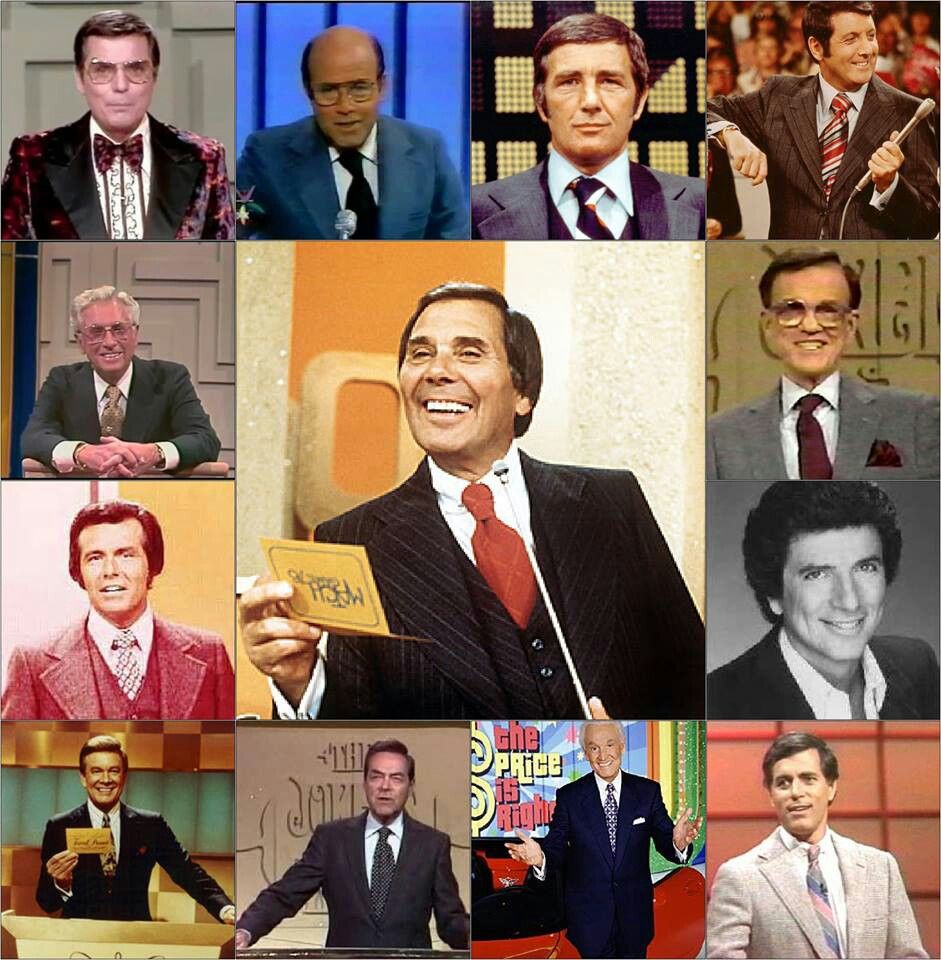
From the 1960s through the 80s, producers of these programs were prolific and turned their hosts into stars. The list includes such performers as Gene Rayburn (Match Game), Monty Hall (Let’s Make A Deal), Allen Ludden (Password), Gary Moore (To Tell the Truth), Chuck Woolery (Wheel of Fortune/Love Connection),Tom Kennedy (Name That Tune), the late Alex Trebek of “Jeopardy!” fame, and many others. As “Wheel of Fortune” host Pat Sajak takes his final spin in June 2024, Ryan Seacrest joins the ranks with other more recent additions like Steve Harvey (Family Feud), Howie Mandell (Deal or No Deal), Keke Palmer (Password, 2022), and Jane Lynch (The Weakest Link, US).
A “host” of hosts … Peter Marshall, Joe Garigiola, Richard Dawson, Monte Hall, Allen Ludden, Gene Rayburn, Bill Cullen, Bob Eubanks, Burt Convey, Wink Martindale, Jack Barry, Bob Barker, and Peter Tomarken.
Many shows started at local TV stations and grew in popularity until they became network products. Although most began at the network level, produced either in New York or Los Angeles, there were a few locals. Around 1975, the Dayton, Ohio edition of “Bowling for Dollars,” a sort of franchised show package that any station could license, was hosted weeknights by long-time radio personality, David G. McFarland. Most local stations chose the cheaper option, however, which was simply to air pre-produced programs like “Wheel of Fortune,” saving thousands on production costs.
At the network level, a staggering amount of money was generated by advertising, and show producers wielded a great deal of power over daytime television. Mark Goodson and Bill Todman produced such long-running shows as “The Price is Right” and “Match Game.” Their programs still generate ratings and money, even the reruns. Chuck Barris helmed “The Newlywed Game” and several others. Talk show host and producer Merv Griffin is responsible for two of the most popular shows still in production: “Jeopardy!” and “Wheel of Fortune.”
“Beat the Clock” started on the radio in 1948 and continued on television in various formats through 1980. Mark Goodson and Bill Todman produced the network TV versions.
Virtually every network scrambled to fill morning daytime slots with gameshows, from card games to shopping sprees. Every type of game or activity was being turned into a gameshow. Even PBS had a game show at one point called “Think Twice,” starring Monteria Ivey. Needless to say, it didn’t last very long.
Like other media, game shows have had their share of scandals over the years. The one with the farthest-reaching repercussions was the 1950s quiz show, “Twenty-One.” Advertisers and producers colluded to provide breakout contestants with quiz answers to keep them in the game longer and drive drama and viewership. Once discovered, convened hearings to determine how the scandal would affect future programs. Eventually, legislation was passed to limit advertisers’ influence over the outcome of these contests.
When he finally became a contestant on the show, Larsen focused on one particular pattern with every spin and timed his hit of the buzzer to stop the board at just the right moment. Through 40 spins, he avoided the prize-stealing “Whammy,” racked up his cash, and went home. The incident was not exactly scandalous, but it was certainly embarrassing for the network.
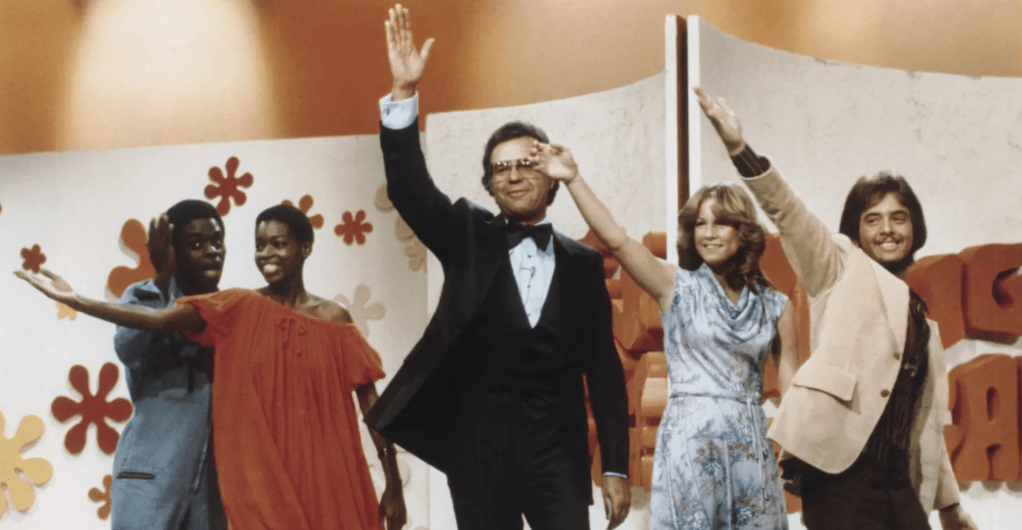
Photo: Jim Lange (center) on ‘The Dating Game’. EVERETT COLLECTION. The Dating Game (1965–1973, 1978–1980, 1986–1989, 1996–1999, 2021)
“Press Your Luck” has seen at least one reboot over the years, but after that incident, the gameboard’s electronics were greatly modified. As for Larsen, he lost a good bit of his money to a home robbery and bad financial decisions. Sadly, he died of cancer just 15 years later at the young age of 49.
Today, three long-running game shows still rule the airwaves: “Jeopardy!,” “The Price is Right,” and “Wheel of Fortune.” “Wheel” and “Jeopardy!” are syndicated programs airing at different times in local markets. However, “The Price is Right” remains a network behemoth that still anchors the CBS daytime lineup.
With its famous phrase, “Come on down,” inviting audience members to Contestants’ Row, “The Price is Right” is the longest-running game show on television. It debuted in 1956 but was revamped some years later. Prior to that, the program was hosted by the venerable “dean of game show hosts,” Bill Cullen. Don Pardo, later of “Jeopardy” and “Saturday Night Live” fame, was one of his announcers.
In 1972, CBS debuted a new, more modern version of the program. The network eventually broke convention by expanding from the typical 30-minute format to a full hour, capitalizing on the show’s wild popularity. They also tapped popular “Truth or Consequences” host Bob Barker to become master of ceremonies. The success of the new format led to a syndicated evening version hosted by Dennis James, also one of the earliest game show hosts.
Today, “Price” is the longest-running television game show at more than 9,000 episodes and Barker spent the last 35 years of his career holding the mic. Upon Barker’s retirement, comedian Drew Carey stepped in during the 2007 season, again giving it a fresh look and attracting a younger demographic.
As Ryan Seacrest assumes the role of spin-maestro on “Wheel of Fortune,” the rest of the show will stay pretty much the same. Vanna White will stay on, although her purpose seems superfluous at this point given the electronic nature of the puzzle board’s letters. She is apparently still needed to tap on a digital screen while someone in the control room pushes a button to reveal the letter.
Game shows generally offer a glimpse of ordinary people in an extraordinary, albeit artificial, situation. Behind door number three, each contestant can hope for a new car, and Monty Hall (and now Wayne Brady) always has a smile and a cash prize for finding that one random object in their pocket.
Those not lucky enough to appear on stage or failed to beat the clock, the buzzer, or whatever received the “home version” of the game they were on.
Some game shows, like Hall’s “Let’s Make A Deal,” are pure silliness, while others offer contestants the unrealistic promise of fulfilling their dreams (at least financially). But modern talent and reality gameshows, like “American Idol,” “Survivor,” and CBS’s “Big Brother,” dangle fame and fortune before their contestants, luring viewers in with contrived drama and fake infighting.
I know what I’m talking about, here. I was a compensated performer on NBC’s “America’s Got Talent” (AGT) in 2006. I met many of the contestants and witnessed their hope and agony as they struggled to meet sometimes impossible demands of producers. The show is crushing to those who compete, some of whom are seasoned, talented performers hoping for a break.
These programs never reveal to the audience the manipulation that goes on behind the scenes as producers subject the performers to the scrutiny of unqualified, B-list celebrity judges. Easy money? Hardly. Quiz shows can be fun and quick entertainment for contestant and viewer. But contests like AGT are arduous, dejecting, sometimes even humiliating for the contestants.
Sadly, it’s unlikely this particular form of gameshow is going away anytime soon. Talent and reality gameshows rake in millions of dollars in ad revenue for every episode, each artificially sweetened and chock full of “unscripted” flavor.
Fear not—the old-school gameshow format is making a resurgence. Thanks to connected TV, you can stream hundreds of these daytime diversions from nearly every decade since their inception. Amazon Prime even includes a channel called Buzzr, a gameshow buff’s paradise that runs them all day, all the time. (Buzzr is owned by Fremantle, the successor owner of the Mark Goodson-Bill Todman game show library.)
Like any other television programming, gameshows must be taken for what they are – mindless diversion. They were never meant to be Shakespeare or Ibsen. As children they often helped pass sick days home from school or gave our mothers something to do while ironing. However you experience them, they’re here to stay. So, until next time, this is Gery Deer saying, “Help control the pet population. Have your pet spayed or neutered. Goodbye, everybody.” (Special thanks to Bob Barker.)
“It’s nine o’clock on a Saturday. The regular crowd shuffles in.” Those are the first lines of Billy Joel’s “Piano Man,” a song that always transports me back to my college days. To help pay for school, I was the pianist at a small Italian restaurant. Even in the 80s, it was old-fashioned, with one large room outlined by raised booths along the walls and a few floor tables in the middle. The decor was, what’s the word, beige. Yep, a lot of beige. Or was it brown? It’s tough to be sure because the lighting was pretty low.
Every Friday and Saturday evening, for about three hours, I performed all instrumentals on a small studio upright. I was like a live Muzak machine without the lyrics. I. Did. Not. Sing. Period. No one would have wanted to hear that. You might as well go outside and toss an alley cat into an upright trash can for that cacophony.
I had a repertoire of about 250 pieces, mostly pop and oldies, but I tossed in the occasional classical number just to show off. A quiet tinkling of “Fur Elise” goes particularly well with linguini, and the leg of lamb begged delivery of Bach’s “Sheep May Safely Graze.” I can’t read music, so everything was by ear. I memorized each song pretty much the first time it fell from my ear to my hands. Regulars would often bring a tape of some song they wanted me to play, and I’d learn it before their next visit.
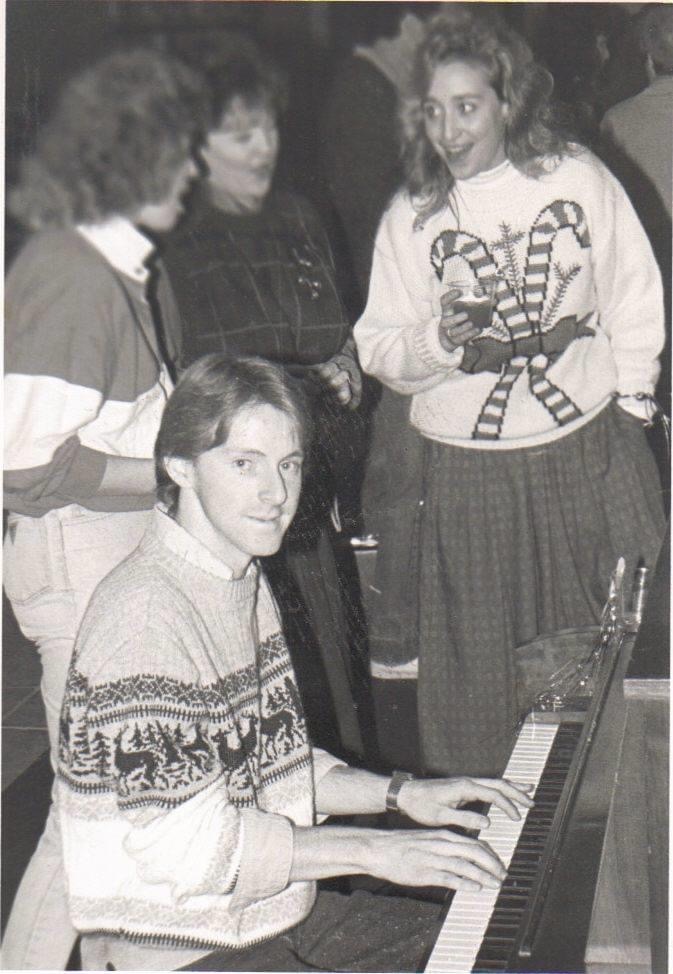
“Piano Man” Gery Deer, performing for a holiday event at Sinclair Community College in 1988.
Once in a while, I’d break out the occasional show tune. On slower nights, I’d rearrange some old TV show theme song into a long, drawn-out ballad. You should hear my dramatic rendition of “Gilligan’s Island” at half speed with Liberace-esque flourishes. People would ask if it was some rare piece by Rubinstein or Mozart. I’d reply, “Oh, no. It’s an original by Schwartz (Sherwood, that is – go look it up).
Playing in a restaurant isn’t all tickling the ivories and clever combinations of sets. It’s more about the people. Unlike a “piano bar” or dueling pianos show, restaurant performances are more atmosphere than anything else. Still, although I got paid for my hours on the bench, my livelihood really depended on tips.
Depending on the traffic, my available talent that evening, and the generosity of the customers, I could have a forty-dollar or four-hundred-dollar night. The latter required some people skills. I was unable to respond with more than a smile or nod when someone tipped me while I was playing. So, I’d take a break at my first opportunity and walk over to their table to thank them.
Here’s a secret about restaurant or bar piano players. We are always watching you. No, I didn’t care what you ordered. I never gave a thought to how stingy you were about tipping the waitstaff after spending a ridiculous amount on too many bottles of cheap wine. Nor did it matter to me that your date’s dress was so short your wife would certainly have disapproved.
No, I was studying my audience’s reaction. It was gratifying when people clearly enjoyed my work and that it added to their evening experience. If a table was paying particular attention to one kind of music, I’d adjust my set list accordingly. More often than not, a request or early tip came from one of those parties, generally the lady of the table. I think the guys were embarrassed to come up to me. I have no idea why.
During my three years there, I also learned a great deal about human behavior. Restaurants only provide a two-dimensional view of human interaction, but it’s alive with celebrations, sadness, gluttony, and togetherness.
I was very young then, so I also learned a lot about myself, particularly that I was more introverted than I’d ever realized. I’d like to think my music always improved someone’s day and that it still does. At least, I hope so.
If a street or restaurant musician ever makes your day just a little brighter, please take time to tell them so and drop a few bucks in their jar. You’ll make their day and yours, too.
Have you ever considered a microcosm? Chances are you haven’t, but we are exposed to them almost every day. Essentially, a microcosm is anything in miniature that represents something bigger. For our purposes, a microcosm is a small group or community whose characteristics represent a larger one.
We see microcosms everywhere, and we’re usually unaware of them. Some are fictional, existing only in books, movies, television, and theatre. Others are happening around us, whether we’re integrated participants or outside observers. Let’s look at a couple of examples.
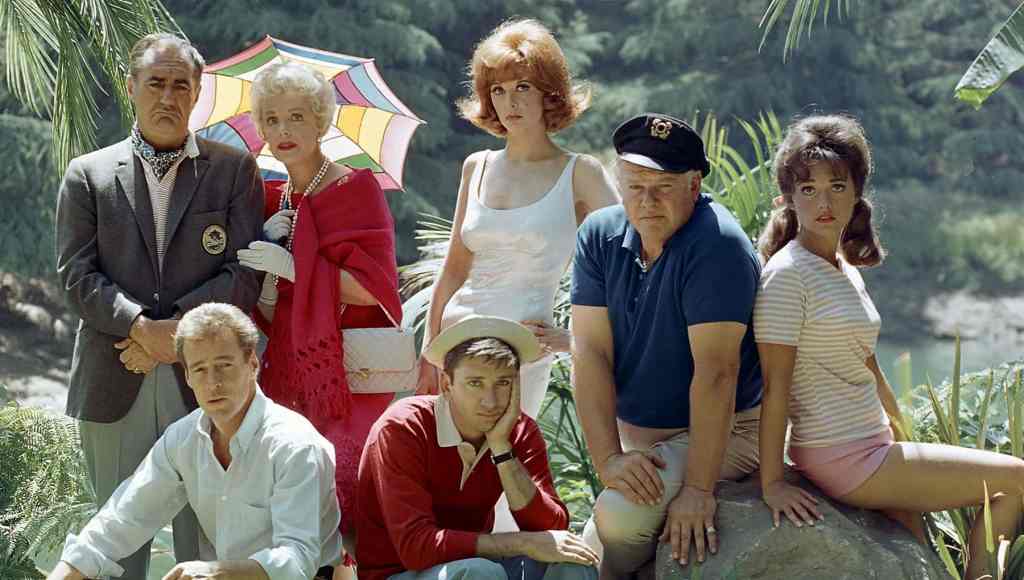
Consider the classic TV show “Gilligan’s Island,” which its creator, Sherwood Schwartz, referred to as a social microcosm. It featured seven characters, each representing a different socioeconomic position. Gilligan and the Skipper embodied the working class, while the Professor symbolized academia.
Mr. and Mrs. Howell (the millionaire and his wife) represented the elite, privileged upper crust. Mary Ann, a girl from the heartland, brought an earthy, grounded perspective, and Ginger, the movie star, added a touch of glamour.
Gilligan’s Island creator Sherwood Schwartz called the slapstick-laden sitcom of the 60s a “social microcosm” because of the socio-economic makeup of the characters.
Shipwrecked on an island in the middle of the Pacific, the writers put these people in absurdly improbable situations where each demonstrated their own inherent characteristics, however unrealistically. That’s where the comedy came from, and it worked.
Of course, to suspend the disbelief and immerse the viewer into the cartoon-like world, the show generally left out more realistic issues in such a situation. Problems like food, water, clothing, and shelter only arose when a comedic lack of some basic survival needs drove the story. But that’s TV. What about in real life? Where do microcosms exist day-to-day?
Recently, I found myself at a family birthday party in a local bowling alley. The guest of honor was turning 18, and a lively group of teenagers had gathered around the scoring console, ready for a game. As the afternoon progressed, the pitcher of soda ran dry, and the pizza had disappeared. Hunger pangs set in. (Kids eat a lot, wow!) With nothing else to do, I volunteered to make a snack bar run, setting the stage for an interesting observation of a real-life microcosm.
It was a Saturday afternoon, and the place was packed. Nearly every lane was occupied. As I walked along the service area at the back wall, past the shoe rental and pro shop, I suddenly noticed how much real life was happening all around me, and it all registered in my mind with sounds.
When I first realized what I was listening to, I literally froze for a moment. A woman nearly collided with me as she hurried along, balancing a pizza, drinks, and bowling shoes. I was so surprised by how I felt at the moment that I was compelled to step out of the foot traffic, close my eyes, and just listen.
Amidst the chaos, I focused on individual sounds. I heard the familiar thud as bowling balls dropped onto the hardwood floors and the dull rumble as each raced down the lane. Finally, the unmistakable crash of the pins as the ball hit them or the disheartening clunk if it dropped into the gutter.
Above pin resets, hand dryers, and clanking ball returns were the sounds of people living life. This was the microcosm of the moment—celebrations, first dates, families, young, old, and everyone in between.
I opened my eyes, looked around, and tried to put sight with sound. More birthday parties, a small child, with a ramp and dad’s help, making her first attempt to roll the ball. Neither she nor her parents will ever forget that day. A couple of lanes down, several older women chatted and crocheted between frames. One of the women working on a large afghan appeared to be winning.
I was standing among people from many different walks and stages of life. They all had one purpose, albeit the motivations were different. Everyone was there to enjoy the game, be with family and friends, and create lasting memories.
Eventually, I had to complete my mission and get the food back to our group before the teenagers ate their own shoes. But I can still hear those sounds and remember all the life that was being lived on that one normal day at the bowling alley.
“Books are uniquely portable magic.”—Stephen King, On Writing: A Memoir of the Craft.
I’ve often quoted classic books in this column for several reasons. For one thing, those brilliant writers of old had wisdom that still eludes me, and I need to borrow it occasionally.
I also enjoy the opportunity to share my love of books with those of you who are kind enough to give me your attention for a few minutes each week. My hope is that, in addition to my humble observations, I can share some words from those scribes who were (or are) far wiser and more eloquent than me.
Of course, I don’t just cite the classics. I toss in something fun and modern here and there as well. You may not realize it, but I’ve shared some words from the likes of Douglas Adams, George R.R. Martin, J.K. Rowling, and more.
I wasn’t a voracious reader when I was young, but that changed as I grew up. In high school, I became interested in Charles Dickens. Later, it was the stories of Mark Twain. From “The Little Red Lighthouse and the Great Gray Bridge” to “Lord of the Flies,” one book led to another. It’s interesting how that happens. Once you’re hooked…
That said, here are my questions of the day: Have books become obsolete in the shadow of the internet and social media? As some try to ban classics like Huckleberry Finn and To Kill A Mockingbird, what has become of literature’s social significance? What does the future hold for the classics and all the unwritten works yet to come? I don’t have the column inches to answer these questions, so here are my brief thoughts.
In my humble opinion, Stephen King had it right. Books are magical. They transport us to faraway lands, introduce us to people around the globe, and inspire imagination and dreams. But books are far more than mere escapism from our daily grind into the worlds of Harry Potter and Captain Nemo.
Books are the arks of our history. They help us learn from the past, hold a mirror to the present, and prepare for the future. Every published page offers a tiny glimpse into who we are as a species—warts and all. When you read a book, you have no choice but to learn something. Ignorance is replaced with knowledge and understanding, and then a funny thing happens—people get along better. Books provide the knowledge that breaks down all the barriers that separate us.
Booksellers are struggling, however. In many American communities, there might be a Starbucks or a parking lot where the neighborhood bookstore once stood. Instead of the pages of some great new novel, many people seem far more interested in scrolling through social media.
Although I prefer the printed page for most of my reading, my appreciation for books is more about content than construction. I typically read two or three books simultaneously, each in a different medium—audio, digital, or print.
A book is a book. Unless you can convince me that words read aloud are less meaningful than those read by eye, listening to an audiobook still counts as reading. You should read however you feel comfortable.
Concerning book bans, I won’t get into the obviously paranoid politics involved. If you don’t like a book, don’t read it. But the concept of book banning should horrify us because it casts a long shadow backlit by terrors of the past.
Some writers spend decades crafting the perfect book, hoping it will positively impact the reader. No matter your age, the genre, or the medium, reading a book will improve critical thinking and creativity and release dopamine, the brain’s “happy” chemical.
If you haven’t done so for a while, it’s time to get some of that happiness for yourself or give it to someone else. A book is one of the most meaningful gifts you can give. Libraries and bookstores offer a fun, affordable family experience you will remember forever.
Thankfully, books, even printed ones, aren’t going away anytime soon. But if they were ever to disappear, so would our society, our humanity, and, eventually, the record of our very existence.
*************
More Information:
Your local library is a great, free resource for the whole family to explore the unlimited world of books!
If you want to learn more about the book industry, the future of printed books and bookstores, check out these documentary films: The Booksellers. And Hello, Bookstore.
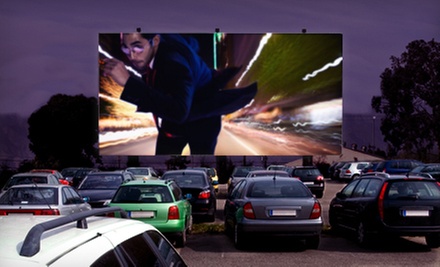
One warm summer evening when I was about 20, I wheeled my 1971 Mustang through the neon-washed gates of the Belmont Auto Drive-In Theater just outside Beavercreek, Ohio. I found the ideal spot and parked. The massive screen filled my windshield.
A few minutes later, an announcement over the speakers says, “Fifteen minutes! Fifteen minutes to show time!” Perfect! I had just enough time to grab a hot dog – I counted what cash remained in my wallet. It didn’t matter, though. They had me at “fresh, hot, buttery popcorn!”
That night, the marquee read, “Double Feature” (Then again, it was always a double feature.) “Star Trek IV: The Voyage Home and Crocodile Dundee.” If memory serves, the price was $5 per car, and I was ready. Drive-ins had been converted to broadcast the movie sound over the radio. So, I outfitted my old Mustang with a stereo amplifier and mounted speakers so you could best hear them outside the car. I tuned in the frequency, adjusted the volume, hopped on the hood with my snacks, and settled in for a great evening’s entertainment under the stars.
I loved drive-ins and still do. There’s something about the atmosphere that is pure Americana. As I’m thinking about it now, I can almost hear the overdriven buzz of those heavy, window-hanging speakers, the dancing refreshments up on the screen at intermission. The drive-in was one of my first solo outings at 16 when I got my driver’s license.
My first memory of going to a drive-in was with my parents in 1974. I was about seven years old, and we went to the Skyborn Drive-In in Fairborn, Ohio, where the original “Benji” movie was showing. I was so enamored with them that, for a short time, I considered owning a drive-in theater, but not your usual run-of-the-mill version.
I had this wacky idea about a massive drive-in theatre and even made concept drawings of it. It featured an unusually large, high-resolution curved screen, Dolby stereo, wireless speakers, and a two-story concessions building with a restaurant on the second floor. It featured a video game arcade, a merchandise shop, supervised playrooms for the kids, a bar for the adults, and more. Plus, it was much larger and could hold more than 400 cars.
Of course, I never made it happen, but it was a cool dream. I’m afraid that in the summer of the late 80s, my concept was way ahead of the required technology. Besides that, even in those days, drive-ins started to disappear.
Most of the Dayton-area drive-in theaters I visited back then are long since gone. If you’re local, you might remember some of them. There was the North Xenia Drive-In, Southland 75, Valley Street Drive-In, Dayton West Drive-In, and many others.
In north Dayton, the Dixie Twin first lit its screens in the early 1950s, and its projectors are still running today. The Melody 49, just off I-70 near Trotwood, is alive and well and shows first-run flicks on two screens. You can find others with a quick Google search. Depending on the travel, you might need to make a night of it if you plan to go.
As many surviving drive-ins faced closer, a strange twist of fate intervened. The very disaster that shuttered businesses worldwide may have been the savior of the drive-ins, at least temporarily. The COVID-19 pandemic gave many drive-ins a surge in business. Families could watch a drive-in movie, maintain social distancing, and enjoy an evening out.
Sadly, box office numbers have slumped since the pandemic, and drive-ins are still trying to bring people back in the gates. People need to be reminded that nearly all drive-in theaters are privately owned small businesses. They’re not million-dollar multiplexes. Most are run as a labor of love with volunteer staff, and most take in barely enough revenue to keep the projector bulbs burning.
For some, drive-ins are a long-held tradition. To others, they represent an era long past. But whatever the attraction, grab your lawn chairs, blankets, and portable radios (to keep from running down your car battery), and head to the closest drive-in. For now, I have to go. Tonight’s feature is about to start.
Recommended Documentaries about Drive-In Theatres:
British writer and theologian C.S. Lewis said, “What you see and what you hear depends a great deal on where you are standing. It also depends on what sort of person you are.” Put simply, reality is based, not on fact, but instead on our personal perception of what we see and hear. That said, it’s been my experience that not everyone has the same perception of reality.
Generally, I would imagine most of us trust our senses to deliver an accurate view of the world around us and then depend on our cognitive reasoning to help us comprehend it. It’s commonly known as, “perception.” Whatever the term, it simply means our view of things depends on how we interpret our surroundings. For instance, if I see a blue sky with clouds drifting by, I assume everyone else sees it too, right? Colorblindness notwithstanding, that all stands to reason.
But we all know people who walk around in more of an oblique version of reality. Often their reality is negative, dark, and painful, not to mention staggeringly inaccurate. Here’s what I mean. We all have a friend or family member who always seems to have it worse than everyone else. Regardless of how bad your case of the flu was last week; his experience was near death. Of course, it wasn’t, but that’s how he relates it to you.
This is known as catastrophizing and tends to be associated with various personality disorders. It can mean that the person behaves and thinks in ways that would be considered different than normal. And yes, I get that normal is relative and subjective. But here, I’m referring to someone with a mental health issue who is exhibiting behavior contrary to acceptable – or safe – social standards.
Sometimes those thoughts and emotions are caused by traumatic experiences and manifest themselves in other ways. I’m not a psychologist, but I do know that borderline personality disorder, for example, might include a strong fear of abandonment. It can cause the individual to always assume the worst about others. Thus, their view of reality – and people – may be somewhat distorted, altered by the painful experience of being left behind.
But what if there is no medical diagnosis for these issues? What if the person’s sense of reality just seems to be completely “out there?” Is that really a thing? How does it happen and is it an indication of mental illness? Probably, but it may never be diagnosed, let alone treated.
In my opinion, someone with a warped sense of reality also seems to be absent any sort of empathy or understanding, instead feeling like the world revolves around them.
It’s possible they’re unaware of their own character, feelings, motives, and desires, each of which helps to define who we are, and has a great influence on how we perceive and cope with the world around us. If you’re unable to see your own attributes, good and bad, then your sense of reality might be drastically altered as well, especially if you have no support system.
Someone like that might seem incredibly self-centered, narcissistic, or even paranoid and probably suffers from a strong persecution complex. It’s doubtful they even know that their behavior hurts those around them, damaging relationships, and even reinforcing abandonment issues because they push people away.
I’ve dealt with people like this, on some level, all my life. Most are completely unaware of their behavior or lack of awareness. At times some exhibit symptoms of bipolar disorder, schizophrenia, and even factitious disorder (what they used to call Munchhausen syndrome) because they often fake or inflict illness to get attention.
Again, we are tiptoeing around various levels of mental illness and I reemphasize that I am not a psychologist. These are simply my personal observations based on some education and limited experience. Mental healthcare is incredibly lacking in the United States, horribly curtailed by ignorance, stigma, and decades-old misinformation.
So, if someone you know is exhibiting these behaviors, please discuss it with someone close to them or seek out a mental health professional to help. Your doctor, local behavioral health agency, or public health department can help find the right resource.
Don’t panic! That’s rarely what you want to hear at those crazy moments when, odds are panicking is exactly the thing you should be doing. The dictionary defines “panic” as a sudden, uncontrollable fear or anxiety, often causing wildly unthinking behavior. Reactions vary widely, from a little nervousness to a full-on panic attack, complete with hyperventilation, rapid pulse, excessive perspiration, and much more.
Fortunately, I’ve never really been someone who panics. I’m generally calm in high-stress situations. Adrenaline probably creates a false sense of clarity and focus. I would say I’ve experienced anxiety, tension, and worry, but nothing I would call panic. It made me wonder, what makes you panic? It’s likely that you’re not alone in your apprehension. So, here are some things that commonly make people panic.
Number one on the list, meeting the potential in-laws for the first time. This is a great one. Symptoms include sweaty palms, a terrible sense of inadequacy, and the feeling that you just swallowed a lizard – and it desperately wants to come back up.
Next up is the dreaded job interview. You spend the days and hours ahead of the big moment researching, reading self-help blogs about how to prepare for interviews, and generally freak out. And talk about sweaty palms, you nearly break into a human sprinkler system just sitting in the lobby waiting for your turn. That bouncing knee, what even causes that?
What about being stuck in an elevator? Do you panic then? It might be comforting to know that fewer than 50 people die in elevator-related accidents every year in the United States. Fatalities range from falling cars to being caught in the doors between floors. Gruesome! But, what are the odds of you being one of those people? You have a better chance of being hit by lightning or winning the lottery, now that should bring on some panic.
You’re lazily riding your bicycle down the street and suddenly realize the neighbor’s Jack Russel is out and has slipped his tether. There is nothing more panic-inducing than a small dog chasing you on a bike. I never worry about the big dogs; they give up at the end of the driveway. But the little ones, oh dear! Just pedal faster and don’t turn around!
A first date. More sweaty palms, overthinking your clothes, and whether your car is cool enough to impress your date. Will you say the wrong thing, talk too much, or manage to seem interesting enough to get a second date? So much at stake and yet nothing at all.
Something I never thought of before – automatic flushers in public bathrooms. My niece shared with me that some people are afraid that the toilet will flush while they’re sitting on it. It’s the anticipation of when the flush happens that apparently induces the anxiety.
Oh, and remember the panic you felt back in grade school that accompanied report card day? (Yes, I’m old. Grade reports were once on paper.) Brow-soaking worry would set in about the grades the comments be, and, above all, will Mom or Dad sign it.
Vacation is supposed to be a relaxing, fun time with family and friends, a break from stress and worry. So, imagine you’re out on the open road and you just passed the first exit you’ve seen for hours and, suddenly, your car’s “low fuel” light comes on. The gas gage is bouncing on “E” and now you start to worry. Will you make it to the next exit? Your car isn’t fancy enough to have the estimated fuel and mileage indicator so you’re in the dark. How much gas do you have left? Can you make it to the next exit?
What else can induce panic? How do you combat those feelings? Sometimes you can avoid things, but often, you just have to face whatever it is, head on, and move forward. Panic is caused by feelings spun up by thoughts. When I feel anxious or worried, I do my best to try to alter my thoughts, which, hopefully, will change my feelings and I can remain calm. Maybe you can find some practice that will help you do the same.
The onset of fall means fair season here in Ohio, and my visit to our county fair this year was simultaneously familiar and foreign. When I was a kid, the county fair was the grand finale of my summer. At the time, I was probably annoyed with how much work it was. But what I wouldn’t give to walk through the fair of my youth. I didn’t appreciate it then, but those were some of the best days of my childhood.
As a young 4-H’er, I always had multiple projects to exhibit each year. If you had livestock (I showed cattle) you generally camped on the grounds to tend to your animals and get show practice in the arena more easily. My Dad always brought our small motorhome for me, so I had a nice place to sleep and some privacy. But sometimes, just to be closer to it all, I tossed my sleeping bag on the bales of hay next to my calf’s stall in the cattle barn. At night, the summer heat gave way to a cool breeze that flowed through the open sides of the barn, and I’d fall asleep to the sounds of the fair all around me, and some occasional mooing.
In the morning, I’d feed and water my calf (I only ever showed one at a time). Then breakfast at my favorite food tent where a youth group sold Bob Evans sausage, biscuits, pancakes, and all the trimmings. A kid’s gotta eat, right? We didn’t have money for it every day, but it was really great on the days I was really busy.
Later, it was exercise time, for me and the cattle. I walked a 900-pound steer as if I were strolling through a park with a poodle. Showing an animal at the fair meant a great deal of training – for them and me. So, my calves behaved more like someone’s pet than a half-ton farm animal.
I showed in the dairy beef class and on show days, I had to wear white. I know, right, white clothes in all that muck and dirt? But we weren’t allowed to be dirty and neither were the animals. After a bath came a good brushing and a polish of the hooves. Finally, I had to “bob” their tails. It was a weird practice of teasing the hair at the end of the calf’s tail until it fluffed out like a ball, then folding the ends under and rubber-banding it, upside down, to the tail. Believe me, even if there was a picture, it wouldn’t make sense.
Along with all the work, there was plenty of play. Many of the kids stayed on the grounds without their parents and no one ever seemed to worry about us. In between chores, we were normal kids, playing games, eating cotton candy, and riding on those rickety carnival rides. Once there was even a woman in a cage who turned into a gorilla! How did we survive all that? For one week every summer, I was in my element, one place I didn’t feel like a misfit.
Amidst all the fun, however, I had responsibilities. So, every kid had to keep one ear tuned to the dreaded public address system because, in the middle of a ride on the Scrambler, a garbled announcement would echo across the entire fairground sounding something like this. “Gery Deer, meet your mother at the FFA tent, immediately. Gery Deer, go to the FFA tent.” You see, before mobile phones, if parents needed the kids to somewhere during the fair, we got paged – very publicly. Talk about embarrassing, I can still hear the other kids. “Ha ha, Gery, your mommy wants you!” Oh, the humiliation.
I still miss those days and even then, I had some appreciation for the role the experience played in my young life. One night, just as the fair was closing, I shut my eyes and just listened for a moment as if storing the sounds for later, maybe when I couldn’t go back there again. I remember every moment of my time there. It’ll always be a part who i am, and I will always be grateful.
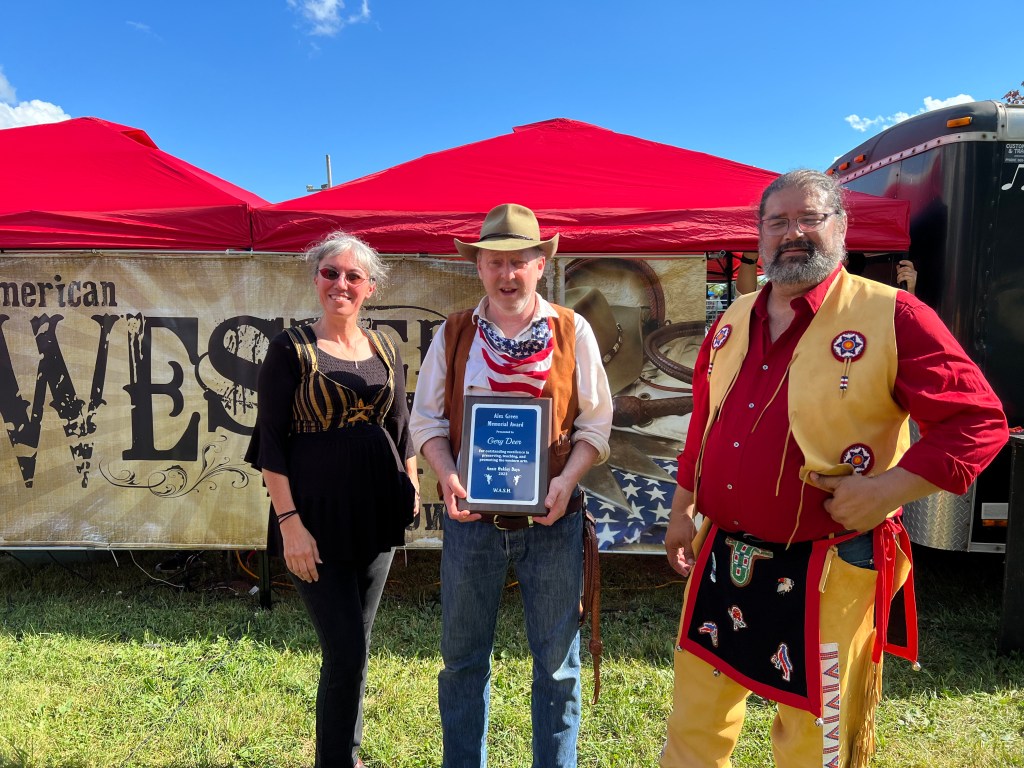
Jamestown, Ohio – August 1, 2023 – Jamestown resident, writer, speaker, and performer, Gery L. Deer, was honored on July 29th during the 20th Annual American Western Arts Showcase at the Annie Oakley Festival in Greenville, Ohio. Deer received the Alex Green Memorial Award for excellence in promoting, perpetuating, and teaching the Western arts over the last two decades. The award was presented by the co-producer of the show, Kirk Bass, of Xenia, supported by the rest of the cast and crew of the long-running Wild West show.
Gery Deer is presented with the Alex Green Memorial Award by American Western Arts Showcase co-producers Melodee and Kirk Bass.
Deer’s primary Western arts work has been teaching the whip as a sport and performance art. He’s instructed hundreds of actors, stunt performers, and hobbyists over 30 years and founded The Whip Artistry Studio, the only permanent facility in the U.S. dedicated to the non-combative study of the whip.
His award was named for the late Australian stuntman, Alex Green, who was a 40-year veteran of television and film stunt work, particularly with the whip. Green was one of the founders of the Wild West Arts Club (WWAC), where Deer earned early recognition as a national bullwhip speed and accuracy champion. The two became good friends and Deer has tried to continue the spirit of those early events by showing the whip in a positive light of sport and performing art.
“My goal has always been to teach and expose young people to these uniquely American skills,” Deer said. “I’m beyond humbled by the award my friends, no, my family have presented to me. It means more than I have words to convey and I’m forever grateful.” In addition to the honorarium, earlier the same day, Deer also won first place in the two-handed bullwhip speed and accuracy competition, called the “Speed Switch.”
Deer started the American Western Arts Showcase started in 2002 with a whip-cracking workshop and exhibition presentations and has produced the event ever since. In 2003, the program moved to the Annie Oakley Festival in Greenville, Ohio, and was retooled to become the Ohio Regional Convention of the Wild West Arts Club and offered whip, knife throwing, and trick roping contests, stunt demonstrations, stage performances, and more.
When the WWAC closed in 2007, Deer and company continued the showcase portion and kept the whip contests, which were even more popular with crowds than the performances. After 20 years, and hundreds of performances, the 2023 season marks the final production of the show at the Annie Oakley Festival.








 The Jamestown Comet