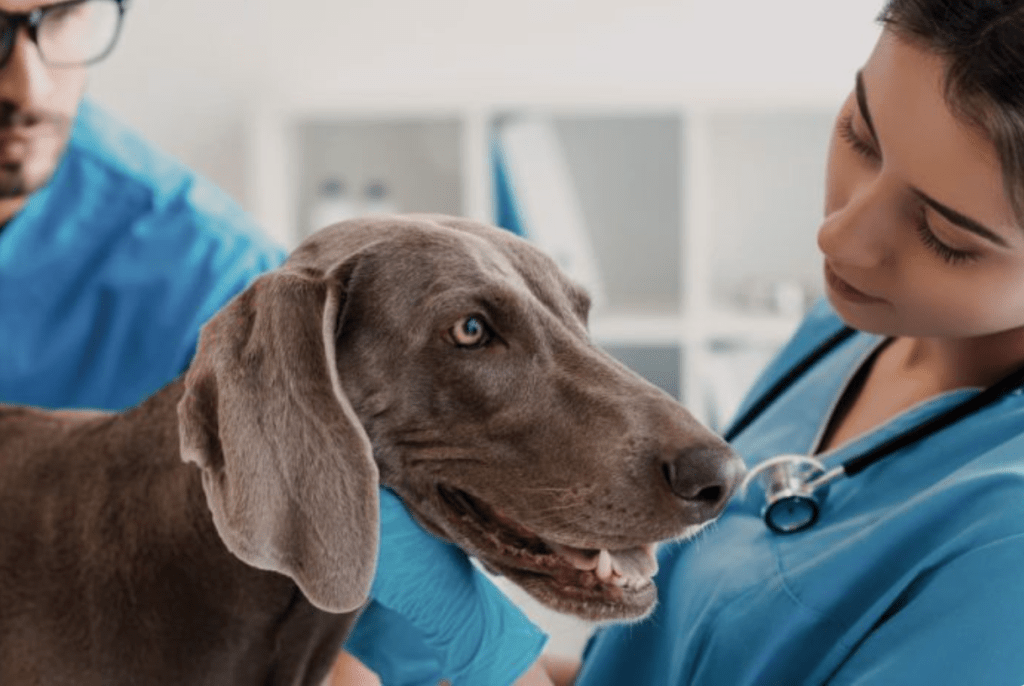
June 24, 2024, DAYTON, OHIO – The Humane Society of Greater Dayton is hosting a free microchipping event, “Chippin’ in the USA,” to help keep pets safe and reunite them with their families in case they get lost. The event will be held on Thursday, June 27th, from 1:00 PM to 5:45 PM at the Humane Society of Greater Dayton located at 1661 Nicholas Road, Dayton, OH.
Free Microchips, No Appointment Needed
This free event is open to the public, and no appointments are necessary. Walk-ins are welcome! Microchips are a permanent form of identification that can significantly increase the chances of a lost pet being returned home safely.
What to Bring:
Cats: Please bring your cat in a carrier for their safety and comfort.
Dogs: All dogs must be on a leash or in a carrier.
Prepare for Fourth of July
The Fourth of July is a notorious time for pets to escape or get loose due to loud fireworks. By microchipping your pet before the holiday, you can ensure a quicker and more successful reunion if they become separated from you.
Event Details:
Date: Thursday, June 27th, 2024
Time: 1:00 PM – 5:45 PM
Location: Humane Society of Greater Dayton (1661 Nicholas Road, Dayton, OH)
Cost: Free
For more than 120 years, the Humane Society of Greater Dayton has been a dedicated champion for both people and pets. With a steadfast commitment to all types of animals, including cats, dogs, rabbits, horses, farm animals, exotics, small animals, and more, the organization takes pride in its role as a comprehensive animal organization.
As an independent 501(c)(3) nonprofit, the Humane Society of Greater Dayton operates without government funding and maintains no affiliations with regional, state, or national animal shelters or humane societies. Every dollar raised directly supports their vital programs and services, making a tangible difference in the lives of animals and pet owners.
To learn more about their remarkable work, please visit www.hsdayton.org.
It’s truly remarkable how we can develop such deep emotional bonds with family heirlooms. Whether it’s an antique jewelry box, a wax candle mold, or even a small piece of roof tile from a 19th-century courthouse, these objects hold a special place in our hearts as cherished remnants of days gone by.
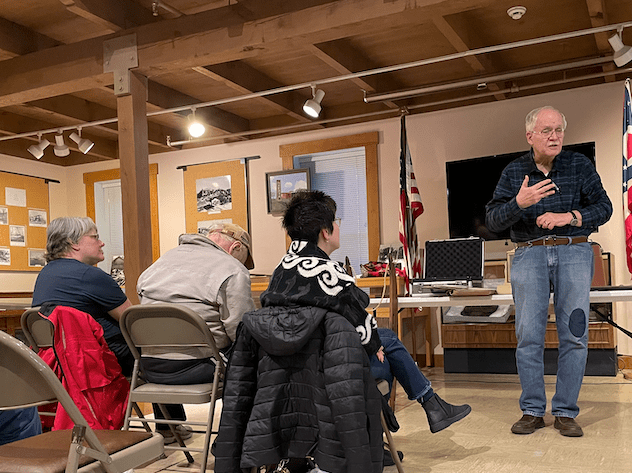
I recently attended an event promoted as a kind of show-and-tell at the local historical society. Visitors were encouraged to bring an item that had some significance to them, the history of the community, or their family, and share the story behind each piece.
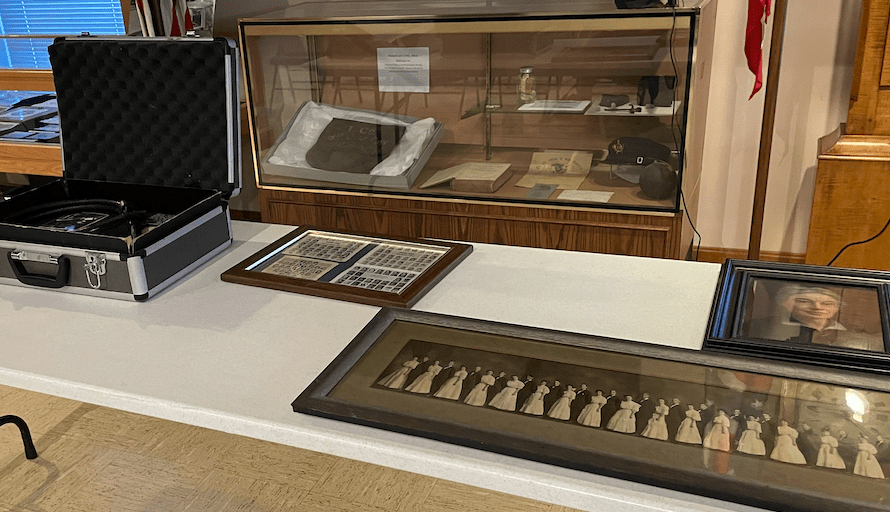
Upon my arrival, I was greeted by a sight that stirred a sense of nostalgia. The organizers had proudly arranged the evening’s offerings on tables at the front of the room. Soon, a representative of the organization initiated the event, and one by one, each presenter stepped forward, their faces beaming with pride as they shared the personal significance of their cherished items.
It was like watching a live edition of The Antiques Roadshow minus the frequent condescension of the hosts. You know, “I’m sorry, but this frog statue lamp with a clock in its belly isn’t worth squat.” I always hated that. Anyway, I doubt any of the artifacts would have been for sale. You’d likely have to pry each one out of its owner’s cold, dead hands.
Even more impressive than the reverence with which each person spoke about their property was the variety of items they brought. One man brought a wooden dynamite crate, which was once used to carry explosives for stump removal at his grandparents’ farm. Another showed off his own grade school pictures, some 65 years old.
Others exhibited familial artifacts ranging from a military bayonet to a small jewelry box, which we learned was the owner’s only connection with her great-grandmother. Though very plain to the eye, it was priceless and beautiful to her, and perspective is everything.
When it originated with the speaker, like the school photos, the speaker relayed a personal account of the object’s significance. If, on the other hand, the possession once belonged to a loved one or close friend, the connection is very different. Things left behind by those before us can be deeply meaningful. Heirlooms strengthen our memory of someone and remind us of the relationship.
You’re unlikely to forget a departed parent, spouse, or sibling. But seeing and touching something that belonged to them reaffirms that connection tactilely and creates an emotional response, good and bad.
As I absorbed each story, a profound realization dawned on me. The pride, honor, or reverence—whatever you may call it—was not about the possessions. It was about the people in the stories, whether they were related or not to the speaker. After all, what is human society without stories? Stories shared between family and tribal members are how we preserve our history. And physical remnants of that history, like these family heirlooms, make the stories more tangible, more real.
And it doesn’t have to be about people who have passed on. For those in the room who had attended the same school, the antique class photos had a more profound, more personal association. Someone who’d been a student at the same school as several of the audience, but a half-century earlier, bound two generations, brought together because someone shared a story about a picture.
Finally, there’s something to be said for legacy. I think we all want to be remembered. I sincerely hope to leave behind more than a half-used pencil and a broken typewriter. But if so, I also hope someone will come up with a compelling and meaningful story about them. I think the ancestors of those who shared family items would be very proud of their legacy.
My parents left behind a treasure trove of memories, from books and dolls to trucks and tractors. Among these, I hold dear my father’s wristwatch. He personally handed it to me, sharing the story of its origin. When I gaze upon it, I am transported back to that moment. It’s not about the watch itself, but the emotional bond it represents, the moments he spent with me that hold the true value.
“It’s nine o’clock on a Saturday. The regular crowd shuffles in.” Those are the first lines of Billy Joel’s “Piano Man,” a song that always transports me back to my college days. To help pay for school, I was the pianist at a small Italian restaurant. Even in the 80s, it was old-fashioned, with one large room outlined by raised booths along the walls and a few floor tables in the middle. The decor was, what’s the word, beige. Yep, a lot of beige. Or was it brown? It’s tough to be sure because the lighting was pretty low.
Every Friday and Saturday evening, for about three hours, I performed all instrumentals on a small studio upright. I was like a live Muzak machine without the lyrics. I. Did. Not. Sing. Period. No one would have wanted to hear that. You might as well go outside and toss an alley cat into an upright trash can for that cacophony.
I had a repertoire of about 250 pieces, mostly pop and oldies, but I tossed in the occasional classical number just to show off. A quiet tinkling of “Fur Elise” goes particularly well with linguini, and the leg of lamb begged delivery of Bach’s “Sheep May Safely Graze.” I can’t read music, so everything was by ear. I memorized each song pretty much the first time it fell from my ear to my hands. Regulars would often bring a tape of some song they wanted me to play, and I’d learn it before their next visit.
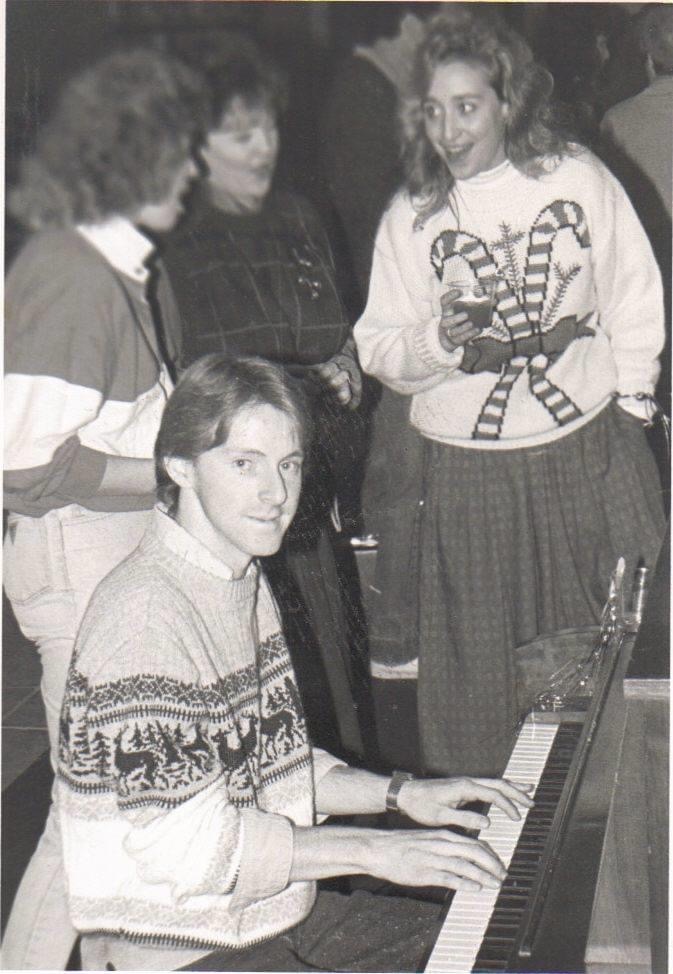
“Piano Man” Gery Deer, performing for a holiday event at Sinclair Community College in 1988.
Once in a while, I’d break out the occasional show tune. On slower nights, I’d rearrange some old TV show theme song into a long, drawn-out ballad. You should hear my dramatic rendition of “Gilligan’s Island” at half speed with Liberace-esque flourishes. People would ask if it was some rare piece by Rubinstein or Mozart. I’d reply, “Oh, no. It’s an original by Schwartz (Sherwood, that is – go look it up).
Playing in a restaurant isn’t all tickling the ivories and clever combinations of sets. It’s more about the people. Unlike a “piano bar” or dueling pianos show, restaurant performances are more atmosphere than anything else. Still, although I got paid for my hours on the bench, my livelihood really depended on tips.
Depending on the traffic, my available talent that evening, and the generosity of the customers, I could have a forty-dollar or four-hundred-dollar night. The latter required some people skills. I was unable to respond with more than a smile or nod when someone tipped me while I was playing. So, I’d take a break at my first opportunity and walk over to their table to thank them.
Here’s a secret about restaurant or bar piano players. We are always watching you. No, I didn’t care what you ordered. I never gave a thought to how stingy you were about tipping the waitstaff after spending a ridiculous amount on too many bottles of cheap wine. Nor did it matter to me that your date’s dress was so short your wife would certainly have disapproved.
No, I was studying my audience’s reaction. It was gratifying when people clearly enjoyed my work and that it added to their evening experience. If a table was paying particular attention to one kind of music, I’d adjust my set list accordingly. More often than not, a request or early tip came from one of those parties, generally the lady of the table. I think the guys were embarrassed to come up to me. I have no idea why.
During my three years there, I also learned a great deal about human behavior. Restaurants only provide a two-dimensional view of human interaction, but it’s alive with celebrations, sadness, gluttony, and togetherness.
I was very young then, so I also learned a lot about myself, particularly that I was more introverted than I’d ever realized. I’d like to think my music always improved someone’s day and that it still does. At least, I hope so.
If a street or restaurant musician ever makes your day just a little brighter, please take time to tell them so and drop a few bucks in their jar. You’ll make their day and yours, too.
Have you ever considered a microcosm? Chances are you haven’t, but we are exposed to them almost every day. Essentially, a microcosm is anything in miniature that represents something bigger. For our purposes, a microcosm is a small group or community whose characteristics represent a larger one.
We see microcosms everywhere, and we’re usually unaware of them. Some are fictional, existing only in books, movies, television, and theatre. Others are happening around us, whether we’re integrated participants or outside observers. Let’s look at a couple of examples.
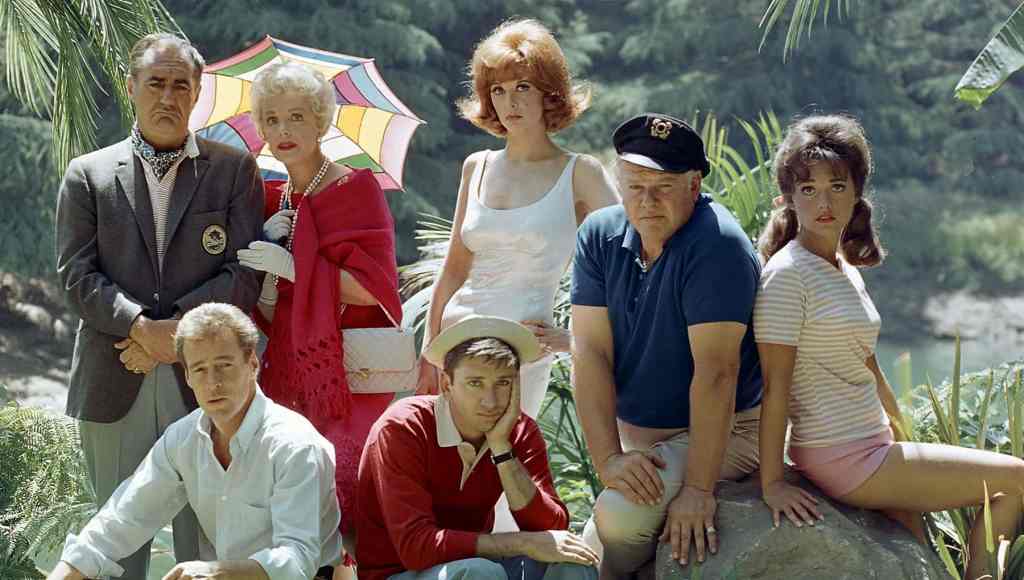
Consider the classic TV show “Gilligan’s Island,” which its creator, Sherwood Schwartz, referred to as a social microcosm. It featured seven characters, each representing a different socioeconomic position. Gilligan and the Skipper embodied the working class, while the Professor symbolized academia.
Mr. and Mrs. Howell (the millionaire and his wife) represented the elite, privileged upper crust. Mary Ann, a girl from the heartland, brought an earthy, grounded perspective, and Ginger, the movie star, added a touch of glamour.
Gilligan’s Island creator Sherwood Schwartz called the slapstick-laden sitcom of the 60s a “social microcosm” because of the socio-economic makeup of the characters.
Shipwrecked on an island in the middle of the Pacific, the writers put these people in absurdly improbable situations where each demonstrated their own inherent characteristics, however unrealistically. That’s where the comedy came from, and it worked.
Of course, to suspend the disbelief and immerse the viewer into the cartoon-like world, the show generally left out more realistic issues in such a situation. Problems like food, water, clothing, and shelter only arose when a comedic lack of some basic survival needs drove the story. But that’s TV. What about in real life? Where do microcosms exist day-to-day?
Recently, I found myself at a family birthday party in a local bowling alley. The guest of honor was turning 18, and a lively group of teenagers had gathered around the scoring console, ready for a game. As the afternoon progressed, the pitcher of soda ran dry, and the pizza had disappeared. Hunger pangs set in. (Kids eat a lot, wow!) With nothing else to do, I volunteered to make a snack bar run, setting the stage for an interesting observation of a real-life microcosm.
It was a Saturday afternoon, and the place was packed. Nearly every lane was occupied. As I walked along the service area at the back wall, past the shoe rental and pro shop, I suddenly noticed how much real life was happening all around me, and it all registered in my mind with sounds.
When I first realized what I was listening to, I literally froze for a moment. A woman nearly collided with me as she hurried along, balancing a pizza, drinks, and bowling shoes. I was so surprised by how I felt at the moment that I was compelled to step out of the foot traffic, close my eyes, and just listen.
Amidst the chaos, I focused on individual sounds. I heard the familiar thud as bowling balls dropped onto the hardwood floors and the dull rumble as each raced down the lane. Finally, the unmistakable crash of the pins as the ball hit them or the disheartening clunk if it dropped into the gutter.
Above pin resets, hand dryers, and clanking ball returns were the sounds of people living life. This was the microcosm of the moment—celebrations, first dates, families, young, old, and everyone in between.
I opened my eyes, looked around, and tried to put sight with sound. More birthday parties, a small child, with a ramp and dad’s help, making her first attempt to roll the ball. Neither she nor her parents will ever forget that day. A couple of lanes down, several older women chatted and crocheted between frames. One of the women working on a large afghan appeared to be winning.
I was standing among people from many different walks and stages of life. They all had one purpose, albeit the motivations were different. Everyone was there to enjoy the game, be with family and friends, and create lasting memories.
Eventually, I had to complete my mission and get the food back to our group before the teenagers ate their own shoes. But I can still hear those sounds and remember all the life that was being lived on that one normal day at the bowling alley.

 The Jamestown Comet