Local News & Commentary Since 1890.

Posts Tagged ‘Xenia Daily Gazette’

Let go of the past, focus on tomorrow

In Education, Holiday, Opinion, psychology, Uncategorized on January 1, 2015 at 1:48 am

DIH LOGOAs we come to the close of a tumultuous 2014, I am reminded that, as a society, we seem to be obsessed with looking over our shoulders with barely a single glance toward the road ahead. Using contemporary terms, our most common mistakes as a people might actually be labeled, “distracted living.” We are so focused on yesterday that we forget to prepare for tomorrow.

Someone much smarter than I once said that those who ignore history are doomed to repeat it. The statement generally refers to preventing the recurrence of negative events. But if something good happened, it’s only logical that you would want to repeat that success. To truly progress, however, we must learn from the past while at the same time keeping our attention focused on the future.

Unfortunately, we are often more affected by the negative in life than the positive; a death in the family, lost job, financial struggle, and so on. People and events from the past have us constantly looking over our shoulders, dwelling on our sadness, sense of loss and nostalgia. But while they may provide momentary comfort, these feelings also tend to hold us in place and keep us from advancing to a better future.

clock-2As 2014 comes to an end, I implore my readers to look to the horizon and make an effort to work towards better things in the coming year. Life is all about making the best choices possible based on personal experience, the current situation, consequences of your actions and your own needs going forward.

Writers are generally encouraged to omit anything – settings, objects, characters – that do not serve to keep the plot of a story moving forward. To keep life moving ahead we must do the same thing by eliminating anything that keeps us stagnant.

First, you need to focus on yourself more. It may sound selfish, but it’s necessary. As someone who has had to help care for aging parents, I have learned that in order to help them, I have to keep myself going. Maintaining your mental and physical health is vital if you are to be of any use to anyone else.

Dismiss negative people from your life and don’t get mixed up in the drama of others. Some people exist solely in their own world, completely unaware of how their behavior affects others. If someone is literally exhausting you from drama or they’re incredibly high-maintenance, it’s time to cut them loose. You can’t move ahead if someone like this is always dragging you down.

Stop repeating pointless behavior while expecting a different outcome. Very often, we can get stuck in a pattern of useless behavior, always doing the same thing and hoping that “this time,” it will come out differently. But it never does and it never will.

Stop procrastinating. Yes, this is probably the hardest piece of the puzzle. How to do today what you can very easily put off until tomorrow. But if you’re someone who constantly complains about your situation yet does little to change it, procrastination could be a big chunk of the problem.

Most people find excuses to cover procrastination; “they’ll never hire me for that new job,” “that’s too hard,” or, “she’ll never say yes.” Get over yourself – and your fear – and take that first step forward. And yes, most procrastination is the result of being afraid, not of failure but success.

Finally, I’ve never been a big believer that writing down a list of goals does anything more than make you feel inadequate. “Self-help” nonsense puts so much pressure on goals that if you don’t meet the ones you wrote down, then you must be a failure and that can result in its own devastating effect.

Forget goals, but at least have an idea of what a better, more successful tomorrow looks like to you. In the end, the future belongs to you, no one else. Get off your tail and do something about it and stop looking backward. Happy New Year! Now get out there and make this one your best ever!

Gery L. Deer is an independent columnist and business writer based in Jamestown, ohio. More at gerydeer.com.


Creative people are not predisposed to mental illness.

In Entertainment, Health, National News, Opinion, Senior Lifestyle, sociology, State News, Uncategorized on December 12, 2014 at 2:12 pm

When it happened, I did not want to be one of the millions of journalists writing about the tragic death of comedian Robin Williams. I wanted no part of the relentless armchair quarterbacking of commentators who so easily claimed to have the man, “figured out.” No one knew what was in his head or heart and pretending to in order to secure 15 seconds of publicity on the morning talk shows is disrespectful on countless levels.

As a kid, “Mork & Mindy” was a favorite television show of mine. Naturally, I was too young to understand that Williams’ extra-terrestrial comic genius may have originated from a man with deep, emotional fragility in a constant struggle with personal demons. However, Williams’ death led to interesting dialogue about whether brilliantly creative people have a higher tendency toward mental illness.

Psychologists have long debated the relationship between the creative mind and various mental illnesses, particularly bipolar disorder.  Personally, I reject the psychobabble that suggests creative people innately suffer from a myriad of mental and emotional disorders.

I’m not a psychiatrist or a physician but I am one of those creative people, albeit that I walk the line to the other side of the brain as well. I can rebuild an engine, write this article, and produce a television segment, all in the same day. But am I, by nature, mentally ill?

Benjamin Franklin was one of the most creative and inventive people in American history. He was a statesman, a writer and an inventor, and there is no evidence to suggest he had any sort of mental illness.

But in today’s era of mass publicity, there are other pressures that can affect the creative mind’s health besides that to produce new work. Anyone who becomes successful or is thrust into the public eye at any level has an entirely different set of stresses to deal with.

From my own, small experience, I can tell you first-hand that, as a public figure, you are expected to be “on” all the time. Because of your public work, people believe they know “you,” and anticipate you to behave a certain way to meet their expectation.

When you don’t, they are disappointed and react negatively. The pressure of not being able to meet those expectations can take a toll on someone who already suffers from self-doubt, depression and other areas where a negative personal image is already prevalent.

Most creative people are in the business they love in order to do a good job at work then go about their lives as normally as possible. Often, however, the public won’t allow it.

Williams’ death serves as a reminder that every creative person is just that, an individual, whether working from their garage or signing million-dollar movie deals. Every day they struggle with the same concerns as you and I, it’s just that the scope of view might be a bit larger or different.

Has anyone considered the possibility that people who already have mental illnesses choose to go into a more creative line of work because it fits their “disability?” It’s no secret that actors and writers tend to be introverted, keep to themselves and often reject the idea of the 9 to 5 job and even general social conformity. Since mental illness isn’t something a person just contracts, like the flu; it’s logical to conclude that it’s got to be in the genetics somewhere waiting for a trigger. Depression and other illnesses can also be affected by the lifestyle of the individual through alcohol and drug use, exacerbating the problem.

Therefore, it is entirely likely that those with mental issues actually choose the more fluid existence of the creative lifestyle early on.  The common absence of structure and responsibility probably plays well into their ever fluctuating mental state.

In other words, it’s a chicken or the egg problem. Are creative people mentally ill (as a generalization), or do the mentally ill choose the more creative path? A great talent was lost in Robin Williams and he was by no means the first. Sadly, regardless of how it comes about, it is unlikely he will be the last.

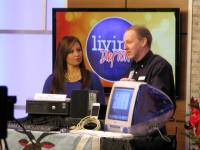
Gery L. Deer is an independent columnist and contributor to WDTN-TV2’s Living Dayton program


Drone use regulation has a long way to go

In Dayton Ohio News, Education, history, National News, Opinion, Technology, Uncategorized on December 1, 2014 at 2:24 pm

DIH LOGOFor the last several years unmanned aircraft systems (UAS) have become a popular tool for everything from wildlife tracking to disaster response. But the wide application of these devices has become a hot button issue for many state lawmakers and in some cases legislation has already been put in place to regulate their use. But there’s still a long way to go.

Also known as unmanned aerial systems, or by the more colloquial term, “drones,” UAS devices are becoming more widely used around the United States by government and law enforcement agencies, commercial business and also private citizens. As the technology becomes more affordable, these devices are turning up everywhere; over residential areas, aerial photography of sporting events, even delivering packages. All of these activities raise questions of privacy invasion and how much is too much.

At the time of this article, Ohio still has no specific laws governing the use of drones but, according to the National Conference of State Legislatures, “Ohio enacted HB 292 creating the aerospace and aviation technology committee. One of the committee’s duties is to research and develop aviation technology including unmanned aerial vehicles.” So, there’s a committee; great.

At present, police departments can use drones in most states to snoop pretty much anywhere they want, and in many regions without the pesky bother of obtaining a warrant first. Drones can also be used by the federal government for the purposes of gathering domestic intelligence. Up to now, there are few “official” limitations on U.S. Government (and military) use of UAS devices to spy on its own citizens, without cause or due process of any kind.

dronesSo until there are clear areas of regulatory legislation, what rights do individual citizens have to protect themselves from the prying robotic eyes of a drone? The answer to that is murky at best, and property law is extremely complicated so it’s tough to know who actually owns the airspace above.

A Slate.com article from October 2014 reports that man-on-drone violence is actually on the rise; that means people are actually shooting the machines right out of the air, sometimes just for the sport of it.

The article shared one story about a New Jersey man who was brought up on unlawful weapons charges for shooting down a drone over his property. The article was unclear about whether the area where the incident took place was rural, commercial or residential. There was also no mention of charges related to what he shot down.

As some states enact technology-related laws and regulations, others have done nothing. Many of the laws that have been enacted are also confusing as to personal responsibility or liability.

In Tennessee for example, SB 1777 makes it a class C misdemeanor for any private entity to use a drone to conduct video surveillance of a person who is hunting or fishing without their consent. So to illustrate how ridiculous this is: if Bob is hunting on Bill’s property without permission and Bill uses a drone to monitor Bob’s activity, Bill is guilty of a crime, but Bob is not?  How’s that for pointless?

Drones and other UAS devices bring about yet one more issue where the technology has advanced faster than the wisdom of the people and the legislators. But what about personal rights until laws are enacted? Do private citizens have the right to take matters in to their own hands? Is it OK to shoot down a drone in an area where firearm use is legal? What if it’s brought down with a slingshot, a boomerang, a whip (sorry, had to include that one) – or even another drone?

It seems likely that if someone destroyed a drone its owner would have some kind of civil litigation options to recover damages. However, UAS operators should keep in mind that, for the most part, firearms are still legal to use in rural areas and an intrusive drone might just go the way of Amelia Earhart.

Gery L. Deer is an independent columnist and business writer and CNN.com iReports contributor. More at deerinheadlines.com.


For some, depression darkens the holiday season

In Children and Family, Health, Holiday, Opinion, Senior Lifestyle, sociology, Uncategorized on November 24, 2014 at 1:54 pm

DIH LOGOIt’s never great to lead off with a cliché, but there may really be a silver lining behind every dark cloud. The hard part is that it’s up to the individual to recognize and interpret it. During the holiday season, however, for some the darkness may become overwhelming and everyone else should be sensitive to those around them suffering from seasonal depression.

As the Thanksgiving Day holiday heralds in the Christmas season, it’s important to try to remember that not everyone is happy and cheerful during this time. Many people suffer from various types of clinical depression, exacerbated by the holidays.

Seasonal Affect Disorder, or SAD, is a seasonal pattern associated with a recurring depressive disorder. It’s a fact that people experience mood changes along with the seasons but some may actually experience an even more sever bout during the stressful holiday season.

According to Healthline.com, “Depression may occur at any time of the year, but the stress and anxiety of the holiday season—especially during the months of November and December (and, to a lesser extent, just before Valentine’s Day)—may cause even those who are usually content to experience loneliness and a lack of fulfillment.”

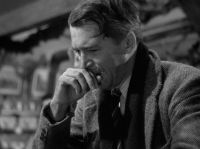
baileygeorgeNot surprisingly, depression during this time can result from loneliness. Healthline.com reports that a 1999 Canadian study of patients treated by emergency psychiatric services during the Christmas season, states the most common stressors were feelings of loneliness and “being without a family.”

Experts also suggest that part of the problem is a level of media bombardment, mostly advertising, that depicts cheerful holiday festivities, smiling families, and so on. The joyful, light-heartedness of the season might to a depressed person seem much more a requirement and painful nuisance than a genuine, heart-felt emotion.

The elderly often suffer from depression caused by any number of contributors including, serious medical problems, poor diet, loss of a spouse, chronic pain and more. Depression may worsen in the elderly, not expressly because of the holiday, but that it brings memories of happier, more fulfilling times, and it might be hard to spot.

Helpguide.org suggests that elderly patients suffering from depression might display rapid mental decline but memory of time and date, as well as awareness of the environment, remain. They may also exhibit more outward concern than usual about slipping memory and their motor skills may be normal but noticeably slower.

Regardless of age, depression is a painful illness to endure at a time of year when the sufferer is surrounded by the usual excitement of the season.  There are many ways to help combat depression.

Social isolation can be a major contributor to depression, particularly during the holidays.  Start by getting involved and being among friends and family wherever possible. Of course, sometimes, family can be the cause of stress. In those instances, it might be better to spend time with close friends or attend some kind of social activity, go to bingo at the local community center, or anything else to avoid being alone. But remember to feel free to leave an event if you feel uncomfortable. Adding stress to depression would be seriously detrimental to the purpose of the interaction.

Other ways to ward off “holiday blues” include, beginning a new tradition, volunteering at local charity centers, or get outside and take a walk or go on a bike ride.  Self-care is an important step to fighting depression. Even with decreased appetite, it’s important to remember to try to eat well, exercise and maintain a regular sleep schedule.

Seek medical treatment as well. General practice doctors can help determine what sort of specialized treatment may be beneficial. Depression is an illness with treatments available to help people live active, involved lives but nothing can happen without taking that first step. Proper treatment may help people have a happier, more meaningful holiday season.

On a final note, although it is a myth that more suicides occur between Thanksgiving and Christmas, those suffering severe depression might still be dealing with suicidal thoughts. Contact one of the local crisis lines, 24/7: Greene County Crisis Services: (513) 376-8702 or Dayton Suicide Prevention Center, Inc.: (937) 297-4777.


Gery L. Deer is an independent columnist and business writer based in Jamestown, Ohio. More at gerydeer.com


E-commerce shoppers beware price steering

In Economy, finances, Holiday, Media, National News, Technology, Uncategorized on November 17, 2014 at 2:28 pm

DIH LOGORecent surveys suggest that nearly 60 percent of shoppers will do their holiday buying online this year. That’s probably not too surprising to most people.  But did you also know that many e-commerce websites actually adjust pricing based on your personal information to get the most money they can from each shopper? It’s called “price steering,” and it’s perfectly legal. Here’s how it works.

Let’s say Bob goes online to buy a hammer using his smart phone. The e-commerce hardware site offers the item for $10 with a $2 shipping charge. From his desktop computer at work, John looking up the very same hammer on the same website, but his price is showing at $15 with a $5 shipping charge. The cost variation is based on data collected from each buyer’s Internet device.

Whenever you visit a website it leaves a “fingerprint,” on your computer, smart phone or tablet in the form of cookies, browsing history, and so on. For our example, let’s say Bob and John live in different parts of the country, work in different occupations, and have individual buying habits, so their computers, smart phones and other devices portray a very different “electronic personality,” or “E.P.”

The E.P. information is used to “steer” each buyer to the same product but with different pricing based on the collected data. That level of electronic tracking might sound a bit distressing, but it’s really been going on for quite some time.

Deer Computer Consulting, Ltd. recommends checking e-commerce prices from different devices.

Deer Computer Consulting, Ltd. recommends checking e-commerce prices from different devices.

Internet users receive a plethora of personalized information every day. As they go about their day-to-day activities, complex programming is used to sift through online profile data and previous online activity, constantly processing it through something called a “personalization algorithm.” If you’ve ever wondered why Amazon knows that you like country music or white tigers, and constantly offers you products related to those things, that’s how they do it.

A similar process is used at grocery and other retail stores, using a combination of product placement and special pricing. I often refer to it as “the milk effect,” because dairy products, meats and other essentials are positioned in the back of the store and shoppers must pass a myriad of floor and end cap displays to get to them.

This “steers” the shopper past all of the sale items, incidentals, and virtually everything else, as they make their way to the household staples. Unlike price steering online, however, this practice is fairly transparent and has few components to allow unique pricing adjustments for each buyer.

User data collection and manipulation may provide many people with better pricing but it can also be used to force others to pay more. A recent study by researchers at Northeastern University brought into question the level of transparency offered by popular e-commerce sites and price steering practices.

Price steering actually hap­pens every day and is well-advertised. In a standard retail setting, for example, senior citizens might get a dis­count at the movies or a col­lege stu­dent pays less for books. And, according to the university’s website, authors of the study note that there is nothing inherently sinister in the processes.

But before you click “buy now,” it’s up to you to make sure you’re getting the best possible price online. Here are a few simple tips to help.

First, clear the browsing history on your device and turn off tracking cookies. Websites can’t access your history if there’s nothing there to see. Be aware, however, that some websites require that cookies be allowed or the site will not work properly.

Next, view the website on different devices. Some of the data collected can tell retailers that you are using an expensive smart phone and may be more inclined to pay more at checkout.

If you’re a regular user of a particular retailer’s website, log out and log in as a guest through another device. Sometimes guests are provided with lower pricing to entice them to buy.

Finally, scroll around, making sure to check the very bottom of the web page. Lower-priced products may be displayed elsewhere besides the top of the page. Do your homework, get the best price and enjoy this holiday shopping season.

(TUNE INTO WDTN-TV2’S LIVING DAYTON AT NOON ON FRIDAY NOVEMBER 28TH FOR A SPECIAL SEGMENT ON THIS TOPIC PRESENTED BY DEER IN HEADLINES AUTHOR GERY L. DEER.)

Gery L. Deer is an independent columnist and business writer based in Jamestown. More at gerydeer.com.


Jamestown Opera House Show celebrates 20 years of a local family’s musical history

In Children and Family, Entertainment, history, Local News, Media, News Media, Senior Lifestyle, Theatre, Uncategorized on November 17, 2014 at 11:51 am
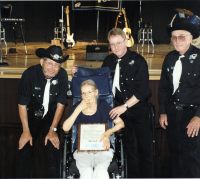
Lois Deer (center) with The Brothers & Co. members Gary Deer Jr., Gery Deer, and husband Gary Deer Sr. at the Jamestown Opera House in 2010

Lois Deer (center) with The Brothers & Co. members Gary Deer Jr., Gery Deer, and husband Gary Deer Sr. at the Jamestown Opera House in 2010

JAMESTOWN, OH – On a cold, winter night, a couple of weeks after a family Christmas party in 1994, something historic took place. William Sutton, his brother Gary “Tuff” Sutton, Sr., and their nephews, Gery Deer and Gary Deer, Jr., did something they’d never done before. They all met up on a Friday night at the Deer family farm in Jamestown, Ohio and collected their musical talents into what would become a lifelong undertaking. While you may never have heard of “The Brothers & Co. Entertainers,” their history is one of a unique brotherhood derived from a family whose musical talent goes back several generations.

While William and Tuff had played together many times over the years, the Deer brothers had never made the attempt. Tuff had helped Gery develop his natural piano skills and Gary Jr. hadn’t played his drums much after graduating high school in Fairborn in the early 1970s. But when they sat down, something really amazing happened, they just “worked.”

Tuff took on the lead and rhythm guitar duties. William was initially the group’s bass player, but picked up his dusty bow and took over the fiddle spot once family friend Jess W. Young, of Fairborn, signed on, and then there were five.

Originally called simply, “The Brothers,” the band went through a lot of changes in its first year or two, adding and subtracting musicians, but always maintaining the two sets of brothers as the foundation. By 1996, a decision was made to change the group’s name, adding, “& Co.” (and company), allowing them to add and subtract whomever they wanted without much of a branding problem, so long as Gery and Gary Jr. at least remained. Somewhere along the way, Gery and Gary Jr. decided that the group was made up more of “entertainers” than trained musicians, so that was tagged onto the name too – “The Brothers & Co. Entertainers.”

SONY DSCBy 1996, Ed Jones had joined up on banjo and acoustic guitar. A cousin to the Deer brothers and another nephew of the Suttons, he also had never played together with his family before in this way. Sadly, the family lost Uncle Tuff Sutton to cancer in 2005, and William stayed with the group only a short time after and also passed away a few years later. Jess Young also retired from the group due to health reasons and passed away shortly after.

“None of who we are now would have happened without each of them,” Gery remembers of his family members who have passed on, including his mother, Lois, who died in 2011 after suffering for several years from Alzheimer’s disease. “We are who we are because of them and my mother was, essentially, the anchor. It was because of her that my brother and I are here and that the others came together with us. We couldn’t have done this without them.” But the changes weren’t over yet.

From inception until about 2004, the boys had maintained an instrumental bluegrass persona. But one Saturday night, shortly after a family friend, Jim Karns of Fairborn, joined the group, something odd happened. As Gery puts it, “We opened our mouths and a terrible, awful, nails on the chalkboard noise hit the air, as if four birds had flown headlong into a window while screeching at the top of their lungs.”

The Brothers & Co Variety Show will perform a 45 minute set at the Schuster December 4. Photo by Jen Copas

The Brothers & Co Variety Show will perform a 45 minute set at the Schuster December 4. Photo by Jen Copas

Brothers_Co-Whip_Gery_JimIn truth, the experiment had landed them in uncharted waters. Although Ed had done some singing, and Jim, as the most experienced, having performed in theater productions while in school at Kettering Fairmont, Gery and Gary Jr. had virtually no singing experience. But there were some golden nuggets amidst the muddy waters of their four-part vocalization.

Working hard to find their respective parts, eventually everything finally fell into place and they had become singers as well as naturally talented musicians. But with change comes growing pains.

An expanded repertoire and wider variety of music required instrument and key changes and since they guys play their own instruments, staging issues caused shows to come to a dead crawl. But a solution for that problem quickly presented itself, and, as is the norm with this group, Mother Necessity birthed yet another Brothers & Co. innovation – one they like to call, “comagic.

In addition to having a great set of bass singing pipes, Jim Karns is also an award-winning, classical stage magician. In addition, Gery was an accomplished stage bullwhip artist, having performed all over the country and on national television shows like America’s Got Talent and The Bonnie Hunt Show. He and Gery had met while working for an engineering center in Dayton and found they had many common interests, the least of which was a somewhat Vaudevillian sense of humor, one that fit in perfectly with an almost Grand Ole Opry styled stage show.

The Brothers & Co. Bus, NOAH'S ARK

The Brothers & Co. Bus

The new family-friendly routines, originally designed to give time for stage and instrument changes, soon added a whole new dimension to the show. It wasn’t long until “The Brothers & Co. Entertainers” became, “The Brothers & Co. Music and Variety Show.”

After two decades of constant evolution, weekly rehearsals in a specially built room at the Deer family farm, and shows that spanned everything from coffee shops to casinos, The Brothers & Co. have more to offer than just four guys standing around singing. They are a full, family-friendly, stage variety show that can perform virtually anywhere. Their signature black, western outfits designed by Gary, Jr. and Gery’s mother, Lois, are a tribute to their family’s country music heritage.

The group has performed at the Schuster Performing Arts Center, the Victoria Theatre and the casino resorts of French Lick, Indiana, but their home is in Jamestown, and that’s where they want this 20th anniversary to tour to start. Gary Deer, Jr. is the percussionist of the group and sees to most of their technical requirements. “Mostly, we want to entertain people and give them a show like most haven’t seen since the 60’s,” he says.

“We put a modern spin on an old kind of entertainment that’s nostalgic and originally presented all at the same time,” says Jim Karns. “If you’ve never seen a live variety show, this is something the whole family will really enjoy.” To celebrate their 20th anniversary, The Brothers & Co. will present a pre-holiday performance beginning at 7PM, Saturday, November 22nd at the Jamestown Opera House, 19 N. Limestone St., Jamestown, Oh 45335, to benefit the Jamestown Area Historical Society.

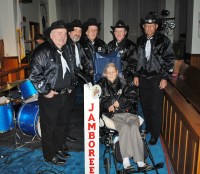
The Brothers & Co. with Gary Deer Sr. and their late mother Lois Deer at the Wheeling Jamboree Radio Show, 2010

The Brothers & Co. with Gary Deer Sr. and their late mother Lois Deer at the Wheeling Jamboree Radio Show, 2010

Gery says the show has something for everyone, and it comes from a place of deep meaning for the family. “This show is hard work, just like anything else of value. It honors our mother’s memory, it gives testimony to the fact that a family can do something together besides watch TV or play a video game. There is a family commitment to The Brothers & Co. that gives other families the chance to bring the kids and enjoy genuine, dare I say it, ‘wholesome’ entertainment that’s just plain fun. It almost doesn’t exist anymore and we rarely get a chance to show it here at home.”

Tickets at the door are $10 for adults, $5 for seniors and students. Children 12 and under are free. Tickets are available at the door the night of the show and for presale at Ted’s Barber Shop, 3 W. Washington St. in Jamestown. Sponsorships are also still available for businesses in the area starting at $100. Proceeds from this performance benefit the Jamestown Area Historical Society. More information is available from The Brothers & Co. website, thebrothersandcompany.com, and from their Facebook page. Watch for The Brothers & Co on the WDTN-TV2 program, Living Dayton, 12 noon, Tuesday November 18.

The creative process cannot be quantified

In Books, Children and Family, crafts, Entertainment, Local News, National News, Opinion, Print Media, Technology, Uncategorized on November 10, 2014 at 1:04 pm

If you haDIH LOGOve any friends who are aspiring novelists and you haven’t seen them for a while, I may know why. November is National Novel Writing Month, a time when writers – hobbyists and professionals alike – forsake virtually everything else in life to get down at least 50,000 words towards a completed novel in just thirty days. As executive director of the Western Ohio Writers Association I am, like many of our members, one of the anticipated 400,000 worldwide participants in the event. But attempting to pen a full-length novel in under a month is not for the faint of heart.

“NaNoWriMo,” as it’s known for short, is a non-profit organization started in 1999. In 2013, more than 310,000 participants signed up, spanning six continents. In the 2014 official press release, NaNoWriMo Executive director Grant Faulkner said, “Every year, we’re reminded that there are still stories that have yet to be told, still voices yet to be heard from all corners of the world. NaNoWriMo helps people make creativity a priority in life and realize the vital ways our stories connect us. We are our stories.”

pcpic1

pcpic1

Given their commitment to the encouragement of writers as a whole, the NaNoWriMo folks certainly seem to want to keep people motivated and working and that extends beyond the November event. The organization also promotes youth programs, writing camps and other writing-focused activities throughout the year.

NaNoWriMo’s organizers insist the purpose of the 30-day novel challenge is to inspire and motivate authors to actually finish something, a common barrier for new writers. To hit the goal, writers must pen approximately 1,667 words per day, regardless of quality. But the “just keep writing” approach doesn’t sit well with some and there are those who say that it instead may be more counterproductive than helpful.

Opponents believe that the idea of such incredible pressure of deadline and competition undermines the inspirational process; robbing the author of the creative time necessary to be more selective of words, phrasing and flow.  Classic American author Mark Twain might well have been in agreement with this thinking.

In a letter dated October 15, 1888 to English minister George Bainton, Twain wrote, “The difference between the almost right word and the right word is really a large matter–it’s the difference between the lightning bug and the lightning.”

nanologoBut those who are regular participants seem to really enjoy a process that they say gives them the opportunity to stay focused and inspires a bit of healthy competition. Throughout the month, each writer updates a public profile on the NaNoWriMo website which includes word count to date; a practice largely appreciated as one of the most motivating aspects of the exercise, or the most discouraging, depending on how you’re doing.

Whether you are a writer or a reader, this is probably a good time to point out that the creative process is not something that can be qualified or quantified. It is different for every artist. While there are people who are proficient with grammar, punctuation, style and general mastery of the English language, there is no such thing as an “expert” writer. Most successful authors – and not just in the commercial sense – will insist that good writing cannot be taught, it has to be practiced and that the creative process is ongoing.

It may very well be that a 30-day novel, after editing and revision, could end up the next New York Times best seller. It is just as probable that another manuscript, in the works for many years, might turn out to be the worst 300 pages ever put to paper. It’s really a coin toss.

Truthfully, the process really doesn’t matter. Although the value of art rests with the audience, its quality depends on the talent, determination and hard work of the artist (writer), rather than the method used for its production. As for those of you typing your way to 50,000 words this month, we who are grateful to get out 700 words every week salute you! Good luck.


Gery L. Deer is an independent columnist and executive director of the Western Ohio Writers Association. More at westernohiowriters.org.

Space flight really is rocket science

In history, National News, Opinion, Science, Technology, Uncategorized on November 3, 2014 at 2:41 pm

DIH LOGOBy now, most have heard about the failed test flight of Virgin Galactic’s “SpaceShip Two,” which crashed in California’s Mojave Desert on October 31st.  One of the spacecraft’s pilots died in the crash, the other critically injured. While this is Virgin’s first fatality during the development of their “sight-seeing” spaceship for the super rich, perhaps it is just another sign that the pursuit of more money and fame may not be adequate reasons attempt another small step for (rich) mankind. Space travel really is rocket science, and then some.

After a successful flight and ocean landing in July of 1961, astronaut Gus Grissom’s Mercury space capsule sank after a premature detonation of explosives blew the hatch. Grissom managed to escape, only to die six years later in a fire during a “plugs out” test of the Apollo 1 capsule on the pad at Cape Kennedy. Astronauts Ed White and Roger Chaffee also perished in that tragedy.

Other terrible accidents followed during America’s “space race” to beat Russia to the moon and meet President Kennedy’s goal of landing a man there before the end of the decade. America did finally put men on the moon, several times. But, as space travel became more complex, the dangers increased exponentially, and so did the cost of human life.

Space flight is hard! It should be left to the experts.

Space flight really is rocket science!

Famously re-created by Ron Howard on film, Apollo 13 was, in short, a miracle of human survival. By all odds, three guys trapped in a freezing pop can, 240,000 miles from Earth, should never have been able to make it home. Fortunately, thanks to the skill, ingenuity and experience of the crews both in space and on the ground, the movie managed to get a real-life happy ending.

More than two decades after the Apollo 1 catastrophe, the Space Shuttle Challenger exploded shortly after liftoff, marking the first time a civilian had died in a space travel accident. In February 2003, the shuttle Columbia broke up on re-entry over Texas after insulating foam from the main fuel tank had damaged the heat shield as it left the launch pad.

No matter how far technology appears to have advanced, space flight is now, and will always be, experimental. The engineers and pilots at the National Aeronautics and Space Administration (NASA) learned a great deal from the catastrophic failures mentioned earlier. But as more, privately developed, manned space flights are attempted, it is important to keep in mind that all of these disasters happened under the watchful eyes of some of the smartest, most experienced aerospace experts in the world. Yet people still died.

At our present level of technology, space flight is not something that should be left to over-privileged billionaires with fancy English titles. It’s dangerous, expensive and the drive for national security and scientific achievement does not exist in these endeavors. Virgin Galactic’s efforts are about money, pure and simple. Upon further reflection, however, cash may not be any less a humanitarian reason to get into manned space flight than beating the Communists to the moon.

After mothballing the last of the space shuttle fleet, America seems to be all but out of any residual space race that may still exist. Massive budget cuts enacted by the Obama administration have stripped NASA to its bare bones, its government money now subsidized more often by private companies using facilities and personnel to launch communications satellites. Without the space shuttle, the International Space Station depends more and more on private industry – and the Russians – to remain manned and supplied.

Lacking a more pressing need to funnel billions of dollars back into government-sponsored space flight, private organizations will eventually be the only way Americans go to space. For more companies like Virgin to get involved in the endeavor, however, there would need to be some kind of return on investment to motivate them.

Perhaps one of the space probes will find gold or platinum on Mars or one of Jupiter’s moons, inspiring a space-age gold rush. Until that happens, people should probably keep an eye open for more rich kids’ toys dropping out of the sky.
The Jamestown Comet Editor/Publisher Gery L. Deer is an independent columnist and business writer based in Jamestown, Ohio. More at gerydeer.com.

Propaganda still has power over Americans

In Dayton Ohio News, Health, Local News, National News, News Media, Opinion, Politics, psychology, Religion, State News, Uncategorized, World News on October 27, 2014 at 9:42 pm

DIH LOGOPolitics and religion both thrive on propaganda, some of it factual, some creatively manufactured. Either way, people will buy into almost anything when you hit them at the gut level. Emotions ride highest when fear is used as the manipulation point.

In 1938, Orson Welles managed to terrify the radio listening public as he destroyed America by Martian invasion in his version of H.G. Wells’, “War of the Worlds.” Of course, it was all a Halloween offering, a prank, “the radio equivalent of dressing up in a sheet and jumping out from behind a bush and saying, ‘boo,’” as Welles put it. But it was, for lack of any other analogy, an hour of “propaganda;” a radio play written to sound exactly like genuine news bulletins, and people fell for it.

According to the dictionary definition, propaganda is information, especially of a biased or misleading nature, often used to promote or publicize a particular political cause or point of view. A deceptive radio broadcast may not be likely to have the same effect today, but if the current Ebola virus scare is any indication, Americans are still far from immune to the effects of well-crafted media spin.

With virtually no qualified medical information being distributed within the propaganda (probably the best word to describe most of the information being circulated), politicians, the media, and the endless barrage of know-it-all cable TV commentators are spreading speculation, misinformation and fear, unabated.

As one might expect, election season has to be one of the most prominent times for the spread of heavy-handed, negative propaganda. Despite laws to limit how “misleading” political ads can be, there is still so much being dispersed that it staggers the imagination of the thinking person as to how it is even allowed.

With fewer people concerned about the accuracy of news reporting these days, believing any blog they run across on Google, media spin no longer needs even to be well-crafted for the masses to fall victim to its intent. There are still, bafflingly, people out there who think that what they see on the news or Internet must be the truth. Not so much “fact,” but truth.

Is the Ebola scare really the menace it's made out to be by politicians and media?

Is the Ebola scare really the menace it’s made out to be by politicians and media?

The spread of propaganda does not require facts but implies truth. Make enough people believe in an idea, factual or not, and it becomes “truth,” at least to those people. Once spread, that truth ends up being the predominant viewpoint and changing the minds of those who fall for it is a challenge, to say the least. Oddly enough, this is the same basis upon which every religion in history has been established.

As pointed out many times in “Deer In Headlines,” decisions are rarely made from factual information but more often based on emotional satisfaction. What makes a person feel good is far more powerful than a list of unemotional statistics. Once again, fear can be one of the most powerful emotions of them all and that is exactly the point.

Without fear, propaganda has much less of an effect. Political propaganda plays on the fear of the voter, suggesting that he or she will suffer under the rule of the opposing candidate – higher taxes, less food on the table, fewer jobs, and so on. In religious propaganda, the fear is purgatory, Hell, or whatever the particular denomination chooses to promote as the reason to show up every Sunday and ante up in the plate as it goes by.

There is, without question, a serious problem concerning the spread of the Ebola virus in the United States. But there is also, sadly, a tremendous opportunity here for politicians to cash in on the fears of those who are probably already paranoid about such things, enhancing the real threat enough to justify the need for such publicity.

Those fifteen minutes of fame come with a high cost, mainly in the stress and emotional trauma experienced by the people who trust their government to take care of them. Avoiding future panic means that people simply need to be cautious about what they take as “fact,” versus what they believe to be “truth.”


The Jamestown Comet.com editor Gery L. Deer is an independent columnist and business writer based in Jamestown, Ohio. More at deerinheadlines.com.

Zombies, the lamest monsters

In Books, Entertainment, Movies, Opinion, sociology, television, Uncategorized on October 20, 2014 at 11:28 am

DIH LOGOHalloween is upon us and, once again, zombie-mania continues to reign supreme. From so-called, community “Zombie Walk” events to AMC’s season premier of the “Walking Dead” boasting the highest-rated cable television show in history, Americans certainly seem to be zombie-obsessed. But why; what is it about an animated, decaying corpse that seems to capture people’s imaginations and gets them to shell out millions of dollars in search of the next big zombie fix?

According to the Oxford English Dictionary the word, “zombie,” has its origins in West Africa, but the concept of the animated corpse most likely comes from Haitian folklore. Legend suggests that the dead are raised by magical means to walk the earth again and do the bidding of the one who performed the revival ritual, as a sort of creepy slave.

Zombies first appeared in American popular literature as early as 1929, then shortly after, actor Bela Lugosi, famous for his portrayal of “Dracula,” starred in the film, “White Zombie,” which introduced the familiar personification of the creature. The modern American zombie pop-culture most likely took hold after the release of George Romero’s 1968 film, “Night of the Living Dead,” although they were never actually referred to by that word in the movie.

zombiesZombies in modern tales aren’t usually created by magic, but science. Today’s authors have penned a more realistic origin for what has become known as the “zombie apocalypse.” In most current story plots, a rogue virus escapes to the population, infecting everyone and turning them into, essentially, zombies. Instead of one or two slave zombies on the loose, entire populations of walking dead murderously meander across the globe, destroying civilization as they consume the living for sustenance; right, whatever.

Really, except for the fact that they’re pretty gross to look at and can sneak up on people, as far as monsters go zombies are probably the lamest (pun intended) and least scary creatures ever dreamed up. Think about it – re-animated dead people, hobbling along with one foot dragging behind them and moving so slowly, any granny on a walker could whiz past. What’s scary about that?

These monsters have no motive for being bad and there is no end goal or desire for world domination. They’re just hungry. They wander the night, aimlessly, hoping only to happen upon a fresh brain to consume.

And would someone please explain why they even need to eat anything? They’re dead! What possible nutritional value could there be in anything for a zombie? And why are they bleeding always? Does it need to be pointed out again, they’re dead – there shouldn’t be any blood pumping.

Add to that killing them is really a piece of cake, depending on which version of zombie lore you adhere to. In the modern, “Walking Dead” style, all you need to do is smash in their heads or decapitate them or something. But, according to Haitian lore, the goal was not to destroy them but to release these poor souls from their magically-induced, wandering purgatory and there were several methods available to do that, like pouring salt on them.

In any case, zombies are just not all that intimidating compared to vampires or werewolves (ignoring the Twilight-styled, sparkling, Calvin Klein model types). And yet, inevitably, story protagonists nearly always get caught by the marauding zombies and get their brains eaten. Really, how dumb does someone in a monster movie need to be to actually get caught by a crippled, decaying dead guy?

So, here is the best possible advice for escaping zombies – run! Or, just walk fast; it’s not that hard to get away from zombies. Just be sure to sacrifice the comic relief character first, giving you extra time (not like you need it).

If for some reason the zombie gets too close, and yes, that will be because you are really, incredibly stupid, just grab the arms and pull them off – how hard can it be? They’re dead and decaying, right? Hopefully the zombie fascination will diminish soon, leaving room for even more ridiculous obsessions, like brooding, teenage werewolves. Oh wait, that’s been done already too. Oh well. Happy Halloween!
Gery L. Deer is an independent columnist and business writer. Deer In Headlines is a production of GLD Enterprises Commercial Writing. More at gerydeer.com.