
Local News & Commentary Since 1890.

Posts Tagged ‘Living Dayton’

Music shines light through darkness of dementia

In Health, Local News, Opinion, Senior Lifestyle, Technology, Uncategorized on August 18, 2014 at 12:20 pm

DIH LOGOAccording to statistics, one in three senior Americans now suffers from some type of dementia. My mother, Lois Deer, was one of those unfortunate millions who had an advanced type of Alzheimer’s disease. As it progressed, she lost the ability to communicate on anything more than a passive level, responding to very little, short of a head nod or facial response here and there. When she spoke, it was in whispers and then only gibberish.

One thing that did seem to register, however, was music. Each Saturday night we would move her wheelchair to the band room at my parents’ farm where our family band, “The Brothers & Co.,” would rehearse. We would feed her dinner – a manual task since she couldn’t do it on her own – and she’d spend most of the rest of the evening listening to us play and sing, surrounded by family in a room she created for us.

Gery Deer discusses Music and Dementia on WDTN-TV2's Living Dayton during a "Deer In Headlines" segment. Click to watch the video clip ...

Gery Deer discusses Music and Dementia on WDTN-TV2’s Living Dayton during a “Deer In Headlines” segment. Click to watch the video clip …

Music was an important part of my mother’s family growing up, with virtually ever member playing some kind of instrument, many of them without the aide of formal lessons. She even sang in an “Andrews Sisters” type quartet with her own sisters in the late 1950s.

By this time, however, Usually, she had a kind of empty, blank expression on her face, a typical Alzheimer’s manifestation. But one evening during our practice, she was sitting near my piano and I caught sight of a slight smile in her eyes and looked down to see her toe tapping on the footrest of her chair.

Since Mom needed 24-hour care, and because we had no intention of leaving her to rot in a nursing home, we cared for her at home and she came along with us to every performance. She had a specially-outfitted seat on our tour bus, complete with an oxygen tank and all of our portable medical supplies. My cousin sat with her in the audience and she would sing, “You are my sunshine,” with us at some point in every show. Music got through, when nothing else would, and I’m relieved to know that I’m not the only one who noticed.
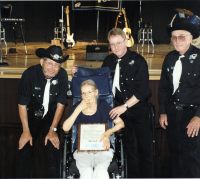
Lois Deer (center) with The Brothers & Co. members Gary Deer Jr., Gery Deer, and husband Gary Deer Sr. at the Jamestown Opera House in 2010

Lois Deer (center) with The Brothers & Co. members Gary Deer Jr., Gery Deer, and husband Gary Deer Sr. at the Jamestown Opera House in 2010

A friend recently told me about a National Public Radio news story related to this phenomenon. The piece focused on a documentary featuring social worker Dan Cohen and his creation of custom music playlists on iPods for elderly dementia patients. Titled, “Alive Inside,” the film explores Cohen’s exploration of the connection between music and long term memory.

“Even though Alzheimer’s and various forms of dementia will ravage many parts of the brain, long-term memory of music from when one was young remains very often,” Cohen told NPR’s Melissa Block. “So if you tap that, you really get that kind of awakening response. It’s pretty exciting to see.”

That all makes a lot of sense when you think about the kinds of music my family band plays and the relationship my mother had to it. There’s no question we were reaching an area of her mind that the Alzheimer’s hadn’t yet shorted out.

After I noticed my mother’s reactions, I paid more attention whenever we performed at nursing facilities where a great number of the residents were suffering from similar illnesses. I can’t tell you what a heart-wrenching experience it always is to see these poor people in such a state; doubled over in wheelchairs, closed off, withdrawn into the isolated torment of their own disease-ravaged minds. And then …

And then we start playing and something would happen, a toe would begin to tap here and there, or a silent face would begin to mouth words to a song. Although it might seem like there’s nothing left of the people they once were, here was a sign that they were still in there – somewhere – and we were reaching into that one place the disease couldn’t penetrate.

All I can imagine is that the music we were playing took my mother somewhere else within a mind that’s organization had long since scattered, as if someone rearranged all the drawers in a wardrobe chest.  She was in another place and another time, a better time.

Christina Corallo, North Shore LIJ Orzach Center for Rehabilitation, Valley Stream, N.Y., tells MusicandMemory.org, “Patients with anxiety and depression are less agitated and appear calmer. The music transports them to a happier place in their minds.”
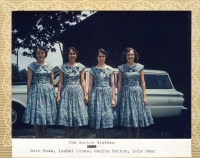
"The Sutton Sisters" singing family, Lois Deer (far right) and her sisters, (from left) Ruth Rowe, Isabel Jones, and Regina Marshall, ca. 1958

“The Sutton Sisters” singing family, Lois Deer (far right) and her sisters, (from left) Ruth Rowe, Isabel Jones, and Regina Marshall, ca. 1958

Cohen’s idea of customized iPod playlists for each patient is still plagued by one major hurtle – money. Nursing care, particularly long-term dementia care, is incredibly expensive and iPods aren’t cheap. It’s the same financial roadblock encountered by virtually every other progressive therapy for dementia ever proposed.

With that, I am challenging one member of the family of every dementia patient to buy an iPod for their loved one and load it with music from their life. Give them a moment to feel who they once were in the most personal, powerful way possible – through music.

 Learn More About Music and Memory…

Click here for a link to the full NPR story,”For elders with dementia, musical awakenings,” by Melissa Block.

Click here to watch the trailer, “Alive Inside: A Story of Music & Memory” featuring Dan Cohen.

Donate to Music & Memory: Monetary or iPods 


Back to school open house focuses on computer security

In Business, Children and Family, Dayton Ohio News, Education, Technology, Uncategorized on July 18, 2014 at 10:14 am

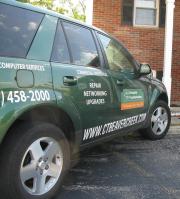
CT_BEAVERCREEK_TRUCKBEAVERCREEK, OH – On Saturday, July 26, Computer Troubleshooters of Beavercreek (CTB), located at 3792 Dayton-Xenia Rd. Beavercreek, Ohio 45432, will host a free open house from 10 a.m. until 3 p.m. to promote student computer security. The event is free, open to the public and will include refreshments, door prize drawings and special deals and information related to keeping student computers secure on campus this school year.

As part of an international network of independently owned franchises, Computer Troubleshooters provides complete information technology (IT) support for residential and commercial clients. Services range from basic, home computer repair and managed business services to cloud computing for advanced medical documentation.

Cliff Brust, president of Computer Troubleshooters in Beavercreek suggests that students are at some of the highest risk of technology theft and data loss. “We’ll be providing information and some free offers with purchase of new hardware,” Brust says. “But most importantly, we want to help parents and students understand how vulnerable their data is to loss and hardware to theft.” Brust offers a few tips in the meantime.

“First, lock up your laptops and smart phones, and don’t leave them unattended – anywhere.” he says. “Many laptops include a slot designed to accept a special cable lock. Wrap the cable around something big and hard to move, insert the lock into the laptop and turn the key or combination. A determined thief could still get the device loose but only by damaging the unit and diminishing its value. Remember, it’s generally the cash from resale of the unit that the thief is interested in, not the data.”

“Next, always use password protection,” Brust advises. “Yes, it is fast and convenient to turn on your computer and have it go right to the desktop, but it’s not safe. You have to password-protect your user account and disable the guest account. When you step away from your computer a quick press of the Windows Key and L will lock your user account. Be sure to manage your passwords also, and keep track of them. Don’t use the same one for everything.”

Brust also reminds students, “Protect your email, don’t share sensitive log-in information with anyone and always keep antivirus and anti-malware software up to date and running.” His final suggestion relates to the use of public wireless Internet hot spots.

“Whether you’re using the school’s network or a free Wi-Fi in a coffee shop your connection could be snooped. Using a VPN (Virtual Private Network) will protect your connection and let you surf anonymously. There are plenty of good free VPN clients to choose from so use one and protect yourself.”

Brust hopes the open house will give visitors the opportunity to learn more about keeping computers and smart phones safe and secure, on and off campus. “Planning and prevention are the keys to protecting your devices and your data,” he says. “Protection plans and keeping security software up to date can go a long way towards keeping important files from being lost. We can help people with the right solution for their needs.”

Computer Troubleshooters is located just west of N. Fairfield Rd., situated between Knollwood Garden Center and Capitol Dry Cleaners. For more information about computer security, call (937) 458-2000 or visit them online at http://www.ctbeavercreek.com.


Cause and effect of drug advertisements

In Business, Education, Health, National News, Opinion, television, Uncategorized on June 26, 2014 at 10:37 am

DIH LOGOAccording to a 2008 study by the peer-reviewed medical journal, PLOS Medicine, pharmaceutical companies spend nearly twice as much on marketing than research. In a review of the study, the consumer advocacy website, Consumerist.com, indicates, “Drug companies pour $57.5 billion into marketing, dwarfing the comparably paltry $31.5 billion devoted to research.”

Pharmaceutical manufacturers have rigid guidelines for promoting their products, but the question lingers: should non-over-the-counter drugs be promoted to the general public at all? The short answer is, probably not. The longer answer is more complex. Since, as a rule, Deer In Headlines deals with “fact,” not “truth,” here are some facts about drug advertising. Incidentally, if it is truth you’re interested in, check out a philosophy column (thanks Dr. Jones).

The official website of the United States Food and Drug Administration states, “Prescription drug advertisements can provide useful information for consumers to work with their health care providers to make wise decisions about treatment.” Leading the pack of heavily-marketed drugs are prescription sleep aids, blood thinners, anti-depressants and erectile dysfunction remedies. Most of the television ads for these medications appear during the day, carefully targeting certain markets.

What the general public fails to realize, however, is that these ads are intended to plant an idea in the head of the consumer who, in all their medical wisdom, will take the information to a doctor and insist on a prescription. Mission accomplished; more drugs are sold and the company’s stock goes up a quarter of a point, not to mention the fact there is one more person who simply can’t live without the latest pill. Perhaps a better understanding of how these ads are structured might help.

pillsThe FDA’s Office of Prescription Drug Promotion classifies medication advertisements into three categories: Product Claims, Reminders, and Help-Seeking ads.  The product claim ad names the drug, the treated condition and lists the benefits and risks. A reminder ad shows the name of the drug, but not its use. Finally, the help-seeking advertisement is directed at people with a particular condition for which they are trying to find a remedy. There is, however, no guideline for how much money a drug company can spend on advertising and some consumer advocates argue that it’s wrong for them to be able to spend more on marketing than research.

The fact is that it’s really hard to say exactly how much any one drug company spends on research vs. marketing because reported advertising expenditures are mixed in with the accounting category which also includes other figures, such as executive salaries. Research money is usually accounted for in a separate line item (R&D), even though it technically could be in the same classification with general operation costs.

Another fact is that everyone is a medical expert – yes that’s sarcasm. From the neighbor with every ailment more painful than the last or the relative who insists his doctor is an idiot but goes back every time his prescription runs out, self-diagnosis and treatment are a real epidemic in America.

There is also the concern that these advertisements actually plant the idea of a particular illness in the mind of the viewer who then heads to the doctor with a new problem, and a new prescription demand. Studies show that about 40-percent of all doctor visits are with the intention of getting a prescription. Since people keep going back, it’s safe to assume there are plenty of doctors obliging, and that needs to change as well.

Prescription medication should be marketed to the experts who will be prescribing it to the patient. Drug companies already spend billions on advertising and on-site sales representatives who offer samples and various other motivators to get the doctors to push their products for various ailments. The patient has no business self-prescribing and doctors need to be more responsible.


Gery L. Deer is an independent columnist and business writer based in Jamestown, Ohio. Side effects of reading Deer In Headlines include a more open mind, alternative points of view and a better understanding of the world around you. No prescription necessary.


Too much rides on a credit score

In Business, Economy, Education, Jobs, National News, Opinion, Uncategorized on June 16, 2014 at 11:33 am

DIH LOGOFor all the important numbers in the life of the average American, the credit score seems to wield the most power. It’s hard to imagine how three little digits could determine how an individual will live his or her life, regardless of the circumstances that created it and with the average person having virtually no understanding of what it is or how it’s calculated.

Credit scores determine how much a consumer will have to pay for credit (as interest rates), insurance, and other necessities. For many years, the credit score was a value hidden from the consumer because Fair Isaac and Company, the firm which created the process, decided it would just be too confusing to the general public. (Of course, that’s the usual excuse offered up by big business and government agencies trying to dupe the general public.)

That’s little comfort, however, to those who have been held hostage by the credit reporting companies for decades. Almost since inception, credit data has been full of inaccuracies and misinformation, a problem to which consumers have had little (practical) recourse other than the slow, usually pointless, process required to amend a report.

As of 2012, the Consumer Financial Protection Bureau was charged with the oversight of personal credit rating companies. With countless rule changes over the years, the Fair Credit Reporting Act finally forced at least some restrictions on the credit rating companies. The FCRA is the legislation that required companies like TransUnion, Experian and Equifax to provide free credit report, limit outside access to personal credit files, initiate identity theft protections and other consumer defense measures. Click here for a downloadable version of the Fair Credit Reporting Act is available.

creditoneRegardless of the current legislation, however, credit monitoring and reporting services still have entirely too much power and control over the general lives of consumers. A credit report (and score) whether accurate or not, can limit access to vital, day-to-day needs like transportation and employment.

Considering how much inaccuracy can exist or the irrelevancy of the information to the situation, it’s bewildering how it is legal for employers to reject applicants based on a credit score. In another example, how is it permitted that credit score can determine whether someone should be provided with car insurance, particularly when coverage is mandated by the government?

Whatever more ignorant people choose to believe a low credit score doesn’t always mean a person is unwilling to pay their bills or is inept at handling money. Sometimes circumstances change, as with the predatory lending practices that contributed to the housing market crash of 2008.

Likewise, although there is a higher risk in lending to people with a sorted credit history, almost no one takes into account how the score got so tarnished. On the heels of the worst recession in U.S. history, the credit rating process seems almost backwards to the average consumer.

If you can afford a higher rate and larger payment, you get a lower one, and vice versa. A person may be in desperate need of a car or renters insurance but, because of a lower credit score, they are charged significantly higher rates and payments. Wouldn’t it make more sense to offer those people lower rates and payments, making it more likely they can pay on time and help shore up the economy in the process?

The consumer should always keep in mind that the credit reporting organizations are private sector businesses, not government agencies. They are not affiliated with the Federal Trade Commission in any way nor any other government office. Credit scores are big business for those companies that calculate and report them.

In the first quarter of 2014, TransUnion, one of the three largest firms, reported earnings just over $303 million. That’s just for one credit reporting company over three months! So, with billions of dollars in revenue at stake, there is little to no motivation for limiting the power of these companies. It’s a sure bet that lobbyists for the credit reporting companies are well-entrenched in Washington, greasing all of the appropriate palms to make sure that the “have nots” never catch up to the 1-percent.


The Jamestown Comet.com editor / publisher Gery L. Deer is an independent columnist and business contributor to WDTN-TV2’s Living Dayton program. More at http://www.gerydeer.com.


More family advocacy needed for elder care

In Children and Family, Health, Opinion, psychology, Religion, Senior Lifestyle, sociology, Uncategorized on April 16, 2014 at 1:31 pm

DIH LOGOCaring for an aging parent is, in my opinion, one of the most difficult and often painful experiences life throws our way. Providing a safe, healthy environment for an elderly family member is just as taxing as doing the same for a child.

What makes this process even harder is when the parent is resistant to help or simply won’t accept that they are no longer in a position to take care of themselves. Poor decisions, an inability to recognize when driving has become hazardous and, worst of all, when they will listen to anyone’s advice but that of their children, complicates the care process and causes serious damage to the parent/child relationship.

It’s hard to watch parents age and knowing you’re headed the same direction only solidifies the reality of it all. It’s harder still when they resist every attempt to maintain their health and sometimes doctors undermine your efforts by telling them they don’t have to do anything they don’t want to.

I understand that people need to make their own choices, but some shrink in a hospital cannot possibly know an individual’s mental status by talking to them once for three minutes and asking a half dozen pointless questions. “Do you know where you are? Do you know what day it is? Can you draw this box? Write your name.” “Draw this box,” are they kidding?

How about we ask them what their checking account number is, or the name of their insurance company? How about asking when they last paid their phone bill? These are vital questions to someone who is supposedly “competent” and yet this is not what is included in a psychiatric evaluation for a senior’s ability to make his or her own decisions.

Then there are those who are intent on taking advantage of the elderly person’s desire to feel “needed” and useful. These individuals worm their way into the lives of the elderly, showering them with compliments and creating a rift between the senior and his or her family. These unscrupulous people are trying to get money and property away from the senior and alienate children and others who are trying to protect their interests.

Deer In Headlines author Gery Deer is helping his brother Gary Jr and sister Cathy to take care of their father, Gary Sr. and it's rarely easy work.

Deer In Headlines author Gery Deer is helping his brother Gary Jr and sister Cathy to take care of their father, Gary Sr. and it’s rarely easy work.

Laws addressing the rights of seniors, as well as those regarding patient rights, seem to take no account to dementia and speak only to protecting them from family members bent on securing money or locking them away in a nursing home. What about those of us who are trying to protect our parents and provide a safe, secure life for them in their own home as long as possible? Where is our protection and support? There is none.

Preserving a person’s dignity is difficult enough without being able to handle even the most basic decisions absent a mile of legal documents in place only to provide more money for lawyers. Power of attorney documents are meaningless unless the person is thoroughly incapacitated and no one will help without signing over deeds and financial statements.

Believe it or not, sometimes money has nothing to do with it! There are actually situations when families are trying to preserve an aging parent’s lifestyle, dignity and financial security. Someone should be out there advocating for us, not making it harder. Unless you’re loaded with money, there is just no support for people dealing with this kind of problem.

So what is to be done? Good question. I am all for protecting the rights of the elderly and maintaining their ability to make decisions, but there are many degrees of incompetence between fully cognizant and Alzheimer’s dementia and that should be taken into account.

My mother lost all of her reasoning ability as Alzheimer’s set in and it nearly bankrupted my family to get her under a guardianship so we could keep her safe and well-cared for. But when a senior has some competence but not all, that needs to be addressed and the family should be able to have some advocacy for protecting the interest of that individual without so many roadblocks.

Legislation should be put into place for the varying degrees of dementia and stop relying on the ‘one size fits all’ psychiatric evaluations that prove nothing more than the person can read a calendar.


Gery L. Deer is the editor and publisher of The Jamestown Comet.com an independent columnist and business writer based in Jamestown, Ohio. More at http://www.gerydeer.com.


Going off the mobile grid.

In Dayton Ohio News, Education, Local News, Opinion, Technology, Uncategorized on January 16, 2014 at 5:48 pm

dih-logo-SEAlmost a century ago, American Telephone and Telegraph (AT&T) considered the prospect of a wireless telephone but quickly abandoned the idea. Today, that move certainly seems at the very least shortsighted. But with a total U.S. population at that time of 180 million, the idea of a future with more than 320 million wireless subscribers was unimaginable.

The information superhighway (Do people even use that phrase anymore?) is truly at our fingertips and it’s also in our pockets or purses and on our hips.  It’s everywhere and it’s with everyone! At the grocery, at the mall, at work, stuck in traffic, at a boring neighbor’s barbecue; and it is only getting better and faster.

GERY_GRIDBut, like the song says, every rose has its thorn and there is an ugly downside of the mobile frenzy – constant connectivity. In the blink of an eye, we were unable to escape the beep, buzz, and ringtone of our smartphones and iPads. It was hard enough to get away from the daily grind when we weren’t carrying the office around in a hip pocket, but now it’s nearly impossible.

The constant mobile distraction is certainly not limited to business professionals, or even adults. School districts have now begun to ban smartphones from classrooms and even entire school grounds just to keep the students’ attention. We are so connected that we’re even missing out on some of life’s most amazing events.

A friend recently shared an anecdote about a man who was in the delivery room for the birth of his first child. Amidst all the breathing and pushing, he was preoccupied with his cell phone, texting with someone about work. Before he realized it, the baby had been born and he totally missed it. I don’t know how true that story is, but it’s not impossible to imagine.

Watch the Living Dayton tie-in segment with Gery Deer and Shaun Kraisman.  Click the photo to watch.

Watch the Living Dayton tie-in segment with Gery Deer and Shaun Kraisman. Click the photo to watch.

And then there’s me. Since my first Commodore VIC-20 computer appeared under the Christmas tree in 1981, I’ve been immersed in technology. I’ve been a programmer, a database developer and a systems administrator. I’ve designed websites and developed social media marketing campaigns. Suffice to say, I know my stuff. But nothing prepared me for how mobile technology was going to grab my life and shake it like a rag in a dog’s mouth!

As a self-employed freelance writer, my day is spent connected to some kind of technology from the time I wake up until I pass out from exhaustion 20 hours later. From my iPhone to my Kindle Fire, I’m constantly surrounded by WiFi gadgets and mobile broadband receivers of all kinds.

For some people, the ability to disconnect from that level of techno-submersion is a serious challenge. But, with a little trial and error, I found easy ways to disconnect without being totally out of touch.

One of the biggest problems with all of this mobility is a lack of personal boundaries, with yourself and others. Back when there were only a couple of phone extensions in the house, many families would not allow calls to be made or received past a certain time of day. A level of courtesy long since gone prevented people from calling during the dinner hour or on a holiday. With a little self discipline, the restrictions can be set regarding cell phone, email and social media time.

When you work for yourself, you don’t have the luxury of watching the clock and a home office keeps the job on your mind almost continually. Fortunately, my office is not in my home, but I’m still connected, even after I lock up for the day. Over time, it was necessary for me to impose what I call “black out” hours; when I don’t answer the phone, I don’t return emails and I don’t post on social media.

I had a particularly hard time sticking to the black outs because, at first, I was always worried about missing that one all-important call that could make or break my career. Trust me, nothing is that important. And, if it is, modern caller ID technology helps you to screen calls so you get to decide whether or not to answer.

Other people need to understand and respect your boundaries as well. Unfortunately, however, it’s up to you to educate them about your availability. Remember if you train people that you answer email, texts and phone calls at all hours, they’re likely to take advantage of that.

Here are some other suggestions that might help you keep your real and cyber lives in better harmony.

  • Time your activity. Keep track of your computing time. You might be surprised how much time you actually spend with your mobile devices.
  • Out of sight, out of mind. Remove your phone and other gadgets from convenient access so you won’t be continuously tempted to check texts or Facebook.
  • No tech at the table. Parents who want better communication with kids should restrict technology use at the dinner table. Of course, that means you have to rule by example. Relationships are better when people talk while sharing a meal.
  • Put down the phone and drive. Besides being safer, listening to music or just some quiet time on your commute might help ease a stressful day.
  • Resurrect an old hobby. For some people, mobile computing has overtaken time once spent on more relaxing pursuits.

Finally, my best piece of advice is to just hit the off button. Shut down the laptop, eReader, and smartphone and do something with family or friends. Go for a walk, visit a museum, read a newspaper or a book – yes, they still make paper ones – just disconnect. Going off the grid a few hours a day can really help you – psychologically, emotionally and professionally.

Click to watch the television interview tie-in that goes with this supplement.

Jamestown salon featured on Dayton television program

In Dayton Ohio News, Economy, Jobs, Local News, Uncategorized on November 19, 2013 at 5:46 pm

JAMESTOWN – Local hair salon owner Samantha Cox was featured on a recent edition of the WDTN-Channel 2 daytime talk show, Living Dayton where she showcased her shop’s hair extension services. She was joined on the show by her hair model, Ryan Bush and interviewed by Living Dayton co-host, Vanessa Freeman.

Uptown_Charleys_LD_1Named after Cox’s two-and-a-half year old daughter, Charley, the shop is located at 9 W. Washington Street, in the historic area of downtown Jamestown. “Uptown Charley’s” is a full-services salon offering haircuts for men, women and children, as well as color, highlights, perms, manicures and pedicures, facial waxing, and licensed therapeutic massage.

Cox is a specialist in hair extensions and customers are coming from all over the Miami Valley to experience the quality and service and “downtown style with an uptown flair.”

Uptown_Charlies_5“I was very nervous,” Cox says about her first television appearance. In addition to demonstrating bonded hair extension, she also explained that her shop is looking for qualified stylists. “We are looking for more help; a managing cosmetologist.

The program originally aired on a live broadcast but the Uptown Charley’s segment can be seen online by going to this link: http://www.wdtn.com/living-dayton/fashion/hair-extensions-in-jamestown

For more information on Uptown Charley’s, call (937) 675-7224 or visit them online at http://uptowncharleys.com/.


Evolve or die: More occupations are becoming extinct.

In Economy, history, Jobs, National News, Opinion, Technology, Uncategorized on November 6, 2013 at 5:45 pm

Deer In Headlines

By Gery L. Deer

What would you do if, not just your particular job, but your entire occupation was no longer needed – ever again? There are on dozens of job categories that are either slowly becoming unnecessary or have already suffered the fate of mechanized extinction.

operatorsAlready gone are the ice and milk delivery man (they were just men back in the day), the telephone operator, record player repairman, elevator operators, professional typists, and a host of others. Those occupational positions feeling the Grim Reaper nipping at their heels may include the gas station attendant, the postal delivery worker, video store clerk, department store sales person, newspaper delivery workers (the paper boy), travel agents and the old-fashioned barber.

Oddly enough even newspaper columnists, like yours truly, are fading away. Modern publishers can use syndicated filler columns or hire “bloggers” who often possess little or no journalistic experience – and pay pennies for the material if anything. Most of my freelancing colleagues have adapted to commercial writing or do as I have, by taking on a wider variety of work to earn a living.

Printing press operator jobs, once abundant in the Dayton, Ohio region are now all but gone. The more publications move toward fully electronic versions, the fewer press jobs there will be and the skill will be in higher demand with those companies still rolling out ink and paper.

As time passes, some of these occupations will have to either evolve into other forms or go the way of the door-to-door vacuum cleaner salesman. Librarians, for example, may have been headed towards obscurity but now manage a variety of media, both on the shelf and online. But others may not be able to adapt to serve alternative functions and will simply die out, like the salaeratus maker (that’s someone from the 1800s who made baking soda). See what you can learn from Deer In Headlines?

So what is to be learned from all of this professional progression? Clearly, more education is going to be necessary and the market will adapt to the need. New types of jobs will be created as others fade away.

But are there any jobs unlikely to be replaced by technological breakthrough? Oddly, anyone who is required to create, build and repair that technology has a goldmine ahead of them. Let’s face it, the nerds rule the world and they’re not going anywhere! There are whole television shows about them now.

Incidentally, it isn’t merely technology that causes occupational evolution, but the economy and changes across a business sector, particularly where several types of industries overlap. Consolidation of responsibilities combined with changes in technology can result in the need for more highly-trained workers, but requiring fewer to do the same jobs.

Doctors and nurses will probably always be required, even though patients will pay more to see them less. Hospitals are in a constant state of change as well. Budget cuts and lack of necessity have long-since done away with the helpful but redundant “orderly” position. Today, nursing and medical assistants have taken the place of orderlies, having more education and medical training that can serve a larger need than merely as a gurney driver.

On-air radio professionals, once called “disc jockeys,” have had to evolve as well. Digital media and station automation have made these jobs scarce, but those who are surviving are evolving through other types of media like Internet-based entertainment and even creating their own online listenership.

Whatever the job, workers should make an effort to stay ahead of the game through personal enrichment, continued education and, above all, keep an open mind. Those people who are very resistant, even defiant, toward technology will have a much harder time adapting.

The bottom line here is that occupational evolution is a necessity of any economy. As technology changes and America continues its slow but steady recovery from recession, more workers will be needed while some jobs disappear because they’re just obsolete. *

Gery L. Deer is an independent columnist and business contributor to WDTN-TV2’s “Living Dayton” program. Learn more at http://www.deerinheadlines.com

What was the “crucible event” that changed your life?

In Opinion, psychology, Religion, sociology, Uncategorized on October 30, 2013 at 9:15 am

DEER IN HEADLINES

By Gery L. Deer

GDEERDIH3Some people believe one is destined to become whatever is predetermined by their god, with all of life’s events planned in advance by some divine manifest destiny. For others, that destiny is in a constant state of change, altered by the ebb and flow of cause and effect, guided not by the hand of a supreme being but by our own choices.

Generally, however, there are some events in life that we can pinpoint as our time of transformation; a crucible, if you will. Within it, parts of us are burned away leaving a changed, newly-formed person, sometimes for the better, sometimes not.

Divorce, extended health problems, the loss of a home, personal income or a job, can all bring about emotions and primal reactions for which we are rarely well prepared. Perhaps the most powerful events that permanently change us are related to the death of someone close such as a family member, mentor or good friend.

For many the death of a loved one can be a crucible, forcing to the surface thoughts and emotions perhaps long buried, or never before experienced. How we deal with death is at least as important as how we deal with life, but we seldom take that concept to heart.

Even as a topic of conversation, death is to be avoided. Its unmistakable finality has so marked humanity that coping with the end of life has served as a catalyst for the formation of enduring religious beliefs, some of which comfort, others frighten.

What may be surprising is that a ‘crucible event’ does not necessarily have to be a negative or unhappy experience. The same kinds of life-changing occurrence can come from positive influences as well such as the birth of a child, a marriage or sudden financial windfall.

The events themselves, however, aren’t what change us; we do that on our own. Most people don’t realize they have the power, for the most part, to alter how they react to outside influence. Feelings are generated by thoughts, so if we control our thoughts, we can better manage our feelings and make more productive decisions during difficult times. That’s a tall order though when it feels like the world is collapsing around you.

I’ve had many challenges in life, from an early age, but the most influential times were during my mother’s long struggle with Alzheimer’s disease. The role reversal (the child becomes the parent), watching helplessly as the illness ravaged her mind and body, and helping to do everything from administer medication to hand-feeding her took a toll on me emotionally that I probably have yet to fully realize. But it did change me; in ways I can’t even imagine yet.

I look at the world a little differently now, having experienced for myself, largely for the first time, the fragility of life. But it was the experience of caring for my mom over the course of a couple of years that slowly burned away layers of my rigid exterior, making me “feel” more than I had previously been accustomed.

It’s really what we do with those feelings that make the difference in the long run. While an experience like I had with my mother could have left me bitter and resentful, I ended up taking to heart a more positive side and a greater appreciation for my family as a whole. Others aren’t so lucky.

Many people emerge from crucible events in a much darker place, filled with resentment or guilt or other emotions that eat away at their core, keeping them from seeing the good that came out of whatever had happened. And, there is always some good – sometimes it’s just very hard to see. Either way, we are changed, different, but it’s up to each of us to decide how those events ultimately affect our lives.


Watch independent columnist Gery L. Deer monthly on WDTN-TV2’s Living Dayton. More at http://www.gerydeer.com.

Not without honor, except at home

In Economy, Entertainment, Jobs, Local News, Opinion, State News, Uncategorized on October 9, 2013 at 9:45 am

DIH LOGOIn the Bible, the book of Mark, chapter 6, verse 4, Jesus says, “A prophet is not without honor except in his own town, among his relatives and in his own home.” The quote refers to the question of Jesus’s work being rejected in his own hometown. That was a couple of thousand years ago but, sadly, this same lack of local support and recognition is still rampant today.

We are constantly barraged by the pleadings by civic and business organizations encouraging us to “buy local.” But, when push comes to shove, even these organizations utilize outside resources more often than not.

The best examples of this kind of behavior are evident in the entertainment industry. I know dozens of performing artists, from musicians to specialty acts, who never seem to get work in their own home areas.

Most make a good living but will always have to travel, which is, of course, somewhat of a necessity for securing regular pay in that kind of business. At the same time, most of them offer much lower fees to work closer to home and yet are rarely taken up on the option in favor of “outside” help.

Someone out there is probably saying, “Well, maybe they’re just not very good.” There is an ignorance surrounding the concept that if someone chooses to remain in their home region, they must be less than expert at their particular job. If not, they’d have been moved to relocate due to excessive demand – untrue.

If these folks are as untalented as that statement implies, why would they have the opportunity to do so much elsewhere? An entertainer or other professional tends to earn far more money on jobs where travel and extended booking time is necessary than if they do a single project in their own community. So why would they be paid more and requested so often out of the region if their talents are less than ideal? The logic there makes no sense.

Take the country singing group, The Statler Brothers, for example. From the 1960s through the early 2000’s, these Staunton, Virginia boys sold millions of records, performed all over the world and yet never relocated from their home town. For more than 25 years, they even did an annual 4th of July concert there to raise money for local charities. And they’re not the only story like this.

Ignorance of local talent is not limited to the entertainment world, however. Other professionals are frequently dismissed in their own communities as well; that is unless they achieve some wider attention and suddenly discover people stacked like cordwood on their coattails.

The point here is that, regardless of the product or service needed, if civic and business organizations are going to practice what they preach, they need to utilize more local talent, and not just the big players on the block. Sadly, with so much “good-old-boy” nepotism at play, without some folks stepping outside the proverbial clique, this is unlikely to change anytime soon. When people do make the effort to connect with local providers, they tend to expect a lot of freebies or slashed pricing. That’s not only unfair, it’s downright disrespectful.

For example, say a chamber of commerce wants to hire a local printer to help with event materials for a charity fundraiser. Often, the organizers want to exchange the work for advertising or sponsorship credits rather than paying the printer’s quoted rates.

In most cases, local business will offer some kind of discount or even an exchange if given the opportunity, but it is disrespectful for the organizers to expect it. Your cause is not the reason the business owner opened his doors. Be prepared to pay for their services.

It would be great if small businesses, local entertainers and other professionals were more appreciated and supported in their home regions. The long term rewards to the community could be unimaginable.

Is this your new site? Log in to activate admin features and dismiss this message
Log In