Local News & Commentary Since 1890.

Posts Tagged ‘Living Dayton’

Editorial series Deer In Headlines extended to a new podcast

In Local News, Media, News Media, Technology, Uncategorized on April 23, 2024 at 3:05 pm

The long-running Xenia Daily Gazette editorial series “Deer In Headlines” has expanded to meet the evolving needs of its audience and is now available as a podcast. Produced by GLD Communications, the weekly column made the leap to digital airways in early April. Listen free – https://deerinheadlines.podbean.com/

Gery Deer is a prolific freelance journalist, award-winning copywriter, editor, and the founder and creative director of GLD Communications, a public relations media agency based in Jamestown, Ohio.

Deer has written for dozens of publications and private clients, providing feature stories, business articles, and three long-running syndicated newspaper columns. The most prominent, “Deer In Headlines,” was a hard-hitting, award-nominated weekly op-ed series from 2008 to 2018.

After a five-year hiatus, Deer revived the series by popular demand, and it is currently published weekly, in print and online. Aptly titled “Deer In Headlines II,” the current series holds a mirror up to the world in a more personal, conversational approach. It has already gained three award nominations.

The podcast, an extension of the newspaper column, offers a unique experience. It not only covers similar topics but also provides a personal touch. Some episodes feature author readings, offering a glimpse into Deer’s process and the stories’ takeaways. This distinct approach sets the podcast apart, making it an attractive sponsorship opportunity.

Deer believes the audience will find value in the podcast’s intimate connection with the author. “Deer In Headlines was never supposed to last this long, but I’m always gratified to hear that people enjoy it and find something useful in my words,” said Deer. “On the podcast, I’ll be talking about the origin of some of the topics, and we’ll discuss writing and books, and, later on, even hear from some guests.” This value proposition makes the podcast an appealing platform for sponsors.

Each episode will run for 15 to 30 minutes. The series is free and available on most streaming platforms, including iHeart Radio, Apple Podcast, Podbean, Google Podcasts, and Amazon Music Podcasts, with more platforms coming soon. A video version of select episodes is also available on YouTube. Just search “Deer In Headlines,” and remember to subscribe for instant notification of new episodes and bonus material.
Deer values his readers’ support of his mission to promote literacy and quality journalism. Therefore, he is offering sponsorship opportunities for the podcast, with a portion of the proceeds going to promote literacy through Reading Is Fundamental.

The weekly print and online column is available by subscription to the Xenia Daily GazetteFairborn Daily Herald, and Beavercreek News Current. It is also available free online at www.deerinheadlines.com on a two-week delay.
The First 10 Miles

In Children and Family, Education, Health, Opinion, psychology, Senior Lifestyle, sociology, Uncategorized on July 1, 2023 at 1:40 pm

Deer In Headlines II

By Gery Deer

I took up long-distance tour cycling in 2017 to give some direction to my fitness routine. I am definitely no gym rat, but I needed to improve my health, and exercise for its own sake was, at least to me, mind-numbing. Preparing for long bicycle tours provided a tangible goal and kept me more engaged.

Growing up in the middle of nowhere, a bike was the only way I could get around, especially when the nearest neighbor kid was a couple of miles away. But this was a different challenge. With higher speeds, longer distances, and greater safety risks, I had a great deal to learn. 

I took the time to learn everything I could about endurance cycling, from choosing the right equipment to managing my food. The first year, I rode about 5 days a week, covering anywhere between six and 12 miles per day, while also maintaining my core and strength exercises.  

With practice, study, and the right workout regimen, my speed, distance, and endurance all improved. That first summer, I completed two, 100-mile, or “century,” rides. Since then, I’ve done six more, averaging two per year. 

I’d never been so driven to accomplish something that physical. I basically became an athlete, and that was never on my radar. Plus, it was as much mental as physical, maybe more. My friends and family probably thought I’d lost it. At 49 years old, I was in the best health of my life and broke physical barriers put in place from the day I was born. It required careful planning, long hours in the saddle, conditioning, and determination.

Any challenging goal always has prerequisites. Maybe you call them milestones or baby steps, whatever. The point is that these smaller goals help measure your progress and keep your eye on the prize. There are no “hacks” to anything worth doing and, if you find one, it’s probably going to rob you of valuable lessons and potentially derail the whole effort. 

The problem with most long-term goals is that people sometimes try to jump to the end, skipping vital steps. People who quit smoking cold turkey, for example, often fail because there are no step-downs to help eliminate, not just the addiction, but the habits that feed it. With cycling, you have to learn to ride 5 miles before you tackle 10, which leads to 20, and so on. More importantly, it might take time and practice to recognize each stage of achievement and what it means to your overall success.

For instance, my average training ride is around 20 miles, but even now, I struggle a bit in the first 6-8. I feel awkward, uncomfortable, and unfocused. It can be discouraging, sometimes even painful. But, as I push ahead, everything starts to smooth out around the 10-mile mark. My body settles into the bike, my cadence has a rhythm, my speed and efficiency improvements, and I become more mentally focused. 

My typical goal is generally far more than 10 miles, but I’ve learned to value that milestone because of its significance to my final goal. When you understand which smaller steps have the greatest impact on your final goal, each subsequent step becomes easier and more valuable. 

Recently I participated in the shortest organized cycling event I’ve ever ridden – 21 miles. There is no fanfare for a ride like this, just people who want to ride in a supported event with fellow cyclists. As expected, the first half of the ride was a little slow and clunky. 

I didn’t have the speed or rhythm I wanted, and the distance didn’t give me much time to “get into it.” But I pressed on, and, just like always, around the 10-mile mark, everything shook out and I even managed to set a speed record for myself. But I learned something different from the experience.

My “first 10 miles” could also be a metaphor for recognizing our strengths or shortcomings as we work toward any goal. Manageable, short-term accomplishments make the overall effort more rewarding. Hopefully, moving forward we learn and adjust, keeping a clear vision of the finish line. Before too long you’ve met your goal and your obstacles are in the rear-view mirror.

Life, interrupted.

In Children and Family, Education, Health, Opinion, psychology, Uncategorized on May 19, 2023 at 6:54 am

Deer In Headlines II

By Gery Deer

Author C.S. Lewis said, “The great thing if one can, is to stop regarding all the unpleasant things as interruptions of one’s ‘own,’ or ‘real’ life. The truth is, of course, what one refers to as the interruptions are precisely one’s real life.” There’s more to Lewis’s intent here, but he is essentially referring to the ways we sometimes watch life fly by while worrying about all the things that supposedly interrupt it. 

Not everything that interrupts life is unpleasant, however. Many of what we would call interruptions tend to be what we use as excuses for things we put off or never do at all, whatever the reason.

Everyone has things we say we are going to do, someday. That trip you still haven’t taken, the home project you never quite got back to, or a visit with old friends or family you haven’t seen for a while. Everything’s always later, tomorrow, or next year. But, for some reason, you just never seem to get there and the next thing you know, it’s too late. 

The excuses for why we never accomplish that list of “laters” may vary but include phrases like, “life happens,” or “life gets in the way.” But does it? The fact is life doesn’t just happen in time to interrupt your unrealized dreams. Believe it or not, it’s going on all around you, every day, every minute, continually advancing and devouring your time like PacMan scooting through the maze of life munching on ghosts. Sadly, most of the time, you’re the one who gets in the way.

It might be hard to accept, but we, each one of us, are responsible for most of the obstacles to our own happiness. We make excuses, take detours, and get in our own way, doing, even subconsciously or unknowingly, whatever we can to keep us from our goal. It’s not clear why we practice this unconscious self-sabotage, but it’s pretty common, and it takes a lot of self-awareness to overcome it.

Remember that blaming life or anything else just allows more excuses. Life doesn’t really get in the way at all but, instead, it is the way. Unfortunately, most people are so worried about what they’re not doing they forget to notice. We forget to live and never toward everything that we later say got interrupted by life. I’ve written many times about appreciating life’s moments, but what I’m talking about here is life as a whole.

See, once it’s done, it’s done. If there’s something you want to do, you have just to do it. Drop the excuses, build a plan, and make it happen, interruptions be damned. Sounds easy, doesn’t it? It’s not. It takes work, commitment, and determination. 

It’s true some things may be out of reach financially, or something like taking time off from work to hike through Italy for a month could be a little unrealistic. But this isn’t just about a visit to the Grand Canyon or buying that big new thing that’ll be replaced by another big new thing 20 minutes after you swipe your credit card. Our goal here is to identify what really matters to you and live those things now, so you don’t regret it later.

As old age creeps up on us just the way a racecar on the track doesn’t, our perspectives shift quite a lot. I doubt anyone waits for the final curtain of life’s performance wishing they’d bought that new car or played the most popular video game of the time. No, what makes life worth the effort are people and time with friends and family – chosen or by blood. 

One of the most overused excuses isn’t some interruption in our daily routine, but time itself. The irony is that time is finite, we only have so much, and we often exhaust a great deal of it claiming we didn’t have enough in the first place. 

Time is the one thing in life that is completely under our control since we can choose how we use it. So, if we want to really live, we need to ignore the interruptions and stop making excuses so we can better use what little we have.


RISE AND SHINE

In Local News on May 12, 2023 at 9:19 am

Deer In Headlines II

By Gery Deer

Are you a morning person? I’ve always been good with early mornings. It seems like you get more done, fewer people interrupt your flow, and you can move just a little more slowly. Mornings don’t bother me, but the process of waking up, that’s entirely different.

A long time ago, someone asked me why it was so different for me, and I realized it probably wasn’t. I wrote down what waking up in the morning was like for me not that long ago. See if any of this sounds familiar – you young folks out there probably won’t relate, but who knows?

First, the relentless electronic honking from my iPhone jars me awake and reminds me that I am, in fact, not dead. I struggle for consciousness and fumble to silence the alarm noise. A moment or so later, I locate the strength to pry my eyes open, revealing the world to me in chaotic splotches of light and darkness. 

I babble something unintelligible to, well, no one as my senses try to reboot. Another long, exasperated, “Ugh,” escapes my lips and my body is making sounds as I move that remind me of breakfast cereal – snap, crackle, and pop. I blearily push myself to an upright position on the edge of the bed.

My feet finally make contact with the floor but my legs have yet to receive the wake-up call from my brain and wobble awkwardly to life. Finally, in what I can only describe as some kind of bullfight with gravity, I slowly stand up. Balance, that’s what I need now. Equilibrium fails me at first as my internal gyroscope goes wonky and I plop back onto the bed. Well, at least I’m sitting upright at this point, right?

I squint at the light coming from the bathroom. I close them again. “I hate this part of the day,” I growl, in a low, gravelly version of my voice. There’s no one around to hear it anyway. Everyone else is up and moving. So, since I was finally on my feet, I should probably make some attempt to begin the exhausting trek to the shower. It seems so far!

I look down again at my feet, recalling the song from that old Christmas TV special about how Santa got to be Santa. I lift a leg and try to put ‘one foot in front of the other.’ “The bathroom needs to be closer,” I think, reaching for the door facing to secure my balance. “Ok, not much farther,” I mumble, as I finish the 6 or 7 whole steps it took to get there. 

“That’s a really dumb show,” thinking again back to the Santa thing. Wheezing as if I’d just run a 5K, I thoroughly fail to pull off the whole ‘walking’ thing, it was more like a controlled stagger. Finally, I am basking in the full glow of the 4 vanity lights. (Yes, there were 4 lights. If you know, you know.)

Everything is louder at that time of the morning like my head is in a metal bucket. Flushing the toilet sounded like a bomb going off in a giant glass jar. The toothpaste even echoed as it spread across the brush.

I move closer to the mirror and examine the image. The reflection that should be my own seems different than my mind’s eye recalls. Instead of a youthful, boyish image, someone has hung a frame here around a different picture. Wrinkles, white whiskers, and weather-worn eyes stare back at me from a once-familiar face. “What happened?” I say to myself, still trying to comprehend the moment. “Who is this old guy wearing my pajamas?”

Just then, my wife comes through the door and stares at me, partly amused, partly annoyed. “It’s about time, your alarm must have gone off five times,” she says, hands on her hips and amused that I sometimes seem to her like a little kid who’s just been rousted up to get ready for school. 

“Yeah, I know,” I reply glancing over at her, then back at the mirror. After a few moments, I accept the image of the guy looking back at me. “Time to rise and shine,” 

Great Expectations

In Local News on March 17, 2023 at 8:54 am

Deer In Headlines II

By Gery Deer

Everyone has expectations and they can have a profound effect on how we perceive reality. Unmet expectations can lead to disappointment, hurt feelings, and even anger. Conversely, those we achieve can leave us feeling fulfilled and successful.

Before I go on, it’s important to clarify that expectations are very different from “hopes.” Expectations depend on the actions or responses of others. Hope does not, it’s entirely internal. While they do often occur simultaneously, they are generated by very different aspects of our emotional state. And, since we are dealing with emotions here, there is no standard – expectations affect everyone differently.

Some lead us to create standards by which we expect ourselves and others to live, with the bar raised so high as to be completely unreachable. Sometimes our expectations are entangled with our personal aspirations, either of which can set us up for success, or crush us in the event of failure.

Expectations affect nearly every aspect of our lives, from our professional careers to personal relationships. What we want out of those experiences is often laid out in our minds well in advance. One of the big problems with expectations in any sort of relationship is that everyone has them, and most of the time they reside only in the mind, unshared.

When someone has unspoken expectations of you they set themselves up for disappointment. Not only is it unfair, but also unrealistic. That person is creating the potential for hurt feelings and will likely blame you, even if you did nothing to warrant the ill will. This can be observed when people have unrealistic expectations of how their life should be because they constantly compare it to something else, real or fictional. 

Take, for instance, someone who thinks the experience of dating or marriage should be like something they saw in a romantic comedy or novel. No question they’re in for one heck of a disappointment. But it happens, to men and women alike. Why? In this case, it’s unlikely any of those expectations are ever voiced because let’s face it, they would sound ridiculous.

Creating an environment for unrealized expectations is common in romantic relationships, but also among coworkers, and even between parents and children. Parents may very well inadvertently pass their own life expectations along to their kids. Those who have unfulfilled dreams could, and often do, however unknowingly, lay those expectations on their children.

Imagine a mother who had been a star athlete in high school and college but, for whatever reason, never made it to professional sports. She might, without meaning to, end up pushing her son or daughter into that same field, feeling as though she is simply sharing a positive experience, but instead harboring expectations of the child obtaining that which she failed to achieve. Living vicariously through them, she rediscovers her youth, hoping this time, for better success, even if it’s not hers. 

I was introduced to Charles Dickens’s classic novel, “Great Expectations,” in my sophomore year of high school (thank you Miss Fasbinder).  It is a compelling tale molded around the ambitions of a young orphan named, Philip Pirrip, otherwise known as, “Pip,” whose expectations robbed him of his ability to value much of the good in his life. 

The story follows the young man’s desire to use a chance inheritance to rise above his station and marry the girl of his dreams. No spoilers here, but I will tell you this. The assumptions Pip made early on turned out to be incorrect, not an uncommon mistake for anyone. As it turns out, expectations can be an incredibly powerful source of stress. Constantly trying to hit some arbitrary goal line can drive you crazy. So, how do we avoid all this disappointment? 

First, consider what really makes you happy and practice some gratitude for what you have. Don’t make comparisons and avoid the social media trap of trying to keep up with the perfect life of strangers. When your expectations far outrun your reality, you set yourself up for failure and unhappiness. Next, build up some emotional acceptance. If you’re regularly disappointed by others, it might very well be that your own undeclared expectations are what have let you down.

Respite is theme of National Family Caregivers Month

In Entertainment, Health, Opinion, Senior Lifestyle, sociology, Uncategorized on November 11, 2015 at 5:36 pm

Deer In Headlines
By Gery L. Deer

DIH LOGOAccording to the latest numbers, around 83-percent of long-term care in the U.S. is provided by unpaid family members. Although it might not affect you directly at this point, odds are someone you know is caring for an elderly or disabled family member.

Family caregivers are saving the government and insurance companies billions of dollars every year and go largely unnoticed. Caregivers play many roles for their charges, from accountant to housekeeper and personal assistant to nurse. It’s a nonstop challenge with daily changes so there is no “normal,” particularly when caring for someone with an advancing deteriorative disease.

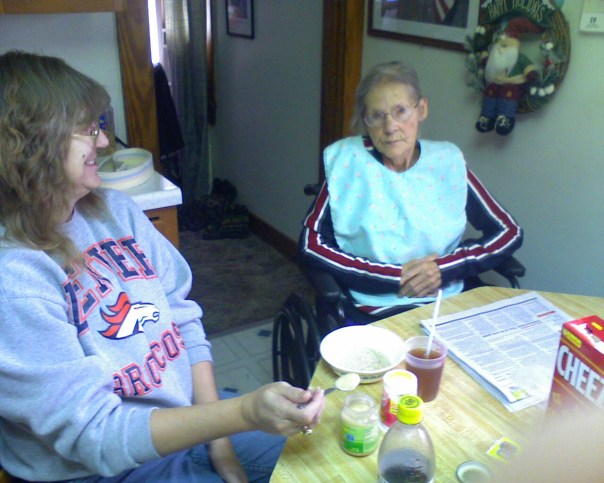
Lois Deer (right), mother of the author, passed away in 2011 after two years of full-time care by her family.

Lois Deer (right), mother of the author, passed away in 2011 after two years of full-time care by her family.

The term, “caregiver” usually conjures up thoughts of an adult child looking after an elderly parent, but that’s certainly not the only situation. Parents of disabled children, grandparents, or even siblings caring for a disabled or elderly brother or sister, are all dealing with a similar situation – too much to handle and not enough help.

Caregivers often suffer from enduring fatigue, emotional stress and broad-reaching financial hardship. Over time, trying to cope with all of this can catch up with a person, causing chronic health problems. The organizers behind the website Caregiveraction.org have declared November as National Family Caregivers Month with the 2015 theme of “Respite: Care for the Caregiver.”

The organization notes that most caregivers feel that respite is a luxury and many even view it as selfish. But trying to find a way to decompress on a regular basis should be made a priority.

Juggling one home, a job and a personal life can be tough enough, but when you’re doing it for two households it can break even the most resilient of people in a hurry. The majority of caregivers pull double duty in order to handle their own homes and families while seeing to the doctor visits, medicine regimens, physical therapy, and other demands of their caregiving charge.

That constant state of stress can often lead to long-term health issues. It’s important that caregivers care for themselves also, set aside time to rest, eat right, and seek support if no other family is available to help out.

Some Caregiver Facts …
 Largest source of long-term care
 Most (66%) are female
 More than half are age 18-49
 Most caring for elderly parents
 Many suffer loss of wages and benefits

There are a number of organizations with resources available to help with respite care. Be aware, however, that generally there is no insurance or Medicare / Medicaid coverage for these services and the costs must be absorbed by the patient or caregiver.

Financial stress is one of the most prominent problems for family caregivers. Many either lose their jobs due to regular absences or have to quit in order to provide full time care. And, when the patient has limited income or other resources, the caregiver picks up the fiscal slack, spending whatever they have to ensure bills are paid.

If you know someone who has recently become a family caregiver, please keep in mind that they may have a different set of priorities than before. Depending on the situation, it is likely their life revolves now around the person for whom they provide care. They may not be able to drop everything and go shopping or out to dinner at a moment’s notice. Be patient and supportive.

Of course there are those who gives the family caregiver a bad name. Anyone who does this out of some kind of need for financial compensation or constant personal praise won’t be seen as anything but self-aggrandizing and reprehensible.

There is no glory or martyrdom in caregiving. It’s emotionally draining and physically exhausting, especially if your family member is terminally ill. The pain of watching someone wither away is like nothing imaginable without first-hand experience.

If you’re taking care of a family member, remember to take care of yourself too. You can’t do anyone else any good if you’re suffering as well. Caregiving is hard work, on any level, and it should be viewed objectively.

You wouldn’t work nonstop on a job would you? Do whatever you need to do to take a little time for yourself every day. Remember you’re doing the best you can and accept help when it’s offered.

Helpful Resources …

Centers for Disease Control : http://www.cdc.gov/aging/caregiving/facts.htm

The Caregiver Space . Org : http://thecaregiverspace.org/

Greene County Council on Aging : http://www.gccoa.org


Hackers: The gangsters of the digital age.

In Business, Crime, Economy, News Media, Opinion, Uncategorized on August 24, 2015 at 10:49 am

Deer In Headlines

By Gery L. Deer

DIH LOGORecently, after watching a news story on the subject, my father, who recently turned 82 years old, asked me about what “hacking” was and why someone would do it. I struggled for a minute to explain it in terms he would understand while still giving him a rudimentary understanding of the technology.

It reminded me of a similar conversation I had with my great aunt in 1999, shortly before the Y2K turnover. At 91, she lived a fairly isolated existence in the Ohio Appalachian foothills and certainly not computer literate. But she was deeply concerned about the Y2K computer bug causing her to lose electricity, water and her savings.

I reassured her that there was nothing to be concerned about, and did my best to explain what was really going on, beyond the media hype, the volume of which was considerable when you take into account she had but one TV channel. However, satisfied with my explanation, she seemed never to give it another thought and the millennium switch came and went without incident.

The fact that she was worried at all was troubling and shows just how influential the media can be in exacerbating a problem. Today, we’re faced with a similar situation, demonstrated by my dad’s concern over hacking. So, just exactly who and what should you be worried about and why?

Hacking costs companies more than $445 billion each year.

Hacking costs companies more than $445 billion each year.

For those who don’t know, “hacking” refers to the act of using specialized programming that identifies and exploits weakness in the security of a computer system in an effort to either steal or expose confidential information, or just to prove it can be done. It is a crime and often the hackers are in another country.

These digital gangsters break in for a variety of reasons, mostly to steal and sell sensitive information, political records or financial information. Without getting into more deep technical and political motives, keep in mind that hackers aren’t interested in getting into your private computer.

Not to rain on anyone’s self-confidence, but you’re just not that important – unless you’re some celebrity or politician – for hackers to waste the effort. There has to be some gain in the end, although it might simply be the act itself, the accomplishment of breaking in.

Some hacked information is sold to other criminals who will use it for their own nefarious purposes. When performed against something like the marital cheating website, Ashley Madison, the hope is that there will be some big name to expose and embarrass. That leaves the potential for some celebrity or politician to pay handsomely to keep his or her name off of the publicized list, essentially using the information for extortion.

Most of the time, the average computer user is not directly at risk, but that said, you could still be vulnerable if a store or bank you frequent happens to be a target. The best advice is to read all correspondence from retailers and financial institutions.

If their systems are compromised, they will contact customers first – very quietly – before going public with the information, so as to limit panic among their patrons. You will be instructed what to do in the event of a hack and how to best communicate with the vendor for further information.

Another way to protect your own information with online accounts, and I can’t stress this enough, is to use strong, complex passwords. Often the data stored for online accounts does not include a visible password, even the website owners can’t help you if you lose it. So the more complex it is, and the more often you change it, the less likely a hacker will be able to gain access to your information even if they get in.

Hacking, as a criminal activity, has created a billion-dollar industry around the world, on both sides of cyber security. More than ever, specialists are being trained to combat cyber attacks and electronic infiltration on every level.

As cyber security becomes more sophisticated, so will the criminals who seek to break it. They are the nameless, faceless equivalents of the modern day Jesse James and John Dillinger. Each generation has its nemeses and cyber criminals are the current lot, intent on wreaking havoc with our digital world.

Gery L. Deer is an independent columnist and business writer. Deer In Headlines is distributed by GLD Enterprises Communications. More at gerydeer.com.

Books and Co. hosts live reading by local authors of WOWA, June 19

In Books, Children and Family, Dayton Ohio News, Education, Entertainment, history, Local News, psychology, Technology on June 15, 2015 at 5:38 pm

IMG_0030Beavercreek, OH – Beginning at 7pm on Friday, June 19, author members of the Western Ohio Writers Association (WOWA) will take the microphone at Books & Co. to present their popular, “Beatnik Café” event. Writers from all genres will regale visitors with original works of poetry and prose to the theme, “Leave No Trace.” The event is free and open to the public.

The live reading pays homage to the hole-in-the-wall poetry clubs of the 1960’s, but with a more modern style. Reading aloud from original work, each writer will take the stage for 10 to 12 minutes, dazzling audiences with short stories, poetry or who knows what.

Barbara Deer is the co-founder of the organization. “WOWA was intended to provide a regular resource for peer critique, educational programs and networking opportunities to local writers of all genres, both amateur and professional,” she says. (Click to watch the television interview about last summer’s Beatnik from WDTN-TV2, Living Dayton 6-12-2014)

Barbara Deer, WOWA co-founder.

Barbara Deer, WOWA co-founder.

“Annual workshops are held all around the country, with two of the most well-known right here in the Miami Valley. But for most writers to thrive that type of support needs to come on a more regular basis,” Deer says. “Our group consists of professional writers and editors, college professors and everyone is ready and willing to offer help, a fresh eye and, sometimes more importantly, an honest opinion about the quality of the work – good or bad.”

wowa-beatnik

Writers come from all around the region – southwest central Ohio, eastern Indiana and northern Kentucky – to attend monthly critique sessions, educational lectures and write-in events. Meetings are held on the first Thursday of the month at the Event Connections, 4140 Linden Ave. in Dayton, near the intersection of US 35 and Woodman Drive.

WOWA Logo 2Now in its seventh year, this talented group of scribes definitely have plenty to celebrate. In addition to the many individual members who have been published on their own, in May of this year eleven of them were featured in an anthology titled, “Flights of Fiction,” produced by GLD Enterprises Commercial Writing and published by Handcar Press (ISBN: 978-0-9885289-4-9). The book features stories set in and around the southwest Ohio region and is available in print and electronic formats from the WOWA website as well as Amazon and BN.com.

The Beatnik Café is a family-friendly, free, public presentation of WOWA and GLD Enterprises Communications. Books & Co. is located at 4453 Walnut St. at The Greene in Beavercreek. For more information, go online to www.westernohiowriters.org or call (937) 902-4857.

Don’t talk to me about, “life.”

In Health, Opinion, psychology, Religion, sociology, Uncategorized on May 28, 2015 at 11:10 am

Deer In Headlines

Special Edition 

By Gery L. Deer

dih-logo-SE“I went to a bookstore and asked the saleswoman, ‘Where’s the self-help section?’ She said if she told me, it would defeat the purpose.” ― George Carlin

No kidding, don’t talk to me about life. I don’t have a clue what to tell you. It’d be great if I could suddenly sound like one of those know-it-all high-dollar advice columnists but, really, they’re full of it too.  You’d have more luck following the meaningless advice from inside your next fortune cookie at the local Chinese restaurant.

Advice columnists, TV experts, so-called “life coaches,” or your favorite self-help author or motivational speaker must be infinitely smarter than any of us regular folks. After all, they motivated your money right out of your wallet; genius, wouldn’t you say? In reality, one can tell you what to do about the perils and promises of life except you.

Life is one of those subjects about which I have never felt confident offering an opinion, nor should anyone else. The very idea that anyone has it figured out or could possibly understand the complexities of someone else’s situation is not just ridiculous, it’s a little insulting.

Special, personal hat tip to the late author, Douglas Adams, who helped to put this writer's perspective into focus.

Special, personal hat tip to the late author, Douglas Adams, who helped to put this writer’s perspective into focus.

If anyone could actually manage such a thing, it would mean that there is nothing inherently special or unique about our lives. It implies that everyone lives a sort of cookie-cutter existence, with no peaks, valleys or crevices, and that’s just silly.

Life is complicated. It cannot be sorted out with an hour on the psychiatrist’s couch or because of some nonsense from a self-help book. We all have to iron it out for ourselves. That’s not to say we don’t need some help sometimes, but it’s not going to come from something you saw on an infomercial at 3 o’clock in the morning.

Even religion offers no answer to such multifaceted issues as, “What should I do with my life?” Religion also guts your wallet without providing a single, concrete solution. In fact, without an incredible level of ambiguity, religion couldn’t exist at all.

Your faith may provide you with peace of mind, but leaving everything “in God’s hands,” is a little like letting go of the wheel while barreling down the highway at 70 miles per hour. I’d say He probably expects you to steer. And, to be fair, science has no solutions either.

For those empirical folks out there, Charles Darwin might have been able to tell you how animals changed over the millennia, but he had no clue how the evolution of your life should proceed. Sometimes you just have to work things out on your own.

Life coaches, support groups, psychobabble – it all comes down to the person you see in the mirror. Everyone has an opinion about your life, but before taking it, you need to look at the source of that information. What kind of shape is their life in?

It’s always puzzling when someone takes marriage advice from a friend or relative whose relationships are a wreck.  That’s kind of like asking a demolition derby driver to teach drivers education. They know how, but the results might be less than desirable.

Theodor Seuss Geisel (Dr. Seuss) once said, “Sometimes the questions are complicated and the answers are simple.” That is probably the best way to look at your world. Occasionally we’re looking too hard for answers to difficult questions with straightforward resolutions. But you won’t find your answers in a self-help workshop or in an advice column.

When standing at a fork in the road, there comes a time when you have to pick a path and start walking. You put one foot in front of the other, get moving and own it, whatever the outcome. If you do that, on your terms, at least you’ll know it was your decision to go left instead of right, to charge ahead instead of turning back. It will be yours, because we are responsible for the paths our lives take and, after all, the journey is the real destination. Make it a good one.
Gery L. Deer is an independent columnist and business writer. Deer In Headlines is distributed by GLD Enterprises Communications. More at gerydeer.com

Old dogs and new tricks

In Dayton Ohio News, Education, Local News, National News, Opinion, Senior Lifestyle, Technology, Uncategorized on March 23, 2015 at 11:38 am

DIH LOGOSome people are of the mind that there is a certain age when learning something new is neither a priority nor even a possibility. As I approach a half-century on this earth, I have a hard time wrapping my head around the idea that, at some point, people just stop learning.

Barring some kind of dementia or other mental disorder, it’s hard to understand why anyone would “choose” to be an old dog, totally uninterested in learning a new trick. In my lines of work, I am frequently exposed to innovative technology and new ideas and I’m expected to keep up or I don’t pay the mortgage.

I spend a considerable amount of time researching, learning new concepts or updating my skills in some way so I can stay relevant in a world that seems to change by the nanosecond. Part of that continuing education includes reading, networking with others and going to conferences and workshops. I just returned from one such conference that was, for me, one of the single best I have ever attended.

A couple of months ago, I was asked by a friend to speak at an upcoming technology event known as, “Dayton WordCamp,” a two-day series focused on the website content management system called “WordPress.” As with most tech, this event would be dominated by much younger, more advanced presenters.

Originally, I hesitated, feeling as if “at my age” (and technical level) I would have little to bring to the table. But, with a little effort I found a spot where I fit into the program nicely and agreed.

Dayton WordCamp

Dayton WordCamp

Dayton’s event is one of hundreds of WordCamps around the world, all presented for the benefit of those using WordPress as their website platform. Lovingly referred to by organizers as an “unconference,” the atmosphere is very relaxed and laid back, with most people wearing jeans and T-shirts.  One of the perks of speaking is the opportunity to attend the event as a spectator as well.

One of the first things I noticed upon arrival was that I was not the oldest person in the room. Of roughly 120 attendees the bell curve probably favored the younger crowd, but there were plenty of people my age and older as well. Such diversity says something for both the reputations of the scheduled presenters and the usability of the software about which we had all come to learn.

As the first day’s session began my apprehension diminished and I began to settle into a comfortable atmosphere for learning. By the conclusion of day two, I was not only charged up to dive in and apply my newly-acquired information, but I wanted to find a way to be more involved in future sessions.

At this point, I have to give a shout out to my friend Dustin Hartzler and his fellow organizers, particularly Nathan Driver, who invited me to speak at the event while also allowing me to be a student as well (that’s not the norm at such functions). These folks gave me the opportunity to expand my knowledge, allowing me to better serve my clients, plus I got to take a couple of days for myself, something for which I rarely have the opportunity.

In my experience, most people who have stopped learning have done so, in some manner, by choice. Learning is not just academic. Expanding your horizons at any age is not limited to taking college classes or immersing yourself in books for hours on end. You can attend free, hands-on workshops, watch “do it yourself” shows on television, or just dive in and try something on your own, learning as you go.

My point is that there is simply no reason any of us should be stagnant. Opportunities for growth exist in many areas of our lives and all we need to do is take the first step. What is important is that you get out there and try, whether your interest is gardening, motorcycles, computers, music, or maybe you want to try something new. Don’t be an old dog with no new tricks.

For more about WordCamp check out the Dayton WordPress Meetup – http://www.meetup.com/Dayton-WordPress/

Gery L. Deer is an independent columnist and business writer. Deer In Headlines is distributed by GLD Enterprises Communications.

Is this your new site? Log in to activate admin features and dismiss this message
Log In