Local News & Commentary Since 1890.

Posts Tagged ‘Gery L. Deer’

Saving our downtowns, one megamall at a time

In Business, Dayton Ohio News, Economy, history, Jobs, Local News, Opinion, Politics, Uncategorized on September 25, 2013 at 9:37 am

DIH LOGOLast week I covered a story for the local newspaper about a business that has been in downtown Xenia, Ohio for more than 70 years. To celebrate, the chamber of commerce held a ribbon cutting attended by the usual fare of friends, associates and dignitaries, all wanting either to sincerely congratulate the proprietors or mug their way into the photo op. Whatever their reasons for attending, it was refreshing to see people taking an interest in a small town’s revitalization.

Every day local governments offer tax breaks and other perks designed to attract new businesses to settle in their region, the obvious benefits to which are jobs and tax revenue. A good idea, of course, but while they’re building new strip malls on one end of town, the downtown sits empty and abandoned leaving the same government officials to puzzle over what to do with empty, decaying buildings.

So why not provide more incentive for businesses to locate in existing downtown areas before adding more sprawl? For those already there, encourage them to stay rather than making it easier for them to move into the latest strip mall.

Some communities sprang up from joined housing developments but for those like Xenia, Bellbrook, Jamestown and Fairborn, there is history, culture and charm still to be reclaimed. It’s truly puzzling why there is not more incentive to do what Xenia’s business owners are doing very well – revitalize and rejuvenate the downtown.

mall interiorMost confusing of all is the approval by local governments of sprawling mega-malls like The Greene, in Kettering, or is it Beavercreek? I’m not sure even they know where they are located. The brick walkways and old-fashioned street lights illuminating an array of sidewalk cafes and specialty shops were designed to look just like old downtown shopping squares that have long since been abandoned.

While they might add something to the local job market, these monster malls with their fake skylines, congested parking lots and Segway-riding rent-a-cops, do little to enhance the community. The sad thing is, eventually, the buildings go out of style and repulse new customers after a dozen years or so.

When Beavercreek’s Mall at Fairfield Commons first opened, it was all the rage; no more driving all the way out to Centerville or northwest Dayton to shop at an indoor mall. Today, there are huge unoccupied spaces in all of the indoor retail behemoths as businesses either shut down or move into newly-designed malls.

Believe it or not, “If you build it, they will come,” applies far more to retail sales than it ever did to a cornfield baseball diamond, so build it downtown. No matter where you put the temples of American gluttony and materialism people will find them and go to worship the almighty Abercrombie.

City governments should do more to help property owners attract major tenants to the old downtown areas, particularly big mall-style anchor stores. It would only take a couple of them to generate more interest from others and grow revenue for the property owners and the municipality.

Over the next month or so, small town politicians will be scrambling to win over your vote. Ask them the same questions posed here. If we really want to save our downtown areas, we have to start at the government level.

Instead of spending time and money worrying about ridiculous issues like whether a store’s sign is wood or plastic, how about making it easier and more attractive for businesses to locate in the downtown areas? It really is that easy.

A civic ambassador with a high-level business background in national retail sales could help to develop a plan of action and take it to companies like Macy’s and Abercrombie. Show them that it’s possible to create the genuine version of the fake atmosphere so popular at the outdoor malls. If it’s done properly, it would bring people downtown again to shop, eat and socialize.

Small business cannot support such efforts without a few major players in the ballgame. If there are to be more 70-year old businesses downtown, there needs to be a downtown for them to be in.


Over-medicated and under-educated

In Children and Family, Education, Health, Media, National News, Opinion, psychology, Science, Senior Lifestyle, Technology, Uncategorized on September 18, 2013 at 9:18 am

DIH LOGOA recent report by the Centers for Disease Control and Prevention (C.D.C.) noted that at as many as two-million Americans become ill from antibiotic-resistant infections annually, killing at least 23,000. The report notes that less than half of the antibiotics prescribed for patients are unnecessary or incorrectly used increasing the potential for more drug-resistant germs to evolve, exacerbating the problem.

Over time, the use of broad-spectrum antibiotics rather than ones targeting specific infections can cause various strains of bacteria to become immune and render conventional treatment ineffective. According to C.D.C. Director, Thomas Frieden, as the trend towards overuse of antibiotics continues, “The medicine cabinet may be empty for patients with life-threatening infections in the coming years.” Additionally, the overuse of antibiotics on farms as preventative medicine in healthy animals is also a contributing factor.

All of that said, these drugs are not prescribing themselves. Doctors know better than to continually prescribe broad-spectrum antibiotics unnecessarily or to treat viral infections, for which the drug is completely ineffective. But, many still do both, either at the insistence of the patient or as a preventative measure. Beyond the issue of nagging patients who want a prescription every time they have a sniffle is the point where the medical professional should say, “no.”

medsIn addition to antibiotics, it seems as though doctors are passing out a pill for everything and never seem to try to dig deep enough to address the real cause of various health problems.  For people with chronic illness it seems like that would be extremely frustrating. Apart from something like long-term, degenerative diseases like Parkinson’s or Multiple Sclerosis, there should be a way to find the cause to a problem and treat that, rather than just trying to drown the symptoms in medication.

More often than not, patients get, maybe, 10 minutes with their doctor after a two-hour office wait only to be handed a prescription and shuffled out the door. People spend far more time filling out forms and waiting to be seen than ever actually getting attention from a person who bills hundreds of dollars an hour for a few minutes work per patient.

An additional problem arises when the drug manufacturers spend far more time and money marketing to the patient than educating the physician about the proper use and potential hazards of a medication. However unethical it should be, doctors are given trial samples and kick-backs for going with one drug-over another. All the while, patients are inundated by drug ads on television, the Internet and in periodicals with no understanding of the treatment process.

Which actually contributes to another step in the downfall of health care is the all-knowing, internet-browsing patient himself. These home-spun experts come in with a fist-full of self-diagnosis printouts from Web MD and a stack of drug ads from Cosmo.  They demand medication for what they are certain is their particular ailment and there is no swaying their shade tree expertise. Except that’s exactly what the doctors should be doing – dissuading them and refusing to prescribe medicine without a thorough examination of the problem.

So what is to be done? Unfortunately, not much can be done. Unless healthcare providers are going to be more proactive and limit use of antibiotics except for targeted need, and other drugs are prescribed only after the cause of the symptoms is determined, it’s unlikely that anything will change soon.

It just seems as if everyone is sick all the time. Chronic illness like fibromyalgia (long-term, body wide tenderness and pain) seem to be affecting more and more people and early-onset dementia appears to be far more common than it once was. Could these diseases the result of long-term misuse of various drugs, including antibiotics?

The truth is, no one really knows for sure. Many of these drugs are relatively new and scientists are only now learning how the long-term use of previous medications is affecting second and third generations. From birth defects to chronic disease, overuse of drugs and under-education of patients definitely has the potential for some serious side effects.


Be considerate of those around you

In Food, Health, Opinion, psychology, Senior Lifestyle, sociology, Uncategorized on September 10, 2013 at 9:20 am

DIH LOGODid you ever see someone behaving a certain way at work or in the grocery store and it made you just want to walk up and say to them, “What is wrong with you?” I have; more times than I can remember. On the whole, people annoy me. Maybe it’s because as I get older, I have less patience for “stupid.” It could also be that people are becoming less thoughtful and far more self-centered than ever.

Here’s an example. One afternoon, I had stopped in at on of the big-box, discount megastores to get some orange juice and aspirin. As I stood patiently in the “20 Items or Less” lane, a middle-aged woman in a leopard-print blouse and hair curlers motored past me on one of those electric shopping cart scooters. She was steering the scooter with one hand and with the other she dragged another full sized cart behind her like a trailer.

STORELINEBoth carts were filled to capacity with loads of healthy foods like barrels of cheese balls, cases of beer and soda and, of course, spray cheese. Although there were other check-out lanes open for larger purchases, the woman obliviously whizzed by everyone in the line and parked her rig right in front of me. All of the adjacent lanes were equally full and what was going to be a 5 minute wait was now bordering on a half hour because either she couldn’t read or didn’t understand the meaning of the words, “express lane.”

For a few minutes, I just stood there; a bit stunned at the woman’s total ignorance that she’d completely jumped over at least four others in line ahead of her. I debated whether to say anything but kept quiet. After all, no matter how rude she had been, I would just end up being the mean guy who scolded an apparently disabled older woman on a scooter. It’s a no win. So, I bit my tongue, opened my aspirin bottle, downed two tablets with some of the juice, and waited.

We all have moments when we’re in a hurry, totally consumed by our own interests and feeling like whatever we’re doing should be just as urgent to those around us. But, short of a natural disaster, that’s almost never the case. In fact, most people have absolutely no concern for your interests because they, themselves, are too wrapped up in their own issues. That doesn’t excuse a complete lack of common courtesy, however.

Lately, I’ve noticed it more often in younger people, walking along, even in a store or down the street, with their noses buried in their cell phones, unconscious to the world around them. No one looks up anymore. No one smiles. No one says, “Hello.” People act as if they are traveling in a bubble, where it’s unnecessary or at least undesirable to interact with anyone else in the real world.

I’d like to be able to blame social media and technology for all of this, and it definitely has altered how we behave towards one another. But, ultimately, it’s our own fault. We choose how to act and interact. If all of your interpersonal relations come through Facebook or by text, you might want to consider taking a class or getting a hobby that requires you to intermingle with other people outside of cyberspace.

As for those like my scooter-riding line jumper, I doubt anything will alter their way of thinking. Society will always have its share of self-centered people who have little regard for common sense or good manners. How the rest of us react to their behavior is really what will make the difference.

Maybe if I had complained to the woman in some polite, diplomatic manner, I could have quietly helped her to another line. But, given that she didn’t seem to notice there were other people around her, it’s unlikely she would have responded to reason.

In the end, it was best to keep the peace and let each of my fellow shoppers decide on their own alternate course of action. But to those of you with no regard for others, keep in mind that I may not be so polite next time. Be nice to people. When all is said and done, all we have is each other.


Shocking! Power companies mislead consumers.

In Business, Children and Family, Economy, Opinion, Senior Lifestyle, Technology, Uncategorized on September 4, 2013 at 9:39 am

DIH LOGO

Today, everyone is trying to save money. From groceries to utilities, we are all looking for a way to hold on to every dollar, particularly our seniors and others on fixed or limited incomes. Unfortunately, some companies are taking advantage of tough times by promising extensive savings on electric bills by switching to third party power suppliers.

Three years ago, my father’s electric bill was increasingly high. I had seen information on a company called “DPL Energy,” being advertised as a partner to Dayton Power and Light (DP&L), offering as much as a 25 percent savings. So, we signed up for the program and DPL Energy became our official service provider.

Confusingly, the electricity bill still comes from DP&L. As time went on, the savings was negligible and outweighed by a definite increase in additional fees for using the outside provider.

IMG_6295Essentially, these companies are “resellers” who broker DP&L’s electric power at a lower rate. Your electricity still originates with the main provider and you continue to call them for outages, emergencies and so on. Plus, once you’re signed up, they make it extremely hard to go back.

Much like cellular phone contracts, if you leave one of these third party plans, there is a termination fee or you must wait until the contract expires – and even then there may be a charge. Having saved nothing, we waited, and finally cancelled the plan. About a year after we left DPL Energy’s plan, my father was apparently signed up with another one of these companies called IGS Energy, although, we have no clear idea how.

According to IGS, someone came to his house and “signed him up by phone.” You read that right. We were told he was signed up in person, but the salesman called in the request for service. First, I don’t believe that anyone went all the way out to where he lives in the middle of nowhere on a cold call without getting any sort of signature verifying his enrollment. I am still investigating this part of the story.

In the end, dad made a couple of late payments and IGS dropped him anyway, but here’s where things get really expensive. According to the DP&L representative I spoke to, since we were signed up with a third party provider, the Public Utilities Commission of Ohio (PUCO) requires DP&L to charge a deposit equal to 130 percent of your average monthly usage. Dad’s deposit fee was over $600. You are essentially being punished for having left the behemoth power company.

Most dangerous of all is the fact that the only requirements to sign up for these misleading programs is your power company account number and the word “yes” anywhere in your conversation with them. Imagine a telemarketer speaking to an elderly person or someone hard of hearing and saying, “I am calling about your DP&L bill.” That’s all they’re going to hear. Panic, concern and fear take over and they listen to whatever the caller has to say because they are afraid of losing power for some reason. It’s really despicable.

Additionally, my investigation turned up the fact that these third party companies are unregulated by the PUCO. There was no explanation as to why there is no oversight, but nothing about their operation is managed by a government agency.

Since DPL Energy is misleadingly branded alongside DP&L while simultaneously claiming not to be the same company, it seems more to me like a way for the mammoth power provider to collect unregulated revenue with plausible deniability. Perhaps Ohio Attorney General DeWine could tear himself away from snooping in the personal records of honest citizens and focus his resources on investigating unscrupulous power companies?

The moral here is to be careful. In my experience, there is no savings with these third-party power companies. Exorbitant fees, inconsistent billing practices and misleading advertising all outweigh any potential benefit.


Watch the news story on this topic with Gery L. Deer and WKEF-TV, ABC 22 Dayton … 

http://abc22now.com/shared/news/top-stories/stories/wkef_vid_15751.shtml


Jamestown business celebrates 15 years with televised ribbon cutting

In Business, Economy, Entertainment, Jobs, Local News, television, Uncategorized on September 3, 2013 at 6:39 pm
Deer In Headlines author and Living Dayton business contributor, Gery L. Deer in the "Stafford Jewelers Diamond Room" at WDTN.

Deer In Headlines author and Living Dayton business contributor, Gery L. Deer in the “Stafford Jewelers Diamond Room” at WDTN.

DAYTON, OH – On Thursday, September 5th, GLD Enterprises Commercial Writing in Jamestown will celebrate 15 years in business with a televised ribbon cutting event on the set of the WDTN-TV2 daytime talk show, Living Dayton. Viewers can see the program live on Dayton channel 2 or streaming online at http://www.livingdaytontv.com.

In March of 1998, Gery L. Deer, of Jamestown, started the business from the spare bedroom of a London, Ohio apartment. Originally called GLD Enterprises & Productions, the company had two areas of focus: on-site computer support and entertainment development. It later expanded into variety talent placement and commercial public relations services.

The name and focus have changed slightly over time and today GLD Enterprises Commercial Writing specializes in communications services for all types and sizes of business including commercial copywriting, public relations and marketing consulting. The company also has two separate divisions for IT support and entertainment development, each serving a limited and exclusive clientele.

In addition to the anniversary celebration, the firm is also launching a totally re-designed website at www.gldenterprises.net and recognizing the addition of its first outside sales and business development specialist. Karen Schroeder joined up in August to help develop house account projects and provide a liaison to the growing community of women-owned companies in the area.

An award-nominated freelance writer and entrepreneur for more than two decades, Deer has also served as the on-air business expert to the Living Dayton program since it started in February of 2012. His educational background is in engineering and writing, but he learned his business sense from his family’s entrepreneurial history.

GLD_Enterprises_ol“We’ve had to make a great many adjustments to the business over the years to keep going, sometimes even altering it into a part-time status,” Deer says. “But this is an important milestone for us and the local economy, particularly since we hire so many other freelance professionals, from graphics artists to research analysts.”

Deer says his company is one of the most streamlined independent businesses in the area. “We do everything we can to save money, get the most from our efforts and act as a partner to our customers in their long-term success,” he says. “We are grateful that we have such a loyal clientele and we hope the next 15 years give us the opportunity to help more Miami Valley businesses succeed and grow.”

More information about GLD Enterprises Commercial Writing and the televised event is available online at www.gldenterprises.net or by calling (937) 902-4857.

We see the 1950s with rose-colored glasses

In Entertainment, Opinion, psychology, sociology, Uncategorized on August 20, 2013 at 6:31 pm

DIH LOGOI recently read a CBS News poll asking people to choose a decade back to which they’d like to time travel. Overwhelmingly, the leading answer was the 1950s. What I can’t wrap my head around is, why?

Some people see those times as simpler, easier to manage, with fewer concerns and more security. Gas was 23-cents per gallon and you could get a really nice home for $22,000. A good price when you consider the average annual salary – hold onto your hats – just over $4,100.

So, yes, things were cheaper but only when compared to today’s prices. Actually, I think we have a fairly tainted view of the 1950s, America’s so-called, “Golden Age.” The “Leave it to Beaver” family unit and less-complicated lifestyles of those days simply wouldn’t work in modern society, for a number of reasons.

First, we had all the same problems back then that we have today, but we perceived and dealt with them differently. The country probably wasn’t as politically fractured as it is today, only because we were all riding a bit of a patriotic “high” after the end of World War II.

Technology or the lack thereof made a difference to our perceptions in those days too. There was the radio, a morning newspaper, an evening newspaper, sometimes an “extra” mid-day edition, and an evening television newscast. We didn’t get all the bad news of the world every moment it was happening. If we were going to tell people how our vacation was going, we had to mail out post cards.

According to the 1955 United States Census, America’s population was 166 million and the average unemployment rate was 4.9 percent, or about 81 million people. Today it’s about 314 million with a 7.4 percent unemployment factor, around 23 million.

So, barring some kind of economic cataclysm, as the population doubled, the unemployment rate followed suit. From a ratio standpoint, there were actually more people out of work 60 years ago than there are now. That’s good news, right? Sort of, yes.

What makes this a steeper hill to climb today is, once again, technology related. Labor-intensive, blue collar jobs like those at GM, NCR and other big manufacturers just don’t exist anymore. Many have been eliminated or sent overseas to take advantage of cheaper labor costs.

Additionally, many people – myself included – believe Americans to be lazier than ever and a good number of us simply don’t want to work. People are especially hard to motivate when employee benefits and pensions are a thing of the past and there is no longer any sort of job security.

Speaking of security, remember the “duck and cover” drills of the 50s and 60s? How much of a pointless endeavor was that? “Here, little Johnny, get under this desk so the Russian atomic bomb won’t hurt you.” Really, I mean, how dumb were we?

I suppose at least it gave us all something to do in the face of the unthinkable. In reality, there was nothing secure about the 50s, especially considering we were always on the brink of war with Russia and it only got worse as 1960 approached.

Personally, I think we spend far too much time looking back and not nearly enough looking forward. The past is done and you can plan for the future to some degree, but, reasonably, all we have is the here and now. Focus on making your present more fruitful and your future will follow along.


Extra! Extra! Examining the plight of print.

In Books, Business, Entertainment, Local News, Media, National News, Opinion, Print Media, Technology on August 13, 2013 at 4:49 pm

Deer In Headlines

By Gery L. Deer

electronic_printAre newspapers dead? Since most of the mass distribution for Deer in Headlines is still in print media, then chances are if you’re reading this it’s probably printed in a newspaper. But it’s also circulated in a fair number of online publications as well so if the publication you’re reading ever went belly-up, you can still find it on the web.

When Amazon’s chairperson, Jeff Bezos purchased The Washington Post, the publication’s circulation had dropped by 40-percent over the last year. A seriously risky bet, Bezos picked up the media icon for pennies and paid for it out of his own pocket. The intention was to preserve the paper in its current state, but it’s just as likely he will take it to the next logical level – all digital.

Far more costly to produce than their digital counterparts, print publications still have a purpose among certain die-hards and the older generation. There’s something about holding that printed page in your hand that has brings about an emotional response unique to each reader.

I’m kind of caught in the middle. I like having a printed page in front of me, whether it’s a book, magazine or newspaper. But I like the convenience of digital media too. If you’re stuck waiting to be seated at a restaurant or in the doctor’s waiting room, you can always bring up something to read on your smart phone or Kindle.

Eventually, pretty much all periodicals (newspapers, magazines, etc.) will be converted to digital, but in my opinion, it’s not just the media format that’s killing print publications. Less ambitious salespeople and a lack of knowledge among advertisers have also helped contribute to their demise.

Publications, like any other media, survive by the vicious circle of subscribers and advertising. The more subscribers, the more profitable the ad revenue, but if the content is lacking no one is going to subscribe. The numbers drop and ad revenue falls along with circulation.

Plus, have you noticed how much smaller your newspaper is these days? Most have shrunken both in sheet size and number of pages, with some content located online to drive people to the publisher’s website. As a practical consumer, why would you pay $1.50 for a publication that has less content than it did when it was 75-cents? Unfortunately, if you want to keep getting a print publication you’ll have to pay whatever price they ask.

Advertising rates are going up too, though that one thoroughly perplexes me. Lower circulation should drive down ad prices, but many publishers are trying to recover lost revenue by adding web-based exposure in conjunction with print packages. For some, it’s too little, too late, however.

An ever more computer-savvy population will eventually drive print to its ultimate end. Attempting to preserve it will be a costly and finally pointless endeavor but some people are making the effort, as Bezos seems to be. But then again, he’s a billionaire and that’s what it would take – deep pockets.

No business can continue to operate in the red, always hemorrhaging money. Unless the operator is treating it like a hobby and has the disposable income to keep it going, it will die.

If you want to keep the presses running on your local newspaper, I suggest the following. First, contact the publisher and remind them how important the paper is to the community. If you are part of a business or organization, make sure to send press releases and other news-worthy information to the editors so they have good, local content to draw from. Include detailed contact information and artwork (photos).

Demand local coverage written by local correspondents. Small, hometown papers can do better financially on their own level than national publications when they have good, locally-created content to drive circulation and advertising.

If you own a business or are part of a community organization, advertise in the local newspaper but do it correctly. You need to display your ad regularly and consistently in the same publication for at least several months before you see a response. Be consistent and be patient. And finally, go buy a paper! You’re helping the community and the economy.


Deer In Headlines is syndicated by and intellectual property of Gery L. Deer / GLD Enterprises Commercial Writing. All rights reserved.


Doc Barth’s Medicine Show, still captivating crowds

In Entertainment, National News, Opinion, Travel, Uncategorized on August 6, 2013 at 3:16 pm

DIH LOGOOver the last couple of decades, I have worked all over the country as a writer and performer. From small hometown stages to Hollywood television projects, I think I’ve seen just about everything. Recently, however, I had the privilege of working at a festival in northern Indiana alongside a gentleman who, in my mind, is the quintessential entertainment professional. His name is Dan Barth and for the last 40-plus years, he’s been in the medicine show business.

From the 1850s through the 1930s the traveling medicine show was one of the most effective advertising endeavors in history. Moving from town to town by horse and wagon, these performing salesmen practiced what has become the foundation of the most successful modern advertising.

With a few magic tricks, some ventriloquism and a plethora of bad jokes, the medicine show brought to town a live, often interactive stage performance long before there was radio or television. At the end of the show, the performer would give a lecture about the health properties of some kind of tonic, the tastiness of a box of candy, or any other positive attributes about whatever product he was selling.

The salesman’s performance was the way he got people to sit there long enough to listen to his advertisement. Now, if you think you’re too modern to fall for such things, you should know that this method still works today – every eight minutes or so during your favorite TV show. Think about it.

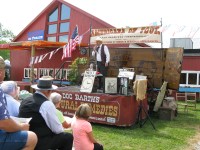
Dan Barth's traveling historical medicine show.

Dan Barth’s traveling historical medicine show.

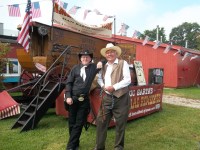
With his 19th Century medicine show wagon in tow, Dan and his charming wife, Ulli, have traveled all around the country educating and entertaining crowds with the same kinds of routines used in the original presentations. From ventriloquism to magic, Dan told the story behind his artifacts and the history of the shows. I watched nearly every show he did over our four days together and marveled at how his audience was so taken with his work.

In today’s high-paced world of Wi-Fi, cell phone apps and squirrel-like attention spans, I was fascinated to watch people of all ages sit in the hot, Indiana sun and hang on Dan’s every motion and word. It was gratifying to see that people still have an interest in this kind of entertainment; a type that now seems relegated to the odd variety act or child’s birthday party and even then, thoroughly under-appreciated.

Not this weekend however. People loved watching Dan’s performance, me included. Ironically, I felt good about the fact that we are using some of the same routines in my family’s variety show. Now I think I finally understand why those simple routines are always so well-received.

But from my own standpoint, Dan’s presentation and his audience’s reaction to it allowed me to see more about my work – both in print and on stage – than I have ever noticed before. As a writer or stage performer, if our mind is in the right place, our ultimate goal is to entertain our audience.

I have always believed that most skilled writers and performers spend far too much time showing off their respective talents and not enough actually entertaining anyone but themselves; but not Dan Barth. His mind is always on the audience. He may be in it to make a living, but he really wants his audience to have experienced something unique for their time and he genuinely appreciates their attention.

Gery L. Deer (left) with Dan Barth

Gery L. Deer (left) with Dan Barth

Personally, I’ve seen just about every possible incarnation of sideshow, Wild West performance, medicine show and variety act. But there was something unique about this performance. It was unassuming, generous and genuine. It had my attention every time, even though, by the end of the first day, I could practically recite his script verbatim.

With a 25 minute show, he captivated the audience with no more than four or five routines. But, in the end, it’s not what you do or say on stage or in print, but how you present it. No matter how great your technical skill, there is always room to be more engaging to an audience. From stage shows, to newspaper articles to television advertisements, it’s the consuming audience that matters. After all, they’re the ones paying for the ticket.

Those thrilling days of yesteryear

In Children and Family, Entertainment, Media, Movies, National News, Opinion, sociology, television, Uncategorized on July 9, 2013 at 8:39 am

DIH LOGOThe Lone Ranger first debuted in 1933 from the studios of WXYZ radio in Detroit, Michigan. Created by station owner George W. Trendle and writer Fran Striker, the character is said to have been based on the exploits of Bass Reeves, a real life federal peace officer who worked in Indian Territory during the late 1870s. Accompanied by his trusty Indian sidekick, Tonto, and themed by the thrilling rhythm of Gioachino Rossini’s operatic William Tell Overture, The Lone Ranger became an immediate success.

By the time that last surviving ranger hit the airways Wild West lore had been incredibly popular for more than two decades, particularly in dime novels, on the radio and in traveling shows. Originally aimed at children, it is estimated that more than half the audience for the program were adults, many of whom had grown up with stories about western legends like Billy the Kid, Bat Masterson and Wyatt Earp.

Unlike his historical counterparts who clearly had bad sides to their character, The Lone Ranger would be the ultimate good guy, with a mask to both maintain his anonymity and help confound corrupt government officials as to his true nature. In order to keep continuity for the character, the original writers created a set of guidelines that established who and what The Lone Ranger is meant to be. Some of the guidelines were a little silly, but others far ahead of their time.

For example, one of the rules stated that the Ranger would never be pitted against an adversary who was not American so as to avoid criticism from minority groups. In other words, it was already practicing political correctness. Another said that he could never drink or smoke and any “saloon” scenes had to be portrayed as cafes with waiters serving food instead of bartenders pouring drinks. One of the most interesting was a rule that stated he would always use perfect grammar and diction, devoid of slang and colloquialisms.

Many people who remember those days believe that actor William Conrad, star of the 1970s P.I. show, “Cannon,” was the original voice of The Lone Ranger on radio, but that is not so. In fact, Conrad voiced another famous western lawman, Gunsmoke’s Marshall Matt Dillon.

In 1949, the show made the ultimate leap from radio to the fledgling technology known as television, with Clayton Moore donning the famous mask and Native American actor Jay Silverheels as Tonto. After eight seasons on ABC, two of which with a different actor in the lead role, the show was cancelled in 1957. A year later, a theatrical feature was released starring the TV actors in a new adventure but the demand for the masked man never quite returned to its former pitch, though a couple of other failed attempts were made to return him to both the theatre and the small screen.

In 1981, a big screen version of The Lone Ranger was met with the harshest of criticism and dismal box office receipts. The movie failed partly because it was just a bad film, but mostly because the producers sued former star, Clayton Moore, to forbid him from wearing the signature mask in public appearances. Who says there’s no such thing as bad press?

The most recent incarnation of the Masked Man hit the silver screen this summer as a tongue-in-cheek Disney flick featuring Armie Hammer as Ranger John Reid (The Lone Ranger) and Johnny Depp as his trusted Indian partner. Unfortunately the campy tone that worked so well for Depp in the Pirates of the Caribbean series falls flat in this film, detracting from the nature of the characters and overshadowing the story.

Disney had the opportunity here to introduce two beloved characters of Americana to a new generation. But, instead of using the elements that made the show a success originally, they changed the formula and merely created another summer flop from a classic franchise. Hopefully, The Lone Ranger has not forever ridden off into the sunset and will get another chance to let audiences experience, “a cloud of dust and a hardy ‘Hi-Yo Silver!’”


Who am I, and what am I doing here?

In Entertainment, Health, Opinion, psychology, Religion, Senior Lifestyle, sociology, Uncategorized on May 15, 2013 at 12:04 pm

Deer In Headlines

By Gery L. Deer

We’ve all had moments when we’ve turned to someone, a father, a brother, a God and asked, “What was I meant for? Am I doing what I was supposed to do?” It’s a normal exercise for us to question our situation, regardless of its status.

But we have to be careful to realize, regardless of how much we’d like the world to be a mystical place, our own choices landed us where we are and nothing was “meant to be,” that wasn’t directed by personal decisions.

I think it’s pretty normal to think we were meant for something more than we are, at least most of us probably feel that way. What many people tend to miss is how much value their lives have to others and how much would be different in the world without their contributions.

Over the last few years, I’ve written a great deal about my late mother, Lois. She passed away in November of 2011 after long battle with Alzheimer’s disease which among other things robbed her of a lifetime of memories.

Mom wasn’t an overly complicated person but she was very smart and caring, always putting others ahead of her – particularly her children and grandchildren. She only ever worked as a school volunteer, on the farm with Dad and for a time as a waitress in a little hometown restaurant where I grew up.

She might not have had the life people grow up dreaming about, but I’d like to think she felt like she had made a difference in the world. I know she did for me and my family. She didn’t have money or status or important connections, but she had wisdom and a level of understanding of her world and those in it that I truly wish I could emulate.

To some people a basic, down-home lifestyle could seem like Purgatory; a futile, pointless existence. Even though she didn’t have a list of college degrees after her name, nor did she work some high-powered job (unless you count managing my dad), her mere influence upon those around her probably had far greater reach than she ever knew.

In my mind, Mom had the life she was “meant” to live, evidenced by the efforts of those who helped care for her and offer support to our family as her illness advanced. We all have a place in the world and it might not seem like it matters at the time, but we are often more influential than we realize.

Since the kind of work life I have chosen does not lend itself to earning fistfuls of cash, far from it, I have always hoped that my labors have at least helped to enhance someone’s life, even in the slightest. Whether I am making people laugh on stage during The Brothers & Co. variety shows, or passing along my worldly observations in my writing, I always try to give people something that will help make their life better, even if it’s only for a moment. To me, that’s rewarding in itself.

Even when people don’t agree with something I’ve written, the point to take away is that they read it, and it made them think. I don’t want everyone to agree with me, nor am I trying to persuade them to alter their life paths based on my opinion of something. My job is to enhance someone’s life just by giving them something new to think about and that is the accomplishment.

So, a sense of accomplishment isn’t always derived from academic or financial achievement, and in my limited view of the world, it almost never comes from material success. Sometimes just being who you are and contributing to the world around you makes the longest-lasting difference.

Were you “meant” to be who you are, though? That’s a question best left to you. Only you can evaluate your level personal satisfaction from the world you’ve created for yourself. You are who you are, right or wrong. So like I heard once in a song, “This is it. This is life, the one you get, so go and have a ball.” And enjoy being you. It doesn’t matter how you got there.

 
Gery L. Deer is an independent columnist and business writer based in Jamestown, Ohio. More at www.gerydeer.com.