Deer In Headlines II – SPECIAL EDITION
By Gery Deer
(Author’s Note: I am publishing this ahead of the normal print schedule because the events took place exactly 3 years ago on the date of this posting. I hope it will comfort people and help them recognize and appreciate that time when it comes – because, sadly, it will.)

While caring for my father, I did some journaling as his Parkinson’s disease advanced. The following is an excerpt from the painful day we both accepted the inevitable and how lonely a feeling it was for both of us.
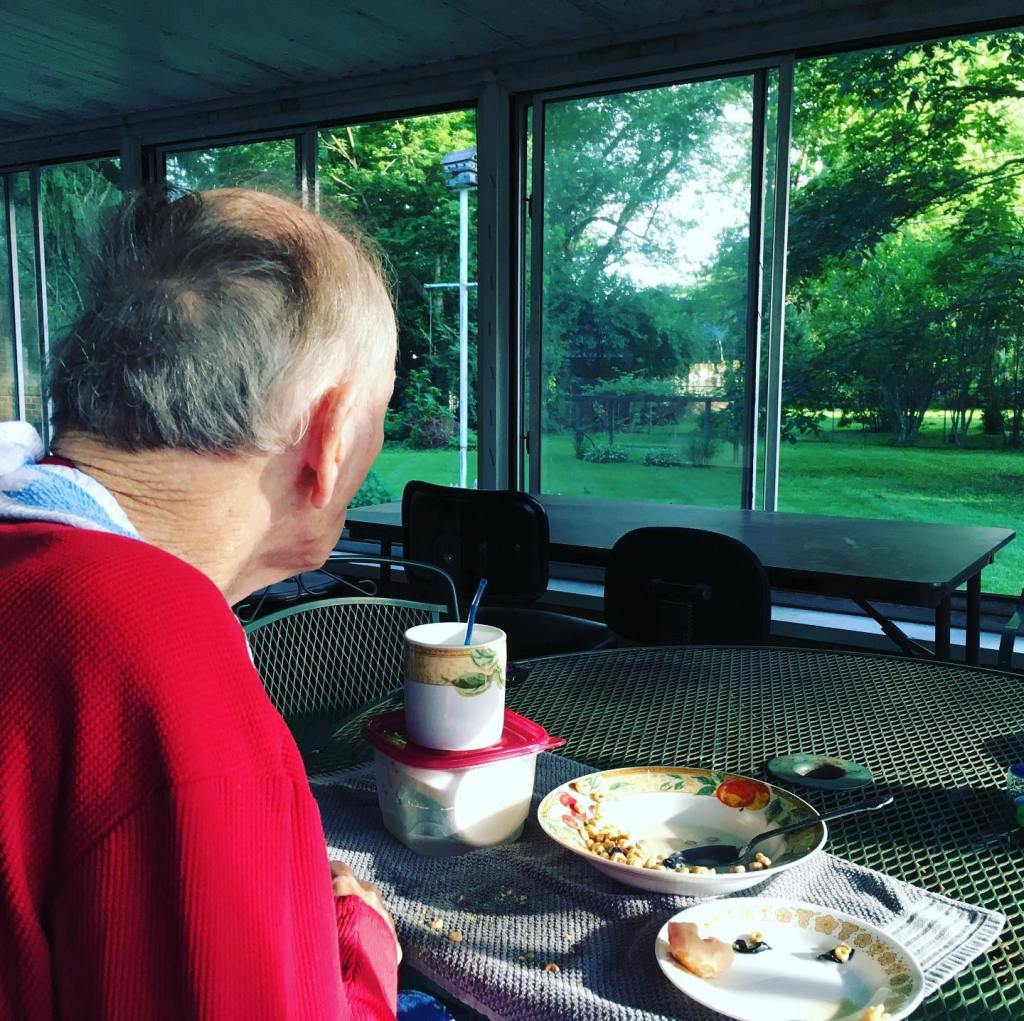
Friday, June 12, 2020. Dad and I were sitting down to breakfast on the screen porch of my house. He’d been living with me for about eight months and, although he preferred spending his day in his recliner, I did my best to make sure he had as much fresh air and sunshine as possible.
By then, he needed help feeding himself, so I always took my meals at the same time. Sometimes he was talkative in the morning, commenting on a TV news story or counting rabbits in the backyard. But today he was quiet and struggling.
We had a really bad night, which had become the norm over the last several weeks. The insomnia caused by his illness was relentless and he grew increasingly restless and anxious by the day. Neither of us had slept more than a full hour that night. By morning, we were both more exhausted than the night before.
Most people are familiar with the tremors and involuntary movements associated with Parkinson’s. But it can also produce dementia, dramatic personality shifts, and even violent behavior – occasionally, all three. Fortunately, my father’s issues weren’t that severe. Instead, he suffered a kind of subconscious agitation, like a whirring mind that wouldn’t let him rest. As his neurological system decayed, it robbed him of the ability to sleep, often until exhaustion set in. It was as if his body’s electrical system was shorting out from some long, slow cascade failure.
All along, Dad had outwardly rejected his diagnosis, repeatedly asking the doctors, nurses, and therapists questions like, “They tell me I have this Parkinson’s disease. What is it?” He never accepted their answers. I think he was just hoping if he asked enough people someone would say everyone else was wrong and he’d be OK.
By this time, though, Dad was far worse than any of us realized. Although it didn’t register consciously, he was in fact in a great deal of pain which worsened at night. It left him painfully restless, and he couldn’t even tell us why. He had fought hard but was losing the battle – and he was becoming aware of it. So was I.
At breakfast that morning, I noticed he was very quiet and barely eating. When he became aware of my interest, he turned and said, in a raspy, enervated voice, “What’s happenin’ to me, Ger?” His eyes were tired, afraid, his expression pained and desperate. I didn’t know how to comfort him. “I don’t know, Dad,” I said. “But we’re not going anywhere, you won’t be alone.” I rubbed his back a bit, as he’d done for me so many times when I lay in a hospital bed as a child, and I realized how helpless and frightened he and Mom must have been.
We sat in silence for a long moment, both powerless, tired, and desperate to cast this burden on anyone who happened by, just to be rid of it. I helped him finish his breakfast and we stared out at the backyard for a long time as the morning sun poured over us through the windows. I didn’t say anything. He didn’t say anything.
After a few minutes, I took our breakfast dishes to the kitchen. When I came back I paused just out of his sight. He was motionless, silent, his head bowed as if in prayer. I didn’t move. I just watched him for a while. My Dad, once a strong, proud man, now reduced to a shell of himself – so alone, tired, helpless, and very sad. And I couldn’t save him. Tears rolled down my cheeks.
He finally raised his head and looked over at me. I sat down with him again and did my best to hide my expression, but I think he knew. We both knew. “Ready to go to your chair?” I said, choking back more tears. “Yeah. I’ll go to my chair.” Just 18 days later, he was gone.
 The Jamestown Comet