Deer In Headlines II
By Gery Deer

The United States of America: the land of innovation and opportunity, where billionaires launch rockets for sport and algorithms decide your mortgage rate. So, it shouldn’t surprise anyone that Americans now turn to crowdfunding to pay for basic healthcare. Not as a quirky side hustle, mind you, but as a legitimate strategy for survival.
This year, roughly 1.8 million Americans will be diagnosed with cancer. The average cost of treatment? A cool $183 billion. That’s not per person, of course—just the collective tab. But when you break it down, individual patients often face six-figure bills, even with insurance. Meanwhile, nearly 70% of seniors will require long-term care, either at home or in a facility. And with government assistance programs shrinking faster than a hospital gown in the dryer, many are left to fend for themselves. Each year, more and more are turning to crowdfunding.
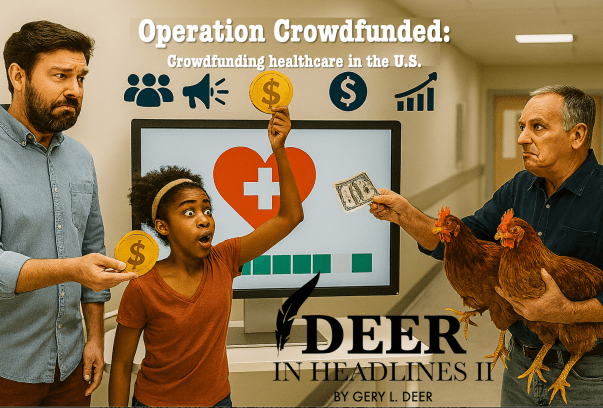
According to statistics published by Astute Analytica, Americans raise more than $3 billion annually through platforms like GoFundMe, GiveSendGo, and others—most of it for medical expenses. While that might seem a heartwarming testament to community spirit, it’s simultaneously a tragic commentary on our national priorities.
When you live in the “richest” country on Earth and someone in a white coat says the words, “You have cancer,” but your best hope for affording chemotherapy is a well-written plea and a viral social media post, something’s gone horribly awry.
Let’s compare this to the more “official” solution: Health Savings Accounts (HSAs), tax-advantaged accounts tied to high-deductible insurance plans. In theory, they help you save for medical expenses. But their nature pretty much excludes the people who actually need the money.
HSAs require disposable income to fund. Plus, they’re capped at a few thousand dollars per year. That’s great if you’re buying allergy meds or paying for a routine checkup. But without some serious money tucked away, you could still be in trouble if you need something like an appendectomy, for example, which averages around $13,000.
Crowdfunding, on the other hand, offers flexibility. You don’t need to qualify for a high-deductible plan. You don’t need to navigate IRS rules. You just need a compelling story, a few sympathetic friends, and the ability to market your misfortune.
Imagine a future where every citizen maintains a personal healthcare fund online. You could even petition the IRS to classify seniors and disabled individuals as not-for-profit entities. That way, when a billionaire donates to your cancer treatment, they get a tax write-off. It’s a win-win. You get a shot at survival, and they get to feel philanthropic without disrupting their yacht schedule.
Of course, this would also stimulate the tech economy. Crowdfunding platforms would flourish, transaction fees would soar, and a new generation of entrepreneurs would emerge to optimize the monetization of the already bloated medical crises. But there are challenges – big ones.
If everyone’s running a campaign, how do you stand out? Do you offer donor perks? “Contribute $100 and receive a personalized thank-you video from my hospital bed.” Do you hire a public relations firm to promote your gallbladder surgery? “Compassion competition” can become fierce. Those without strong social networks or digital savvy would likely struggle to raise anything at all.
With so many medical coverage decisions being made in the board room rather than at the bedside, this model has its appeal. It’s more transparent than insurance billing, more immediate than government aid, and more democratic than corporate healthcare.
Some say healthcare should be a right, not a raffle – I tend to agree. It’s absurd that anyone should have to beg for insulin or auction off their belongings to afford a colonoscopy. But in a country where tax breaks for billionaires are considered sacred and universal healthcare is viewed as some kind of socialist takeover, absurdity might just be the most realistic and successful option.
So sure, let’s embrace the irony of a system where survival depends on storytelling and digital advertising prowess and crowdfund our medical care. We will just have to hope that, someday, we’ll look back on this era not as a failure of policy, but as a resourceful bureaucratic bypass—when Americans took their health into their own hands, one donation at a time.
 The Jamestown Comet