Local News & Commentary Since 1890.

Archive for the ‘weather’ Category

Snow Drifts

In Environment, Local News, Opinion, Uncategorized, weather on February 1, 2026 at 1:34 pm

Deer In Headlines

By Gery Deer

I was 10 when the Blizzard of ’78 hit our small farm in southwestern Ohio. Holed up in an 8 by 10-foot room of our tiny farmhouse, with no power and only a small, very 1970s cone-shaped fireplace for heat, the five of us survived because of the experience and fortitude of my parents. 

It was 36 degrees in our kitchen that first morning and, without electricity, we had no water, and no other heat source. Plus, we had to figure out how to mix formula for 14 bottle-fed feeder calves in the barn. The temperature continued to drop, the wind was relentless, and a seven-foot snow drift sealed our back door. 

My father and brother tunneled like gofers from our basement walkout, creating a passable though treacherous path to the barn. Diesel fuel siphoned from a tractor filled nearly every one of our 15 or so antique kerosene lamps. Some provided light while others were placed next to open cabinet doors to warm water pipes. As it turned out, those weren’t the only family antiques that were called into service.

Me, my mother, and my brother’s very pregnant wife, melted snow in large canning pots and used the water to feed the calves – one bottle at a time. It took hours. Oddly, the barn was warmer than you might expect since the walls of stacked hay provided good insulation. Mom also found a way to feed us too. She cobbled together foil packs of vegetables and beef and cooked them in the little fireplace.

On day two, the national guard plowed our quarter mile-long driveway, and my father and brother took one of our farm trucks into the village to get supplies for us and the elderly couple who lived at the orchard across the road. It took them almost eight hours to make the seven-mile round trip. Once they made it back, they didn’t go out again. We had enough challenges at home.

Our electricity was out for almost four days. Over the next year, my father gutted our home’s heating system, replacing the electric oil furnace with a wood-burning version he designed. They also added generators, and a 1905 wood-burning cook stove. They were determined we’d never be so crippled again. 

I still use the lessons I learned during that very cold week and the events that followed. Our electricity was knocked out on a more than regular basis, but we were well prepared for most situations, thanks to my family’s know-how and tenacity. As a different kind of pioneer once said, “Failure is not an option.”

This past week, our small part of the world, as well as most of the Midwest and northeastern United States, experienced a similar winter event. As I prepared our home for the coming snow and cold, I was reminded of every moment during that frigid week on our farm all those years ago. For me, it was like my folks were still here because I could hear their words and see their actions in my mind – the lessons of growing up in a remarkable place with uncommon people. 

Sadly, it seems to me that such self-sufficiency is less common than years gone by. Instead of a calm thoughtful response to something like a snowstorm, people today seem more likely to overreact. Not even those who take preparedness to an extreme level can be ready for everything. But for situations like this, we have more resources, better access to information, and more reliable infrastructure than anything available a half century ago. Still, most people panic, clearing store shelves of bread and milk, while doing little to adequately prepare.  

I’m incredibly fortunate to have grown up at a time and with a family who gave me the knowledge and resourcefulness to look after myself in most situations. Probably like many of those reading this, I take whatever steps I can to manage a situation and try to help others whenever possible. General observers might see my heightened sense of urgency as anxiety, but I’m generally the calm one. Even so, there’s always that thing you didn’t plan on. That’s when improvisation, fueled by experience and common sense, can literally save your life.
When Snow Is in the Forecast, Calm Should Be Too

In Local News, Uncategorized, weather on January 23, 2026 at 8:43 am

By Gery Deer

Editor

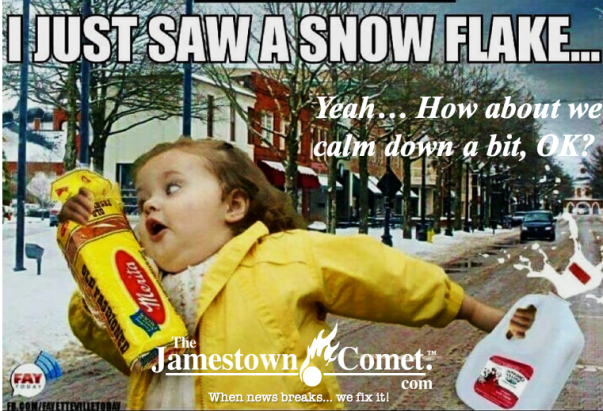
By now, you’ve probably heard it. A winter storm is headed our way this weekend, with forecasts calling for up to 12 inches of snow across Jamestown, Greene County, and other parts of the Miami Valley. Cue the dramatic music, the urgent weather graphics, and—if history is any guide—the sudden disappearance of milk, bread, and eggs from grocery store shelves. Not to mention the appearance of the all too familiar grocery store meme of the panicked little kid running with milk and bread in tow.

How about we all just calm down for a minute? A dose of common sense would be great right about now.

Yes, 12 inches of snow is nothing to shrug off. It deserves respect and preparation. But it does not require panic, hoarding, or acting like we’re about to be snowed in until spring. Around here, heavy snow is usually cleared from main roads within a day or two. Life slows down briefly, then it gets back to normal. That’s how it’s gone for decades.

The problem is that winter storm coverage often turns preparation into panic. Words like crippling, paralyzing, and historic get thrown around, and suddenly people are fighting over the last loaf of white bread as if it’s the final one on Earth. We’ve all seen it. We’ve all laughed about it later. And yet, here we are again.

So, let’s try something different this time: calm, common sense.

Here’s what actually makes sense to do.

First, stock enough essentials for about three days. Not three weeks. Three days. Food you already eat, medications you need, pet supplies, and a little extra drinking water. If the power stays on, great. If it doesn’t, you’ll still be fine for a short stretch.

Second, be ready for possible power outages. Heavy snow combined with wind can bring down tree limbs and power lines. Have flashlights with fresh batteries, or candles if you use them safely and responsibly. If you rely on fuel-burning space heaters, make sure they are properly vented. This is important enough to repeat: never run generators, grills, or fuel-burning heaters inside your home or garage. Carbon monoxide is silent, invisible, and deadly.

Third, think about warmth. Extra blankets, warm clothing, and closing off unused rooms can help conserve heat. Even if your home cools down, layers and common sense go a long way.

Fourth, limit travel. If you don’t absolutely have to be on the roads, stay home. Snow-covered roads, reduced visibility, and impatient drivers are not a great combination. Staying put helps snow crews do their jobs faster and safer, which gets everyone back on the move sooner.

Fifth, charge your devices. Phones, tablets, battery packs—anything that keeps you connected. Reliable communication matters in an emergency, and it’s a lot easier to top off batteries before the lights go out.

A few other smart reminders:

• Park cars away from trees if possible.

• Keep your gas tank at least half full.

• Check on elderly neighbors or those who might need assistance—by phone if travel isn’t safe.

• If you shovel, take it slow. Snow shoveling is more dangerous than the snow itself for many people.

And finally—this is the most important advice of all— don’t panic. Not because the news says everything will be fine. Not because someone on social media claims this storm is “nothing.” But because panic doesn’t help anyone.

Be informed. Be prepared. Be smart.

Winter happens in Ohio. It always has. We get snow, we deal with it, and we move on. A calm, level-headed community handles storms far better than a frantic one. So, skip the panic buying, ignore the hype, and focus on what actually matters: keeping yourself, your family, and your neighbors safe.

The snow will fall. The plows will roll. And in a day or two, we’ll all be talking about how it really wasn’t as bad as everyone thought—again.

Keep Pets Safe As Winter Storms Approach

In National News, Uncategorized, weather on January 3, 2025 at 2:47 pm

January 3, 2025, DAYTON, OHIO – As a major winter storm approaches Ohio, the Humane Society of Greater Dayton urges pet owners to take extra precautions to keep their animals safe. Freezing temperatures, snow, and ice can pose severe risks to pets, but their safety and well-being can be ensured with proactive care.

Top Winter Storm Tips for Pet Owners

1. Keep Pets Healthy and Indoors

  • Stay Indoors: Whenever possible, bring pets indoors during the storm. Even animals with thick fur are vulnerable to frostbite and hypothermia during extreme cold.
  • Schedule an Exam: Pets may face health challenges in cold weather. Schedule a preventive care exam with your vet to ensure your furry friend is ready and healthy for the chilly season. Arthritis and other conditions can worsen in the cold, so a wellness check is a pawsitively good idea! Don’t have a vet? Schedule an appointment with us at the Dayton Humane Veterinary Hospital by calling (937) 965-4399.

2. Outdoor Shelters for Companion Animals
Although keeping pets outdoors is not ideal, Ohio law permits animals to remain outside as long as they have adequate shelter and access to fresh food and water. For pets that must remain outdoors, proper shelter is essential:

  • Bedding Materials: Never use blankets or hay as bedding. These materials absorb moisture, freeze, and can do more harm than good. Instead, use straw, which is naturally water-repellant and provides warmth, comfort, and insulation.
  • Shelter Design: Ensure your pet’s shelter is sturdy, waterproof, and insulated. Position the entrance away from prevailing winds, and keep the shelter off the ground to prevent moisture buildup.
  • Access to Food and Water: Ensure pets have fresh, unfrozen water and adequate food to maintain their energy levels. Heated water bowls can be helpful in sub-freezing conditions.

3. Protect Paws and Skin

  • Paw Care: Wipe paws clean after walks to remove salt, ice, and chemical de-icers that can irritate or harm you pet’s feet.
  • Booties or Balm: Use protective booties or paw balm for added protection from the elements.
  • Check Regularly: Frequent paw checks are essential. Cracked or bleeding paw pads can result from cold-weather injuries. Clip hair between the toes to reduce ice accumulation during walks.

4. Avoid Toxic Hazards
Many things used by humans this time of year can be toxic to your pets. Antifreeze can smell sweet and appealing to your pets, so if you spill anything, clean it up quickly to keep them safe. De-icers can also be toxic if swallowed. Protect your pet by avoiding these hazards. If you pet does ingest these items, contact your veterinarian immediately.

5. Limit Outdoor Exposure
Pets have varying tolerances to cold based on factors like coat thickness and health. Adjust outdoor activities according to your pet’s tolerance. Remember, arthritic and elderly pets may need extra care, while long-haired breeds still need protection. Also, be aware of signs of discomfort, such as whining, shivering, or weakness in your pet. These could be signs of hypothermia.

6. Emergency Preparedness
As the storm approaches, have a disaster kit ready for your pets, including:

  • Five days’ worth of food, water, and medications.
  • Updated identification tags and microchip information.
  • Blankets, toys, and other comfort items.

7. Increase Food Portions

Outdoor pets may need more calories to stay warm, so consult your vet about their nutritional needs. As it takes pets more energy to stay warm, you may need to feed them more in the colder months to help their bodies produce more energy.

Resources for Pet Owners

The Humane Society of Greater Dayton offers resources to help keep pets safe this winter, including microchipping services and disaster preparedness checklists. For more information, visit www.hsdayton.org or call us at (937) 268-7387.

About the Humane Society of Greater Dayton
For more than 120 years, the Humane Society of Greater Dayton has been a trusted advocate for animals in the Dayton community. As a 501(c)(3) nonprofit organization, we are dedicated to improving the lives of pets and their owners through education, outreach, wellness, and comprehensive animal welfare programs.

Gone With The Wind

In Opinion, Technology, Uncategorized, weather on May 10, 2024 at 4:21 pm

Deer In Headlines II

By Gery Deer

I hate thunderstorms. Some people find them relaxing, even romantic. Not me. Storms like that wind me into a sort of controlled anxiety. Growing up in the shadow of the 1974 Xenia Tornado, a thunderstorm always set me on alert, scanning the skies like Chicken Little, certain something terrible would swoop down and obliterate my world.

When I was a little kid, I put together an emergency kit and hid it under the basement stairway. It had a thermos of water, dehydrated ice cream (that gross, Neapolitan NASA museum stuff), a flashlight, matches, candles, and cans of soup. I know it seems silly now, but give me a break. I was like ten, and I thought I was being prepared.

I was always taught that knowledge was my best defense against fear. Over time, I educated myself about the meteorology surrounding tornados and the storms that spawned them. As I got older, the fear dissipated, eventually replaced by scientific understanding and respect. I wasn’t scared anymore. I even went on a couple of storm chases. But one rainy spring day, that newly minted resolve would be tested up close.

It was the spring of 1988, and I was a commuting college student. One afternoon, I’d just arrived home after class, and my parents were making a bedding delivery in the truck. I popped in a video and settled in with some takeout before starting my homework.

The weather had been threatening since mid-morning, and the afternoon brought even darker skies. Our house sat in the center of 25 acres, back a long lane, so it was very quiet there. I was sitting next to the open window in my bedroom, engaged in my movie when a massive clap of thunder and lightning nearly knocked me out of my chair. The power went out.

I went downstairs and out the back door to look at the sky. An ominous wall of clouds was closing in from the southwest. I hurried around the house and behind our barn, where I could see the livestock. Usually, when a storm approached, the cattle meandered down the hillside into the valley behind our house. That’s just where they were. Smart creatures.

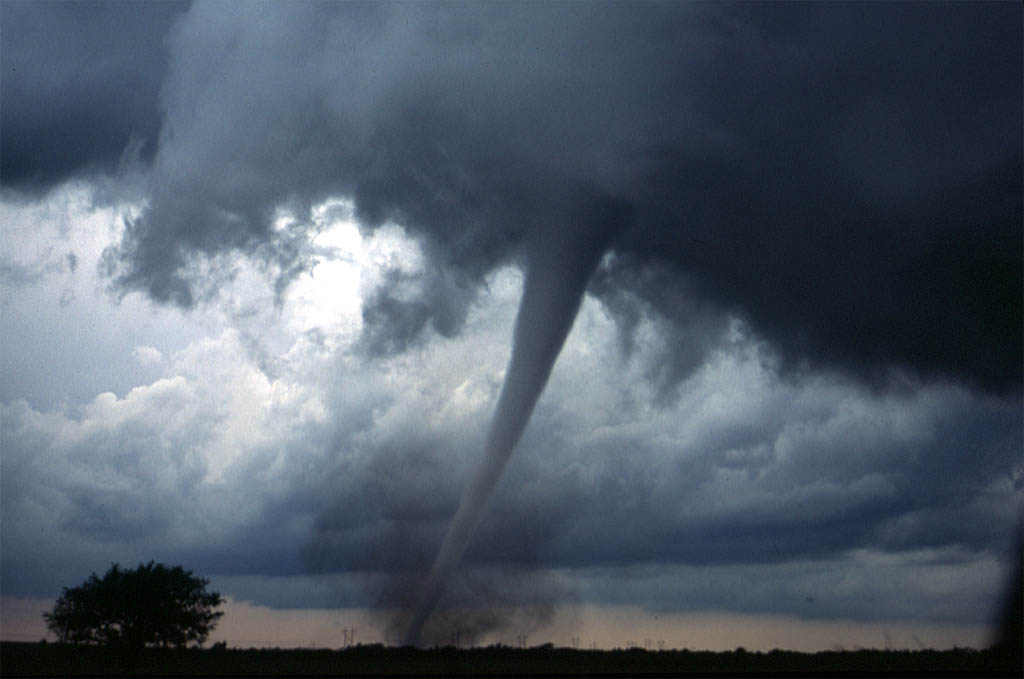
Back at the house, I paused on the front porch step as the wind kicked up. Another bone-rattling clap of thunder boomed, and brilliant lightning illuminated the dark sky. That’s when I saw it. Rainwater ran into my eyes as I stood there motionless in the downpour. A small tornado spun down out of the sky like a crooked finger reaching for the ground.

It touched down, moved along the edge of our hayfield, and whipped up dirt, grass, and other debris as it intensified. Moving parallel to my position, the funnel picked up speed, crashed into one of my dad’s grain trucks, and shattered its old wooden sideboards into kindling.

I probably should have run to the basement, but I couldn’t move. Unconsciously, I fought my basic instinct and didn’t move. I wanted to see it. I needed to see it. I never imagined I would be so close and never felt threatened. It was oddly quiet. There was no freight train sound, as most people usually report; it was probably too small.

My ears popped as it passed, however. The funnel continued another quarter-mile, still moving along the field. It was as if a hidden puppeteer controlled it. The thing slipped across the road, narrowly missed a house, and blew apart a small horse barn. As quickly as it had appeared, it was gone, dissolved into the air. All was quiet.

I’m not sure how smart it was to stand there. I knew the tornado, however small, was dangerously unpredictable and could have changed course and come right at me. But sometimes, we just must face our fears and meet them head-on. I was never again afraid.

Since that day back on the farm, I’ve been close to at least three other tornadoes. I still do my best to be prepared. When shopping for my first house, I had only one deal-breaking requirement—a basement. I also have a little more in my emergency kit these days than a can of Campbell’s.

Ohio’s Spring Severe Weather Awareness Week: March 19 – 25, 2023

In Dayton Ohio News, Environment, Health, Local News, Science, Technology, Uncategorized, weather on March 20, 2023 at 6:26 pm

GREENE COUNTY, OH – March 16, 2023 – When it comes to severe weather, it is never too early to start preparing. Ohio is not a stranger to severe weather, including tornadic activity in the early months of the year. Greene County Public Health will recognize Ohio’s Spring Severe Weather Awareness Week, March 19-25, 2023.  Residents are reminded to prepare for severe weather before it happens. Hazardous conditions can occur anytime and anywhere without advance notice.

As part of Severe Weather Awareness Week, Emergency Preparedness Coordinator, Kim Caudill, urge schools, businesses, and residents to practice their preparedness skills in the event of a severe storm. Severe weather and disasters are a certainty, and your family may not be together when something happens. Ohio’s Spring Severe Weather Awareness Week is the perfect time to learn what disasters might affect you. Now is the time to ‘Get a Kit, Make a Plan, and Be Prepared’. How you survive depends on what you do before the event, not after, said Caudill.

Most recently, The National Weather Service (NWS) has confirmed four tornadoes touched down in the state of Ohio on the afternoon of Monday, Feb. 27. Two EF 1 tornadoes were confirmed to have touched down in the Miami Valley: one just northwest of Middletown in Butler County and another north of New Carlisle in Clark County. NWS also confirmed two EF 0 tornadoes: one in Licking County and one in Pickaway County.

Two of the major tornadoes that tore through the area are unfortunately names a lot of residents know all too well: The Xenia Tornado of 1974 and The 2019 Memorial Day Tornadoes.

It is never too soon to prepare for severe weather of any kind since it can strike at any time. There are steps you can take to keep you and your loved ones safe.

One of the most important preventative things you can do ahead of the storm is to locate and designate a safe spot for tornadoes or other severe weather activity.

If you find yourself in severe weather, you are encouraged to go inside and follow the acronym “D.U.C.K.“:

  • If there is an approaching storm that is a severe storm, you should get down to the lowest level of the building or your home. If you are not home and, in a vehicle, or outside with nowhere to go, it is
    recommended to either seek a building, stay in your car with your seatbelt on, or even get in the lowest part of the area outside of your vehicle, even if it is a ditch.
  • When you are on the lowest level as you can be, if you are able to, you should safely get under something sturdy, like a basement staircase or a heavy table. 
  • Finally, cover your head and keep in your safe spot until the storm has passed.

Ms. Caudill encourages residents to be prepared for all types of severe weather, not just tornadoes, by following these important safety procedures:

Know the Risk – Learn and understand the different types of weather hazards facing Greene County.  The top hazards can be found on our website. You can also download our Greene County Emergency Preparedness Guide, which is a handbook for the entire family featuring information on how to make a plan, types of emergencies we could face in Greene County, and much more, with areas to take notes and includes personal information that is critical in an emergency.

Know the Weather Terms – Know the difference between storm watches and storm warnings. For example, a tornado watch is issued by the National Weather Service when conditions are favorable for the development of tornadoes in and close to the area. A tornado warning is issued by the NWS when a tornado has been detected by radar or sighted by storm spotters.

Receive Notifications – Register online with Nixle to receive severe weather alerts and important information that can keep you and your family safe. It can be found here: https://local.nixle.com/county/oh/greene/. Residents are encouraged to have an NOAA Weather Radio and tune into TV or radio newscasts for up-to-date weather information.

Have a Plan/Build a Kit – Develop and practice an emergency plan with your family and include your pets. Know how to communicate and have a designated safe meeting place.  Build an emergency supply kit.  Be sure to include enough food, water, and other supplies in sufficient quantity to last for at least 72 hours. 

For more information about emergency preparedness, please call 937-374-5627 or email kcaudill@gcph.info. You can also visit the website at www.gcph.info.