Local News & Commentary Since 1890.

Archive for the ‘National News’ Category

Hobby Lobby ruling sets religious freedom in business

In Business, Charities, history, Media, National News, Opinion, Politics, Religion, sociology, Uncategorized on June 30, 2014 at 11:59 am

DIH LOGOOn June 30th, the United States Supreme Court ruled in favor of Hobby Lobby’s suit to be exempted from the ObamaCare mandate forcing companies to provide contraceptive coverage to employees, including the controversial Plan B, or “morning after,” drugs. Many conservative business owners equate these drugs to abortion since they’re designed to terminate a pregnancy within hours of conception.

The primary argument to the court is whether the owners or management of a corporation has the same rights to freedom of religion as an individual. The Obama administration has already set exceptions for various religious non-profit organizations, which, other than their non-profit status, are structured similarly to their for-profit counterparts.

In March of this year, according to TheHill.com, the U.S. House of Representatives, “Approved the Equitable Access to Care and Health (EACH) Act, H.R. 1814. The bill allowed people avoid buying health insurance under ObamaCare if they could cite a religious reason. People seeking an exemption would have to include sworn statements in their tax returns explaining their objection to health insurance.” In effect, all they needed to get out of paying the federal healthcare mandate (tax) was a note from home.

A further question is whether there is a fundamental business difference between a non-profit corporation and a for-profit corporation? The practical answer is, no. Charity or not, a corporation is created to protect the individual operators from legal responsibility with regard to the business. Most non-profit filings are for tax and donation purposes, a process that seems outdated and inefficient with the advent of mega churches and multi-billion-dollar evangelical organizations.

uscourtIn America, there are countless religiously-focused, non-profit corporations worth millions more than some of the largest for-profit businesses. The Christian television network, Daystar, for example has been approved by the Internal Revenue Service as a “church,” according to NPR.com news. Celebrity, sometimes politician evangelist Pat Robertson and the late Billy Graham registered with the IRS as “religious organizations,” making them exempt from most taxes. All they had to do was file disclosure papers.

According to available records, NPR.com reports that the top three evangelical television broadcasters – Christian Broadcast Network, Trinity Broadcasting Network and Daystar Television — have a combined net worth of more than a quarter of a billion dollars. It is unknown whether the corporations that operate these broadcasters have filed for religious exemption under the healthcare reform laws.

The question persists, however, that if the only difference between a for-profit corporation and these mega non-profits is an earnings disclosure, why have the distinction at all? Certainly there are for-profit companies that give away millions of dollars in charitable funds each year but still have to comply with the law in every respect. Why then are religious non-profit organizations exempt from anything, much less a controversial healthcare mandate that has American small business struggling to comply or face bankrupting penalties?

The court’s latest decision with regard to religious exemption could have long-reaching implications, and not just in the healthcare arena. Giving a for-profit entity the same constitutional protections provided to non-profit religious groups could cause a flood of lawsuits ranging from tax law to equal employment regulations. Once again, major non-profits have million-dollar earners at the top, private jets, limousines and pretty much every other extravagance thought only to exist in for-profit American business.

If a church – any church – can make a case for religious freedom from legal mandates, why can’t a business owner cite his or her – or their – own religious beliefs for the same purposes? Is the constitution not written for everyone or does it exist specifically to meet the needs of religious groups so they can avoid taxes and dodge the law at their convenience?

This argument poses a great many questions and there will likely be countless more as ObamaCare reaches further corners of commerce. But, if that’s not enough to chew on, here’s another one. What happens if a Muslim, Jewish or non-Christian group requests exemption as well? Will the Christian right fight against their having the same protections?


Gery L. Deer is an independent columnist and business writer and contributor for WDTN-TV2’s LIVING DAYTON program. More at www.gerydeer.com.


 

Cause and effect of drug advertisements

In Business, Education, Health, National News, Opinion, television, Uncategorized on June 26, 2014 at 10:37 am

DIH LOGOAccording to a 2008 study by the peer-reviewed medical journal, PLOS Medicine, pharmaceutical companies spend nearly twice as much on marketing than research. In a review of the study, the consumer advocacy website, Consumerist.com, indicates, “Drug companies pour $57.5 billion into marketing, dwarfing the comparably paltry $31.5 billion devoted to research.”

Pharmaceutical manufacturers have rigid guidelines for promoting their products, but the question lingers: should non-over-the-counter drugs be promoted to the general public at all? The short answer is, probably not. The longer answer is more complex. Since, as a rule, Deer In Headlines deals with “fact,” not “truth,” here are some facts about drug advertising. Incidentally, if it is truth you’re interested in, check out a philosophy column (thanks Dr. Jones).

The official website of the United States Food and Drug Administration states, “Prescription drug advertisements can provide useful information for consumers to work with their health care providers to make wise decisions about treatment.” Leading the pack of heavily-marketed drugs are prescription sleep aids, blood thinners, anti-depressants and erectile dysfunction remedies. Most of the television ads for these medications appear during the day, carefully targeting certain markets.

What the general public fails to realize, however, is that these ads are intended to plant an idea in the head of the consumer who, in all their medical wisdom, will take the information to a doctor and insist on a prescription. Mission accomplished; more drugs are sold and the company’s stock goes up a quarter of a point, not to mention the fact there is one more person who simply can’t live without the latest pill. Perhaps a better understanding of how these ads are structured might help.

pillsThe FDA’s Office of Prescription Drug Promotion classifies medication advertisements into three categories: Product Claims, Reminders, and Help-Seeking ads.  The product claim ad names the drug, the treated condition and lists the benefits and risks. A reminder ad shows the name of the drug, but not its use. Finally, the help-seeking advertisement is directed at people with a particular condition for which they are trying to find a remedy. There is, however, no guideline for how much money a drug company can spend on advertising and some consumer advocates argue that it’s wrong for them to be able to spend more on marketing than research.

The fact is that it’s really hard to say exactly how much any one drug company spends on research vs. marketing because reported advertising expenditures are mixed in with the accounting category which also includes other figures, such as executive salaries. Research money is usually accounted for in a separate line item (R&D), even though it technically could be in the same classification with general operation costs.

Another fact is that everyone is a medical expert – yes that’s sarcasm. From the neighbor with every ailment more painful than the last or the relative who insists his doctor is an idiot but goes back every time his prescription runs out, self-diagnosis and treatment are a real epidemic in America.

There is also the concern that these advertisements actually plant the idea of a particular illness in the mind of the viewer who then heads to the doctor with a new problem, and a new prescription demand. Studies show that about 40-percent of all doctor visits are with the intention of getting a prescription. Since people keep going back, it’s safe to assume there are plenty of doctors obliging, and that needs to change as well.

Prescription medication should be marketed to the experts who will be prescribing it to the patient. Drug companies already spend billions on advertising and on-site sales representatives who offer samples and various other motivators to get the doctors to push their products for various ailments. The patient has no business self-prescribing and doctors need to be more responsible.


Gery L. Deer is an independent columnist and business writer based in Jamestown, Ohio. Side effects of reading Deer In Headlines include a more open mind, alternative points of view and a better understanding of the world around you. No prescription necessary.


Too much rides on a credit score

In Business, Economy, Education, Jobs, National News, Opinion, Uncategorized on June 16, 2014 at 11:33 am

DIH LOGOFor all the important numbers in the life of the average American, the credit score seems to wield the most power. It’s hard to imagine how three little digits could determine how an individual will live his or her life, regardless of the circumstances that created it and with the average person having virtually no understanding of what it is or how it’s calculated.

Credit scores determine how much a consumer will have to pay for credit (as interest rates), insurance, and other necessities. For many years, the credit score was a value hidden from the consumer because Fair Isaac and Company, the firm which created the process, decided it would just be too confusing to the general public. (Of course, that’s the usual excuse offered up by big business and government agencies trying to dupe the general public.)

That’s little comfort, however, to those who have been held hostage by the credit reporting companies for decades. Almost since inception, credit data has been full of inaccuracies and misinformation, a problem to which consumers have had little (practical) recourse other than the slow, usually pointless, process required to amend a report.

As of 2012, the Consumer Financial Protection Bureau was charged with the oversight of personal credit rating companies. With countless rule changes over the years, the Fair Credit Reporting Act finally forced at least some restrictions on the credit rating companies. The FCRA is the legislation that required companies like TransUnion, Experian and Equifax to provide free credit report, limit outside access to personal credit files, initiate identity theft protections and other consumer defense measures. Click here for a downloadable version of the Fair Credit Reporting Act is available.

creditoneRegardless of the current legislation, however, credit monitoring and reporting services still have entirely too much power and control over the general lives of consumers. A credit report (and score) whether accurate or not, can limit access to vital, day-to-day needs like transportation and employment.

Considering how much inaccuracy can exist or the irrelevancy of the information to the situation, it’s bewildering how it is legal for employers to reject applicants based on a credit score. In another example, how is it permitted that credit score can determine whether someone should be provided with car insurance, particularly when coverage is mandated by the government?

Whatever more ignorant people choose to believe a low credit score doesn’t always mean a person is unwilling to pay their bills or is inept at handling money. Sometimes circumstances change, as with the predatory lending practices that contributed to the housing market crash of 2008.

Likewise, although there is a higher risk in lending to people with a sorted credit history, almost no one takes into account how the score got so tarnished. On the heels of the worst recession in U.S. history, the credit rating process seems almost backwards to the average consumer.

If you can afford a higher rate and larger payment, you get a lower one, and vice versa. A person may be in desperate need of a car or renters insurance but, because of a lower credit score, they are charged significantly higher rates and payments. Wouldn’t it make more sense to offer those people lower rates and payments, making it more likely they can pay on time and help shore up the economy in the process?

The consumer should always keep in mind that the credit reporting organizations are private sector businesses, not government agencies. They are not affiliated with the Federal Trade Commission in any way nor any other government office. Credit scores are big business for those companies that calculate and report them.

In the first quarter of 2014, TransUnion, one of the three largest firms, reported earnings just over $303 million. That’s just for one credit reporting company over three months! So, with billions of dollars in revenue at stake, there is little to no motivation for limiting the power of these companies. It’s a sure bet that lobbyists for the credit reporting companies are well-entrenched in Washington, greasing all of the appropriate palms to make sure that the “have nots” never catch up to the 1-percent.


The Jamestown Comet.com editor / publisher Gery L. Deer is an independent columnist and business contributor to WDTN-TV2’s Living Dayton program. More at http://www.gerydeer.com.


India vs. China: Economic growth and national security

In Economy, history, National News, Opinion, sociology, Uncategorized on June 9, 2014 at 9:47 pm

DIH LOGOOn June 4, 1989, after three weeks of civil rights protests by nearly a million Chinese, many of them students, Chinese troops stormed a packed square in Beijing, killing and arresting thousands. The Tiananmen Square Massacre shocked the world and confirmed the belief, not that there was any doubt, that China’s political system is completely incompatible with that of the United States and pretty much any other democratic nation.

A quarter of a century later, it’s still largely incomprehensible why America is so tied to a country with no decency with regard to human rights. It’s about two things that shouldn’t surprise anyone, money and political power. There’s a little fear thrown into the mix as well associated with China’s massive military might and a government with no reservations about using it.

Labor costs are incredibly also low in China, with the average factory worker earning just one-tenth of what their American counterparts bring home, according to the Bureau of Labor Statistics. Cheap labor is an attractive prospect to American companies looking to expand production with fewer tax and employment expenses. It seems there is no end to U.S. manufacturers relocating in China; producing cheaper goods to be shipped back America and sold at a premium profit.

Contrary to popular belief, however, according to the Council on Foreign Relations, only 15-percent of U.S. imports come from China. That comes out to something like $29 billion of a $1 trillion monthly output. There are more than 1.3 billion people in China, many of whom, like their American counterparts, want, more than ever, the latest technology, fashions, entertainment and so on. Although it is generally exaggerated, a definite trade deficit exists between the two nations, which is unlikely to change anytime soon.

China or India? Which makes more sense for the US?

China or India? Which makes more sense for the US?

It’s entirely possible the United States should be looking a little further southwest for political and economic growth in Asia – India. After all, which would seem a much more stable and amiable political and economic ally? With more than 1.2 billion people living in 29 states, India is the world’s second-largest country and second-largest democracy, English speaking and primed for growth.

If India is a more lucrative and stable prospect, what’s holding America back from a greater fueling of the fire of partnership, economically and socially? Unfortunately, recent years have seen the U.S./India relationship strained over trade and intellectual property disputes. Plus, the Indian economy has had some rocky spots recently.

In 2013, the average median income per capita in India was around $1,200 (Compared to China at $2,100). Add to that, India’s economy has fallen off nearly 5-percent with 8-percent inflation and the country’s fiscal health is a major barrier. However, the election of a new prime minister, Narendra Modi has encouraged investors and the economy has reflected that confidence.

According to CNN Money, “The prospect of a government led by Modi has boosted Indian stocks by 15 percent so far this year. The rupee has responded too, gaining six percent against the dollar after a dismal performance in 2013.”

There are other more politically charged issues slowing down a more aggressive relationship with India, but most U.S. officials see the country as a thriving democracy and a strategic gold mine. Close to Afghanistan and Pakistan, a more advanced partnership between America and India would benefit both countries in terms of economic growth and national security.

America imposed sanctions against India in 1998 because of nuclear testing. But, thanks to former presidents Clinton and Bush, relations improved greatly and the two nations even signed a ground-breaking defense and civil nuclear (power) agreement.

With the possible exception of the political unknowns surrounding a new prime minister, previously a Hindu Nationalist, there is little reason to spend so much time courting the stagnant communist regime in China instead of nurturing a reasonably stable democracy, and growing economy, in India. In the end, it certainly seems that it would be much wiser for Washington to advance trade and economic partnerships with India.


Gery L. Deer is an independent columnist and business writer based in Jamestown, Ohio. More at http://www.gerydeer.com.


Reward yourself for a job well done.

In Business, Economy, National News, Opinion, Uncategorized on June 3, 2014 at 8:28 am

DIH LOGODo you hate your job? You might be surprised how many people despise their work. Even those making upwards of six figures can find the grind most tedious and would do nearly anything to change it. So why don’t they? Chances are, especially at the high end, people have locked themselves into a lifestyle that requires a certain level of money and position that becomes inescapable, or so they think.

If you were one of the millions of folks displaced from a job during the recession, you’re just counting your blessings and dealing with whatever unpleasantness comes along at work. Whatever the reason for staying, there are many reasons why people hate their jobs.

Much of what causes people to dislike their jobs has to do with a lack of obvious appreciation or recognition for your efforts. It takes more than a paycheck to feel fulfilled in your profession and most people don’t get the recognition they feel they deserve for hard work and dedicated service.

Recognition can also come from promotion and a change in responsibilities which can offer more challenges to your day, as well as a better paycheck. If you don’t have opportunities to grow within an organization, you’re likely to feel stifled and unproductive. That will eat away at you over time.

Another reason for someone might feel badly in their job is when they feel they’re meant to do something else or went to school for something entirely different. We all have had moments when we thought we should be something else. I grew up thinking I was going to be a doctor. When I finally enrolled in a pre-med program, I found I really didn’t like it and transferred into an engineering track.

girl_bookDespite what the academics would like us to believe, very few people really know what they want to do at the age of 18 when society is telling us to choose a lifelong career. The fact is we’re just not that grown up yet and, if we think we are and choose a direction, it often change with age and experience.

So what do you do if you are one of those who is just plain unhappy at work? First, it might be a good idea to try to find another job. Don’t wait until you lose the one you have to be looking for something better. Knee-jerk reactions to an employment crisis rarely bring about good change in life, instead just leading to more of the same mediocrity. Get out there and start looking and interviewing for the kind of work you really feel like you want to do, provided it meets your financial and professional qualifications.

Secondly, if changing jobs isn’t a practical option right now, try to provide yourself with some self-rewards and do things throughout the week to make your situation more enjoyable. As an independent worker and small business owner, I don’t get “rewards” for what I do all day. There is no employee of the month or chance for promotion. I’m as high up as I get and, unless the cat learns to use the printer, it’s doubtful I’m going to receive a certificate for outstanding performance anytime soon.

I still need to stay motivated, though, and so do you. So set up rewards for yourself throughout the week. For example, say you have a big project coming up that may test your patience and tolerance of others. Instead of going home stressed every night, establish yourself some rewards for hanging in there. Schedule a special lunch with a friend or ice cream after work. Go to a movie with your significant other in the middle of the week or even plan for a day off if possible.

These observations merely brush the surface of why people might hate their job, but it’s a start. Having a plan to help yourself better enjoy your work will reduce your stress level and increase your productivity. It will also make you less dependent on others for personal growth and self-worth. More importantly, developing a system of self-reward is something you can take with you.

Gery L. Deer is an independent columnist and business writer based in Jamestown, OH. More at http://www.gerydeer.com.

V.A. health care debacle is nothing new

In Health, National News, News Media, Opinion, Politics, Senior Lifestyle, Uncategorized on May 27, 2014 at 8:06 am

DIH LOGOAs an organization that serves more than 9 million, it would be difficult to imagine a more complicated system than the United States office of Veterans Affairs (V.A.). Recent allegations of wrong doing within the V.A. health care system has erupted in congressional investigations and strong admonishment from President Obama, one of a half-dozen occupants of the Oval Office under whom this system has thoroughly failed its distinguished beneficiaries.

Naturally, the White House spin doctors tried to express the president’s astonishment and outrage over this issue with their typical press room song and dance. When he finally spoke about the matter publically last Wednesday, Mr. Obama said, “I will not stand for it. There must be consequences.”

Of course there was absolutely no mention of exactly what kinds of consequences.  Even more insulting was the way the administration has fained ignorance about one of the worst kept secrets in America – that there is a mind-blowing level of back-door politics and bureaucracy grinding away below the V.A.’s spit and polished façade.

In the 1992 movie, "Article 99," Kiefer Sutherland struggles to adapt to a broken V.A. system.

In the 1992 movie, “Article 99,” Kiefer Sutherland struggles to adapt to a broken V.A. system.

Critics of the administration are also using this crisis to, once again, lambaste Democrats over Obamacare, to which they compare the crippled V.A. medical system. Some of them have even suggested that the problems deep in the core of the V.A. health care system will eventually overwhelm Obamacare in a similar manner.

Plagued with technical issues and lackluster participation, the “Affordable Care Act” has not been the overwhelming success once envisioned. Legislating mandated health care coverage for all is one thing, but managing patient care based on politics is quite another.

But if you think it’s a stretch to compare the V.A. problems with eventual Obamacare snags, consider this.  Once the Affordable Care Act became law, the U.S. Government suddenly turned into a middle man for selling health insurance and controlling the care received by the patients. Keep in mind this isn’t a “Conservative vs. Liberal” problem. The simple lesson to be learned here is that the government should stay out of the health care business.

As for the existing V.A. problems, the congressional hearings so far have managed to do little more than humiliate the head honcho, Veterans Affairs Secretary Eric Shinseki, a guy who, while maybe turning a blind eye to these concerns, most certainly inherited the majority of them.

Way back in 1992 director Howard Deutch released a dramatic comedy  called, “Article 99,” which followed a V.A. hospital intern played by Kiefer Sutherland who struggled to acclimate in ridiculously bureaucratic and money-driven system where patients are either denied treatment or made to wait months for life-saving procedures until it’s too late. In a style similar to Robert Altman’s original 1970 film, “MASH,” the main characters are dedicated doctors who regularly defy government rules to help get their veteran patients urgently needed care.

Set in present day – 1992, during the Clinton administration – “Article 99” exposes only a few known problems within the veterans’ health care system. Apparently, things grew increasingly worse.

Oddly enough, government’s treatment of veterans (of all ages) can often mirror the way in which American society deals with the elderly; by putting them off a few more times until they eventually die and the problem solves itself. Shameful.

Perhaps it’s time for the V.A.’s executives, congress and the president, maybe even Supreme Court justices, to be forced to wait a ridiculous amount of time for care. It’s a foregone conclusion that a solution would rapidly appear if the Obama daughters had to wait six months to get their tonsils out, or if John Boehner knew that coverage for some future tanning-induced skin cancer would be denied because it wasn’t a work-related condition. Instead, they enjoy free, top-of-the-line medical care, all on the dime of hard-working Americans, including veterans.

So what to do? Well making a blustering speech on TV is a start, but it’s also an overture to a lack of any real action. Firing the head guy is a gesture to appease the public but it’ll last about 12 seconds. Instead, the entire system needs a full shakedown. That’ll take time and money. Meanwhile, more veterans are waiting for treatment. Drop the bureaucracy and treat the patients, regardless of the paperwork and expense.


The Jamestown Comet editor, Gery L. Deer, is an independent columnist and business writer based in Jamestown, Ohio. More at http://www.gerydeer.com.


Godzilla: King of the anti-nuclear message

In Entertainment, Environment, Movies, National News, Opinion, Politics, Science, Technology, Uncategorized, World News on May 12, 2014 at 12:00 pm


DIH LOGOIn 1955, the Japanese film company, Toho, Inc., introduced America to “Godzilla, King of the Monsters.” The bulky, green monster terrified audiences in the marginally familiar form of an enormous T-Rex, with notable size differences, muscular body and bigger arms and all brought to life by a puppeteer in a rubbery body suit. Originally called by the Japanese word, “Gojira,” meaning “gorilla whale,” the monster was so successful he’s been a worldwide star since his first black and white appearance in Tokyo.

Uncertain how a Japanese film would fare only a decade after the end of World War II, American exhibitors insisted an “American” element be added to make the dubbed, foreign monster flick more relatable to U.S. audiences. So, who better to report on the devastation than one of the most trusted faces on television at the time, Perry Mason himself, Raymond Burr. Not included in the Japanese version, Burr played an American journalist reporting on Godzilla’s attack into a tape recorder from the safety of a nearby office building.

During the 1960s and 70s Godzilla made his way into color features where his ominous appearance was softened a bit and his character reworked a bit from a menace to more of a hero as he battled other creatures threatening Tokyo from Monster Island. His gigantic, “30-story” upright posture, signature stomp, glowing dorsal plates and fiery breath were a hit with movie goers around the world.

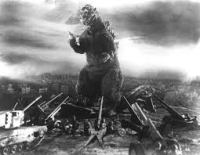
Gozilla's original appearance in Japan, 1954. He appeared in America a year later.

Gozilla’s original appearance in Japan, 1954. He appeared in America a year later.

In 1985, Godzilla reappeared in a more serious, direct sequel to the original. Although the monster had made countless appearances in other, sillier films, like “Godzilla vs. King Kong,” and “Godzilla vs. Mothra,” this reprisal brought Godzilla back to his roots – as a devastating, uncontrollable statement on the increasing nuclear scare at the peak of the Cold War.

Although it was no longer necessary to smooth over American audiences, Raymond Burr reprised his role from the original film in a few scenes added to the U.S. release to provide continuity and attract a nostalgic audience. “Godzilla 1985,” did well at the box office and even better in the newly-minted home video market.

Fast forward a few years to 1998, when the monster was licensed by Tri-Star Pictures for an American, almost campy, version set in New York City. Studied by a worm biologist played by the likable Matthew Broderick (Ferris Bueller’s Day Off / The Producers), Godzilla takes up residence in Manhattan and is hunted by the US Military who manages to lay waste to everything except their target, even wrecking the iconic Chrysler Building. A liberally-preachy, anti-nuclear storyline and a totally computer-animated Godzilla, that didn’t look or act much like the original, completely failed to lure audiences.

Over the years, Godzilla appeared in 28 films and an American cartoon show. He even achieved the honor of a star on the Hollywood Walk of Fame. But the origins of the character are deep in Japan’s nuclear pain and far more serious than most people might know.

Godzilla as he will look in the 2014 version.

Godzilla as he will look in the 2014 version.

Like the newest American incarnation set for release in May 2014, Godzilla is portrayed as a mutation directly resulting from nuclear testing, emphasizing the need to do away with these weapons. He was, essentially, the symbol of everything that can go wrong with nuclear power and weaponry.

The underlying message in the more serious Godzilla story lines is that use of nuclear weapons and power has unimaginable consequences. A mutation that can cause a giant monster with nuclear powered breath is a pretty good personification.

In any case, the new film is sticking closer to the original concept, not just in story but in the look and actions of the monster himself. He’s a rampaging beast and the addition of Breaking Bad’s Bryan Cranston, adds another level of drama to a once-campy character.

In no loss of irony, Japan is the only country in the world whose people have experienced the horrible result of nuclear devastation and America is the only country who has ever inflicted it on anyone else. It’s somehow fitting that people from both countries come together to create a fictional character that personifies the horror that can result.
Gery L. Deer is an independent columnist and business contributor to the WDTN-TV2 program, Living Dayton. More at http://www.gerydeer.com.


Criminalizing rhetorical hyperbole in political ads

In Local News, National News, News Media, Opinion, Politics, Uncategorized on May 7, 2014 at 12:36 pm

DIH LOGOThere is an Ohio law on the books that prohibits politicians from making false claims against an opponent in election campaign ads. Recently, however, the United States Supreme Court took up the question as to whether the legislation infringes on free speech.

Although a dozen other states have similar laws in place, Ohio’s version has come under fire by a conservative group, called the Susan B. Anthony List, who claimed discouraged them from running advertisements against a pro-choice Democratic congressman. It’s likely the case will be kicked back to a lower court, but the implication of the argument leaves room for the exploitation of loopholes, like rhetorical hyperbole.

In general, the law makes it illegal to lie about a political candidate or ballot initiative. What’s left somewhat to interpretation is whether rhetorical hyperbole is permitted. That is, can statements be exaggerated to the edge of falsehood without actually crossing the line? Hyperbole would still stretch the truth, making hours seem like days.

For those who slept through sixth grade English, like me (I know, ironic, huh?), an hyperbole is an exaggerated statement or claim not meant to be taken literally. It comes from a Greek work meaning, “over-casting.” For example, you’re standing in line at the bureau of motor vehicles and you say, “This is taking forever!” Your ordeal in line is not literally going to be indefinite, but you express your irritation and impatience in hyperbole to punctuate your displeasure.

Politicians (and most other advertisers) use hyperbole in many ways. In an extreme example, imagine seeing a political ad where a pro-choice candidate is being attacked by a conservative group. The ad might say, “Congressman Bob hates babies.” Bob may be pro-choice, but no evidence is offered in the ad that he actually hates babies.

What about a conservative senatorial candidate painted as if she is, “going to overturn years of gun control” because she was photographed at a shooting range for a stump speech? In both cases, there’s no evidence given to support the claims but it could be argued that these statements are simple hyperbole and cleverly dodge the “no lying” clause of the Ohio law.

Until this kind of legislation was enacted, only commercial advertisers had to follow rules guarding the consumer against false advertising. Advertising agencies and marketing representatives sometimes find loopholes in the law, but generally color within the lines or risk paying severe (even criminal) penalties to the Federal Communications Commission and the Federal Trade Commission.

So why shouldn’t politicians have to follow the same rules as any other advertiser? Really, they should. A politician has no more right to lie, or even grossly exaggerate, to the consumer than a toothpaste or fast food company. If anything, they should be held to an even tougher standard than someone selling milkshakes – but that’s not likely to happen.

President Richard Nixon has remained one of the poster children for lying politicians. But they ALL do it.

President Richard Nixon has remained one of the poster children for lying politicians. But they ALL do it.

Is it a violation of free speech for a fast food chain to be restricted from promoting their food as “healthy” because a burger contains less special sauce than the competition? No, it’s not; plain and simple. If legislation can be enforced to protect the public from losing $3 to a misrepresented health claim for a hamburger, why shouldn’t the law prevent the potential loss of millions of taxpayer dollars to a dishonest politician?

Then again, most people, if asked off the record, tend to believe all politicians are dishonest. But, dishonest or not, misleading the public in an advertisement is fraud and probably should be criminalized.

The idea of rhetorical hyperbole being some kind of back door to the law should also be addressed. Exaggeration is still misrepresentation because more often than not, the jelly-brained voter out there tends to take things more literally than they probably should.

Regardless of advertising content, the final decision about the truthful nature of our politics is made at the polls. Voters must be proactive and learn as much as possible about the candidates and issues before dropping their choice into the ballot box. In a democracy, you have the power, use it wisely.


E.T. game dig reveals start of Atari collapse

In Business, Economy, Entertainment, National News, Opinion, Technology, Uncategorized on April 28, 2014 at 11:36 am

DIH LOGOIn the nerd-infested world of video game lore, legend says that Atari was so embarrassed by the abject failure of its “E.T.: The Extra Terrestrial” video game cartridge, the company buried all remaining copies of the game in a secret, desert landfill. Following the phenomenal success of Steven Spielberg’s big-budget, heart-wrenching feature film of the same name, the E.T. game was released in 1982 for the classic Atari 2600 game console.

Recently, the legend of the secret cartridge burial was confirmed as a documentary filmmaker set out to unearth the long-lost Atari graveyard, located in a landfill outside Alamogordo, New Mexico, about 200 miles southeast of Albuquerque. Three hours and several layers of trash later, digging in a 150 by 150-foot area, workers uncovered the first signs that this was, in fact, the legendary Atari burial site.

The dig was undertaken by Microsoft Corp’s Xbox Entertainment Studios, the producers behind the documentary film reportedly to be focused on the early years and eventual collapse of the Atari video game empire. The story goes that Atari was saddled with most of the 5 million E.T. cartridges, which were a commercial failure, and buried them, secretly, under cover of night.

One of the VIP’s at the dig was Howard Scott Warshaw, the game’s original designer, who told the press that there could be as many as 750,000 game cartridges buried at the site. Warshaw also designed one of Atari’s biggest hits, “Yar’s Revenge.” Given the “archeological” nature of the Atari dig, there’s an irony in that the game maker also put out a “Raiders of the Lost Ark” video game, also listed with E.T. as one of the company’s worst releases.

ET_GAME_SCREENOn a personal note, and possibly stranger than this story to some, is the fact that I actually still have my original, 1982 Atari 2600 console and game cartridges, all in pristine, working order. Ah, I still marvel at the sleek, faux wood grain finish and the uncomplicated joystick with a single button; classic. I know weird, right? But I always loved my Atari set. It was one of the first “computer” games to which I was exposed and probably contributed to the years of work I spent as a programmer and computer specialist.

A couple of years ago, a friend gave me a modern knock-off of the classic console which is considerably smaller with wireless joysticks and 20 or so games already programmed into it – so no cartridges. Strangely, it loses something on the 46-inch, HD TV screen it’s plugged into. I kind of miss my little, 19-inch color Zenith. Incidentally, I still have my Atari E.T. cartridge and a book that tells you how to win the game. The newer version is just not the same.

In spite of the nostalgia experienced by those of us who grew up in the 80s, there’s a lot to be learned from the E.T. game story. In 1983, Atari was struggling to recover from a failed product and losing sales during a national recession. When a company like Atari creates a product based on a film franchise like “E.T.” or “Batman,” the expense of licensing alone can significantly increase the cost of production over an original title like “Pong” or “Missile Command.”

Because of the added expense, the licensed products must far outperform their counterparts just to be considered successful and add profit for the manufacturer. The E.T. game clearly started out in the red and, because people simply didn’t like the over-priced cartridge, Atari couldn’t recover from the financial blow.

Since Microsoft’s production division is funding the excavation of the Atari landfill site, it stands to reason there is finally money to be made from the demise of the game. My guess is that the dig is simply a film-length “advertisement” for the Xbox game consoles engaged primarily as what now appears to be a highly successful publicity stunt; something Atari could have used more of back in the day.

There’s probably a lot more to be gained from a study of Atari’s successes and failures, but I just don’t have the time. I have to go and see if I can get to the next level on my “Asteroids” cartridge. Good gaming!


Jamestown Comet Editor Gery L. Deer is an independent columnist and owner of Deer Computer Consulting, Ltd. in Jamestown, Ohio. More at www.deercomputerconsulting.com


Alas, the plight of the plastic shopping bag

In Business, Economy, Education, Environment, Health, history, National News, Opinion, Politics, Science, Uncategorized on March 31, 2014 at 8:42 am

Deer In Headlines
By Gery L. Deer
The Jamestown Comet Editor

bag_blowingTake a look around outside after a storm and you’ll see them, clinging to the lathe of a garden fence like barnacles to a ship’s hull – those sad, indigent, plastic shopping bags. They’re everywhere, bouncing along the roadside, hung up in the branches of your backyard tree, even melted and tangled around the undercarriage of your car. Once revered for their strength and amazingly useful handles, these marvels of modern shopping are now the scourge of environmental political correctness.

With humble beginnings in 1950s Sweden, the modern plastic shopping bag was the creation of engineer Sten Gustaf Thulin who developed the simple, one-piece bag for Celloplast, the company which patented the design in 1965. Popularity of the product grew rapidly, for a time even knocking paper bags into relative obscurity.

Never again would husbands need worry about earning a night in the doghouse after losing a gallon of milk to the pavement when it crashed through the bottom of a wet paper sack. But, it was that set of wonderfully brilliant handles that really endeared the bags to shoppers. Since the dawn of time, mothers everywhere have struggled on shopping trips to juggle groceries and family.

With plastic bags, Mom now had the ability to carry half a dozen fully loaded bags on her arms while clutching Junior in one hand and the dog’s leash in the other. Her world now under complete control, at least for one brief moment, thanks to a simple pair of parallel holes in a plastic tube. Once the groceries were put away, she could even re-use them to line the bathroom wastebasket with a water-proof bag that fit both the can and her household budget.

PBThere was no doubt the plastic shopping bag was truly a miracle of modern commerce. By 1982, most major grocery chains, including Kroger, began replacing paper shopping bags with plastic citing cost savings and customer preference. Sadly, however, as with most other success stories, rival jealousy led to ridicule and scrutiny, mostly from operatives of the paper bag industry determined to unseat the plastic bag from its world-wide fame.

By the 1990s, world ecologists became increasingly vocal about plastic’s potentially destructive effects on the environment. Soon, the plastic shopping bag became an innocent by-stander, caught up in the ever increasing fight between good and evil, liberal and conservative, environmentalist and capitalist – or whoever was paying the most lobbyists. More than ever, environmental groups were touting the need for more extensive use of recyclable materials in consumer goods.

Almost overnight, the plastic shopping bag became the poster child for everything wrong with the environment as pundits heatedly debated their recyclability on cable news and in fiercely negative op-eds.  As usual, the critics had it all wrong because plastic shopping bags were every bit as recyclable as their paper counterparts, but were, in a way, victims of their own success.

As it turned out, the very innovations that made plastic shopping bags so powerful in the supermarket were like Kryptonite to the sorting machines used in recycling. When put through, they bound up the machinery and left it jammed and inert, and the cost to overcome that problem outweighed the benefits.

For years, rumors of a plastic bag uprising have permeated the media, suggesting that millions of these poor, trodden-down bags were massing a resistance in landfills all over America. There, they waited silently, collectively preparing to strike back against their opposition by refusing to decompose, even over thousands of years.

Sadly, an empty threat, since the structure of a landfill is meant to keep the refuse dry and stable, limiting degradation. Nothing is intended to fully decompose; not paper, not food, not plastic … nothing. In fact, newspapers buried in the 1960s have recently been exhumed intact and readable.

Perhaps one day, the full truth of their story will be exposed and plastic shopping bags will regain their once proud position at the end of the checkout. But for now, these bags exist as second-class totes, drifting like tumbleweeds on the wind, dancing their lament of a time when they were kings of the market.
Deer In Headlines is available for syndication. Contact GLD Enterprises Commercial Writing – http://www.gldenterprises.net.