Local News & Commentary Since 1890.

Archive for the ‘National News’ Category

Rogue nation: USA

In National News, Opinion, Politics, Uncategorized, World News on January 11, 2026 at 11:24 pm

Deer In Headlines

By Gery Deer
I’ve avoided direct political commentary but, on this subject, it’s hard to remain silent. I’m sickened by the recent behavior of our federal government – all three branches. Whatever your political affiliation, it is impossible to look at the behavior of the current American administration and call it normal. 

What we are witnessing is not tough diplomacy or considered leadership, but a pattern of outlandish conduct that mocks international law and the values the United States claims to champion. When power is exercised without restraint, justification becomes propaganda and accountability disappears.

First, there’s the kidnapping and prosecution of a sitting president of Venezuela. Nicolás Maduro may be a corrupt, authoritarian, drug-trafficking criminal. But none of that gives the U.S. Government legal or moral authority to invade a sovereign nation, seize its head of state, and drag him into an American courtroom without extradition or due process.

Defenders argue that Venezuela’s constitution explicitly prohibits extraditing its own citizens, and the bilateral extradition treaty has long been shaky, suspended in practice by Caracas itself. However, that does not excuse abduction. When lawful avenues are blocked, the answer is not to ignore law altogether. The absence of a workable treaty is not permission to kidnap; it is proof that diplomacy and international pressure, however slow, are the legitimate tools.

This is not how a nation behaves that claims to respect due process. When the world’s most powerful democracy discards extradition treaties and international courts, it signals that rules apply only to the weak. History demonstrates that such a precedent will not protect Americans when the balance of power shifts.

We have been down a similar road before. In 2003, the United States invaded Iraq and removed its leader under the banner of national security. In hindsight, no weapons of mass destruction were found – the years-long operation failed. Hundreds of thousands died. A region was destabilized. Extremism flourished. American credibility was deeply damaged. The lesson should have been clear: removing leaders by force creates chaos, not democracy. Yet here we are again, acting as though power excuses everything.

As if that were not reckless enough, the same administration now speaks openly about literally stealing Greenland from Denmark, as though the territory were merely a trinket to be bought, bullied, or taken by force. Denmark is a NATO ally and Greenland’s people have repeatedly said, “no thanks.” The insanity of a United States military invasion and seizure is unprecedented. It’s forced occupation and shatters trust with allies.

We are told these actions keep us safe and project strength. Instead, they isolate us, invite retaliation, and encourage other nations to discard restraint. When America behaves like regimes it once condemned, the moral high ground collapses beneath our feet.

What is perhaps most alarming is the resistant silence. Congress, entrusted by the Constitution with oversight, war powers, and the duty to restrain executive excess, appears paralyzed. Some lawmakers mutter concerns and look away. Too many say nothing, whether from fear or calculation. This is not how a functioning republic responds to dangerous overreach.

The Democratic Party looks toothless. Republicans who should speak out remain complicit. Checks and balances mean nothing if not exercised. History will not be kind to those who watched democracy collapse and did nothing to prevent it.

Once respected because it claimed to stand for something great and honorable, the U.S. now risks becoming a cautionary tale. Feared and mocked rather than trusted and admired. 

And all of this would be just as wrong if the other party did it and none of it is patriotic. Patriotism is not blind loyalty to a leader or party. Patriotism is fidelity to principles: the rule of law, respect for sovereignty, restraint in the use of force, and accountability at home. Plus, when billions are spent on coercion while vulnerable children, seniors, and veterans lose essential services, moral priorities have evaporated. 

If this behavior continues unchecked, the damage will outlast any presidency. Democracy demands courage from lawmakers who will resist, and citizens unwilling to excuse abuses of power perpetrated in their name. Laws can be repaired, and alliances restored, but only if someone is finally willing to draw a line and Congress acts with courage, and constitutional responsibility.


Dayton area PR firm named agency of record for controversial biotech author

In Books, Dayton Ohio News, Education, Health, Literature, National News, Print Media, Technology, Uncategorized on October 30, 2025 at 1:45 pm

GLD Enterprises Communications, Ltd. Named Agency of Record for Biotech Whistleblower Becky McClain’s New Memoir, “Exposed”

Jamestown, OH — October 30, 2025 — GLD Enterprises Communications, Ltd. (GLD Communications), a strategic media marketing and public relations firm based in Jamestown, Ohio, has been named the agency of record for biotech whistleblower Becky McClain, author of the explosive new book, “Exposed,” which hits shelves October 28 from Skyhorse Publishing.

Led by founder and creative director Gery L. Deer, GLD Communications will oversee all media access management for McClain, whose story has already sparked widespread interest. The agency will also manage social media engagement and coordinate interviews and appearances related to the book’s release.

“This is a story that demands attention,” said Gery L. Deer. “Becky McClain’s courage in speaking out—despite enormous personal and professional risk—embodies the kind of integrity we strive to amplify. GLD Communications is honored to support her mission and ensure her voice reaches the audiences who need to hear it.”

“Exposed” chronicles McClain’s harrowing journey from molecular biologist to whistleblower, detailing her legal battle against a major biotech corporation over alleged safety violations and retaliation. The book dives deep into the ethical and regulatory failures she witnessed, offering a sobering look at the intersection of science, corporate power, and public health. The topic has proven highly controversial, drawing attention from journalists, activists, and policymakers alike.

Consumer advocate Ralph Nader, who was involved in the original case, penned the book’s powerful foreword, lending further weight to McClain’s revelations. Early media coverage has included interviews with national outlets and investigative podcasts, with more expected following the book’s release.

McClain’s voice resonates throughout the pages of her book. “I’ve written this book as a witness to a system gone bad — a system that breaks people bad — a system that threatens the public’s health, workers’ rights, and America’s right to freedom of speech,” she states, underscoring the urgency and personal cost of her journey.

“Exposed” is more than a memoir—it’s a call to action. Through meticulous documentation and emotional candor, McClain invites readers to examine the intersection of science, ethics, and power. The book also explores the broader implications for workers in high-risk industries and the mechanisms that protect—or fail to protect—them.

The book is poised to become a touchstone in discussions about whistleblower protections and corporate transparency. As the biotech industry continues to evolve, McClain’s story serves as a stark reminder of the human cost of scientific advancement––and the ongoing risks to worker safety as well as public health in a world still marked by the pain and uncertainty caused by the COVID-19 pandemic.

Effective immediately, all media inquiries, interview requests, and public engagement related to “Exposed” will be handled through GLD Communications. For more information or to request media access, contact the agency directly via email gdeer@gldenterprises.net. “Exposed” is available now on Amazon.com and in bookstores. Questions about the publisher or distribution should be directed to the offices of Skyhorse Publishing, New York, New York.

Journalists turn in access badges, exit Pentagon rather than agree to new reporting rules

In National News on October 16, 2025 at 7:43 am
DAVID BAUDER

DAVID BAUDER

Bauder is the AP’s national media writer, covering the intersection of news, politics and entertainment. He is based in New York.

Members of the Pentagon press corp carry their belongings out of the Pentagon after turning in their press credentials, Wednesday, Oct. 15, 2025 in Washington. (AP Photo/Kevin Wolf)

Members of the Pentagon press corp carry their belongings out of the Pentagon after turning in their press credentials, Wednesday, Oct. 15, 2025 in Washington. (AP Photo/Kevin Wolf)

Washington Post reporter Tara Copp saves the name plaques from various news organizations as she and members of the media pack up their belongings in the press area in the Pentagon, Wednesday, Oct. 15, 2025 in Washington. (AP Photo/Kevin Wolf)

Washington Post reporter Tara Copp saves the name plaques from various news organizations as she and members of the media pack up their belongings in the press area in the Pentagon, Wednesday, Oct. 15, 2025 in Washington. (AP Photo/Kevin Wolf)

A cleaning person throws a bag of trash in a dumpster as members of the media pack up their belongings in the press area of the Pentagon, Wednesday, Oct. 15, 2025 in Washington. (AP Photo/Kevin Wolf)

A cleaning person throws a bag of trash in a dumpster as members of the media pack up their belongings in the press area of the Pentagon, Wednesday, Oct. 15, 2025 in Washington. (AP Photo/Kevin Wolf)

Members of the Pentagon press corp gather for a group photo after turning in their press credentials, Wednesday, Oct. 15, 2025 in Washington. (AP Photo/Kevin Wolf)

Members of the Pentagon press corps gather for a group photo after turning in their press credentials, Wednesday, Oct. 15, 2025, in Washington. (AP Photo/Kevin Wolf)

NEW YORK (AP) — Dozens of reporters turned in access badges and exited the Pentagon on Wednesday rather than agree to government-imposed restrictions on their work, pushing journalists who cover the American military further from the seat of its power. The nation’s leadership called the new rules “common sense” to help regulate a “very disruptive” press.

News outlets were nearly unanimous in rejecting new rules imposed by Defense Secretary Pete Hegseth that would leave journalists vulnerable to expulsion if they sought to report on information — classified or otherwise — that had not been approved by Hegseth for release.

Many of the reporters waited to leave together at a 4 p.m. deadline set by the Defense Department to get out of the building. As the hour approached, boxes of documents lined a Pentagon corridor and reporters carried chairs, a copying machine, books and old photos to the parking lot from suddenly abandoned workspaces. Shortly after 4, about 40 to 50 journalists left together after handing in badges.

“It’s sad, but I’m also really proud of the press corps that we stuck together,” said Nancy Youssef, a reporter for The Atlantic who has had a desk at the Pentagon since 2007. She took a map of the Middle East out to her car.

It is unclear what practical impact the new rules will have, though news organizations vowed they’d continue robust coverage of the military no matter the vantage point.

Images of reporters effectively demonstrating against barriers to their work are unlikely to move supporters of President Donald Trump, many of whom resent journalists and cheer his efforts to make their jobs harder. Trump has been involved in court fights against The New York TimesCBS NewsABC News, the Wall Street Journal and The Associated Press in the past year.

Trump supports the new rules

Speaking to reporters at the White House on Tuesday, Trump backed his defense secretary’s new rules. “I think he finds the press to be very disruptive in terms of world peace,” Trump said. “The press is very dishonest.”

Even before issuing his new press policy, Hegseth, a former Fox News Channel host, has systematically choked off the flow of information. He’s held only two formal press briefings, banned reporters from accessing many parts of the sprawling Pentagon without an escort and launched investigations into leaks to the media.

He has called his new rules “common sense” and said the requirement that journalists sign a document outlining the rules means they acknowledge the new rules, not necessarily agree to them. Journalists see that as a distinction without a difference.

“What they’re really doing, they want to spoon-feed information to the journalist, and that would be their story. That’s not journalism,” said Jack Keane, a retired U.S. Army general and Fox News analyst, said on Hegseth’s former network.

When he served, Keane said he required new brigadier generals to take a class on the role of the media in a democracy so they wouldn’t be intimidated and also see reporters as a conduit to the American public. “There were times when stories were done that made me flinch a little bit,” he said. “But that’s usually because we had done something that wasn’t as good as we should have done it.”

Youssef said it made no sense to sign on to rules that said reporters should not solicit military officials for information. “To agree to not solicit information is to agree to not be a journalist,” she said. “Our whole goal is soliciting information.”

Reporting on US military affairs will continue — from a greater distance

Several reporters posted on social media when they turned in their press badges.

“It’s such a tiny thing, but I was really proud to see my picture up on the wall of Pentagon correspondents,” wrote Heather Mongilio, a reporter for USNINews, which covers the Navy. “Today, I’ll hand in my badge. The reporting will continue.”

Washington Post reporter Tara Corp, center right, embraces NBC News correspondent Courtney Kube as they leave the Pentagon after turning in their press credentials, Wednesday, Oct. 15, 2025 in Washington. (AP Photo/Kevin Wolf)

Mongilio, Youssef and others emphasized that they’ll continue to do their jobs no matter where their desks are. Some sources will continue to speak with them, although they say some in the military have been chilled by threats from Pentagon leadership.

In an essay, NPR reporter Tom Bowman noted the many times he’d been tipped off by people he knew from the Pentagon and while embedded in the military about what was happening, even if it contradicted official lines put out by leadership. Many understand the media’s role.

“They knew the American public deserved to know what’s going on,” Bowman wrote. “With no reporters able to ask questions, it seems the Pentagon leadership will continue to rely on slick social media posts, carefully orchestrated short videos and interviews with partisan commentators and podcasters. No one should think that’s good enough.”

The Pentagon Press Association, whose 101 members represent 56 news outlets, has spoken out against the rules. Organizations from across the media spectrum, from legacy organizations like The Associated Press and The New York Times to outlets like Fox and the conservative Newsmax, told their reporters to leave instead of signing the new rules.

Only the conservative One America News Network signed on. Its management likely believes it will have greater access to Trump administration officials by showing its support, Gabrielle Cuccia, a former Pentagon reporter who was fired by OANN earlier this year for writing an online column criticizing Hegseth’s media policies, told the AP in an interview.

___

Associated Press reporter Laurie Kellman in London contributed to this report. David Bauder writes about the intersection of media and entertainment for the AP. Follow him at http://x.com/dbauder and https://bsky.app/profile/dbauder.bsky.social

RELATED STORIES:

Multiple news outlets say they won’t sign new Pentagon rules on access

Journalists fighting back against Pentagon reporting restrictions

Journalists face Pentagon deadline over new restrictions

Another New Hampshire man gets a pig kidney as transplant trials are poised to start

In Health, National News, Uncategorized on September 8, 2025 at 9:16 am

Courtesy the Associated Press

By  LAURAN NEERGAARD

Updated 8:09 AM EDT, September 8, 2025

View the entire story with video here.

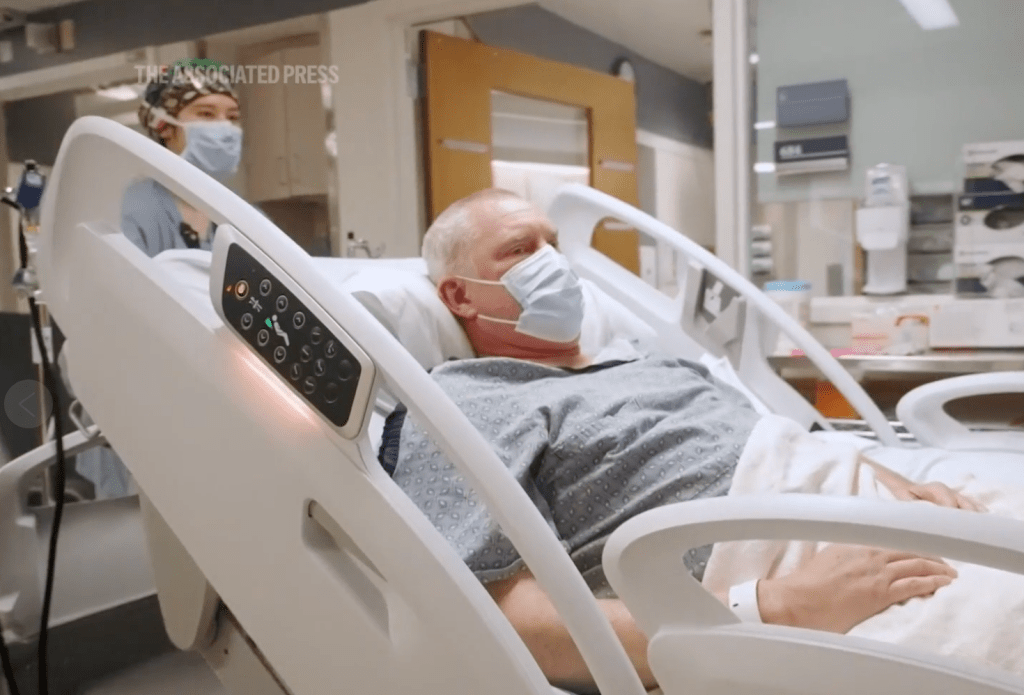
WASHINGTON (AP) — A self-described science nerd is the latest American to get an experimental pig kidney transplant, at a crucial point in the quest to prove if animals organs really might save human lives.

The 54-year-old New Hampshire man is faring well after his June 14 operation, doctors at Massachusetts General Hospital announced Monday.

“I really wanted to contribute to the science of it,” Bill Stewart, an athletic trainer from Dover, New Hampshire, told The Associated Press.

That’s not the only milestone the Mass General team is marking: A pig kidney has kept another New Hampshire man, Tim Andrews, off dialysis for a record seven months and counting. Until now, the longest that a gene-edited pig organ transplant was known to last was 130 days.

Based on lessons from the New Hampshire men and a handful of other one-off attempts, the Food and Drug Administration approved pig producer eGenesis to begin a rigorous study of kidney xenotransplants.

“Right now we have a bottleneck” in finding enough human organs, said Mass General kidney specialist Dr. Leonardo Riella, who will help lead the new clinical trial.

More than 100,000 people are on the U.S. transplant list, most who need a kidney, and thousands die waiting. As an alternative, scientists are genetically altering pigs so their organs are more humanlike, less likely to be immediately attacked and destroyed by people’s immune system.

Initial experiments, two hearts and two kidneys, were short-lived and included very ill patients. Chinese researchers also recently announced a kidney xenotransplant but released little information. Then an Alabama woman whose pig kidney lasted 130 days before rejection prompted its removal, sending her back to dialysis, helped researchers shift to not-as-sick patients.

In New Hampshire, high blood pressure caused Stewart’s kidneys to fail but he had no other health problems. It can take up to seven years for people with his blood type to find a matching kidney from a deceased donor, and some would-be living donors didn’t qualify. After two years in dialysis, he heard about Mass General’s most recent xenotransplant recipient – Andrews – and applied to be the next candidate.

“I’ve always been a little bit of a science nerd,” Stewart said. Conscious of how new these experiments are, he sought out Andrews for advice and ultimately decided, “worst case scenario, they can always take it out.”

Thrilled to no longer have his time and energy sapped by dialysis, Stewart said he’s easing back into desk duties at work and visited his old dialysis clinic to “let everyone know I’m doing all right and maybe kind of give some people some hope.”

Riella, the kidney specialist, said Stewart had his anti-rejection drugs adjusted to counter an early concern and that Andrews has needed similar adjustments. He said it’s far too early to predict how long pig kidneys might be able to last — but it would be useful even if initially they can buy people time off dialysis until they get a matching human organ.

“A year, hopefully longer than that – that’s already a huge advantage,” he said.

The new eGenesis trial will provide gene-edited pig kidney transplants to 30 people age 50 or older who are on dialysis and the transplant list. Another developer of gene-edited pig organs, United Therapeutics, is about to start enrolling people in a similar FDA-approved study.

___

The Associated Press Health and Science Department receives support from the Howard Hughes Medical Institute’s Department of Science Education and the Robert Wood Johnson Foundation. The AP is solely responsible for all content.

Your questions, answered

In Media, National News, Uncategorized, World News on July 7, 2025 at 12:04 pm
By the Associated Press Staff of The Morning
Editor’s Note: Courtesy of the Associated Press.

As journalists, we ask questions for a living. And we strive to make sure our work addresses the pressing ones on readers’ minds, especially in this time of dizzying political news. That’s why we regularly invite the audience of The Morning to send us their questions, and have our expert beat reporters respond.

Today, we’re addressing your queries about immigration, military spending, Social Security, Medicaid and whether now is a good time to build a house. (Got a question for us? Submit them here.)

ICE raids

With the raids on undocumented immigrants going on, targeting the people who work in the fields and the slaughterhouses, how have these actions affected the supply and prices in our grocery stores? — Anna Halbrook, Otis, Ore.

We asked Julie Creswell, who covers the food industry, to field this one:

We haven’t seen any obvious fallout from immigration raids on grocery prices yet. As of the end of May, prices were up about 2.2 percent compared with a year earlier. Eggs, coffee and meats — ground beef in particular — drove that increase.

But beef prices were climbing even before the raids, because of droughts and high interest rates (ranchers take out loans to run their operations). The nation’s cattle inventory is at its lowest level since the 1950s. Prices of fruits and vegetables have stayed about flat over the past year; tomatoes and lettuce are actually much cheaper right now.

Defense spending

Trump has pushed NATO countries to spend 5 percent of their economic output on the military. How much of its economic output does the U.S. spend on the military? — Diann Ebersole, Copperopolis, Calif.

From German Lopez, who has written several Morning newsletters on this very topic:

The U.S. spends about 3.5 percent of its gross domestic product on the military. That used to put America at the top of NATO’s ranks, but Poland now spends a larger portion, 4.1 percent.

Critics say this makes President Trump a hypocrite: If the U.S. isn’t spending 5 percent, why should other countries? But Trump says that the U.S. doesn’t need to spend as much now because it’s invested a lot more historically. Europe, the argument goes, has let its militaries and defense industries languish through disinvestment. (Some experts agree.) The president contends that those countries need to rebuild in a way that the U.S. doesn’t, and rebuilding has a big upfront cost.

Trump also has a transactional view of the world and alliances. He sees Europe’s renewed spending as payback after the U.S. bore the brunt of NATO’s duties and expenditures for decades.

Retirement benefits

I’ve heard a lot of talk that Social Security will be running out of money. I plan on retiring in the next two to three years. Should I retire sooner to collect my full benefit? — Elizabeth Y.

Here’s Tara Siegel Bernard, who recently interviewed retirees on this:

Social Security has long faced financing challenges, but the issue becomes more pressing each year. The trust fund that pays retiree benefits is projected to be depleted in 2033, or when today’s 59-year-olds turn 67. At that point, the program will have enough incoming revenue to pay only 77 percent of benefits — in other words, a 23 percent cut. But that happens if Congress does nothing to address the problem, like raising payroll taxes or trimming benefits.

The decision of when an individual should take Social Security is highly personal. There can be a huge payoff for healthy people who can afford to wait: Starting at 67 instead of 62, for example, can mean monthly checks that are 43 percent higher. And for each year you delay retirement past 67, your monthly payment rises 8 percent.

Ask yourself: Would collecting a reduced benefit for a couple of extra years be preferable to locking in a higher benefit for the rest of your life? A conversation with a financial planner is often a solid investment; these are high-stakes decisions.

Who loses Medicaid?

Are there some specific examples of who will be affected by Medicaid cuts and requirements to work in the big policy bill passed last week? Will people with Parkinson’s who are in long-term care be cut off because they can’t work? — Amy, Glenview, Ill.

From Margot Sanger-Katz, who covers health care for The Upshot:

The bill’s work requirement is focused on a relatively specific group of Medicaid beneficiaries: childless adults without disabilities and parents of children older than 13. But it is certainly plausible that the bill’s policies could have spillover effects for other populations.

A person in long-term care with Parkinson’s would almost certainly still be covered. But someone with Parkinson’s who has not yet qualified for Social Security disability status may have to prove they are too sick to work. States will also have to build new enrollment systems to check who is eligible and who is compliant, and several current and former state officials are worried the magnitude of that effort could lead to errors and delays for everyone.

When to build

Is this a good time to build a house? — Janie Spataro, Ringgold, Ga.

Conor Dougherty, who covers the housing industry, offers this advice:

Can you afford to build it, and do you plan on living there for seven to 10 years? If the answer to both of those questions is yes, then it’s as good a time as any to build.

Housing is an unusual good in that it is both a consumable, like a car, and an investment, like a stock. Most of the worst home-buying decisions — overstretching on a mortgage, buying in an area you don’t really like — come from thinking of housing as an opportunity to make money instead of as a place to live. A house is only a good investment if you think of it as home.

Corruption fears the press

In history, National News, News Media, Opinion, Politics, Uncategorized on June 22, 2025 at 10:47 am

Deer In Headlines II

By Gery Deer

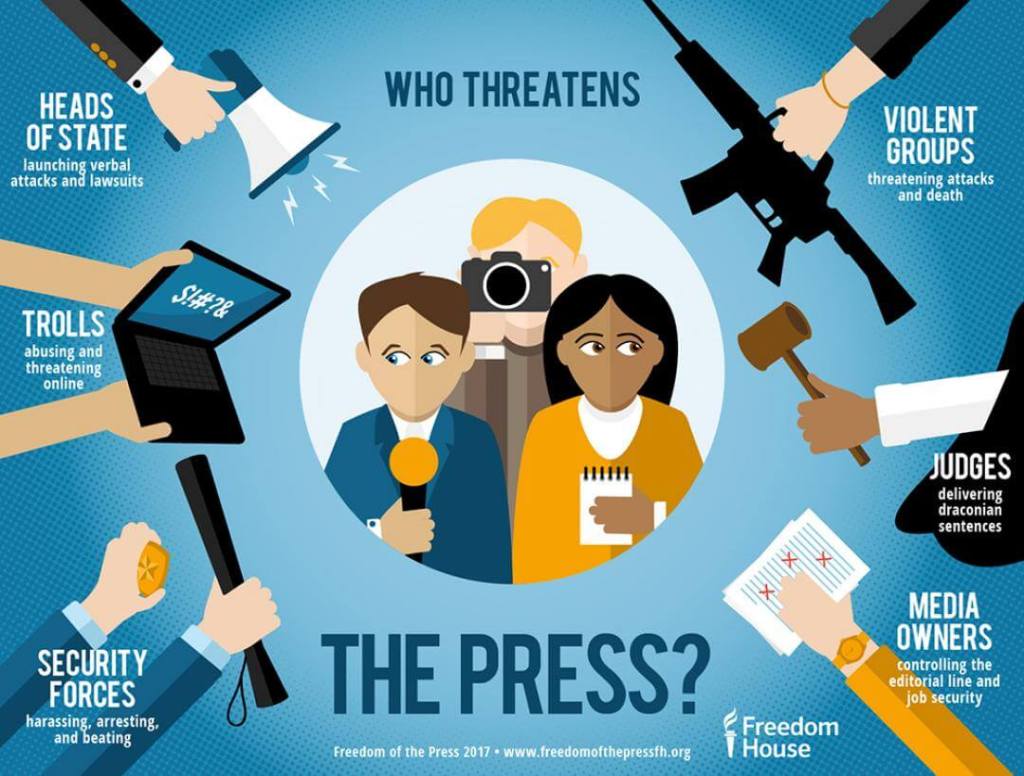
It’s one thing to feel your job is in danger—industries evolve, businesses close, and livelihoods shift. It’s another thing to fear that your work and profession could be criminalized. For those of us in the press, in my opinion, that moment has arrived.

Not long ago, journalists were considered the fourth estate, so-called because the press was seen as the fourth, unofficial, branch of government – the public’s eyes and ears, so to speak. A free press is a necessary check on power, the watchdogs of democracy. Today, Trump and company would rather call any of us who dare question them troublemakers, agitators—enemies of the people. And now, with the Supreme Court’s recent decision to uphold the White House’s ban on the Associated Press (AP), we stand on the edge of something far more dangerous than a bruised ego or a contentious press conference.

The justification? National security – as always. A vague, malleable excuse that’s nearly impossible to challenge or verify. Too convenient to ignore, too broad to oppose. It sets a precedent with sharp teeth. If AP can be barred, who’s next? The Washington PostReuters, or maybe any reporter who dares ask uncomfortable questions?

When a government moves to silence journalism, it isn’t just about limiting press access—it’s about controlling the public’s perception of facts. A free press must do more than inform; it should hold power accountable on behalf of the citizenry. That accountability is inconvenient, even infuriating, for those who prefer not to be held accountable for their actions.

We don’t have to delve deeply into history to see what happens when dissenting voices are silenced. Totalitarian regimes have long understood the value of controlling the narrative. In Nazi Germany, Joseph Goebbels, the minister of propaganda, ensured that only state-approved messaging reached the public. In Stalinist Russia, independent journalism became synonymous with treason. And now, in a supposed beacon of freedom, we find ourselves edging toward a similar state.

Perhaps some believe these measures are justified—that journalism has gone too far and biased reporting warrants a firm correction. Some might even argue that disinformation (a great deal of which originates with the White House) has muddied the waters so thoroughly that restricting the press helps protect the public from chaos. The question we must ask ourselves is not whether we like the press—it’s whether we need it. And if those in charge are willing to erase dissent under the guise of security, we may not have much time left to answer.

The implications go well beyond a single news outlet losing access or presidential attempts to discredit them. If a major institution like the Associated Press can be barred from the White House, and with Supreme Court approval, every journalist in America faces the same risk.

What happens when smaller, independent outlets push too hard? What happens when investigative reporters publicize facts surrounding corruption at the highest levels? This is how truth becomes dictated rather than discovered. This is how governments rewrite history while the present unfolds in silence.

The press has never been perfect—it has biases, it makes mistakes, and yes, sometimes it gets the story wrong. But journalism, at its core, is a profession based on the pursuit of facts. A reporter’s job is not to flatter or cater to power, but to question, to dig, to expose injustice and demand answers.

Our democracy was built on the idea that those in power answer to the people, not the other way around. That principle is maintained through open discourse, through transparency, through a press that is free to ask uncomfortable questions and uncover uncomfortable truths. Of course, that’s not how Trump sees it. He doesn’t answer to you or me – only to his donors.

Still, the president can boot them out of the West Wing, but he can’t stop them from reporting – yet. If we allow this moment to pass unchallenged, accepting that barring journalists is just another policy decision, we lose the foundation of informed democracy set in place under the First Amendment of the United States Constitution. Once the press is muzzled, once silence replaces scrutiny, and propaganda overshadows fact, there’s no telling what comes next.

Supplemental Information:

(Courtesy https://www.carnegielibrary.org/the-first-amendment-and-censorship/)

The First Amendment Defined

The First Amendment to the U.S. Constitution protects what are commonly known as The Five Freedoms: freedom of religion, freedom of the press, freedom of speech, freedom of assembly, and freedom of petition. The amendment is one of the first ten amendments to the Constitution, known as the Bill of Rights, which was adopted in 1791. 

The First Amendment Reads:

“Congress shall make no law respecting an establishment of religion, or prohibiting the free exercise thereof; or abridging the freedom of speech, or of the press; or the right of the people peaceably to assemble, and to petition the Government for a redress of grievances.” (Source: National Archives

This amendment gives Americans the right to express themselves verbally and through publication without government interference. It also prevents the government from establishing a “state” religion and from favoring one religion over others. And finally, it protects Americans’ rights to gather in groups for social, economic, political, or religious purposes; sign petitions; and even file a lawsuit against the government. (Source: History.com)

Suspect captured in Minnesota shootings

In National News, Politics, Uncategorized on June 16, 2025 at 8:09 am
By Sarah Naffa June 16, 2025
 In the news today: A suspect in the Minnesota lawmaker shootings is charged with two counts of murder; Donald Trump directs ICE to expand deportations in Democratic-run cities; and Israel claims it now has air superiority over Tehran. Also, the next head of the U.K.’s foreign intelligence agency is currently the agency’s head of technology and innovation — the real-world equivalent of the James Bond gadget-master Q. Vance Luther Boelter, the man accused of assassinating the top Democrat in the Minnesota House, as he was arrested late Sunday.Vance Luther Boelter, the man accused of assassinating the top Democrat in the Minnesota House, as he was arrested late Sunday. (Ramsey County Sheriff’s Office via AP)

U.S. NEWSMan suspected of shooting 2 Minnesota lawmakers is in custody
The man suspected of killing a Minnesota lawmaker and wounding another crawled to officers in surrender Sunday after they located him in the woods near his home, bringing an end to a massive, nearly two-day search. Read more.
What to know:Vance Boelter was arrested and charged with two counts of murder and two of attempted murder. He is accused of posing as a police officer and fatally shooting former Democratic House Speaker Melissa Hortman and her husband, Mark, in their home early Saturday in the northern Minneapolis suburbs. Authorities say he also shot Sen. John Hoffman, a Democrat, and his wife, Yvette.

Brooklyn Park police officers arrived early Saturday just in time to see Boelter shoot Mark Hortman through the open door of the home, the criminal complaint says. It says they exchanged gunfire with Boelter, who fled inside the home before escaping the scene.

A list of about 70 names was found in writings recovered from the fake police vehicle that was left at the crime scene, said two law enforcement officials who spoke to The Associated Press on condition of anonymity.
RELATED COVERAGE ➤Minnesota’s slain Democratic leader lived the political divisions in the US every day

Friends say Minnesota shooting suspect was deeply religious and conservative

WATCH: Officials announce suspect in shootings of Minnesota lawmakers is caught

Courtesy Associated Press – All rights reserved.

Loretta Swit, Emmy-winner who played Houlihan on pioneering TV series ‘M.A.S.H.,’ has died at 87

In Entertainment, National News, Uncategorized on May 30, 2025 at 4:08 pm

From the Associated Press

BY  MARK KENNEDYUpdated 3:41 PM EDT, May 30, 2025

NEW YORK (AP) — Loretta Swit, who won two Emmy Awards playing Major Margaret Houlihan, the demanding head nurse of a behind-the-lines surgical unit during the Korean War on the pioneering hit TV series “M.A.S.H.,” has died. She was 87.

Publicist Harlan Boll says Swit died Friday at her home in New York City, likely from natural causes. 

Swit and Alan Alda were the longest-serving cast members on “M.A.S.H.,” which was based on Robert Altman’s 1970 film, which was itself based on a novel by Richard Hooker, the pseudonym of H. Richard Hornberger.

The CBS show aired for 11 years from 1972 to 1983, revolving around life at the 4077th Mobile Army Surgical Hospital, which gave the show its name. The two-and-a-half-hour finale on Feb. 28, 1983, lured over 100 million viewers, the most-watched episode of any scripted series ever.

Rolling Stone magazine put “M.A.S.H.” at No. 25 of the best TV shows of all time, while Time Out put it at No. 34. It won the Impact Award at the 2009 TV Land annual awards. It won a Peabody Award in 1975 “for the depth of its humor and the manner in which comedy is used to lift the spirit and, as well, to offer a profound statement on the nature of war.”

Swit transforms the character of Houlihan

In Altman’s 1970 film, Houlihan was a one-dimensional character — a sex-crazed bimbo who earned the nickname “Hot Lips.” Her intimate moments were broadcast to the entire camp after somebody planted a microphone under her bed.

The early years of MASH saw Swit’s character much as the film predecessor had been. That would change as she was allowed to evolve and gain more substance.

Sally Kellerman played Houlihan in the movie version and Swit took it over for TV, eventually deepening and creating her into a much fuller character. The sexual appetite was played down and she wasn’t even called “Hot Lips” in the later years.

The growing awareness of feminism in the ’70s spurred Houlihan’s transformation from caricature to real person, but a lot of the change was due to Swit’s influence on the scriptwriters. 

“Around the second or third year I decided to try to play her as a real person, in an intelligent fashion, even if it meant hurting the jokes,” Swit told Suzy Kalter, author of “The Complete Book of ‘M.A.S.H.’”

“To oversimplify it, I took each traumatic change that happened in her life and kept it. I didn’t go into the next episode as if it were a different character in a different play. She was a character in constant flux; she never stopped developing.”

“M.A.S.H.” wasn’t an instant hit. It finished its first season in 46th place, out of 75 network TV series, but it nabbed nine Emmy nominations. It was rewarded with a better time slot for its sophomore season, paired on Saturday nights with “All in the Family,” then TV’s highest-rated show. At the 1974 Emmys, it was crowned best comedy, with Alda winning as best comedy actor.

The series also survived despite cast churn. In addition to Swit and Alda, the first season featured Wayne Rogers, McLean Stevenson, Larry Linville and Gary Burghoff. Harry Morgan, Mike Farrell and David Ogden Stiers would later be added, while Jamie Farr and William Christopher had expanded roles.

Swit appeared in all but 11 episodes of the series, nearly four times longer than the Korean War itself, exploring issues like PTSD, sexism and racism. Swit pushed for a better representation for women.

“One of the things I liked, with Loretta’s prodding, was every time I had a chance to write for her character, we’d get away from the Hot Lips angle and find out more about who Margaret was. She became more of a real person,” Alda told The Hollywood Reporter in 2018.

The series ended on a happy note for Houlihan, who spends much of the finale debating whether she wants to head to Tokyo or Belgium for her next overseas post. Ultimately she opts to return to America and work at a hospital, citing her father — a career Army man. 

Swit didn’t personally agree that was the correct decision for a military-minded official: “I didn’t think that was correct for my Margaret,” she told Yahoo Entertainment in 2023. “I think her next move was Vietnam. So I didn’t agree with that, but that’s what they wanted her to do.”

But the actor did get to write the speech that Houlihan delivers to her fellow nurses on their final night together, in which she says: “It’s been an honor and privilege to have worked with you. And I’m very, very proud to have known you.”

null

“I was consumed with writing that. And I still get letters from women all over the world who became nurses because of Margaret Houlihan. To have contributed to someone’s life like that is remarkable,” she told Yahoo Entertainment.

During her run, Houlihan had an affair with Hawkeye’s foil, the bumbling Frank Burns, played by Linville in the TV version, and in Season 5, Houlihan returns from a stay in Tokyo engaged to a handsome lieutenant colonel, a storyline that Swit says she advocated for with the writers.

“I told them: ‘Can you imagine what fun you’re going to have with Larry when I come back to town and I tell him I’m engaged? He’ll rip the doors off of the mess tent!’ And that’s exactly what they had him do. So we were all of the same mind.”

Toward the end, Swit was tempted to leave the show. She played the role of Chris Cagney in a 1981 television movie, “Cagney & Lacey,” and was offered the part when it was picked up as a mid-season series for the spring of 1982. But producers insisted she stay with “M.A.S.H.” for its last two seasons.

Swit told The Florida Times-Union in 2010 she might have stayed with “M.A.S.H.” anyway. “You can’t help but get better as an actor working with scripts like that,” she said. “If you’re in something that literate, well, we got spoiled.”

In 2022, James Poniewozik, The New York Times’s chief television critic, looked back on the show and said it held up well: “Its blend of madcap comedy and pitch-dark drama — the laughs amplifying the serious stakes, and vice versa — is recognizable in today’s dramedies, from ‘Better Things’ to ‘Barry,’ that work in the DMZ between laughter and sadness.”

After the TV series, Swit became a vocal animal welfare activist, selling SwitHeart perfume and her memoir through her official website, with proceeds benefiting various animal-related nonprofit groups.

In 1983, she married actor Dennis Holahan, whom she’d met when he was a guest star on “M.A.S.H.” They divorced in 1995.

Swit was born in New Jersey

Born in Passaic, New Jersey, the daughter of Polish immigrants, Swit enrolled in the American Academy of Dramatic Arts, then paid her dues for years in touring productions.

In 1969, she arrived in Hollywood and was soon seen in series such as “Gunsmoke,” “Hawaii Five-O,” “Mission Impossible” and “Bonanza.” Then in 1972, she got her big break when she was asked to audition for the role of “Hot Lips.”

She would regularly return to theater, starring on Broadway in 1975 in “Same Time, Next Year” and “The Mystery of Edwin Drood” in 1986. She was in “Amorous Crossing,” a romantic comedy, at Alhambra Theatre & Dining in 2010 and in North Carolina Theatre’s production of “Mame” in 2003.

MARK KENNEDY

MARK KENNEDY

Kennedy is a theater, TV, music, food and obit writer and editor for The Associated Press, as well as a critic for theater, movies and music. He is based in New York City.

Exploring Radio Independence at Dayton Hamvention 2025

In Dayton Ohio News, Local News, National News, News Media, Technology, Uncategorized, World News on May 20, 2025 at 4:12 pm

By Gery Deer

Courtesy Xenia Daily Gazette

Editor’s Note:

An update from the Dayton Hamvention officials on May 28th reads as follows: The 2025 Hamvention set a new high attendance record with 36,814 attendees. The general chair, Brian Markland, said he felt fabulous about watching large crowds of amateur radio enthusiasts from all over the world enjoying exhibits, forums, and the flea market. 

XENIA — Before cell phones or the internet, there was amateur, or “ham,” radio.

Once a year, thousands of enthusiasts descend on the Greene County Fairground and Expo Center in Xenia for the largest amateur radio convention in the world – Dayton Hamvention. Although final numbers will not be tallied for some time, organizers estimate that this year’s turnout exceeded the 35,000 attendees of 2024.

During Dayton Hamvention, participants from as many as 30 countries had the opportunity to see and buy the latest technology, attend educational and informational forums, sit for radio license exams, and take part in youth activities. This year’s event also included groups of young radio enthusiasts, organizations from all over the country made up of young people interested in both the analog and digital nature of amateur radio.

Jim Gifford, call sign N8KET, is the chairman of the media committee for Dayton Hamvention. He shared this year’s theme – Radio Independence – noting that what makes this event so important and impactful to the amateur radio community is the people. One of his favorite moments of this year’s event happened on Friday. “We had 73 students of the Community STEAM Academy (Science Technology Engineering Art and Math) in Xenia here,” he said. “They were really excited to learn how amateur radio relates to science and even space communication.”

With some 800,000 licensed ham radio operators in the United States alone, there is a remarkable sense of community among radio operators, regardless of geography. “It’s so nice for all of us in the local area to be able to come to Hamvention, but then you have to stop and think, this is a big ham fest,” said Glenn Rodgers, WI80, assistant chairman of the event’s media committee. “This is the biggest ham gathering in the world, and we’re so fortunate to be able to come to something like this in this area and it’s an honor to work here.”

Amateur radio enthusiasts, vendors, and organizations from around the world converged at the Dayton Hamvention. Here’s a promotional booth for Tokyo Hamfair.

With such widespread interest, one might expect the world’s current geopolitical tension would hamper those relationships. According to Gifford, it does not. “We have a multitude of political views here,” he said. “But we’re ham operators, we take care of each other.”

“Because you meet people,” Gifford continued. “We talk to people all over the world. Just the other day, I spoke to somebody from Norway, and somebody from Italy, and it crosses barriers. It really does.”

Most amateur radio enthusiasts are known on the air, and to each other, only by their call sign, an alphanumeric identification given to each license holder by the Federal Communications Commission (FCC).

Jesse Walker, N8XC, is U.S. Navy Veteran, and business development manager with Aegis Protective Services in Eaton. He’s been involved in amateur radio since the age of 15. He explained that, although the call signs are assigned, they become part of your identity.

“Many of us only know each other by our call sign,” Walker explained, who is a member of the Preble Amateur Radio Association in Preble County. “Coming here, we get to meet face-to-face often for the first time.”

Both Rodgers and Gifford also noted that, apart from being a hobby for some, ham operators play an important role in the community during emergencies. “Amateur radio groups work as sky spotters during severe weather, they work with and support our area first responders, providing backup communications and volunteers during local emergencies,” Gifford said.

“Essentially, the Preble Amateur Radio Association is involved in public service,” said Jesse Walker. “We work with the Preble County emergency management agency. Our motto in amateur radio emergency service is, ‘when all else fails.’”

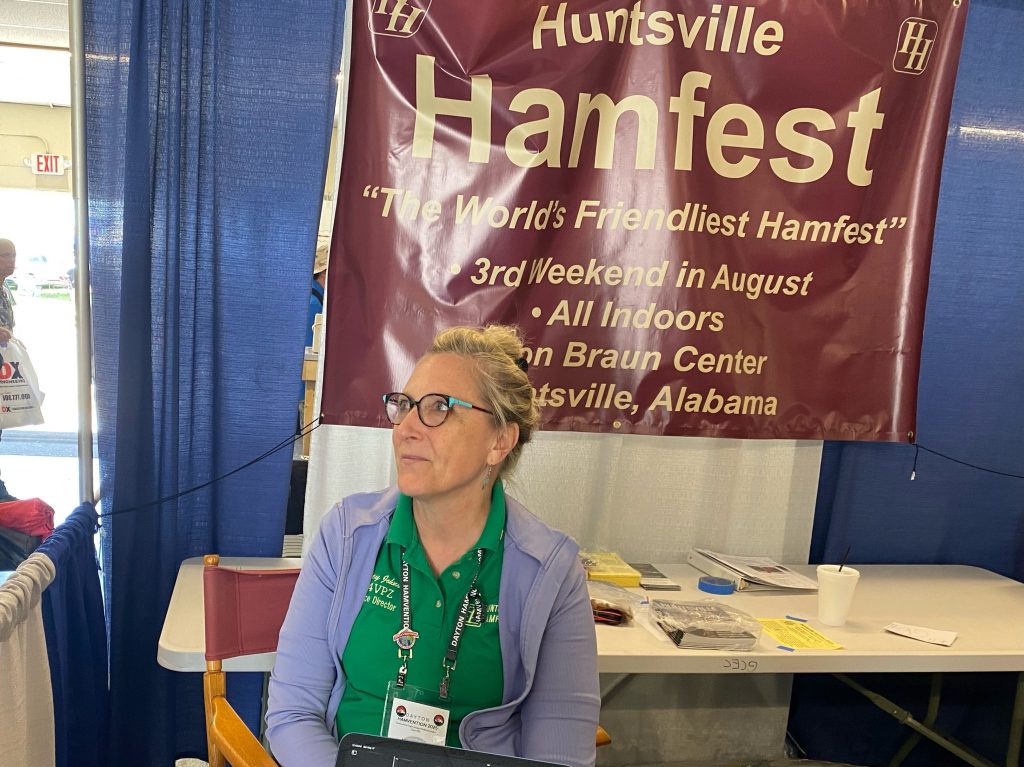
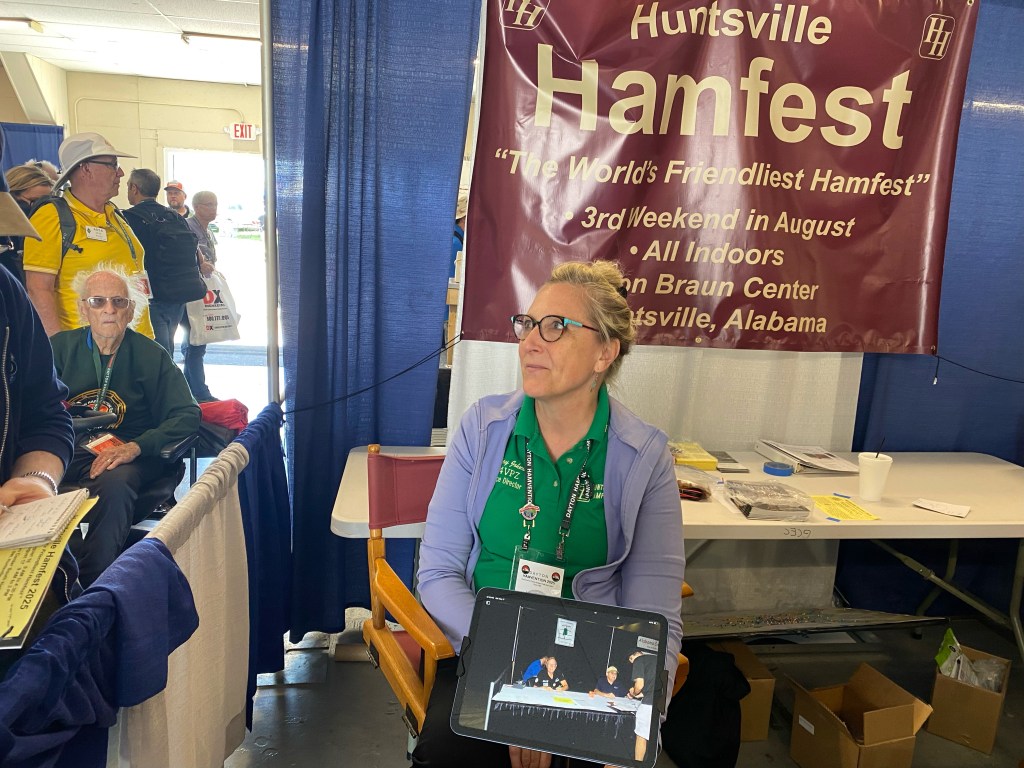
Other amateur radio convention organizers also attend to promote their own events. Huntsville Hamfest, held annually in Huntsville, Alabama, is one such organization. Mark Brown, N4BCD, is the chairperson for the Huntsville Hamfest Association. “Ours is the third largest Ham radio convention in the country, behind Dayton and Orlando, Florida,” Brown said. “We all cooperate and help support each other’s events.”

Mark Brown, N4BCD, and Kelley Johns, W4VPZ, (pictured) provided information about the Huntsville Hamfest in Alabama.

Brown suggested the consistent growth of these events and interest in amateur radio is due in part to younger people learning about its technical diversity. “I think to attract kids, we’ve got to show different aspects of the hobby, like the satellite communications, the youth on the air, and the parks on the air,” he said. “Get youth involved in it. That’s one thing these events do is bring all ages together.”

Planning for next year’s Dayton Hamvention is already underway. For more information visit hamvention.org.

Pope Francis has died at age 88

In National News, Uncategorized on April 21, 2025 at 7:32 am

Updates Courtesy THE ASSOCIATED PRESSUpdated 7:18 AM EDT, April 21, 2025

(Editorial Note: The Jamestown Comet will post updates and news regarding the Pope’s passing on our Facebook Page – https://www.facebook.com/thejamestowncomet)

Pope Francis (born Jorge Mario Bergoglio; 17 December 1936 – 21 April 2025) was the head of the Catholic Church and sovereign of the Vatican City State from 13 March 2013 until his death on Easter Monday, 21 April 2025.

Pope Francis, the Catholic Church’s first Latin American pontiff who charmed the world with his humble style and concern for the poor, has died, as announced by Cardinal Kevin Farrell, the Vatican camerlengo. He was 88.

Live view from the Vatican after Pope Francis dies at age 88. He was the first pontiff from Latin America and brought a new tone to the papacy with his informality and humility.

Here’s what to know

  • Pope Francis has died. “At 7:35 this morning, the Bishop of Rome, Francis, returned to the home of the Father. His entire life was dedicated to the service of the Lord and of his Church,″ Cardinal Kevin Farrell said. Read the full announcement.
  • Francis became pope in 2013. The Argentinean-born Jorge Mario Bergoglio brought a breath of fresh air into a 2,000-year-old institution. He took over as the Catholic Church’s influence waned during the troubled papacy of Pope Benedict XVI, whose surprise resignation led to Francis’ election.
  • The next pope is still to be decided. Eligible cardinals vote for a papal successor in the Sistine Chapel ina centuries-old ritual. It comprises sacred oaths, Latin chants and white or black smoke emanating from the chimney from burned ballots.

Churches in the Philippines ring bells to mourn Francis

By JIM GOMEZShare

Churches in the Philippines, the largest Roman Catholic nation in Asia, rang their bells Monday to mourn Francis. He visited in 2015 to console survivors of Typhoon Haiyan and celebrate Mass before millions in Manila.

“Pope Francis showed us what it means to suffer with others and find hope in the midst of pain,” Manila Archbishop Jose Advincula said, citing the pope’s visit to a central region where Haiyan left more than 7,300 people dead or missing in November 2013.

“The Holy Father has reminded us that the church must be close to the poor, merciful to all and a welcoming home for the forgotten,” said Advincula.

Philippine President Ferdinand Marcos Jr. said Francis “taught us that to be a good Christian is to extend kindness and care to one another. His humility brought many back to the fold of the church.”

Flags across UK ordered to fly at half-staff

By DANICA KIRKAShare

British authorities ordered that government buildings fly flags at half-staff until Tuesday evening in light of the pope’s death.

Mother of a slain Israeli-American hostage praises Francis

By JOSEPH KRAUSSShare

The mother of a slain American-Israeli hostage praised Pope Francis’ advocacy for Hamas-held captives in the Gaza Strip.

Rachel Goldberg-Polin, who was among families of the hostages who met with the pope in November 2023, said he “felt our sorrow and suffering, and we so appreciated his advocacy on this topic, and on trying to find peace and reconciliation.”

Francis had repeatedly called for the release of the hostages abducted in Hamas’ Oct. 7, 2023, attack and for an end to the war it sparked.

Hersh Goldberg-Polin and five other hostages were killed by their captors last year as Israeli troops closed in on the tunnel where they were being held.

Is this your new site? Log in to activate admin features and dismiss this message
Log In