Local News & Commentary Since 1890.

Archive for the ‘Media’ Category

Never go shopping while having a stroke.

In Health, Local News, Opinion, Senior Lifestyle on February 5, 2014 at 7:21 pm

DIH LOGOPresented for your consideration, a middle aged man somewhere in America who awakens one seemingly normal morning to discover his right arm has become a lifeless dead-weight, movable but numb. Puzzled, he pays little attention and goes to the kitchen for coffee but abandons the attempt when his hand is too weak to hold the cup. Strangely, he pulls on his coat and makes his way out the door to his car where he drives to the grocery store. Soon, he realizes that the right side of his face feels heavy and tingling, like it’s sliding off his skull and eventually goes numb.

He tries to speak, but his words are garbled and slow, as if he’d just had a root canal and a face full of Novocain. Somehow he makes it home, but after consulting WebMD.com, he finally accepts that something is seriously wrong. He dials 9-1-1 and struggles his way through mush-mouthing the word, “help,” followed shortly by the pulsing strobes and screeching sirens of an ambulance.

No, this wasn’t some bizarre trip through an episode of The Twilight Zone. Instead, it was a reasonably accurate account of what happened to my friend Jim Karns just a few days ago when he experienced what turned out to be a series of very dangerous strokes.

Sounds ridiculous, doesn’t it? Maybe so, but, oddly enough, this is not an uncommon story. While he was having coffee, surfing the web and doing his shopping, Jim’s brain cells were being eradicated by a shotgun blast of tiny blood clots which cut off life-sustaining oxygen.

It’s certainly funny to think now about all the silly things Jim was doing instead of calling for help, but a stroke is certainly no laughing matter. Many stroke victims don’t even realize what is happening because symptoms may be so mild as to go virtually unnoticed.

Stroke Risk Chart  (Courtesy The Huffington Post)

Stroke Risk Chart (Courtesy The Huffington Post)

Every year nearly 800,000 Americans fall victim to some type of stroke, a sort of “brain attack,” which happens when a restriction of blood flow kills off vital cells. Symptoms can occur one at a time or simultaneously, depending on the type and severity of the stroke.

In Jim’s case, he experienced numbness and weakness in his face and right arm but his legs were unaffected. A bass singer with what most describe as a strong radio voice, during the attack his speech was slow, frail and garbled and he had trouble closing his right eye.

According to experts people experience a combination of symptoms during a stroke including numbness, confusion or trouble understanding other people, impaired vision, difficulty walking, dizziness, or a severe headache that comes on for no apparent reason.

Jim Karn, Magician, performer, electronics technician.

Jim Karn, Magician, performer, electronics technician.

Fortunately, Jim is recovering remarkably well and I would say the best lesson to be learned from his incident is to act immediately. Coffee and the grocery store can wait, and don’t waste time looking up your symptoms online before taking action. It’s thoroughly frightening to think that a person could be driving or doing something equally as dangerous while these things are happening.

Most importantly, never ignore the warning signs of a stroke and call 9-1-1 as soon as possible. If you are around someone who is experiencing some of these symptoms, take charge and call for help right away, even if the individual protests or says the symptoms have subsided.

The best defense against stroke is to try to avoid one, so know your risks. Women, the elderly, African-Americans, those seriously overweight and people with a family history of stroke are at the greatest risk. As always, eat a heart-healthy diet, exercise and get regular checkups to help stack the odds in your favor. To learn more about the prevention and symptoms of strokes, see your doctor or visit The American Stroke Association online at www.strokeassociation.org.

Gery L. Deer is an independent columnist from Jamestown, Ohio. More at http://www.gerydeer.com

Liberals and corporate America must co-exist

In Business, Charities, Economy, Local News, Media, Opinion, Politics, Uncategorized on January 22, 2014 at 11:52 am

DIH LOGOIt wouldn’t be inaccurate to say that most liberals with a severe opinion of corporate America are primarily on the left-wing extremist end of things. But their voices are heard, nonetheless, and help to further expand the gap between left and right.

I recently posted to my social media page a paraphrased quote from a conservative business owner expressing her outrage over a liberal commentary on how businesses shamelessly promote themselves to generate sales. Her response was as follows, “Liberal bleeding hearts always seem to hate corporate America, right up until they want money for something.” Needless to say, the woman’s comment was not taken well by some of my liberal Facebook friends.

Regardless of how they want to think of themselves, liberal-based non-profits are, in fact, corporations in business. Although the term “non-profit” could be debated in many respects, they are still in business to create a product that generates revenue and pays salaries. In fact, they pay employees very well. The current CEO of National Public Radio pulls in about $1.4 million a year, a number that the network’s news commentators would likely find deplorable were it related to a commercial business chief.

So, how does one respond to a conservative business person who remarks, “If I advertise my business then the liberals call me vulgar? But it’s perfectly acceptable for them to go on TV and beg for money to keep their non-profit going. Why is that ok?” Seems like a simple question, but the answer is a bit more complex.

Corporate advertisers are regularly accused of manipulating consumers into buying. At the same time, non-profits (typically liberal causes or organizations) are just as manipulative when asking for “member support,” or however they decide to word it. Is there a difference? Not really. It’s actually more about perspective.

debt calamityLiberal non-profit heads will argue that what they do is for a greater good; people helping people, and so on. At the same time, they will accuse the conservative business owner of being interested only in turning a profit and getting rich. He, in turn, will refute the charge, saying that he’s offering a quality product for a premium price and doesn’t need to “guilt” anyone into handing over their money, all while employing people and keeping the economy going.

Mr. Conservative Business Man will also add to his statement that several times a year some non-profit knocks on his door wanting a handout, to which he responds with a nice, fat check. No one loses. People are employed, consumers get what they want – and if they didn’t want it, there’d be no product – all while the non-profit gets to keep its doors open.

The truth is, non-profits could not exist without big business. It just can’t be done. The majority of money given to public charities and social causes, as well as larger efforts like PBS, all comes from big business or charitable trusts created from successful corporate endeavors. To argue that people in corporate America make “too much money,” is also ridiculous, since the majority of U.S. companies are classified as small business, owned by middle-class people.

Several of the arguments against the Facebook quote I noted earlier focused on what one poster called, “a certain political persuasion speaking in absolutes,” and she couldn’t have been more accurate. This entire concept is based on black and white vision with no gray areas of mutual understanding. Fortunately, most people who are successful, either in business or non-profit management, understand that both have to co-exist to survive.

Corporate America has the responsibility to help those less fortunate but to do that they first have to be successful and self-sufficient. Simultaneously, non-profits have a responsibility to balance needs with wants and manage both budgets accordingly. We all have to do the best we can and work together so there will be good jobs, sustainable social programs and a strong economy.

Gery L. Deer is an independent columnist and business contributor to WDTN-TV2’s Living Dayton program. More at http://www.gerydeer.com.

Going off the mobile grid.

In Dayton Ohio News, Education, Local News, Opinion, Technology, Uncategorized on January 16, 2014 at 5:48 pm

dih-logo-SEAlmost a century ago, American Telephone and Telegraph (AT&T) considered the prospect of a wireless telephone but quickly abandoned the idea. Today, that move certainly seems at the very least shortsighted. But with a total U.S. population at that time of 180 million, the idea of a future with more than 320 million wireless subscribers was unimaginable.

The information superhighway (Do people even use that phrase anymore?) is truly at our fingertips and it’s also in our pockets or purses and on our hips.  It’s everywhere and it’s with everyone! At the grocery, at the mall, at work, stuck in traffic, at a boring neighbor’s barbecue; and it is only getting better and faster.

GERY_GRIDBut, like the song says, every rose has its thorn and there is an ugly downside of the mobile frenzy – constant connectivity. In the blink of an eye, we were unable to escape the beep, buzz, and ringtone of our smartphones and iPads. It was hard enough to get away from the daily grind when we weren’t carrying the office around in a hip pocket, but now it’s nearly impossible.

The constant mobile distraction is certainly not limited to business professionals, or even adults. School districts have now begun to ban smartphones from classrooms and even entire school grounds just to keep the students’ attention. We are so connected that we’re even missing out on some of life’s most amazing events.

A friend recently shared an anecdote about a man who was in the delivery room for the birth of his first child. Amidst all the breathing and pushing, he was preoccupied with his cell phone, texting with someone about work. Before he realized it, the baby had been born and he totally missed it. I don’t know how true that story is, but it’s not impossible to imagine.

Watch the Living Dayton tie-in segment with Gery Deer and Shaun Kraisman.  Click the photo to watch.

Watch the Living Dayton tie-in segment with Gery Deer and Shaun Kraisman. Click the photo to watch.

And then there’s me. Since my first Commodore VIC-20 computer appeared under the Christmas tree in 1981, I’ve been immersed in technology. I’ve been a programmer, a database developer and a systems administrator. I’ve designed websites and developed social media marketing campaigns. Suffice to say, I know my stuff. But nothing prepared me for how mobile technology was going to grab my life and shake it like a rag in a dog’s mouth!

As a self-employed freelance writer, my day is spent connected to some kind of technology from the time I wake up until I pass out from exhaustion 20 hours later. From my iPhone to my Kindle Fire, I’m constantly surrounded by WiFi gadgets and mobile broadband receivers of all kinds.

For some people, the ability to disconnect from that level of techno-submersion is a serious challenge. But, with a little trial and error, I found easy ways to disconnect without being totally out of touch.

One of the biggest problems with all of this mobility is a lack of personal boundaries, with yourself and others. Back when there were only a couple of phone extensions in the house, many families would not allow calls to be made or received past a certain time of day. A level of courtesy long since gone prevented people from calling during the dinner hour or on a holiday. With a little self discipline, the restrictions can be set regarding cell phone, email and social media time.

When you work for yourself, you don’t have the luxury of watching the clock and a home office keeps the job on your mind almost continually. Fortunately, my office is not in my home, but I’m still connected, even after I lock up for the day. Over time, it was necessary for me to impose what I call “black out” hours; when I don’t answer the phone, I don’t return emails and I don’t post on social media.

I had a particularly hard time sticking to the black outs because, at first, I was always worried about missing that one all-important call that could make or break my career. Trust me, nothing is that important. And, if it is, modern caller ID technology helps you to screen calls so you get to decide whether or not to answer.

Other people need to understand and respect your boundaries as well. Unfortunately, however, it’s up to you to educate them about your availability. Remember if you train people that you answer email, texts and phone calls at all hours, they’re likely to take advantage of that.

Here are some other suggestions that might help you keep your real and cyber lives in better harmony.

  • Time your activity. Keep track of your computing time. You might be surprised how much time you actually spend with your mobile devices.
  • Out of sight, out of mind. Remove your phone and other gadgets from convenient access so you won’t be continuously tempted to check texts or Facebook.
  • No tech at the table. Parents who want better communication with kids should restrict technology use at the dinner table. Of course, that means you have to rule by example. Relationships are better when people talk while sharing a meal.
  • Put down the phone and drive. Besides being safer, listening to music or just some quiet time on your commute might help ease a stressful day.
  • Resurrect an old hobby. For some people, mobile computing has overtaken time once spent on more relaxing pursuits.

Finally, my best piece of advice is to just hit the off button. Shut down the laptop, eReader, and smartphone and do something with family or friends. Go for a walk, visit a museum, read a newspaper or a book – yes, they still make paper ones – just disconnect. Going off the grid a few hours a day can really help you – psychologically, emotionally and professionally.

Click to watch the television interview tie-in that goes with this supplement.

Aging in place: Helping seniors remain home longer

In Economy, Home Improvement, Local News, Opinion, Senior Lifestyle, Uncategorized on January 8, 2014 at 11:26 am

DIH LOGOCurrent statistics show approximately 1.3 million American seniors now reside in nursing homes at an annual cost of more than $83,000 per room. As more of the population comes to retirement age in the next decade, those numbers are expected to triple. Some seniors, however, are choosing to invest money to modify their current homes to meet specific accessibility needs so they can remain there as long as possible.

The professional building trade refers to it as, “aging in place,” adapting an existing home to serve as a long-term residence including the retrofit of service equipment such as grab bars, ramps, side-entry bathtubs and so on. Other alterations include the widening of hallways, lowering of cabinets and sinks, or the addition of an elevator.

Some builders now offer certified contracting services for the express purpose of refitting a home for longer occupancy, regardless of disability. For the last several years, the National Association of Home Builders (NAHB) has provided a specialized certification called, “Certified Aging in Place Specialist, or CAPS. The program is designed to educate contractors on the latest methods and products for creating a safe, supportive environment in a senior’s existing residence.

The number of seniors living in retirement communities and nursing facilities is expected to triple in the next decade.

The number of seniors living in retirement communities and nursing facilities is expected to triple in the next decade.

Keep in mind that when you hire a Certified Aging in Place Specialist you are buying a service rather than a product. Each CAPS professional draws from a different knowledge base and will approach your project from a unique perspective, focusing on your needs.

Marty Walling, owner of Marty Walling Construction, LLC, in Riverside, Ohio, has been an NAHB Certified Aging in Place Specialist for more than two years. According to Walling, the process should be all about the individual experience and meeting the needs of the resident.

“A CAPS professional is trained to identify and recommend attractive design solutions that create a safe and comfortable environment for individuals who want to age in place,” Walling said. “Aging in place is more than the simple addition of grab bars and bathtub seating. These modifications offer seniors the ability to live in their own home and community safely, independently, and comfortably regardless of age, income, or ability level.”

But not every contractor is right for these kinds of jobs and consumers should do their homework before hiring. The first step is to contact the NAHB to find a CAPS designated builder in your area. This is a niche market and few remodelers have the proper certifications.

Next, have a meeting with the builder in the home to be remodeled and discuss the needs and expectations of the project. Attendees should include the caregiver and, if possible, the individual who will most benefit from the alterations. He or she can demonstrate any accessibility problems in their existing environment so the builder can properly adapt solutions to the need.

Expense and time are also of importance and should be discussed as soon as needs are assessed and products are selected. Walling noted, “Project costs will vary with need but the average bathroom upgrade, for example, takes about two weeks to complete and the resident can remain in the home while the work is done.”

Décor should also be considered when making changes to existing furnishings. “Savvy CAPS builders will work with designers to incorporate color and style to match the home’s décor and do their best to avoid the sterile, hospital look,” Walling said. “There are safety products available that blend right in with the current design of the space which can sometimes make the modifications less obvious.”

It’s also important to stress that this kind of remodel is helpful to all types of people, not just the elderly or disabled. Alterations can be made for any need and it is all about making the homeowner more comfortable and providing them with a feeling of safety, security and ease of access.

If you or a loved one are considering nursing care because of accessibility and you own your home, an Aging in Place upgrade might be the right solution. A CAPS specialist can help you determine what works for you or whether the changes are practical, mechanically and financially. In either case, the safety and security of the resident should be the primary concern.


Deer In Headlines author and Living Dayton business contributor, Gery L. Deer in the "Stafford Jewelers Diamond Room" at WDTN.

Gery L. Deer is an independent business contributor to WDTN-TV2’s LIVING DAYTON program. More at http://www.gerydeer.com.

So many topics, so little substance

In history, Local News, National News, News Media, Opinion, Politics, World News on December 11, 2013 at 8:30 pm

DIH LOGOAs the year draws to a close, I’ve been planning the final few topics for Deer In Headlines in 2013. So far, I’ve got ten political topics, six personal, nine general and two holiday-related; none of which jump out at me as interesting to you, my readers. It could be I’ve decided that the absence of a subject is a topic in and of itself. Let me explain.

How much time each day do you spend thinking or worrying (not always the same activity) about things you can’t control? Are you readily preoccupied with global issues that have little or nothing to do with your daily life? What is it that really motivates you to get out of bed each day? I think we are just spending far too much time worried about nonsense.

I think maybe we are overly concerned with problems and situations that 1) have nothing to do with us directly, or 2) about which we can do absolutely nothing. Focusing on these things only wastes time and energy and takes our attention from far more pressing matters.

For example, a great leader was lost last week when Nelson Mandela passed away. Strangely, to me at least, it wasn’t really that much of a shock; the guy was 95, after all. What was shocking, however, was how little time the media and bloggers (no, they’re not interchangeable) spent discussing the Obama selfie photo and the fake sign language translator instead of focusing of the former South African president and his achievements.

It’s truly maddening that our attention was overtaken not on the legacy of a true hero but on how to politicize whether the president should have been smiling during the memorial. Think about it, that’s kind of a big deal. He was taking a cell phone picture with the prime ministers of Great Britain and Denmark. He had good reason to smile, even if Mrs. Obama seemed indifferent. But I think even that was out of context. We have no clue what she was thinking or what happened just before and after the picture.

President Obama speaks at Nelson Mandela memorial with reported "fake" sign language interpreter. Photo Courtesy AFP, Pedro Ugarte.

President Obama speaks at Nelson Mandela memorial with reported “fake” sign language interpreter. Photo Courtesy AFP, Pedro Ugarte.

Given the state of the world today, instead of criticizing them, we should be grateful that there are two world leaders willing to be in the same picture with the American president in the first place. I believe Mr. Mandela would have been gratified that people were getting along and smiling as they celebrated his life, including Obama’s handshake with Cuban leader Raul Castro. At least we’re not shooting at each other.

Every day we’re confronted with bad news. I work in the media but try to ignore much of the negative. I have enough of my own problems and I needn’t concern myself with the ridiculousness of the latest Washington scandal or whether the president should have shaken hands with a dictator. Who cares? No one but the pundits, that’s who.

Pundits are supposed “experts” in a particular field called upon for comment by the news media. Sadly, most of these so-called experts are nothing of the kind. They’re often just celebrities who tend to be publicity hounds and find a way to know something about everything at precisely the right moment. Once again, there we go worrying about things that have nothing to do with us. Why do we care what these people think about anything?

Most pundits are so far removed from average people there is no way they could relate to the trials and tribulations of holding a job, paying a mortgage or trying to determine the source of your next meal. They just don’t get it – and they don’t care.

Taking this back around to the idea of the non-topic, as we slide headlong down that snowy slope into the Christmas holidays, remember to stay focused on what matters to you and yours. Ignore the sensationalized news and the nonsense spewed out of Hollywood. Your life and the lives of your family and friends are what make the most difference in your world so center on those things and you’ll be much happier.


Gery L. Deer is an independent  contributor to WDTN-TV2’s “Living Dayton” program. More at gerydeer.com.

Horror author sets December tour in Greene County

In Books, Entertainment, Holiday, Local News, Print Media, Uncategorized on December 11, 2013 at 12:29 pm

howtosaveaworld-bookshot1GREENE COUNTY, OH – Beavercreek author Carl S. Plumer has been a writer since childhood, beginning with his own, single-issue newspaper. Now with the release of his second work of apocalyptic fiction, “How To Save A World From Dying: A Demon Apocalypse Love Story,” Plumer is visiting local bookstores in December to read, sign and talk about his journey from cub reporter to novelist.

Plumer will be visiting two Greene County bookstores beginning at 3:00 p.m. on Saturday December 7, with Dark Star Books, 247 Xenia Ave. in Yellow Springs. On December 14th, from 2-4:00 p.m., he will stop by Blue Jacket Books, 30 S. Detroit St. in Xenia. Each event will include a reading from the novels, question and answer time and of course an autograph session.

The second in his series of, “Apocalypse Love Stories,” his newest novel is a loose collection of stories with different characters, plots, and locations. All share the same mash-up of horror, comedy, and love. Plumer said he wanted to inject some humor in to his favorite genre and, with the first book, wrote the title first, setting the stage for a new collection of horror.

Author Carl S. Plumer

Author Carl S. Plumer

“I’m a fan of horror movies and books; I love getting scared,” Plumer said. “When I first started writing, all of my characters (spoiler alert) died at the end. I think because I couldn’t figure out how to end the story, not because I was trying to write horror.” Plumer noted that there really is an important message he wants to convey to his readers, even amid all of the blood, gore and humor.

“I put my characters into dire situations – apocalypses; as bad as things get. But they rise above extreme adversity with grace, dignity, and a sense of humor. The plot may be adventure with a bit of gross horror, but my message is, ‘Carry on, regardless.’ Chin up, chest out, you know? It’s the British side of my ancestry.”

“Plus, I thought death made my stories seem cool,” he noted. “Turns out horror mashed with humor is where I’m most at home.” His first book, “Mad About Undead You: A Zombie Apocalypse Love Story,” has been on shelves for about a year. His third is planned for July 2014. Plumer’s books are released by Someday Press.

Both of Plumer’s current titles will be available for purchase at the events. For more information on his appearances and a complete synopsis of both novels, visit the author’s website at www.carlplumer.com. Watch for Carl S. Plumer on the WDTN-TV2 daytime program, Living Dayton, at noon, Wednesday, December 4th.

U.S. Stalking economy is likely here to stay.

In Business, Dayton Ohio News, Economy, Media, Opinion, Technology on December 5, 2013 at 12:00 am

DIH LOGOIf you shop online or use social media on a regular basis, you’ve probably wondered how the ads you see seem so perfectly suited to your own interests. That’s because you told them. Really, you did, but it’s unlikely you were even aware of having done so.

Some experts refer to this practice as just another component of today’s ever advancing “stalker economy,” referring to constant surveillance for what you buy, talk about and “LIKE” online. It’s all being monitored by websites and social media pages on which the transaction occurs. The data is collected, analyzed, and regurgitated into useful information and sold to future advertisers.

No longer do advertisers need to track ‘cookies,’ those tiny bread crumbs of data left behind when you visit a website that lay a clean, detailed trail of your online pathways. Instead, they just get the information directly from you – in many different ways.

While there is so-called, “do not track” legislation designed to regulate companies which monitor and customize ads based on a user’s experiences, the laws are mostly toothless. Much of the existing legislation makes compliance voluntary. Plus, if a user does not want to be tracked, the information is still collected but no personalized advertising will be generated. Why even bother having the laws in the first place?

Today’s “stalking economy” is unlikely to change but rather get progressively more invasive and nosey because of the explosion of mobile devices and enhanced cellular communication options. According to the CTIA-The Wireless Association, 89-percent of people living in the United States have mobile broadband subscriptions.

The CTIA’s research shows that, “The U.S. wireless industry is valued at $195.5 billion, which is larger than publishing, agriculture, hotels and lodging, air transportation, motion picture and recording and motor vehicle manufacturing industry segments.”

It might sound like just a lot of meaningless industry trivia until you consider how much goes into its infrastructure and operation. From website and app development to marketing and advertising strategies, hundreds of thousands are employed in the business of keeping you connected to your favorite things. And the advertisers sell to millions that way.

Many experts still believe the mobile and web-based media industries are still just in their infancy! Think of it, just five years ago most cell phones were barely capable of sending a text message, today people can do their banking, video chat with their children away at college and watch the TV show they missed the night before.

Learning to capitalize on America’s obsession with the web has made tracking essential, but still relatively unwanted. Of course there are those who simply don’t care if their online activity is being monitored. If anything, these individuals believe they’ll be of the first to know about a new product or service and be in on version 1-point-0, trend-setting from the ground floor.

Most websites allow a user to opt-out from receiving advertising material, but that won’t stop them from keeping an eye on them. So what’s the good side of the “stalker economy” to the consumer? Over the long haul, consumers are more frequently introduced to products and services they wouldn’t have otherwise known about and in a much shorter time period than would have been possible otherwise.

The consumer also wins because advertising to a highly focused target market will cost less to execute. Since marketing is one of the most expensive parts of selling a product, this will help the merchant maintain affordability.

It’s doubtful that people will ever be completely free from electronic snooping, at least the kind that keeps a running list of our Amazon purchases. But you can do some things to limit what they see. First, read everything; every single line presented to you on a website regarding your account or how your information is used. The rest is due diligence. Keep a running record of websites you use for social media, shopping, whatever. Make sure they have what you want them to have and no more. In any case, it’s up to you to decide how much to put out there. Keep it as little as possible.

Small Town Christmas returns to Jamestown, December 6 and 7.

In Charities, Children and Family, Entertainment, Holiday, Local News, Senior Lifestyle, Theatre, Uncategorized on November 19, 2013 at 6:33 pm
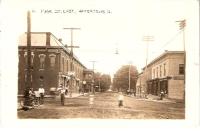
Jamestown ca. 1913: It may not look like this anymore, but Jamestown, Ohio residents bring back the days of old with this year's Small Town Christmas celebration Dec. 6 and 7.

Jamestown ca. 1913: It may not look like this anymore, but Jamestown, Ohio residents bring back the days of old with this year’s Small Town Christmas celebration Dec. 6 and 7.

JAMESTOWN – A Small Town Christmas celebration returns once again this year to Jamestown beginning Friday, December 6th at 5:30 p.m., downtown, with the Sensations show choir. At 6:30, the official town Christmas tree lighting will kick off a parade and the arrival of Santa Claus. Festivities continue through Saturday evening. Here is a general rundown of events:

Friday, December 6:

St. Augustine Catholic Church, 44 E. Washington St., is hosting a holiday bazaar and chicken noodle dinner from 4 p.m. until 8 p.m.

Saturday, December 7:

Santa returns to visit with children beginning at 11 a.m., downtown at his cottage.

The Senior Citizen Center (located in the back of the Jamestown Opera House) and many businesses will be hosting open house hours beginning at 9 in the morning.

Arts and craft fair Saturday December 7, from 9 a.m. until 1 p.m. at the Jamestown Opera House, 19 N. Limestone Street. Vendor space is still available, $25 for a 6-foot table. Contact Sandy Williams for details at (937) 675-7141. There will also be vendors inside the Phoenix Restaurant, 13 E. Washington Street.

Several area churches are hosting bazaars beginning at 9 a.m. including Jamestown United Methodist Church and the Jamestown Presbyterian Church. St. Augustine Catholic Church will host a Tyke Shop and at 1:30 p.m., an “Old Bag” auction as well.

From 6-8p.m., the Xenia Hospitality Chorus will perform at the Jamestown Opera House.

No events are scheduled for Sunday. For more information on specific venues, contact the organization hosting the event. Complete event fliers are available from the Jamestown Area Chamber of Commerce website, jtchamber.com.

Jamestown salon featured on Dayton television program

In Dayton Ohio News, Economy, Jobs, Local News, Uncategorized on November 19, 2013 at 5:46 pm

JAMESTOWN – Local hair salon owner Samantha Cox was featured on a recent edition of the WDTN-Channel 2 daytime talk show, Living Dayton where she showcased her shop’s hair extension services. She was joined on the show by her hair model, Ryan Bush and interviewed by Living Dayton co-host, Vanessa Freeman.

Uptown_Charleys_LD_1Named after Cox’s two-and-a-half year old daughter, Charley, the shop is located at 9 W. Washington Street, in the historic area of downtown Jamestown. “Uptown Charley’s” is a full-services salon offering haircuts for men, women and children, as well as color, highlights, perms, manicures and pedicures, facial waxing, and licensed therapeutic massage.

Cox is a specialist in hair extensions and customers are coming from all over the Miami Valley to experience the quality and service and “downtown style with an uptown flair.”

Uptown_Charlies_5“I was very nervous,” Cox says about her first television appearance. In addition to demonstrating bonded hair extension, she also explained that her shop is looking for qualified stylists. “We are looking for more help; a managing cosmetologist.

The program originally aired on a live broadcast but the Uptown Charley’s segment can be seen online by going to this link: http://www.wdtn.com/living-dayton/fashion/hair-extensions-in-jamestown

For more information on Uptown Charley’s, call (937) 675-7224 or visit them online at http://uptowncharleys.com/.