Local News & Commentary Since 1890.

Archive for the ‘history’ Category

Space flight really is rocket science

In history, National News, Opinion, Science, Technology, Uncategorized on November 3, 2014 at 2:41 pm

DIH LOGOBy now, most have heard about the failed test flight of Virgin Galactic’s “SpaceShip Two,” which crashed in California’s Mojave Desert on October 31st.  One of the spacecraft’s pilots died in the crash, the other critically injured. While this is Virgin’s first fatality during the development of their “sight-seeing” spaceship for the super rich, perhaps it is just another sign that the pursuit of more money and fame may not be adequate reasons attempt another small step for (rich) mankind. Space travel really is rocket science, and then some.

After a successful flight and ocean landing in July of 1961, astronaut Gus Grissom’s Mercury space capsule sank after a premature detonation of explosives blew the hatch. Grissom managed to escape, only to die six years later in a fire during a “plugs out” test of the Apollo 1 capsule on the pad at Cape Kennedy. Astronauts Ed White and Roger Chaffee also perished in that tragedy.

Other terrible accidents followed during America’s “space race” to beat Russia to the moon and meet President Kennedy’s goal of landing a man there before the end of the decade. America did finally put men on the moon, several times. But, as space travel became more complex, the dangers increased exponentially, and so did the cost of human life.

Space flight is hard! It should be left to the experts.

Space flight really is rocket science!

Famously re-created by Ron Howard on film, Apollo 13 was, in short, a miracle of human survival. By all odds, three guys trapped in a freezing pop can, 240,000 miles from Earth, should never have been able to make it home. Fortunately, thanks to the skill, ingenuity and experience of the crews both in space and on the ground, the movie managed to get a real-life happy ending.

More than two decades after the Apollo 1 catastrophe, the Space Shuttle Challenger exploded shortly after liftoff, marking the first time a civilian had died in a space travel accident. In February 2003, the shuttle Columbia broke up on re-entry over Texas after insulating foam from the main fuel tank had damaged the heat shield as it left the launch pad.

No matter how far technology appears to have advanced, space flight is now, and will always be, experimental. The engineers and pilots at the National Aeronautics and Space Administration (NASA) learned a great deal from the catastrophic failures mentioned earlier. But as more, privately developed, manned space flights are attempted, it is important to keep in mind that all of these disasters happened under the watchful eyes of some of the smartest, most experienced aerospace experts in the world. Yet people still died.

At our present level of technology, space flight is not something that should be left to over-privileged billionaires with fancy English titles. It’s dangerous, expensive and the drive for national security and scientific achievement does not exist in these endeavors. Virgin Galactic’s efforts are about money, pure and simple. Upon further reflection, however, cash may not be any less a humanitarian reason to get into manned space flight than beating the Communists to the moon.

After mothballing the last of the space shuttle fleet, America seems to be all but out of any residual space race that may still exist. Massive budget cuts enacted by the Obama administration have stripped NASA to its bare bones, its government money now subsidized more often by private companies using facilities and personnel to launch communications satellites. Without the space shuttle, the International Space Station depends more and more on private industry – and the Russians – to remain manned and supplied.

Lacking a more pressing need to funnel billions of dollars back into government-sponsored space flight, private organizations will eventually be the only way Americans go to space. For more companies like Virgin to get involved in the endeavor, however, there would need to be some kind of return on investment to motivate them.

Perhaps one of the space probes will find gold or platinum on Mars or one of Jupiter’s moons, inspiring a space-age gold rush. Until that happens, people should probably keep an eye open for more rich kids’ toys dropping out of the sky.
The Jamestown Comet Editor/Publisher Gery L. Deer is an independent columnist and business writer based in Jamestown, Ohio. More at gerydeer.com.

Police officers are people too

In Crime, Dayton Ohio News, history, Local News, National News, Opinion, Politics, sociology, Technology on October 16, 2014 at 12:15 pm

DIH LOGOWith so much attention over the last several months focused on the tragic shootings at the Beavercreek Walmart and in Ferguson, Missouri, the police are being vilified in the media now more than ever.  As these issues play out in the court of public opinion, people must remember the importance of police and that these men and women are, after all, only human.

Regardless of what people think politically or racially about the situation at the Beavercreek Walmart, without hesitation officers went in to protect the public. What happened next is a tragedy for certain, but irrelevant to this particular discussion. The point here is that the police put their lives on the line because that’s their job.

No one is suggesting that police officers are perfect, not by any stretch of the imagination. It does, however, take a particular kind of individual to work as a police officer, at any level. There are those who suggest, however, that the majority of cops are just muscle-headed, former military or high-school football jocks looking to legally exercise their aggressions and bullying nature. Those people need to watch less television.

If a police officer seems detached or cold when he or she is speaking to you it’s because they don’t know you or your intentions. They are constantly on guard, and that’s the way they need to be or they could endanger their own lives or the lives of people around them in a given situation. Keep in mind that badge on their chest may be respectable to everyone else, but makes a pretty good target for the bad guys.

police1Are there racist, misogynistic, and anti-gay police officers? Of course there are, as much as with any other profession. Prejudices, regardless of how liberal one pretends or tries to be, are normal, and not always outwardly racist or violent. But condemning the entire body of those who protect and serve because of the actions of a few does not make one a liberal or progressive thinker – it makes he or she just as prejudiced as they believe the police to be.

The average person avoids interaction with police officers wherever possible. Most Americans only encounter one during routine traffic stops. But they are always there doing their jobs, and for surprisingly little reward, all things considered.

According to the Bureau of Labor Statistics Occupational Employment Statistics Survey, as of May 2008 (the most recent, confirmable data available), the average annual wage for police and sheriff’s patrol officers in America was just under $53,000. How many people would willingly put their life on the line for fifty grand a year? Many officers work 10 to 12 hour shifts and smaller departments around the country remain understaffed due to budget cuts and a lack of qualified applicants who prefer big-city jobs.

As for overly-violent and aggressive officers, unfortunately, they exist too. Hopefully, as video surveillance and smart phone technology becomes more invasive, any officers who exert excessive force – above and beyond what is necessary to defend themselves or subdue a suspect – will be discovered and properly disciplined.

On the occasions when the cops are the bad guys, that’s a tragedy, and labels the rest with a bad rap. Once again, remember, police officers are people to, with all the same weaknesses and temptations afflicting every other man and woman since the models first came out.

Even so, the police are not the enemy. Most do their jobs with honor and can be depended upon to help in any time of need, by any citizen.

Final thought: Where guns and emotions are involved something bad will always follow. A little girl cries in the dark after learning that her mother won’t be coming home from her police duty tonight after being stabbed trying to save an old lady from a mugger. A sobbing mother grieves the death of her wayward son after learning he was shot by police when he stabbed a police woman during a failed robbery. No one ever wins. On both sides there is always tragedy.

Gery L. Deer is an independent columnist and business writer. Deer In Headlines is distributed by GLD Enterprises Commercial Writing. http://www.gerydeer.com

Support religious freedom by defending rights of atheists

In Education, history, Local News, Media, National News, Opinion, Politics, psychology, Religion, sociology, Uncategorized on September 3, 2014 at 11:24 pm

dih-logo-SEFor what is apparently the first time ever, an openly atheist candidate is running for United States Congress this fall. James Woods, an atheist Democrat, is seeking election in the Arizona 5th Congressional District, a region well known as strictly Republican. According to a CNN op-ed piece by columnist Carlos S. Moreno, Woods will be the only congressional candidate to ever run after outing himself as a non-believer.

As it turns out, under the constitutions of eight American states, atheists are banned from holding public office: Arkansas, Maryland, Mississippi, North Carolina, Pennsylvania, South Carolina, Tennessee, and Texas (Source: The Washington Post). More accurately, the restriction applies to those who deny the existence of, “a Supreme Being,” or “Almighty God,” the wording varies.

Regardless of whether people agree with it, such bans would seem to violate Article VI of the U.S. Constitution, which states, “no religious test shall ever be required as a qualification to any office or public trust under the United States.” It’s probable that any related civil suit would eventually land at the feet of the United States Supreme Court which would undoubtedly have to rule these laws unconstitutional.

Even so, most atheists stay, “in the closet,” so to speak, to avoid social repercussions and public scrutiny and rarely do they attempt to run for political positions. It might be assumed that the anti-atheist rules were originally established to ensure that public servants would have a predictable moral fiber.

But, the very idea that the religious are inherently “moral,” is, in a word, ridiculous. History is full of religiously-sanctioned violations of God’s moral commandments, from centuries of open warfare to decades of child abuse. As usual, many of the devout try to pretend none of it ever happened. So, in a completely predictable act of contradiction, violations of God’s laws are fine so long as they serve a “higher purpose.”

Likewise, the moral character of a politician is supposed to be part of the reason why people choose to elect him or her to office. Sadly, a disturbing lack of morality is evident in many high-ranking politicians, who spend much of their time lying, cheating and stealing. These are the same men and women who, at some point, stood up in front of their God and everyone else and swore to their personal integrity and commitment.

Easy examples come to mind like John F. Kennedy and Bill Clinton, who were known to be serial adulterers, and it could be argued that the very definition of politician should include, “liar.” In any case, one needn’t be a Christian, nor a member of any other religion, to have a well-aligned moral compass.

Put simply, being frightened into morality by the threat of fire and brimstone only goes so far in keeping people on the straight and narrow, particularly those who crave power and believe themselves at some point to be above retribution. It seems like it would be better to have a public servant who has found his or her own moral direction rather than having it lorded over them by fear of suffering in the hereafter.

Regardless of how the devout are behaving when no one is looking, however, what Americans need to understand from all of this is that freedom from religion must be protected in order to preserve its uninhibited practice. The fine balance between freedom “from” and “of” religion is necessary to ensure every citizen can practice his or her faith openly, all while any other may enjoy none at all. It goes both ways.

Put another way, no one likes to have religious groups going door to door pedaling their ideology. So why is it alright for anyone else to do the same thing simply using more socially acceptable methods, such as being coerced into declaring a religion before qualifying for political office?

Up until now a great many public servants who have affirmed a religious affiliation and filled speeches with thanks to God for their success have managed to shame both their religion and their office with shaky morality. In the end, the most devout Christian can take the same oath as their atheist counterpart and guarantee no greater a moral platform. If history is any indicator, it might even be less.

 
Gery L. Deer is the editor and publisher of The Jamestown Comet.com and a syndicated independent columnist.


Gainsay of Gaza school bombing not anti-Semitic

In history, National News, Opinion, Politics, sociology, Uncategorized, World News on August 9, 2014 at 2:50 pm

DIH LOGOThere’s an inherent problem with “political correctness” when it extends to speaking out against bad policy or horrific acts against the innocent. When the super-sensitive “left” can’t accept that people can dislike someone’s opinion without literally hating them, any hope of long-term, productive dialogue or constructive discourse is totally squelched.

When President Obama was elected, people became so obsessed about his being our first African American president, that to even mention a disagreement with his policies labeled one a racist. Naturally, that’s ridiculous. But, for the majority of his first term anyone who argued against him was considered to simply be hateful and bigoted.

We’re in a similar, uncomfortable, situation now with the problems going on in Gaza and the alleged bombing of civilian targets by both Israel and Hamas. There is no question that what’s going on there is terrible and it’s a given that Israel has suffered its share of problems in its short existence as a nation. But, criticism of their tactics in the current conflict does not make one anti-Semitic.

Because Hamas is seen by many as a “terrorist” organization, it is therefore more acceptable to criticize them publicly, but that’s not the debate. It’s not anti-Semitic to state, “It’s wrong for Israel to bomb civilian targets and kill innocent people, including children.” Anyone who thinks that it’s ok to bomb kids regardless of the purpose may be hinging on sociopathic mentality.

Many United Nations officials condemned the bombing of a UN-run school in Gaza, including  Secretary-General Ban Ki-moon, seen here.

Many United Nations officials condemned the bombing of a UN-run school in Gaza, including Secretary-General Ban Ki-moon, seen here.

After a United Nations-operated school was bombed in Gaza City last week, killing 20 and wounding dozens, including children, The Washington Post reported that the U.N. officially condemned Israel for the bombing with UNRWA Commissioner-General Pierre Krähenbühl saying, “I condemn in the strongest possible terms this serious violation of international law by Israeli forces. This is an affront to all of us, a source of universal shame. Today the world stands disgraced.”

There are, of course, those who have accused the U.N., as an organization, of being anti-Semitic since its inception, but this is not an indication of that. This is a statement from the commissioner-general communicating that the world group disagrees with the Israeli tactic and would prefer they try to find a peaceful solution.

Considering that the GPS coordinates of the school had been reportedly sent to Israel at least 17 times, at this point it’s Israel’s own actions drawing negative opinion and squelching sympathy for their cause. Still, it’s seen as distasteful to speak against the Jewish nation without being labeled racist and therein lays the problem.

Will it always be that with any minority or historically trodden-down group, negative opinion or public critique will draw for the speaker undo hatred or have them forever labeled racist, anti-Semitic or worse? Is political correctness always this blind, even in the court room? Yes. It always will be. Take, for instance, mandatory minimum sentences for drug crimes here in America.

Statistics suggest that the vast majority of drug criminals in the U.S. are African American. Since there are often mandatory minimum prison sentences on the books for various levels of possession, sale and use of street narcotics, by the logic of some, which makes mandatory minimums racist. Are they? That’s a debate for another time, but the same logic is at work here as well.

There seems to be a belief among modern liberals and conservatives alike that freedom of speech is a wonderful thing, so long as you only say what they want to hear. Anything that goes against the grain on either side of the aisle will earn a swift retribution for the originator of the message. Oddly, it’s always been that way, but now, with social media, the Internet and an instant news cycle, there’s just more of a platform for argument.

Speaking one’s mind about an atrocity is the purview of any conscientious observer. Whether someone is doing so from a racial bias is another matter entirely. However, if those committing the atrocity expect sympathy in some way, it’s unlikely that they will achieve any of their goals by fueling the fires of hate through horrific actions, regardless of whether they believe it to be the means to the end.
Gery L. Deer is an independent columnist and business writer syndicated by GLD Enterprises Commercial Writing. More at gerydeer.com.


Celebrating the paramedic and EMS

In Health, history, Jobs, National News, Opinion, Science, television, Uncategorized on July 21, 2014 at 11:44 am

DIH LOGOWhen was the last time you felt the urge to run into a burning building? What about cutting your way into a mangled car to extract an injured child after a wreck? It takes a particularly kind of person to reject self-protective responses and dive in, head first, to help others. Fortunately, our first responders – firefighters, emergency medical services (EMS) and police officers – never hesitate to do exactly that.

Firefighters and police officers have been around for centuries, but can you remember a time when no one had ever heard of a “paramedic?” Actually, it wasn’t that long ago, only about 45 years. Although there’s no officially recorded origin, the word “paramedic” can be loosely broken down to two parts. The Latin prefix, “para,” means, in this context, “apart from, or beyond,” and “medic” referring to “physician.”

The first paramedic training began in California in the mid 1960s. But in January of 1972, television producers Jack Webb and R.A. Cinader (“Dragnet,” and “Adam 12,”) helped introduce the rest of the country to the concept in a new show called, simply, “Emergency!.”

Each week, viewers rode along with a pair of fictional, Los Angeles County Station 51 firefighter paramedics named Johnny Gage and Roy DeSoto, portrayed by actors Randolph Mantooth and Kevin Tighe. Back then, firefighters were skilled in only a minimum of first aid techniques. Paramedic training allowed more advanced medical treatment for victims at the scene, when time is critical, performed at the time under the direction of a hospital physician communicating by radio.

Emergency! aired on NBC for six seasons and introduced the country to the job of the paramedic. (Kevin Tighe as Roy DeSoto and Randolph Mantooth as John Gage).

Emergency! aired on NBC for six seasons and introduced the country to the job of the paramedic. (Kevin Tighe as Roy DeSoto and Randolph Mantooth as John Gage).

For six seasons, using real-life, contemporary techniques, the fictional team of “Squad 51” demonstrated how vital paramedics could be to accident survival rates. Additionally, by shining some Hollywood light on the subject, the show helped ease resistance by doctors who fought the adaptation of advanced medical field support, referring to it as, “remote controlled medicine.”

Paramedics are sometimes referred to inaccurately as EMTs (Emergency Medical Technicians), but there are differences between the two, although regulations and educational requirements can vary. According to the University of Southern California Los Angeles’s Center for Prehospital Care, “EMTs usually complete a course that is about 120-150 hours in length. Paramedic courses can be between 1,200 to 1,800 hours.” But that’s not where the difference ends.

Both fields of study include lectures, clinical and field internships and hands-on skills training such as CPR, administering oxygen, glucose for diabetics and helping to treat asthma attacks. “With very few exceptions, such as in the case of auto-injectors for allergic reactions,” UCLA’s website states, “EMTs are not allowed to provide treatments that require breaking the skin: that means no needles.”

At the time of the “Emergency!” TV series, Los Angeles County, had only about 36 paramedics. But after the show became a hit, applications came pouring in anywhere the programs were offered. As of 2012, StudentDoctor.net reports that there are an estimated 142,000 paramedics and 600,000 EMTs currently working in the United States and that number is growing. From big cities to rural communities, paramedics and EMTs are regularly in great demand.

On September 11, 2001, first responders took center stage, paramedics included, with hundreds giving their lives trying to save the victims of the World Trade Center attacks. Hopefully, our local fire and rescue personnel will never be required to perform such a dire duty, but you can rest assured that if the need would ever arise, they are ready and willing.

I can’t convey how grateful my family was to the men and women of our local EMS (New Jasper Township, in Greene County, Ohio) when I was helping to care for my mother who, in addition to Alzheimer’s disease, also suffered from heart disease. Our emergency medical responders see us at the most difficult, stressful moments of life. So, since we often forget at the time, “Thank You,” from a grateful public to our fire and EMS providers, for all you do to help keep us safe.


Gery L. Deer is an independent columnist and business writer based in Jamestown, Ohio. More at http://www.gerydeer.com

Hobby Lobby ruling sets religious freedom in business

In Business, Charities, history, Media, National News, Opinion, Politics, Religion, sociology, Uncategorized on June 30, 2014 at 11:59 am

DIH LOGOOn June 30th, the United States Supreme Court ruled in favor of Hobby Lobby’s suit to be exempted from the ObamaCare mandate forcing companies to provide contraceptive coverage to employees, including the controversial Plan B, or “morning after,” drugs. Many conservative business owners equate these drugs to abortion since they’re designed to terminate a pregnancy within hours of conception.

The primary argument to the court is whether the owners or management of a corporation has the same rights to freedom of religion as an individual. The Obama administration has already set exceptions for various religious non-profit organizations, which, other than their non-profit status, are structured similarly to their for-profit counterparts.

In March of this year, according to TheHill.com, the U.S. House of Representatives, “Approved the Equitable Access to Care and Health (EACH) Act, H.R. 1814. The bill allowed people avoid buying health insurance under ObamaCare if they could cite a religious reason. People seeking an exemption would have to include sworn statements in their tax returns explaining their objection to health insurance.” In effect, all they needed to get out of paying the federal healthcare mandate (tax) was a note from home.

A further question is whether there is a fundamental business difference between a non-profit corporation and a for-profit corporation? The practical answer is, no. Charity or not, a corporation is created to protect the individual operators from legal responsibility with regard to the business. Most non-profit filings are for tax and donation purposes, a process that seems outdated and inefficient with the advent of mega churches and multi-billion-dollar evangelical organizations.

uscourtIn America, there are countless religiously-focused, non-profit corporations worth millions more than some of the largest for-profit businesses. The Christian television network, Daystar, for example has been approved by the Internal Revenue Service as a “church,” according to NPR.com news. Celebrity, sometimes politician evangelist Pat Robertson and the late Billy Graham registered with the IRS as “religious organizations,” making them exempt from most taxes. All they had to do was file disclosure papers.

According to available records, NPR.com reports that the top three evangelical television broadcasters – Christian Broadcast Network, Trinity Broadcasting Network and Daystar Television — have a combined net worth of more than a quarter of a billion dollars. It is unknown whether the corporations that operate these broadcasters have filed for religious exemption under the healthcare reform laws.

The question persists, however, that if the only difference between a for-profit corporation and these mega non-profits is an earnings disclosure, why have the distinction at all? Certainly there are for-profit companies that give away millions of dollars in charitable funds each year but still have to comply with the law in every respect. Why then are religious non-profit organizations exempt from anything, much less a controversial healthcare mandate that has American small business struggling to comply or face bankrupting penalties?

The court’s latest decision with regard to religious exemption could have long-reaching implications, and not just in the healthcare arena. Giving a for-profit entity the same constitutional protections provided to non-profit religious groups could cause a flood of lawsuits ranging from tax law to equal employment regulations. Once again, major non-profits have million-dollar earners at the top, private jets, limousines and pretty much every other extravagance thought only to exist in for-profit American business.

If a church – any church – can make a case for religious freedom from legal mandates, why can’t a business owner cite his or her – or their – own religious beliefs for the same purposes? Is the constitution not written for everyone or does it exist specifically to meet the needs of religious groups so they can avoid taxes and dodge the law at their convenience?

This argument poses a great many questions and there will likely be countless more as ObamaCare reaches further corners of commerce. But, if that’s not enough to chew on, here’s another one. What happens if a Muslim, Jewish or non-Christian group requests exemption as well? Will the Christian right fight against their having the same protections?


Gery L. Deer is an independent columnist and business writer and contributor for WDTN-TV2’s LIVING DAYTON program. More at www.gerydeer.com.


India vs. China: Economic growth and national security

In Economy, history, National News, Opinion, sociology, Uncategorized on June 9, 2014 at 9:47 pm

DIH LOGOOn June 4, 1989, after three weeks of civil rights protests by nearly a million Chinese, many of them students, Chinese troops stormed a packed square in Beijing, killing and arresting thousands. The Tiananmen Square Massacre shocked the world and confirmed the belief, not that there was any doubt, that China’s political system is completely incompatible with that of the United States and pretty much any other democratic nation.

A quarter of a century later, it’s still largely incomprehensible why America is so tied to a country with no decency with regard to human rights. It’s about two things that shouldn’t surprise anyone, money and political power. There’s a little fear thrown into the mix as well associated with China’s massive military might and a government with no reservations about using it.

Labor costs are incredibly also low in China, with the average factory worker earning just one-tenth of what their American counterparts bring home, according to the Bureau of Labor Statistics. Cheap labor is an attractive prospect to American companies looking to expand production with fewer tax and employment expenses. It seems there is no end to U.S. manufacturers relocating in China; producing cheaper goods to be shipped back America and sold at a premium profit.

Contrary to popular belief, however, according to the Council on Foreign Relations, only 15-percent of U.S. imports come from China. That comes out to something like $29 billion of a $1 trillion monthly output. There are more than 1.3 billion people in China, many of whom, like their American counterparts, want, more than ever, the latest technology, fashions, entertainment and so on. Although it is generally exaggerated, a definite trade deficit exists between the two nations, which is unlikely to change anytime soon.

China or India? Which makes more sense for the US?

China or India? Which makes more sense for the US?

It’s entirely possible the United States should be looking a little further southwest for political and economic growth in Asia – India. After all, which would seem a much more stable and amiable political and economic ally? With more than 1.2 billion people living in 29 states, India is the world’s second-largest country and second-largest democracy, English speaking and primed for growth.

If India is a more lucrative and stable prospect, what’s holding America back from a greater fueling of the fire of partnership, economically and socially? Unfortunately, recent years have seen the U.S./India relationship strained over trade and intellectual property disputes. Plus, the Indian economy has had some rocky spots recently.

In 2013, the average median income per capita in India was around $1,200 (Compared to China at $2,100). Add to that, India’s economy has fallen off nearly 5-percent with 8-percent inflation and the country’s fiscal health is a major barrier. However, the election of a new prime minister, Narendra Modi has encouraged investors and the economy has reflected that confidence.

According to CNN Money, “The prospect of a government led by Modi has boosted Indian stocks by 15 percent so far this year. The rupee has responded too, gaining six percent against the dollar after a dismal performance in 2013.”

There are other more politically charged issues slowing down a more aggressive relationship with India, but most U.S. officials see the country as a thriving democracy and a strategic gold mine. Close to Afghanistan and Pakistan, a more advanced partnership between America and India would benefit both countries in terms of economic growth and national security.

America imposed sanctions against India in 1998 because of nuclear testing. But, thanks to former presidents Clinton and Bush, relations improved greatly and the two nations even signed a ground-breaking defense and civil nuclear (power) agreement.

With the possible exception of the political unknowns surrounding a new prime minister, previously a Hindu Nationalist, there is little reason to spend so much time courting the stagnant communist regime in China instead of nurturing a reasonably stable democracy, and growing economy, in India. In the end, it certainly seems that it would be much wiser for Washington to advance trade and economic partnerships with India.


Gery L. Deer is an independent columnist and business writer based in Jamestown, Ohio. More at http://www.gerydeer.com.


Alas, the plight of the plastic shopping bag

In Business, Economy, Education, Environment, Health, history, National News, Opinion, Politics, Science, Uncategorized on March 31, 2014 at 8:42 am

Deer In Headlines
By Gery L. Deer
The Jamestown Comet Editor

bag_blowingTake a look around outside after a storm and you’ll see them, clinging to the lathe of a garden fence like barnacles to a ship’s hull – those sad, indigent, plastic shopping bags. They’re everywhere, bouncing along the roadside, hung up in the branches of your backyard tree, even melted and tangled around the undercarriage of your car. Once revered for their strength and amazingly useful handles, these marvels of modern shopping are now the scourge of environmental political correctness.

With humble beginnings in 1950s Sweden, the modern plastic shopping bag was the creation of engineer Sten Gustaf Thulin who developed the simple, one-piece bag for Celloplast, the company which patented the design in 1965. Popularity of the product grew rapidly, for a time even knocking paper bags into relative obscurity.

Never again would husbands need worry about earning a night in the doghouse after losing a gallon of milk to the pavement when it crashed through the bottom of a wet paper sack. But, it was that set of wonderfully brilliant handles that really endeared the bags to shoppers. Since the dawn of time, mothers everywhere have struggled on shopping trips to juggle groceries and family.

With plastic bags, Mom now had the ability to carry half a dozen fully loaded bags on her arms while clutching Junior in one hand and the dog’s leash in the other. Her world now under complete control, at least for one brief moment, thanks to a simple pair of parallel holes in a plastic tube. Once the groceries were put away, she could even re-use them to line the bathroom wastebasket with a water-proof bag that fit both the can and her household budget.

PBThere was no doubt the plastic shopping bag was truly a miracle of modern commerce. By 1982, most major grocery chains, including Kroger, began replacing paper shopping bags with plastic citing cost savings and customer preference. Sadly, however, as with most other success stories, rival jealousy led to ridicule and scrutiny, mostly from operatives of the paper bag industry determined to unseat the plastic bag from its world-wide fame.

By the 1990s, world ecologists became increasingly vocal about plastic’s potentially destructive effects on the environment. Soon, the plastic shopping bag became an innocent by-stander, caught up in the ever increasing fight between good and evil, liberal and conservative, environmentalist and capitalist – or whoever was paying the most lobbyists. More than ever, environmental groups were touting the need for more extensive use of recyclable materials in consumer goods.

Almost overnight, the plastic shopping bag became the poster child for everything wrong with the environment as pundits heatedly debated their recyclability on cable news and in fiercely negative op-eds.  As usual, the critics had it all wrong because plastic shopping bags were every bit as recyclable as their paper counterparts, but were, in a way, victims of their own success.

As it turned out, the very innovations that made plastic shopping bags so powerful in the supermarket were like Kryptonite to the sorting machines used in recycling. When put through, they bound up the machinery and left it jammed and inert, and the cost to overcome that problem outweighed the benefits.

For years, rumors of a plastic bag uprising have permeated the media, suggesting that millions of these poor, trodden-down bags were massing a resistance in landfills all over America. There, they waited silently, collectively preparing to strike back against their opposition by refusing to decompose, even over thousands of years.

Sadly, an empty threat, since the structure of a landfill is meant to keep the refuse dry and stable, limiting degradation. Nothing is intended to fully decompose; not paper, not food, not plastic … nothing. In fact, newspapers buried in the 1960s have recently been exhumed intact and readable.

Perhaps one day, the full truth of their story will be exposed and plastic shopping bags will regain their once proud position at the end of the checkout. But for now, these bags exist as second-class totes, drifting like tumbleweeds on the wind, dancing their lament of a time when they were kings of the market.
Deer In Headlines is available for syndication. Contact GLD Enterprises Commercial Writing – http://www.gldenterprises.net.

Xenia Lives: 40th Anniversary of the 1974 Xenia Tornado

In Books, history, Local News, Uncategorized on March 4, 2014 at 1:35 pm

tornado poster finalXenia, Ohio – This year marks the 40th anniversary of a tragic event that changed the course of history for the Xenia community. The 1974 tornado that devastated Xenia was a reminder of both the power of nature and the resiliency of our people. In recognition of this, the City of Xenia, the Greene County Historical Society, Xenia City Schools, and the Greene County Libraries, Xenia Branch are proud to present a month of remembrance and education.

Photo after the tornado of the main intersection of US 35 and SR 68, looking southwest from the lawn of the Greene County Courthouse

Photo after the tornado of the main intersection of US 35 and SR 68, looking southwest from the lawn of the Greene County Courthouse

Beginning in March 2014, special programming and events will be offered to the general public to learn about weather phenomena and severe weather preparedness, to understand the history of the 1974 tornado and its aftermath, and to recognize the efforts and leadership displayed in the recovery and rebuilding of our community. A memorial service will be held at the 1974 Tornado Memorial in front of Xenia City Hall, 101 N. Detroit Street, at 4:15 p.m. with a reception immediately following at the Xenia Branch of the Greene County Public Library.

Possibly the most famous (and ominous) photos of the 1974 Xenia Tornado.

Possibly the most famous (and ominous) photos of the 1974 Xenia Tornado.

“The April 3, 1974 event, while tragic, does not the define Xenia. What defines this community is our ability to rise from tragedy. It is our ability to overcome, to withstand these hardships, to transform destruction into a thriving community, to embrace friendship, and to be greater than our suffering, that makes us truly great,” stated City
Manager Brent Merriman. “We remember this day, and those we have lost; but reflecting on this event allows us to see how far we have come and how much farther we can go.”

More information and a complete schedule of events are available on the City of Xenia website, www.ci.xenia.oh.us.

So many topics, so little substance

In history, Local News, National News, News Media, Opinion, Politics, World News on December 11, 2013 at 8:30 pm

DIH LOGOAs the year draws to a close, I’ve been planning the final few topics for Deer In Headlines in 2013. So far, I’ve got ten political topics, six personal, nine general and two holiday-related; none of which jump out at me as interesting to you, my readers. It could be I’ve decided that the absence of a subject is a topic in and of itself. Let me explain.

How much time each day do you spend thinking or worrying (not always the same activity) about things you can’t control? Are you readily preoccupied with global issues that have little or nothing to do with your daily life? What is it that really motivates you to get out of bed each day? I think we are just spending far too much time worried about nonsense.

I think maybe we are overly concerned with problems and situations that 1) have nothing to do with us directly, or 2) about which we can do absolutely nothing. Focusing on these things only wastes time and energy and takes our attention from far more pressing matters.

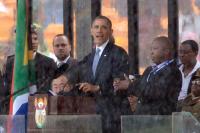
For example, a great leader was lost last week when Nelson Mandela passed away. Strangely, to me at least, it wasn’t really that much of a shock; the guy was 95, after all. What was shocking, however, was how little time the media and bloggers (no, they’re not interchangeable) spent discussing the Obama selfie photo and the fake sign language translator instead of focusing of the former South African president and his achievements.

It’s truly maddening that our attention was overtaken not on the legacy of a true hero but on how to politicize whether the president should have been smiling during the memorial. Think about it, that’s kind of a big deal. He was taking a cell phone picture with the prime ministers of Great Britain and Denmark. He had good reason to smile, even if Mrs. Obama seemed indifferent. But I think even that was out of context. We have no clue what she was thinking or what happened just before and after the picture.

President Obama speaks at Nelson Mandela memorial with reported "fake" sign language interpreter. Photo Courtesy AFP, Pedro Ugarte.

President Obama speaks at Nelson Mandela memorial with reported “fake” sign language interpreter. Photo Courtesy AFP, Pedro Ugarte.

Given the state of the world today, instead of criticizing them, we should be grateful that there are two world leaders willing to be in the same picture with the American president in the first place. I believe Mr. Mandela would have been gratified that people were getting along and smiling as they celebrated his life, including Obama’s handshake with Cuban leader Raul Castro. At least we’re not shooting at each other.

Every day we’re confronted with bad news. I work in the media but try to ignore much of the negative. I have enough of my own problems and I needn’t concern myself with the ridiculousness of the latest Washington scandal or whether the president should have shaken hands with a dictator. Who cares? No one but the pundits, that’s who.

Pundits are supposed “experts” in a particular field called upon for comment by the news media. Sadly, most of these so-called experts are nothing of the kind. They’re often just celebrities who tend to be publicity hounds and find a way to know something about everything at precisely the right moment. Once again, there we go worrying about things that have nothing to do with us. Why do we care what these people think about anything?

Most pundits are so far removed from average people there is no way they could relate to the trials and tribulations of holding a job, paying a mortgage or trying to determine the source of your next meal. They just don’t get it – and they don’t care.

Taking this back around to the idea of the non-topic, as we slide headlong down that snowy slope into the Christmas holidays, remember to stay focused on what matters to you and yours. Ignore the sensationalized news and the nonsense spewed out of Hollywood. Your life and the lives of your family and friends are what make the most difference in your world so center on those things and you’ll be much happier.


Gery L. Deer is an independent  contributor to WDTN-TV2’s “Living Dayton” program. More at gerydeer.com.

Is this your new site? Log in to activate admin features and dismiss this message
Log In