
Local News & Commentary Since 1890.

Archive for the ‘Environment’ Category

Godzilla: King of the anti-nuclear message

In Entertainment, Environment, Movies, National News, Opinion, Politics, Science, Technology, Uncategorized, World News on May 12, 2014 at 12:00 pm


DIH LOGOIn 1955, the Japanese film company, Toho, Inc., introduced America to “Godzilla, King of the Monsters.” The bulky, green monster terrified audiences in the marginally familiar form of an enormous T-Rex, with notable size differences, muscular body and bigger arms and all brought to life by a puppeteer in a rubbery body suit. Originally called by the Japanese word, “Gojira,” meaning “gorilla whale,” the monster was so successful he’s been a worldwide star since his first black and white appearance in Tokyo.

Uncertain how a Japanese film would fare only a decade after the end of World War II, American exhibitors insisted an “American” element be added to make the dubbed, foreign monster flick more relatable to U.S. audiences. So, who better to report on the devastation than one of the most trusted faces on television at the time, Perry Mason himself, Raymond Burr. Not included in the Japanese version, Burr played an American journalist reporting on Godzilla’s attack into a tape recorder from the safety of a nearby office building.

During the 1960s and 70s Godzilla made his way into color features where his ominous appearance was softened a bit and his character reworked a bit from a menace to more of a hero as he battled other creatures threatening Tokyo from Monster Island. His gigantic, “30-story” upright posture, signature stomp, glowing dorsal plates and fiery breath were a hit with movie goers around the world.
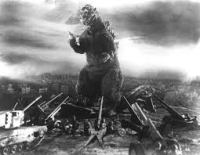
Gozilla's original appearance in Japan, 1954. He appeared in America a year later.

Gozilla’s original appearance in Japan, 1954. He appeared in America a year later.

In 1985, Godzilla reappeared in a more serious, direct sequel to the original. Although the monster had made countless appearances in other, sillier films, like “Godzilla vs. King Kong,” and “Godzilla vs. Mothra,” this reprisal brought Godzilla back to his roots – as a devastating, uncontrollable statement on the increasing nuclear scare at the peak of the Cold War.

Although it was no longer necessary to smooth over American audiences, Raymond Burr reprised his role from the original film in a few scenes added to the U.S. release to provide continuity and attract a nostalgic audience. “Godzilla 1985,” did well at the box office and even better in the newly-minted home video market.

Fast forward a few years to 1998, when the monster was licensed by Tri-Star Pictures for an American, almost campy, version set in New York City. Studied by a worm biologist played by the likable Matthew Broderick (Ferris Bueller’s Day Off / The Producers), Godzilla takes up residence in Manhattan and is hunted by the US Military who manages to lay waste to everything except their target, even wrecking the iconic Chrysler Building. A liberally-preachy, anti-nuclear storyline and a totally computer-animated Godzilla, that didn’t look or act much like the original, completely failed to lure audiences.

Over the years, Godzilla appeared in 28 films and an American cartoon show. He even achieved the honor of a star on the Hollywood Walk of Fame. But the origins of the character are deep in Japan’s nuclear pain and far more serious than most people might know.

Godzilla as he will look in the 2014 version.

Godzilla as he will look in the 2014 version.

Like the newest American incarnation set for release in May 2014, Godzilla is portrayed as a mutation directly resulting from nuclear testing, emphasizing the need to do away with these weapons. He was, essentially, the symbol of everything that can go wrong with nuclear power and weaponry.

The underlying message in the more serious Godzilla story lines is that use of nuclear weapons and power has unimaginable consequences. A mutation that can cause a giant monster with nuclear powered breath is a pretty good personification.

In any case, the new film is sticking closer to the original concept, not just in story but in the look and actions of the monster himself. He’s a rampaging beast and the addition of Breaking Bad’s Bryan Cranston, adds another level of drama to a once-campy character.

In no loss of irony, Japan is the only country in the world whose people have experienced the horrible result of nuclear devastation and America is the only country who has ever inflicted it on anyone else. It’s somehow fitting that people from both countries come together to create a fictional character that personifies the horror that can result.
Gery L. Deer is an independent columnist and business contributor to the WDTN-TV2 program, Living Dayton. More at http://www.gerydeer.com.




Campaign educates drivers about distracted driving

In Children and Family, Education, Environment, Health, Local News, Technology, Uncategorized on April 2, 2014 at 7:19 pm

DDXENIA, OH – In an effort to make our roads safer, the Greene County Safe Communities Coalition announced today that it has joined the “One Text or Call Could Wreck It All” campaign to stop distracted driving.  April is National Distracted Driving Awareness Month and the Coalition has pledged its support to help spread the message that distracted drivers are not only a danger to themselves, but everyone else on the road.

“We all know that talking on our cell phones while driving is distracting, but that doesn’t stop most people from continuing to do it,” said Laurie Fox, Safe Communities Coordinator.  “This effort is intended to educate our community about the dangers of cell phone use and other distractions while driving.  We hope that once people see the statistics and realize the danger involved, they will change their driving habits to help protect themselves, their families, and others on the road.”

In 2012, 3,328 people were killed in crashes involving a distracted driver and an estimated additional 421,000 were injured in motor vehicle crashes involving a distracted driver. That same year, eleven percent of fatal crashes were reported as distraction-affected crashes.

While anything that takes your eyes off the road, hands off the wheel, or mind off the task of driving is a hazard, there is heightened concern about the risks of texting while driving because it combines all three types of distraction – visual, manual and cognitive.

The national distracted driving effort focuses on ways to change the behavior of drivers through legislation, enforcement, public awareness and education – the same activities that have curbed drunk driving and increased seat belt use.

“Every driver in Greene County has a role in this effort,” said Fox.  “However, we especially want to reach out to parents with teen drivers because we know that statistically, the under-20 age group had the highest proportion of distracted drivers involved in fatal crashes.”

The Coalition’s goal is simple – save lives by getting drivers to remember that “One Text or Call Could Wreck It All.”  All drivers are encouraged to put down the phone and arrive alive.

For more information about distracted driving, please visit www.distraction.gov, or you can contact Laurie Fox at 937-374-5669 or lfox@gcchd.org.  

LIVE! With Michael and Kelly announces Gery L. Deer as guest host.

In Environment, Local News, television on April 1, 2014 at 10:14 am

Gery_Live_April_FoolNew York, NY – April 1, 2014 – Producers of the hit daytime television program, Live! With Michael and Kelly, announce the newest guest host. Writer, entrepreneur Gery L. Deer will join the list of guest hosts to head up the popular morning entertainment show after a successful run as a regular guest on the popular Dayton, Ohio talk show, “Living Dayton.”

An award-nominated writer and marketing expert, the Jamestown, Ohio native is no stranger to the national television stage, having appeared on programs like America’s Got Talent, The Bonnie Hunt Show and Steve Harvey’s Big Time.

An attempt was made to contact Deer, but the only word from his representative, one Bray T Cat, was, “Meow.”
YES THIS WAS AN APRIL FOOL’S DAY JOKE. THANKS FOR PLAYING! (But if Kelly and Michael are reading, I’d be happy to co-host! – Gery D.


Alas, the plight of the plastic shopping bag

In Business, Economy, Education, Environment, Health, history, National News, Opinion, Politics, Science, Uncategorized on March 31, 2014 at 8:42 am

Deer In Headlines
By Gery L. Deer
The Jamestown Comet Editor

bag_blowingTake a look around outside after a storm and you’ll see them, clinging to the lathe of a garden fence like barnacles to a ship’s hull – those sad, indigent, plastic shopping bags. They’re everywhere, bouncing along the roadside, hung up in the branches of your backyard tree, even melted and tangled around the undercarriage of your car. Once revered for their strength and amazingly useful handles, these marvels of modern shopping are now the scourge of environmental political correctness.

With humble beginnings in 1950s Sweden, the modern plastic shopping bag was the creation of engineer Sten Gustaf Thulin who developed the simple, one-piece bag for Celloplast, the company which patented the design in 1965. Popularity of the product grew rapidly, for a time even knocking paper bags into relative obscurity.

Never again would husbands need worry about earning a night in the doghouse after losing a gallon of milk to the pavement when it crashed through the bottom of a wet paper sack. But, it was that set of wonderfully brilliant handles that really endeared the bags to shoppers. Since the dawn of time, mothers everywhere have struggled on shopping trips to juggle groceries and family.

With plastic bags, Mom now had the ability to carry half a dozen fully loaded bags on her arms while clutching Junior in one hand and the dog’s leash in the other. Her world now under complete control, at least for one brief moment, thanks to a simple pair of parallel holes in a plastic tube. Once the groceries were put away, she could even re-use them to line the bathroom wastebasket with a water-proof bag that fit both the can and her household budget.

PBThere was no doubt the plastic shopping bag was truly a miracle of modern commerce. By 1982, most major grocery chains, including Kroger, began replacing paper shopping bags with plastic citing cost savings and customer preference. Sadly, however, as with most other success stories, rival jealousy led to ridicule and scrutiny, mostly from operatives of the paper bag industry determined to unseat the plastic bag from its world-wide fame.

By the 1990s, world ecologists became increasingly vocal about plastic’s potentially destructive effects on the environment. Soon, the plastic shopping bag became an innocent by-stander, caught up in the ever increasing fight between good and evil, liberal and conservative, environmentalist and capitalist – or whoever was paying the most lobbyists. More than ever, environmental groups were touting the need for more extensive use of recyclable materials in consumer goods.

Almost overnight, the plastic shopping bag became the poster child for everything wrong with the environment as pundits heatedly debated their recyclability on cable news and in fiercely negative op-eds.  As usual, the critics had it all wrong because plastic shopping bags were every bit as recyclable as their paper counterparts, but were, in a way, victims of their own success.

As it turned out, the very innovations that made plastic shopping bags so powerful in the supermarket were like Kryptonite to the sorting machines used in recycling. When put through, they bound up the machinery and left it jammed and inert, and the cost to overcome that problem outweighed the benefits.

For years, rumors of a plastic bag uprising have permeated the media, suggesting that millions of these poor, trodden-down bags were massing a resistance in landfills all over America. There, they waited silently, collectively preparing to strike back against their opposition by refusing to decompose, even over thousands of years.

Sadly, an empty threat, since the structure of a landfill is meant to keep the refuse dry and stable, limiting degradation. Nothing is intended to fully decompose; not paper, not food, not plastic … nothing. In fact, newspapers buried in the 1960s have recently been exhumed intact and readable.

Perhaps one day, the full truth of their story will be exposed and plastic shopping bags will regain their once proud position at the end of the checkout. But for now, these bags exist as second-class totes, drifting like tumbleweeds on the wind, dancing their lament of a time when they were kings of the market.
Deer In Headlines is available for syndication. Contact GLD Enterprises Commercial Writing – http://www.gldenterprises.net.