Local News & Commentary Since 1890.

Archive for the ‘Entertainment’ Category

Jamestown Opera House Show celebrates 20 years of a local family’s musical history

In Children and Family, Entertainment, history, Local News, Media, News Media, Senior Lifestyle, Theatre, Uncategorized on November 17, 2014 at 11:51 am
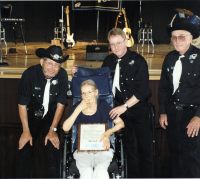
Lois Deer (center) with The Brothers & Co. members Gary Deer Jr., Gery Deer, and husband Gary Deer Sr. at the Jamestown Opera House in 2010

Lois Deer (center) with The Brothers & Co. members Gary Deer Jr., Gery Deer, and husband Gary Deer Sr. at the Jamestown Opera House in 2010

JAMESTOWN, OH – On a cold, winter night, a couple of weeks after a family Christmas party in 1994, something historic took place. William Sutton, his brother Gary “Tuff” Sutton, Sr., and their nephews, Gery Deer and Gary Deer, Jr., did something they’d never done before. They all met up on a Friday night at the Deer family farm in Jamestown, Ohio and collected their musical talents into what would become a lifelong undertaking. While you may never have heard of “The Brothers & Co. Entertainers,” their history is one of a unique brotherhood derived from a family whose musical talent goes back several generations.

While William and Tuff had played together many times over the years, the Deer brothers had never made the attempt. Tuff had helped Gery develop his natural piano skills and Gary Jr. hadn’t played his drums much after graduating high school in Fairborn in the early 1970s. But when they sat down, something really amazing happened, they just “worked.”

Tuff took on the lead and rhythm guitar duties. William was initially the group’s bass player, but picked up his dusty bow and took over the fiddle spot once family friend Jess W. Young, of Fairborn, signed on, and then there were five.

Originally called simply, “The Brothers,” the band went through a lot of changes in its first year or two, adding and subtracting musicians, but always maintaining the two sets of brothers as the foundation. By 1996, a decision was made to change the group’s name, adding, “& Co.” (and company), allowing them to add and subtract whomever they wanted without much of a branding problem, so long as Gery and Gary Jr. at least remained. Somewhere along the way, Gery and Gary Jr. decided that the group was made up more of “entertainers” than trained musicians, so that was tagged onto the name too – “The Brothers & Co. Entertainers.”
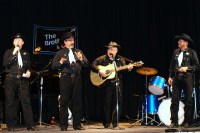
SONY DSCBy 1996, Ed Jones had joined up on banjo and acoustic guitar. A cousin to the Deer brothers and another nephew of the Suttons, he also had never played together with his family before in this way. Sadly, the family lost Uncle Tuff Sutton to cancer in 2005, and William stayed with the group only a short time after and also passed away a few years later. Jess Young also retired from the group due to health reasons and passed away shortly after.

“None of who we are now would have happened without each of them,” Gery remembers of his family members who have passed on, including his mother, Lois, who died in 2011 after suffering for several years from Alzheimer’s disease. “We are who we are because of them and my mother was, essentially, the anchor. It was because of her that my brother and I are here and that the others came together with us. We couldn’t have done this without them.” But the changes weren’t over yet.

From inception until about 2004, the boys had maintained an instrumental bluegrass persona. But one Saturday night, shortly after a family friend, Jim Karns of Fairborn, joined the group, something odd happened. As Gery puts it, “We opened our mouths and a terrible, awful, nails on the chalkboard noise hit the air, as if four birds had flown headlong into a window while screeching at the top of their lungs.”

The Brothers & Co Variety Show will perform a 45 minute set at the Schuster December 4. Photo by Jen Copas
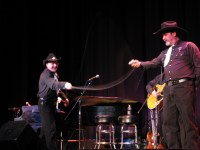
The Brothers & Co Variety Show will perform a 45 minute set at the Schuster December 4. Photo by Jen Copas

Brothers_Co-Whip_Gery_JimIn truth, the experiment had landed them in uncharted waters. Although Ed had done some singing, and Jim, as the most experienced, having performed in theater productions while in school at Kettering Fairmont, Gery and Gary Jr. had virtually no singing experience. But there were some golden nuggets amidst the muddy waters of their four-part vocalization.

Working hard to find their respective parts, eventually everything finally fell into place and they had become singers as well as naturally talented musicians. But with change comes growing pains.

An expanded repertoire and wider variety of music required instrument and key changes and since they guys play their own instruments, staging issues caused shows to come to a dead crawl. But a solution for that problem quickly presented itself, and, as is the norm with this group, Mother Necessity birthed yet another Brothers & Co. innovation – one they like to call, “comagic.

In addition to having a great set of bass singing pipes, Jim Karns is also an award-winning, classical stage magician. In addition, Gery was an accomplished stage bullwhip artist, having performed all over the country and on national television shows like America’s Got Talent and The Bonnie Hunt Show. He and Gery had met while working for an engineering center in Dayton and found they had many common interests, the least of which was a somewhat Vaudevillian sense of humor, one that fit in perfectly with an almost Grand Ole Opry styled stage show.

The Brothers & Co. Bus, NOAH'S ARK

The Brothers & Co. Bus

The new family-friendly routines, originally designed to give time for stage and instrument changes, soon added a whole new dimension to the show. It wasn’t long until “The Brothers & Co. Entertainers” became, “The Brothers & Co. Music and Variety Show.”

After two decades of constant evolution, weekly rehearsals in a specially built room at the Deer family farm, and shows that spanned everything from coffee shops to casinos, The Brothers & Co. have more to offer than just four guys standing around singing. They are a full, family-friendly, stage variety show that can perform virtually anywhere. Their signature black, western outfits designed by Gary, Jr. and Gery’s mother, Lois, are a tribute to their family’s country music heritage.

The group has performed at the Schuster Performing Arts Center, the Victoria Theatre and the casino resorts of French Lick, Indiana, but their home is in Jamestown, and that’s where they want this 20th anniversary to tour to start. Gary Deer, Jr. is the percussionist of the group and sees to most of their technical requirements. “Mostly, we want to entertain people and give them a show like most haven’t seen since the 60’s,” he says.

“We put a modern spin on an old kind of entertainment that’s nostalgic and originally presented all at the same time,” says Jim Karns. “If you’ve never seen a live variety show, this is something the whole family will really enjoy.” To celebrate their 20th anniversary, The Brothers & Co. will present a pre-holiday performance beginning at 7PM, Saturday, November 22nd at the Jamestown Opera House, 19 N. Limestone St., Jamestown, Oh 45335, to benefit the Jamestown Area Historical Society.
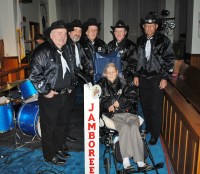
The Brothers & Co. with Gary Deer Sr. and their late mother Lois Deer at the Wheeling Jamboree Radio Show, 2010

The Brothers & Co. with Gary Deer Sr. and their late mother Lois Deer at the Wheeling Jamboree Radio Show, 2010

Gery says the show has something for everyone, and it comes from a place of deep meaning for the family. “This show is hard work, just like anything else of value. It honors our mother’s memory, it gives testimony to the fact that a family can do something together besides watch TV or play a video game. There is a family commitment to The Brothers & Co. that gives other families the chance to bring the kids and enjoy genuine, dare I say it, ‘wholesome’ entertainment that’s just plain fun. It almost doesn’t exist anymore and we rarely get a chance to show it here at home.”

Tickets at the door are $10 for adults, $5 for seniors and students. Children 12 and under are free. Tickets are available at the door the night of the show and for presale at Ted’s Barber Shop, 3 W. Washington St. in Jamestown. Sponsorships are also still available for businesses in the area starting at $100. Proceeds from this performance benefit the Jamestown Area Historical Society. More information is available from The Brothers & Co. website, thebrothersandcompany.com, and from their Facebook page. Watch for The Brothers & Co on the WDTN-TV2 program, Living Dayton, 12 noon, Tuesday November 18.

The creative process cannot be quantified

In Books, Children and Family, crafts, Entertainment, Local News, National News, Opinion, Print Media, Technology, Uncategorized on November 10, 2014 at 1:04 pm

If you haDIH LOGOve any friends who are aspiring novelists and you haven’t seen them for a while, I may know why. November is National Novel Writing Month, a time when writers – hobbyists and professionals alike – forsake virtually everything else in life to get down at least 50,000 words towards a completed novel in just thirty days. As executive director of the Western Ohio Writers Association I am, like many of our members, one of the anticipated 400,000 worldwide participants in the event. But attempting to pen a full-length novel in under a month is not for the faint of heart.

“NaNoWriMo,” as it’s known for short, is a non-profit organization started in 1999. In 2013, more than 310,000 participants signed up, spanning six continents. In the 2014 official press release, NaNoWriMo Executive director Grant Faulkner said, “Every year, we’re reminded that there are still stories that have yet to be told, still voices yet to be heard from all corners of the world. NaNoWriMo helps people make creativity a priority in life and realize the vital ways our stories connect us. We are our stories.”

pcpic1

pcpic1

Given their commitment to the encouragement of writers as a whole, the NaNoWriMo folks certainly seem to want to keep people motivated and working and that extends beyond the November event. The organization also promotes youth programs, writing camps and other writing-focused activities throughout the year.

NaNoWriMo’s organizers insist the purpose of the 30-day novel challenge is to inspire and motivate authors to actually finish something, a common barrier for new writers. To hit the goal, writers must pen approximately 1,667 words per day, regardless of quality. But the “just keep writing” approach doesn’t sit well with some and there are those who say that it instead may be more counterproductive than helpful.

Opponents believe that the idea of such incredible pressure of deadline and competition undermines the inspirational process; robbing the author of the creative time necessary to be more selective of words, phrasing and flow.  Classic American author Mark Twain might well have been in agreement with this thinking.

In a letter dated October 15, 1888 to English minister George Bainton, Twain wrote, “The difference between the almost right word and the right word is really a large matter–it’s the difference between the lightning bug and the lightning.”

nanologoBut those who are regular participants seem to really enjoy a process that they say gives them the opportunity to stay focused and inspires a bit of healthy competition. Throughout the month, each writer updates a public profile on the NaNoWriMo website which includes word count to date; a practice largely appreciated as one of the most motivating aspects of the exercise, or the most discouraging, depending on how you’re doing.

Whether you are a writer or a reader, this is probably a good time to point out that the creative process is not something that can be qualified or quantified. It is different for every artist. While there are people who are proficient with grammar, punctuation, style and general mastery of the English language, there is no such thing as an “expert” writer. Most successful authors – and not just in the commercial sense – will insist that good writing cannot be taught, it has to be practiced and that the creative process is ongoing.

It may very well be that a 30-day novel, after editing and revision, could end up the next New York Times best seller. It is just as probable that another manuscript, in the works for many years, might turn out to be the worst 300 pages ever put to paper. It’s really a coin toss.

Truthfully, the process really doesn’t matter. Although the value of art rests with the audience, its quality depends on the talent, determination and hard work of the artist (writer), rather than the method used for its production. As for those of you typing your way to 50,000 words this month, we who are grateful to get out 700 words every week salute you! Good luck.


Gery L. Deer is an independent columnist and executive director of the Western Ohio Writers Association. More at westernohiowriters.org.

Zombies, the lamest monsters

In Books, Entertainment, Movies, Opinion, sociology, television, Uncategorized on October 20, 2014 at 11:28 am

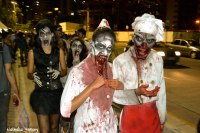
DIH LOGOHalloween is upon us and, once again, zombie-mania continues to reign supreme. From so-called, community “Zombie Walk” events to AMC’s season premier of the “Walking Dead” boasting the highest-rated cable television show in history, Americans certainly seem to be zombie-obsessed. But why; what is it about an animated, decaying corpse that seems to capture people’s imaginations and gets them to shell out millions of dollars in search of the next big zombie fix?

According to the Oxford English Dictionary the word, “zombie,” has its origins in West Africa, but the concept of the animated corpse most likely comes from Haitian folklore. Legend suggests that the dead are raised by magical means to walk the earth again and do the bidding of the one who performed the revival ritual, as a sort of creepy slave.

Zombies first appeared in American popular literature as early as 1929, then shortly after, actor Bela Lugosi, famous for his portrayal of “Dracula,” starred in the film, “White Zombie,” which introduced the familiar personification of the creature. The modern American zombie pop-culture most likely took hold after the release of George Romero’s 1968 film, “Night of the Living Dead,” although they were never actually referred to by that word in the movie.

zombiesZombies in modern tales aren’t usually created by magic, but science. Today’s authors have penned a more realistic origin for what has become known as the “zombie apocalypse.” In most current story plots, a rogue virus escapes to the population, infecting everyone and turning them into, essentially, zombies. Instead of one or two slave zombies on the loose, entire populations of walking dead murderously meander across the globe, destroying civilization as they consume the living for sustenance; right, whatever.

Really, except for the fact that they’re pretty gross to look at and can sneak up on people, as far as monsters go zombies are probably the lamest (pun intended) and least scary creatures ever dreamed up. Think about it – re-animated dead people, hobbling along with one foot dragging behind them and moving so slowly, any granny on a walker could whiz past. What’s scary about that?

These monsters have no motive for being bad and there is no end goal or desire for world domination. They’re just hungry. They wander the night, aimlessly, hoping only to happen upon a fresh brain to consume.

And would someone please explain why they even need to eat anything? They’re dead! What possible nutritional value could there be in anything for a zombie? And why are they bleeding always? Does it need to be pointed out again, they’re dead – there shouldn’t be any blood pumping.

Add to that killing them is really a piece of cake, depending on which version of zombie lore you adhere to. In the modern, “Walking Dead” style, all you need to do is smash in their heads or decapitate them or something. But, according to Haitian lore, the goal was not to destroy them but to release these poor souls from their magically-induced, wandering purgatory and there were several methods available to do that, like pouring salt on them.

In any case, zombies are just not all that intimidating compared to vampires or werewolves (ignoring the Twilight-styled, sparkling, Calvin Klein model types). And yet, inevitably, story protagonists nearly always get caught by the marauding zombies and get their brains eaten. Really, how dumb does someone in a monster movie need to be to actually get caught by a crippled, decaying dead guy?

So, here is the best possible advice for escaping zombies – run! Or, just walk fast; it’s not that hard to get away from zombies. Just be sure to sacrifice the comic relief character first, giving you extra time (not like you need it).

If for some reason the zombie gets too close, and yes, that will be because you are really, incredibly stupid, just grab the arms and pull them off – how hard can it be? They’re dead and decaying, right? Hopefully the zombie fascination will diminish soon, leaving room for even more ridiculous obsessions, like brooding, teenage werewolves. Oh wait, that’s been done already too. Oh well. Happy Halloween!
Gery L. Deer is an independent columnist and business writer. Deer In Headlines is a production of GLD Enterprises Commercial Writing. More at gerydeer.com.


Local festivals must evolve to continue.

In Charities, Economy, Entertainment, Holiday, Local News, Media, Opinion on September 22, 2014 at 12:05 pm

DIH LOGOVirtually every community festival I’ve been involved with around Ohio this season has reported steadily decreasing attendance. Some of them have run for more than a half-century, others only a few years, but regardless of their endurance, the people just aren’t coming like they used to. Could it be time to mothball the town festival and pool resources into larger, joint events like county fairs?

Over the course of the last couple of decades I have participated annually in more than a dozen different festivals and similar community events. Since 2002, I’ve produced the Western Arts Showcase performances at the Annie Oakley Festival in Greenville, Ohio, an event that’s been running for more than 50 years. Sadly, I’ve watched the attendance at these events dwindle year after year to the point where even the vendors aren’t coming.

I hate the idea of our local festivals shutting down, but it’s not possible to perpetuate an event on good intentions. It must evolve with the times. With that in mind, and for those interested in trying to breathe new life into a long-running festival, here are a few ideas to consider.

First, whether you want to think of it this way or not, a town festival is like any other product you’re trying to sell to the public, from toothpaste to breakfast cereal. Consumers have options and getting them to choose your event over another takes effort and money.

Poor marketing on the part of festival organizers is common and usually the result of inadequate funding. It’s simply not enough to pin up cookie-cutter fliers that look the same year after year. Like any business venture, it takes real advertising and legwork to get the word out.

Could deteriorating attendance kill local festivals?

Could deteriorating attendance kill local festivals?

Community organizers should consider another question too, “What is the purpose of the festival?” If the reason is just to have one, then maybe that’s part of the problem. Every event should have an end goal, whether it’s charitable fundraising or increased awareness of what the community has to offer.

Successful events tend to seek out corporate sponsorships; not from local merchants but larger resources. For example, instead of going to the local Pepsi retailer, contact Pepsi’s corporate office and ask to speak to regional marketing reps or district managers. Tell them what you need and they can often direct you to the right department.

Those advanced funds should go toward better marketing and, most importantly, high-end feature entertainment, the real draw to any community event. Organizers should strongly resist the trend toward using the local bluegrass garage band.  Grants are also a potential funding option, but carry oversight burdens and restrictions on festival content.

Financially, local residents don’t provide enough of a revenue base to sustain an event year after year. To keep people coming in, you have to reach outside the area to draw attendees to your event with something to set it apart from all of the others – feature entertainment, unique exhibits, something. Let’s face the facts, there’s no difference between the funnel cakes at your event and those at any other.

Finally, one organizer I spoke to recently suggested that the major roadblock to growing his local festival was the old guard’s resistance to fresh ideas, complicated by an unbreakable, well-established good old boy system – a common problem in small communities. Organization committees are generally manned by those who show up or others who need to feel powerful. If that’s the case, and the argument given against change is often something like, “We’ve done it this way for 20 years and …” and nothing has improved! It’s probably time for new blood.

If no one is willing to change, it may be hard to maintain an event and people will just stop coming. If you belong to an organization that’s trying to decide whether to keep an event running, and few are open to change, ask this simple question. After the bills are paid this year, is there enough money left over from the event to cover start up costs on next year’s festival? If the answer is no, it may be time to hang it up. Remember, nostalgia won’t pay the bills.
The Jamestown Comet.com Editor / Publisher Gery L. Deer is an independent columnist and business writer based in Jamestown, Ohio. More at gerydeer.com

Amateur radio classes offered September 7

In Dayton Ohio News, Education, Entertainment, Media, News Media, Science, Technology, Uncategorized on September 2, 2014 at 8:43 am

The number of amateur radio operators continues to grow as more people realize the role that ham radio can play in providing emergency communication during natural disasters. To help those interested in obtaining a ham radio license, the Greene County Amateur Radio Emergency Service (GCARES) is offering three free Amateur Radio license courses. In addition to GCARES, the courses are supported by the Bellbrook  Amateur Radio Club (BARC), the Upper Valley Amateur Radio Club (UVARC) and the Xenia Weather Amateur Radio Network (XWARN).

radios     The nine week courses will prepare students to take the FCC test for the entry-level technician, the intermediate level general, or the top level extra class licenses. Classes will meet from 7–9 p.m. Sundays beginning Sept. 7.  The exams for all three licenses will be given at 6 p.m. Sunday, Nov. 9. There is no charge for the courses or the test.

   The entry level technician class course will be held in the TrainingCenter at the Bellbrook Amateur Radio Club Clubhouse, Room 1 Sugarcreek Elementary School, 51 South East Street in Bellbrook.  No experience is required and there is no minimum age required to earn a technician class license.  Morse code no longer is required for any amateur radio license.

    The general class course and the test session will be held in the training room at Beavercreek Township Fire Station 61 located at 1298 Dayton-Xenia Road just west of Orchard Lane.

     The extra class course will be held in the training room at Fairborn Fire Station 2 located at 2200 Commerce Center Blvd just south of Dayton-Yellow Springs Road.

      Students are encouraged to have a copy of the respective ARRL License Manual. For more information about obtaining a manual go to gcares.febo.com.

     To register for one of the courses or for more information, please contact Bill Watson, K8WEW,  by email at wwatson4@att.net or by phone between 10 a.m. and 9 p.m. at (937) 426-2166.

Celebrating the paramedic and EMS

In Health, history, Jobs, National News, Opinion, Science, television, Uncategorized on July 21, 2014 at 11:44 am

DIH LOGOWhen was the last time you felt the urge to run into a burning building? What about cutting your way into a mangled car to extract an injured child after a wreck? It takes a particularly kind of person to reject self-protective responses and dive in, head first, to help others. Fortunately, our first responders – firefighters, emergency medical services (EMS) and police officers – never hesitate to do exactly that.

Firefighters and police officers have been around for centuries, but can you remember a time when no one had ever heard of a “paramedic?” Actually, it wasn’t that long ago, only about 45 years. Although there’s no officially recorded origin, the word “paramedic” can be loosely broken down to two parts. The Latin prefix, “para,” means, in this context, “apart from, or beyond,” and “medic” referring to “physician.”

The first paramedic training began in California in the mid 1960s. But in January of 1972, television producers Jack Webb and R.A. Cinader (“Dragnet,” and “Adam 12,”) helped introduce the rest of the country to the concept in a new show called, simply, “Emergency!.”

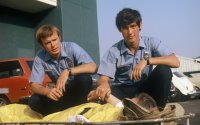
Each week, viewers rode along with a pair of fictional, Los Angeles County Station 51 firefighter paramedics named Johnny Gage and Roy DeSoto, portrayed by actors Randolph Mantooth and Kevin Tighe. Back then, firefighters were skilled in only a minimum of first aid techniques. Paramedic training allowed more advanced medical treatment for victims at the scene, when time is critical, performed at the time under the direction of a hospital physician communicating by radio.

Emergency! aired on NBC for six seasons and introduced the country to the job of the paramedic. (Kevin Tighe as Roy DeSoto and Randolph Mantooth as John Gage).

Emergency! aired on NBC for six seasons and introduced the country to the job of the paramedic. (Kevin Tighe as Roy DeSoto and Randolph Mantooth as John Gage).

For six seasons, using real-life, contemporary techniques, the fictional team of “Squad 51” demonstrated how vital paramedics could be to accident survival rates. Additionally, by shining some Hollywood light on the subject, the show helped ease resistance by doctors who fought the adaptation of advanced medical field support, referring to it as, “remote controlled medicine.”

Paramedics are sometimes referred to inaccurately as EMTs (Emergency Medical Technicians), but there are differences between the two, although regulations and educational requirements can vary. According to the University of Southern California Los Angeles’s Center for Prehospital Care, “EMTs usually complete a course that is about 120-150 hours in length. Paramedic courses can be between 1,200 to 1,800 hours.” But that’s not where the difference ends.

Both fields of study include lectures, clinical and field internships and hands-on skills training such as CPR, administering oxygen, glucose for diabetics and helping to treat asthma attacks. “With very few exceptions, such as in the case of auto-injectors for allergic reactions,” UCLA’s website states, “EMTs are not allowed to provide treatments that require breaking the skin: that means no needles.”

At the time of the “Emergency!” TV series, Los Angeles County, had only about 36 paramedics. But after the show became a hit, applications came pouring in anywhere the programs were offered. As of 2012, StudentDoctor.net reports that there are an estimated 142,000 paramedics and 600,000 EMTs currently working in the United States and that number is growing. From big cities to rural communities, paramedics and EMTs are regularly in great demand.

On September 11, 2001, first responders took center stage, paramedics included, with hundreds giving their lives trying to save the victims of the World Trade Center attacks. Hopefully, our local fire and rescue personnel will never be required to perform such a dire duty, but you can rest assured that if the need would ever arise, they are ready and willing.

I can’t convey how grateful my family was to the men and women of our local EMS (New Jasper Township, in Greene County, Ohio) when I was helping to care for my mother who, in addition to Alzheimer’s disease, also suffered from heart disease. Our emergency medical responders see us at the most difficult, stressful moments of life. So, since we often forget at the time, “Thank You,” from a grateful public to our fire and EMS providers, for all you do to help keep us safe.


Gery L. Deer is an independent columnist and business writer based in Jamestown, Ohio. More at http://www.gerydeer.com

Fire House Poker Run to benefit child victims of domestic violence

In Charities, Children and Family, Entertainment, Local News, State News, Uncategorized on July 15, 2014 at 7:23 pm

IMG_7297On Saturday, July 19, motorcyclists will have the opportunity to participate in the first annual Fire House Poker Run to benefit the “Shoe Barn Project,” a fundraising effort to provide new shoes for children who come through the Greene County Children Services or The Family Violence Prevention Center. Registration begins at 10:30 AM for $15 per bike at Buckminn’s D and D Harley Davidson at 1213 Cincinnati Avenue in Xenia.

With kickstands up at noon from Buckminn’s, participants will ride from one fire house to the next, enjoying the unique look and atmosphere of each and actually driving through several of them as if they were covered bridges.  After a long, scenic tour along the Greene County countryside, including Cedarville, New Jasper, Silvercreek, Jefferson, Xenia and Spring Valley Township fire departments, the ride will conclude at Willie’s Bar in the Xenia Towne Square with an after party featuring gift raffles and entertainment by the Just-N-Time band. Willie’s will be donating 10 percent of sales to the fundraiser.

The first annual Fire House Poker Run is an event organized by First Responders And Bikers Advocating Against Abuse (FRABAAA). According the FRABAAA’s mission statement, the group is, “committed to empowering, educating, advocating, as well as facilitating victims of abuse and violence to become survivor, one HERO at a time.”

IMG_7293Shella Baker is the organizer of FRABAAA. “After helping kids and families who lived in The Family Violence Prevention Center of Greene County (FVPC) what we noticed each year was that, even above toys, children were asking for shoes,” she says. “This really struck me as such a basic need; it was surprising that a lot of children would even think about asking for shoes at Christmas.”

“This past April, during child abuse awareness month, we had a shoe drive with local hospitals and fire departments as well as Samaritan Crisis center and Xenia Walmart,” she says. “We collected shoes to start what has become known as the Shoe Barn Project to benefit the kids housed at the center.”

Supporting the FVPC is a personal mission for Baker, a nurse and paramedic who sees, first hand, the devastating toll domestic violence can take on a family. But Baker’s actions are driven from a much more personal experience – as a survivor of domestic violence. Twenty-five years ago, she and her son took refuge at the FVPC to escape an abuser and now she wants to give back. Today, she has joined with fellow first responders to advocate for victims and promote awareness and prevention, the poker run will help support that cause.

The FVPC began in 1979 as a project of the Greene County Welfare Department known as the Greene County Domestic Violence Project. It started out as a simple, two-bedroom apartment in Yellow Springs but the agency has evolved to provide support and education through services such as a 24-hour crisis hotline and safe housing as well as prevention and outreach programs.

Today the agency is located at 380 Bellbrook Avenue in Xenia and is certified by the Council on Accreditation. It was also recently renamed, The Kathryn K. Hagler Family Violence Prevention Center, to honor the late Greene County leader’s service in advocacy of families and children.

“When FRABAAA started the Shoe Barn Project we wanted to reach out even further to help all kids in the system that have been victims of abuse,” Baker notes. “We hope to one day have a huge operation to help not only Greene County but counties across the state and Country. To make that happen, we need to get more communities on board.”

FIRE_HOUSE_POKER_RUN_1Riders in the poker run will get to actually drive through the fire stations at Cedarville, Xenia and Spring Valley, with a snack stop at the Jefferson Township station in Bowersville. Awards will be given for first, second and third place hands and a Fire House award for the worst hand. For more information about the poker run, visit the group website at http://www.frabaaa.com or call Shella Baker at (937) 789-7262. If you are in immediate need of help in a domestic violence situation, call the center’s crisis line at 937-372-4552 or 937-426-2334.

“When FRABAAA started the Shoe Barn Project we wanted out  reach out even further to help all kids in the system that have been victims of abuse,” Baker notes. “We hope to one day have a huge operation to help not only Greene County but counties across the state and Country. To make that happen, we need to get more communities on board.”

Riders in the poker run will get to actually drive through the fire stations at Cedarville, Xenia and Spring Valley, with a snack stop at the Jefferson Township station in Bowersville. Awards will be given for first, second and third place hands and a Fire House award for the worst hand. For more information about the poker run, visit the group website at www.frabaaa.com or call Shella Baker at (937) 789-7262. If you are in immediate need of help in a domestic violence situation, call the center’s crisis line at 937-372-4552 or 937-426-2334.

Watch the full video interview on WDTN-TV2’s Living Dayton.

IMG_7290


Long-arm quilting services now available at Crafters Lodge in Sugarcreek Plaza

In Business, crafts, Education, Entertainment, Senior Lifestyle, Technology, Uncategorized on July 15, 2014 at 9:05 am

By Gery L. Deer

IMG_7258 Sugarcreek Twp. – A homemade quilt can be a treasured and very personal family heirloom. From the earliest American settlers, the craft of quilting has been passed down from one generation to the next, each adding a new creative style to the process. Once the top of a quilt is completed, it must be stitched to the back with batting in between – a detailed and painstaking process if done by hand. Fortunately, Crafters Lodge in Sugarcreek Township now offers long-arm quilting services and certification classes for those who wish to learn to do the work personally.

A long arm quilting machine is an industrial sewing machine similar to those used in the mattress industry.  It moves along a track or rails and sews the three parts of a quilt together. “We have the American Professional Quilting Systems (APQS) Millennium or Millie as it’s also known,” says Crafters Lodge co-owner, JoBeth Bryant. “The Millennium is the top of the line long arm quilting machine.”

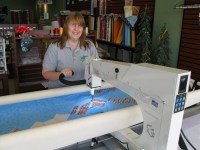
JoBeth Bryant of Crafters Lodge demonstrates the Long Arm Quilting Machine nicknamed, "Millie"

JoBeth Bryant of Crafters Lodge demonstrates the Long Arm Quilting Machine nicknamed, “Millie”

Bryant says the store currently has two certified long-arm operators on staff and walk-ins are welcome. “When you bring your quilt top to us it will be measured and checked for any issues that may affect the quilting process.  Then you can choose the type of quilting you want done and the thread color.”A fifty-percent deposit and signed contract are required at time of drop-off.  Customers can also choose any additional services they may want, such as binding, a hanging sleeve, or a label.

To make the process go as smoothly as possible, Bryant notes that customers should properly prepare the work. “Make sure the backing is square, backing must be at least six inches wider than the top,” she says.  “There are some materials, particularly generic brands from chain stores, which may not be suitable for batting, and they must be clean and odor-free. Check with us for details on acceptable batting and backing materials, both are available in our store.”

Certification classes are also available for those who wish to learn to use the long arm machine and handle the IMG_7254quilting job personally.  Students are given expert instruction on how to load a quilt, threading the machine, wind and load bobbins, access the various features, use of the pantograph, and how to create basic “meander” quilting pattern.

Crafters Lodge is located at 6056 Wilmington Pike, just behind Fazoli’s in the Sugarcreek Plaza in Sugarcreek Township. Regular store hours are Tuesday through Saturday 11:00 am to 8:00pm, Sunday noon to 6:00 pm and closed on Monday. For more information and a schedule of classes, visit the store’s website, http://www.crafterslodge.com or call (937) 470-2649.

Cause and effect of drug advertisements

In Business, Education, Health, National News, Opinion, television, Uncategorized on June 26, 2014 at 10:37 am

DIH LOGOAccording to a 2008 study by the peer-reviewed medical journal, PLOS Medicine, pharmaceutical companies spend nearly twice as much on marketing than research. In a review of the study, the consumer advocacy website, Consumerist.com, indicates, “Drug companies pour $57.5 billion into marketing, dwarfing the comparably paltry $31.5 billion devoted to research.”

Pharmaceutical manufacturers have rigid guidelines for promoting their products, but the question lingers: should non-over-the-counter drugs be promoted to the general public at all? The short answer is, probably not. The longer answer is more complex. Since, as a rule, Deer In Headlines deals with “fact,” not “truth,” here are some facts about drug advertising. Incidentally, if it is truth you’re interested in, check out a philosophy column (thanks Dr. Jones).

The official website of the United States Food and Drug Administration states, “Prescription drug advertisements can provide useful information for consumers to work with their health care providers to make wise decisions about treatment.” Leading the pack of heavily-marketed drugs are prescription sleep aids, blood thinners, anti-depressants and erectile dysfunction remedies. Most of the television ads for these medications appear during the day, carefully targeting certain markets.

What the general public fails to realize, however, is that these ads are intended to plant an idea in the head of the consumer who, in all their medical wisdom, will take the information to a doctor and insist on a prescription. Mission accomplished; more drugs are sold and the company’s stock goes up a quarter of a point, not to mention the fact there is one more person who simply can’t live without the latest pill. Perhaps a better understanding of how these ads are structured might help.

pillsThe FDA’s Office of Prescription Drug Promotion classifies medication advertisements into three categories: Product Claims, Reminders, and Help-Seeking ads.  The product claim ad names the drug, the treated condition and lists the benefits and risks. A reminder ad shows the name of the drug, but not its use. Finally, the help-seeking advertisement is directed at people with a particular condition for which they are trying to find a remedy. There is, however, no guideline for how much money a drug company can spend on advertising and some consumer advocates argue that it’s wrong for them to be able to spend more on marketing than research.

The fact is that it’s really hard to say exactly how much any one drug company spends on research vs. marketing because reported advertising expenditures are mixed in with the accounting category which also includes other figures, such as executive salaries. Research money is usually accounted for in a separate line item (R&D), even though it technically could be in the same classification with general operation costs.

Another fact is that everyone is a medical expert – yes that’s sarcasm. From the neighbor with every ailment more painful than the last or the relative who insists his doctor is an idiot but goes back every time his prescription runs out, self-diagnosis and treatment are a real epidemic in America.

There is also the concern that these advertisements actually plant the idea of a particular illness in the mind of the viewer who then heads to the doctor with a new problem, and a new prescription demand. Studies show that about 40-percent of all doctor visits are with the intention of getting a prescription. Since people keep going back, it’s safe to assume there are plenty of doctors obliging, and that needs to change as well.

Prescription medication should be marketed to the experts who will be prescribing it to the patient. Drug companies already spend billions on advertising and on-site sales representatives who offer samples and various other motivators to get the doctors to push their products for various ailments. The patient has no business self-prescribing and doctors need to be more responsible.


Gery L. Deer is an independent columnist and business writer based in Jamestown, Ohio. Side effects of reading Deer In Headlines include a more open mind, alternative points of view and a better understanding of the world around you. No prescription necessary.


Godzilla: King of the anti-nuclear message

In Entertainment, Environment, Movies, National News, Opinion, Politics, Science, Technology, Uncategorized, World News on May 12, 2014 at 12:00 pm


DIH LOGOIn 1955, the Japanese film company, Toho, Inc., introduced America to “Godzilla, King of the Monsters.” The bulky, green monster terrified audiences in the marginally familiar form of an enormous T-Rex, with notable size differences, muscular body and bigger arms and all brought to life by a puppeteer in a rubbery body suit. Originally called by the Japanese word, “Gojira,” meaning “gorilla whale,” the monster was so successful he’s been a worldwide star since his first black and white appearance in Tokyo.

Uncertain how a Japanese film would fare only a decade after the end of World War II, American exhibitors insisted an “American” element be added to make the dubbed, foreign monster flick more relatable to U.S. audiences. So, who better to report on the devastation than one of the most trusted faces on television at the time, Perry Mason himself, Raymond Burr. Not included in the Japanese version, Burr played an American journalist reporting on Godzilla’s attack into a tape recorder from the safety of a nearby office building.

During the 1960s and 70s Godzilla made his way into color features where his ominous appearance was softened a bit and his character reworked a bit from a menace to more of a hero as he battled other creatures threatening Tokyo from Monster Island. His gigantic, “30-story” upright posture, signature stomp, glowing dorsal plates and fiery breath were a hit with movie goers around the world.

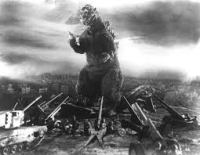
Gozilla's original appearance in Japan, 1954. He appeared in America a year later.

Gozilla’s original appearance in Japan, 1954. He appeared in America a year later.

In 1985, Godzilla reappeared in a more serious, direct sequel to the original. Although the monster had made countless appearances in other, sillier films, like “Godzilla vs. King Kong,” and “Godzilla vs. Mothra,” this reprisal brought Godzilla back to his roots – as a devastating, uncontrollable statement on the increasing nuclear scare at the peak of the Cold War.

Although it was no longer necessary to smooth over American audiences, Raymond Burr reprised his role from the original film in a few scenes added to the U.S. release to provide continuity and attract a nostalgic audience. “Godzilla 1985,” did well at the box office and even better in the newly-minted home video market.

Fast forward a few years to 1998, when the monster was licensed by Tri-Star Pictures for an American, almost campy, version set in New York City. Studied by a worm biologist played by the likable Matthew Broderick (Ferris Bueller’s Day Off / The Producers), Godzilla takes up residence in Manhattan and is hunted by the US Military who manages to lay waste to everything except their target, even wrecking the iconic Chrysler Building. A liberally-preachy, anti-nuclear storyline and a totally computer-animated Godzilla, that didn’t look or act much like the original, completely failed to lure audiences.

Over the years, Godzilla appeared in 28 films and an American cartoon show. He even achieved the honor of a star on the Hollywood Walk of Fame. But the origins of the character are deep in Japan’s nuclear pain and far more serious than most people might know.

Godzilla as he will look in the 2014 version.

Godzilla as he will look in the 2014 version.

Like the newest American incarnation set for release in May 2014, Godzilla is portrayed as a mutation directly resulting from nuclear testing, emphasizing the need to do away with these weapons. He was, essentially, the symbol of everything that can go wrong with nuclear power and weaponry.

The underlying message in the more serious Godzilla story lines is that use of nuclear weapons and power has unimaginable consequences. A mutation that can cause a giant monster with nuclear powered breath is a pretty good personification.

In any case, the new film is sticking closer to the original concept, not just in story but in the look and actions of the monster himself. He’s a rampaging beast and the addition of Breaking Bad’s Bryan Cranston, adds another level of drama to a once-campy character.

In no loss of irony, Japan is the only country in the world whose people have experienced the horrible result of nuclear devastation and America is the only country who has ever inflicted it on anyone else. It’s somehow fitting that people from both countries come together to create a fictional character that personifies the horror that can result.
Gery L. Deer is an independent columnist and business contributor to the WDTN-TV2 program, Living Dayton. More at http://www.gerydeer.com.