Local News & Commentary Since 1890.

Archive for the ‘Education’ Category

Hogan’s hero: author celebrates life of slain actor

In Books, Charities, Education, Entertainment, Local News, National News, Opinion, television, Uncategorized on June 13, 2016 at 8:20 am

Deer In Headlines
By Gery L. Deer

DIH LOGOIn 1978 “Hogan’s Heroes” star, Bob Crane, was murdered in his Arizona hotel room. The scandalous details of his death have been the subject of speculation and salacious headlines ever since. Crane’s murder was never solved.

I won’t give more press time to the dark circumstances surrounding this man’s death, except to say that Americans can’t seem to ever get enough of sensationalism when it comes to celebrity. Over the years a great deal of negative material has been written about the actor’s life, troubled marriage, divorce and personal addictions, and that was all anyone ever seemed to say about him.

13442349_10153959108224342_9123420470911191836_n

Gery L. Deer, with author Carl M. Ford at the Liberty Aviation Museum in Port Clinton, OH

Always left out of those stories were the facts about Crane’s long career in entertainment and the character he couldn’t leave behind. Barely spoken of were his level of commitment to his colleagues, to his children and to the armed forces to whom he felt a deep responsibility and connection through his “Hogan’s” character and his older brother, Al, who was severely injured while serving in World War II.

Enter author Carol M. Ford, who has written a new biography about Bob Crane in a dedicated effort to celebrate the life and career of this beloved actor. Her care and commitment to restoring this man’s honor and humanity is nothing less than incredible.

I had the good fortune, recently, to meet Ms. Ford and talk with her about her experience in writing this book. She was holding a signing at the Liberty Aviation Museum in Port Clinton, Ohio, on the shores of Lake Erie. Next to her table was a display featuring a very important artifact – Col. Hogan’s leather flight jacket from the “Hogan’s Heroes” series.

“We all have those parts of our lives that we’re not proud of,” she told me. “Divorce, family strain, addictions, whatever it is, everyone has something. The sad part about Bob’s death is less about how he died but that how he lived had always been so completely overlooked. This is a celebration of his life.”

Ford’s new book, “Bob Crane: The Definitive Biography,” is a fitting tribute to a man whose life is, to most fans, a blur between fact and fiction, where the focus has been for more nearly 40 years on his death. This book chronicles, in great detail, Crane’s life as told by family, friends, colleagues and fans who had the good fortune to share a moment with him.

Ford’s research is impressive, having collected interviews from nearly 200 people who actually knew Crane. Going as far back as elementary school, the interviews, photos and stories provide us with a real picture of the man we loved as Colonel Hogan but who was obviously so much more.

Bob Crane's costume jacket from Hogan's Heroes is on display at the Liberty Aviation Museum in Port Clinton, OH

Bob Crane’s costume jacket from Hogan’s Heroes is on display at the Liberty Aviation Museum in Port Clinton, OH

Crane’s character of Hogan was a hero to me, and to countless others of my generation. But, like so many celebrities, most of us never knew who he was outside of Stalag 13 or away from the microphone.

As a fan, I am grateful to Ford and her colleagues for writing this book to focus on the life of a man I had admired since childhood. Much of my stage persona comes from watching him – and Colonel Hogan. I’m glad I get to understand the man over the mystery.

This wasn’t intended to sound like a book review, but I have a great respect for the effort, time and commitment that went into this book. As a fellow writer, I can’t imagine the work, personal expense and thoughtful insight that went into the attempt to capture the life of someone whose life was so full and still resonates today with all those who knew him.

You can find the book Barnes & Noble, on Amazon and at the website for the official campaign to have Bob Crane entered into the National Radio Hall of Fame www.vote4bobcrane.org. I highly recommend the hardback version, filled with historical documents, more than 200 pictures and more. So, all my thanks to Bob for his talent, and to Carol Ford for hers.

*******

Author’s Note: I strongly related to the idea of writing the positive of a celebrity’s life after they’d died in scandalous circumstances. A colleague and friend of mine, well known in the media, passed away suddenly after a long struggle with addiction and depression. The only things the media would write about seemed to be the negatives in her life and the circumstances surrounding her tragic death. I couldn’t let that stand. I wrote a piece, from her own word as she had told me, of the good in her life, the promise and the hope. It is my hope that her legacy carries more of that than of her ending, as I hope with Carol’s book and Bob Crane’s story. 


Gery L. Deer is an independent columnist and business writer. Deer In Headlines is distributed by GLD Enterprises Communications, Ltd. More at deerinheadlines.com.

Fitting in at Hamvention.

In Education, Local News, Opinion, sociology, Technology, Uncategorized on May 24, 2016 at 8:30 am

Deer In Headlines

By Gery L. Deer

DIH LOGOWe all have it; that one single thing about ourselves that makes us either feel different or seem weird to other people. Different and weird are relative terms, of course, depending on the perception of those around us.

For example, someone walking around a cattle ranch in Birkenstocks and shorts might seem incredibly out of place. Is it weird to be wearing this kind of apparel or just so because of the location? It really depends on the observer.

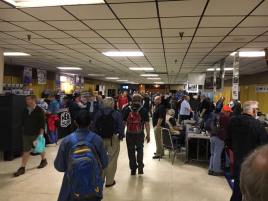
Case in point. This past weekend I attended my very first “Hamvention;” the massive amateur radio convention held in Dayton, Ohio each spring. Hamvention, which is a registered trademark by the way, has for many years been the world’s largest amateur radio event dating back to 1952.

It’s organized and sponsored by the Dayton Amateur Radio Association (DARA) and draws thousands each year to attend workshops, learn about new technologies and shop the hundreds of vendors selling everything from antennas to software. I was raised around the CB radio, but never really exposed to the culture surrounding “ham” users. Incidentally, the term “ham” is a derivative of the colloquial name for an amateur radio operator.

Unlike citizen band (CB) radio, amateur radio requires an FCC license and operates on a different set of frequencies and power guidelines. Each operator is assigned an alphanumeric call sign that become a kind of personal nickname in the ham circle.

13244704_10153908418374342_9000172653944694244_nI admit some trepidation about attending, even though the adventure was my idea. My hesitation was mostly due to the shadowy reputation ham operators have for being made up mostly of the off-your-rocker survivalist, who walks around with a bag full of canned beans, a shotgun, and a ham radio and 15 foot antenna sticking out of his backpack. With no first-hand experience, it all seemed a bit bizarre.

Now, before I go much further, I need to point out here that I am no stranger to the bizarre. I’ve spent a good portion of my free time at science fiction conventions. You know, full on “Star Trek” events complete with green people and otherwise normal folks walking around speaking Klingon to each other.

Instead of me thinking the convention goers were odd, I’m the one who actually felt weird and strangely out of place. What I experienced, standing there amidst thousands of people from very different walks of life, was a fascinating collection of people, all of whom had one thing in common – their interest in amateur radio.

13263851_10153908418309342_1241895779973128889_n

Geiger counters and radiation detection of all kinds … at Hamvention 2016 – Photo GLD Enterprises Communications, Ltd.

Yes there were some, what I would normally describe as, oddballs, as well as stereotypical survivalist types. In fact, one vendor sold nothing but Geiger counters. I couldn’t have imagined where a table full of Geiger counters would look at home, carefully packed together like someone had spray painted yellow all the pieces of a life-sized Tetris game.

Still, I’m the one who didn’t look like he belonged there. But it was fascinating how people were sharing their knowledge and experiencing the trade and technology of ham radio as if it was a big group of friends who’d never met and only got together on this one occasion.

People tend to congregate with those of common interest. Conventions like this are representative of virtually all aspect of our sociological makeup as human beings. From churchgoers and athletes to writers and amateur radio enthusiasts, an interest or devotion to a culture or activity brings people together in a consistently predictable way that nothing else can.

We should all have that one thing that makes us feel odd or weird, so long as we remember we’re not alone. When we come together with others of similar interests, great things can happen. We learn, grow, and build friendships that might otherwise never have come about.

In the end, I was indoctrinated into this eclectic family. On his birthday, Jim bought himself a couple of hand-held radios but got one for me as well. I guess it’s time for me to go take the test and get my license. I’m just relieved you’re no longer required to learn Morse code. Oh, Happy Birthday, Jim and thanks.


Gery L. Deer is an independent columnist and business writer. Deer In Headline is distributed by GLD Enterprises Communications, Ltd. More at gerydeer.com

Get smart about birth defects.

In Children and Family, Education, Local News, Opinion, Science, Technology, Uncategorized on March 3, 2016 at 8:12 am

Deer In Headlines
By Gery L. Deer

DIH LOGOAccording to the March of Dimes, one out of every 33 babies in the United States is born with some kind of birth defect. The severity of these problems is broad reaching, from minor defects needing no intervention at all to those requiring invasive surgical treatment.

It’s important that people understand how many different kids of birth defects exist and how they affect the child, and the family. A structural birth defect occurs when a part of the body is missing or deformed. Kidshealth.org reports that heart defects are the most common of these but others include cleft palate and spina bifida.

When the child’s body chemistry is affected, it’s called a metabolic defect, which prevent the body from breaking down food for energy. Tay-sachs and phenylketonuria (PKU) are examples of this kind of defect. Causes of birth defects are not always clear but may include a combination of genetics and outside influences such as prescription drug use.

My mother, Lois, was epileptic. Sometime in her 20s she was prescribed phenobarbital to help reduce seizure events. Phenobarbital is an FDA-approved drug introduced in 1912 and was presumed safe. Mom took it for decades, including during the entire time she was pregnant with me.

According to findings by the North American Antiepileptic Drug (AED) pregnancy registry, and countless medical studies, phenobarbital has been linked to a myriad of birth defects. Research shows the drug to have some negative effect on an expectant mother’s level of folic acid.

Photo Courtesy ScienceMag.org

Photo Courtesy ScienceMag.org

Enter, me. I came into the world in the late 60s, fat, happy … and somewhat inside out. I was blessed by one of those structural birth defects mentioned earlier, apparently the result of my mother’s anti-seizure medication.

Without getting into specifics I had an internal organ protrusion to the outside through a defect in the abdominal wall, missing vertebra, malformed hip joints and several other related deformities.

As a result, I was neither expected to walk nor was there any exact estimation of a prognosis. Much of the surgical procedures involved in my care had yet to be invented and it took many years to get some of it right. Fortunately, nearly a half century later, thanks to medical science and my family’s level of faith and determination, I’m up and walking and in relative good health.

During her pregnancy with my two siblings in the early 1950s, my mother was not yet on the drugs and they were born with no similar issues. And, although the exact causes of my defects were never conclusive, mostly due to the lack of medical knowledge on the subject at the time, the drug angle is widely accepted as fact.

Countless lawsuits are going on to help families of those children affected by these drugs. But that’s a little like closing the barn doors after the horses have come home.

After decades of experimental surgery, trial and error medicine, and, at many times, constant pain, when I see an expectant mother smoking or drinking or doing something equally as stupid, I just want to scream. She has no idea what she is probably doing to her child and what he or she will go through because of it.

My mother and her doctors didn’t know that her treatment would do such damage to her youngest child’s life. But now, in our modern day of free and easy access to constant information, how can anyone be so ignorant as to do that to an unborn child?

And spare me the speeches and excuses about addiction. If you’re pregnant, you stop. If the life of your unborn child isn’t enough motivation to make you put down the bottle, or whatever it is that makes you a bad risk, nothing will be. You have to do whatever it takes to stop and hope the damage isn’t already done.

The point is that there are things we cannot control for our children and those that are entirely up to us. Do not consciously put your child through the kinds of horrible things I experienced because of a lack of knowledge or an unwillingness to change.


Gery L. Deer is an independent columnist and business writer. Deer In Headlines is distributed by GLD Enterprises Communications, Ltd. More at deerinheadlines.com


Game Plan for Super Bowl 50: Are You Drinking or Are You Driving?

In Education, Health, Sports News, Uncategorized on February 1, 2016 at 9:45 am

This is NOT the Time for an Option Play

XENIA, OH – The Super Bowl is America’s most watched national sporting event. On Super Bowl 50 Sunday, February 7, there will be lots of game day socializing that may include drinking. That’s why the U.S. Department of Transportation’s National Highway Traffic Safety Administration, Greene County Safe Communities Coalition and Greene County’s highway safety and law enforcement officials are urging football fans to call the play now: drinking or driving.

safe communities logoIf you plan on drinking on Super Bowl Sunday, designate a sober driver to get you home safely. NHTSA’s Fans Don’t Let Fans Drive Drunk campaign encourages people to make plans ahead of time that will prevent them from getting behind the wheel of a vehicle after drinking.

Driving impaired could result in injury or death for you or others on the road. According to data from NHTSA, in 2013 10,076 people were killed in alcohol-impaired-driving crashes in the United States—31 percent of all vehicle crash fatalities in the nation. The numbers go even higher on weekends. (There were 5,637 alcohol-impaired driving fatalities, making up 41 percent of all fatalities that occurred during weekends.)

A driver is considered alcohol-impaired with a blood alcohol concentration of .08 or higher, the set limit in all states. This February 7, don’t become a tragic Super Bowl stat.

“Drunk driving is completely preventable,” said Ashley Steveley, Greene County Safe Communities Coordinator. “All it takes is a little planning. We want fans to remember that it’s a choice. Drink or drive—but never do both.” For those who plan to drink, leave your keys at home. Designate a sober driver, whether it’s a friend, relative, taxi, ride share or public transportation. Use NHTSA’s new SaferRide mobile app.

The app helps people who have been drinking get a safe ride home; it helps users call a taxi or a friend and identifies their location so they can be picked up. The app is available for Android devices on Google Play, and Apple devices on the iTunes store. For those who plan to drive, refrain from any alcohol.

Instead, enjoy the game with food and nonalcoholic drinks. Being a sober, designated driver is a key role on Super Bowl Sunday. You might just save a life. Press Release Page 2 of 2 If you’re hosting a Super Bowl 50 party, designate a responsible driver before the game begins. One way to thank your designated driver is by tweeting us their name during Super Bowl 50, which will appear on NHTSA’s Wall of Fame.

If you’re the designated driver, be sure to tweet us your name during Super Bowl 50, and make NHTSA’s Wall of Fame! For more Super Bowl weekend safety information, visit www.trafficsafetymarketing.gov/SuperBowl For more information on the Greene County Safe Communities Coalition, please contact Ms. Steveley at 937- 374-5624 or email her at asteveley@gcph.info.

PREVENT BLINDNESS DECLARES NOVEMBER DIABETIC EYE DISEASE AWARENESS MONTH

In Charities, Children and Family, Dayton Ohio News, Education, Health, Local News, National News, Senior Lifestyle, Uncategorized on November 6, 2015 at 3:35 pm

Dayton, OH – In an ongoing effort to help educate the public on diabetes risk factors and prevention strategies, Prevent Blindness has declared November as “Diabetic Eye Disease Awareness Month.”

Diabetes is the leading cause of new cases of blindness in adults. The National Eye Institute reports that diabetics are 25 times more likely to become blind than people without the disease. But when detected early, the blinding effects of diabetes can be lessened.

According to a recent study from Prevent Blindness, more than 8 million Americans have diabetic retinopathy, the most common diabetic eye disease. By 2032, that number is projected to increase by 35 percent.

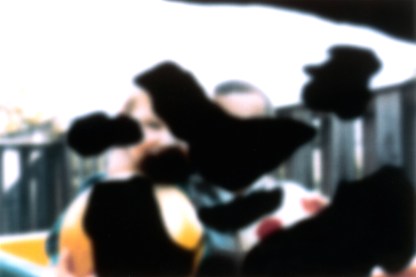
This is something like the world might appear to someone with diabetic retinopathy.

This is something like the world might appear to someone with diabetic retinopathy.

Those suffering from the disease may not experience any symptoms at first. However, as the disease progresses, patience experience a variety of symptoms including spots in the field of vision, varying blurred vision, and complete vision loss.

“With diabetes reaching epidemic levels across the US, Prevent Blindness urges everyone to get a dilated eye exam annually or as often as your eye health care professional recommends,” says Katie Neubert, the Dayton Area Manager of Prevent Blindness. “Eye care professionals can detect diabetes in its early stages, sometimes even before the patient has any idea.”

Diabetics are at risk of developing diabetic eye disease that can permanently damage their vision and even lead to blindness. Some factors can put some at higher risk for vision loss, include, age, ethnicity, duration of the disease, blood sugar control, hypertension, kidney disease and pregnancy.

“For those already diagnosed with diabetes, a doctor can help monitor vision and advise you of the necessary steps to take today to help lessen the impact that the disease may have on your sight,” Neubert says.

Prevent Blindness offers a variety of free resources dedicated to the education of diabetic eye disease including its dedicated website, preventblindness.org/diabetes. For more information contact Dayton Area Prevent Blindness by calling (937) 223-8766.

Community colleges are vital to economy

In Business, Economy, Education, Politics, State News, Uncategorized on October 26, 2015 at 9:42 am

Deer In Headlines

By Gery L. Deer

DIH LOGOAs college tuition continues to climb, more students are going into debt from loans or even dropping out because of the expense and the cycle is getting worse, not better. According to a 2013 estimate by Forbes magazine, students in the U.S. owed a whopping $1.2 trillion in tuition loans and that number is climbing.

Upon graduation, the average student will need to work enough to live while trying to pay off nearly $25,000 in loan debt. This is one reason community colleges are gaining ground as the first, best option for people who want a solid education that leads to gainful employment – and for less money.

Not too long ago the Obama administration announced the importance of community college and an effort to make them tuition-free for low-income families. While there is merit to the sentiment, the idea that an Ivy Leaguer, like the president, speaks as if he just discovered the value of these institutions always comes across as elitist and insulting.

When highbrow critics slam community college curriculum as easier, less valuable, or someplace only the low-performers go, it only serves to make those ivory-towered onlookers appear less intelligent. For some people, the community college serves to fill in educational gaps left by their high school experience.

College_graduate_students (1)The department of education reports that 40-percent of students who set out to earn a four-year degree still have not completed it by year six. Even so, many guidance counselors don’t suggest community college to lower-income or poorly performing students out of a sense of political correctness.

If the counselor sincerely suggests to a low-income individual, particularly a minority, that community college might be their best option, he or she could very well appear racist or the like. As a result, many students head for universities who may either not be ready for it academically or who simply cannot afford it.

Of course, not all community colleges are created equal. There are certainly those institutions that need curriculum improvement, which is why these schools must make every effort to attract talented faculty.

The Dayton, Ohio area has about a half-dozen, highly rated community colleges including Edison Community College, ITT Technical Institute, and, the fastest growing and largest, Sinclair Community College. Established in the basement of the Dayton YMCA in 1887, Sinclair is the oldest and often rated as most popular in the region and a leader in healthcare and high tech education.

Sinclair established university parallel programs more than 25 years ago, providing students the opportunity to earn an associate’s degree in engineering and other programs that transfer directly into four-year schools like University of Dayton and Ohio University, Athens. Many community colleges today offer this type of continuing program to allow students to build momentum in their college careers and nail down the academic path that most suits their goals.

Community college is an amazing opportunity for many students, allowing for more hands-on training that is generally possible at the university level and from people who have worked in the field. Most community college instructors and professors have spent years in real-life work situations, not just in academia and theory.

As it has been since their inception, community colleges also tailor programs for adult and continuing education students. From evening courses to satellite classes, adult students can earn their associate’s degree or work toward a certificate required to advance in their current job. Some larger employers even collaborate with the colleges to offer the course work on site.

Whatever the reason, lower tuition, work advancement or kick starting a longer academic career, community colleges offer a great many options for students and are not merely the “last resort.” Education and knowledge are what grow an economy, not political rhetoric and empty promises.

The university experience is simply not for everyone, regardless of academic prowess and financial means. Americans must relieve the stigma associated with community college programs and present instead a unified front for educational options in the 21st Century. Everyone benefits from education, workers, employers, the community and the country.


Gery L. Deer is an independent columnist and business writer. Deer In Headlines syndicated by GLD Enterprises Communications. More at gerydeer.com.

Amateur radio license classes start Sept 13 in Beavercreek

In Dayton Ohio News, Education, Local News, Science, Technology, Uncategorized on August 31, 2015 at 2:57 pm

radiosGREENE COUNTY, OH – Anyone interested in obtaining or upgrading an amateur (ham) radio license should sign up for one of the Amateur Radio license classes being offered by the Greene County Amateur Radio Emergency Service (GCARES) starting on Sept. 13. The classes will meet from 7 to 9 p.m. each Sunday through Nov. 8.  A test for all classes of licenses will be given Nov. 15 at 6 p.m. in the Training Room at Beavercreek Township Fire Station 61, 2195 Dayton-Xenia Road.

There is no charge for the classes  which are supported by the Bellbrook  Amateur Radio Club (BARC), the Upper Valley Amateur Radio Club (UVARC) and the Xenia Weather Amateur Radio Network (XWARN) in addition to GCARES.

The entry level Technician Class course will be held in the Training Center at the Bellbrook Amateur Radio Club Clubhouse, Room 1 Sugarcreek Elementary School, 51 South East Street in Bellbrook. No experience is required and there is no minimum age required to earn a Technician Class license. There is no Morse Code requirement.

The General Class course and the Test Session will be held in the Training Room at Beavercreek Township Fire Station 61 located at 2195 Dayton-Xenia Road just west of Orchard Lane.

The Extra Class course will be held in the Training Room at Fairborn Fire Station 2 located at 2200 Commerce Center Blvd just south of Dayton-Yellow Springs Road just east of I-675.

To register for a courses or for more information, please contact Bill Watson K8WEW by email at wwatson4@att.net or by phone between 10 a.m. and 9 p.m. at (937) 426-2166.

How secure is your child’s information at school?

In Children and Family, Education, Opinion, Technology, Uncategorized on August 10, 2015 at 12:48 pm

Deer In Headlines

By Gery L. Deer

DIH LOGOA high quality digital learning experience for students is something every school strives to accomplish. But as a parent, have you ever wondered just how your child’s educational and personal records are protected? It is possible that schools are unintentionally putting student privacy at risk.

Some student information, such as that disclosed when using digital learning material, may be managed, not internally at the district level, but by what are known as educational technology, or “edtech,” companies. That information can also end up in the hands of marketing companies and other third-party data collectors.

Joni Lupovitz is the vice president of policy at Common Sense Media, a nonprofit organization that rates the safety of media and technology for students and families. In a recent article on DistrictAdministration.com, Lupovitz says, “Everything is going digital, whether it’s taking attendance, seeing what kids buy for lunch, collecting and storing records, or integrating laptops and tablets into the classroom lessons.”

To ensure every child’s privacy, parents should ask questions such as the following. Does your school outsource edtech services and systems? If so, what are the company’s privacy policies and how do they compare to those of the school district? You have every right to know exactly where your child’s data is being used, who has it and how they manage that information.

schoolroomHow is the wireless computer network in the school system secured? Does the school system provide in-house information technology support or is it outsourced? Who has access to security information? What guarantees are in place regarding the security of any cloud system being used?

Unlike medical record management, legislation governing the management of students’ electronic personal information continues to lag. Even the Family Educational Rights and Privacy Act (FERPA), designed to help restrict access to student records, does not adequately address these issues since it only speaks to the improper disclosure of personal information.

If a school utilizes an outside edtech vendor for record keeping or other digital data management, they may be unaware of holes in the company’s privacy agreement allowing them that provider to sell collected information under certain circumstances. School administrators should then be held responsible to maintain control of that information and have a complete understanding of how the data might be used by the vendor.

Beyond the administrative holes in security and privacy, education of the student (and parents) on safe and proper use of technology is sorely lacking. Most people still have no idea of the security risks when using public wireless access.

Parents should also ask about the security of any websites being hosted by the administration where school information is readily available. Is private data, such as performance or attendance records, easily accessed? Is the data encrypted and to what extent? Be sure to read any privacy paperwork provided and make sure it’s well understood. If not, ask!

Parents must take the time to visit any and all websites managed by the school and familiarize themselves with the layout and information offered there. Sadly, better security usually means more expense, so there is every possibility that substance (good security) gave way to style (a prettier website).

If your child has a smart phone, laptop or other portable technology and utilizes the school’s Wi-Fi system, you may want to reconsider. Public Wi-Fi, even in a school, is insecure and should never be used to access personal or private information like banking, private email, or any other sensitive data.

Whenever a user logs into a website or online account through a public wireless system, there is a risk of breech. Without getting into the techno-babble of how it works, suffice to say that hackers “tag” certain Wi-Fi access points to collect data as people log in. This can happen at schools just as easily as anywhere else.

The take-away from all of this is that parents should be diligent in their understanding of how technology is used at school, whether it’s data management by the administration or Internet access by their child. Schools have an obligation to transparency, especially with regard to student records.

Further Resources:

https://www.commonsensemedia.org/kids-action/issues/privacy-and-safety

http://www.districtadministration.com/article/asking-edtech-vendors-tough-questions

http://www2.ed.gov/policy/gen/guid/fpco/ferpa/students.html

http://www.education.com/reference/article/what-educational-technology/


Gery L. Deer is an independent columnist and business writer. Deer In Headlines is distributed by GLD Enterprises Communications. More at gerydeer.com


Books and Co. hosts live reading by local authors of WOWA, June 19

In Books, Children and Family, Dayton Ohio News, Education, Entertainment, history, Local News, psychology, Technology on June 15, 2015 at 5:38 pm

IMG_0030Beavercreek, OH – Beginning at 7pm on Friday, June 19, author members of the Western Ohio Writers Association (WOWA) will take the microphone at Books & Co. to present their popular, “Beatnik Café” event. Writers from all genres will regale visitors with original works of poetry and prose to the theme, “Leave No Trace.” The event is free and open to the public.

The live reading pays homage to the hole-in-the-wall poetry clubs of the 1960’s, but with a more modern style. Reading aloud from original work, each writer will take the stage for 10 to 12 minutes, dazzling audiences with short stories, poetry or who knows what.

Barbara Deer is the co-founder of the organization. “WOWA was intended to provide a regular resource for peer critique, educational programs and networking opportunities to local writers of all genres, both amateur and professional,” she says. (Click to watch the television interview about last summer’s Beatnik from WDTN-TV2, Living Dayton 6-12-2014)

Barbara Deer, WOWA co-founder.

Barbara Deer, WOWA co-founder.

“Annual workshops are held all around the country, with two of the most well-known right here in the Miami Valley. But for most writers to thrive that type of support needs to come on a more regular basis,” Deer says. “Our group consists of professional writers and editors, college professors and everyone is ready and willing to offer help, a fresh eye and, sometimes more importantly, an honest opinion about the quality of the work – good or bad.”

wowa-beatnik

Writers come from all around the region – southwest central Ohio, eastern Indiana and northern Kentucky – to attend monthly critique sessions, educational lectures and write-in events. Meetings are held on the first Thursday of the month at the Event Connections, 4140 Linden Ave. in Dayton, near the intersection of US 35 and Woodman Drive.

WOWA Logo 2Now in its seventh year, this talented group of scribes definitely have plenty to celebrate. In addition to the many individual members who have been published on their own, in May of this year eleven of them were featured in an anthology titled, “Flights of Fiction,” produced by GLD Enterprises Commercial Writing and published by Handcar Press (ISBN: 978-0-9885289-4-9). The book features stories set in and around the southwest Ohio region and is available in print and electronic formats from the WOWA website as well as Amazon and BN.com.

The Beatnik Café is a family-friendly, free, public presentation of WOWA and GLD Enterprises Communications. Books & Co. is located at 4453 Walnut St. at The Greene in Beavercreek. For more information, go online to www.westernohiowriters.org or call (937) 902-4857.

Yoga studio ribbon cutting and free class in Beavercreek May 19

In Business, Dayton Ohio News, Economy, Education, Health, Religion on May 5, 2015 at 1:05 am
Innerlight Yoga and Wellness offers a variety of classes.

Innerlight Yoga and Wellness offers a variety of classes.

Beavercreek, OH  – Innerlight Yoga and Wellness invites the public to share in celebration as they cut the ribbon on a new facility and celebrate a second anniversary in Beavercreek. A free open house is scheduled for 5:00PM, Tuesday, May 19, 2015, at the new location, 1265 N Fairfield Road, with the official ribbon cutting ceremony slated for 5:30PM. Open house visitors are also invited to attend a free, 45-minute, “all levels” yoga class beginning at 6:15PM, RSVP requested.

Jen Ater is the owner of Innerlight Yoga and Wellness. She has been teaching since 2005 and holds a master’s degree from Antioch University in yoga studies with a focus on yoga therapy.

Ater started out in Indiana but opened her first studio in Yellow Springs, Ohio in 2008, then moved to Beavercreek five years later. Innerlight Yoga and Wellness offers somewhere between 24 and 26 classes each week ranging from gentle, restorative yoga to more active, hot power yoga. The studio also offers private yoga sessions, massage, yoga therapy, and other wellness services.

“We have a wide variety of classes, as a human being shows up in many different body shapes and sizes, different ages, different health and mobility issues,” said Ater.  “So, I find that it’s important to offer yoga that’s available for everyone and make it as inclusive as possible.”

Jen Ater, Instructor and owner of Innerlight Yoga and Wellness.

Jen Ater, Instructor and owner of Innerlight Yoga and Wellness.

“I try, on the fly, to present yoga to all different types of people in a down-to-earth way,” said Ater, who, over the years, has taught yoga in diverse settings from chiropractic offices to juvenile detention centers. “Sometimes maybe I failed, but I think that someone who is truly successful has to fail quite a lot in order to really know what they’re doing.”

“I don’t think there’s anyone with as much experience teaching in as many different environments,” she suggested. “And people like the simplicity of our studio. It’s well-kept and organized. It’s also not an overly feminine environment, but very neutral in terms of feminine or masculine.”

Outreach is also a big part of the mission at Innerlight. “I am not

Watch Jen Ater on WDTN, TV2's LIVING DAYTON --- http://wdtn.com/2015/05/14/innerlight-yoga-wellness/

Watch Jen Ater on WDTN, TV2’s LIVING DAYTON — http://wdtn.com/2015/05/14/innerlight-yoga-wellness/

happy, unless I feel like I’m helping people,” explained Ater. Although the programs are not yet in order, Ater has a history of organizing community outreach programs such as the YS Youth Yoga Project, a grant-funded free yoga immersion for Yellow Springs School’s students and staff. “Three percent of the studio’s revenue will go towards outreach programs to bring yoga to schools and other organizations that cannot afford to provide classes,” she continued. “We want to make a difference, on many levels.”

Light refreshments will be provided at the open house, and space is limited for free yoga class, so those interested in attending are asked to RSVP by email to Erin at info@innerlightwellness.net. For more on classes and schedules, call 937-306-8235 or visit Innerlight Yoga and Wellness online at http://www.innerlightwellness.net. CLICK HERE to watch the WDTN-TV2 interview with Jen Ater.

Is this your new site? Log in to activate admin features and dismiss this message
Log In