Local News & Commentary Since 1890.

Archive for the ‘Business’ Category

Jamestown communications firm adds IT services

In Business, Dayton Ohio News, Local News, Media, Technology, Uncategorized on January 7, 2015 at 7:35 pm

JAMESTOWN, OH – Jamestown-based marketing and PR firm GLD Enterprises Commercial Writing has announced it has merged services with its sister company, Deer Computer Consulting, Ltd., as of January 1, 2015 under the new name, GLD Enterprises Communications. The move combines on-site IT and computer support with the firm’s current line of business communications services.

Deer Computer Consulting, Ltd. was founded in March of 1998 by Jamestown, Ohio entrepreneur and author, Gery L. Deer. The company provides a wide range of technology support for home and small business users including computer repair, mobile device service, anti-virus and Internet security, document management and digital integration.

Shortly after the IT support business proved to be successful, Deer created a second start-up focused on entertainment and marketing that eventually became, “GLD Enterprises.” Both companies have operated simultaneously, but separately, until some market research indicated how much clients would benefit by the unique blend of services.

Writer, Entrepreneur Gery L. Deer, owner of GLD Enterprises Communications.

Writer, Entrepreneur Gery L. Deer, owner of GLD Enterprises Communications.

“Without our technology to provide us with a means of exchanging information, the rest of our communications material is pretty useless,” said Deer about the pairing of seemingly very different businesses. “We already provide both levels of service to many of our clients. Now it will be more convenient for customers to take advantage of everything we offer.”

Deer noted that his company was one of the first in the area to offer on-site computer service and has never been a marketing arm for a retail company like many of its competitors.  “My goal has always been to make the technology suit the user, not the other way around,” Deer explained. “Most tech support people have stuff to sell and do their best to shoe-horn hardware and software into a user’s life without much regard for how it is used or the needs of the customer.”

Until now, GLD Enterprises has primarily serviced the commercial communications market. But Deer explained that, “By adding the Deer Computer Consulting line of services, we are able to expand into the residential base as well. This adds another revenue stream to our business and allows us to better support our customers, all under one roof.”

According to Julie Hicks, GLD Enterprises business development manager, “Current customers of Deer Computer Consulting, Ltd. will remain so with no changes in service or rates. And, as always, we will still come to you.”

GLD Enterprises Communications updated logo. The red circle signifies the addition of "technology support" to the company's offerings.

GLD Enterprises Communications updated logo. The red circle signifies the addition of “technology support” to the company’s offerings.

GLD Enterprises Communications has no store front but operates only as an on-site support service and there are no plans for a change. “Excessive, unnecessary overhead kills small business and the consumer shouldn’t have to pay for the business owner’s extravagance,” said Deer, who is also a prolific business writer and the resident consumer expert for the WDTN-TV2 daytime television program, “Living Dayton.”

A full list of the company’s services is available online at http://www.gldenterprises.net or by calling (937) 902-4857.


E-commerce that supports local business

In Business, Economy, finances, Holiday, Local News, National News, Technology, Uncategorized on November 26, 2014 at 4:25 pm
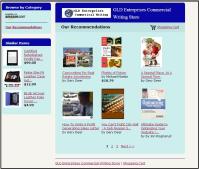
GLD Enterprises Commercial Writing's "e-commerce kiosk," at Amazon.com

GLD Enterprises Commercial Writing’s “e-commerce kiosk,” at Amazon.com

JAMESTOWN, OH – Shoppers are being encouraged to buy from small, local retailers this holiday season, but did you know there was a way to support local business and still buy from Amazon.com? They’re called “Amazon aStores,” and they allow local business to set up a virtual storefront through Amazon.com and offer products of their own choosing.

Retailers can set up what is essentially a virtual kiosk inserted within the company website. Each item is selected individually and can be categorized for easy indexing. Shoppers can then visit the main website for the company, providing the owner with valuable marketing information about how often the site is frequented, and then click on the business’s amazon store to shop further.

The hosting business is then paid an advertising fee by Amazon for each product sold through its store. Such a store doesn’t generate a great deal of revenue, but it can provide some helpful cash flow, if people know to use it.

Gery L. Deer, owner and creative director fro GLD Enterprises of Jamestown, Ohio has three such Amazon stores in operation on different websites. “We do a great deal of work with local authors, and the Amazon store allowed us a way to market the electronic versions of books, as well as other specialized items, often unavailable from local retailers.”

Deer says this kind of pre-packaged e-commerce is a good way for small businesses to have an online sales presence, even if the company is not necessarily a retailer. “Our business is primarily a business-to-business marketing and copywriting agency,” Deer says. “As a service business, we don’t have retail sales, but the products we provide through our online store can benefit the customer by offering another way to both save money on shopping and support local business, all at the same time.” For more information visit Amazon.com.

Here are links to the Amazon stores managed by GLD Enterprises and its partner companies:

GLD Enterprises Commercial Writing Amazon Store: Features locally-authored books and related products. Some product sales benefits the Western Ohio Writers Association.

GLD Enterprises & Production: Features a wide variety of books, electronics, specialty items and locally-authored material.

Deer Computer Consulting, Ltd.: Books, software, electronics, and more “computer” related products.


Medication adherence vital to senior health

In Business, Dayton Ohio News, Education, Health, Local News, National News, Senior Lifestyle, Uncategorized on November 19, 2014 at 7:16 pm

PrsnlCareSrvcs-300x300Dayton, OH – According to studies published in the New England Journal of Medicine, approximately one-half of senior adults who take at least one medication per day find keeping to the regimen difficult to maintain. Elderly patients can often become confused about dosage and scheduling and sometimes do not even understand the purpose for each prescription.

Because medication is metabolized differently as people age, timing is important. To be most effective, many medications have to be taken exactly as prescribed for the full benefit to be achieved. Unfortunately, many seniors may be taking prescriptions at the wrong time or missing doses entirely.

Medications can also get mixed up when there is more than one elderly resident in the home, creating an additional danger to the individuals. Without daily monitoring, it may also be difficult to identify older adults who may be at risk for medication nonadherence. In the absence of daily oversight by close friends or family members, one helpful alternative is a professional senior care provider.

Becky Kearney is the Senior Director of Operations for Golden Heart Senior Care in Centerville, Ohio. She notes that, along with other tasks, one of the jobs asked of Golden Heart caregivers is to help seniors maintain their medication adherence.

“Our caregivers frequently deal with the effects of over or under medicating,” Kearney says. “Improper medication administration can create havoc for both the individual and his or her family members.”

Daily home care providers can help to ensure that medication is properly taken, in the accurate dosage and by the correct method (oral, topical, etc.), and at the right time. “Mishandling of prescriptions can cause long term, if not permanent damage to the physical and mental health of the individual.  All of which could be prevented with medication monitoring by a caregiver,” adds Kearney.

As a senior’s health and independence decline, constant prescription changes can also become more confusing and difficult to manage alone. For those with elderly friends or family, inquire how he or she is managing medications and if no one is monitoring the situation, suggest a call to an in-home senior care agency or contact the local council on aging for a referral.

To learn more about getting help for senior medication adherence in the Miami Valley area, contact Golden Heart Senior Care by calling, 937-506-0190.

Think Pink Motorcycle Poker Run to sponsor cancer survivor in Susan G. Komen walk

In Business, Charities, Local News, Sports News, Travel, Uncategorized on September 22, 2014 at 4:43 pm

IMG_0476DAYTON, OH – In 2010, Dayton area resident Karen Clary became one of America’s 2.9 million breast cancer survivors. This year, she hopes to be one of the thousands across the country to participate in the 2014 Susan G. Komen 3-Day® walk. To support her participation, the Miami Valley Victory Riders motorcycle club and Motor Sports of Dayton are sponsoring the 2nd Annual “Think Pink” Poker Run, Saturday, September 27. The event will help raise awareness and generate the $2,300 Clary needs to attend the 3-day, 60 mile the race.

The Susan G. Komen Race for the Cure series of 5K runs and fitness walks attracts people of all ages and fitness levels, from walkers to elite runners. Celebrating breast cancer survivors and honoring those who have lost their battle with the disease, the series began in 1983 with a single race with 800 participants in Dallas. Today, it has grown into a global series of more than 140 Races with 1.5 million runners.

Susan G. Komen is the world’s largest grassroots network of breast cancer survivors and activists working to save lives, empower people, ensure quality care for all and energize science to find the cures. Thanks to events like the Komen Race for the Cure® and the Komen 3-Day, the organization has invested more than $2.2 billion, making it the largest worldwide source of nonprofit funds dedicated to the fight against breast cancer.

Seventy-five percent of the net proceeds raised by the Susan G. Komen 3-Day® help support Komen’s global research program, the largest nonprofit source of breast cancer research funding outside of the U.S. government. Money raised also supports large public health programs that address critical issues in breast cancer treatment and care. The remaining 25 percent stays in the local community, funding financial, social and medical needs.

Two years ago, Clary and her daughter, Jen, attended the San Francisco 3-day race together. “My daughter asked me to do the 3-day walk with her in 2012,” Clary says. “At first I thought she was crazy; 60 miles in three days? I eventually decided to go because it looked like so much fun and because of how much this means to others who shared my experience, and their families.”

Beginning at 10AM from Motor Sports of Dayton, 2135 Dayton-Lakeview Rd., in New Carlisle (45344), riders will collect a card from each stop, trying for the highest hand at the end of the ride. From Motor Sports of Dayton, riders will make stops at Moose Lodge in Beavercreek, Buckminn’s D&D Harley Davidson in Xenia, Little River Café in Oregonia, Whiskey Barrell in Oregonia, and finally end up at Jack Ass Flats in Huber Heights. The rider with the highest poker hand at the end of the run will win the grand prize. Single riders can participate for $15, doubles for $20, or buy an extra hand at $5 each. Other activities during the event include a 50/50 drawing, raffle prizes, silent auction, door prizes and entertainment.

“My first walk was the hardest thing I have ever done in my life and also the most awesome,” Clary says. “Jen wanted to do the walk for me and, because I have given her a greater chance of getting cancer, I wanted to do it for her. Hopefully we can all help to wipe it out.” For more information, call Karen Clary at (937) 620-8597 or email her at teampol@aol.com.


Back to school open house focuses on computer security

In Business, Children and Family, Dayton Ohio News, Education, Technology, Uncategorized on July 18, 2014 at 10:14 am

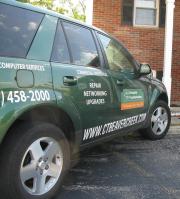
CT_BEAVERCREEK_TRUCKBEAVERCREEK, OH – On Saturday, July 26, Computer Troubleshooters of Beavercreek (CTB), located at 3792 Dayton-Xenia Rd. Beavercreek, Ohio 45432, will host a free open house from 10 a.m. until 3 p.m. to promote student computer security. The event is free, open to the public and will include refreshments, door prize drawings and special deals and information related to keeping student computers secure on campus this school year.

As part of an international network of independently owned franchises, Computer Troubleshooters provides complete information technology (IT) support for residential and commercial clients. Services range from basic, home computer repair and managed business services to cloud computing for advanced medical documentation.

Cliff Brust, president of Computer Troubleshooters in Beavercreek suggests that students are at some of the highest risk of technology theft and data loss. “We’ll be providing information and some free offers with purchase of new hardware,” Brust says. “But most importantly, we want to help parents and students understand how vulnerable their data is to loss and hardware to theft.” Brust offers a few tips in the meantime.

“First, lock up your laptops and smart phones, and don’t leave them unattended – anywhere.” he says. “Many laptops include a slot designed to accept a special cable lock. Wrap the cable around something big and hard to move, insert the lock into the laptop and turn the key or combination. A determined thief could still get the device loose but only by damaging the unit and diminishing its value. Remember, it’s generally the cash from resale of the unit that the thief is interested in, not the data.”

“Next, always use password protection,” Brust advises. “Yes, it is fast and convenient to turn on your computer and have it go right to the desktop, but it’s not safe. You have to password-protect your user account and disable the guest account. When you step away from your computer a quick press of the Windows Key and L will lock your user account. Be sure to manage your passwords also, and keep track of them. Don’t use the same one for everything.”

Brust also reminds students, “Protect your email, don’t share sensitive log-in information with anyone and always keep antivirus and anti-malware software up to date and running.” His final suggestion relates to the use of public wireless Internet hot spots.

“Whether you’re using the school’s network or a free Wi-Fi in a coffee shop your connection could be snooped. Using a VPN (Virtual Private Network) will protect your connection and let you surf anonymously. There are plenty of good free VPN clients to choose from so use one and protect yourself.”

Brust hopes the open house will give visitors the opportunity to learn more about keeping computers and smart phones safe and secure, on and off campus. “Planning and prevention are the keys to protecting your devices and your data,” he says. “Protection plans and keeping security software up to date can go a long way towards keeping important files from being lost. We can help people with the right solution for their needs.”

Computer Troubleshooters is located just west of N. Fairfield Rd., situated between Knollwood Garden Center and Capitol Dry Cleaners. For more information about computer security, call (937) 458-2000 or visit them online at http://www.ctbeavercreek.com.


Long-arm quilting services now available at Crafters Lodge in Sugarcreek Plaza

In Business, crafts, Education, Entertainment, Senior Lifestyle, Technology, Uncategorized on July 15, 2014 at 9:05 am

By Gery L. Deer

IMG_7258 Sugarcreek Twp. – A homemade quilt can be a treasured and very personal family heirloom. From the earliest American settlers, the craft of quilting has been passed down from one generation to the next, each adding a new creative style to the process. Once the top of a quilt is completed, it must be stitched to the back with batting in between – a detailed and painstaking process if done by hand. Fortunately, Crafters Lodge in Sugarcreek Township now offers long-arm quilting services and certification classes for those who wish to learn to do the work personally.

A long arm quilting machine is an industrial sewing machine similar to those used in the mattress industry.  It moves along a track or rails and sews the three parts of a quilt together. “We have the American Professional Quilting Systems (APQS) Millennium or Millie as it’s also known,” says Crafters Lodge co-owner, JoBeth Bryant. “The Millennium is the top of the line long arm quilting machine.”

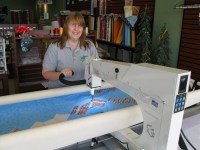
JoBeth Bryant of Crafters Lodge demonstrates the Long Arm Quilting Machine nicknamed, "Millie"

JoBeth Bryant of Crafters Lodge demonstrates the Long Arm Quilting Machine nicknamed, “Millie”

Bryant says the store currently has two certified long-arm operators on staff and walk-ins are welcome. “When you bring your quilt top to us it will be measured and checked for any issues that may affect the quilting process.  Then you can choose the type of quilting you want done and the thread color.”A fifty-percent deposit and signed contract are required at time of drop-off.  Customers can also choose any additional services they may want, such as binding, a hanging sleeve, or a label.

To make the process go as smoothly as possible, Bryant notes that customers should properly prepare the work. “Make sure the backing is square, backing must be at least six inches wider than the top,” she says.  “There are some materials, particularly generic brands from chain stores, which may not be suitable for batting, and they must be clean and odor-free. Check with us for details on acceptable batting and backing materials, both are available in our store.”

Certification classes are also available for those who wish to learn to use the long arm machine and handle the IMG_7254quilting job personally.  Students are given expert instruction on how to load a quilt, threading the machine, wind and load bobbins, access the various features, use of the pantograph, and how to create basic “meander” quilting pattern.

Crafters Lodge is located at 6056 Wilmington Pike, just behind Fazoli’s in the Sugarcreek Plaza in Sugarcreek Township. Regular store hours are Tuesday through Saturday 11:00 am to 8:00pm, Sunday noon to 6:00 pm and closed on Monday. For more information and a schedule of classes, visit the store’s website, http://www.crafterslodge.com or call (937) 470-2649.

All In One from CMG Financial pays off mortage faster, builds equity

In Business, Economy, finances, Local News, Uncategorized on July 7, 2014 at 12:43 pm

By Gery L. Deer

Business Editor

With interest rates at historic lows, American homeowners are constantly on the lookout for the best way to pay off a mortgage loan at the lowest cost and in the shortest time. CMG Financial has a loan solution, just made available in Ohio, specifically designed to help borrowers put idle money to work reducing mortgage debt.

CMG Financial was established in 1993 as a privately held, mortgage-banking firm based in San Ramon, California. The company is widely known for responsible lending practices, industry and consumer advocacy, operational efficiency and market innovation.  Among those innovations is what the company refers to as the All in One mortgage.

Joseph P. Beach is the Ohio Operations manager at the firm’s Dayton area office, opened in 2011, and a thirteen-year veteran of the mortgage industry. “The All in One mortgage has been offered in California since 2005, but is now available in Ohio and seven other Midwest states exclusively from CMG,” Beach says. “It’s designed to benefit the disciplined borrower who is interested in paying off their mortgage and growing the equity funds available as fast as possible.

According to CMG Financial, this type of mortgage option has been available in England, Canada and Australia, where interest regulations are different. Essentially, the All in One mortgage, “Puts lazy money to work.” That is, money that would normally just sit in a checking account doing nothing is used to lower the balance of the mortgage loan until the cash is needed elsewhere.  The idea is to lower the total interest expense over the term of the loan by paying down the balance right from the beginning using the idle cash in checking, certificates of deposit and other low interest-earning accounts.

Beach notes that there are some specific advantages to the All in One mortgage, unavailable under other products. “A borrower can significantly cut the total interest expense over the life of the loan, pay off your mortgage in as little as seven years with no change to your spending habits, and still be able to access home equity 24 hours a day, seven days a week, without refinancing.

Stein_CMG-CapturePopular economist and author Ben Stein has personally endorsed the CMG loan stating in a promotional video now available on YouTube, “I think it’s the greatest invention in personal finance in my lifetime.”

Of course, the All in One is not for everyone and certainly not a product for those in an upside down or problematic financial situation. Beach’s description of a “disciplined borrower” is very accurate. To qualify, borrowers require a credit score exceeding 700, are active savers and use funds that would normally be sitting in a checking account earning minimal interest.

For more information, contact Joe Beach at CMG Financial’s Dayton office by calling, (937) 937-723-8095 or email jbeach@cmgfi.com. The All in One was patent protected in 2009 and is a trademarked mortgage product of CMG Financial. Catch Joe Beach on WDTN-TV2’s “Living Dayton” program, 12-Noon, Thursday July 10.

Hobby Lobby ruling sets religious freedom in business

In Business, Charities, history, Media, National News, Opinion, Politics, Religion, sociology, Uncategorized on June 30, 2014 at 11:59 am

DIH LOGOOn June 30th, the United States Supreme Court ruled in favor of Hobby Lobby’s suit to be exempted from the ObamaCare mandate forcing companies to provide contraceptive coverage to employees, including the controversial Plan B, or “morning after,” drugs. Many conservative business owners equate these drugs to abortion since they’re designed to terminate a pregnancy within hours of conception.

The primary argument to the court is whether the owners or management of a corporation has the same rights to freedom of religion as an individual. The Obama administration has already set exceptions for various religious non-profit organizations, which, other than their non-profit status, are structured similarly to their for-profit counterparts.

In March of this year, according to TheHill.com, the U.S. House of Representatives, “Approved the Equitable Access to Care and Health (EACH) Act, H.R. 1814. The bill allowed people avoid buying health insurance under ObamaCare if they could cite a religious reason. People seeking an exemption would have to include sworn statements in their tax returns explaining their objection to health insurance.” In effect, all they needed to get out of paying the federal healthcare mandate (tax) was a note from home.

A further question is whether there is a fundamental business difference between a non-profit corporation and a for-profit corporation? The practical answer is, no. Charity or not, a corporation is created to protect the individual operators from legal responsibility with regard to the business. Most non-profit filings are for tax and donation purposes, a process that seems outdated and inefficient with the advent of mega churches and multi-billion-dollar evangelical organizations.

uscourtIn America, there are countless religiously-focused, non-profit corporations worth millions more than some of the largest for-profit businesses. The Christian television network, Daystar, for example has been approved by the Internal Revenue Service as a “church,” according to NPR.com news. Celebrity, sometimes politician evangelist Pat Robertson and the late Billy Graham registered with the IRS as “religious organizations,” making them exempt from most taxes. All they had to do was file disclosure papers.

According to available records, NPR.com reports that the top three evangelical television broadcasters – Christian Broadcast Network, Trinity Broadcasting Network and Daystar Television — have a combined net worth of more than a quarter of a billion dollars. It is unknown whether the corporations that operate these broadcasters have filed for religious exemption under the healthcare reform laws.

The question persists, however, that if the only difference between a for-profit corporation and these mega non-profits is an earnings disclosure, why have the distinction at all? Certainly there are for-profit companies that give away millions of dollars in charitable funds each year but still have to comply with the law in every respect. Why then are religious non-profit organizations exempt from anything, much less a controversial healthcare mandate that has American small business struggling to comply or face bankrupting penalties?

The court’s latest decision with regard to religious exemption could have long-reaching implications, and not just in the healthcare arena. Giving a for-profit entity the same constitutional protections provided to non-profit religious groups could cause a flood of lawsuits ranging from tax law to equal employment regulations. Once again, major non-profits have million-dollar earners at the top, private jets, limousines and pretty much every other extravagance thought only to exist in for-profit American business.

If a church – any church – can make a case for religious freedom from legal mandates, why can’t a business owner cite his or her – or their – own religious beliefs for the same purposes? Is the constitution not written for everyone or does it exist specifically to meet the needs of religious groups so they can avoid taxes and dodge the law at their convenience?

This argument poses a great many questions and there will likely be countless more as ObamaCare reaches further corners of commerce. But, if that’s not enough to chew on, here’s another one. What happens if a Muslim, Jewish or non-Christian group requests exemption as well? Will the Christian right fight against their having the same protections?


Gery L. Deer is an independent columnist and business writer and contributor for WDTN-TV2’s LIVING DAYTON program. More at www.gerydeer.com.


Cause and effect of drug advertisements

In Business, Education, Health, National News, Opinion, television, Uncategorized on June 26, 2014 at 10:37 am

DIH LOGOAccording to a 2008 study by the peer-reviewed medical journal, PLOS Medicine, pharmaceutical companies spend nearly twice as much on marketing than research. In a review of the study, the consumer advocacy website, Consumerist.com, indicates, “Drug companies pour $57.5 billion into marketing, dwarfing the comparably paltry $31.5 billion devoted to research.”

Pharmaceutical manufacturers have rigid guidelines for promoting their products, but the question lingers: should non-over-the-counter drugs be promoted to the general public at all? The short answer is, probably not. The longer answer is more complex. Since, as a rule, Deer In Headlines deals with “fact,” not “truth,” here are some facts about drug advertising. Incidentally, if it is truth you’re interested in, check out a philosophy column (thanks Dr. Jones).

The official website of the United States Food and Drug Administration states, “Prescription drug advertisements can provide useful information for consumers to work with their health care providers to make wise decisions about treatment.” Leading the pack of heavily-marketed drugs are prescription sleep aids, blood thinners, anti-depressants and erectile dysfunction remedies. Most of the television ads for these medications appear during the day, carefully targeting certain markets.

What the general public fails to realize, however, is that these ads are intended to plant an idea in the head of the consumer who, in all their medical wisdom, will take the information to a doctor and insist on a prescription. Mission accomplished; more drugs are sold and the company’s stock goes up a quarter of a point, not to mention the fact there is one more person who simply can’t live without the latest pill. Perhaps a better understanding of how these ads are structured might help.

pillsThe FDA’s Office of Prescription Drug Promotion classifies medication advertisements into three categories: Product Claims, Reminders, and Help-Seeking ads.  The product claim ad names the drug, the treated condition and lists the benefits and risks. A reminder ad shows the name of the drug, but not its use. Finally, the help-seeking advertisement is directed at people with a particular condition for which they are trying to find a remedy. There is, however, no guideline for how much money a drug company can spend on advertising and some consumer advocates argue that it’s wrong for them to be able to spend more on marketing than research.

The fact is that it’s really hard to say exactly how much any one drug company spends on research vs. marketing because reported advertising expenditures are mixed in with the accounting category which also includes other figures, such as executive salaries. Research money is usually accounted for in a separate line item (R&D), even though it technically could be in the same classification with general operation costs.

Another fact is that everyone is a medical expert – yes that’s sarcasm. From the neighbor with every ailment more painful than the last or the relative who insists his doctor is an idiot but goes back every time his prescription runs out, self-diagnosis and treatment are a real epidemic in America.

There is also the concern that these advertisements actually plant the idea of a particular illness in the mind of the viewer who then heads to the doctor with a new problem, and a new prescription demand. Studies show that about 40-percent of all doctor visits are with the intention of getting a prescription. Since people keep going back, it’s safe to assume there are plenty of doctors obliging, and that needs to change as well.

Prescription medication should be marketed to the experts who will be prescribing it to the patient. Drug companies already spend billions on advertising and on-site sales representatives who offer samples and various other motivators to get the doctors to push their products for various ailments. The patient has no business self-prescribing and doctors need to be more responsible.


Gery L. Deer is an independent columnist and business writer based in Jamestown, Ohio. Side effects of reading Deer In Headlines include a more open mind, alternative points of view and a better understanding of the world around you. No prescription necessary.


Too much rides on a credit score

In Business, Economy, Education, Jobs, National News, Opinion, Uncategorized on June 16, 2014 at 11:33 am

DIH LOGOFor all the important numbers in the life of the average American, the credit score seems to wield the most power. It’s hard to imagine how three little digits could determine how an individual will live his or her life, regardless of the circumstances that created it and with the average person having virtually no understanding of what it is or how it’s calculated.

Credit scores determine how much a consumer will have to pay for credit (as interest rates), insurance, and other necessities. For many years, the credit score was a value hidden from the consumer because Fair Isaac and Company, the firm which created the process, decided it would just be too confusing to the general public. (Of course, that’s the usual excuse offered up by big business and government agencies trying to dupe the general public.)

That’s little comfort, however, to those who have been held hostage by the credit reporting companies for decades. Almost since inception, credit data has been full of inaccuracies and misinformation, a problem to which consumers have had little (practical) recourse other than the slow, usually pointless, process required to amend a report.

As of 2012, the Consumer Financial Protection Bureau was charged with the oversight of personal credit rating companies. With countless rule changes over the years, the Fair Credit Reporting Act finally forced at least some restrictions on the credit rating companies. The FCRA is the legislation that required companies like TransUnion, Experian and Equifax to provide free credit report, limit outside access to personal credit files, initiate identity theft protections and other consumer defense measures. Click here for a downloadable version of the Fair Credit Reporting Act is available.

creditoneRegardless of the current legislation, however, credit monitoring and reporting services still have entirely too much power and control over the general lives of consumers. A credit report (and score) whether accurate or not, can limit access to vital, day-to-day needs like transportation and employment.

Considering how much inaccuracy can exist or the irrelevancy of the information to the situation, it’s bewildering how it is legal for employers to reject applicants based on a credit score. In another example, how is it permitted that credit score can determine whether someone should be provided with car insurance, particularly when coverage is mandated by the government?

Whatever more ignorant people choose to believe a low credit score doesn’t always mean a person is unwilling to pay their bills or is inept at handling money. Sometimes circumstances change, as with the predatory lending practices that contributed to the housing market crash of 2008.

Likewise, although there is a higher risk in lending to people with a sorted credit history, almost no one takes into account how the score got so tarnished. On the heels of the worst recession in U.S. history, the credit rating process seems almost backwards to the average consumer.

If you can afford a higher rate and larger payment, you get a lower one, and vice versa. A person may be in desperate need of a car or renters insurance but, because of a lower credit score, they are charged significantly higher rates and payments. Wouldn’t it make more sense to offer those people lower rates and payments, making it more likely they can pay on time and help shore up the economy in the process?

The consumer should always keep in mind that the credit reporting organizations are private sector businesses, not government agencies. They are not affiliated with the Federal Trade Commission in any way nor any other government office. Credit scores are big business for those companies that calculate and report them.

In the first quarter of 2014, TransUnion, one of the three largest firms, reported earnings just over $303 million. That’s just for one credit reporting company over three months! So, with billions of dollars in revenue at stake, there is little to no motivation for limiting the power of these companies. It’s a sure bet that lobbyists for the credit reporting companies are well-entrenched in Washington, greasing all of the appropriate palms to make sure that the “have nots” never catch up to the 1-percent.


The Jamestown Comet.com editor / publisher Gery L. Deer is an independent columnist and business contributor to WDTN-TV2’s Living Dayton program. More at http://www.gerydeer.com.


Is this your new site? Log in to activate admin features and dismiss this message
Log In