Local News & Commentary Since 1890.

Posts Tagged ‘Deer In Headlines’

Don’t talk to me about, “life.”

In Health, Opinion, psychology, Religion, sociology, Uncategorized on May 28, 2015 at 11:10 am

Deer In Headlines

Special Edition 

By Gery L. Deer

dih-logo-SE“I went to a bookstore and asked the saleswoman, ‘Where’s the self-help section?’ She said if she told me, it would defeat the purpose.” ― George Carlin

No kidding, don’t talk to me about life. I don’t have a clue what to tell you. It’d be great if I could suddenly sound like one of those know-it-all high-dollar advice columnists but, really, they’re full of it too.  You’d have more luck following the meaningless advice from inside your next fortune cookie at the local Chinese restaurant.

Advice columnists, TV experts, so-called “life coaches,” or your favorite self-help author or motivational speaker must be infinitely smarter than any of us regular folks. After all, they motivated your money right out of your wallet; genius, wouldn’t you say? In reality, one can tell you what to do about the perils and promises of life except you.

Life is one of those subjects about which I have never felt confident offering an opinion, nor should anyone else. The very idea that anyone has it figured out or could possibly understand the complexities of someone else’s situation is not just ridiculous, it’s a little insulting.

Special, personal hat tip to the late author, Douglas Adams, who helped to put this writer's perspective into focus.

Special, personal hat tip to the late author, Douglas Adams, who helped to put this writer’s perspective into focus.

If anyone could actually manage such a thing, it would mean that there is nothing inherently special or unique about our lives. It implies that everyone lives a sort of cookie-cutter existence, with no peaks, valleys or crevices, and that’s just silly.

Life is complicated. It cannot be sorted out with an hour on the psychiatrist’s couch or because of some nonsense from a self-help book. We all have to iron it out for ourselves. That’s not to say we don’t need some help sometimes, but it’s not going to come from something you saw on an infomercial at 3 o’clock in the morning.

Even religion offers no answer to such multifaceted issues as, “What should I do with my life?” Religion also guts your wallet without providing a single, concrete solution. In fact, without an incredible level of ambiguity, religion couldn’t exist at all.

Your faith may provide you with peace of mind, but leaving everything “in God’s hands,” is a little like letting go of the wheel while barreling down the highway at 70 miles per hour. I’d say He probably expects you to steer. And, to be fair, science has no solutions either.

For those empirical folks out there, Charles Darwin might have been able to tell you how animals changed over the millennia, but he had no clue how the evolution of your life should proceed. Sometimes you just have to work things out on your own.

Life coaches, support groups, psychobabble – it all comes down to the person you see in the mirror. Everyone has an opinion about your life, but before taking it, you need to look at the source of that information. What kind of shape is their life in?

It’s always puzzling when someone takes marriage advice from a friend or relative whose relationships are a wreck.  That’s kind of like asking a demolition derby driver to teach drivers education. They know how, but the results might be less than desirable.

Theodor Seuss Geisel (Dr. Seuss) once said, “Sometimes the questions are complicated and the answers are simple.” That is probably the best way to look at your world. Occasionally we’re looking too hard for answers to difficult questions with straightforward resolutions. But you won’t find your answers in a self-help workshop or in an advice column.

When standing at a fork in the road, there comes a time when you have to pick a path and start walking. You put one foot in front of the other, get moving and own it, whatever the outcome. If you do that, on your terms, at least you’ll know it was your decision to go left instead of right, to charge ahead instead of turning back. It will be yours, because we are responsible for the paths our lives take and, after all, the journey is the real destination. Make it a good one.
Gery L. Deer is an independent columnist and business writer. Deer In Headlines is distributed by GLD Enterprises Communications. More at gerydeer.com


Join my #facebookfast and unplug for Memorial Day

In Children and Family, Health, Holiday, News Media, Opinion, Technology, Uncategorized on May 23, 2015 at 5:58 am

DIH LOGOOver the years I’ve done several articles and television interviews on the subject of going “off the grid,” when you put down the smartphone and tablet computer to unplug for a while. But some people simply can’t imagine letting go of their connection to the information superhighway, even for a few minutes.

Who knows what disasters might befall them if they miss that one, all-important posting that could quite literally change their lives forever. Of course, in reality, none of that stuff really matters.

It could be argued that political, racial and other social tensions might be less volatile if there were no social media to spread negativity and anger at the speed of light. Although it offers a positive outlet to promote social change, it also invites hateful rhetoric that can be distributed instantly and constantly.

Social media can sometimes even exacerbate depression in people already prone to the problem. True, it can sometimes elicit encouragement, support and sympathy. In my opinion, however, that level of support is only effective in the long term if it comes from in-person contact with people who really know you and care.

For the record, my job and my lifelong ties in technology leave me as guilty as the next person when it comes to maintaining my cyber connection. That said I still try to treat it like a tool – one for communication, maintaining a surface contact with friends I rarely get to see or just keeping up with my interests. But it can still be overwhelming at times and then I have to shut it off.

As it turns out, there is something called “social media anxiety.” Although it’s not recognized as a mental disorder (yet), from what I have read the problem results, in part, from this unrealistic sense of urgency with which we have endowed our virtual engagements. So, I think we all need a break.

Can you unplug for the #facebookfast?

Can you unplug for the #facebookfast?

If you’re one of the millions suffering from social media anxiety or just need a respite from the constant “Likes,” texts, tweets, pins and pokes, I’d like to make the following proposal. I’m inviting all of my readers, followers, and everyone else, to join me in what I’ve chosen to call, “The Facebook Fast.”

For 24 hours, we turn off all social media, going cold turkey on everything; no tweets, Facebook messages, or Pinterest posts – nothing. I considered suggesting a 48-hour-moratorium, but I thought that might send some people to a rubber room. The big question is, when?

The Memorial Day holiday weekend is always best spent with family and friends in the real world, so it seems the perfect time for a cyber-fast. Therefore, “The Facebook Fast” will kick off on Monday, May 25, 2015, at 12:01 a.m. and remain in effect until 11:59 p.m. the same day, so you even get two free minutes.

I expect this will be a challenge for a lot of people, me included. Because of the holiday, we’re all going to want to post and check in all day but we must resist temptation. If you can get your family and friends to participate too, it’ll be easier to hang in there.

Oh, I can almost feel the panic setting in at the mere thought of cutting the social media cord. But relax, consider it a “cyber cleanse.” Don’t worry; these particular DTs will pass quickly. And, in the event you can’t possibly imagine how you will stay in touch with the world for a whole day without social media, I have a few suggestions.

You could: read a book or newspaper, go outside, pick up the phone and actually call someone, meet a friend for dinner, go to a ball game, visit a local attraction, or any number of other activities that involve actual, human contact.

In something of an irony, the best way to spread the word about the fast is by using the hash tag, #facebookfast. I feel safe in guaranteeing to you that nothing bad will happen from ignoring social media for one day. The world will continue to turn and, if we’re lucky, it might also slow down just a little bit and give us all a moment to catch our breath.


Special Editorial Note: For fans of the late author Douglas Adams and his series of books from “The Hitchhiker’s Guide to the Galaxy,” May 25th is also “Towel Day.” If you want to participate in the #facebookfast, just save up photos from Towel Day events and activities and post them at 11:59PM! If everyone hits it at once, “Towel Day” will trend on Twitter! 


Gery L. Deer is an independent columnist and business writer. Deer In Headlines is distributed by GLD Enterprises Communications. More at gerydeer.com.


More money needed to combat child poverty

In Children and Family, Economy, National News, Opinion, Politics, sociology on May 19, 2015 at 11:51 am

Deer In Headlines
By Gery L. Deer

DIH LOGOFor many Americans, a day of suffering might include a flat tire on the way to work, the cable going out right before a favorite program, or a long line at the coffee shop. But for millions of children, suffering means doing without basic necessities like proper nutrition and even the most basic health care.

According to the National Center for Children in Poverty (NCCP), more than 16 million children in the United States live in families with income below the poverty level of $23,550. That’s a staggering 22-percent of all the kids in the country.

Some people today believe that childhood poverty in America is something from the past. In fact, one in six children in the United States lives below the poverty line.

Some people today believe that childhood poverty in America is something from the past. In fact, one in six children in the United States lives below the poverty line.

Despite the political rhetoric, generally coming from conservatives who feel poverty is a problem of the lazy, the NCCP reports that most of the parents of these children do indeed work. But low wages and in unstable employment situations continue to restrict any sort of progress for them. Experts agree that poverty is the single greatest threat to the welfare of American children in modern society.

In addition, for those who believe that poverty is a problem mainly suffered by minorities, here are some statistics. The NCCP reports that among America’s poorest children, 4.2 million are white, 4 million are Latino, 3.6 million are African American, 400,000 are Asian, and 200,000 are American Indian. That’s right; the majority of American kids living in poverty are white. But, clearly, the numbers are fairly close, so it’s certainly clear that poverty doesn’t seem to discriminate.

Red Nose DayMost of what’s needed to help this problem involves, as always, more money. There just isn’t enough funding through government social service programs to provide the needed services to support poverty-stricken children and younger adults. The National Broadcasting Company (NBC), along with charity partners such as Boys and Girls Clubs of America and Feeding America, is sponsoring a national day of awareness and fund-raising called, “Red Nose Day,” on Thursday, May 21st.

The United Way of Orange County, California explained the event on their website, “The campaign encourages everyone from children to corporations to do something fun in the name of raising awareness around a serious global issue, while also raising funds to help identify and deliver solutions. Red Nose Day USA activities culminate in a 3-hour telethon airing on NBC Saturday May 21 at 8pm.”

In addition to events like Red Nose Day, people are encouraged to help out in whatever capacity available to them, and it’s not just about writing a check. Those interested in volunteering can check with their local chapter of The United Way or other social service organizations to find out more.

Living in the richest, most powerful country in the world should inherently provide some kind of security for a child, at the very least with regard to food and shelter. Without proper living conditions, a child will simply not be able to learn well and that makes school less of a priority than eventually helping the family to support itself.

Children who can’t learn or leave school will only continue the cycle of poverty in many instances, forever locking themselves into the lowest paying work, when employment is even available.

So the question begs to be asked, “Can’t the government do more?” Yes, it can. But it hasn’t, and it probably won’t. Annually, only a pittance of tax dollars is allocated towards this problem and local social service programs are continually scaled back because of lack of funding.

Even the great Affordable Healthcare Act (a.k.a. Obamacare), which was supposed to provide health insurance for America’s poorest citizens, has made no significant difference. Because of its incredibly complicated application procedures, among other reasons, the program has thoroughly failed to meet healthcare needs of these children and their families.

Even if someone only has a little more, there is always a way to help those with far less. Red Nose Day is a fun start, but there needs to be more done to help those living in poverty. Congress (liberal and conservative alike) and the president share the blame for this tragic disfigurement of American culture. It’d be interesting to see how they would handle living without the six-figure salaries and free insurance.


Gery L. Deer is an independent columnist and business writer. Deer In Headlines is distributed by GLD Enterprises Communications. More at gerydeer.com

Voters don’t care about dishonesty  

In history, National News, Opinion, Politics on May 11, 2015 at 11:33 am

Deer In Headlines
By Gery L. Deer

DIH LOGOA recent Associated Press poll found that only four in ten Democrats would describe Hillary Rodham Clinton, the liberals’ leading presidential hopeful, as “honest.” The data also indicated that about the same number see her as uninspiring and not especially, “likeable.”

As the AP article reported on May 1, 2015, “Americans appear to be suspicious of Hillary Rodham Clinton’s honesty, and even many Democrats are only lukewarm about her presidential candidacy, according to a new Associated Press-GfK poll.”

Yet, it’s still likely these uninspired voters will likely pull a lever next to her name through the primaries and on to the 2016 ticket. Doesn’t the voting public care whether or not a president is honest? The short answer is, no.

Regardless of whether they call themselves Democrat, Republican or Independent, many voters would describe the phrase, “honest politician” as a contradiction in terms. Unless they are a tireless idealist or go through life wearing blinders and ear plugs most people have come to expect politicians to be dishonest to some extent.

Presidents "swear" an oath then spend a good part of their term lying.

Presidents “swear” an oath then spend a good part of their term lying.

The reality is that Americans have made an unconscious decision that all political lies are not created equal. A lie to the media or the public in the interest of national security is generally accepted. For example, President Kennedy hid the fact that he ended the Cuban missile crisis by making a deal with Khrushchev for U.S. missile removal from Turkey. Was it a lie or something the public simply didn’t need to know? Is a political lie of omission still wrong?

Other types of political lies can have more sinister grounds. In the 1980s, President Reagan mislead the country about his involvement in the Iran Contra affair, the secret arrangement to supply arms to Nicaraguan contra rebels using profits generated by selling weapons to Iran. And does Watergate even need a mention here?

This kind of dishonesty is certainly not limited to the executive branch. The level of deceit and back-door dealing that likely takes place on Capitol Hill would stagger the imagination. But, if dishonestly is a hot-button issue against Hillary Clinton during the upcoming primaries, the GOP certainly has no room to play innocent.

George W. Bush, for example, was largely regarded as most dishonest, not about what he had already done, but in an effort to persuade the public to go along with what he had yet to do. Can anyone say, “W.M.D.?” Still, he was re-elected, as were so many of the biggest liars to ever sit behind the Resolute Desk.

Looking back, it seems that some of the deepest deceptions appear to have come from presidents who served more than one term. From FDR to Bill Clinton, and now Barack Obama, the longer they serve, the more lies they tell.

It’s clearer than ever that a large part of the voting public couldn’t care less about a presidential candidate’s honesty. Oddly, it seems like the higher the office, the more dishonesty is tolerated. At the ground level, even school board members or the mayoral candidates of the tiniest towns are taken further to task over honesty issues than any presidential candidate. To some, that seems – backwards.

Put very simply, “Laws (and governments) are like sausages. You don’t want to see how they’re made.” It’s hard to say who originally uttered those words, but the sentiment is as true today as ever. There is a level of blind eye turned toward some of this behavior just because of an inherent expectation and acceptance.

The modern media plays also into this problem a bit. With instantaneous information, literally at everyone’s fingertips, word spreads before anything can be properly vetted. Rumor and innuendo can rapidly become “Internet fact.” It’s tough for the average person to know the difference between reality and hype without doing some digging.

Regardless of what people might prefer, given the state of American politics, it’s unlikely that any operative would be able to function without mastering some level of deception towards his or her rivals or constituents. It would be refreshing, however, if the voting public demanded more honesty from presidential hopefuls and if even one of them could meet that expectation.


Gery L. Deer is an independent columnist and business writer. GLD Enterprises is distributed by GLD Enterprises Communications. More at gerydeer.com.


Learning from McHenry’s vicious rant

In Business, Entertainment, Media, National News, Opinion, psychology, television, Uncategorized on April 24, 2015 at 10:07 am

DIH LOGOHave you ever had a really bad day? I mean one of those days when the slightest thing will set you off and you bite someone’s head off for no particular reason? Having a rough day can cause anyone to lash out for no apparent reason. The unfortunate recipient of such wrath could be your kids, a co-worker, or even a clerk at a towing company.

Last week ESPN sports broadcaster Britt McHenry did just that, but she added a few frills and dressings that she now most likely regrets. More accurately, she probably regrets that there was a security camera recording every moment of her vicious tirade leveled at a towing company clerk in Arlington, Virginia.

Britt McHenry on security camera ranting at towing clerk.

Britt McHenry on security camera ranting at towing clerk.

By suggesting that McHenry may have been reacting to a bad day, I am certainly not defending her. She clearly has some deep-seated personal insecurities to be so mean to, well, anyone. She had her back to the wall and we may have seen a glimpse of the real person behind the media façade. But, ignoring the woman’s obvious personal shortcomings, how many of us would be appalled to see our behavior replayed for the entire world after a difficult experience?

As for McHenry, I’ll grant her that it’s not easy to be a normal human being in the public eye, although, in truth, not being a sports consumer, I’d never heard of her until this incident surfaced. Still, no one is perfect. We all have our warts, but, for some of us, sometimes they’re a bit uglier than we realize, no matter how much we try to conceal them.

A difficult experience can bring all of that ugliness to the surface with great force, sometimes beyond our awareness. And, once it’s out there, it’s out there, particularly if you happen to be a public figure in a world of constant surveillance and instantaneous social media.

One op-ed I read after the incident commented more on McHenry’s apparent self-image, suggesting that she clearly exhibited an, “overblown sense of entitlement and evidence of a mean girl who never left high school.” The writer then went on to defend her somewhat, noting how quickly she was judged by the public without the other side of the story ever being revealed.

Well, since this is my op-ed column, I will say that, given her behavior, the other side doesn’t really matter much. Being angry at the situation and lashing out is understandable, particularly if you just had your car towed. But McHenry’s personal, demeaning attacks against the clerk were just plain vial. If you haven’t seen it, I won’t go into detail, but suffice to say she was arrogant, snobby, and just plain brutal.

Others in defense of McHenry call the release of the video a “public shaming,” but I can’t agree. McHenry shamed herself, no one made her behave that way. We all make choices and we have to live with the consequences. The pretty, popular and famous people of the world can’t be held to a higher standard (since they’re human too), but they are certainly no exception.

One thing struck me even more oddly. I have worked in media for many years and I have to ask how it never occurred to McHenry that there were probably security cameras on her? Even after the camera was pointed out by the clerk, she continued her rant, which became even more despicable.

After that, she got what she deserved. In my professional opinion, from a public relations standpoint, the best thing her bosses could do is show her the door – permanently. She’s bad for business and constant judgment and public scrutiny are the price of life in the media. Those who choose that life don’t get to whine about it.

Everyone has the right to be upset in difficult circumstances but no one has the right – not even the rich and famous – to belittle a person because of his or her own delusions of grandeur and privilege. Perhaps we could all learn an important lesson from McHenry’s behavior? Difficult situations might be more tolerable if everyone involved behaved as though the cameras are on them.


Gery L. Deer is an independent columnist and business writer. Deer In Headlines is distributed by GLD Enterprises Communications. More at gerydeer.com.

Clinton and the lesser of “who cares.”

In Economy, history, National News, Opinion, Politics on April 14, 2015 at 7:37 am

DIH LOGONow that Hillary Clinton has finally confirmed her run at the 2016 Democratic presidential nomination, there is growing concern that the next election will be all about electing a woman, rather than choosing the right candidate for the job.

America’s political landscape has changed a great deal since Clinton’s first run at the Oval Office in 2008. After eight years with a Democrat in the White House, and with Barack Obama’s job approval numbers struggling to maintain a tepid 47-percent, the country may simply be ready for a change. But is a female president too much change?

Back in 1984, the Democrats put the first woman on a presidential ticket, selecting former Congresswoman Geraldine Ferraro as the vice presidential candidate alongside former Vice President Walter Mondale.  Despite her strong political background and experience many saw her as somewhat of a publicity stunt, designed to appeal to women and a rising number of younger voters.

Ferraro’s albatross, however, turned out to be, not the indecisive voter, but Walter Mondale, a stale, crusty relic of the 1960s who really had no chance against an incredibly popular incumbent by the name of Ronald Regan. Many experts still suggest that the democrats might well have prevailed had the ticket been reversed, with Ferraro as the presidential candidate.

Former Alaska Governor Sarah Palin suffered a similar problem having been anchored to old-guard republican, John McCain. But Palin also lacked Ferraro’s professionalism, legal education and political clout and she was often viewed as little more than a tactic to draw votes from Hillary Clinton.

clintonWomen always seem to be held back from being in the real fight. Vice president is obviously a great job – the photo ops, the ribbon cuttings, the pacifiers. But if anything is going to be accomplished in the name of social evolution, the female candidate is going to have to be strong enough to lead the ticket; a trait Hillary has certainly demonstrated in her various roles throughout the last couple of decades.

However, if the next election turns out to be all about social popularity, breaking the glass ceiling of the Oval Office and a long campaign of “he said,” “she said,” then the smartest thing the GOP could do to increase their chances of winning in 2016 is go out and find an African American republican woman with impeccable professional and personal credentials. Actually, they already have someone in their camp that fits all of those qualifications – Condoleezza Rice.

Former Secretary of State Rice is one of the few conservatives (male or female) who could potentially give Clinton a real challenge. A republican ticket led by Rice could very well offer conservative voters something besides the lesser of “who cares.”

Unfortunately, based on her previous statements, she would be unlikely to run at all and, from a public relations standpoint, she’s been out of the limelight for some time. With such a hard-hitting campaign expected, Rice would simply not have the time to help voters get reacquainted with her and her platform.

In the opinion of objective observers, President Obama may have achieved a few things, but his current approval demonstrates that he fell short in many ways. If a well-suited opponent ever surfaces from the conservative sea, Hillary Clinton will have a tough time convincing people another democrat can improve things further.

Sadly, if the voting public is true to their tunnel-versioned pattern, they will once again miss an incredible opportunity to elect the right person for the job, rather than simply pulling the lever to motivate an agenda. Regardless of how seriously Americans want social evolution, it will never be a good idea to vote for someone – to any office – solely because of race, gender, religious background or party affiliation.

For once, if politicians would speak honestly and if voters would take just a moment to consider qualifications, character, and intent, American politics might finally be productive, compassionate and properly serve the people. But, as long as human beings still act with more emotion than good sense, any change would be nothing less than a miracle and Hillary is a sure thing.

Gery L. Deer is an independent columnist and business writer. Deer In Headlines is distributed by GLD Enterprises Communications. More at gerydeer.com.


Indiana religious freedom law can go both ways

In Media, National News, Opinion, Politics, sociology on March 30, 2015 at 9:56 am

DIH LOGOA few years ago, I published an article on what is, in my opinion, one of the major problems with the heated debate over the legality of same-sex marriage. Most arguments seem to dance around the principal question of why the government has any authority to dictate who we marry in the first place. A state-mandated definition of marriage seems to be, again in my opinion, at the very least, a violation of the most basic of human rights.

Just as is the case for marriage, once again most people are missing the more serious issue with Indiana’s controversial “Religious Freedom Restoration Act.” Everyone’s so focused on discrimination towards one group that they’ve overlooked the larger issue that this ill-conceived legislation has opened the door to every manner of state-enforced, religiously-based discrimination.

IMG_3317Having read the actual bill text (Indiana Senate Bill Numbers 568 and 101) I can tell you that it seems to me so open-ended, it seems to give people the right to discriminate against anyone they choose claiming only religious offense. Apparently, what the brilliant Indiana legislature didn’t take into account is that it works both ways. In other words, would they still uphold their law if a Christian is discriminated against by someone of another faith, say a Muslim or Jew?

Or, let me put it another way. Suppose a Christian man comes into a Jewish-owned shop. He removes his hat as he enters but, as a person of Jewish faith, the shopkeeper’s tradition is for men to keep the head covered at all times. Immediately offended, the shopkeeper refuses him service and asks him to leave citing the Religious Freedom Restoration Act. Yes, this is an exaggerated scenario. But, were it to happen, would the shopkeeper be protected for this bit of state-approved discrimination? My guess is the intolerance at the Indiana State House works only one direction.

Incidentally, I’ve never much liked the term “tolerance” with regard to social diversity. Instead, it would be nice if people made at least some small effort to understand other ways of life, although I realize that is probably an uphill climb. One place where the word does apply, however, is when people have to tolerate the ignorance and bigotry of others.

Despite differences in faith, race, ethnicity, choice of Apple over Microsoft, green over blue, whatever, it really is possible for people to disagree without prejudice. Every day I am exposed to people and concepts that don’t mesh with my view of life.

Regardless, I try to just accept that their way is different, let people be, and hope they are kind enough to do the same. Ignorance may be bliss for some people but will never further the cause of peace and goodwill.

Accepting the differences of others without fighting them to bend to my way of thinking doesn’t mean I’ve compromised my own beliefs. If anything, it reassures me that my choices are right for my life and helps me to encourage people be who they are, whether I agree with it or not.

Don’t get me wrong, I still have and voice strong opinions. But it’s not my place, nor anyone else’s, to implement it by denying someone the basic liberties granted by the 14th Amendment of the U.S. Constitution – to say nothing of the first 10. And, in my amateur opinion, when the Indiana bill is finally challenged – and it will be – the 14th will undoubtedly be the machete that severs the snake’s head.

Until then, I offer a word of apology to my western neighbors in The Crossroads of America, the great State of Indiana. Your entire state is being hurt over this and that’s unfair. We all need to remember that, like everywhere else, kind people live and work in the Hoosier state and shouldn’t be labeled because of the stupidity of a few.

And to Indiana Governor Mike Pence I say this on behalf of myself and my fellow 21st Century business owners in the great Buckeye State of Ohio. We refuse service to you and those who authored and approved this bill because you are offensive to our belief in good character and common decency.

Gery L. Deer is an independent columnist and business writer. Deer In Headlines is distributed by GLD Enterprises Communications. More at deerinheadlines.com.

Old dogs and new tricks

In Dayton Ohio News, Education, Local News, National News, Opinion, Senior Lifestyle, Technology, Uncategorized on March 23, 2015 at 11:38 am

DIH LOGOSome people are of the mind that there is a certain age when learning something new is neither a priority nor even a possibility. As I approach a half-century on this earth, I have a hard time wrapping my head around the idea that, at some point, people just stop learning.

Barring some kind of dementia or other mental disorder, it’s hard to understand why anyone would “choose” to be an old dog, totally uninterested in learning a new trick. In my lines of work, I am frequently exposed to innovative technology and new ideas and I’m expected to keep up or I don’t pay the mortgage.

I spend a considerable amount of time researching, learning new concepts or updating my skills in some way so I can stay relevant in a world that seems to change by the nanosecond. Part of that continuing education includes reading, networking with others and going to conferences and workshops. I just returned from one such conference that was, for me, one of the single best I have ever attended.

A couple of months ago, I was asked by a friend to speak at an upcoming technology event known as, “Dayton WordCamp,” a two-day series focused on the website content management system called “WordPress.” As with most tech, this event would be dominated by much younger, more advanced presenters.

Originally, I hesitated, feeling as if “at my age” (and technical level) I would have little to bring to the table. But, with a little effort I found a spot where I fit into the program nicely and agreed.

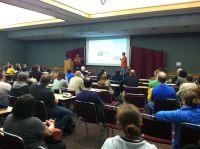
Dayton WordCamp

Dayton WordCamp

Dayton’s event is one of hundreds of WordCamps around the world, all presented for the benefit of those using WordPress as their website platform. Lovingly referred to by organizers as an “unconference,” the atmosphere is very relaxed and laid back, with most people wearing jeans and T-shirts.  One of the perks of speaking is the opportunity to attend the event as a spectator as well.

One of the first things I noticed upon arrival was that I was not the oldest person in the room. Of roughly 120 attendees the bell curve probably favored the younger crowd, but there were plenty of people my age and older as well. Such diversity says something for both the reputations of the scheduled presenters and the usability of the software about which we had all come to learn.

As the first day’s session began my apprehension diminished and I began to settle into a comfortable atmosphere for learning. By the conclusion of day two, I was not only charged up to dive in and apply my newly-acquired information, but I wanted to find a way to be more involved in future sessions.

At this point, I have to give a shout out to my friend Dustin Hartzler and his fellow organizers, particularly Nathan Driver, who invited me to speak at the event while also allowing me to be a student as well (that’s not the norm at such functions). These folks gave me the opportunity to expand my knowledge, allowing me to better serve my clients, plus I got to take a couple of days for myself, something for which I rarely have the opportunity.

In my experience, most people who have stopped learning have done so, in some manner, by choice. Learning is not just academic. Expanding your horizons at any age is not limited to taking college classes or immersing yourself in books for hours on end. You can attend free, hands-on workshops, watch “do it yourself” shows on television, or just dive in and try something on your own, learning as you go.

My point is that there is simply no reason any of us should be stagnant. Opportunities for growth exist in many areas of our lives and all we need to do is take the first step. What is important is that you get out there and try, whether your interest is gardening, motorcycles, computers, music, or maybe you want to try something new. Don’t be an old dog with no new tricks.

For more about WordCamp check out the Dayton WordPress Meetup – http://www.meetup.com/Dayton-WordPress/

Gery L. Deer is an independent columnist and business writer. Deer In Headlines is distributed by GLD Enterprises Communications.

A national, online university is impractical.

In Economy, Education, finances, history, National News, Opinion, Technology, Uncategorized on March 9, 2015 at 12:59 pm

DIH LOGOA recent CNN.com article by Kevin Carey proposed the idea that America could bring to reality George Washington’s dream of a national university by utilizing the Internet-based programs of existing institutions. Colleges and universities already receive millions every year in federal money, so some of that could be allocated towards low-tuition, online education. Good idea in concept, but not practical.

Although Internet-based programs have been in place for some time at universities around the country, many educators still believe that online education lacks the face-to-face contact necessary for students to connect with the subtleties of concepts and ideas. Questions cannot be answered immediately and written communication skills become more vital since intent and personality don’t always come across the same way virtually as in person.

Obviously, online options are not well-suited for every course of study, particularly where hands-on work is vital, such as the physical sciences or engineering. The ITDL article notes that videos would need to be produced, substantially increasing costs, while still lacking in the ability for students to get direct, immediate feedback. Flaws aside for a moment, online options have some positive aspects as well.

booksA few years ago, one article in the International Journal of Instructional Technology and Distance Learning noted that some educators employ online discussion boards to compensate for absent face time. One professor referenced in the article also suggested that, “a virtual environment reduces gender differences,” creating a more equal educational setting for men and women.

A national university could potentially be cobbled together from existing web-based programs and at a considerable savings. With online education there are fewer administrative issues, no buildings to construct and no libraries to collect.

But if the intent of such a program would be a stepping stone towards achieving President Obama’s promises of free community college education, further examination is probably needed. On the surface, a virtually-based, national community college program looks like a great solution to a daunting issue. Digging down, however, the financial and educational factors that sparked the idea in the first place would also be its greatest hindrance.

In order for such a program to be of value, it would need to be within the reach of the poorest of American citizens. Computers, for all they seem readily available by the upper-middle class, are still fiscally out of reach for those of lower income.

A computer at the local library is great for submitting job resumes or checking Facebook, but long-term study on public computers is impractical and insecure. Add to that most public computers are painfully slow and out-of-date, with restricted web search capability, and they seem like a thoroughly impossible option.

Additionally, free (or nearly free) dial-up Internet access would be wholly insufficient for higher learning programs so students would need to use high-speed broadband service. Once again, pricing and accessibility become the major issues. It simply costs too much for most lower-income families to afford high-speed Internet service and, in rural communities, availability remains shockingly limited.

Finally, there is the issue of prerequisite education. Besides whatever background might be needed for enrollment and future success in any particular program, a lack of computer skills can also hamper online class work.

The average computer user has a parenthetical set of skills: they can surf the web (but tend to stay on websites they know how to navigate), use a simple word processor, send a basic email (without attachments), print something and turn the machine off and on. That’s pretty much it.

Some of college coursework would require the student to possess advanced computer skills related to online research, clerical software manipulation, media production and so on. That might be a problem for someone coming from a background of limited resources or a family where technology didn’t play a major role.

None of this is impossible, but the limits on infrastructure, funding and practicality might be too great a challenge to reach those who would most benefit. An online program alone is just not the answer to America’s higher education deficiencies. Sorry George, no national university just yet. But, hopefully, there are some smart people out there trying to make something like it a reality in the near future.

Gery L. Deer is an independent columnist and business writer. Deer In Headlines is distributed by GLD Enterprises Communications. More at gerydeer.com.

Remembering “Spock,” actor Leonard Nimoy

In Entertainment, Movies, National News, Opinion, television, Theatre, Uncategorized, World News on March 3, 2015 at 1:43 pm

DIH LOGO

In 1982, fans of the science fiction franchise, “Star Trek,” more commonly referred to as “Trekkies,” or the more accepted, “Trekkors,” took a kidney punch when Leonard Nimoy’s character of Mr. Spock died at the end of the film “Star Trek II – The Wrath of Khan.” But, thanks to the miracle of science fiction, Spock was resurrected and the Starship Enterprise continued to boldly go where no man had gone before.

Sadly, fans must now face a more painful and permanent fact of life as they mourn the passing of the actor who, for nearly a half century, portrayed their favorite pointy-eared alien. Leonard Nimoy passed away on February 27th at the age of 83 at his home in Los Angeles following a long battle with chronic obstructive pulmonary disease, or COPD.

As a lifelong fan there is no way to adequately convey the sadness of losing such a talented performer whose on-screen character inspired so many. Mr. Spock, Captain Kirk, Dr. McCoy, and the rest of the U.S.S. Enterprise crew, were great sources, not only of entertainment, but incredible inspiration for individual achievement and social change.

spockNetwork executives originally told Star Trek creator Gene Roddenberry to, “get rid of the guy with the ears.” But, thanks to Mr. Nimoy’s talented development of the character,  Mr. Spock became a quintessential part of “Star Trek’s” hopeful future in which everyone worked together to eliminate hunger, pettiness and poverty.

Such a vision is still somewhat unique – and often poked fun at – in the science fiction genre, which more often paints a dark, pessimistic outlook for man and a holocaust-ravaged world of tomorrow.  But with Spock’s presence, a bright future for mankind seemed more plausible. In Spock, Mr. Nimoy created the embodiment of chaos with focus, logic with feeling, and understanding with wonder.

I have been incredibly fortunate on a couple of occasions to have had the chance to meet and speak to Mr. Nimoy, as well as see him perform. At one Star Trek anniversary convention I attended, he invited questions from the audience. He chose my raised hand from several dozen other hopefuls seated nearby and I didn’t waste the opportunity.

A bit stunned at having been selected, I stood up and managed to ask something from the original “Star Trek” pilot episode that I’d been wondering about for years. With a genuinely amused laugh, he thought for a moment and informed us that he’d never before been asked about it.

Then, he answered with a detailed, behind the scenes story and directly thanked me when he finished. I will never forget that. Naturally it was cool even to be picked out of hundreds, but I was far more privileged to have given Leonard Nimoy even a tiny moment of entertainment in return for all he’d given us.

Mr. Nimoy played Spock for the last time in the most recent “Star Trek” film, “Into Darkness,” and, although he will be most remembered for his logical alter-ego, he also performed in dozens of other movies and television programs over the years. Besides “Star Trek,” he’s probably most remembered for his time on “Mission Impossible” and, more recently, in the TV drama, “Fringe.”

Besides being a gifted actor, Mr. Nimoy was a director, poet, photographer and activist. In the “Star Trek” animated series Spock is quoted to have said, “Loss of life is to be mourned. But only if that life was wasted.” Clearly, his was certainly not wasted.

Any of us should be so lucky as to have touched even a fraction of the lives Mr. Nimoy did, and in so many positive ways. To all those mourning a loss, remember the burden will ease over time and those we lose really aren’t gone, as long as we remember them. Live long and prosper.

If you would like to know Gery’s convention question to Mr. Nimoy and what answer he gave, read the BONUS MATERIAL at the end of this article.

Gery L. Deer is an independent columnist and business writer. Deer In Headlines is distributed by GLD Enterprises Communications. More at gerydeer.com.


BONUS MATERIAL:
Question from Gery Deer to Leonard Nimoy in a talk at the Star Trek 35th Anniversary Convention, Las Vegas, Nevada.

Gery L. Deer: Mr. Nimoy, in the Star Trek pilot episode, “The Cage,” you beam down to the surface of planet Talos IV with Captain Pike and a landing party. As you walk around the planet set, you appear to be limping and I wanted to know if you could tell us why? I’ve heard people say it had something to do with your boots, or the set floor, whatever. I just wondered what the real reason was.

Deer In Headlines author, Gery L. Deer in one of the uniforms designed for Star Trek II-The Wrath of Khan

Deer In Headlines author, Gery L. Deer in one of the uniforms designed for Star Trek II-The Wrath of Khan

Leonard Nimoy: (Laughing) You’ve been worried about that all of these years, why I was limping? Well, I have to say I have never been asked about that before.

(The crowd of about 1,200 in the room was really laughing at this point and applauding.)

Leonard Nimoy: Well, I’ll tell you because I really don’t want you to be troubled by this any longer. (More laughter). If you remember in the story there was some discussion about a fight that had taken place on a planet several weeks prior.

As the story goes, the Enterprise crew was ambushed and there was a battle in which crew members were killed or injured. Spock was supposed to have hurt his leg in that fight. In television and movies, you often shoot scenes and story lines out of sequence and the scenes where the fight takes place would have been in another episode to go before the events in The Cage had Star Trek had been picked up without any changes. Then you’d see Spock get hurt and know why he’s limping later. (Crowd applauds.)

Leonard Nimoy: (Nimoy, looking back again at Gery) That’s why I was limping and now you don’t have to worry about it anymore. Thank you for that question, that was really the first time anyone has ever asked me that. (Mr. Nimoy gives Gery the Vulcan salute and the crowd applauds again.)

END.