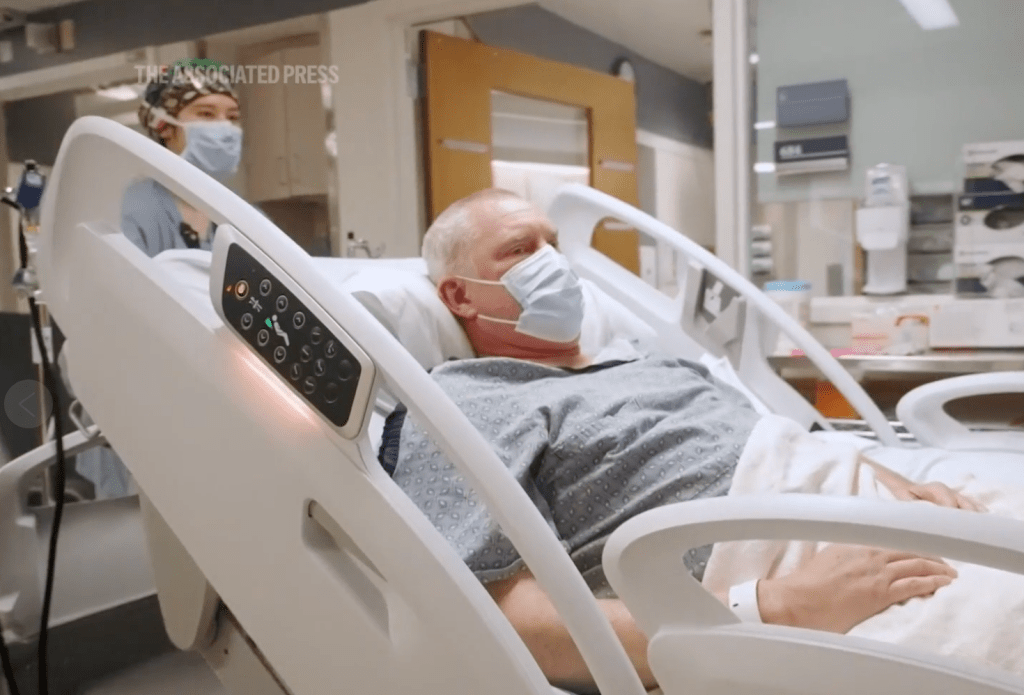
WASHINGTON (AP) — A self-described science nerd is the latest American to get an experimental pig kidney transplant, at a crucial point in the quest to prove if animals organs really might save human lives.
The 54-year-old New Hampshire man is faring well after his June 14 operation, doctors at Massachusetts General Hospital announced Monday.
“I really wanted to contribute to the science of it,” Bill Stewart, an athletic trainer from Dover, New Hampshire, told The Associated Press.
That’s not the only milestone the Mass General team is marking: A pig kidney has kept another New Hampshire man, Tim Andrews, off dialysis for a record seven months and counting. Until now, the longest that a gene-edited pig organ transplant was known to last was 130 days.
Based on lessons from the New Hampshire men and a handful of other one-off attempts, the Food and Drug Administration approved pig producer eGenesis to begin a rigorous study of kidney xenotransplants.
“Right now we have a bottleneck” in finding enough human organs, said Mass General kidney specialist Dr. Leonardo Riella, who will help lead the new clinical trial.
More than 100,000 people are on the U.S. transplant list, most who need a kidney, and thousands die waiting. As an alternative, scientists are genetically altering pigs so their organs are more humanlike, less likely to be immediately attacked and destroyed by people’s immune system.
Initial experiments, two hearts and two kidneys, were short-lived and included very ill patients. Chinese researchers also recently announced a kidney xenotransplant but released little information. Then an Alabama woman whose pig kidney lasted 130 days before rejection prompted its removal, sending her back to dialysis, helped researchers shift to not-as-sick patients.
In New Hampshire, high blood pressure caused Stewart’s kidneys to fail but he had no other health problems. It can take up to seven years for people with his blood type to find a matching kidney from a deceased donor, and some would-be living donors didn’t qualify. After two years in dialysis, he heard about Mass General’s most recent xenotransplant recipient – Andrews – and applied to be the next candidate.
“I’ve always been a little bit of a science nerd,” Stewart said. Conscious of how new these experiments are, he sought out Andrews for advice and ultimately decided, “worst case scenario, they can always take it out.”
Thrilled to no longer have his time and energy sapped by dialysis, Stewart said he’s easing back into desk duties at work and visited his old dialysis clinic to “let everyone know I’m doing all right and maybe kind of give some people some hope.”
Riella, the kidney specialist, said Stewart had his anti-rejection drugs adjusted to counter an early concern and that Andrews has needed similar adjustments. He said it’s far too early to predict how long pig kidneys might be able to last — but it would be useful even if initially they can buy people time off dialysis until they get a matching human organ.
“A year, hopefully longer than that – that’s already a huge advantage,” he said.
The new eGenesis trial will provide gene-edited pig kidney transplants to 30 people age 50 or older who are on dialysis and the transplant list. Another developer of gene-edited pig organs, United Therapeutics, is about to start enrolling people in a similar FDA-approved study.
___
The Associated Press Health and Science Department receives support from the Howard Hughes Medical Institute’s Department of Science Education and the Robert Wood Johnson Foundation. The AP is solely responsible for all content.
As journalists, we ask questions for a living. And we strive to make sure our work addresses the pressing ones on readers’ minds, especially in this time of dizzying political news. That’s why we regularly invite the audience of The Morning to send us their questions, and have our expert beat reporters respond.
Today, we’re addressing your queries about immigration, military spending, Social Security, Medicaid and whether now is a good time to build a house. (Got a question for us? Submit them here.)
ICE raids
With the raids on undocumented immigrants going on, targeting the people who work in the fields and the slaughterhouses, how have these actions affected the supply and prices in our grocery stores? — Anna Halbrook, Otis, Ore.
We asked Julie Creswell, who covers the food industry, to field this one:
We haven’t seen any obvious fallout from immigration raids on grocery prices yet. As of the end of May, prices were up about 2.2 percent compared with a year earlier. Eggs, coffee and meats — ground beef in particular — drove that increase.
But beef prices were climbing even before the raids, because of droughts and high interest rates (ranchers take out loans to run their operations). The nation’s cattle inventory is at its lowest level since the 1950s. Prices of fruits and vegetables have stayed about flat over the past year; tomatoes and lettuce are actually much cheaper right now.
Defense spending
Trump has pushed NATO countries to spend 5 percent of their economic output on the military. How much of its economic output does the U.S. spend on the military? — Diann Ebersole, Copperopolis, Calif.
From German Lopez, who has written several Morning newsletters on this very topic:
The U.S. spends about 3.5 percent of its gross domestic product on the military. That used to put America at the top of NATO’s ranks, but Poland now spends a larger portion, 4.1 percent.
Critics say this makes President Trump a hypocrite: If the U.S. isn’t spending 5 percent, why should other countries? But Trump says that the U.S. doesn’t need to spend as much now because it’s invested a lot more historically. Europe, the argument goes, has let its militaries and defense industries languish through disinvestment. (Some experts agree.) The president contends that those countries need to rebuild in a way that the U.S. doesn’t, and rebuilding has a big upfront cost.
Trump also has a transactional view of the world and alliances. He sees Europe’s renewed spending as payback after the U.S. bore the brunt of NATO’s duties and expenditures for decades.
Retirement benefits
I’ve heard a lot of talk that Social Security will be running out of money. I plan on retiring in the next two to three years. Should I retire sooner to collect my full benefit? — Elizabeth Y.
Here’s Tara Siegel Bernard, who recently interviewed retirees on this:
Social Security has long faced financing challenges, but the issue becomes more pressing each year. The trust fund that pays retiree benefits is projected to be depleted in 2033, or when today’s 59-year-olds turn 67. At that point, the program will have enough incoming revenue to pay only 77 percent of benefits — in other words, a 23 percent cut. But that happens if Congress does nothing to address the problem, like raising payroll taxes or trimming benefits.
The decision of when an individual should take Social Security is highly personal. There can be a huge payoff for healthy people who can afford to wait: Starting at 67 instead of 62, for example, can mean monthly checks that are 43 percent higher. And for each year you delay retirement past 67, your monthly payment rises 8 percent.
Ask yourself: Would collecting a reduced benefit for a couple of extra years be preferable to locking in a higher benefit for the rest of your life? A conversation with a financial planner is often a solid investment; these are high-stakes decisions.
Who loses Medicaid?
Are there some specific examples of who will be affected by Medicaid cuts and requirements to work in the big policy bill passed last week? Will people with Parkinson’s who are in long-term care be cut off because they can’t work? — Amy, Glenview, Ill.
From Margot Sanger-Katz, who covers health care for The Upshot:
The bill’s work requirement is focused on a relatively specific group of Medicaid beneficiaries: childless adults without disabilities and parents of children older than 13. But it is certainly plausible that the bill’s policies could have spillover effects for other populations.
A person in long-term care with Parkinson’s would almost certainly still be covered. But someone with Parkinson’s who has not yet qualified for Social Security disability status may have to prove they are too sick to work. States will also have to build new enrollment systems to check who is eligible and who is compliant, and several current and former state officials are worried the magnitude of that effort could lead to errors and delays for everyone.
When to build
Is this a good time to build a house? — Janie Spataro, Ringgold, Ga.
Conor Dougherty, who covers the housing industry, offers this advice:
Can you afford to build it, and do you plan on living there for seven to 10 years? If the answer to both of those questions is yes, then it’s as good a time as any to build.
Housing is an unusual good in that it is both a consumable, like a car, and an investment, like a stock. Most of the worst home-buying decisions — overstretching on a mortgage, buying in an area you don’t really like — come from thinking of housing as an opportunity to make money instead of as a place to live. A house is only a good investment if you think of it as home.
I’ve been a freelance journalist for most of my adult life, going back to my days as a staff writer on a college newspaper. Since then, I’ve been published hundreds of times in everything from weekly newspapers to regional trade magazines. Much of my work consists of feature stories, opinion columns, and a few hard news pieces.
I was trained by an old-school newspaper editor who demonstrated consistent ethics and integrity. I was taught never to take a story to press without three primary sources and on-the-record statements from those directly involved to back up the information.
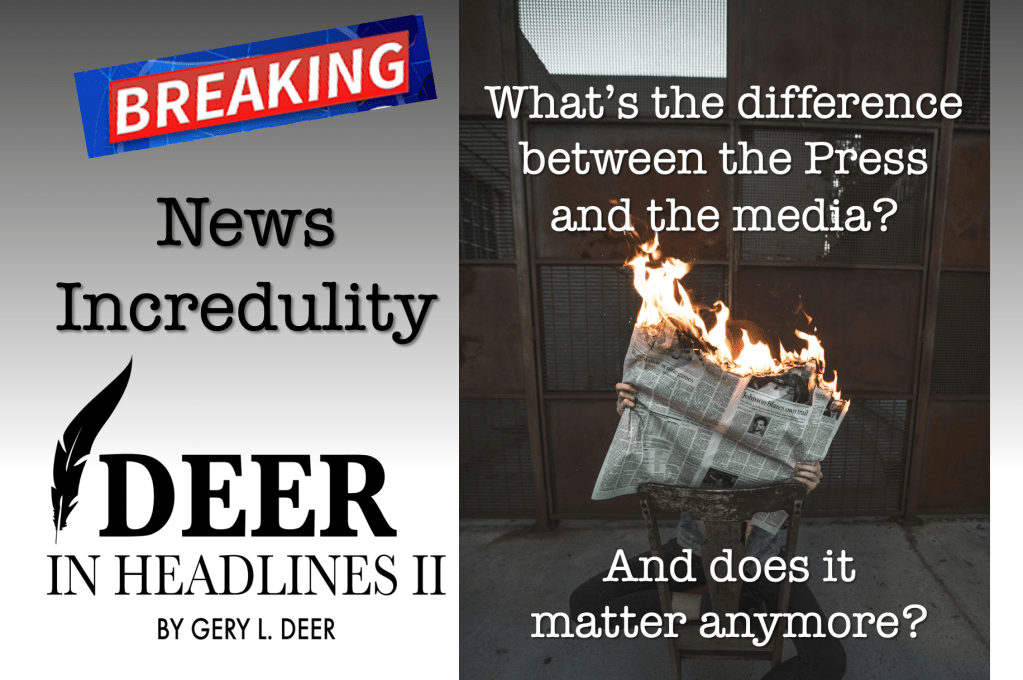
As the Internet became an easy way for the citizen journalist to publish news and information, credibility and fact gave way to sensationalism and uninformed opinion. Click bait replaced proper headlines. Soon, what was once referred to as “the press,” was suddenly renamed, “the media.” In this reporter’s humble opinion, they are not the same.
Webster’s Dictionary defines media (plural of the word medium) as a means of communication, such as radio, TV, newspapers, social, the internet, and so on. In other words, it refers to the delivery system rather than the content or its source.
For example, social media is a primary source of news for many Americans. Unless the information originates from a reputable news source, the content may have no oversight, no editorial integrity, no fact-checking, nothing.
You may have no idea where the information came from or how it may have changed. Think of it as a game of telephone. The more the word spreads, the less accurate it becomes. To reiterate, the social media platform (or app), such as Facebook, X, or Instagram, is just the vehicle – the medium. Reputable or not, the message originates elsewhere.
“The Press,” on the other hand, is guaranteed by the First Amendment of the U.S. Constitution. Like the three branches of government, it’s literally set up right there in black and white – which is why it’s called the Fourth Estate.
The Press should serve as a watchdog to help hold those in power accountable and provide the public with the information they need to make informed decisions. Trained Press journalists gather facts, verify information, and present it objectively across a variety of media.
A functional and qualified Press works within the realm of fact – not truth (that’s for philosophers). It should present information without bias or commentary (there’s a page for that and you’re looking at it now) and demonstrate integrity in the process.
Before I have people shouting at the screen or tearing up the paper, I agree the problem of misinformation spread by so-called news outlets is in epidemic proportions. Unfortunately, many news agencies have traded integrity for revenue, to say nothing about a complete disregard for journalistic expertise.
Cable news programs often fall into this category. They base their content on current news stories, targeting the biases and interests of a single segment of audience to grow advertising revenue. This is not news – it’s entertainment.
Even worse is when a news outlet censors content to favor the business or political interests of their owners. For example, once a paragon of investigative journalism, “The Washington Post” is rapidly losing credibility because of interference with its newsroom by its owner, Amazon founder Jeff Bezos.
Between social media, so-called citizen journalists, bloggers, and whatever else is out there, unvetted, unqualified, and often false content is cranked at an alarming rate. Their goal is to spread as much click bait as possible and deliver customers to advertisers – it’s all about money. That makes it hard to sift through the noise for qualified, factual news.
In the end, the Press should be rooted in ethics and accuracy. Sadly, many news outlets now prioritize profit, sensationalizing content to stay competitive in digital media. That’s muddied the journalistic waters, making it harder for the public to distinguish between fact and opinion.
My only advice is to check the source and remember that perspective isn’t the same as bias. News should be factual and accurate, not “fair.” There is no such thing as “fair and balanced” news. Fairness suggests compromise, whereas facts stand alone. The standard should be: is it factual, or not?
WASHINGTON (AP) — References to a World War II Medal of Honor recipient, the Enola Gay aircraft that dropped an atomic bomb on Japan and the first women to pass Marine infantry training are among the tens of thousands of photos and online posts marked for deletion as the Defense Department works to purge diversity, equity and inclusion content, according to a database obtained by The Associated Press.
The database, which was confirmed by U.S. officials and published by AP, includes more than 26,000 images that have been flagged for removal across every military branch. But the eventual total could be much higher.
1 of 5 |
In this image provided by the U.S. Marine Corps, Pfc. Christina Fuentes Montenegro prepares to hike to her platoon’s defensive position during patrol week of Infantry Training Battalion near Camp Geiger, N.C. Oct. 31, 2013. (Sgt. Tyler Main/U.S. Marine Corps via AP)
2 of 5 |
In this image provided by the U.S. Air Force, the Boeing B-29 named the “Enola Gay” is seen on Tinian in the Marianas Islands. (U.S. Air Force via AP)
3 of 5 |
In this image provided by the U.S. Air Force, armorers and other ground personnel undergo training at Chanute Field, Ill., during World War II (U.S. Air Force via AP)
4 of 5 |
In this image provided by the U.S. Air Force, Staff Sgt. Krysteena Scales, a 816th Expeditionary Airlift Squadron Flying Crew Chief, performs pre-flight checks before departing on a mission in a C-17 Globemaster III, March 19, 2009, at an undisclosed location in Southwest Asia. (Senior Airman Andrew Satran/U.S. Air Force via AP)Read More
5 of 5 |
This image provided by the U.S. Marine Corps shows World War II Medal of Honor recipient Pfc. Harold Gonsalves during World War II. (U.S. Marine Corps via AP)
In this image provided by the U.S. Air Force, the Boeing B-29 named the “Enola Gay” is seen on Tinian in the Marianas Islands. (U.S. Air Force via AP)
One official, who spoke on condition of anonymity to provide details that have not been made public, said the purge could delete as many as 100,000 images or posts in total, when considering social media pages and other websites that are also being culled for DEI content. The official said it’s not clear if the database has been finalized.
Defense Secretary Pete Hegseth had given the military until Wednesday to remove content that highlights diversity efforts in its ranks following President Donald Trump’s executive order ending those programs across the federal government.
The vast majority of the Pentagon purge targets women and minorities, including notable milestones made in the military. And it also removes a large number of posts that mention various commemorative months — such as those for Black and Hispanic people and women.
In this image provided by the U.S. Air Force, armorers and other ground personnel undergo training at Chanute Field, Ill., during World War II (U.S. Air Force via AP)
In some cases, photos seemed to be flagged for removal simply because their file included the word ”gay,” including service members with that last name and an image of the B-29 aircraft Enola Gay, which dropped the first atomic bomb on Hiroshima, Japan, during World War II.
In this image provided by the U.S. Air Force, Staff Sgt. Krysteena Scales, a 816th Expeditionary Airlift Squadron Flying Crew Chief, performs pre-flight checks before departing on a mission in a C-17 Globemaster III, March 19, 2009, at an undisclosed location in Southwest Asia. (Senior Airman Andrew Satran/U.S. Air Force via AP)
Several photos of an Army Corps of Engineers dredging project in California were marked for deletion, apparently because a local engineer in the photo had the last name Gay. And a photo of Army Corps biologists was on the list, seemingly because it mentioned they were recording data about fish — including their weight, size, hatchery and gender.
In addition, some photos of the Tuskegee Airmen, the nation’s first Black military pilots who served in a segregated WWII unit, were listed on the database, but those may likely be protected due to historical content.
The Air Force briefly removed new recruit training courses that included videos of the Tuskegee Airmen soon after Trump’s order. That drew the White House’s ire over “malicious compliance,” and the Air Force quickly reversed the removal.
Many of the images listed in the database already have been removed. Others were still visible Thursday, and it’s not clear if they will be taken down at some point or be allowed to stay, including images with historical significance such as those of the Tuskegee Airmen.
This image provided by the U.S. Marine Corps shows World War II Medal of Honor recipient Pfc. Harold Gonsalves during World War II. (U.S. Marine Corps via AP)
Asked about the database, Pentagon spokesman John Ullyot said in a statement, “We are pleased by the rapid compliance across the Department with the directive removing DEI content from all platforms. In the rare cases that content is removed that is out of the clearly outlined scope of the directive, we instruct components accordingly.”
He noted that Hegseth has declared that “DEI is dead” and that efforts to put one group ahead of another through DEI programs erodes camaraderie and threatens mission execution.
Some images aren’t gone
In some cases, the removal was partial. The main page in a post titled “Women’s History Month: All-female crew supports warfighters” was removed. But at least one of the photos in that collection about an all-female C-17 crew could still be accessed. A shot from the Army Corps of Engineers titled “Engineering pioneer remembered during Black History Month” was deleted.
Other photos flagged in the database but still visible Thursday included images of the World War II Women Air Service Pilots and one of U.S. Air Force Col. Jeannie Leavitt, the country’s first female fighter pilot.
Also still visible was an image of then-Pfc. Christina Fuentes Montenegro becoming one of the first three women to graduate from the Marine Corps’ Infantry Training Battalion and an image of Marine Corps World War II Medal of Honor recipient Pfc. Harold Gonsalves.
It was unclear why some other images were removed, such as a Marine Corps photo titled “Deadlift contenders raise the bar pound by pound” or a National Guard website image called “Minnesota brothers reunite in Kuwait.”
Why the database?
The database of the 26,000 images was created to conform with federal archival laws, so if the services are queried in the future, they can show how they are complying with the law, the U.S. official said. But it may be difficult to ensure the content was archived because the responsibility to ensure each image was preserved was the responsibility of each individual unit.
In many cases, workers are taking screenshots of the pages marked for removal, but it would be difficult to restore them if that decision was made, according to another official, who like the others spoke on the condition of anonymity to provide additional details that were not public.
A Marine Corps official said every one of its images in the database “either has been taken down or will be taken down.” The Marines are moving on the directive as fast as possible, but as with the rest of the military, very few civilian or contractor employees at the Pentagon can perform content removal, the official said.
In the Marine Corps, just one defense civilian is available to do the work. The Marine Corps estimates that person has identified at least 10,000 images for removal — and that does not count more than 1,600 social media sites that have not yet been addressed.
Many of those social media sites were military base or unit support groups created years ago and left idle. No one still has the administrative privileges to go in and change the content.
The Marine official said the service is going through each site and getting new administrative privileges so it can make the changes.
On Feb. 26, the Pentagon ordered all the military services to spend countless hours poring over years of website postings, photos, news articles and videos to remove any mentions that “promote diversity, equity and inclusion.”
If they couldn’t do that by Wednesday, they were told to “temporarily remove from public display” all content published during the Biden administration’s four years in office.
___
AP reporters Nicholas Riccardi in Denver, Christina Cassidy in Atlanta, Will Weissert and Ayanna Alexander in Washington and Christine Fernando in Chicago contributed to this report
(The Jamestown Comet.com claims no origin or ownership for this content and is providing it as a service to our readers. All sources and content verified. Please see the Associated Press main website for detailed stories.)



 The Jamestown Comet