Local News & Commentary Since 1890.

Archive for the ‘World News’ Category

Combating fear and terrorism at the holidays

In Crime, history, Local News, Media, National News, News Media, Opinion, Politics, psychology, sociology, Technology, Travel, Uncategorized, World News on November 19, 2015 at 11:05 am

Deer In Headlines
By Gery L. Deer

DIH LOGOAs the holiday season begins, bad guys around the world are watching and willing to do anything to disrupt safety and security. In the shadow of the Paris attacks in which 129 people died and more than 350 injured, it’s hard not to worry that another strike is just around the corner.

The level of anger and hatred leveled at peace-loving people is almost incomprehensible. But what can we do, as individual Americans, to remain safe and keep the terrorists from spreading fear?

For the most part, remaining diligent about safety should be a common sense concept. But, surprisingly, many Americans are complacent about their place on the global stage. But it’s only a matter of time before ISIS and similar groups manage to hit an American target on a massive scale, just as al Qaeda did in 2001. In other words, we’ve been lucky.

As the White House plans for the reception of thousands of Syrian refugees fleeing terrorism themselves, many conservatives are debating the idea that the inrush of refugees may include planted ISIS terrorists. Although this is certainly a legitimate concern, my guess is, however, they already have people on the ground here in the States, recruiting American young people on our own soil.

It can still happen here ... again.

It can still happen here … again.

Young, mush-brained Americans are being recruited into these terrorist cells in staggering numbers. One report by CNN.com states, “ISIS takes a somewhat secular approach, portraying how much better life purportedly is in the caliphate as compared to the corrupt West.”

The article also offers a reminder that it’s not just American youth who are attracted to the ISIS recruitment process. It also appeals to a wide demographic of people from all ages and socioeconomic ranges.

Additionally, gun control in the U.S. may help reduce domestic terror violence, but taking guns from the hands of law-abiding citizens might actually make ISIS’ job easier by making them bolder. My guess is that one of the few things keeping the bad guys at bay is a “Texas” mentality – the belief that we’re all gun-crazy and packing heats everywhere we go.

While that wouldn’t scare the leaders or group on the whole, those individuals they recruit to actually act would think twice if there was a possibility of not completing their “holy” mission – the deaths of hundreds of free Americans. If the assailant were to be gunned down by a regular citizen before he can detonate his bomb or unload his weapon on innocents, he’d be a failure and dishonor himself.

Americans can’t afford to depend entirely on the federal government to protect them from these threats and should remember the advice of the Department of Homeland Security (DHS). On the official DHS website, the agency states, “Citizens should report suspicious activity to their local law enforcement authorities.”

DHS officials urge citizens to be “vigilant for indicators of potential terrorist activity” and watch the National Terrorism Advisory System (NTAS) Alerts for information about specific threats. While being vigilant, however, it’s important to be clear on who exactly constitutes “the enemy.”

Clearly, Americans are behind our French allies, in solidarity against a common enemy with no borders, no face, no diplomatic recognition, no motive (except murder) – the enemy could be anyone. But we must keep in mind that “alert” doesn’t mean “paranoid.”

The words “Islam” and “Muslim” are being thrown around in the reports about the most recent terror attacks. We must remember that Muslims are not the enemy – ISIS is the threat. Muslims, like most Christians, are peaceful, law-abiding citizens who are deeply harmed by what these radicals are doing.

History is full of religious extremism, from virtually every major sect on the planet. We’ll never be completely rid of it, but we can do our best to keep it from damaging our society and protect citizens of the free world as effectively as possible.

As a people and a country, America survived 9/11 and we’ll survive whatever ISIS throws at us. But anything we can do to prevent this most recent threat from any level of success is worth the effort and diligence.


Gery L. Deer is an independent columnist and business writer. Deer In Headlines is distributed by GLD Enterprises Communications. More at gerydeer.com.



What happened to real news?

In Business, Entertainment, Media, News Media, Opinion, Sports News, State News, Uncategorized, World News on June 5, 2015 at 11:38 am

Deer In Headlines

By Gery L. Deer

DIH LOGOIn my long, diverse career, I have had the privilege of meeting and working with some of the best news and media people in the business. I have provided content for Pulitzer Prize-winning publications and even earned some award nominations myself, in part thanks to my association with so many talented colleagues.

But, and I admit it freely, there are times when I am thoroughly embarrassed to be a member of the media in any capacity. Most recently, I feel that way regarding the nauseating, continuous coverage of the Kardashian “family” and their talentless train wreck.

I just don’t get it. Am I missing something here? I keep hearing them referred to as “superstars,” and, for the life of me, I can’t think of any reason they have even come close to earning that moniker.

But my point here is not to rant about these ridiculously out-of-touch people, but to ask my colleagues, what happened to the news and stories about real people? The world is filled with incredible stories of success, survival, family, and even plenty of dysfunction, if that’s your thing, so it’s not like there aren’t better subjects out there.

91389965_36f4f323cc_oBear in mind, I’m not referring to tabloids, celebrity blogs or grocery store gossip rags, but media outlets who claim to have journalistic integrity and brag about their commitment to bringing real news to the forefront. My favorite example of this kind of hypocrisy has got to be CBS, which now uses the social media hashtag “#newsisback;” really guys?

Recently, CBS News social media and even their morning show, which is advertised as, “responsible, intelligent information,” reported details about a Kardashian baby announcement. First, who cares? Second, can someone explain to me how something like that qualifies as “real” news?

One of CBS’s early morning competitors, NBC’s Today Show, can’t seem to get enough of the ridiculous Kardashians. This is primarily because E! Entertainment Television – which carries the Kardashian reality show – and NBC TV are both owned by NBCUniversal.

But, although I think they spend too much time on this nonsense, they get a bit of a pass because their program is more entertainment than news. That is, the format allows for more light-hearted stories, entertainment information, and so on.

However, in the case of CBS This Morning, if they are going to spend their ad budget slamming competitors while claiming to be the leading news resource, they need to put their money where their mouth is, so to speak. If the producers and executive bean counters (because that’s who makes the real decisions) want to actually “be” the news leaders, they need to drop this stuff and stay focused. Let the cable entertainment shows promote this junk and give the audience what you promised.

As mentioned before, looking more closely, you find that media giants like CBS and NBC are connected to all manner of media, from publishing companies to film studios. The news programs are used to promote these endeavors and make more money.

For example, say some actor has a book coming out by “publisher A,” which happens to be owned by “media company B,” which produces “morning TV show C.” How better to promote the book and subsequent movie and rake in more cash?

Speaking of bean counting, a big chunk of the responsibility for this problem has to lie at the feet of the consuming public because if they weren’t “buying,” the media wouldn’t be “selling.” Unfortunately, it’s a bit of a self-propelling monster because if stuff like this were never aired in the first place, the public would never have seen it to demand more, and the cycle goes on.

I regularly struggle with content myself, albeit on a much smaller level, but I do my best to consider my audience. I ask myself what they would want to know and how my information will help them in their day-to-day lives. So should the big guys.

The production of news media is big business with lots of complex nooks and crannies, and, honestly, no one wants to see how the sausages are made. All I am asking is that news media practice what they preach.


Gery L. Deer is an independent columnist and business writer. Deer In Headlines is distributed by GLD Enterprises Communications. All Rights Reserved. More at gerydeer.com.

Remembering “Spock,” actor Leonard Nimoy

In Entertainment, Movies, National News, Opinion, television, Theatre, Uncategorized, World News on March 3, 2015 at 1:43 pm

DIH LOGO

In 1982, fans of the science fiction franchise, “Star Trek,” more commonly referred to as “Trekkies,” or the more accepted, “Trekkors,” took a kidney punch when Leonard Nimoy’s character of Mr. Spock died at the end of the film “Star Trek II – The Wrath of Khan.” But, thanks to the miracle of science fiction, Spock was resurrected and the Starship Enterprise continued to boldly go where no man had gone before.

Sadly, fans must now face a more painful and permanent fact of life as they mourn the passing of the actor who, for nearly a half century, portrayed their favorite pointy-eared alien. Leonard Nimoy passed away on February 27th at the age of 83 at his home in Los Angeles following a long battle with chronic obstructive pulmonary disease, or COPD.

As a lifelong fan there is no way to adequately convey the sadness of losing such a talented performer whose on-screen character inspired so many. Mr. Spock, Captain Kirk, Dr. McCoy, and the rest of the U.S.S. Enterprise crew, were great sources, not only of entertainment, but incredible inspiration for individual achievement and social change.

spockNetwork executives originally told Star Trek creator Gene Roddenberry to, “get rid of the guy with the ears.” But, thanks to Mr. Nimoy’s talented development of the character,  Mr. Spock became a quintessential part of “Star Trek’s” hopeful future in which everyone worked together to eliminate hunger, pettiness and poverty.

Such a vision is still somewhat unique – and often poked fun at – in the science fiction genre, which more often paints a dark, pessimistic outlook for man and a holocaust-ravaged world of tomorrow.  But with Spock’s presence, a bright future for mankind seemed more plausible. In Spock, Mr. Nimoy created the embodiment of chaos with focus, logic with feeling, and understanding with wonder.

I have been incredibly fortunate on a couple of occasions to have had the chance to meet and speak to Mr. Nimoy, as well as see him perform. At one Star Trek anniversary convention I attended, he invited questions from the audience. He chose my raised hand from several dozen other hopefuls seated nearby and I didn’t waste the opportunity.

A bit stunned at having been selected, I stood up and managed to ask something from the original “Star Trek” pilot episode that I’d been wondering about for years. With a genuinely amused laugh, he thought for a moment and informed us that he’d never before been asked about it.

Then, he answered with a detailed, behind the scenes story and directly thanked me when he finished. I will never forget that. Naturally it was cool even to be picked out of hundreds, but I was far more privileged to have given Leonard Nimoy even a tiny moment of entertainment in return for all he’d given us.

Mr. Nimoy played Spock for the last time in the most recent “Star Trek” film, “Into Darkness,” and, although he will be most remembered for his logical alter-ego, he also performed in dozens of other movies and television programs over the years. Besides “Star Trek,” he’s probably most remembered for his time on “Mission Impossible” and, more recently, in the TV drama, “Fringe.”

Besides being a gifted actor, Mr. Nimoy was a director, poet, photographer and activist. In the “Star Trek” animated series Spock is quoted to have said, “Loss of life is to be mourned. But only if that life was wasted.” Clearly, his was certainly not wasted.

Any of us should be so lucky as to have touched even a fraction of the lives Mr. Nimoy did, and in so many positive ways. To all those mourning a loss, remember the burden will ease over time and those we lose really aren’t gone, as long as we remember them. Live long and prosper.

If you would like to know Gery’s convention question to Mr. Nimoy and what answer he gave, read the BONUS MATERIAL at the end of this article.

Gery L. Deer is an independent columnist and business writer. Deer In Headlines is distributed by GLD Enterprises Communications. More at gerydeer.com.


BONUS MATERIAL:
Question from Gery Deer to Leonard Nimoy in a talk at the Star Trek 35th Anniversary Convention, Las Vegas, Nevada.

Gery L. Deer: Mr. Nimoy, in the Star Trek pilot episode, “The Cage,” you beam down to the surface of planet Talos IV with Captain Pike and a landing party. As you walk around the planet set, you appear to be limping and I wanted to know if you could tell us why? I’ve heard people say it had something to do with your boots, or the set floor, whatever. I just wondered what the real reason was.

Deer In Headlines author, Gery L. Deer in one of the uniforms designed for Star Trek II-The Wrath of Khan

Deer In Headlines author, Gery L. Deer in one of the uniforms designed for Star Trek II-The Wrath of Khan

Leonard Nimoy: (Laughing) You’ve been worried about that all of these years, why I was limping? Well, I have to say I have never been asked about that before.

(The crowd of about 1,200 in the room was really laughing at this point and applauding.)

Leonard Nimoy: Well, I’ll tell you because I really don’t want you to be troubled by this any longer. (More laughter). If you remember in the story there was some discussion about a fight that had taken place on a planet several weeks prior.

As the story goes, the Enterprise crew was ambushed and there was a battle in which crew members were killed or injured. Spock was supposed to have hurt his leg in that fight. In television and movies, you often shoot scenes and story lines out of sequence and the scenes where the fight takes place would have been in another episode to go before the events in The Cage had Star Trek had been picked up without any changes. Then you’d see Spock get hurt and know why he’s limping later. (Crowd applauds.)

Leonard Nimoy: (Nimoy, looking back again at Gery) That’s why I was limping and now you don’t have to worry about it anymore. Thank you for that question, that was really the first time anyone has ever asked me that. (Mr. Nimoy gives Gery the Vulcan salute and the crowd applauds again.)

END.


Propaganda still has power over Americans

In Dayton Ohio News, Health, Local News, National News, News Media, Opinion, Politics, psychology, Religion, State News, Uncategorized, World News on October 27, 2014 at 9:42 pm

DIH LOGOPolitics and religion both thrive on propaganda, some of it factual, some creatively manufactured. Either way, people will buy into almost anything when you hit them at the gut level. Emotions ride highest when fear is used as the manipulation point.

In 1938, Orson Welles managed to terrify the radio listening public as he destroyed America by Martian invasion in his version of H.G. Wells’, “War of the Worlds.” Of course, it was all a Halloween offering, a prank, “the radio equivalent of dressing up in a sheet and jumping out from behind a bush and saying, ‘boo,’” as Welles put it. But it was, for lack of any other analogy, an hour of “propaganda;” a radio play written to sound exactly like genuine news bulletins, and people fell for it.

According to the dictionary definition, propaganda is information, especially of a biased or misleading nature, often used to promote or publicize a particular political cause or point of view. A deceptive radio broadcast may not be likely to have the same effect today, but if the current Ebola virus scare is any indication, Americans are still far from immune to the effects of well-crafted media spin.

With virtually no qualified medical information being distributed within the propaganda (probably the best word to describe most of the information being circulated), politicians, the media, and the endless barrage of know-it-all cable TV commentators are spreading speculation, misinformation and fear, unabated.

As one might expect, election season has to be one of the most prominent times for the spread of heavy-handed, negative propaganda. Despite laws to limit how “misleading” political ads can be, there is still so much being dispersed that it staggers the imagination of the thinking person as to how it is even allowed.

With fewer people concerned about the accuracy of news reporting these days, believing any blog they run across on Google, media spin no longer needs even to be well-crafted for the masses to fall victim to its intent. There are still, bafflingly, people out there who think that what they see on the news or Internet must be the truth. Not so much “fact,” but truth.

Is the Ebola scare really the menace it's made out to be by politicians and media?

Is the Ebola scare really the menace it’s made out to be by politicians and media?

The spread of propaganda does not require facts but implies truth. Make enough people believe in an idea, factual or not, and it becomes “truth,” at least to those people. Once spread, that truth ends up being the predominant viewpoint and changing the minds of those who fall for it is a challenge, to say the least. Oddly enough, this is the same basis upon which every religion in history has been established.

As pointed out many times in “Deer In Headlines,” decisions are rarely made from factual information but more often based on emotional satisfaction. What makes a person feel good is far more powerful than a list of unemotional statistics. Once again, fear can be one of the most powerful emotions of them all and that is exactly the point.

Without fear, propaganda has much less of an effect. Political propaganda plays on the fear of the voter, suggesting that he or she will suffer under the rule of the opposing candidate – higher taxes, less food on the table, fewer jobs, and so on. In religious propaganda, the fear is purgatory, Hell, or whatever the particular denomination chooses to promote as the reason to show up every Sunday and ante up in the plate as it goes by.

There is, without question, a serious problem concerning the spread of the Ebola virus in the United States. But there is also, sadly, a tremendous opportunity here for politicians to cash in on the fears of those who are probably already paranoid about such things, enhancing the real threat enough to justify the need for such publicity.

Those fifteen minutes of fame come with a high cost, mainly in the stress and emotional trauma experienced by the people who trust their government to take care of them. Avoiding future panic means that people simply need to be cautious about what they take as “fact,” versus what they believe to be “truth.”


The Jamestown Comet.com editor Gery L. Deer is an independent columnist and business writer based in Jamestown, Ohio. More at deerinheadlines.com.

Gainsay of Gaza school bombing not anti-Semitic

In history, National News, Opinion, Politics, sociology, Uncategorized, World News on August 9, 2014 at 2:50 pm

DIH LOGOThere’s an inherent problem with “political correctness” when it extends to speaking out against bad policy or horrific acts against the innocent. When the super-sensitive “left” can’t accept that people can dislike someone’s opinion without literally hating them, any hope of long-term, productive dialogue or constructive discourse is totally squelched.

When President Obama was elected, people became so obsessed about his being our first African American president, that to even mention a disagreement with his policies labeled one a racist. Naturally, that’s ridiculous. But, for the majority of his first term anyone who argued against him was considered to simply be hateful and bigoted.

We’re in a similar, uncomfortable, situation now with the problems going on in Gaza and the alleged bombing of civilian targets by both Israel and Hamas. There is no question that what’s going on there is terrible and it’s a given that Israel has suffered its share of problems in its short existence as a nation. But, criticism of their tactics in the current conflict does not make one anti-Semitic.

Because Hamas is seen by many as a “terrorist” organization, it is therefore more acceptable to criticize them publicly, but that’s not the debate. It’s not anti-Semitic to state, “It’s wrong for Israel to bomb civilian targets and kill innocent people, including children.” Anyone who thinks that it’s ok to bomb kids regardless of the purpose may be hinging on sociopathic mentality.

Many United Nations officials condemned the bombing of a UN-run school in Gaza, including  Secretary-General Ban Ki-moon, seen here.

Many United Nations officials condemned the bombing of a UN-run school in Gaza, including Secretary-General Ban Ki-moon, seen here.

After a United Nations-operated school was bombed in Gaza City last week, killing 20 and wounding dozens, including children, The Washington Post reported that the U.N. officially condemned Israel for the bombing with UNRWA Commissioner-General Pierre Krähenbühl saying, “I condemn in the strongest possible terms this serious violation of international law by Israeli forces. This is an affront to all of us, a source of universal shame. Today the world stands disgraced.”

There are, of course, those who have accused the U.N., as an organization, of being anti-Semitic since its inception, but this is not an indication of that. This is a statement from the commissioner-general communicating that the world group disagrees with the Israeli tactic and would prefer they try to find a peaceful solution.

Considering that the GPS coordinates of the school had been reportedly sent to Israel at least 17 times, at this point it’s Israel’s own actions drawing negative opinion and squelching sympathy for their cause. Still, it’s seen as distasteful to speak against the Jewish nation without being labeled racist and therein lays the problem.

Will it always be that with any minority or historically trodden-down group, negative opinion or public critique will draw for the speaker undo hatred or have them forever labeled racist, anti-Semitic or worse? Is political correctness always this blind, even in the court room? Yes. It always will be. Take, for instance, mandatory minimum sentences for drug crimes here in America.

Statistics suggest that the vast majority of drug criminals in the U.S. are African American. Since there are often mandatory minimum prison sentences on the books for various levels of possession, sale and use of street narcotics, by the logic of some, which makes mandatory minimums racist. Are they? That’s a debate for another time, but the same logic is at work here as well.

There seems to be a belief among modern liberals and conservatives alike that freedom of speech is a wonderful thing, so long as you only say what they want to hear. Anything that goes against the grain on either side of the aisle will earn a swift retribution for the originator of the message. Oddly, it’s always been that way, but now, with social media, the Internet and an instant news cycle, there’s just more of a platform for argument.

Speaking one’s mind about an atrocity is the purview of any conscientious observer. Whether someone is doing so from a racial bias is another matter entirely. However, if those committing the atrocity expect sympathy in some way, it’s unlikely that they will achieve any of their goals by fueling the fires of hate through horrific actions, regardless of whether they believe it to be the means to the end.
Gery L. Deer is an independent columnist and business writer syndicated by GLD Enterprises Commercial Writing. More at gerydeer.com.


Godzilla: King of the anti-nuclear message

In Entertainment, Environment, Movies, National News, Opinion, Politics, Science, Technology, Uncategorized, World News on May 12, 2014 at 12:00 pm


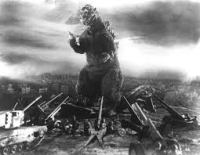
DIH LOGOIn 1955, the Japanese film company, Toho, Inc., introduced America to “Godzilla, King of the Monsters.” The bulky, green monster terrified audiences in the marginally familiar form of an enormous T-Rex, with notable size differences, muscular body and bigger arms and all brought to life by a puppeteer in a rubbery body suit. Originally called by the Japanese word, “Gojira,” meaning “gorilla whale,” the monster was so successful he’s been a worldwide star since his first black and white appearance in Tokyo.

Uncertain how a Japanese film would fare only a decade after the end of World War II, American exhibitors insisted an “American” element be added to make the dubbed, foreign monster flick more relatable to U.S. audiences. So, who better to report on the devastation than one of the most trusted faces on television at the time, Perry Mason himself, Raymond Burr. Not included in the Japanese version, Burr played an American journalist reporting on Godzilla’s attack into a tape recorder from the safety of a nearby office building.

During the 1960s and 70s Godzilla made his way into color features where his ominous appearance was softened a bit and his character reworked a bit from a menace to more of a hero as he battled other creatures threatening Tokyo from Monster Island. His gigantic, “30-story” upright posture, signature stomp, glowing dorsal plates and fiery breath were a hit with movie goers around the world.

Gozilla's original appearance in Japan, 1954. He appeared in America a year later.

Gozilla’s original appearance in Japan, 1954. He appeared in America a year later.

In 1985, Godzilla reappeared in a more serious, direct sequel to the original. Although the monster had made countless appearances in other, sillier films, like “Godzilla vs. King Kong,” and “Godzilla vs. Mothra,” this reprisal brought Godzilla back to his roots – as a devastating, uncontrollable statement on the increasing nuclear scare at the peak of the Cold War.

Although it was no longer necessary to smooth over American audiences, Raymond Burr reprised his role from the original film in a few scenes added to the U.S. release to provide continuity and attract a nostalgic audience. “Godzilla 1985,” did well at the box office and even better in the newly-minted home video market.

Fast forward a few years to 1998, when the monster was licensed by Tri-Star Pictures for an American, almost campy, version set in New York City. Studied by a worm biologist played by the likable Matthew Broderick (Ferris Bueller’s Day Off / The Producers), Godzilla takes up residence in Manhattan and is hunted by the US Military who manages to lay waste to everything except their target, even wrecking the iconic Chrysler Building. A liberally-preachy, anti-nuclear storyline and a totally computer-animated Godzilla, that didn’t look or act much like the original, completely failed to lure audiences.

Over the years, Godzilla appeared in 28 films and an American cartoon show. He even achieved the honor of a star on the Hollywood Walk of Fame. But the origins of the character are deep in Japan’s nuclear pain and far more serious than most people might know.

Godzilla as he will look in the 2014 version.

Godzilla as he will look in the 2014 version.

Like the newest American incarnation set for release in May 2014, Godzilla is portrayed as a mutation directly resulting from nuclear testing, emphasizing the need to do away with these weapons. He was, essentially, the symbol of everything that can go wrong with nuclear power and weaponry.

The underlying message in the more serious Godzilla story lines is that use of nuclear weapons and power has unimaginable consequences. A mutation that can cause a giant monster with nuclear powered breath is a pretty good personification.

In any case, the new film is sticking closer to the original concept, not just in story but in the look and actions of the monster himself. He’s a rampaging beast and the addition of Breaking Bad’s Bryan Cranston, adds another level of drama to a once-campy character.

In no loss of irony, Japan is the only country in the world whose people have experienced the horrible result of nuclear devastation and America is the only country who has ever inflicted it on anyone else. It’s somehow fitting that people from both countries come together to create a fictional character that personifies the horror that can result.
Gery L. Deer is an independent columnist and business contributor to the WDTN-TV2 program, Living Dayton. More at http://www.gerydeer.com.


It takes a maverick to make a difference

In Education, National News, Opinion, Politics, psychology, Religion, Science, sociology, State News, Uncategorized, World News on March 24, 2014 at 7:59 am

DIH LOGOAccording to one definition, a maverick is, “an unorthodox or independent-minded person.” But a maverick is also someone who chooses not to give in to the pressures of society, breaking ranks, not for personal gain, but in an effort to improve conditions or expand knowledge for everyone.

In the 16th Century, the now revered scientist Galileo Galilei would certainly have fit the definition of maverick. At a time when the church kept tight control over the public’s understanding of the world around them, Galileo’s challenge that the earth was not actually the center of the universe but instead part of a solar system with our sun at its center was controversial.

Of course he was eventually proven right, but standing against such a powerful entity as the Catholic Church sent Galileo to be tried for heresy. There are countless cases like this throughout history, most related to individuals who chose to challenge long-standing beliefs in politics or religion.

Today, as in Galileo’s time, society is taught and expected, from an early age, to keep quiet; never to upset the status quo for fear of retribution. Those willing to stand up and be heard shape the most change in the world, but often pay a high price for their contribution to progress. Much of what society deems acceptable is dependent on one’s position and the sphere of influence there encompassed.

whatsrightFor example, it is unacceptable in many religious groups for a married couple to divorce. They are expected to remain together indefinitely for the good of the church, their families and so on, regardless of the situation, even in cases of physical abuse. It stands to reason, therefore, that the first few individuals who challenged these rules were certainly dealt with harshly. Fortunately, over time, this type of censure has eased somewhat, at least publically.

On the whole, it is difficult to greatly influence public perception and alter the behavior of a society or to get people to remove the blinders of ideology and accept the possibility that there are other ways of thinking. Ignorance, prejudice and misunderstanding usually lead to fear and resistance.

It should also be made clear that religious groups are certainly not alone in such ridiculously judgmental behavior. Anyone who challenges established norms can find themselves on the receiving end of some pretty unpleasant retribution, particularly in the workplace.

Often employees are never to question authority or decisions made by their superiors, otherwise face reprisal. But what does one do when superiors are actually breaking the law? In 1989, Congress passed the Whistleblower Protection Act. The law is designed to shield workers against retaliatory personnel action – meaning, essentially, it keeps them from being fired – for “blowing the whistle” on illegal activities perpetrated by their employers.

Unfortunately, there is no such protection for the everyday person who simply wants to do the right thing. From Moses and Lady Godiva to Rosa Parks and Martin Luther King, taking a stand to alter deeply engrained social beliefs has never been a task for the weak-hearted.

Most people are discouraged by how much retribution might be taken out on them for going against the grain. Sometimes, however, just standing up for the little things can help to affect larger changes. Making a difference in the boardroom, at school or even in the hallowed halls of church might ruffle some feathers, but if the purpose is worthwhile, it would be wrong not to do something.

So, what about those by-standers who agree with the maverick but are afraid to stand with her? If only one other person supported the cause then another would as well, then another, and another. That’s how revolutions are started in the face of resistance. So the next time you see an injustice being done and you have the opportunity to act, what will it be: Maverick or conformist?  Ω

Gery L. Deer is an independent columnist and business contributor to the WDTN-TV2 program, “Living Dayton.” More at www.gerydeer.com.

Jamestown native Fred Claire announced as special advisor to Baseball New Zealand

In Business, Dayton Ohio News, Jobs, Local News, National News, News Media, Sports News, Uncategorized, World News on March 18, 2014 at 3:16 pm
fredclaire1

Fred Claire

PASADENA, CA – Baseball New Zealand this week has secured the services of Jamestown, Ohio native, Fred Claire, former Executive Vice-President and General Manager of the Los Angeles Dodgers Major League Baseball organization, as a special advisor to the organization.

Besides his long tenure with the Dodgers, Claire is a longtime mentor for many executives in the professional and international sports communities and Baseball New Zealand CEO Ryan Flynn is one of Claire’s baseball “disciples.”

“We’ve just scored a large victory with the addition of Fred as a key advisor and stakeholder in our program,” said Flynn. “Securing the services of someone with such a lengthy baseball pedigree, someone as respected in the sport as he is a huge coup for the sport in this country.”

Flynn said Claire has been advising the country’s national body unofficially for some time, but added that the program is now at a critical juncture and the timing is right to formalize this key relationship and take it to the next level.

In a distinguished 30-year career with the Dodgers, Claire served the team as a publicity director; vice president of public relations, promotions and marketing; Executive Vice President in charge of day-to-day operations; and Executive Vice President and General Manager in charge of player personnel.

A shop keeper’s son starting out at the tail-end of the Great Depression, Fred Claire was born on October 5, 1935 in Jamestown, Ohio. His mother, Mary Frances Harper, was born and raised in Jamestown where her father operated Harper’s Drug Store.

Ironically, given the town’s modern history, his grandfather’s store was eventually destroyed by fire. Claire’s father, Marston, later opened another drug store on the opposite corner of the village. “My Dad’s drug store was simply known as Claire’s Corner Drug Store,” Claire said.

As a young boy, he lived in the apartment above the store with his parents, his brother Doug and one sister named Lynn. With his family, Claire enjoyed fishing trips to Canada and nearby Indian Lake and began his business career as a young entrepreneur. “My brother and I trapped muskrats,” Claire recalled. “And I had a newspaper route delivering the Xenia Daily Gazette.”

Claire suggested that his passion for sports came from early summer mornings in Jamestown when friends would throw pebbles at his second-floor apartment window. This was, according to Claire, “the indication that it was time to get up, get the baseball equipment and head out to the diamond at Silvercreek School.” He was referring to the historic school at the corner of SR 72 and South Charleston road in Jamestown which was razed in 2013 but, for many years, served as the Greeneview primary and junior high building.

Claire joined the Dodgers in 1969 and he proved to be an award-winning executive at every stage of his career. Claire was directing the team’s marketing efforts when the Dodgers first hit the three-million mark in attendance and established a period of record-setting attendance figures.

In April of 1987, Claire was named general manager of the Dodgers and when the team won the World Series in 1988 he was selected Major League Baseball’s “Executive of the Year” by The Sporting News. Claire became the fifth Dodger executive in the team’s history to win the award, following Larry MacPhail (1939), Branch Rickey (1947), Walter O’Malley (1955) and Buzzie Bavasi (1959).

Since his departure from the Dodgers in June of 1998, Claire has maintained an active schedule as an educator and as a consultant to a variety of businesses in addition to an on-going civic involvement. He is a partner in the baseball analytic company AriBall.com.

“Having someone on board with the experience and expertise that Fred Claire has is a huge win for this country and our fast-growing baseball program,” Flynn said. “Bouncing ideas and strategy off of a man with a great history of baseball experience and successes in the game, plus his ability to bring key people and organizations together, will pay dividends for many years for Baseball New Zealand, and we couldn’t be more fortunate with this development.”

“I’ve always had an interest in growing the game of baseball and to have the opportunity with Baseball New Zealand and to work with Ryan Flynn and his group is very exciting,” said Claire. Claire had made a trip to Australia in the late 1970’s and helped to set the stage for a connection between the Dodgers and the Australian Baseball Federation.  Dodger coaches Monty Basgall, Red Adams and Guy Wellman traveled to Australia a few years after Claire’s visit to give clinics and promote baseball.

“I liked the fact that the baseball officials in Australia were growing the game from the standpoint of placing an emphasis on youngsters learning and playing the game  and this is what I see happening in New Zealand today,” said Claire.

During his 12 seasons as the Dodger general manager, the team signed pitchers Hideo Nomo from Japan and Chan Ho Park from South Korea. Nomo was one of five consecutive National League Rookies of the Year during Claire’s tenure, joining Eric Karros, Mike Piazza, Raul Mondesi and Todd Hollandsworth.

For more on Fred ClaireReference: Fred Claire, “30 Years in Dodger Blue”

So many topics, so little substance

In history, Local News, National News, News Media, Opinion, Politics, World News on December 11, 2013 at 8:30 pm

DIH LOGOAs the year draws to a close, I’ve been planning the final few topics for Deer In Headlines in 2013. So far, I’ve got ten political topics, six personal, nine general and two holiday-related; none of which jump out at me as interesting to you, my readers. It could be I’ve decided that the absence of a subject is a topic in and of itself. Let me explain.

How much time each day do you spend thinking or worrying (not always the same activity) about things you can’t control? Are you readily preoccupied with global issues that have little or nothing to do with your daily life? What is it that really motivates you to get out of bed each day? I think we are just spending far too much time worried about nonsense.

I think maybe we are overly concerned with problems and situations that 1) have nothing to do with us directly, or 2) about which we can do absolutely nothing. Focusing on these things only wastes time and energy and takes our attention from far more pressing matters.

For example, a great leader was lost last week when Nelson Mandela passed away. Strangely, to me at least, it wasn’t really that much of a shock; the guy was 95, after all. What was shocking, however, was how little time the media and bloggers (no, they’re not interchangeable) spent discussing the Obama selfie photo and the fake sign language translator instead of focusing of the former South African president and his achievements.

It’s truly maddening that our attention was overtaken not on the legacy of a true hero but on how to politicize whether the president should have been smiling during the memorial. Think about it, that’s kind of a big deal. He was taking a cell phone picture with the prime ministers of Great Britain and Denmark. He had good reason to smile, even if Mrs. Obama seemed indifferent. But I think even that was out of context. We have no clue what she was thinking or what happened just before and after the picture.

President Obama speaks at Nelson Mandela memorial with reported "fake" sign language interpreter. Photo Courtesy AFP, Pedro Ugarte.

President Obama speaks at Nelson Mandela memorial with reported “fake” sign language interpreter. Photo Courtesy AFP, Pedro Ugarte.

Given the state of the world today, instead of criticizing them, we should be grateful that there are two world leaders willing to be in the same picture with the American president in the first place. I believe Mr. Mandela would have been gratified that people were getting along and smiling as they celebrated his life, including Obama’s handshake with Cuban leader Raul Castro. At least we’re not shooting at each other.

Every day we’re confronted with bad news. I work in the media but try to ignore much of the negative. I have enough of my own problems and I needn’t concern myself with the ridiculousness of the latest Washington scandal or whether the president should have shaken hands with a dictator. Who cares? No one but the pundits, that’s who.

Pundits are supposed “experts” in a particular field called upon for comment by the news media. Sadly, most of these so-called experts are nothing of the kind. They’re often just celebrities who tend to be publicity hounds and find a way to know something about everything at precisely the right moment. Once again, there we go worrying about things that have nothing to do with us. Why do we care what these people think about anything?

Most pundits are so far removed from average people there is no way they could relate to the trials and tribulations of holding a job, paying a mortgage or trying to determine the source of your next meal. They just don’t get it – and they don’t care.

Taking this back around to the idea of the non-topic, as we slide headlong down that snowy slope into the Christmas holidays, remember to stay focused on what matters to you and yours. Ignore the sensationalized news and the nonsense spewed out of Hollywood. Your life and the lives of your family and friends are what make the most difference in your world so center on those things and you’ll be much happier.


Gery L. Deer is an independent  contributor to WDTN-TV2’s “Living Dayton” program. More at gerydeer.com.

Former Dayton television journalist Asa George dead at 34

In Dayton Ohio News, Local News, Media, National News, News Media, State News, Uncategorized, World News on September 12, 2013 at 9:34 pm
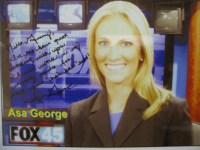
Asa George

Asa George, on the set of Fox 45 / ABC 22 News, May 2008. Photo by Gery L. Deer

By Gery L. Deer

Editor, The Jamestown Comet

Former Dayton broadcast journalist Asa George was found dead in her suburban Milwaukee home on September 6 after family members expressed concerns to police regarding her safety. According to a report by the Milwaukee Journal, George’s father, who lives in California, had been unable to reach the 34-year-old for four days and called the local police to check on her.

CBS television affiliate WDJT-TV cited a Milwaukee County Medical Examiner’s Office report stating that firefighters entered the home through a window where they found a badly decomposed female body in a tub full of water. A malnourished boxer dog, two empty vodka bottles and numerous prescription medications were reportedly discovered as well. The body was positively identified as that of Asa George on September 12 after dental records were received from Dayton.

The Journal reported that relatives informed investigators that George had battled alcoholism for several years. Family members reportedly told police that her career had suffered greatly because of her drinking problem, and she had received treatment for it several times.

A press release provided by the West Allis Police Department stated, “Officers, detectives and members of the Milwaukee County Medical Examiner’s Office are investigating to determine the circumstances surrounding this incident to include positive identification and cause/manner of death.”  Although identification has been confirmed, the medical examiner’s office has yet to release a cause of death pending toxicology results.

Asa George was the cover story for the May 29, 2008 edition of the Times Community Newspapers' "Your Home" magazine, written by Gery L. Deer

Asa George was the cover story for the May 29, 2008 edition of the Times Community Newspapers’ “Your Home” magazine, written by Gery L. Deer

Early risers became acquainted with George in 2004, when she became co-anchor on the WKEF-ABC22/WRGT-Fox45 morning news programs. In 2008, Xenia Daily Gazette columnist Gery L. Deer interviewed George for a special spotlight cover story in the Times Community’s Your Home magazine where she opened up about her life and career.

“I was born in Madison, Wisconsin, but only lived there about a year before moving to Houston, Texas,” she said. “I graduated from the University of Texas with a degree in journalism and then on to the University of Salamanca in Spain where I studied Art History and Spanish.” Prior to coming to the Miami Valley, George worked as a reporter in Lincoln, Nebraska, and Austin, Texas.

At the time of the Your Home interview, George seemed content to call Dayton home. “Dayton has been a great place for me,” George said. “I have grown professionally, and people here have been so nice and welcoming. I love the fact that I get to meet so many people, whether through reporting or at charity events.”

George was an avid animal lover and regularly volunteered for the Humane Society of Greater Dayton, doing everything from acting as master of ceremonies at local events to fostering a puppy.  For three consecutive years, she hosted the Furry Scurry and Hair Ball fundraiser events. “Anything the Humane Society needs me to do, I am there for them,” she told Your Home. George was also a great supporter of the local Cystic Fibrosis Foundation.

Television journalism can be an overwhelmingly busy job, but while in Dayton, George always seemed to find time for friends and family. “I love to spend time with friends and eating out; sushi is my favorite, and I also enjoy cooking,” she once said.

Other relaxing time, she explained, was devoted to more active personal endeavors such as riding her motorcycle, painting and lifting weights.  “I also enjoy boxing and riding my motorcycle,” she said. “I also love to travel.” George left Dayton in 2009 and returned to Wisconsin where she held her anchor position at channel 58, WDJT-TV in Milwaukee, before she became a freelancer in 2011.

During her short broadcast career, George was recognized several times for outstanding work. In 2004, she received the Nebraska Associated Press Award for General News and in 2006 was honored by the Ohio Associated Press.

IMG_6310Editorial Note: I had the privilege of knowing Asa George, but only for a very short time. She was always pleasant, fun and thoughtful, a credit to our profession. In light of this terrible tragedy, I hope she finally has peace and wish for everyone to keep her memory bright and honor her life. She will be missed.

– Gery L. Deer

Is this your new site? Log in to activate admin features and dismiss this message
Log In