Local News & Commentary Since 1890.

Archive for the ‘Uncategorized’ Category

Dayton-based 3D manufacturing leader Bastech, Inc., combines brands

In Business, Dayton Ohio News, Economy, Media, News Media, Science, Technology, Uncategorized on September 27, 2015 at 2:53 pm

BUSINESS NEWS …

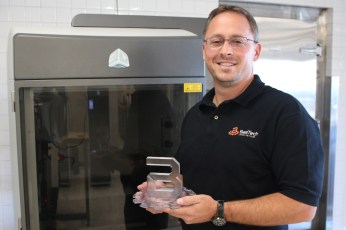
Ben Staub, Jr., owner and president of Bastech, Inc.

Dayton, OH – Dayton-based Bastech, Inc., has combined its full range of manufacturing and consumer services under one brand. Since its founding two decades ago, Bastech, Inc., has grown into three separate divisions offering a wide range of services and products from manufacturing prototypes and end-use parts to professional and consumer 3D printing equipment solutions.

Bastech, Inc., is an industry leader in field of “additive manufacturing,” or what is now more commonly known as 3D printing. The company opened in 1994 and first applied the process to automotive and product design.

Today Bastech, Inc., develops revolutionary solutions for many applications including aerospace, medical device, jewelry, packaging, metal casting, injection molding, education and more. As more commercial opportunities arose the firm established separate companies to manage industry-changing niche services.

The first, Rapid Direction, Inc., was founded in 2006 to provide 3D printing equipment and supplies, meeting the needs of those manufacturers who wanted to have in-house, 3D part production capability. Next, the retail 3D printing service, GetPrinting3D, was established in 2012 and offers consumer-based products, ranging from desktop 3D printers to full-color, 3D figurines and custom bobble heads.

Bastech’s president and owner, Ben Staub, Jr., first worked with additive manufacturing during the early 1990s. During that time, he learned the complexities of programming and prototyping with stereolithography (SLA), one of several methods used to create 3D printed objects.

That experience, combined with his background from a strong manufacturing-based, entrepreneurial family culture gave him the tools to master the process and, more importantly, match advancing capabilities with industry demand.

As the technology becomes more accessible and the industry more fluid, Staub recognized that the division of these related products and services into separate entities might make for missed opportunities.

“Many times, customers of one company have no idea what the other has to offer,” Staub says. “Explaining why we have different business units has often been confusing, even to our own people.”

For example, an electronics manufacturer outsourcing prototype parts to Bastech might not be aware that Rapid Direction could actually provide an in-house solution.

More applications for 3D printing are being developed every day and Staub’s team wants Bastech to grow with the demand while giving customers the single, best resource. Over the next few months, a concentrated brand identity will be rolled out to present a clear, single solution under the name Bastech.

“Rebranding is never an easy decision, or an uncomplicated one to execute,” he said. “Nevertheless, it is the right time for that to take place and ‘Bastech’ will become the one solution for our customers.”

Bastech, Inc., corporate facility is located at 9233 N. Dixie Dr. in Dayton. For more information, contact Bastech, Inc., by calling the corporate offices at 855-890-9292 or go online to http://www.bastech.com.


Prevent Blindness declares September as Sports Eye Safety Awareness Month

In Children and Family, Dayton Ohio News, Health, Sports News, Uncategorized on September 14, 2015 at 10:11 am

Dayton, OH – Prevent Blindness has declared September as Sports Eye Safety Awareness Month to encourage athletes to wear proper eye protection while playing sports. According to estimates by Prevent Blindness, the top five sports resulting in the most eye injuries were basketball, water and pool activities, use of air, gas, spring or BB guns, baseball/softball and football. In fact, in a single year, more than 6,000 Americans suffered an eye injury related to playing basketball.

Founded in 1908, Prevent Blindness is America’s leading volunteer eye health and safety organization dedicated to fighting blindness and saving sight. Serving the entire state, the Ohio Affiliate of Prevent Blindness provides direct services to more than 800,000 Ohioans annually and educates millions of consumers about how to protect and preserve the precious gift of sight.

The National Eye Institute reports that a sports-related eye injury is admitted to a U.S. emergency room every 13 minutes. Eye injuries from sports may include infection, corneal abrasions, blunt trauma, inflamed iris, fracture of the eye socket, swollen or detached retinas or a traumatic cataract. In the worst cases, some injuries may result in permanent vision loss. However, this kind of eye injury is 90-percent preventable.

sports googleKatie Neubert is the Dayton Area Manager for Prevent Blindness. “An injury can happen in a split second, but the effects of a series eye injury can have lasting negative effects for a lifetime,” she says. “That’s why Prevent Blindness encourages all athletes to always make sure that appropriate, properly fitting protective eye gear is part of their uniform.”

Parents, coaches, school staff and others can support children’s sports eye safety by following these tips.

Learn About The Risks – Parents, teachers, school nurses and coaches should learn about eye injury risks associated with sports before allowing children to participate. Enroll your child only in adult-supervised sporting activities through a school district, community center, etc., and try to discourage participation in high-risk sports, such as boxing, since adequate eye protection does not yet exist.

Always Use Protective Eyewear – Most sports-related eye injuries are preventable. Whatever the sport or the athlete’s age, appropriate protective eyewear is the first, best defense against eye injury. Also, be sure the child is seeing clearly by getting him or her an eye exam and request recommendations for protective eyewear before enrolling in any sports program.

Learn Warning Signs of Injury – Parents, teachers, school nurses and coaches should familiarize themselves with the warning signs of a serious eye injury and know when to seek treatment. Parents should also make it a point to meet with coaches or athletic trainers to ensure the proper procedures are in place to deal with a child’s eye injury should one occur.

To further support these efforts, Prevent Blindness is teaming up with Liberty Sport to provide eye care professionals with free information and materials through the “September is Sports Eye Injury Prevention Awareness Month” campaign. For more information please call Prevent Blindness locally at 937-223-8766 or visit preventblindness.org/sports-eye-safety.

Struggling to care for seniors at home

In Children and Family, Health, National News, Opinion, Senior Lifestyle, Uncategorized on September 14, 2015 at 9:33 am

Deer In Headlines

By Gery L. Deer

DIH LOGOA recent article in The Atlantic discussed the question of the difficulty of finding adequate care for America’s senior citizens as more of them are choosing to remain in their own homes as they age. In the article, published April 27, 2015 by Alana Samuels, the author relates the story of her grandmother’s plight to find adequate, affordable home care near the college town of Amherst, Massachusetts.

A shortage of qualified Certified Nursing Assistants (CNAs) coupled with outrageous hourly fees made the task of caring for her Parkinson’s ridden spouse that much more difficult. The author’s grandmother eventually gave up on agencies and a friend helped out until her husband’s death a couple of years later. It’s a story becoming all too common today.

By the year 2030, more than one quarter of all Americans will be over the age of 65. More than ever, those people are choosing to remain in their homes as long as possible, relying on home health care and the assistance of family for everything from grocery shopping to bathing.

Screen Shot 2015-09-14 at 9.31.25 AMOver the last few years, a host of “non-medical” in-home care agencies have sprung up all around the country, spread by franchise. Most offer no skilled health care services and little more than baby-sitting. They can help with things like shopping, cleaning and some companionship for homebound seniors.

But, these home care workers are not permitted to help in medical matters, not even to distribute medications, as would a CNA or other state-registered, skilled health care worker. One published estimate by Genworth puts the cost of non-medical home at a range of $10 to $36 per hour. The extreme discrepancy is attributed to variations in region and the type of care required.

One question families should be asking is exactly what could an unskilled worker possibly do that’s worth $36 per hour? Still, most have few options available; it’s either a nursing facility or home care.

Plus, the home itself can be more hazardous than the disabilities suffered by the senior. It may be necessary to modify the home to accommodate “aging in place,” with zero-clearance shower stalls, raised toilets, grab bars, and much more. This also carries added expense and attention to which families might be unaware.

The fact is that it’s much better, psychologically, and far cheaper for seniors to remain in their own home. But most people caring for an elderly family member cannot be with them all hours – people have to work and care for their own homes and families – and still need outside support.

The first place to start is with the local agencies on aging. Most counties or regions have a non-profit organization such as this to help put families and seniors in touch with needed services such as meals on wheels, in-home healthcare, and more.

Be aware, however, that most services referred by these agencies are self-pay and are not covered by Medicare or insurance. The advantage, however, is that they can generally offer a discounted rate on certain services based on the income of the senior. Contact the local agency for details.

For support on in-home modifications, consult the local builders association for referrals to certified aging in place specialists. Most can provide design and construction information for everything from a simple grab bar installation to more complex additions such as elevators.

Additionally, financial and insurance companies out there might be missing the boat on a potentially golden profit center – “in-home care insurance.” Separate from long-term care or other types of health insurance, this could be a specific product that addresses the far less-expensive options of keeping a senior at home rather than in a skilled care facility. Give it a slightly lower premium and the ability to purchase later in life, and it would likely be less difficult to sell.

Before hiring anyone, caregivers should do their homework. Get at least three references from previous clients and do a thorough Google search on the agency you choose.

Whatever the overall solutions to the home health care problem, it’s clear something has to be done in a hurry. With incidents of elder abuse on the rise in nursing facilities, it’s imperative that families have alternate care options.

Gery L. Deer is an independent columnist and business writer. Deer In Headlines is distributed by GLD Enterprises Communications. More at gerydeer.com.

Old Haunts Beatnik Cafe celebrates original Halloween stories by local authors

In Books, Children and Family, Dayton Ohio News, Entertainment, Holiday, Local News, Theatre, Uncategorized on September 11, 2015 at 8:37 am
Artwork by Michael Martin, WOWA Editorial Committee

Artwork by Michael Martin, WOWA Editorial Committee

Beavercreek, OH – Beginning at 7pm on Friday, October 16, author members of the Western Ohio Writers Association (WOWA) will take the microphone at Books & Co. to present the 2015 Halloween addition of their popular, “Beatnik Café” event. Writers from all genres will regale visitors with original works of poetry and prose to the theme, “Old Haunts.” The event is free and open to the public.

The live reading pays homage to the hole-in-the-wall poetry clubs of the 1960’s, but with a more modern style. Reading aloud from original work, each writer will take the stage for 10 to 12 minutes, dazzling audiences with short stories, poetry or who knows what. This is the 6th year for the quarterly event.

Barbara Deer is the co-founder of the organization. “WOWA was intended to provide a regular resource for peer critique, educational programs and networking opportunities to local writers of all genres, both amateur and professional,” she says.

Barbara Deer, WOWA co-founder.

Click to watch the video!

“Annual workshops are held all around the country, with two of the most well-known right here in the Miami Valley. But for most writers to thrive that type of support needs to come on a more regular basis,” Deer says. “Our group consists of professional writers and editors, college professors and everyone is ready and willing to offer help, a fresh eye and, sometimes more importantly, an honest opinion about the quality of the work – good or bad.”


Writers come from all around the region – southwest central Ohio, eastern Indiana and northern Kentucky – to attend monthly critique sessions, educational lectures and write-in events. Meetings are held on the first Thursday of the month at the Event Connections, 4140 Linden Ave. in Dayton, near the intersection of US 35 and Woodman Drive.

WOWA Logo 2Now in its seventh year, this talented group of scribes definitely have plenty to celebrate. In addition to the many individual members who have been published on their own, in May of this year eleven of them were featured in an anthology titled, “Flights of Fiction,” produced by GLD Enterprises Commercial Writing and published by Handcar Press (ISBN: 978-0-9885289-4-9). The book features stories set in and around the southwest Ohio region and is available in print and electronic formats from the WOWA website as well as Amazon and BN.com.

The Beatnik Café is a family-friendly, free, public presentation of WOWA and GLD Enterprises Communications. Books & Co. is located at 4453 Walnut St. at The Greene in Beavercreek. For more information, go online to www.westernohiowriters.org or call (937) 902-4857.

Can there be gratitude without God?

In Opinion, Politics, psychology, Religion, sociology, Uncategorized on September 7, 2015 at 11:59 am

Deer In Headlines

By Gery L. Deer

DIH LOGOFor those who live without a God to thank, some kinds of gratitude might seem an awkward concept. So, whom do atheists thank for the world around them? Where is gratitude concentrated when benevolent events occur from what non-believers would accredit to random chance? Well, here are two ways people without a god express their thanks.

First, intransitive gratitude, as it’s become known, is a broad, indirect, sense of thankfulness. The beneficiary is thankful in general for life, health, flowers, bugs, whatever, but the gratitude is directed toward nothing specific.

From a practical standpoint, the concept of intransitive gratitude falls apart upon deeper analysis because it leaves people to a perception that random chance has some kind of purpose behind it, which might as well be called “supernatural” in nature. Suddenly, it becomes something akin to religion.

Perhaps then, a more tangible and less unbalanced concept of gratitude is preferable for those who would rather have it more focused. Most “non believers” direct their gratitude at those individuals they consider responsible for the positive events.

Say, for example, atheist Bob has a great meal at a friend’s house one evening. Obviously, he wouldn’t pray over it, but instead thanks his friend who worked for the money that paid for the food that she then cooked. From Bob’s point of view, there was no deity or other supernatural involvement.

yarpBob could trace that gratitude all the way back to the friend’s parents, who decided to have a child, and on and on. It’s more of a cause and effect concept but with some level of human direction.

For someone like Bob, directing the gratitude at some invisible, supernatural force seems illogical and improper. Instead, he prefers to honor the people directly responsible for the events or their subsequent results. It might not be accurate, however, to call this type of gratitude a “belief” because it has tangible beneficiaries – Bob’s friend, her employer, her parents, and so on.

The devout likely see this practice as sacrilegious, to say the least. For them the only “one” responsible for all the good in the world is the god they worship. He or She or It is responsible for everything, and nothing is random.

But is someone like Bob wrong or is his gratitude misplaced? Is he evil? Is he a heathen? Therein hangs the question, and one that can only be answered by the individual affected. Any prejudice or personal judgment, however, should be left out of the equation.

Indeed, it would be hard to argue against the idea, in the case of Bob’s meal, that the people who grow, package, ship, prepare and serve food, share a fair portion of the responsibility in his enjoyment of it, godly intervention not withstanding. So being grateful to those people would be highly appropriate.

On the other hand, to the logical eye, and without context, someone clench-eyed, bowing over the dinner plate with clasped hands and appearing to be talking to his or herself would seem quite silly. As with so many concepts, it’s all a matter of personal perception.

Gratitude must be measured and delivered by the grateful in his or her own way. If someone is religious, they’ll likely pray in thanks. For the less rigidly devout, it may be something more informal. Atheists or agnostics may thank the people directly, as Bob did in the example.

Religious or not, it’s important to keep in mind that nothing happens without some human intervention, somewhere down the line, even if not readily apparent. Every decision made by each person has some kind of an effect on the lives of countless others. So directly thanking people for their participation in some good fortune is always a kindness.

Regardless of where gratitude is directed – God, the grocer, a famer, an employer – being generally appreciative of the goodness in life will never be misplaced, even if it’s just within one’s own thoughts.

Remember that good things happen, not to those who wait, but who act. Recognizing good fortune and taking action is just as important as thanks given to those believed responsible.


Gery L. Deer is an independent columnist and business writer. Deer In Headlines is distributed by GLD Enterprises Communications. More at gerydeer.com

Amateur radio license classes start Sept 13 in Beavercreek

In Dayton Ohio News, Education, Local News, Science, Technology, Uncategorized on August 31, 2015 at 2:57 pm

radiosGREENE COUNTY, OH – Anyone interested in obtaining or upgrading an amateur (ham) radio license should sign up for one of the Amateur Radio license classes being offered by the Greene County Amateur Radio Emergency Service (GCARES) starting on Sept. 13. The classes will meet from 7 to 9 p.m. each Sunday through Nov. 8.  A test for all classes of licenses will be given Nov. 15 at 6 p.m. in the Training Room at Beavercreek Township Fire Station 61, 2195 Dayton-Xenia Road.

There is no charge for the classes  which are supported by the Bellbrook  Amateur Radio Club (BARC), the Upper Valley Amateur Radio Club (UVARC) and the Xenia Weather Amateur Radio Network (XWARN) in addition to GCARES.

The entry level Technician Class course will be held in the Training Center at the Bellbrook Amateur Radio Club Clubhouse, Room 1 Sugarcreek Elementary School, 51 South East Street in Bellbrook. No experience is required and there is no minimum age required to earn a Technician Class license. There is no Morse Code requirement.

The General Class course and the Test Session will be held in the Training Room at Beavercreek Township Fire Station 61 located at 2195 Dayton-Xenia Road just west of Orchard Lane.

The Extra Class course will be held in the Training Room at Fairborn Fire Station 2 located at 2200 Commerce Center Blvd just south of Dayton-Yellow Springs Road just east of I-675.

To register for a courses or for more information, please contact Bill Watson K8WEW by email at wwatson4@att.net or by phone between 10 a.m. and 9 p.m. at (937) 426-2166.

Hackers: The gangsters of the digital age.

In Business, Crime, Economy, News Media, Opinion, Uncategorized on August 24, 2015 at 10:49 am

Deer In Headlines

By Gery L. Deer

DIH LOGORecently, after watching a news story on the subject, my father, who recently turned 82 years old, asked me about what “hacking” was and why someone would do it. I struggled for a minute to explain it in terms he would understand while still giving him a rudimentary understanding of the technology.

It reminded me of a similar conversation I had with my great aunt in 1999, shortly before the Y2K turnover. At 91, she lived a fairly isolated existence in the Ohio Appalachian foothills and certainly not computer literate. But she was deeply concerned about the Y2K computer bug causing her to lose electricity, water and her savings.

I reassured her that there was nothing to be concerned about, and did my best to explain what was really going on, beyond the media hype, the volume of which was considerable when you take into account she had but one TV channel. However, satisfied with my explanation, she seemed never to give it another thought and the millennium switch came and went without incident.

The fact that she was worried at all was troubling and shows just how influential the media can be in exacerbating a problem. Today, we’re faced with a similar situation, demonstrated by my dad’s concern over hacking. So, just exactly who and what should you be worried about and why?

Hacking costs companies more than $445 billion each year.

Hacking costs companies more than $445 billion each year.

For those who don’t know, “hacking” refers to the act of using specialized programming that identifies and exploits weakness in the security of a computer system in an effort to either steal or expose confidential information, or just to prove it can be done. It is a crime and often the hackers are in another country.

These digital gangsters break in for a variety of reasons, mostly to steal and sell sensitive information, political records or financial information. Without getting into more deep technical and political motives, keep in mind that hackers aren’t interested in getting into your private computer.

Not to rain on anyone’s self-confidence, but you’re just not that important – unless you’re some celebrity or politician – for hackers to waste the effort. There has to be some gain in the end, although it might simply be the act itself, the accomplishment of breaking in.

Some hacked information is sold to other criminals who will use it for their own nefarious purposes. When performed against something like the marital cheating website, Ashley Madison, the hope is that there will be some big name to expose and embarrass. That leaves the potential for some celebrity or politician to pay handsomely to keep his or her name off of the publicized list, essentially using the information for extortion.

Most of the time, the average computer user is not directly at risk, but that said, you could still be vulnerable if a store or bank you frequent happens to be a target. The best advice is to read all correspondence from retailers and financial institutions.

If their systems are compromised, they will contact customers first – very quietly – before going public with the information, so as to limit panic among their patrons. You will be instructed what to do in the event of a hack and how to best communicate with the vendor for further information.

Another way to protect your own information with online accounts, and I can’t stress this enough, is to use strong, complex passwords. Often the data stored for online accounts does not include a visible password, even the website owners can’t help you if you lose it. So the more complex it is, and the more often you change it, the less likely a hacker will be able to gain access to your information even if they get in.

Hacking, as a criminal activity, has created a billion-dollar industry around the world, on both sides of cyber security. More than ever, specialists are being trained to combat cyber attacks and electronic infiltration on every level.

As cyber security becomes more sophisticated, so will the criminals who seek to break it. They are the nameless, faceless equivalents of the modern day Jesse James and John Dillinger. Each generation has its nemeses and cyber criminals are the current lot, intent on wreaking havoc with our digital world.

Gery L. Deer is an independent columnist and business writer. Deer In Headlines is distributed by GLD Enterprises Communications. More at gerydeer.com.

How secure is your child’s information at school?

In Children and Family, Education, Opinion, Technology, Uncategorized on August 10, 2015 at 12:48 pm

Deer In Headlines

By Gery L. Deer

DIH LOGOA high quality digital learning experience for students is something every school strives to accomplish. But as a parent, have you ever wondered just how your child’s educational and personal records are protected? It is possible that schools are unintentionally putting student privacy at risk.

Some student information, such as that disclosed when using digital learning material, may be managed, not internally at the district level, but by what are known as educational technology, or “edtech,” companies. That information can also end up in the hands of marketing companies and other third-party data collectors.

Joni Lupovitz is the vice president of policy at Common Sense Media, a nonprofit organization that rates the safety of media and technology for students and families. In a recent article on DistrictAdministration.com, Lupovitz says, “Everything is going digital, whether it’s taking attendance, seeing what kids buy for lunch, collecting and storing records, or integrating laptops and tablets into the classroom lessons.”

To ensure every child’s privacy, parents should ask questions such as the following. Does your school outsource edtech services and systems? If so, what are the company’s privacy policies and how do they compare to those of the school district? You have every right to know exactly where your child’s data is being used, who has it and how they manage that information.

schoolroomHow is the wireless computer network in the school system secured? Does the school system provide in-house information technology support or is it outsourced? Who has access to security information? What guarantees are in place regarding the security of any cloud system being used?

Unlike medical record management, legislation governing the management of students’ electronic personal information continues to lag. Even the Family Educational Rights and Privacy Act (FERPA), designed to help restrict access to student records, does not adequately address these issues since it only speaks to the improper disclosure of personal information.

If a school utilizes an outside edtech vendor for record keeping or other digital data management, they may be unaware of holes in the company’s privacy agreement allowing them that provider to sell collected information under certain circumstances. School administrators should then be held responsible to maintain control of that information and have a complete understanding of how the data might be used by the vendor.

Beyond the administrative holes in security and privacy, education of the student (and parents) on safe and proper use of technology is sorely lacking. Most people still have no idea of the security risks when using public wireless access.

Parents should also ask about the security of any websites being hosted by the administration where school information is readily available. Is private data, such as performance or attendance records, easily accessed? Is the data encrypted and to what extent? Be sure to read any privacy paperwork provided and make sure it’s well understood. If not, ask!

Parents must take the time to visit any and all websites managed by the school and familiarize themselves with the layout and information offered there. Sadly, better security usually means more expense, so there is every possibility that substance (good security) gave way to style (a prettier website).

If your child has a smart phone, laptop or other portable technology and utilizes the school’s Wi-Fi system, you may want to reconsider. Public Wi-Fi, even in a school, is insecure and should never be used to access personal or private information like banking, private email, or any other sensitive data.

Whenever a user logs into a website or online account through a public wireless system, there is a risk of breech. Without getting into the techno-babble of how it works, suffice to say that hackers “tag” certain Wi-Fi access points to collect data as people log in. This can happen at schools just as easily as anywhere else.

The take-away from all of this is that parents should be diligent in their understanding of how technology is used at school, whether it’s data management by the administration or Internet access by their child. Schools have an obligation to transparency, especially with regard to student records.

Further Resources:

https://www.commonsensemedia.org/kids-action/issues/privacy-and-safety

http://www.districtadministration.com/article/asking-edtech-vendors-tough-questions

http://www2.ed.gov/policy/gen/guid/fpco/ferpa/students.html

http://www.education.com/reference/article/what-educational-technology/


Gery L. Deer is an independent columnist and business writer. Deer In Headlines is distributed by GLD Enterprises Communications. More at gerydeer.com


Preventing student debt will take work

In Economy, finances, history, National News, Opinion, Uncategorized on August 5, 2015 at 11:10 am

Deer In Headlines
By Gery L. Deer

DIH LOGOIn recent months, democrats seem more upset than ever about the level of student debt, with President Obama leading the charge to loan forgiveness. But as tuition continues to rise for state students in a still struggling economy, why has nothing been done to limit massive salaries paid to state college administrators, many near the million-dollar mark, while students struggle to pay skyrocketing fees?

Constantly up in arms over the greed of wealthy conservatives, liberals seem to maintain a blissful ignorance toward millionaires who help to push their own political agenda, such as college administrators. But limiting the salaries of these academic fat cats could help to ease the financial burden on the schools and the students.

According to the salary database of the Ohio State University, for example, former President E. Gordon Gee “earned” a whopping, $859,566 in 2013. And that’s only the cash salary; this figure doesn’t include any sort of benefits or bonuses. You could easily surmise that his nearest underlings earn somewhere close to that, at least in the middle six figures.

What could a state employed “figurehead” possibly do to be worth that kind of money? After all, it’s OSU, not Harvard. That’s simply ridiculous, no matter how many letters are stacked up after his name.

IMG_3970Universities aren’t alone in this outrageous salary model, however. According to a December 2015 report by the Dayton Business Journal, Sinclair Community College President Steven Johnson now earns a base salary – without benefits – of $371,454.

Why are the taxpayers shelling out nearly a half-million dollars for a community college president? Keep in mind that these people are not teachers and most high-level administrators continue to receive raises and bonuses even when the schools are making budget cuts everywhere else.

Still, while it could help lower tuition slightly, even if the salaries are cut back in top-heavy administrations, it wouldn’t do much to help people actually pay for school. College students need to take on some of the responsibility to limit their own debt, in ways that no one wants to talk about because they’re politically incorrect.

First, here’s a thought just way out of left field – get a job. Most of the people I went to college with were not from wealthy families and many of the loans we’re talking about today didn’t exist three decades ago. So, they did what I did, applied for every grant and scholarship available and worked as many as three, part-time jobs to help cover the costs. Some did take out small loans, a semester or two at a time, and paid them back as they went.

It’s hard to pinpoint exactly when “work” became such a bad word? A student who works while in school gains a better sense of responsibility, learns how to handle money more efficiently and is more self-sufficient. That also makes them less likely to return home after they graduate because they aren’t afraid to take jobs to make ends meet while looking for their career spot.

Another major sticking point of the American university mentality is that you have to finish your degree in no more than four years. Those who don’t hit the mark may end up at the bottom of the placement pile, labeled as disengaged or unmotivated, and that’s just ridiculous.

Common sense suggests that if it takes longer and the student works during their higher education years, future employers will benefit from applicants with more real-world experience and the worker is more likely to excel faster and make more money.

The simple fact remains that the American economy is still wounded, and all of the handouts in the world won’t change that. Students today would be far better off to work while going to school. If that means they don’t get done in four years, so be it. In adult life, you don’t always have it easy and you need to take responsibility for yourself.

Loan forgiveness is treating the symptom, not the disease. With the foregone conclusion that they’ll never have to pay back a student loan, there is simply no incentive for people to try to stay out of that debt in the first place.


Gery L. Deer is an independent columnist and business writer. Deer In Headlines is distributed by GLD Enterprises Communications. More at gerydeer.com

Public perception and the dusty GOP

In Economy, history, Opinion, Politics, Uncategorized on July 7, 2015 at 3:02 pm

Deer In Headlines

By Gery L. Deer


DIH LOGOIt seems the republican field of presidential candidacy is bursting at the seams, not to mention getting a little ridiculous. At the time of this writing, there are a dozen GOP candidates hoping to sway voters, and the RNC, before next year’s primary season, while only four democrats have officially tossed their hats into the ring.

At this point in the game, it’s anyone’s race. Until the democratic field shakes out, it’s unlikely there will be many republican endorsements. Before that can happen, supporters need to see is how their favorite conservative candidate stands up against the opposition.

Most early candidacies are a function of money – how much they have, how much is coming in and where to spend it for the best return on the investment. Media is critical to political perception, and expensive, but, at this point many of the candidates will have to spend time doing the old grip and grin just to introduce themselves to key voters in New Hampshire, South Carolina and Iowa. It seems old school in a world of nonstop social media, but it’s necessary.

1280px-Republican_National_ConventionThere are too many GOP candidates with little to no name recognition and that will be an obstacle. Keep in mind, most of the country had no idea who Barack Obama was until the eleventh hour and, two terms later, he has repeatedly made history. But, can the Republican National Committee change the perception of the GOP as the tired, dusty party to something more progressive?

Dem forerunner Hillary Clinton has experience, but not in the same “boots on the ground” role as Jeb Bush or one of the other candidates who have been state governors. Still, just having been a governor isn’t enough to guarantee any sort of mileage in a presidential campaign, especially when accomplishments in office have been lackluster, to say the least.

Ohio Governor John Kasich, for example, has announced that he will officially launch his 2016 White House bid in late July. To hear Kasich describe it, he’s earned his seat at the table having been single handedly responsible for Ohio’s economic recovery following the recession. But, economists have been clear that Ohio’s recuperation is consistent with the rest of the country, resulting instead from federal stimulus packages, short term interest rate reductions and bail outs.

Assuming respectable advancement in the primaries, the candidates could experience secondary problems based on their choice of running mate. While the announcement comes much later in the game, everyone is thinking about it now and those interested in the job are quietly knocking on the door behind the scenes.

Hitching a ride on Kasich’s coat tails as a running mate would most likely be Ohio’s attorney general, Mike DeWine, an obvious choice for the short list. Although he served in congress for a time, DeWine’s name recognition is relatively useless beyond the borders of the Buckeye State.

If Kasich chooses DeWine, he would probably also have to deal with conservative backlash for the AG’s many liberal-leaning policies, the least of which is gun control, including his sponsorship of legislation against assault weapons and personal firearm ownership. Though carefully kept out of any published information, DeWine is also rumored to have been a democrat before changing sides in order to make a political name for himself in Ohio’s largely conservative Greene County. If true, that could further impede any national conservative support of a Kasich-DeWine ticket.

But even if the GOP candidacy field narrows, republicans are still stuck with the public perception as a “rich white guys club,” despite the fact there are two minorities on the list; an African American, retired neurosurgeon Ben Carson, and a woman, former business exec Carly Fiorina. Historically, the GOP has great difficulty connecting with younger voters and minorities and, so far, nothing has happened to mitigate that problem.

Republicans are largely seen by young voters as bigoted, gun-happy, greedy and stuck in the1950s. Until one of the many conservative candidates manages to offer an alternative to that perception for a mass audience, Americans might be looking at another term under a democratic administration.


Gery L. Deer is an independent columnist and business writer. Deer In Headlines is distributed by GLD Enterprises Communications. More at gerydeer.com.