Local News & Commentary Since 1890.

Archive for the ‘Science’ Category

Celebrating the paramedic and EMS

In Health, history, Jobs, National News, Opinion, Science, television, Uncategorized on July 21, 2014 at 11:44 am

DIH LOGOWhen was the last time you felt the urge to run into a burning building? What about cutting your way into a mangled car to extract an injured child after a wreck? It takes a particularly kind of person to reject self-protective responses and dive in, head first, to help others. Fortunately, our first responders – firefighters, emergency medical services (EMS) and police officers – never hesitate to do exactly that.

Firefighters and police officers have been around for centuries, but can you remember a time when no one had ever heard of a “paramedic?” Actually, it wasn’t that long ago, only about 45 years. Although there’s no officially recorded origin, the word “paramedic” can be loosely broken down to two parts. The Latin prefix, “para,” means, in this context, “apart from, or beyond,” and “medic” referring to “physician.”

The first paramedic training began in California in the mid 1960s. But in January of 1972, television producers Jack Webb and R.A. Cinader (“Dragnet,” and “Adam 12,”) helped introduce the rest of the country to the concept in a new show called, simply, “Emergency!.”

Each week, viewers rode along with a pair of fictional, Los Angeles County Station 51 firefighter paramedics named Johnny Gage and Roy DeSoto, portrayed by actors Randolph Mantooth and Kevin Tighe. Back then, firefighters were skilled in only a minimum of first aid techniques. Paramedic training allowed more advanced medical treatment for victims at the scene, when time is critical, performed at the time under the direction of a hospital physician communicating by radio.
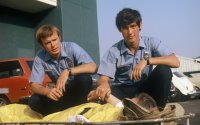
Emergency! aired on NBC for six seasons and introduced the country to the job of the paramedic. (Kevin Tighe as Roy DeSoto and Randolph Mantooth as John Gage).

Emergency! aired on NBC for six seasons and introduced the country to the job of the paramedic. (Kevin Tighe as Roy DeSoto and Randolph Mantooth as John Gage).

For six seasons, using real-life, contemporary techniques, the fictional team of “Squad 51” demonstrated how vital paramedics could be to accident survival rates. Additionally, by shining some Hollywood light on the subject, the show helped ease resistance by doctors who fought the adaptation of advanced medical field support, referring to it as, “remote controlled medicine.”

Paramedics are sometimes referred to inaccurately as EMTs (Emergency Medical Technicians), but there are differences between the two, although regulations and educational requirements can vary. According to the University of Southern California Los Angeles’s Center for Prehospital Care, “EMTs usually complete a course that is about 120-150 hours in length. Paramedic courses can be between 1,200 to 1,800 hours.” But that’s not where the difference ends.

Both fields of study include lectures, clinical and field internships and hands-on skills training such as CPR, administering oxygen, glucose for diabetics and helping to treat asthma attacks. “With very few exceptions, such as in the case of auto-injectors for allergic reactions,” UCLA’s website states, “EMTs are not allowed to provide treatments that require breaking the skin: that means no needles.”

At the time of the “Emergency!” TV series, Los Angeles County, had only about 36 paramedics. But after the show became a hit, applications came pouring in anywhere the programs were offered. As of 2012, StudentDoctor.net reports that there are an estimated 142,000 paramedics and 600,000 EMTs currently working in the United States and that number is growing. From big cities to rural communities, paramedics and EMTs are regularly in great demand.

On September 11, 2001, first responders took center stage, paramedics included, with hundreds giving their lives trying to save the victims of the World Trade Center attacks. Hopefully, our local fire and rescue personnel will never be required to perform such a dire duty, but you can rest assured that if the need would ever arise, they are ready and willing.

I can’t convey how grateful my family was to the men and women of our local EMS (New Jasper Township, in Greene County, Ohio) when I was helping to care for my mother who, in addition to Alzheimer’s disease, also suffered from heart disease. Our emergency medical responders see us at the most difficult, stressful moments of life. So, since we often forget at the time, “Thank You,” from a grateful public to our fire and EMS providers, for all you do to help keep us safe.


Gery L. Deer is an independent columnist and business writer based in Jamestown, Ohio. More at http://www.gerydeer.com


Ignorance: A leading cause of illness in America

In Children and Family, Education, Health, Opinion, Science, Uncategorized on July 14, 2014 at 6:00 pm

DIH LOGOAhead of heart disease and cancer, could ignorance be one of the leading causes of serious illness in the United States? It seems as though, regardless of the facts related to disease prevention, there are literally millions of people who simply choose to take no notice.

First, a definition of the word, “ignorance” as it is used here, so as not to intentionally offend anyone. Ignorance refers mainly to a lack of understanding, education or information. Most of the time, the deficiency of knowledge is unintentional, resulting from inexperience or an educational history lacking in a specific area. However, ignorance can also result from a choice, a conscious decision to disregard certain information, in this case regarding health.

Excessive alcohol consumption, for example, is the fourth leading preventable cause of death in the United States, according to the Centers for Disease Control and Prevention (CDC).  From 2006-2010, the agency reports, excessive alcohol use resulted in, “approximately 88,000 deaths and 2.5 million years of potential life lost annually during that period, costing an estimated $223.5 billion.”

The CDC also reports that nearly 20 percent of Americans smoke, that’s around 43 million people. With nearly one in five deaths now caused by smoking-related illness, why would anyone consciously choose to continue such a disgusting and polluting habit? Denial of the necessity of childhood vaccines may also contribute to preventable disease contraction.

Parents who refuse to vaccinate their children expose them, and those around them, to potentially life-altering illness ranging from measles to polio (poliomyelitis). Because of polio’s recurrence in several African countries, in May of 2014 the World Health Organization declared the resurging polio threat an international emergency stating that it is, “one of the world’s most serious vaccine preventable diseases.” Many experts fear that, if unchecked, it could be brought to the United States and make a devastating comeback due to a fall in newborn vaccinations.

Food is another contributing problem to preventable illness in the United States. Well-educated, intelligent people commonly turn a blind eye to the facts related to diabetes, obesity and cholesterol-related heart disease. More often, Americans tend to choose potato chips and soda pop over a fresh apple or glass of unsweetened fruit juice.

poor choicesIt is one thing when people don’t know about these issues, but it’s quite another if they simply refuse to pay attention or take action. Billions of dollars is spent every year caring for those who may never have become so ill had they taken some basic, precautionary steps.

Of course, regular contradictions between those giving advice on better health and their own behavior also inhibit the effectiveness of patient education. Many healthcare workers are just as guilty as the general public; perhaps even more so because they should, by profession, know better. Why should a patient listen to the recommendations of their healthcare provider if he or she ignores the same information?

How many nurses, doctors and staff are readily seen smoking outside a hospital or other healthcare facility? Logically, it’s hard to grasp how people can work daily around people suffering from diseases that might have either been prevented or mitigated and not take that knowledge to heart for their own health.

In some cases, moderation can help reduce a person’s risks; eating less fat, cutting back on sugar, and limited indulgence in junk food will certainly make a difference. But there is no safe amount of smoking or recreational drug use. It’s all deadly, one cigarette or 50, the body just wasn’t meant to have to process that kind of toxic material day in and day out.

The bottom line is that any reduction in positive health will compromise the body’s ability to fight off disease. When people become ill, they can no longer work, contribute to society or provide for their families. Quality of life suffers for the individual and all of those around them. Ignorance of facts and undisputed medical advice can take a terrible toll on a person – and everyone around them.


Gery L. Deer is an independent columnist and business writer based in Jamestown, Ohio. More at http://www.gerydeer.com.

UPDATE: CFL bulbs save money, but threaten safety

In Children and Family, Dayton Ohio News, Environment, Health, Home Improvement, Opinion, Politics, Science, Technology, Uncategorized on June 10, 2014 at 8:40 am

GLD_CFL_TV2_SCREENSHOTSpecial Update / Editor’s Note: This article was originally published in November of 2013 and updated in April 2014. Since that time, and investigative report by Pam Elliot at WDTN-TV, 2News in Dayton has yielded the following information on the dangers of CFL bulbs.

Deer In Headlines author and Jamestown Comet publisher, Gery L. Deer, was tapped as the initial interview source for the investigation based on the content of this edition of his column. Here for you is the video from that investigation which aired on Monday, May 19, 2014.

Click here for a link to the full 2News investigative story which includes suggestions for the safe use of CFL bulbs.


dih-logo-SEApril 7, 2014 – The incandescent light bulb was developed in 1876 by Thomas Edison, founder of General Electric. But as more energy efficient technology is introduced, even Edison’s greatest achievement has been all but extinguished forever. On September 24th, 2013, it was announced that the last of the incandescent light bulbs had rolled off the GE assembly line to be replaced by compact fluorescents, or “CFLs.” The spiral-twisted tube bulbs use low-energy, fluorescent technology and there is really nothing cutting-edge about them, except for their size and the potential fire risk when they go bad.

Fluorescent lighting has been around since the late 19th Century, but wasn’t developed for widespread use until the 1930s. Less expensive to operate than their incandescent counterparts, most of the bulbs last longer and are safe for everyday use. But as the environmentalist lobby pushes for more energy-efficient or, “green,” technology, has the heightened concern for the environment surpassed that for human safety? Recently I went into my kitchen and switched on the light over the sink, as I did countless times throughout the week. I left the room for a moment and when I returned it was dark, the familiar morning glow of the light fixture having just been replaced with the smell of burned ceramic and melted plastic. Upon investigation I discovered that the CFL bulb in the overhead light had quite literally burned out.

20W CFL Bulb from Gery Deer's kitchen.   Photo by Gery L. Deer

20W CFL Bulb from Gery Deer’s kitchen. Photo by Gery L. Deer

Just before it went dark, the 20-Watt, General Electric CFL bulb I had installed a few months earlier had gone so hot that it flamed through the plastic and ceramic base, causing it to melt and crack at the bottom of the glass tubing. The discovery of such a potential fire hazard was, to say the least, surprising, but apparently the problem is well-documented and manufacturers have been aware of it since the product’s release.

In a Snopes.com article John Drengenberg, consumer affairs manager at Underwriters Laboratories (UL), said about how CFLs expire, “People expect to see the bright flash and to hear the popping like a traditional incandescent bulb, but the burn out of a CFL is different. The light dims over time and might produce a more dramatic pop, emit a distinct odor, and maybe even release some smoke.” Drengenberg is referring to the Voltage Dependent Resistor (VDR). The CFL burns out when the ballast overheats, causing the VDR to open the circuit like a blown fuse and prevent any hazards.

Instead of resulting in a mild puff of smoke, however, the heat generated can, as in my case, burn through the base. As I dug deeper into this issue, I discovered countless articles, videos and online debates regarding the safety of CLF lighting and how there might be more to their compulsory introduction than simply reducing energy costs. It’s important to note here that Underwriters Laboratories is not a government agency but a private company paid by manufacturers to “certify” the safety of their products.

DP&L has a vested interest in getting these bulbs out to the public. It's unclear where that interest lies, but here is the proof - a Walmart display in Xenia, Ohio offers huge discounts.

DP&L has a vested interest in getting these bulbs out to the public. It’s unclear where that interest lies, but here is the proof – a Walmart display in Xenia, Ohio offers huge discounts.

In the early 1990s, I worked for a major appliance manufacturer as an engineering technologist following UL guidelines in operational and safety testing of ovens, ranges and cook-tops. In my experience, a bit of heat and smoke being released from a popping resister is, by itself, not enough to cause the kind of damage apparently so common with this product.

I am well aware of UL testing practices and it is beyond my comprehension how anything short of political pressure could be responsible for the approval of a consumer electronics product that literally lets flame out of its casing. From a consumer standpoint, it’s baffling to me how UL, or the Federal Trade Commission – the governmental agency responsible for consumer safety, can justify the approval of a device that clearly presents a fire safety hazard under “normal use” conditions. Incidentally, the CFLs also contain mercury, another potential environmental health hazard often conveniently overlooked.

It is entirely possible that these products were rushed to market, not so much to help reduce pollution or save money for the consumer, but to further a political agenda. Whatever the reason, the consumer should be aware of the inherent dangers and always be careful when using CFL lighting.  (End original story.)

Here are some detailed photos of the original, failed bulb. General Electric requested it be returned for investigation (we have complied).


UPDATE : June 6, 2014 – Today Gery L. Deer received several boxes of light bulbs from General Electric (Pictured below). The shipment included several packages of original, incandescent bulbs and several packages of LED bulbs. Once again, it is important to note that Gery insisted to GE’s representatives, by phone, he was not looking for any sort of restitution, but simply wanted to make the public aware of the dangers surrounding these bulbs. But, here they are anyway.

An assortment of incandescent and LED light bulbs sent to Gery L. Deer by General Electric on June 6.

An assortment of incandescent and LED light bulbs sent to Gery L. Deer by General Electric on June 6.


VIDEO UPDATE: June 10, 2014 – Hard to believe – ANOTHER shipment of LED light bulbs from General Electric. These are of a totally different style and are said to “distribute” light more efficiently. Watch the video for a complete follow up.


Jamestown Comet Editor Gery L. Deer is an independent columnist and business contributor to WDTN-TV2’s Living Dayton program. More at www.gerydeer.com.

Godzilla: King of the anti-nuclear message

In Entertainment, Environment, Movies, National News, Opinion, Politics, Science, Technology, Uncategorized, World News on May 12, 2014 at 12:00 pm


DIH LOGOIn 1955, the Japanese film company, Toho, Inc., introduced America to “Godzilla, King of the Monsters.” The bulky, green monster terrified audiences in the marginally familiar form of an enormous T-Rex, with notable size differences, muscular body and bigger arms and all brought to life by a puppeteer in a rubbery body suit. Originally called by the Japanese word, “Gojira,” meaning “gorilla whale,” the monster was so successful he’s been a worldwide star since his first black and white appearance in Tokyo.

Uncertain how a Japanese film would fare only a decade after the end of World War II, American exhibitors insisted an “American” element be added to make the dubbed, foreign monster flick more relatable to U.S. audiences. So, who better to report on the devastation than one of the most trusted faces on television at the time, Perry Mason himself, Raymond Burr. Not included in the Japanese version, Burr played an American journalist reporting on Godzilla’s attack into a tape recorder from the safety of a nearby office building.

During the 1960s and 70s Godzilla made his way into color features where his ominous appearance was softened a bit and his character reworked a bit from a menace to more of a hero as he battled other creatures threatening Tokyo from Monster Island. His gigantic, “30-story” upright posture, signature stomp, glowing dorsal plates and fiery breath were a hit with movie goers around the world.

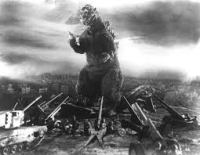
Gozilla's original appearance in Japan, 1954. He appeared in America a year later.

Gozilla’s original appearance in Japan, 1954. He appeared in America a year later.

In 1985, Godzilla reappeared in a more serious, direct sequel to the original. Although the monster had made countless appearances in other, sillier films, like “Godzilla vs. King Kong,” and “Godzilla vs. Mothra,” this reprisal brought Godzilla back to his roots – as a devastating, uncontrollable statement on the increasing nuclear scare at the peak of the Cold War.

Although it was no longer necessary to smooth over American audiences, Raymond Burr reprised his role from the original film in a few scenes added to the U.S. release to provide continuity and attract a nostalgic audience. “Godzilla 1985,” did well at the box office and even better in the newly-minted home video market.

Fast forward a few years to 1998, when the monster was licensed by Tri-Star Pictures for an American, almost campy, version set in New York City. Studied by a worm biologist played by the likable Matthew Broderick (Ferris Bueller’s Day Off / The Producers), Godzilla takes up residence in Manhattan and is hunted by the US Military who manages to lay waste to everything except their target, even wrecking the iconic Chrysler Building. A liberally-preachy, anti-nuclear storyline and a totally computer-animated Godzilla, that didn’t look or act much like the original, completely failed to lure audiences.

Over the years, Godzilla appeared in 28 films and an American cartoon show. He even achieved the honor of a star on the Hollywood Walk of Fame. But the origins of the character are deep in Japan’s nuclear pain and far more serious than most people might know.

Godzilla as he will look in the 2014 version.

Godzilla as he will look in the 2014 version.

Like the newest American incarnation set for release in May 2014, Godzilla is portrayed as a mutation directly resulting from nuclear testing, emphasizing the need to do away with these weapons. He was, essentially, the symbol of everything that can go wrong with nuclear power and weaponry.

The underlying message in the more serious Godzilla story lines is that use of nuclear weapons and power has unimaginable consequences. A mutation that can cause a giant monster with nuclear powered breath is a pretty good personification.

In any case, the new film is sticking closer to the original concept, not just in story but in the look and actions of the monster himself. He’s a rampaging beast and the addition of Breaking Bad’s Bryan Cranston, adds another level of drama to a once-campy character.

In no loss of irony, Japan is the only country in the world whose people have experienced the horrible result of nuclear devastation and America is the only country who has ever inflicted it on anyone else. It’s somehow fitting that people from both countries come together to create a fictional character that personifies the horror that can result.
Gery L. Deer is an independent columnist and business contributor to the WDTN-TV2 program, Living Dayton. More at http://www.gerydeer.com.


Alas, the plight of the plastic shopping bag

In Business, Economy, Education, Environment, Health, history, National News, Opinion, Politics, Science, Uncategorized on March 31, 2014 at 8:42 am

Deer In Headlines
By Gery L. Deer
The Jamestown Comet Editor

bag_blowingTake a look around outside after a storm and you’ll see them, clinging to the lathe of a garden fence like barnacles to a ship’s hull – those sad, indigent, plastic shopping bags. They’re everywhere, bouncing along the roadside, hung up in the branches of your backyard tree, even melted and tangled around the undercarriage of your car. Once revered for their strength and amazingly useful handles, these marvels of modern shopping are now the scourge of environmental political correctness.

With humble beginnings in 1950s Sweden, the modern plastic shopping bag was the creation of engineer Sten Gustaf Thulin who developed the simple, one-piece bag for Celloplast, the company which patented the design in 1965. Popularity of the product grew rapidly, for a time even knocking paper bags into relative obscurity.

Never again would husbands need worry about earning a night in the doghouse after losing a gallon of milk to the pavement when it crashed through the bottom of a wet paper sack. But, it was that set of wonderfully brilliant handles that really endeared the bags to shoppers. Since the dawn of time, mothers everywhere have struggled on shopping trips to juggle groceries and family.

With plastic bags, Mom now had the ability to carry half a dozen fully loaded bags on her arms while clutching Junior in one hand and the dog’s leash in the other. Her world now under complete control, at least for one brief moment, thanks to a simple pair of parallel holes in a plastic tube. Once the groceries were put away, she could even re-use them to line the bathroom wastebasket with a water-proof bag that fit both the can and her household budget.

PBThere was no doubt the plastic shopping bag was truly a miracle of modern commerce. By 1982, most major grocery chains, including Kroger, began replacing paper shopping bags with plastic citing cost savings and customer preference. Sadly, however, as with most other success stories, rival jealousy led to ridicule and scrutiny, mostly from operatives of the paper bag industry determined to unseat the plastic bag from its world-wide fame.

By the 1990s, world ecologists became increasingly vocal about plastic’s potentially destructive effects on the environment. Soon, the plastic shopping bag became an innocent by-stander, caught up in the ever increasing fight between good and evil, liberal and conservative, environmentalist and capitalist – or whoever was paying the most lobbyists. More than ever, environmental groups were touting the need for more extensive use of recyclable materials in consumer goods.

Almost overnight, the plastic shopping bag became the poster child for everything wrong with the environment as pundits heatedly debated their recyclability on cable news and in fiercely negative op-eds.  As usual, the critics had it all wrong because plastic shopping bags were every bit as recyclable as their paper counterparts, but were, in a way, victims of their own success.

As it turned out, the very innovations that made plastic shopping bags so powerful in the supermarket were like Kryptonite to the sorting machines used in recycling. When put through, they bound up the machinery and left it jammed and inert, and the cost to overcome that problem outweighed the benefits.

For years, rumors of a plastic bag uprising have permeated the media, suggesting that millions of these poor, trodden-down bags were massing a resistance in landfills all over America. There, they waited silently, collectively preparing to strike back against their opposition by refusing to decompose, even over thousands of years.

Sadly, an empty threat, since the structure of a landfill is meant to keep the refuse dry and stable, limiting degradation. Nothing is intended to fully decompose; not paper, not food, not plastic … nothing. In fact, newspapers buried in the 1960s have recently been exhumed intact and readable.

Perhaps one day, the full truth of their story will be exposed and plastic shopping bags will regain their once proud position at the end of the checkout. But for now, these bags exist as second-class totes, drifting like tumbleweeds on the wind, dancing their lament of a time when they were kings of the market.
Deer In Headlines is available for syndication. Contact GLD Enterprises Commercial Writing – http://www.gldenterprises.net.

It takes a maverick to make a difference

In Education, National News, Opinion, Politics, psychology, Religion, Science, sociology, State News, Uncategorized, World News on March 24, 2014 at 7:59 am

DIH LOGOAccording to one definition, a maverick is, “an unorthodox or independent-minded person.” But a maverick is also someone who chooses not to give in to the pressures of society, breaking ranks, not for personal gain, but in an effort to improve conditions or expand knowledge for everyone.

In the 16th Century, the now revered scientist Galileo Galilei would certainly have fit the definition of maverick. At a time when the church kept tight control over the public’s understanding of the world around them, Galileo’s challenge that the earth was not actually the center of the universe but instead part of a solar system with our sun at its center was controversial.

Of course he was eventually proven right, but standing against such a powerful entity as the Catholic Church sent Galileo to be tried for heresy. There are countless cases like this throughout history, most related to individuals who chose to challenge long-standing beliefs in politics or religion.

Today, as in Galileo’s time, society is taught and expected, from an early age, to keep quiet; never to upset the status quo for fear of retribution. Those willing to stand up and be heard shape the most change in the world, but often pay a high price for their contribution to progress. Much of what society deems acceptable is dependent on one’s position and the sphere of influence there encompassed.

whatsrightFor example, it is unacceptable in many religious groups for a married couple to divorce. They are expected to remain together indefinitely for the good of the church, their families and so on, regardless of the situation, even in cases of physical abuse. It stands to reason, therefore, that the first few individuals who challenged these rules were certainly dealt with harshly. Fortunately, over time, this type of censure has eased somewhat, at least publically.

On the whole, it is difficult to greatly influence public perception and alter the behavior of a society or to get people to remove the blinders of ideology and accept the possibility that there are other ways of thinking. Ignorance, prejudice and misunderstanding usually lead to fear and resistance.

It should also be made clear that religious groups are certainly not alone in such ridiculously judgmental behavior. Anyone who challenges established norms can find themselves on the receiving end of some pretty unpleasant retribution, particularly in the workplace.

Often employees are never to question authority or decisions made by their superiors, otherwise face reprisal. But what does one do when superiors are actually breaking the law? In 1989, Congress passed the Whistleblower Protection Act. The law is designed to shield workers against retaliatory personnel action – meaning, essentially, it keeps them from being fired – for “blowing the whistle” on illegal activities perpetrated by their employers.

Unfortunately, there is no such protection for the everyday person who simply wants to do the right thing. From Moses and Lady Godiva to Rosa Parks and Martin Luther King, taking a stand to alter deeply engrained social beliefs has never been a task for the weak-hearted.

Most people are discouraged by how much retribution might be taken out on them for going against the grain. Sometimes, however, just standing up for the little things can help to affect larger changes. Making a difference in the boardroom, at school or even in the hallowed halls of church might ruffle some feathers, but if the purpose is worthwhile, it would be wrong not to do something.

So, what about those by-standers who agree with the maverick but are afraid to stand with her? If only one other person supported the cause then another would as well, then another, and another. That’s how revolutions are started in the face of resistance. So the next time you see an injustice being done and you have the opportunity to act, what will it be: Maverick or conformist?  Ω

Gery L. Deer is an independent columnist and business contributor to the WDTN-TV2 program, “Living Dayton.” More at www.gerydeer.com.

Like Earhart, evidence lacking in Malaysian Air mystery

In National News, News Media, Opinion, Science, Technology, Travel, Uncategorized on March 17, 2014 at 9:29 am

DIH LOGOMore than 76 years after aviator Amelia Earhart and her navigator, Fred Noonan, vanished during an attempt to fly around the world at the equator, their fate is still an unsolved mystery. The two were presumed lost somewhere over the Pacific Ocean, along with any trace of their Lockheed Electra aircraft. While many theories have surfaced over the years, no conclusive evidence has ever been found to indicate what really happened to, “Lady Lindy,” a woman who was well aware of the potential dangers she faced as a pilot.

On AameliaEarhart.com, the official website commemorating the aviation pioneer, there are passages from a letter written to her husband, publisher G.P. Putnam, in case a dangerous flight proved her last. One particular section fully demonstrates her bravery and total acceptance of the risks she took in the sky. It reads, “Please know I am quite aware of the hazards. I want to do it because I want to do it. Women must try to do things as men have tried. When they fail, their failure must be but a challenge to others.”

Aviation Pioneer, Amelia Earhart vanished in 1937 during an attempt to fly around the world.

Aviation Pioneer, Amelia Earhart vanished in 1937 during an attempt to fly around the world.

Earhart was a ground breaker, driven by a desire, not only to set an example to women who wanted a piece of man’s world, but also to meet a public expectation created by her husband. She was a risk taker at a time when flying was still young. Even now the risks associated with flying are still quite real but there is a reasonable expectation of safety in modern commercial aviation.

Still, no one could have predicted the circumstances surrounding the disappearance of Malaysia Air Flight 370. As of the time of this writing, there is still no trace of the plane. One needn’t be an aviation expert or pilot to know that a Boeing 777, one of the most complex flying machines ever built, cannot simply vanish into thin air. As with the Earhart disappearance, conspiracy theories are running rampant. Was it sabotage, hijacking, or might the plane have been shot down by terrorists? So far, there are no answers.

Other than the tragedy and sheer mystery involved, there is little similarity between the Earhart disappearance and this most recent incident, with one exception: the sheer lack of telemetry data in both situations. Like Earhart’s Lockheed Electra, the Boeing twin-turbofan is a well-tested, commercial passenger aircraft. But, in order to stay aloft longer with fewer stops, the Electra had been stripped down to what amounted to a flying gas can, even leaving behind two parachutes and a life raft to save weight.

Earhart also left behind key equipment that might have aided in pinpointing her position when she went down; the equivalent of disabling satellite tracking systems and radio transponders used on modern aircraft. Officials are reasonably sure that virtually every piece of telemetry technology aboard Flight 370 was intentionally deactivated making it, like Earhart’s Electra, nearly impossible to track.

With a possible search area stretching north into Central Asia and almost as far south as Australia, finding a needle in a haystack would be a piece of cake in comparison. Malaysian officials have requested electronic and satellite data, as well as search and rescue assistance, from more than two-dozen countries. What data does exist suggests that Flight 370 most likely crashed, either in the Bay of Bengal or elsewhere in the Indian Ocean.

Boeing_777_above_clouds,_cropWhether in pieces at the bottom of the sea or parked on some secret tarmac, someone knows where Flight 370 is and how it got there. The real trick will be to find out who orchestrated the plane’s disappearance and what security flaws exist which allowed it to happen.

The mystery of what really happened to Amelia Earhart may never be solved but the search for answers continues. It seems easier to accept the loss of two people in a primitive aircraft than that of 300 in a modern commercial jetliner, but the lack of information invites uninformed speculation. Until some hard evidence is uncovered, however, all anyone can do is let the investigation proceed … and wait.

Jamestown Comet.com Editor Gery L. Deer is an independent columnist and business contributor to WDTN-TV2’s “Living Dayton” program.

Greene County Combined Health District to offer Flu Vaccines

In Children and Family, Education, Health, Local News, Science, Senior Lifestyle on September 30, 2013 at 4:10 pm

XENIA, OH — The Greene County Combined Health District (GCCHD) has announced that the 2013 seasonal flu vaccine is now being offered. The seasonal flu vaccine is recommended for persons 6 months of age and older. Appointments are not needed. The cost for each flu shot is $25.00 for adults and $14.50 for children. Flu Mist for children is $20.00.

tosh22Cash and checks will be accepted for self-pay clients. GCCHD does accept Medicaid, CareSource, Molina or Medicare. Cards must be shown.

Starting on October 1, 2013, seasonal flu shots will be available for adults and children at GCCHD during the regular immunization clinic on Tuesdays, 8:00 – 11:00 a.m. and 12:30 – 3:00 p.m.

GCCHD will also be visiting the various senior centers in Greene County. The following is the schedule of dates, locations and times:

• Tuesday, October 1 – Cedarville Senior Center, 48 N. Main St., Cedarville; 12:30 – 2:00pm.

• Monday, October 7 – Xenia Adult Recreation & Service Center, 130 E. Church St., Xenia; 9:00am –
12:00pm.

• Tuesday, October 8 – Spring Valley Senior Center, 2551 US 42, Spring Valley; 1:30 – 3:30pm.

• Thursday, October 10 – Bryan Community Center, 100 Dayton St., Yellow Springs; 9:00 – 11:30am.

Greene County Health Commissioner, Melissa Howell, reminds everyone to maintain good health by washing hands regularly, covering coughs and sneezes, eating a balanced diet, exercising and getting the right amount of sleep.

For more information, please call Becky Dunbar at (937) 374-5636.

Over-medicated and under-educated

In Children and Family, Education, Health, Media, National News, Opinion, psychology, Science, Senior Lifestyle, Technology, Uncategorized on September 18, 2013 at 9:18 am

DIH LOGOA recent report by the Centers for Disease Control and Prevention (C.D.C.) noted that at as many as two-million Americans become ill from antibiotic-resistant infections annually, killing at least 23,000. The report notes that less than half of the antibiotics prescribed for patients are unnecessary or incorrectly used increasing the potential for more drug-resistant germs to evolve, exacerbating the problem.

Over time, the use of broad-spectrum antibiotics rather than ones targeting specific infections can cause various strains of bacteria to become immune and render conventional treatment ineffective. According to C.D.C. Director, Thomas Frieden, as the trend towards overuse of antibiotics continues, “The medicine cabinet may be empty for patients with life-threatening infections in the coming years.” Additionally, the overuse of antibiotics on farms as preventative medicine in healthy animals is also a contributing factor.

All of that said, these drugs are not prescribing themselves. Doctors know better than to continually prescribe broad-spectrum antibiotics unnecessarily or to treat viral infections, for which the drug is completely ineffective. But, many still do both, either at the insistence of the patient or as a preventative measure. Beyond the issue of nagging patients who want a prescription every time they have a sniffle is the point where the medical professional should say, “no.”

medsIn addition to antibiotics, it seems as though doctors are passing out a pill for everything and never seem to try to dig deep enough to address the real cause of various health problems.  For people with chronic illness it seems like that would be extremely frustrating. Apart from something like long-term, degenerative diseases like Parkinson’s or Multiple Sclerosis, there should be a way to find the cause to a problem and treat that, rather than just trying to drown the symptoms in medication.

More often than not, patients get, maybe, 10 minutes with their doctor after a two-hour office wait only to be handed a prescription and shuffled out the door. People spend far more time filling out forms and waiting to be seen than ever actually getting attention from a person who bills hundreds of dollars an hour for a few minutes work per patient.

An additional problem arises when the drug manufacturers spend far more time and money marketing to the patient than educating the physician about the proper use and potential hazards of a medication. However unethical it should be, doctors are given trial samples and kick-backs for going with one drug-over another. All the while, patients are inundated by drug ads on television, the Internet and in periodicals with no understanding of the treatment process.

Which actually contributes to another step in the downfall of health care is the all-knowing, internet-browsing patient himself. These home-spun experts come in with a fist-full of self-diagnosis printouts from Web MD and a stack of drug ads from Cosmo.  They demand medication for what they are certain is their particular ailment and there is no swaying their shade tree expertise. Except that’s exactly what the doctors should be doing – dissuading them and refusing to prescribe medicine without a thorough examination of the problem.

So what is to be done? Unfortunately, not much can be done. Unless healthcare providers are going to be more proactive and limit use of antibiotics except for targeted need, and other drugs are prescribed only after the cause of the symptoms is determined, it’s unlikely that anything will change soon.

It just seems as if everyone is sick all the time. Chronic illness like fibromyalgia (long-term, body wide tenderness and pain) seem to be affecting more and more people and early-onset dementia appears to be far more common than it once was. Could these diseases the result of long-term misuse of various drugs, including antibiotics?

The truth is, no one really knows for sure. Many of these drugs are relatively new and scientists are only now learning how the long-term use of previous medications is affecting second and third generations. From birth defects to chronic disease, overuse of drugs and under-education of patients definitely has the potential for some serious side effects.


Greene County Combined Health District Announces “Public Health Heat Warning”

In Children and Family, Health, Local News, Science, Senior Lifestyle, Technology, Uncategorized on July 15, 2013 at 3:02 pm

dog2XENIA, OH – The upcoming days are going to be dangerously hot and humid if you’re working or playing outside, or living without air conditioning.  The Greene County Combined Health District is cautioning that weather conditions are going to remain hazardous for a few days.

The primary reason for the public notification is that GCCHD expects a stretch of days with daytime heat indices at least in the mid to upper 90’s, coupled with nighttime lows in excess of 70 degrees. These types of conditions may cause those without air conditioning to experience significant physical and mental stress. When nighttime lows fail to drop below 70 degrees, the human body has a difficult time recovering from the ongoing heat.

Greene County Combined Health District officials are stressing that everyone needs to take precautions to prevent heat-related illnesses. Physical activity should be limited as much as possible. Individuals are also encouraged to minimize prolonged exposure to high heat conditions.

It is recommended that everyone pay particular attention to the following suggestions to prevent heat-related illness:

  • Drink plenty of water and non-alcoholic fluids. Put the alcoholic beverages away until cooler weather. Alcoholic drinks can increase a person’s risk to heat-related illnesses.
  • Decrease physical activity. This is particularly advisable for joggers and high school or junior high school athletic teams. Exercise activities should occur in the morning or early in the evening. Stay in the shade as much as possible.  Greene County agencies and jurisdictions that have heat mitigation plans should implement those plans now.
  • Use air conditioning, if available. Many public buildings, libraries, malls, and other locations are air-conditioned.
  • Wear loose lightweight and light-colored cotton clothing.
  • Eat light meals.
  • Cool down with showers, baths, and recreational swimming.
  • Adjust blinds, shades, and awnings to keep out the sun.
  • Use your basement, if it is cool, during the hottest hours.
  • Be a good neighbor and check on those who may need assistance.
  • Individuals with chronic health problems, such as heart disease or lung problems, should minimize activities because the heat will add additional stress.
  • Extra caution should be taken for the elderly and young infants and children to assure that they are protected from the heat.
  • Children and pets should not be left unattended in closed vehicles. Temperatures can reach dangerous levels rapidly.
  • Individuals on various medications should check with their doctor to see if the heat puts them at increased risk.


Background on heat information

High temperatures and humidity stress the body’s ability to cool itself, and heat illness becomes a special concern. There are three major forms of heat illnesses: heat cramps, heat exhaustion, and heat stroke, with heat stroke being a life threatening condition.


Heat Cramps

Heat cramps are muscle spasms that usually affect the arms, legs, or stomach. Frequently they don’t occur until sometime later after work, at night, or when relaxing. Heat cramps are caused by dehydration. Although heat cramps can be quite painful, they usually don’t result in permanent damage. To prevent them, drink water every 15 to 20 minutes. Sports drinks that replace electrolytes help prevent a loss of sodium caused by excessive sweating. If nausea occurs discontinue fluids and seek medical attention.


Heat Exhaustion

Heat exhaustion is more serious than heat cramps. It occurs when the body’s internal air-conditioning system is overworked, but hasn’t completely shut down. This condition can occur when you don’t drink enough fluids to replace what you’re sweating away. The symptoms of heat exhaustion include headache, nausea, weakness, dizziness, heavy perspiration and extreme thirst.  Somebody suffering these symptoms should be moved to a cool location such as a shaded area or air-conditioned building. Have them lie down with their feet slightly elevated. Loosen their clothing, apply cool, wet cloths or fan them. Have them take sips of water or sports drinks. If nausea occurs, discontinue fluids.


If vomiting continues or if little to no improvement after 30 minutes, seek immediate medical attention. Victims of heat exhaustion should avoid strenuous activity for at least a day, and they should continue to drink water to replace lost body fluids.


Heat Stroke

Heat stroke is a life threatening illness with a high death rate. It occurs when the body has depleted its supply of water and salt, and the victim’s body temperature rises to deadly levels. A heat stroke victim may first suffer heat cramps and/or the heat exhaustion before progressing into the heat stroke stage, but this is not always the case. It should be noted that, heat stroke is sometimes mistaken for heart attack. It is therefore very important to be able to recognize the signs and symptoms of heat stroke and to check for them anytime someone collapses while in a hot environment.  The symptoms of heat stroke include confusion, irrational behavior, loss of consciousness, convulsions, lack of sweating, hot dry skin, and abnormally high body temperature. If someone is having any of these symptoms, call 911 immediately. Seconds count. It is vital to lower a heat stroke victim’s body temperature. Do not give fluids. Pour water on them, fan them, or apply cold packs until medical help arrives.

Is this your new site? Log in to activate admin features and dismiss this message
Log In