Local News & Commentary Since 1890.

Archive for the ‘Local News’ Category

Jamestown Whip Artist Appears On “Living Dayton”

In Business, Entertainment, Local News, Senior Lifestyle, Sports News, Uncategorized on February 21, 2012 at 7:00 am

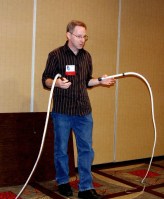
Writer, Entertainer Gery L. Deer with "Living Dayton" co-hosts, Nathalie Basha and Zuri Hall

JAMESTOWN – Writer, entertainer Gery L. Deer of Jamestown appeared Friday on WDTN’s new daytime lifestyle program, Living Dayton to showcase bullwhip classes available at The Whip Artistry Studio. Deer spent a few minutes on the live program talking about the whip with the hosts, Nathalie Basha and Zuri Hall, and gave them the opportunity to try their hand.

“We really just want to let everyone know we are here and we are local,” Deer says. “We have a great offering of whip lessons and performances available to just about any individual or venue. ”

The Whip Artistry Studio opened in 1998 providing the only permanent facility in the U.S. dedicated to the non-combative study of bullwhips and stockwhips for use in sport and performance art. The facility offers individual and group whip lessons for ages 8 and up, as well as providing specialty whip artistry performers for stage, film and television shows, school presentations and educational programs.

For more information go online to http://www.thewhipstudio.com or call (937) 902-4857. All activities are by appointment. The Whip Artistry Studio is an entertainment subsidiary of GLD Enterprises & Productions.

50 Years Later, Oh, That View Is Still Tremendous

In Local News, National News, Opinion, Politics, Science, State News on February 21, 2012 at 6:36 am

Col. John Glenn on his first orbit aboard Friendship 7 in 1962

By Gery L. Deer

Deer In Headlines


In 1958 the National Aeronautics and Space Administration (NASA) was commissioned to getAmericainto the space race and beat the Russians to the moon. President Kennedy had set a public deadline of landing a man on the moon by the end of the 1960’s but no one even knew if it could be done. To make it happen, NASA had to invent new technology and learn new skills previously conceived of only in the pages of comic books.

To get things started, NASA established Project Mercury and seven test pilots were chosen from various branches of the armed services to be the first American astronauts. Sitting in tiny capsules atop converted ballistic missiles, these brave men learned how to break the bonds of gravity, achieve orbit, navigate and then return safely back to earth.

On February 20, 1962, Colonel John H. Glenn, Jr., a Marine Corps fighter pilot fromCambridge,Ohio, blasted off fromCape Canaveralto become the first American to orbit the earth. Only the second Mercury flight, Glenn’s Friendship 7 capsule and splashed down safely in the ocean after completing three orbits. The mission lasted only 4 hours, 53 minutes and 23 seconds but it was long enough to allow the United States to catch up to the Soviets.

Glenn’s mission was considered a great success especially considering it happed less than a year after Mercury astronaut Alan Shepard flew the firstU.S.space shot aboard his Mercury capsule, Freedom 7. Shepard and Glenn had paved the way for the future of theU.S.space program, and within a few years, Project Mercury had achieved all its objectives.

The next series of missions, Project Gemini, allowed the astronauts to leave the relative safety of the capsule and the new two-person spacecraft that was more maneuverable than the Mercury craft. The Gemini vehicles were also used to develop docking and rendezvous technology, vital to the lunar landings.

By 1967, however, NASA had hit yet another growth spurt. Project Apollo replaced Gemini and, along with a few of the original Mercury 7 astronauts, nine new pilots were selected. Things were moving at a feverish pace and NASA was making good time to fulfill Kennedy’s promise but that achievement did not come without a price.

Each and every mission had multiple objectives ranging from simple tests of new equipment to advanced flight evaluations. Whatever the purpose, procedures were established in order to minimize danger. Ultimately, however, space flight was dangerous and these men were test pilots and sometimes things didn’t go as planned.

In January of 1967, Apollo 1 Command Pilot Virgil “Gus” Grissom, Senior Pilot Edward H. White and Pilot Roger B. Chaffee died in a fire during a ground test of the command module capsule atCape Canaveral. The accident forced several design and safety procedure changes and delayed manned Apollo flights for nearly two years.

When the first manned Apollo mission launched in October of 1968, many in Washington felt the Apollo 1 accident was caused by haste and carelessness and pushed for the program to be shut down before more money and lives were lost. Work continued, however and today Neil Armstrong’s immortal words from the Sea of Tranquilitystill resonate across the generations.

Between 1969 and 1972, there were six successful moon landings. In 1973, NASA launched America’s first space station, “Skylab,” and by 1977, the first space shuttle, Enterprise, was ready for flight control and landing tests. The space shuttles were retired in 2011 after three decades of service.


None of these later accomplishments would have been possible without the bravery and fortitude of those first 7 space pioneers. Ironically, John Glenn was one of the first astronauts to leave the space program (to pursue a career in politics) but he is also the only Mercury astronaut to return to space after retiring.

In 1998, Glenn flew as a payload specialist aboard the Space Shuttle Discovery at the age of 76 – the oldest human ever to fly in space. Here’s to John Glenn on the 50th Anniversary of America’s first orbital flight.


Appreciating the Buckeye State

In Local News on February 8, 2012 at 12:53 pm

By Gery L. Deer

Deer In Headlines

Image

Because of the different kinds of work I do, from writing to my involvement in film and television projects, I am asked regularly why I remain in Ohio, rather than moving to New York or the West Coast. The way people ask, it’s almost as if my skills aren’t worthy of recognition or my work’s value is somehow reduced because I choose to live where my family has its roots. In fact, if you pay attention to how Ohio is treated by Hollywood, one might think all we produce here are backwoods rednecks and serial killers. Of course, that perception couldn’t be further from the truth.

My diverse career has taken me from the stages of Las Vegas resorts to the decks of oil tankers. I’ve seen Hollywood Blvd. at midnight and worked alongside stars like Bonnie Hunt and Steve Harvey. I’ve watched as cranes placed the giant Oscar statues and workers rolled out the red carpets outside the Kodak Theatre the day before the Academy Awards. Suffice to say, I’ve seen a lot. But nothing has ever made me want to leave Ohio permanently.

I’ve known people living in the Buckeye State who can’t wait to get out of it, longing for the greener grass somewhere else; Florida, South Carolina, California. But they never seem to go. They just continue to complain. In fact, most of the people I know who behave this way have never really been anywhere else.

Most people forget what Ohio has produced since it was added to the Union in 1803. Even if we overlook the obvious contributions Ohioans have made, like powered flight, the advancement of minority rights, the first electric starter for automobiles and more U.S. Presidents than you can shake a buckeye branch at (8 in all), Ohio still has much to offer.

While we may not be surrounded by oceans or have perfect weather year around, Ohio offers some of the most amazing country anyone has ever seen. The name “Ohio” comes from an Iroquoian word meaning “great river” and that would certainly be hard to argue. The Ohio River connects the eastern states to the Missouri and finally the Mississippi, making it vital to trade and commerce for many regions. Other major waterways such as the Scioto and Great Miami Rivers also provided opportunities for growth to Dayton, Cincinnati and Columbus.

Incidentally, everyone who just cleaned up after a Superbowl party owes a world of debt to the never-ending ingenuity of Ohioans. If not for Dayton engineer Ermal Cleon Fraze, your guests would still have been fighting over the can opener! On a sleepless night in 1959, “Ernie” Fraze invented the pop-top opener, now common on beer and soft drink cans.

With the Oscars coming up, it wouldn’t be right to ignore Ohio’s contribution to Hollywood, seeing as how that’s where most of the glib remarks about our fare state originate. Oscar winners Paul Newman and Halle Berry both called Ohio home, as did MASH’s Jamie Farr, comedian Drew Carey, film director Chris Columbus (Harry Potter),  Jerry Siegel and Joe Schumacher (the creators of Superman),  and Jack Warner, founder of Warner Brothers Studios. My father even grew up with country and western star Bobby Bare, not far from Roy Rogers’ childhood home near Portsmouth, on the banks of the Ohio River. The list is practically endless.

No place is perfect and, like anyone else, I have my share of complaints about how things are run here. In my experience there is far too much small-town, good old boy politics, and little doubt that the people we have sent to Columbus need to be reminded that they work for us, not the other way around, as seems to be the case lately.

But in spite of these shortcomings, Ohio is a good place to call home. We have weathered floods, tornados, a Great Depression and numerous recessions. But Ohioans are of America’s most creative, innovative and intelligent people and we always seem to come out on top. So the next time you start your car, pop open a soda or fly away to your favorite vacation spot, give a little nod to the Buckeye State, truly, the Heart of it All. 


Local Elections are More Important and Less Visible

In Business, Economy, Local News, Media, National News, Opinion, Politics, State News, Uncategorized on January 24, 2012 at 1:03 pm

By Gery L. Deer

Deer In Headlines

Over the next ten months, the American people will be bombarded with campaign propaganda from all sides. From local races to the push for the White House, billions will be spent in 2012 to persuade voters to flip the lever in favor of one over the others.

Meanwhile, down onMain Street, local campaigns are underway relatively unnoticed almost until the day of the election. Voters often report on exit polls that they know little or nothing about local candidates and make selections based on name recognition alone, with no real basis for the choice.

So why don’t people take as much of an interest in local politics as they do in the national elections? In my opinion, there are several reasons for this, the first being flat out laziness.

Most people are exposed to the daily media barrage of national campaign information, although its accuracy is always in question. But there is almost no coverage of local candidates and virtually no direct resource for voters to learn about them.

Ask someone on the street about local council members or county commissioners and it’s unlikely they can name even one of them. Most people can’t name their state representative.

Some say they simply don’t care about the local races citing relevance to their lives. But, regardless of someone’s view of politics it will still affect them – especially on the local level.

Unfortunately, information about local and state candidates can be a challenge. Voters can usually find a variety of information about state or national elections on the Internet, but, without knowing the names of local candidates that option may be unrevealing.

It may be necessary to do a little legwork in order to obtain details about open government seats and candidates for those jobs. A good place to start is the local board of elections.

The boards of elections offer resources for local races and are positioned based on the region. It may be named by county, city or district, depending on the area and most can provide the most current and complete information about the various races on the November ballot. It may take some time to figure out exactly who to speak to for the right information, but most have a chairperson or board president to begin with, and then work down the list of committee members from there.

Another resource is the local League of Women Voters office. Not only will they have information on each and every race, they usually publish a voter’s guide available to anyone. In addition, most league offices offer a representative who can come out to speak to other concerned organizations such as service clubs or business groups. Information about all possible sides of issues campaigns is provided.

For those who tend to lean on party lines, the local precinct office can provide ballot information, but for their side only. Any issue information will likely be written towards the party line as well. So if balanced, neutral information is important this may not be the best option.

As antique an option as it might seem to the younger crowd, the local library can also be an invaluable source of information about local candidates and issues. Newspaper archives, free Internet access and the reference personnel can offer great benefits unavailable to someone doing the research alone on the home computer.

Business owners concerned about how candidates and issues affect their future in today’s economy might want to contact the area chambers of commerce. Sometimes the chamber will have already assembled any information that may have an affect on their members, including the repercussions of certain candidates being elected. Be aware, again, that there may be a politically-motivated slant to the information but it’s generally in favor of small business development.

These are only a few of the potential resources available to voters where they can learn more about the candidates and issues affecting them on the local level, where the real work is done. Clearly, the point to take away here is that it is up to the individual to educate themselves on those elections that most affect their lives.

Gery L. Deer is an independent business writer and columnist based in Jamestown, Ohio. More at http://www.deerinheadlines.com.

Prayer Is Meaningless Without Action

In Local News, Media, National News, Opinion, Politics, Religion, Uncategorized on January 17, 2012 at 9:30 am

Gery L. Deer

Deer In Headlines


I have known people in my life who are very religious, counting on and crediting God for every positive thing in their lives. I’ve also known those who have no god at all – relying entirely on practical indecision to produce the same unpredictable outcome to a situation. While polar opposites in belief, these people are actually different sides of the same coin.

Anyone who depends on prayer or supernatural intervention to solve every problem is doomed to a lifetime of disappointment. The same can be said about someone who continues to make bad choices on their own, letting an indecisive nature create self-doubt and shadow individual common sense.

While it appears nowhere in the Bible, there is an old saying. God helps those who help themselves. The saying is attributed to Benjamin Franklin but probably originated much earlier in Ancient Greece.

Even though some Christians have criticized the expression as being contrary to the Bible’s message of God’s grace, but I disagree. Indeed, for the faithful, I think it may be the quintessential stepping stone to that enlightenment.

Some argue that this statement nullifies charity and faith. Instead, it implies a common sense approach to helping others and ourselves. After all, before we can help anyone else, we must stand on solid ground. Every structure needs a foundation.

The phrase also illustrates that each of us must take action to be successful in our endeavors or improve our situation. We can’t depend on others – God or otherwise – to solve our problems.

Of course there are times when we must make decisions for which we need guidance.  In those instances, a prayer, a talk with a friend or family member, or just quiet meditation can help. But, in the end, we must still act on our own accord to bring about the desired outcome. Dependence solely on prayer may do far more harm than good.

There is an anecdotal story about a very religious man who was seriously ill. Friends and neighbors begged him to seek medial help, but he just insisted he would pray and God would save him. After a few weeks the man finally died, never having seen a doctor. He is said to have had a simple case of pneumonia that could have been easily treated with antibiotics.

One interpretation of this story is that the man didn’t recognize God was, indeed, sending him help – in the form of friends and neighbors who were trying to get him to a doctor. So how do we know when and how to act? Good question, to which we all have to look inside ourselves for the answer.

Regardless of the denomination, to the devout, understanding what their god wants of them is rarely clear but all important. Even when the opportunities are placed in front of us, sometimes our own interpretations can get in the way of taking the action necessary to solve the problem for ourselves.

Even more confusing, however, is the realization that there are times when inaction is the best action to take. And, for some people, one of the hardest things to do is nothing. I’m one of those people.

As my mother’s Alzheimer’s disease exhibited more symptoms and complications, sometimes there was nothing to do but wait and watch. Nothing could have been more frustrating. Still, we all made the decision to wait and see what happened. But even in our day-to-day lives, sometimes we have to decide what to do, take whatever actions we can and then wait.

Whatever we are faced with, we each have decisions to make every day that determine the outcome of our lives. Should you have turned left instead of right, zigged instead of zagged.

There is no way to know for sure what to do. Whether we are guided by prayer, an inner voice or a Magic 8 Ball, how we act on those decisions is what really counts.


Gery L. Deer is an independent columnist based in Jamestown. More at http://www.deerinheadlines.com.

Blue Jacket Books Hosts Signing with Novelist Liz Coley

In Business, Economy, Entertainment, Local News, Uncategorized on January 10, 2012 at 12:38 pm

Liz Coley, of Cincinnati, Author of the young adult fiction novel, "Out of Xibalba"

XENIA, OH – Blue Jacket Books, located at 60 S. Detroit St. in Xenia, Ohio, will host a reading and book signing by noted Cincinnati author Liz Coley from 5:30 p.m. until 7:00 p.m. on Thursday February 16th.

Originally from San Diego, CaliforniaLiz Coley is a prolific author of young adult science fiction and fantasy. Her published works include six short stories and two novels, including her newest work, Pretty Girl-13, a contemporary psychological thriller set for a 2013 release by Harper Collins, Katherine Tegen Books. Her work is also featured in three recently published anthologies, The Last Man Anthology: Tales of Catastrophe, Disaster, and Woe, Strange Worlds Anthology and More Scary Kisses.

“I vividly remember my teenage years, and while I know things have changed, the emotions of those years are universal,” Coley says. “I think that’s why my stories speak to teens and to people who ever were teens.”

During her presentation, Coley will offer her own insight on the writing process and read from her book, Out of Xibalba, (pronounced Shi-bal-ba) a young adult novel about a teenage Ohio girl thrown back in time over a thousand years. Finding herself in pre-Columbian Belize and mistaken for a Mayan goddess, the young heroine is immersed in the culture of her father’s ancestors. The fast-paced story is told from two points of view and based on the Mayan prophecy foretelling the end of time on December 21, 2012.

The event is free and open to the public, but seating is limited. Copies of Out of Xibalba will be on sale at the event for $14.99. Blue Jacket Books is south of the Greene County Courthouse, just off Main St., downtown. For more information visit the author’s website, http://www.LCTeen.com or contact her publicist, Gery L. Deer, at (937) 902-4857.

Employers within Rights to Reject Smokers

In Business, Economy, Health, Jobs, Local News, National News, Opinion, Uncategorized on January 10, 2012 at 10:52 am

By Gery L. Deer

Deer In Headlines

Recently, USA Today reported that an increasing number of employers, primarily hospitals, are imposing bans on smoking – even on personal time. More employers are rejecting applicants who test positive for any traces of nicotine in pre-employment drug screenings.

Tobacco smoke contains more than 7,000 chemical compounds. More than 250 of these chemicals are known to be harmful, and more than 60 are known to cause cancer. Regardless of the proven health risks involved however, there are an estimated 46 million smokers in the United States.

Employers of all stripes are tightening their belts just to keep the lights on. Productivity and healthcare costs can both have a major impact on the bottom line in any business. Smoking is considered an addiction caused by the nicotine contained in the tobacco – though some also attribute the problem to artificial additives. Either way, many smokers see it as their right to disrupt productivity and force non-smokers to make more expensive contributions to employer-sponsored health insurance.

Contrary to what some would like to believe smoking is not (yet) protected under the Americans with Disabilities Act or equal opportunities laws. Smoking is a choice, unlike being a paraplegic or having some other kind of legitimate disability. Smokers do not deserve special treatment any more than someone hooked on alcohol or even caffeine.

Since the anti-smoking campaigns of the 1990’s, many companies have instituted a ‘no smoke break’ rule. That doesn’t mean that people cannot smoke on their breaks. It means they have to wait and take the same number of breaks as everyone else, and rightfully so.

If a company hires someone to work, they expect the employee to honor his or her agreement to do so. In exchange they receive a paycheck, possibly health or retirement benefits, and valuable experience which may provide future opportunities.

When a worker is spending more time for smoke breaks than doing the job, however, they are costing the employer far more than they are producing, in more ways than one. Studies suggest that smokers cause a substantial increase in employer healthcare premiums and reduce earnings and productivity.

One of the earliest investigations into this issue, a 2007 study of more than 14,000 Swedish workers, was performed by Petter Lundborg, Ph.D., an economist at the Free University of Amsterdam in theNetherlands. Lundborg’s research found smokers took an average of 11 more sick days than non-smokers.

In the current state of unemployment, any individuals who would rather spend more time smoking than working should quit the job and let someone who wants to work have the position. Outside of work, however, is another matter entirely and therein lays the controversy.

Except for those working certain government or military positions, or short of criminal behavior, an employer really has very little say in what a worker does outside the office. However, smoking, alcoholism or drug abuse, have a significant effect on the overall performance of an employee and sometimes affects the public’s perception of the employer.

First is the aforementioned hike in the insurance expense caused by having smokers on the group plan. Smoking drives up the cost. No explanations required here –though many smokers see this policy as discriminatory as well, ignoring the science and economics behind it.

As for image, perception is everything. It is difficult to take seriously the advice of a healthcare professional, for example, who reeks of tobacco. It’s like a convicted felon offering legal defense strategies, “Don’t do as I do, do as I say.”

In short, Nicotine is a controlled substance. Employers have the right to refuse a job to anyone who fails their drug testing criteria. Who knows, perhaps this kind of regulations will give some die-hard smokers the motivation to finally kick the habit. There is never a down side to quitting.

Gery L. Deer is an independent columnist and business writer based in Jamestown. More at http://www.deerinheadlines.com

Bullwhip Lessons Offer Unique Valentine’s Day Gift

In Business, Entertainment, Local News, Media, National News, State News, Uncategorized on January 4, 2012 at 11:05 am

“Writer, entertainer Gery L. Deer of Jamestown is offering a unique Valentine’s Day gift idea – Bullwhip Lessons!”

Jamestown, Ohio – Since its inception, men and women have struggled to find the perfect Valentine’s Day gift, often settling for the tired triad of dinner, flowers and candy. Shared activities, however, are enjoyed by both and remembered far longer than some clichéd gift.

One Ohio-based performing arts studio urges couples to forget ballroom dancing and horse-drawn carriage rides this Valentine’s Day and try something new – bullwhip lessons. For the fifth year, The Whip Artistry Studio based in Jamestown, Ohio, is offering special bullwhip handling lessons designed just for couples.

“Whip artistry” is a relatively new concept applied to an ancient skill. The term refers to the use of a bullwhip or stock whip, not just to crack it and make a loud noise, but for precision sport and performance art.

The Whip Artistry Studio opened in 1998 as the only full-time, permanent facility in the United States dedicated to the study of whip arts. The studio is the home base of the Society of American Whip Artistry and operates like a creative arts center, providing certified individual or group lessons and stage performances.

Each year, individuals, couples and even entire families come to The Whip Artistry Studio to learn the whip for fun and sport. Most are hobbyists who are just interested in learning a unique skill. Others are professional performers and stage entertainers who want to add the whip to their repertoire.

Couple’s bullwhip lessons starts with a quick safety overview and covers the basics of whip artistry. Contrary to what one might think, the couple does not crack the whip at each other nor is it used in any dangerous manner. Instead the couple shares a unique experience and learns a new skill together.

Gery L. Deer, an independent writer and nationally-known whip artistry performer and instructor, is the studio’s managing director. “Whips have been around in some form for thousands of years,” says Deer. “They are a fun, precision tool for sport and entertainment and a great activity for couples and families to share; akin to archery, fencing and target shooting.”

An award-winning whip artist of 20 plus years, Deer has coached and performed around the country including Dayton’s Victoria Theatre as well as national television programs like The Bonnie Hunt Show and NBC’s America’s Got Talent. He also develops whip-holstering equipment and specialty training for movie studios and theatrical companies.

Deer says, “Similar to ballroom dancing, whip artistry is learned in steps with basic techniques branching into precision movement. It really is a unique and entertaining activity, and much safer than people might expect.” In addition to training, The Whip Artistry Studio also supplies custom-designed whip accessories for stage, film and television productions.

Couple’s whip lessons start at $85.00 for 90-minutes, including equipment rental. Individual lessons are also available at a reduced cost during this promotion. To get the special rates, a deposit is required and reservations must be made by Tuesday, February 13th,but the actual lesson can be scheduled for any date. Studio hours vary and all activities are by appointment only. For more information go online to The Whip Artistry Studio website http://www.thewhipstudio.com or call (937) 902-4857.

Was Verizon Payment Fee A Publicity Stunt?

In Business, Economy, Local News, Media, National News, Opinion, Uncategorized on January 2, 2012 at 11:14 pm

By Gery L. Deer

Deer In Headlines

In November of 2011, a consumer backlash led Bank of America to scrap plans for a monthly, $5 fee levied on all debit card users. Customers took to social media like Facebook and Twitter, berating the company for punishing the middle class with nickel and dime fees.

On average, the lower and middle classes are the largest group of debit card users. But what if another company, seeing the tremendous amount of free media attention bestowed on Bank of America, decided to try the same thing?

In December, Verizon Wireless attempted to stick customers with a $2 fee for paying bills either online or by telephone. Most experts agree that these services are used primarily by those who either pay at the last minute or late. According to Bloomberg writer Alex Sherman in a January 1st story, Verizon, “It would add the fee to address costs it incurs for processing the single payments.”

Within moments of the announcement, however, customers began railing against the proposal through social media and online discussion boards. By December 30th, less than 72 hours after the fee announcement was released, Verizon Wireless, the largest cellular wireless carrier in the United States, scrapped the entire plan.

In a public statement, Dan Mead, chief executive officer of Verizon Wireless said, “The best path forward is to encourage customers to take advantage of the best and most efficient options, eliminating the need to institute the fee at this time.”

It should be noted that Verizon Communications, one of two parent firms that owns the wireless giant, experienced 12 percent growth over the last year. The company employees more than 83,000 workers nationwide and services approximately 90 million customers.

The consistently volatile economy has made consumers more sensitive to overcharging, particularly by major corporations. Based on what happened with Bank of America, it’s hard to imagine that Verizon executives wouldn’t have predicted a similar, overwhelmingly negative response? Or maybe that was their plan all along.

While no evidence exists to support such a statement, there are those who are speculating that the fee and its subsequent elimination were little more than a publicity stunt. Theorists imagine that Verizon executives and marketing wizards were inspired by the staggering amount of free media coverage Bank of America as a result of the ATM fee debacle.

Where Bank of America was concerned, it’s unlikely that executives were concerned about losing customers. Sitting atop an industry that already had its share of bad press and facing legal troubles over bad mortgages, it’s far more likely the financial behemoth backed down to minimize the amount of negative attention they were getting. In this case, bad press was only making things worse.

Similarly, under attack for excessive and often hidden fees, Verizon has been getting some equally bad press. But they may have decided to see if they could make the negative media work to their benefit by creating a situation wherein they would end up the good guys. It’s possible they may have even initiated the aggressive social media barrage on their own accord just to prime the proverbial pump and get people talking about it.

Going on the old adage, “there’s no such thing as bad publicity,” the company might never have intended to charge the fee in the first place – unless no one complained. If that had happened, they could simply apply the fee where stated, rake in millions in extra revenue, and maintain business as usual with the public none the wiser. They really couldn’t lose either way.

Could the stunt have cost them customers? Maybe, but the number would have been insignificant compared to the amount of free, national media coverage that, in the end, painted a bright, sunny picture of a big corporation that listened to the little people.

Consumers need to be smarter than to think a multi-billion-dollar corporation is really going to be so responsive, regardless of how many people Tweet about them. They are all in the business to make money and as long as they have what the buying public needs, they will continue to do so, unfair fees and all.
Gery L. Deer is an independent columnist based in Jamestown. More information available at http://www.gerydeer.com.


Well-Fed Writer Packs Fairborn Community Center

In Business, Economy, Entertainment, Local News, Media, National News, State News, Uncategorized on December 30, 2011 at 1:13 pm

Award-winning author Peter Bowerman speaking to members of the Western Ohio Writers Association at the Fairborn Community Center.

FAIRBORN, OH – On December 29th, aspiring freelance writers packed the Fairborn Community Center for the opportunity to meet veteran commercial writer Peter Bowerman, author of the award-winning book, The Well-Fed Writer. The Atlanta-based author and business coach spoke Thursday evening about the perils and promise of breaking into the lucrative field of commercial freelance writing.

A commercial freelance writer is someone who his hired to write material such as marketing literature, human resources documentation, and ghost writing projects.  “In today’s downsized business world, companies of all sizes outsource many writing tasks to well-paid freelancers,” Bowerman says.
Bowerman’s appearance was sponsored by the Western Ohio Writers Association (WOWA), a creative arm of GLD Enterprises Commercial Writing in Jamestown. The group provides networking and educational opportunities to writers of all genres, living and working in southwest-central Ohio.  Writers attend monthly critique sessions to hone their writing skills through peer feedback, networking opportunities and educational presentations.

For nearly two hours, and to a full house, Bowerman shared his experiences about commercial writing; what it is, why it makes sense to embark on a career in this industry now, how to build a portfolio, how to find work, what to charge, and much more.

“The work is out there and a talented writer could earn anywhere from $50 to $125 per hour,” he says, with his passion for the job clearly visible in his presentation style. He cautions aspiring freelancers, however.

“Freelancing is not a get rich quick scheme or a multilevel marketing scam; this is hard work that you have to do yourself.” After the presentation, Bowerman spent the remainder of his time signing books and talking with the audience.

Western Ohio Writers Association meetings are held from 7PM until 10PM on the first Thursday of each month at the Fairborn Community Center. Meetings are $2 per person to attend and open to the public, but RSVP’s are requested.

The next session is scheduled for Thursday, January 5th. For more information, visit www.westernohiowriters.org or call (937) 902-4857. The Fairborn Community Center is not responsible for the management or content of events hosted by the Western Ohio Writers Association.