Local News & Commentary Since 1890.

Archive for the ‘history’ Category

Evolve or die: More occupations are becoming extinct.

In Economy, history, Jobs, National News, Opinion, Technology, Uncategorized on November 6, 2013 at 5:45 pm

Deer In Headlines

By Gery L. Deer

What would you do if, not just your particular job, but your entire occupation was no longer needed – ever again? There are on dozens of job categories that are either slowly becoming unnecessary or have already suffered the fate of mechanized extinction.

operatorsAlready gone are the ice and milk delivery man (they were just men back in the day), the telephone operator, record player repairman, elevator operators, professional typists, and a host of others. Those occupational positions feeling the Grim Reaper nipping at their heels may include the gas station attendant, the postal delivery worker, video store clerk, department store sales person, newspaper delivery workers (the paper boy), travel agents and the old-fashioned barber.

Oddly enough even newspaper columnists, like yours truly, are fading away. Modern publishers can use syndicated filler columns or hire “bloggers” who often possess little or no journalistic experience – and pay pennies for the material if anything. Most of my freelancing colleagues have adapted to commercial writing or do as I have, by taking on a wider variety of work to earn a living.

Printing press operator jobs, once abundant in the Dayton, Ohio region are now all but gone. The more publications move toward fully electronic versions, the fewer press jobs there will be and the skill will be in higher demand with those companies still rolling out ink and paper.

As time passes, some of these occupations will have to either evolve into other forms or go the way of the door-to-door vacuum cleaner salesman. Librarians, for example, may have been headed towards obscurity but now manage a variety of media, both on the shelf and online. But others may not be able to adapt to serve alternative functions and will simply die out, like the salaeratus maker (that’s someone from the 1800s who made baking soda). See what you can learn from Deer In Headlines?

So what is to be learned from all of this professional progression? Clearly, more education is going to be necessary and the market will adapt to the need. New types of jobs will be created as others fade away.

But are there any jobs unlikely to be replaced by technological breakthrough? Oddly, anyone who is required to create, build and repair that technology has a goldmine ahead of them. Let’s face it, the nerds rule the world and they’re not going anywhere! There are whole television shows about them now.

Incidentally, it isn’t merely technology that causes occupational evolution, but the economy and changes across a business sector, particularly where several types of industries overlap. Consolidation of responsibilities combined with changes in technology can result in the need for more highly-trained workers, but requiring fewer to do the same jobs.

Doctors and nurses will probably always be required, even though patients will pay more to see them less. Hospitals are in a constant state of change as well. Budget cuts and lack of necessity have long-since done away with the helpful but redundant “orderly” position. Today, nursing and medical assistants have taken the place of orderlies, having more education and medical training that can serve a larger need than merely as a gurney driver.

On-air radio professionals, once called “disc jockeys,” have had to evolve as well. Digital media and station automation have made these jobs scarce, but those who are surviving are evolving through other types of media like Internet-based entertainment and even creating their own online listenership.

Whatever the job, workers should make an effort to stay ahead of the game through personal enrichment, continued education and, above all, keep an open mind. Those people who are very resistant, even defiant, toward technology will have a much harder time adapting.

The bottom line here is that occupational evolution is a necessity of any economy. As technology changes and America continues its slow but steady recovery from recession, more workers will be needed while some jobs disappear because they’re just obsolete. *

Gery L. Deer is an independent columnist and business contributor to WDTN-TV2’s “Living Dayton” program. Learn more at http://www.deerinheadlines.com


27th Amendment: Congress gets paid no matter what.

In Economy, history, National News, Opinion, Politics, Uncategorized on October 1, 2013 at 9:57 pm

DEER IN HEADLINES

By Gery L. Deer

Did you know that the 27th Amendment to the Constitution of the United States prohibits Congress from changing its own pay? The exact wording is, “No law, varying the compensation for the services of the Senators and Representatives, shall take effect, until an election of Representatives shall have intervened.”

congress 1Although the amendment was submitted to the states for ratification way back in 1789, it was not adopted until 1992, more than 200 years later. It was conceived to prevent the legislative branch from giving itself unwarranted and outrageous increases in pay, but it also works in the reverse. So, according to the constitution, congress gets paid, no matter what happens.

Amid a government shutdown unnecessarily created by a congress that simply refuses to compromise (on either side), it is thoroughly reprehensible that they are not also deprived a paycheck. Compensation certainly outshines performance, particularly by congressional leaders.

According to an article published in 2011 by the Center for Public Integrity, “No legislator – living or dead – has been paid a higher salary by the taxpayer than Speaker Boehner.”

The article notes that the Speaker earns the highest annual salary of all his peers, at $223,500. On the other side of the dome, Senate Majority Leader Harry Reid and other congressional leaders are paid much less; just $193,400 per year.

Poor folks; It’s hard not to feel bad for them. Really, it must be terrible to have to struggle by on a measly couple-hundred-thousand a year. Yes, that was sarcasm.

There should be some way to cut Congress’s pay in midterm when they’re not living up to expectations and actually doing more harm than good. If they had to work a normal job, the current level of unsatisfactory performance would have gotten them all fired a couple of years ago.

con1Apparently, the only way to do have any financial impact on these people is to amend the 27th Amendment, allowing for congressional pay reductions at the will of the people. Administering such a procedure would be something of a logistical and legal challenge, but working it out would pay off in the end.

Direct and immediate job performance accountability, like everyone else endures at work, might actually motivate congressional leaders to the action of the people. At the moment, the only action they are taking is that which gives them the most spots on the Sunday morning news shows.

While hard-working government employees and their families go without pay, some struggling to put food on the table due to recent sequestrations, congressional big wigs luxuriate in the perks of the office, content in their jobs and in the foolhardiness and shockingly short memories of their constituencies. While there may be a few normal people on Capitol Hill, they are greatly outnumbered and hopelessly meek-voiced. A whisper from the back of the hall is nothing to the roar from the leadership seats.

Congress is currently enjoying its lowest approval rating ever, 87 percent of Americans disapprove of Congress’s performance according to an October 1st CNN poll. But until the American people say, “enough is enough,” this pointless bickering over the country’s finances will never cease. It’s as if the House and Senate are like an old married couple arguing over the checkbook register and who spent too much on the new blender they both needed.

Ridiculous filibusters and other Washington-style temper tantrums accomplish nothing, except to secure free press by presidential hopefuls no one has ever heard of now clambering for the spotlight. But, if members of Congress suddenly knew their pay would be cut and their jobs were in danger – now, not two years from now – they might make some effort to straighten all this out.

Until the 27th Amendment is amended, however, every single ineffectual member of congress will continue to collect their overstuffed paycheck. It’s time to show these people how the rest of America has to live because they clearly have no idea.

 CLICK HERE TO SIGN A PETITION TO AMEND THE 27th AMENDMENT …

Saving our downtowns, one megamall at a time

In Business, Dayton Ohio News, Economy, history, Jobs, Local News, Opinion, Politics, Uncategorized on September 25, 2013 at 9:37 am

DIH LOGOLast week I covered a story for the local newspaper about a business that has been in downtown Xenia, Ohio for more than 70 years. To celebrate, the chamber of commerce held a ribbon cutting attended by the usual fare of friends, associates and dignitaries, all wanting either to sincerely congratulate the proprietors or mug their way into the photo op. Whatever their reasons for attending, it was refreshing to see people taking an interest in a small town’s revitalization.

Every day local governments offer tax breaks and other perks designed to attract new businesses to settle in their region, the obvious benefits to which are jobs and tax revenue. A good idea, of course, but while they’re building new strip malls on one end of town, the downtown sits empty and abandoned leaving the same government officials to puzzle over what to do with empty, decaying buildings.

So why not provide more incentive for businesses to locate in existing downtown areas before adding more sprawl? For those already there, encourage them to stay rather than making it easier for them to move into the latest strip mall.

Some communities sprang up from joined housing developments but for those like Xenia, Bellbrook, Jamestown and Fairborn, there is history, culture and charm still to be reclaimed. It’s truly puzzling why there is not more incentive to do what Xenia’s business owners are doing very well – revitalize and rejuvenate the downtown.

mall interiorMost confusing of all is the approval by local governments of sprawling mega-malls like The Greene, in Kettering, or is it Beavercreek? I’m not sure even they know where they are located. The brick walkways and old-fashioned street lights illuminating an array of sidewalk cafes and specialty shops were designed to look just like old downtown shopping squares that have long since been abandoned.

While they might add something to the local job market, these monster malls with their fake skylines, congested parking lots and Segway-riding rent-a-cops, do little to enhance the community. The sad thing is, eventually, the buildings go out of style and repulse new customers after a dozen years or so.

When Beavercreek’s Mall at Fairfield Commons first opened, it was all the rage; no more driving all the way out to Centerville or northwest Dayton to shop at an indoor mall. Today, there are huge unoccupied spaces in all of the indoor retail behemoths as businesses either shut down or move into newly-designed malls.

Believe it or not, “If you build it, they will come,” applies far more to retail sales than it ever did to a cornfield baseball diamond, so build it downtown. No matter where you put the temples of American gluttony and materialism people will find them and go to worship the almighty Abercrombie.

City governments should do more to help property owners attract major tenants to the old downtown areas, particularly big mall-style anchor stores. It would only take a couple of them to generate more interest from others and grow revenue for the property owners and the municipality.

Over the next month or so, small town politicians will be scrambling to win over your vote. Ask them the same questions posed here. If we really want to save our downtown areas, we have to start at the government level.

Instead of spending time and money worrying about ridiculous issues like whether a store’s sign is wood or plastic, how about making it easier and more attractive for businesses to locate in the downtown areas? It really is that easy.

A civic ambassador with a high-level business background in national retail sales could help to develop a plan of action and take it to companies like Macy’s and Abercrombie. Show them that it’s possible to create the genuine version of the fake atmosphere so popular at the outdoor malls. If it’s done properly, it would bring people downtown again to shop, eat and socialize.

Small business cannot support such efforts without a few major players in the ballgame. If there are to be more 70-year old businesses downtown, there needs to be a downtown for them to be in.

Xenia law firm celebrates more than 70 years downtown

In Business, Dayton Ohio News, Economy, history, Local News, News Media, Politics, Uncategorized on September 20, 2013 at 7:14 am

By Gery L. Deer

Editor

(Front Row From Left) Attorney Jeremiah Webb, Xenia Area Chamber of Commerce President Alan Liming, Attorney Alan Anderson, Xenia Mayor Marsha Bayless, Attorney David Phipps, Jim Saner (Montgomery Insurance) and Diane Davis.   Photo by Gery L. Deer

(Front Row From Left) Attorney Jeremiah Webb, Xenia Area Chamber of Commerce President Alan Liming, Attorney Alan Anderson, Xenia Mayor Marsha Bayless, Attorney David Phipps, Jim Saner (Montgomery Insurance) and Diane Davis. Photo by Gery L. Deer

XENIA, OH – When Robert Hirst Wead opened his law practice at the southwest corner of Main and Detroit Streets in Xenia’s Allen building, he probably had no idea it would still be serving Greene County more than 70 years later. On Wednesday, September 18 Wead, Anderson, Phipps and Aultman, LLC celebrated the milestone with a new sign, a ribbon cutting reception and a commitment to their part in the continuing rejuvenation of the city’s downtown.

About six years after Wead opened his original office, Philip Aultman joined him as a partner. Over the years, the firm was home for as many as six attorneys and the original partners have since passed away. Today, there are three lawyers working in the firm headed up by partners David Phipps and Alan Anderson. Phipps joined the team in 1991 and Anderson got his start with the practice back in 1979.

In addition to his private practice, Anderson is also currently serving on the Greene County Board of Commissioners. He believes that the current efforts toward the revitalization of Xenia one of the greatest benefits to those who live and work downtown.

“Xenia is so blessed to have a thriving, active downtown and the business owners and the city should be commended for all of their hard work towards continued improvement,” he says. “We’ve got nice restaurants, the new Harvest Moon Bakery, and there are some great businesses coming in downtown. We have a wonderful chamber of commerce with a lot of young people. When you get young people involved you know you have a future and they’re going to be building towards it.”

IMG_6316The third and latest addition to the team is attorney of counsel, Jeremiah B. Webb, who came on in February. A University of Dayton School of Law graduate, Webb was instrumental in the design and execution of the firm’s signage upgrade.

“I’m proud to be a part of Wead, Anderson, Phipps and Aultman,” Webb says. “Although our efforts may pale in comparison to other recent community improvements, we are yet another example, however small, of Xenia’s progress and movement toward a brighter future.”

Alan Anderson adds that there is plenty more to do. “We’re not done here yet,” he says, referring to the revitalization of Xenia and his own office building. “We’re going get some lighting on the sign and do some painting, possibly a mural on the side of the building.”

IMG_6312The ribbon cutting event was organized by the Xenia Area Chamber of Commerce and attended by local business associates. Wead, Anderson, Phipps and Aultman, LLC, is located at 53 W. Main Street. For more information go online to www.wapalawxenia.com or call (937) 372-4436.

Media distorts facts in high profile cases

In Education, Health, history, National News, Opinion, Politics, Senior Lifestyle, sociology, Uncategorized on July 16, 2013 at 9:40 am

DIH LOGOUnless you’re one of those people who can outwit the trivia nerds on Jeopardy!, you probably don’t remember the name, Stella Liebeck. It’s a sure bet, though, that you more than likely remember hearing of a woman awarded millions after spilling hot McDonald’s coffee on herself while driving – except that’s not exactly what happened.

In 1992, 79-year-old Liebeck sued McDonald’s Corporation after being severely burned by coffee spilled in her lap. Her case drew national attention to the idea of “frivolous lawsuits,” igniting a firestorm of conservative push for swift and devastating tort reform.

For those of you who slept through high school civics class, a tort is a wrongful act or infringement of rights leading to a legal liability. In other words, if someone hurts you in some way and they may be liable for the injury (physical, emotional, financial, or otherwise), that’s called a tort.

Torts exist to help protect the public from the negligence of others, whether the fault of an individual or a business. Without them, no one would ever be held legally accountable for causing accidents and injuries. Like other well-meaning legislation, sometimes greedy people abuse the system – or attempt to – just out to make an easy buck. The majority of, what might be considered “frivolous,” lawsuits die out in the first hearings or are settled out of court to avoid public scrutiny.

With rampant distortion of the facts in the Liebeck case, it’s easy to understand why people really didn’t know what happened and just assumed she was looking for a big payday from a huge corporation. Sadly, the particulars were lost in the hype, turning this poor woman into a media joke, even inspiring a groin-scalding episode of “Seinfeld.”

At the time, the media’s fractured reporting stated Liebeck was herself negligent because she was driving at the time of the spill when, in fact, she was a passenger in a stationary vehicle at the time. It really would have made little difference anyway, since the coffee in question was estimated to have been around 180 degrees Fahrenheit. Medical experts suggest that any skin in contact with liquid of that temperature for more than a few seconds would experience severe burns of, at minimum, second degree and potentially surpassing third.

As it turned out, evidence in the case showed that the fast food giant’s franchisees were required to maintain coffee at a sitting temperature between 180 and 190 degrees Fahrenheit. The searing heat of the fast food giant’s coffee had resulted in hundreds of documented injuries. Liebeck’s burns were located on her inner and back thigh and were so severe as to require a series of major skin grafts over several months and caused agonizing pain.

HERE IS A LINK TO PHOTOS OF MRS. LIEBECK’s INJURIES – PLEASE NOTE, THEY ARE GRAPHIC IN NATURE. PARENTAL DISCRETION IS ADVISED.

Initially, the Liebeck’s family wrote a letter to McDonald’s merely asking they cover medical bills for her treatment but with no response, they were forced to take legal action. In the end, the jury found McDonald’s liable for the severity of the injuries due to temperature policy and frequency of documented injuries.

Punitive damages (additional monetary punishment to the wrong-doer) were awarded by the jury in the amount of $2.7 million. That figure was later reduced by the judge to $480,000, but Liebeck eventually settled with McDonald’s for an undisclosed amount.

Sensational news stories like the Liebeck case should always be taken a dose of skepticism because. The court of public opinion can be devastating to a case like this, and like so many more recent ones. No media outlet is fair or balanced and no one reports all the facts because reporters are not privy to everything. Guilt or innocence should be based on the decision of the jury, not the news media.

Daredevil Performances: Is the spectacle worth the risk?

In Education, Entertainment, history, Local News, Media, National News, Opinion, sociology, Technology, television, Theatre, Uncategorized, World News on June 25, 2013 at 6:27 pm

DIH LOGODanger as a spectacle has long been a past time of human culture. Death-defying stunts have graced stages of theatres and circus tents for centuries. Never has there been a more awe-inspiring sight, however, than the dramatic aerobatics of stunt pilots and wing walkers. On Saturday, June 22nd, wing walker Jane Wicker and her pilot Charlie Schwenker died in a fiery crash during a performance at the Dayton Vectren Air Show in Vandalia, Ohio.

Wicker, who had been involved with aerobatics for more than a quarter-century, was sitting on the wing of the inverted plane as it dove, nose-first, into the ground and exploded. The aftermath of the crash left a burning wreck, two people dead and hundreds of spectators horrified.

News of the accident quickly spread around the country, landing on the lead story of every print, broadcast and online media outlet from the New York Daily News to the Huffington Post. Preliminary investigations of the cause of the crash from the Federal Aviation Administration and the National Transportation Safety Board are as yet inconclusive.

The very next day, high wire performer Nik Wallenda spent his evening engaged in a heart-stopping, quarter-mile tightrope walk across a 1,500 foot deep section of the Grand Canyon. As a record number of viewers tuned in to the Discovery Channel to watch, they were treated to more than a half hour of listening to Wallenda continually pray or thank God and praising Jesus with nearly every successful step. One might wonder if they would think he’s crazy too.

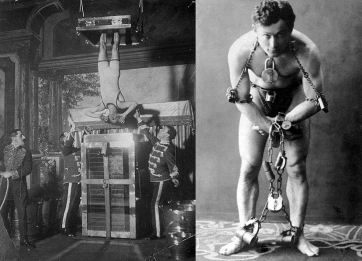
Harry Houdini

Harry Houdini

From escape artist Harry Houdini to motorcycle stunt rider Robert “Evil” Knievel, daredevils have long attracted crowds of spectators and generated millions upon millions of dollars for their promoters over the years. While Houdini eventually died of a ruptured appendix, he was nearly killed several times by his own hand as a result of escape attempts gone wrong. Many of his compatriots, like Wicker, were not so lucky; which begs the question, is the spectacle worth the risk? Apparently it is because the public keeps going to see them, like sadistic voyeurs almost hoping to see something go horribly wrong.

Local government, concerned about the staggering level of liability involved, does everything it can to discourage people from attempting these kinds of stunts by requiring miles of paperwork and expensive permits before allowing these kinds of activities on public lands. Some simply don’t allow it to happen at all.

Wallenda’s high wire walk, for example, didn’t actually cross over the Grand Canyon, but the gorge of the Little Colorado River Navajo Tribal Park. His 1,400 foot steel cable was actually suspended over land of the Navajo Nation, near Cameron, Arizona.

Could these daredevils have what Freud called a “death wish,” a desire, often deeply repressed, for self-destruction, accompanied by feelings of depression, hopelessness, and self-reproach? That might be said of Houdini, given his almost obsessive interest in death and the afterlife. But for most everyone else in this line of work, it’s about attention and a desire to push the envelope – that need for the adrenaline rush associated with doing what no one else is brave enough to do (or stupid enough, depending on your point of view).

In the end, there would be no market for these kinds of acts if the public wasn’t thoroughly fascinated by them. As for the performers themselves, it’s probably best to take into account Jane Wicker’s own words.

“Why do I do this? There is nothing that feels more exhilarating or freer to me than the wind and sky rushing by me as the earth rolls around my head,” Wicker once wrote. The day before the crash she told WDTN TV2, “I’m never nervous or scared because I know if I do everything as I usually do everything’s going to be fine.”

For those left behind, there is a great sense of loss when these daring entertainers pass doing what they love. But they will be remembered for their spirit and the smiles on the face of those who sat in awe of their skill and passion to defy the very fabric of nature.

Gery L. Deer is an independent columnist and business writer based in Jamestown, Ohio. More at http://www.deerinheadlines.com.

I pledge allegiance, on Flag Day

In Education, history, National News, Opinion, Politics, sociology on June 13, 2013 at 12:11 pm

DIH LOGO

“I pledge allegiance to the flag, of the United States of America and to the republic for which it stands, one nation, under God, indivisible, with liberty and justice for all.” This is how the Pledge of Allegiance is worded today. When it was originally penned in 1892, however, the author of the oath, socialist minister Francis Bellamy, included no references to America or God.

ros123Bellamy’s hope was that the pledge could be used by any citizen around the world to honor their own country’s flag. Later, it was adopted as a pledge to the American flag and the words, “under God,” were added in 1923.

To some Americans, there is no more powerful a symbol of liberty and freedom. To others, the flag is a symbol to be used in protest of government tyranny. Whatever the semiotics involved, the American flag has profound meaning around the world.

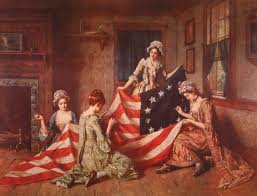
Legend has it that Betsy Ross, a Philadelphia seamstress who made flags for the navy, was commissioned by George Washington to create the first flag for the colonies. As charming a story as that may be, however, there is no verifiable information to support the tale.

What is known, historically, is that the first unofficial national flag, called the Grand Union Flag or the Continental Colours, was raised near George Washington’s headquarters outside Boston on January 1, 1776. It had 13 alternating red and white horizontal stripes and the complete British Union Flag in the canton (the upper corner, where the blue field and stars are located today). Another early flag included a rattlesnake and the motto “Don’t Tread on Me,” emblazoned on it; a design popular today with the conservative Tea Party movement.

The design of the Grand Union flag was altered about a year later to include the better known blue field in the canton with a circular pattern of stars representing each of the original 13 colonies. On June 14, 1777, the Second Continental Congress adopted this version as the flag of the United States. More than two centuries later, the date is still honored throughout the country as a holiday called, Flag Day.

Since its creation, the “Stars and Stripes” has been one of the single most recognized symbols in the world. Sadly, some people in America today believe that honoring the flag is no longer relevant, that it’s distasteful to fly or display the flag, or even offensive.

There is no question that our country is not perfect, and our leaders have made their share of mistakes. But the ideals of peace, justice and freedom are worth honoring, regardless of your political views, and that’s what Old Glory represents.

Today, children are no longer encouraged, sometimes even prohibited, to say the Pledge of Allegiance in school. The Pledge is seen by some as indoctrination to an ideology or worship of a false idol or some other such nonsense.

The truth is, indoctrination is everywhere and is usually voluntarily accepted without question. It’s in our social organizations, our schools, our businesses and especially in our political parties, churches, synagogues and mosques.

Each of these doctrines tend to divide us as a people, but getting behind a common symbol, the one that is intended to represent the best in us, the honor and sacrifice of those who came before, that is an indoctrination that can unite us in a way not found anywhere else on earth. It’s not forced, commanded or required – it’s our choice, each and every one of us.

Our flag has been burned, spat upon, dragged in the dirt, destroyed in battle, and shredded in conflict. It has withstood civil war, social unrest and political mudslinging. Far too many times, it has also covered the remains of those who died to defend it.

It may only be a red, white and blue piece of cloth, but it represents blood and sacrifice and signifies your right to find it distasteful, continuing to be a symbol of those rights whether or not you appreciate it. So happy Flag Day and may God (whoever your god happens to be) bless the United States of America.

Deer In Headlines is distributed by GLD Enterprises Commercial Writing. More information at http://www.gerydeer.com.

Is this your new site? Log in to activate admin features and dismiss this message
Log In