Local News & Commentary Since 1890.

Archive for the ‘Opinion’ Category

Those thrilling days of yesteryear

In Children and Family, Entertainment, Media, Movies, National News, Opinion, sociology, television, Uncategorized on July 9, 2013 at 8:39 am

DIH LOGOThe Lone Ranger first debuted in 1933 from the studios of WXYZ radio in Detroit, Michigan. Created by station owner George W. Trendle and writer Fran Striker, the character is said to have been based on the exploits of Bass Reeves, a real life federal peace officer who worked in Indian Territory during the late 1870s. Accompanied by his trusty Indian sidekick, Tonto, and themed by the thrilling rhythm of Gioachino Rossini’s operatic William Tell Overture, The Lone Ranger became an immediate success.

By the time that last surviving ranger hit the airways Wild West lore had been incredibly popular for more than two decades, particularly in dime novels, on the radio and in traveling shows. Originally aimed at children, it is estimated that more than half the audience for the program were adults, many of whom had grown up with stories about western legends like Billy the Kid, Bat Masterson and Wyatt Earp.

Unlike his historical counterparts who clearly had bad sides to their character, The Lone Ranger would be the ultimate good guy, with a mask to both maintain his anonymity and help confound corrupt government officials as to his true nature. In order to keep continuity for the character, the original writers created a set of guidelines that established who and what The Lone Ranger is meant to be. Some of the guidelines were a little silly, but others far ahead of their time.

For example, one of the rules stated that the Ranger would never be pitted against an adversary who was not American so as to avoid criticism from minority groups. In other words, it was already practicing political correctness. Another said that he could never drink or smoke and any “saloon” scenes had to be portrayed as cafes with waiters serving food instead of bartenders pouring drinks. One of the most interesting was a rule that stated he would always use perfect grammar and diction, devoid of slang and colloquialisms.

Many people who remember those days believe that actor William Conrad, star of the 1970s P.I. show, “Cannon,” was the original voice of The Lone Ranger on radio, but that is not so. In fact, Conrad voiced another famous western lawman, Gunsmoke’s Marshall Matt Dillon.

In 1949, the show made the ultimate leap from radio to the fledgling technology known as television, with Clayton Moore donning the famous mask and Native American actor Jay Silverheels as Tonto. After eight seasons on ABC, two of which with a different actor in the lead role, the show was cancelled in 1957. A year later, a theatrical feature was released starring the TV actors in a new adventure but the demand for the masked man never quite returned to its former pitch, though a couple of other failed attempts were made to return him to both the theatre and the small screen.

In 1981, a big screen version of The Lone Ranger was met with the harshest of criticism and dismal box office receipts. The movie failed partly because it was just a bad film, but mostly because the producers sued former star, Clayton Moore, to forbid him from wearing the signature mask in public appearances. Who says there’s no such thing as bad press?

The most recent incarnation of the Masked Man hit the silver screen this summer as a tongue-in-cheek Disney flick featuring Armie Hammer as Ranger John Reid (The Lone Ranger) and Johnny Depp as his trusted Indian partner. Unfortunately the campy tone that worked so well for Depp in the Pirates of the Caribbean series falls flat in this film, detracting from the nature of the characters and overshadowing the story.

Disney had the opportunity here to introduce two beloved characters of Americana to a new generation. But, instead of using the elements that made the show a success originally, they changed the formula and merely created another summer flop from a classic franchise. Hopefully, The Lone Ranger has not forever ridden off into the sunset and will get another chance to let audiences experience, “a cloud of dust and a hardy ‘Hi-Yo Silver!’”


Daredevil Performances: Is the spectacle worth the risk?

In Education, Entertainment, history, Local News, Media, National News, Opinion, sociology, Technology, television, Theatre, Uncategorized, World News on June 25, 2013 at 6:27 pm

DIH LOGODanger as a spectacle has long been a past time of human culture. Death-defying stunts have graced stages of theatres and circus tents for centuries. Never has there been a more awe-inspiring sight, however, than the dramatic aerobatics of stunt pilots and wing walkers. On Saturday, June 22nd, wing walker Jane Wicker and her pilot Charlie Schwenker died in a fiery crash during a performance at the Dayton Vectren Air Show in Vandalia, Ohio.

Wicker, who had been involved with aerobatics for more than a quarter-century, was sitting on the wing of the inverted plane as it dove, nose-first, into the ground and exploded. The aftermath of the crash left a burning wreck, two people dead and hundreds of spectators horrified.

News of the accident quickly spread around the country, landing on the lead story of every print, broadcast and online media outlet from the New York Daily News to the Huffington Post. Preliminary investigations of the cause of the crash from the Federal Aviation Administration and the National Transportation Safety Board are as yet inconclusive.

The very next day, high wire performer Nik Wallenda spent his evening engaged in a heart-stopping, quarter-mile tightrope walk across a 1,500 foot deep section of the Grand Canyon. As a record number of viewers tuned in to the Discovery Channel to watch, they were treated to more than a half hour of listening to Wallenda continually pray or thank God and praising Jesus with nearly every successful step. One might wonder if they would think he’s crazy too.

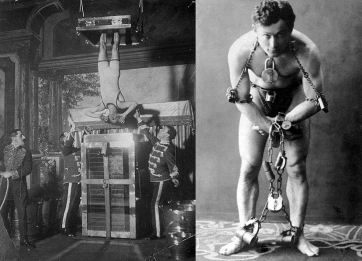
Harry Houdini

Harry Houdini

From escape artist Harry Houdini to motorcycle stunt rider Robert “Evil” Knievel, daredevils have long attracted crowds of spectators and generated millions upon millions of dollars for their promoters over the years. While Houdini eventually died of a ruptured appendix, he was nearly killed several times by his own hand as a result of escape attempts gone wrong. Many of his compatriots, like Wicker, were not so lucky; which begs the question, is the spectacle worth the risk? Apparently it is because the public keeps going to see them, like sadistic voyeurs almost hoping to see something go horribly wrong.

Local government, concerned about the staggering level of liability involved, does everything it can to discourage people from attempting these kinds of stunts by requiring miles of paperwork and expensive permits before allowing these kinds of activities on public lands. Some simply don’t allow it to happen at all.

Wallenda’s high wire walk, for example, didn’t actually cross over the Grand Canyon, but the gorge of the Little Colorado River Navajo Tribal Park. His 1,400 foot steel cable was actually suspended over land of the Navajo Nation, near Cameron, Arizona.

Could these daredevils have what Freud called a “death wish,” a desire, often deeply repressed, for self-destruction, accompanied by feelings of depression, hopelessness, and self-reproach? That might be said of Houdini, given his almost obsessive interest in death and the afterlife. But for most everyone else in this line of work, it’s about attention and a desire to push the envelope – that need for the adrenaline rush associated with doing what no one else is brave enough to do (or stupid enough, depending on your point of view).

In the end, there would be no market for these kinds of acts if the public wasn’t thoroughly fascinated by them. As for the performers themselves, it’s probably best to take into account Jane Wicker’s own words.

“Why do I do this? There is nothing that feels more exhilarating or freer to me than the wind and sky rushing by me as the earth rolls around my head,” Wicker once wrote. The day before the crash she told WDTN TV2, “I’m never nervous or scared because I know if I do everything as I usually do everything’s going to be fine.”

For those left behind, there is a great sense of loss when these daring entertainers pass doing what they love. But they will be remembered for their spirit and the smiles on the face of those who sat in awe of their skill and passion to defy the very fabric of nature.

Gery L. Deer is an independent columnist and business writer based in Jamestown, Ohio. More at http://www.deerinheadlines.com.

Is Big Brother watching too closely?

In National News, Opinion, Politics on June 19, 2013 at 2:06 pm

DIH LOGO

In his book, “1984,” author George Orwell noted, “If you want to keep a secret, you must also hide it from yourself.” Even though he published his most famous work in 1949, Orwell seems to have had a sixth sense about the future of government scrutiny.

Orwell’s dystopian society may seem too dark and ominous to be believable, but given the recent events surrounding the National Security Agency’s (NSA) surveillance operations, it may be more reality than fiction. As more information is revealed about these activities, congressional hearings are turning up little in the way of explanations by those in charge.

So why is it so offensive that the government would eaves drop on phone calls and emails to help prevent another 9-11 disaster? According to officials, hundreds of potential threats have been thwarted thanks to the tireless efforts of those who invade the privacy of law-abiding Americans. Unfortunately, since all of that information is classified, there is no evidence to show the public that corroborates their claim.

Civil liberties watchdog groups pounced on this story as soon as the information was leaked to the press. The question begs asking, however – under which rock were the leaders of these groups living where they didn’t think this was going on already? To the bigger point, who cares?

Modern society is full of surveillance cameras, listening devices and internet-based tracking systems, only a tiny fraction of which are used by government agencies. Most of them are operated privately to collect marketing or usage information or provide security. And people just accept it. It’s there, there’s nothing that can be done about it and just part of life in a technologically advancing society.

ringyIn the early 1900’s, “party lines” were the main method for which residential customers were provided with telephone service. Everyone on the same circuit would have to wait their turn to use the telephone and simply agree not to listen in on each other’s conversations. Of course, this was a source of great amusement in early radio and television comedy sketches. Today, it would be viewed as a huge invasion of privacy and thoroughly unacceptable.

Barreling through continually updated technology requires that people must adapt at a faster pace. Users of that technology should be aware that anything posted on the internet or passed through an electronic broadcast system (i.e.: cell phones, Wi-Fi, etc.) could be intercepted without their permission or knowledge. There’s no telling who is listening or reading any of it or what will become of that information.

If the NSA or other government agencies are tracking information, the assumption should be that there is something worth listening to. If they’re violating the law based on having no just cause for acting on that information then it’s probably best to let the courts iron it out, not congress. The last thing anyone wants is for the one group in America with the most detrimental secrets – and with the hardest time keeping them – to be in control of everyone else’s.

Whether there is legitimate cause for any branch of the U.S. government to spy on its own people is still debatable. As it is, President Obama now finds himself in defense of an administration whose platform for election included condemnation of the previous one for the same kinds of anti-privacy actions.

In a post-9/11 America, the Bush administration was constantly under fire for what liberals saw as a violation of privacy and infringement of civil liberties all in the name of national security. As it turns out, what’s good for the goose really does appear to be good for the gander. The truth is, Democrat or Republican, as long as terrorists threaten the free nations of the world there will always be some loss of personal privacy in the name of security.

In “1984,” Orwell presented a future devoid of personal freedoms and independent thought, not protected from terror but from free choice. America’s leaders have a choice – to be diligent or let history repeat itself in the name of popular opinion. In the meantime, the citizenry will have choices to make as well – in the next elections.

Gery L. Deer is an independent journalist and business writer from Jamestown, Ohio. More at the new website, http://www.deerinheadlines.com.

I pledge allegiance, on Flag Day

In Education, history, National News, Opinion, Politics, sociology on June 13, 2013 at 12:11 pm

DIH LOGO

“I pledge allegiance to the flag, of the United States of America and to the republic for which it stands, one nation, under God, indivisible, with liberty and justice for all.” This is how the Pledge of Allegiance is worded today. When it was originally penned in 1892, however, the author of the oath, socialist minister Francis Bellamy, included no references to America or God.

ros123Bellamy’s hope was that the pledge could be used by any citizen around the world to honor their own country’s flag. Later, it was adopted as a pledge to the American flag and the words, “under God,” were added in 1923.

To some Americans, there is no more powerful a symbol of liberty and freedom. To others, the flag is a symbol to be used in protest of government tyranny. Whatever the semiotics involved, the American flag has profound meaning around the world.

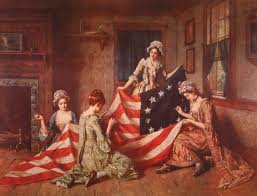
Legend has it that Betsy Ross, a Philadelphia seamstress who made flags for the navy, was commissioned by George Washington to create the first flag for the colonies. As charming a story as that may be, however, there is no verifiable information to support the tale.

What is known, historically, is that the first unofficial national flag, called the Grand Union Flag or the Continental Colours, was raised near George Washington’s headquarters outside Boston on January 1, 1776. It had 13 alternating red and white horizontal stripes and the complete British Union Flag in the canton (the upper corner, where the blue field and stars are located today). Another early flag included a rattlesnake and the motto “Don’t Tread on Me,” emblazoned on it; a design popular today with the conservative Tea Party movement.

The design of the Grand Union flag was altered about a year later to include the better known blue field in the canton with a circular pattern of stars representing each of the original 13 colonies. On June 14, 1777, the Second Continental Congress adopted this version as the flag of the United States. More than two centuries later, the date is still honored throughout the country as a holiday called, Flag Day.

Since its creation, the “Stars and Stripes” has been one of the single most recognized symbols in the world. Sadly, some people in America today believe that honoring the flag is no longer relevant, that it’s distasteful to fly or display the flag, or even offensive.

There is no question that our country is not perfect, and our leaders have made their share of mistakes. But the ideals of peace, justice and freedom are worth honoring, regardless of your political views, and that’s what Old Glory represents.

Today, children are no longer encouraged, sometimes even prohibited, to say the Pledge of Allegiance in school. The Pledge is seen by some as indoctrination to an ideology or worship of a false idol or some other such nonsense.

The truth is, indoctrination is everywhere and is usually voluntarily accepted without question. It’s in our social organizations, our schools, our businesses and especially in our political parties, churches, synagogues and mosques.

Each of these doctrines tend to divide us as a people, but getting behind a common symbol, the one that is intended to represent the best in us, the honor and sacrifice of those who came before, that is an indoctrination that can unite us in a way not found anywhere else on earth. It’s not forced, commanded or required – it’s our choice, each and every one of us.

Our flag has been burned, spat upon, dragged in the dirt, destroyed in battle, and shredded in conflict. It has withstood civil war, social unrest and political mudslinging. Far too many times, it has also covered the remains of those who died to defend it.

It may only be a red, white and blue piece of cloth, but it represents blood and sacrifice and signifies your right to find it distasteful, continuing to be a symbol of those rights whether or not you appreciate it. So happy Flag Day and may God (whoever your god happens to be) bless the United States of America.

Deer In Headlines is distributed by GLD Enterprises Commercial Writing. More information at http://www.gerydeer.com.

Science and the public benefit from storm chasers

In Education, Local News, Media, National News, Opinion, Science, Technology, Uncategorized on June 3, 2013 at 10:52 pm

Deer In Headlines

By Gery L. Deer

WHIO-TV's weather radar as it appeared on April 3, 1974 approximately 4:20PM as the Xenia Tornado touched down. Notice the "hook" echo indicating the twister.

WHIO-TV’s weather radar as it appeared on April 3, 1974 approximately 4:20PM as the Xenia Tornado touched down. Notice the “hook” echo indicating the twister.

In the 48 hour period between April 3rd and 4th, 1974, the Midwestern United States experienced one of the most devastating tornado outbreaks in history. Known as a “super outbreak,” 148 confirmed tornadoes touched down from Michigan to Alabama and Illinois to West Virginia, with 30 of them in the F4-F5 categories and resulting in the deaths of 300.

One of the most devastated towns was Xenia, Ohio, where a massive F5 funnel tore through the city leaving a mile-wide path of destruction, killing 33 and injuring more than 1,100. The low death toll is attributed to advanced warning provided by WHIO-TV weatherman, Gil Whitney using the first local weather radar system in the Dayton area.

Satellite, GPS and advanced warning networks, along with modern Doppler radar have all helped increase early warnings for tornado victims from less than 3 minutes to more than 15 minutes. Much advancement in severe weather detection might never have happened, however, without the work of the brave men and women who call themselves, storm chasers.

Storm chasers are serious scientists working to increase our knowledge of tornadoes and how they behave. Unlike those depicted in the 1996 movie, “Twister,” however, chasers experience little glory instead spending days and weeks in preparation that may result only in a few moments of tornado spotting.

As you might expect, purposely trying to outmaneuver the proverbial “finger of God” carries with it some inherent danger. Unfortunately, that danger can turn deadly at any moment.

On May 31st, revered storm chaser Tim Samaras, 55; his son, Paul, 24; and meteorologist Carl Young, 45, were killed near El Reno, Oklahoma as they tried to document one of several tornadoes moving through the area. Since their deaths, many have asked, “Is the data gathered from storm chasing worth the risk?” In my opinion, yes, it is.

I’ve always been fascinated by tornadoes. The day after the Xenia tornado of ’74, my parents took me along as they assisted with the cleanup efforts by using our grain trucks to help haul away debris. I never forgot what I saw there. Nor will I ever forget the darkened, green sky and the strange, coldness of the air as the monster storm was passing through. It marked my psyche for years to come.

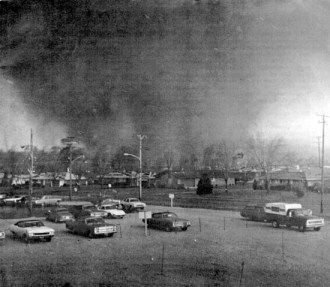
Possibly the most famous photo of the Xenia Ohio 1974 Tornado. Taken from Greene Memorial Hospital by Fred Stewart.

Possibly the most famous photo of the Xenia Ohio 1974 Tornado. Taken from Greene Memorial Hospital by Fred Stewart.

The experience left me nearly terrified of storms, until one day in 1988, when I was alone at our family farm and stepped outside after hearing tree branches break during a storm. I stood on our front porch, paralyzed, as I watched a small funnel cloud worm its way across the pasture in front of me, parallel to our house.

My ears popped as I stood motionless, surrounded by completely still air except for the slim tube descending from the sky into a swirling mass of dust. With almost no sound at all, it smashed the wooden sideboards of one of our old trucks, crossed the field about a half mile away and totally demolished a neighbor’s barn.

As quickly as it came, it was gone. That day, my fear gave way to a new respect for one of nature’s most dangerous, ephemeral phenomena. Since then, I’ve been within eye-shot of two more tornadoes and educated myself about them as best I could without taking to the road as a chaser.

But, I have the utmost respect – not to mention appreciation – for those who have. While there are probably some storm chasers who are just thrill-seekers, I have no doubt that most are in it for the science and the potential benefit that comes from the effort.

Early warning systems now broadcast through TV, Internet and cell phones, and most air raid sirens have been re-purposed for use as tornado warning systems. Everyone in and around Tornado Alley should remain diligent when severe weather approaches and heed warnings when they are issued.

It’s doubtful we’ll ever be able to fully predict when and where a tornado will strike but, thanks to the work done by storm chasers, scientists can give people a fighting chance to be better prepared.


Gery L. Deer is an independent columnist and business writer based in Jamestown, Ohio. More at http://www.gerydeer.com.

Disasters help us appreciate the easy things

In Children and Family, Opinion, psychology, Senior Lifestyle, Uncategorized on May 22, 2013 at 11:13 pm

Deer In Headlines

By Gery L. Deer

What’s your life like? Are you regularly faced with life-changing decisions? Is your life in danger with uncommon regularity? Fortunately, not many of us have to face such situations in our daily routines.

First response officers (police, fire, EMS), U.S. Secret Service agents and military personnel in war zones are probably some of the few groups of Americans who routinely face life-threatening events. For the rest of us, a visit to Walmart can put us into fight of flight mode.

A favorite author of mine once noted that when faced with a completely hopeless, potentially life-ending situation, one should consider how good life has been up to that point. On the other hand, if life hadn’t been so good, one should think about how lucky it is that it won’t be troubling you for much longer. The point is that usually, life’s situations are rarely as hopeless as we think.

Nearly two decades ago, on a beautiful summer day, on a quiet country road in the middle of nowhere, I was faced with just that kind of situation, but it all happened in the blink of an eye. While driving one of our farm trucks to pick up hay, a massive cement mixing truck struck my vehicle, head on, left front fender to left front fender, with unbelievable speed and force.

The power of the collision destroyed my truck and literally cut the front wheels and axle out from under me, burying the frame, nose first, into the asphalt below. A heartbeat later, I was sitting motionless in a shower of debris, dust and glass as the big Louisville Ford crashed to a halt in the hot sun.

Without sounding overly dramatic, had the other vehicle been six inches further to my right when it struck my truck, I’d have been killed instantly. There is much more to the story, but what stands out here is how different your life’s perspective is when you come that close to death. In fact, I actually remember bursting out in laughter.

My father had been in front of me, helplessly watching all of this unfold in his rear view mirrors. As we stood in the street surveying the wreckage, I busted out laughing and said, “My brother’s going to kill me.” After all, it was his truck and he hadn’t had it too long. Oh well, I thought, that’s life.

When faced with life-threatening events like the massive tornado in Oklahoma on May 20th, our perspectives change in an instant and what seemed important one second becomes the last thing on your mind a moment later. Maybe the lesson to take away from these events is about how much we value our day-to-day lives, or rather, how much we devalue them.

Every day without suffering, disease, pain or trauma is a gift. We should appreciate anytime we can just sit back, take a deep breath and think how calm and good life is at that moment. Most of us don’t do that, though.

In our country, we seem to be a little too preoccupied with what we don’t have to appreciate what we do. I remember times at family events when I literally stopped, sat there and looked around, and, like on a camera or video tape, tried to capture the image of family and friends laughing, smiling and being happy to be together, just in that instant. I have stored countless gigabytes of space in my head full of nothing but that – appreciation for the moment.

Admittedly, I don’t do it as much as I should and I don’t think I’ve ever met anyone else who does that. But when life’s hard, or you can’t seem to find the good in a moment, it’s nice to be able to close your eyes and go back to those times to give yourself a sense of peace and calm. It makes you appreciate every moment just a little more.


Gery L. Deer is an independent columnist and business writer from Jamestown, Ohio. More at http://www.gerydeer.com

Who am I, and what am I doing here?

In Entertainment, Health, Opinion, psychology, Religion, Senior Lifestyle, sociology, Uncategorized on May 15, 2013 at 12:04 pm

Deer In Headlines

By Gery L. Deer

We’ve all had moments when we’ve turned to someone, a father, a brother, a God and asked, “What was I meant for? Am I doing what I was supposed to do?” It’s a normal exercise for us to question our situation, regardless of its status.

But we have to be careful to realize, regardless of how much we’d like the world to be a mystical place, our own choices landed us where we are and nothing was “meant to be,” that wasn’t directed by personal decisions.

I think it’s pretty normal to think we were meant for something more than we are, at least most of us probably feel that way. What many people tend to miss is how much value their lives have to others and how much would be different in the world without their contributions.

Over the last few years, I’ve written a great deal about my late mother, Lois. She passed away in November of 2011 after long battle with Alzheimer’s disease which among other things robbed her of a lifetime of memories.

Mom wasn’t an overly complicated person but she was very smart and caring, always putting others ahead of her – particularly her children and grandchildren. She only ever worked as a school volunteer, on the farm with Dad and for a time as a waitress in a little hometown restaurant where I grew up.

She might not have had the life people grow up dreaming about, but I’d like to think she felt like she had made a difference in the world. I know she did for me and my family. She didn’t have money or status or important connections, but she had wisdom and a level of understanding of her world and those in it that I truly wish I could emulate.

To some people a basic, down-home lifestyle could seem like Purgatory; a futile, pointless existence. Even though she didn’t have a list of college degrees after her name, nor did she work some high-powered job (unless you count managing my dad), her mere influence upon those around her probably had far greater reach than she ever knew.

In my mind, Mom had the life she was “meant” to live, evidenced by the efforts of those who helped care for her and offer support to our family as her illness advanced. We all have a place in the world and it might not seem like it matters at the time, but we are often more influential than we realize.

Since the kind of work life I have chosen does not lend itself to earning fistfuls of cash, far from it, I have always hoped that my labors have at least helped to enhance someone’s life, even in the slightest. Whether I am making people laugh on stage during The Brothers & Co. variety shows, or passing along my worldly observations in my writing, I always try to give people something that will help make their life better, even if it’s only for a moment. To me, that’s rewarding in itself.

Even when people don’t agree with something I’ve written, the point to take away is that they read it, and it made them think. I don’t want everyone to agree with me, nor am I trying to persuade them to alter their life paths based on my opinion of something. My job is to enhance someone’s life just by giving them something new to think about and that is the accomplishment.

So, a sense of accomplishment isn’t always derived from academic or financial achievement, and in my limited view of the world, it almost never comes from material success. Sometimes just being who you are and contributing to the world around you makes the longest-lasting difference.

Were you “meant” to be who you are, though? That’s a question best left to you. Only you can evaluate your level personal satisfaction from the world you’ve created for yourself. You are who you are, right or wrong. So like I heard once in a song, “This is it. This is life, the one you get, so go and have a ball.” And enjoy being you. It doesn’t matter how you got there.

 
Gery L. Deer is an independent columnist and business writer based in Jamestown, Ohio. More at www.gerydeer.com.

Excuse me; is that your nose in my business?

In Children and Family, Entertainment, Opinion, psychology, sociology, Uncategorized on May 8, 2013 at 2:43 pm

Deer In Headlines

By Gery L. Deer

On "Bewitched," nosey neighbor, Gladys Kravits (Alice Pearce) always got more than she bargained for with her cup of sugar!

On “Bewitched,” nosey neighbor, Gladys Kravits (Alice Pearce) always got more than she bargained for with her cup of sugar!

Fifteen years ago, I was shopping for my first house when I realized I had no idea exactly what it was I wanted. I grew up on a farm with a house smack in the middle of a valley of trees, pasture and corn fields so I was lacking some of the social necessities of being a ‘neighbor.’

I had no idea what it meant to have to “keep up with the Joneses,” and I never saw my mother so desperate for sweetener that she needed to bang on someone else’s door and demand they fill her measuring cup with sugar. I just didn’t get it. And, after a good fifteen years, I still don’t.

Growing up in such isolation taught me self-reliance and a good feeling for minding my own business. Even as an adult, as public as I might seem between my published work, music and television appearances, I tend to be a bit of an introvert. It’s not that I’m unfriendly, quite the opposite, but I just feel like I should keep my nose in my own cupboard and leave others to do the same.

For some, however, that’s not the case. When I first considered a suburban home, I visited several developments and each put me in mind of TV shows of years past. On TV, the houses looked all the same and there was always that one, nosey neighbor who just couldn’t keep off your grass.

Inevitably, I think of Gladys Kravits, the screeching butinsky from “Bewitched,” who spent her day tormenting her happily ignorant husband Abner all about the goings on at the Stevens home across the street. Granted, there were weird things happening on Morning Glory Circle (that’s the street where Samantha and Darren lived on the show), but rarely did those events directly impact the neighbors.

I tend to be an observer of human behavior, which helps me, I hope, to be a good writer. I’ve noticed over the years that the preoccupation of people with the activities of their neighbors can be close to a debilitating obsession.

Constant worry about the concerns of others is, to my mind, ridiculous and kind of neurotic. What if you did nothing all day but ponder such things like … When did John cut his grass – for the tenth time? How did Bob buy that above ground pool when he doesn’t make that kind of money? Do those people have anything else to do but remodel their house every month?

It can get out of control. I’m hoping that level of unwarranted curiosity isn’t the norm but the exception. I would hate to think that my comings and goings were costing a good night’s sleep to anyone but me. That’s not to say that even rural suburbs don’t offer some level of low-brow entertainment of a kind that would even sour Jerry Springer’s sensibilities.

Fortunately, where I finally chose to buy a home turned out to be the perfect fit for me. But I know people who live in suburbs where you can’t make a move without someone commenting on it or having an opinion to gossip about. I’m sure it happens everywhere, but I think people should spend their time worrying about their own lives and stay out of the affairs of others.

If the concerns of those around you occupy your thoughts more than your own actions, it might be time to take a look in a mirror instead of out the front window. Being nosey isn’t the same as being neighborly.

Thoughtful compassion for a neighbor with a sick parent or welcoming a new baby is not the same as feeling the compulsion to always see what’s going on next door. It’s important for people to know the difference and respect those boundaries.


Gery L. Deer is an independent business writer and contributor to the WDTN-TV2 show, “Living Dayton.” More at http://www.gerydeer.com

Money cannot buy eternal salvation

In Charities, Media, National News, Opinion, psychology, Religion, television, Uncategorized on April 30, 2013 at 10:55 am

EVANGDeer In Headlines

By Gery L. Deer

Have you ever turned on the TV early on a weekend morning and heard something like this, “Friends, dig deep for those green rockets of salvation. Help us to lead the sheep to His lovin’ care with your kind love offering. Operators are standing by to pray with you – all for just $49.99.” A cross between an infomercial and a bad Saturday Night Live parody, television evangelists have been conning millions from the pockets of the devout since the medium was invented.

These clergy-covered con men (and women) take the stage amidst gold-plated, throne-like chairs, religious statuary and acrylic podiums to convince us all that we’re damned to the fiery pits of Hell unless we give and give generously. Armani-suited, well-quaffed, jewel-bedazzled TV preachers spout dramatic sermons from a teleprompter while holding up a Bible as if it were the newly presented cub in the Lion King movie.

If that’s not enough drama, it’s is followed by repeated moments of squint-eyed, hand-raised prayer and Lord praising before thousands of onlookers in the audience who are doing the same. Without opening their eyes, the host preacher prays that God will direct the viewers to the telephone number that appears at the bottom of the screen and give generously to the ministry so that more souls can be saved.

At home, viewers dial quickly, handing over millions upon millions of dollars to what could easily be compared to a guy begging on a highway exit ramp. The difference is that at least you know the panhandler is exactly that. He’s not pretending to give you a direct phone line to eternal salvation at the same time.

Holier-than-thou in their demeanor and testimony, eventually they fall from their pedestals in some kind of sex scandal or tax evasion allegations. I’m sure everyone remembers the rise and fall of Jim and Tammy Baker, Oral Roberts and Jimmy Swaggart.

Religious panhandling – might as well call it by name – is a real problem in America and, unfortunately, it’s completely legal and largely tax-exempt. For the truly devout, there is a clear understanding that man is meant to be humble and kneel before God. That doesn’t mean we were meant to live in abject poverty, but we’re not supposed to use the Almighty as a way to dupe billions of dollars out of unsuspecting people searching for answers in a life full of uncertainty and hardship.

With multi-million-dollar homes, limousines and servants, there is nothing holy about these so-called “evangelists.” In fact, in my opinion, it’s just flat out criminal. These people soil the image and intentions of faithful, honest people all over the country who are genuinely trying to do some good in the world. Most live modestly, often with a second job or from a share of whatever comes in the offering on Sunday morning. There are no limousines, golden thrones or evangelical stadiums.

There is nothing to excuse the fact that some of the poorest people in America, the elderly, are the most common victims to this kind of nonsense. Looking for spiritual leadership and often lonely and shut-in, seniors often send money to these TV charlatans before even paying for food and medicine.

Of course, these religious phonies don’t care who they hurt because they can hide out in tax-sheltered mansions, go for a dip in their Olympic-sized swimming pools or jet off to vacation homes in the Cayman Islands.

Not convinced? According to CelebrityNetWorth.Com, one of the most popular TV evangelists, Benny Hinn, is worth more than $42 million; all from donations to his “ministry.” Another extremely popular – and rich – television pastor, Joel Osteen, is reportedly roughing it on only $40 million. And more money is still pouring in.

I don’t have a problem with people living prosperously and giving generously from hard work and the success built from that labor. I am deeply offended, however, when those claiming to be men and women of God live in luxury at the expense and from the charity of lost souls desperately searching for comfort. It would do them well to go read that book they’re always waiving around on TV; particularly the book of Matthew, Chapter 19, Verse 24.


Don’t Panic. Really, we mean it this time.

In Books, Literature, Media, National News, Opinion, Politics, psychology, sociology on April 17, 2013 at 7:00 am

Deer In Headlines

By Gery L. Deer

dontpanicIn 1978, a radio comedy called The Hitchhiker’s Guide to the Galaxy, written by Douglas Adams, aired as a series on the BBC. Hitchhiker’s was a wholly remarkable radio show that eventually became a wholly remarkable television program, and a series of wholly remarkable – not to mention lucrative – novels, five in the so-called trilogy. A sixth novel was completed by a different author in 2009, eight years after Adams’ untimely death.

Commonly known by fans as, “HG2G,” Hitchhiker’s was essentially a parody of age-old science fiction with a satirical spin. The story line is filled with political satire and a pinch of sarcastic banter, the focus of which was the “establishment,” whatever that meant to the reader.

The story begins with one ordinary man’s adjustment to being transported from Earth only moments before it is destroyed to make way for a bypass for space ships. Suddenly thrust into a galaxy of crazy characters and a manically depressed robot named Marvin, human Arthur Dent is dumbstruck by his complete lack of ability to adapt.

Arthur’s friend Ford, an intergalactic researcher who rescued Arthur from his doomed world, finds his way through the galaxy hitchhiking and following the advice of an electronic book, whose cover is inscribed, in large, friendly letters, with the words, “Don’t Panic.” As the pair travels through the stars, Arthur finds little comfort in his new life except for the constant search for a nice hot cup of tea and the friendly inscription on the cover of his electronic guidebook.

A prolific writer and avid environmentalist, Douglas Adams may be single-handedly responsible for inventing the concept of the e-reader (which is essentially what the “Guide” was) nearly three decades before Amazon, the iPad or even the Internet ever existed. Adams also managed to show us the world more as it really it is than how we’d rather it be. I think that’s where, “Don’t Panic,” came from in the first place.

As Adams’ character, Arthur Dent found out, there are simply things we cannot control so the best thing to do is try to keep our heads and move through it. By a curious coincidence, as I watched the tragic events of terrorism unfold in Boston this week, I found myself thinking about the cover of Adams’ book and those large, friendly letters. “Don’t Panic” seemed like just the kind of thing you’d want someone to say to you at a moment like that.

I’ve never been in a situation like a terrorist bombing, but I have had my share of life and death scrapes over the years. From a head-on truck crash that should have certainly killed me to dealing with the painful helplessness of watching my mother whither away from Alzheimer’s disease, I have learned which things I should panic about and what I should try to just push through. And I don’t believe I’m alone in that practice, by any stretch of the imagination.

Given the circumstances, there is no level of security that could have prevented what happened in Boston. But when it did, people clearly pushed their fear and panic aside, stepped up and did their best to help each other through a horrible situation. Human beings are resilient, even though some might seem like they’re not. We’ve managed around 15 million years of evolution so there must be something to us, right?

I had the good fortune to meet Douglas Adams in 1992 when he came to Dayton for a book signing. Thanks to a fortuitous hiccup in the autograph line, I found myself standing in front of the author for several minutes. He was as gracious and humble, kindly asking how I liked his work.

As we chatted, I asked him what it meant – Don’t Panic. He said simply, “Whatever you need it to.” He also told me I should continue writing and not let the problems of the world interfere with my creativity and positive outlook. I’ve tried hard to do both. So the next time you’re faced with a tough situation just remember the Hitchhiker’s cover line: Don’t Panic. After all, what doesn’t kill you will make you stronger.

Gery L. Deer is an independent columnist and business writer based in Jamestown, Ohio. More at http://www.gerydeer.com