Local News & Commentary Since 1890.

Archive for the ‘Health’ Category

Stories, the tapestry of our lives

In Dayton Ohio News, Health, Literature, Opinion, Uncategorized on November 9, 2016 at 9:35 am

By Gery L. Deer

Deer In Headlines
DIH LOGOLong before man learned to put pen to paper, stories kept the history of human kind. Passed down from generation to generation, our stories weave the tapestry of who we are as a people, the perils and the promise, the struggles and successes.

One might think in this modern age of nonstop information, digital data and wearable technology, that we would have abandoned the need for sharing stories verbally. Thankfully, I’ve learned not only that the practice is alive and well, but also takes place often in the most unlikely places.

Recently I was privileged to attend a storytelling event hosted by my friend Michael. For more than two decades, he and some of his closest friends have gathered each year to share stories of all kinds.

Painting by Albert Anker

Painting by Albert Anker

Everyone brings a snack or beverage to share and gather, goodies in hand, to lose themselves in the tales spun by each reader.  Those chosen to read take, in turn, the “reader’s chair” to share aloud an original story or a piece by a favorite author.

I’ve both hosted and attended author readings before. But I’ve never been to something like this. But there is no formal group or organization involved here. There is no religious or political agenda – something I found beyond refreshing.

The entire evening is focused, not the quality of the writing or the impact of the stories, but the fellowship and common interest of long time friends and new acquaintances. It was the modern day equivalent of a tribe sitting around a campfire.

What I was most impressed by was everyone’s level of attention, respect and admiration for the person in the reader’s chair. This was not something people were compelled to attend. There was no work obligation or social requirement.

And, while some of us who were there are writers, most were not. Add to that such a variety of people who really had only one thing in common – our host. One person whose circle of friends combined for this single purpose, a couple of hours of distance between us and the chaos of the world outside.

The stories chosen were also captivating, not as much because of the tales being told but the teller. Each reader had his or her own, individual style, some more animated, others more calm and quiet. To say it was entertaining would be an understatement.

I guess the point I’m trying to make is that in our “immediate” society, it was really nice to calm down, relax and just be there, in the moment, among friends and new acquaintances.

You know what else? No one was looking at their smart phone or any other kind of screen for a couple of hours! Sure people checked for texts once in a while from the sitter or verified the ringer was off. But, for just a little while, no one was nose-down into a glowing box.

It might sound corny to some people but there’s something great about the disconnection from the outside to connect with the in. That’s saying something since socializing is not my strong suit. I’ve never been that comfortable at social gatherings, always feeling awkward and out of place, but not this time.

Everyone was engaged and welcoming in this setting, with no hidden agendas, no ulterior motives, no business maneuvering. This was just some great people getting together to enjoy an evening of calm, thoughtful writing.

Yes, it’s probably a bit nerdy and may sound pretentious to some people. But, I can assure you it wasn’t. If anything, it gave me a break from the hustle bustle of the week and I got to see my friend Michael in a different environment, something we should all try to do from time to time.

Sharing stories creates our history and weaves our society together and we need to remember that it started with two people communicating with each other – directly, person to person. Try it sometime. You might just find you have more in common with those around you than you may have thought. And thanks again to Michael and his storytellers.


Gery L. Deer is an independent columnist and business writer. Catch the Deer In Headlines podcast at MyGreeneRadio.com.


Detach and de-stress from politics

In Health, National News, Opinion, Politics, psychology on May 17, 2016 at 7:57 am

Deer In Headlines

By Gery L. Deer

DIH LOGOA July 2014 article in The Washington Post included a headline that read, “Politicians are the No. 1 cause of stress in our lives.” The article focused on a stress survey in which, “Americans cited, ‘Hearing about what the government or politicians are doing,’ as the most frequent daily stressor on their lives, and at a substantially higher rate than the usual annoyances like commuting, chores and general schedule-juggling.”

That was nearly two years ago and reactions to day-to-day politics were driving the survey. At that time the dizzying level of ridiculousness surrounding the 2016 presidential bid had yet to shift into high gear. Now, with just a few weeks until the first convention, the stakes have never been higher, and neither has our collective blood pressure.

In the time between now and the conventions, it’s unlikely anything of consequence will occur. There will be blustering and feather ruffling from candidates, but, in the end, the convention is the next decisive event. It’s time to back away for a while.

If the presidential race has driven a wedge between you and those close to you, it may be time let it go. It’s not important. The truth is, very little that takes place on the presidential campaign level will affect those of us down here in the real world.

And it certainly is not worth the loss of close friendships. So how do you disconnect? Well, here are a few short tips.

First, step away from social media – immediately! As if the cable news blather wasn’t enough, Facebook, Twitter and all the rest of social media is inundated with opinion, and certainly not necessarily what you would call, “informed” opinion.

maxresdefaultMost people, for whatever reason, have a difficult time recognizing fact from rhetoric. How many times have you been taken in on Facebook or Twitter by some fake news story? Generally those kinds of things are harmless. But when conflict and gossip are presented as factually based information, things get murky and you have to know the difference.

Along with the computer, switch off the TV as well. Face it you’re never going to get an “objective” view of any candidate, party or issue from corporate news agencies. Every organization introduces the spin they want you to hear. Fox News, CNN, MSNBC, and all the rest, have their own political agendas and when they want you to think, they’ll tell you how.

Consider also, how you feel when you encounter political news. Take close note of your emotions when you’re reading, watching or listening to political material. Does your heart rate jump? Do you feel angry or enraged? Well, believe it or not, that’s exactly what they want; “they” being the media manipulators.

But, you don’t have to fall for it. You can choose what information to which you are exposed and how it affects you. If you just let them get to you, that’s your own fault.

Probably the best way to keep from being overwhelmed by the election hype is to be informed. Do your own research on the candidates and issues and get the information as first-hand as possible. The more facts you know, the less likely you are to get sucked into the garbage.

Politics can sometimes be a fun diversion, though for whom I haven’t a clue. But when things are as charged up as they are this time around, most of what results is stress, angry feelings and regretful behavior.

Remember that politicians at that level – including Hillary, Bernie, and Donald – have no stake in your life. They could care less about anything save their own quest for power, ego and personal benefit. And they’ll say anything to get the votes they want. Anyone who sincerely believes otherwise is a bit naive.

So as the election creeps up on us, be prepared to go vote your conscience when the time comes. Until then, shut it all down, tune it all out, and relax!

For further study and resource …

6 Ways To Cope With Political Stress by Dr. David Lowenstein

http://drlowenstein.com/2016/03/10/6-ways-to-cope-with-political-stress/

5 Ways To Avoid Stress and Stay Healthy In Political Campaigns by PoliticalCampaigningTips.com

http://www.politicalcampaigningtips.com/5-ways-to-avoid-stress-stay-healthy-in-political-campaigns/


Gery L. Deer is an independent columnist and business writer. Deer In Headlines is distributed by GLD Enterprises Communications, Ltd. More at gerydeer.com


Confronting your greatest fear

In Children and Family, Health, Local News, Opinion, psychology, Uncategorized on April 26, 2016 at 4:59 pm

Deer In Headlines
By Gery L. Deer

In the aftermath of the 1974 Xenia tornado, people in surrounding communities did what they could to help with the cleanup. Although my father was a teacher at the vocational school at the time, he also had heavy trucks so we went to help as well.

Everywhere you looked was devastation. Stunned families cried or stared blankly as broken water mains sprayed the splintered remains of unrecognizable homes. It was horrific. Even as a first-grader, what I saw that first day among the shattered remains of Xenia was inexorably seared into my memory and cultivated a fear of storms that’s hard for me to, even now, put into words.

During my first couple of years of college, I was fortunate enough to live at home and commute. One after class I went home and settled in to watch a movie and scarf down some drive thru before hitting the books. It was a dark, rainy day and the sky had that “look” about it.

Ever since that day in 1974, I’ve been keenly aware of unstable weather, as if I had some kind of built in, biological barometer in my head and this was one of those days when that sense was at its peak.

As I plowed through my burger and onion rings in front of the TV, the power flickered several times, but I did my best to ignore it. I was home alone, and as the wind and rain picked up, the trees in the valley surrounding our small farm it sounded like wild animals roaring in the distance.

At one point, I ventured out the back door and stood behind the house, watching the clouds off to the southwest. The wind became still. The rain stopped. It was dead quiet. I walked to the other side of the house for a better view on the far side of our barn. And there it was. About a hundred yards away, spinning down from the sky to the pasture in front of me – a tornado. It was small, gray, kicking up debris and dancing its way across the field in front of me as if with some kind of purpose in mind.

The 1974 Xenia Tornado was one of hundreds in a massive storm outbreak on April 3.

The 1974 Xenia Tornado was one of hundreds in a massive storm outbreak on April 3. This is probably the most famous photo taken of the giant twister from Greene Memorial Hospital by Fred Stewart.

I was frozen; not with fear, but with fascination. There it was, right in front of me, the thing I feared most; no, more than that. It was the only thing I’d ever been afraid of. Any normal person would have bolted to the nearest cellar. But I didn’t. I stood there, motionless.

A moment later, the funnel met the ancient wooden sideboards of one of my dad’s old farm trucks and they exploded into splinters with a sound like the cracking of a dozen brittle bones. I still didn’t move. I wasn’t afraid at all.

It seemed like it took an eternity for it to cross the 10-acre spread of pasture field, but it was probably more like 30 seconds. It bounced across the road a quarter mile away, circumvented one neighbor’s home completely but then crashed into an adjacent barn, destroying it in the blink of an eye and scattered bits of wood, sheet metal and hay for miles. I stood there, still motionless, taking it all in.

And as quickly as it came, it was gone. After it wrecked the barn across the road, it dissolved into nothing. A moment later, I realized I was being soaked by rain but still staring off across the field. It left a path of small debris along the way and mashed down the high grass as if some kids had tromped a trail through the field. But it was over. And any fear I once felt of these storms was gone.

As I got older, I studied everything I could about tornadoes, even going on a few local storm chases back in school. Over the years, I faced with two more of the swirling monsters but no longer fear any kind of storm. Today I am respectful of their power and unpredictability and still have a sixth sense when things aren’t right in the wind. The best thing any of us can do during Ohio’s tornado seasons is to be alert and prepared.

Gery L. Deer is an independent columnist and business writer. Deer In Headlines is distributed by GLD Enterprises Communications, Ltd. More at gerydeer.com.

Exercise and de-clutter this spring.

In Children and Family, Entertainment, Health, Opinion, psychology on March 24, 2016 at 11:02 pm

Deer In Headlines
By Gery L. Deer

DIH LOGOSpring has sprung and, even though temperatures aren’t quite sweltering yet, it’s time to get off that couch and get moving. No more excuses. You can do it! It’s time to get things done and here are two ideas to help.

If your goal is to get into a new outdoor workout routine, it’s best to get started sooner than later. I can’t help you much on running or some of the other athletics, but, for our would-be bicyclists out there, here are some suggestions from my own experience.

Growing up where I did, a bike was a necessity. Early on, I had to learn the rules of the road, long before there were “bike paths,” or lanes anywhere around our farm. So, my first recommendation for would be cyclers, do your homework.

Before you hit the road, be sure that you know the available routes and trails understand the rules. Hit up the local parks and recreation websites to learn about off-road, public trails and street-based bike routes.

Take extra care to plan out your route with each excursion and take a friend. It’s best not to ride alone on back roads or on isolated trails. Use the buddy system to stay safe.

Since many bike paths replaced former railroad lines, some of them go through small towns and take you onto sidewalks and thoroughfares. Be sure to watch for directional signs, both at eye level and painted on the pavement.

Make sure your cycle is in good shape as well. If you don’t do that kind of stuff, take it in for professional maintenance. Nothing’s worse than being stranded from a poorly maintained chain or crank.

Another thing that’s great about this time of year is the fresh start it brings. So how about those of you for whom a spring goal is to clear out the garage, basement or storage rental. It’s good for the living space and great exercise.

12903726_10153764334789342_1452602020_oMy friend Tami Doling is the owner of Silver Lining Organizers, LLC, and a fellow contributor to the WDTN-TV2 Living Dayton program, as well as Dayton Parent Magazine. She has some great advice on her website and blog on how to clear out the clutter, but it all begins with list of some pretty tough questions.

In her “ask the organizer” blog at Dayton Parenting Magazine, Tami offers the following “test” you can take to decide whether to keep something or not.

Begin by asking yourself the following: do you love it? Would you buy it again? Is it broken? Is it worth cleaning and storing? Can someone else use it?

I’d probably expand on the “cleaning and storing” question a bit further. For example, if you haven’t properly maintained an item, that is, you didn’t keep it well cleaned or stored, why would you start now? Probably time to chuck it.

But possibly my favorite of Tami’s advice is her 60 second rule. “If it takes you more than 60 seconds to decide to keep it,” she writes, “you probably don’t need it.” She also suggests that you try not to do too much at once. You could get blindsided by a sense of being a bit overwhelmed.

“Just start, and start small,” Tami says. “Pick a closet or drawer. Empty it and get rid of anything that you no longer need or use. Enjoy the clutter free area and use that feeling to motivate you as you tackle the next area.”

For the last several months, I’ve been in a state of consistent de-cluttering at home. I’ve thrown away things I didn’t even remember keeping, or why they were still there. Broken lamps, old VCRs, TV remotes – why did I keep old TV remotes?

This spring, I’m using the good weather to clear out a great many other areas too, and you can do the same. You can find more of Tami Doling’s articles, TV spots and great ideas about organizing and de-cluttering at silverliningorganizers.com.

Whether you’re starting a new exercise routine or getting some long overdue items checked off of that “honey do” list, the onset of spring is a great opportunity to start. Get up and get moving and I’ll see you outside!


Gery L. Deer is an independent columnist and business writer. Deer In Headlines is distributed by GLD Enterprises Communications, Ltd. More at deerinheadlines.com.

Living in the family museum

In Health, Opinion, psychology, Senior Lifestyle, Uncategorized on February 7, 2016 at 7:57 pm

Deer In Headlines
By Gery L. Deer

DIH LOGOAlthough there is a lot of talk about millennials returning home to live with parents, the majority of Americans still move away from their family home. As a teenager, most people long for independence to explore different worlds, expand careers and so on while at the same time freeing themselves from the obligations and responsibility associated with living close to parents and immediate family.

But that wasn’t me. Yes, I had the same desire to see and experience the world, but I seemed to need a grounding to make it work properly for me. I did move away from my hometown for brief periods during college, a few years for work and the like. But for the majority of my life, I’ve remained within just a few miles of my family farm, where my father still lives.

12674271_10153643748619342_101686889_nFor the last two decades, my family music group has called our family farm “home” and that’s where we practice and produce our shows. But it wasn’t until I began helping to care for my mother in 2009 that I ended up having to spend far more time in the home where I grew up than one might think is usual – or psychologically healthy.

My mother passed in 2011 but, a few years later, I had to repeat that effort as my dad’s health made it necessary for us to assist him as well. Fortunately, not to the degree Mom needed help, but once again the situation required me to be at his house several days each week.

My family home is pretty much as it always was with minor changes here and there. But to me it seems simultaneously totally familiar and completely foreign. My job makes it easy for me to work remotely, but there’s a constantly present, underlying distraction.

I’m not entirely sure it’s psychologically healthy to be in this situation sometimes. I’m surrounded by the past every day, as if my dad’s home is a museum with dusty, disorganized exhibits displayed out of context and unvisited.

Growing up, our family home was always a bit of a sanctuary for me, a place the difficulties of the world didn’t penetrate. Today, it can sometimes seem more like a workplace. There’s something disquieting occasionally about walking the halls in what used to be a nurturing home but that now serves another purpose.

Of my siblings and me I am the only one to have grown up in the house. Still, it can still feel very strange to be there now. Today, Dad occupies only certain rooms, but once upon a time the whole house rang with laughter and music, as the smell of homemade food wafted throughout. Now I walk through the dark, silence wondering where the years went.

Maybe it’s having come so close to losing my brother to a serious illness last summer that has triggered some of these deeply buried thoughts. But, whatever the reason, they’ve come blasting to the surface like a volcanic eruption.

Mostly I’m troubled by the fact that my father is so very alone in the world now, having outlived everyone close to him save his children. Within just a few years of each other he lost the aunt who raised him, his brother-in-law who was like a little brother to him, and, most tragically, my mother.

There’s no one left of his generation except a sister, who lives a few hours away, a half-brother whom he doesn’t know very well, and a couple of school friends he speaks to on the phone. These are problems he has that I can’t fix.

Someday, because of my birth position in the family, I’ll likely be the only one left of my mother, father and siblings. I can’t replace what Dad’s lost, so I spend my time with him trying to give him a good quality of life in the present. But there are days when we both sit melancholy and remember the past in the quiet emptiness and solitude of our family home.

Gery L. Deer is an independent columnist and business writer. Deer In Headlines is distributed by GLD Enterprises Communications, Ltd. More at gerydeer.com

Game Plan for Super Bowl 50: Are You Drinking or Are You Driving?

In Education, Health, Sports News, Uncategorized on February 1, 2016 at 9:45 am

This is NOT the Time for an Option Play

XENIA, OH – The Super Bowl is America’s most watched national sporting event. On Super Bowl 50 Sunday, February 7, there will be lots of game day socializing that may include drinking. That’s why the U.S. Department of Transportation’s National Highway Traffic Safety Administration, Greene County Safe Communities Coalition and Greene County’s highway safety and law enforcement officials are urging football fans to call the play now: drinking or driving.

safe communities logoIf you plan on drinking on Super Bowl Sunday, designate a sober driver to get you home safely. NHTSA’s Fans Don’t Let Fans Drive Drunk campaign encourages people to make plans ahead of time that will prevent them from getting behind the wheel of a vehicle after drinking.

Driving impaired could result in injury or death for you or others on the road. According to data from NHTSA, in 2013 10,076 people were killed in alcohol-impaired-driving crashes in the United States—31 percent of all vehicle crash fatalities in the nation. The numbers go even higher on weekends. (There were 5,637 alcohol-impaired driving fatalities, making up 41 percent of all fatalities that occurred during weekends.)

A driver is considered alcohol-impaired with a blood alcohol concentration of .08 or higher, the set limit in all states. This February 7, don’t become a tragic Super Bowl stat.

“Drunk driving is completely preventable,” said Ashley Steveley, Greene County Safe Communities Coordinator. “All it takes is a little planning. We want fans to remember that it’s a choice. Drink or drive—but never do both.” For those who plan to drink, leave your keys at home. Designate a sober driver, whether it’s a friend, relative, taxi, ride share or public transportation. Use NHTSA’s new SaferRide mobile app.

The app helps people who have been drinking get a safe ride home; it helps users call a taxi or a friend and identifies their location so they can be picked up. The app is available for Android devices on Google Play, and Apple devices on the iTunes store. For those who plan to drive, refrain from any alcohol.

Instead, enjoy the game with food and nonalcoholic drinks. Being a sober, designated driver is a key role on Super Bowl Sunday. You might just save a life. Press Release Page 2 of 2 If you’re hosting a Super Bowl 50 party, designate a responsible driver before the game begins. One way to thank your designated driver is by tweeting us their name during Super Bowl 50, which will appear on NHTSA’s Wall of Fame.

If you’re the designated driver, be sure to tweet us your name during Super Bowl 50, and make NHTSA’s Wall of Fame! For more Super Bowl weekend safety information, visit www.trafficsafetymarketing.gov/SuperBowl For more information on the Greene County Safe Communities Coalition, please contact Ms. Steveley at 937- 374-5624 or email her at asteveley@gcph.info.

Prevent Blindness luncheon honors 2016 People of Vision Recipient

In Charities, Children and Family, Dayton Ohio News, Health, Local News, Uncategorized on January 12, 2016 at 5:45 pm


Screen Shot 2016-01-12 at 4.44.49 PMDayton, OH – The Ohio Affiliate of Prevent Blindness, the Levin Foundation and Shrimpf Eye Center at Grandview Medical Center are pleased to announce that Fifth Third Bank and Doug Compton, Dayton City Executive and Commercial Banking Team Lead, will be honored at the Annual People of Vision Award Event for their outstanding visionary leadership and philanthropic work in the community.

The award will be presented by the Levin Foundation and Karen Levin, Executive Director and Shrimpf Eye Center at Grandview Medical Center and Russ Wetherell, Senior VP, Administrator at the luncheon ceremony on February 9, 2016 at noon at the Racquet Club. The Master of Ceremonies for year’s luncheon will be The Jamestown Comet.com editor and entrepreneur, Gery L. Deer.

Screen Shot 2016-01-12 at 4.43.40 PMFounded in 1908, Prevent Blindness is the nation’s leading volunteer eye health and safety organization dedicated to fighting blindness and saving sight. The Ohio Affiliate of Prevent Blindness is Ohio’s leading volunteer nonprofit public health organization dedicated to prevent blindness and preserve sight. We serve all 88 Ohio counties, providing direct services to more than 800,000 Ohioans annually and educating millions of consumers about what they can do to protect and preserve their precious gift of sight.

Nearly 200 people attend the People of Vision Award Luncheon each year and the event raises over $50,000 to support the sight saving programs of Prevent Blindness including vision screening training, advocacy to widen access to vision care and vision research support.

“Fifth Third Bank and Doug Compton possess an exemplary commitment to serving our community and providing resources to people in need living in Montgomery County,” said Michael Martens, Prevent Blindness, Ohio Affiliate Dayton Area Leadership Committee Chair. “Their support of the community provides a strong foundation for families to build upon and Prevent Blindness is proud to honor them with this award,” he added.

The People of Vision Award was established in 1985 by the Ohio Affiliate of Prevent Blindness to honor and recognize visionary organizations and their top leadership for the outstanding work they have undertaken to enhance the quality of life within their communities. The premise of the People of Vision Award is that our community is enriched by such leadership which reflects a “vision of community” to be celebrated and emulated. It’s been recognized as one of Montgomery County premier charitable events

For more information or to make a contribution, call 800-301-2020. Or, visit us on the web at www.pbohio.org or on Facebook and Twitter.

Respite is theme of National Family Caregivers Month

In Entertainment, Health, Opinion, Senior Lifestyle, sociology, Uncategorized on November 11, 2015 at 5:36 pm

Deer In Headlines
By Gery L. Deer

DIH LOGOAccording to the latest numbers, around 83-percent of long-term care in the U.S. is provided by unpaid family members. Although it might not affect you directly at this point, odds are someone you know is caring for an elderly or disabled family member.

Family caregivers are saving the government and insurance companies billions of dollars every year and go largely unnoticed. Caregivers play many roles for their charges, from accountant to housekeeper and personal assistant to nurse. It’s a nonstop challenge with daily changes so there is no “normal,” particularly when caring for someone with an advancing deteriorative disease.

Lois Deer (right), mother of the author, passed away in 2011 after two years of full-time care by her family.

Lois Deer (right), mother of the author, passed away in 2011 after two years of full-time care by her family.

The term, “caregiver” usually conjures up thoughts of an adult child looking after an elderly parent, but that’s certainly not the only situation. Parents of disabled children, grandparents, or even siblings caring for a disabled or elderly brother or sister, are all dealing with a similar situation – too much to handle and not enough help.

Caregivers often suffer from enduring fatigue, emotional stress and broad-reaching financial hardship. Over time, trying to cope with all of this can catch up with a person, causing chronic health problems. The organizers behind the website Caregiveraction.org have declared November as National Family Caregivers Month with the 2015 theme of “Respite: Care for the Caregiver.”

The organization notes that most caregivers feel that respite is a luxury and many even view it as selfish. But trying to find a way to decompress on a regular basis should be made a priority.

Juggling one home, a job and a personal life can be tough enough, but when you’re doing it for two households it can break even the most resilient of people in a hurry. The majority of caregivers pull double duty in order to handle their own homes and families while seeing to the doctor visits, medicine regimens, physical therapy, and other demands of their caregiving charge.

That constant state of stress can often lead to long-term health issues. It’s important that caregivers care for themselves also, set aside time to rest, eat right, and seek support if no other family is available to help out.

Some Caregiver Facts …
 Largest source of long-term care
 Most (66%) are female
 More than half are age 18-49
 Most caring for elderly parents
 Many suffer loss of wages and benefits

There are a number of organizations with resources available to help with respite care. Be aware, however, that generally there is no insurance or Medicare / Medicaid coverage for these services and the costs must be absorbed by the patient or caregiver.

Financial stress is one of the most prominent problems for family caregivers. Many either lose their jobs due to regular absences or have to quit in order to provide full time care. And, when the patient has limited income or other resources, the caregiver picks up the fiscal slack, spending whatever they have to ensure bills are paid.

If you know someone who has recently become a family caregiver, please keep in mind that they may have a different set of priorities than before. Depending on the situation, it is likely their life revolves now around the person for whom they provide care. They may not be able to drop everything and go shopping or out to dinner at a moment’s notice. Be patient and supportive.

Of course there are those who gives the family caregiver a bad name. Anyone who does this out of some kind of need for financial compensation or constant personal praise won’t be seen as anything but self-aggrandizing and reprehensible.

There is no glory or martyrdom in caregiving. It’s emotionally draining and physically exhausting, especially if your family member is terminally ill. The pain of watching someone wither away is like nothing imaginable without first-hand experience.

If you’re taking care of a family member, remember to take care of yourself too. You can’t do anyone else any good if you’re suffering as well. Caregiving is hard work, on any level, and it should be viewed objectively.

You wouldn’t work nonstop on a job would you? Do whatever you need to do to take a little time for yourself every day. Remember you’re doing the best you can and accept help when it’s offered.

Helpful Resources …

Centers for Disease Control : http://www.cdc.gov/aging/caregiving/facts.htm

The Caregiver Space . Org : http://thecaregiverspace.org/

Greene County Council on Aging : http://www.gccoa.org


PREVENT BLINDNESS DECLARES NOVEMBER DIABETIC EYE DISEASE AWARENESS MONTH

In Charities, Children and Family, Dayton Ohio News, Education, Health, Local News, National News, Senior Lifestyle, Uncategorized on November 6, 2015 at 3:35 pm

Dayton, OH – In an ongoing effort to help educate the public on diabetes risk factors and prevention strategies, Prevent Blindness has declared November as “Diabetic Eye Disease Awareness Month.”

Diabetes is the leading cause of new cases of blindness in adults. The National Eye Institute reports that diabetics are 25 times more likely to become blind than people without the disease. But when detected early, the blinding effects of diabetes can be lessened.

According to a recent study from Prevent Blindness, more than 8 million Americans have diabetic retinopathy, the most common diabetic eye disease. By 2032, that number is projected to increase by 35 percent.

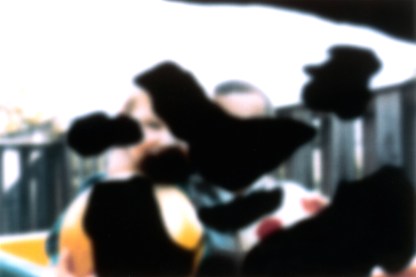
This is something like the world might appear to someone with diabetic retinopathy.

This is something like the world might appear to someone with diabetic retinopathy.

Those suffering from the disease may not experience any symptoms at first. However, as the disease progresses, patience experience a variety of symptoms including spots in the field of vision, varying blurred vision, and complete vision loss.

“With diabetes reaching epidemic levels across the US, Prevent Blindness urges everyone to get a dilated eye exam annually or as often as your eye health care professional recommends,” says Katie Neubert, the Dayton Area Manager of Prevent Blindness. “Eye care professionals can detect diabetes in its early stages, sometimes even before the patient has any idea.”

Diabetics are at risk of developing diabetic eye disease that can permanently damage their vision and even lead to blindness. Some factors can put some at higher risk for vision loss, include, age, ethnicity, duration of the disease, blood sugar control, hypertension, kidney disease and pregnancy.

“For those already diagnosed with diabetes, a doctor can help monitor vision and advise you of the necessary steps to take today to help lessen the impact that the disease may have on your sight,” Neubert says.

Prevent Blindness offers a variety of free resources dedicated to the education of diabetic eye disease including its dedicated website, preventblindness.org/diabetes. For more information contact Dayton Area Prevent Blindness by calling (937) 223-8766.

Prevent Blindness declares September as Sports Eye Safety Awareness Month

In Children and Family, Dayton Ohio News, Health, Sports News, Uncategorized on September 14, 2015 at 10:11 am

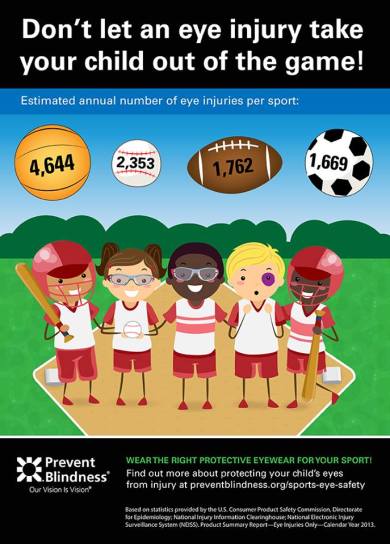
Dayton, OH – Prevent Blindness has declared September as Sports Eye Safety Awareness Month to encourage athletes to wear proper eye protection while playing sports. According to estimates by Prevent Blindness, the top five sports resulting in the most eye injuries were basketball, water and pool activities, use of air, gas, spring or BB guns, baseball/softball and football. In fact, in a single year, more than 6,000 Americans suffered an eye injury related to playing basketball.

Founded in 1908, Prevent Blindness is America’s leading volunteer eye health and safety organization dedicated to fighting blindness and saving sight. Serving the entire state, the Ohio Affiliate of Prevent Blindness provides direct services to more than 800,000 Ohioans annually and educates millions of consumers about how to protect and preserve the precious gift of sight.

The National Eye Institute reports that a sports-related eye injury is admitted to a U.S. emergency room every 13 minutes. Eye injuries from sports may include infection, corneal abrasions, blunt trauma, inflamed iris, fracture of the eye socket, swollen or detached retinas or a traumatic cataract. In the worst cases, some injuries may result in permanent vision loss. However, this kind of eye injury is 90-percent preventable.

sports googleKatie Neubert is the Dayton Area Manager for Prevent Blindness. “An injury can happen in a split second, but the effects of a series eye injury can have lasting negative effects for a lifetime,” she says. “That’s why Prevent Blindness encourages all athletes to always make sure that appropriate, properly fitting protective eye gear is part of their uniform.”

Parents, coaches, school staff and others can support children’s sports eye safety by following these tips.

Learn About The Risks – Parents, teachers, school nurses and coaches should learn about eye injury risks associated with sports before allowing children to participate. Enroll your child only in adult-supervised sporting activities through a school district, community center, etc., and try to discourage participation in high-risk sports, such as boxing, since adequate eye protection does not yet exist.

Always Use Protective Eyewear – Most sports-related eye injuries are preventable. Whatever the sport or the athlete’s age, appropriate protective eyewear is the first, best defense against eye injury. Also, be sure the child is seeing clearly by getting him or her an eye exam and request recommendations for protective eyewear before enrolling in any sports program.

Learn Warning Signs of Injury – Parents, teachers, school nurses and coaches should familiarize themselves with the warning signs of a serious eye injury and know when to seek treatment. Parents should also make it a point to meet with coaches or athletic trainers to ensure the proper procedures are in place to deal with a child’s eye injury should one occur.

To further support these efforts, Prevent Blindness is teaming up with Liberty Sport to provide eye care professionals with free information and materials through the “September is Sports Eye Injury Prevention Awareness Month” campaign. For more information please call Prevent Blindness locally at 937-223-8766 or visit preventblindness.org/sports-eye-safety.

Is this your new site? Log in to activate admin features and dismiss this message
Log In