Local News & Commentary Since 1890.

Archive for the ‘Politics’ Category

Media distorts facts in high profile cases

In Education, Health, history, National News, Opinion, Politics, Senior Lifestyle, sociology, Uncategorized on July 16, 2013 at 9:40 am

DIH LOGOUnless you’re one of those people who can outwit the trivia nerds on Jeopardy!, you probably don’t remember the name, Stella Liebeck. It’s a sure bet, though, that you more than likely remember hearing of a woman awarded millions after spilling hot McDonald’s coffee on herself while driving – except that’s not exactly what happened.

In 1992, 79-year-old Liebeck sued McDonald’s Corporation after being severely burned by coffee spilled in her lap. Her case drew national attention to the idea of “frivolous lawsuits,” igniting a firestorm of conservative push for swift and devastating tort reform.

For those of you who slept through high school civics class, a tort is a wrongful act or infringement of rights leading to a legal liability. In other words, if someone hurts you in some way and they may be liable for the injury (physical, emotional, financial, or otherwise), that’s called a tort.

Torts exist to help protect the public from the negligence of others, whether the fault of an individual or a business. Without them, no one would ever be held legally accountable for causing accidents and injuries. Like other well-meaning legislation, sometimes greedy people abuse the system – or attempt to – just out to make an easy buck. The majority of, what might be considered “frivolous,” lawsuits die out in the first hearings or are settled out of court to avoid public scrutiny.

With rampant distortion of the facts in the Liebeck case, it’s easy to understand why people really didn’t know what happened and just assumed she was looking for a big payday from a huge corporation. Sadly, the particulars were lost in the hype, turning this poor woman into a media joke, even inspiring a groin-scalding episode of “Seinfeld.”

At the time, the media’s fractured reporting stated Liebeck was herself negligent because she was driving at the time of the spill when, in fact, she was a passenger in a stationary vehicle at the time. It really would have made little difference anyway, since the coffee in question was estimated to have been around 180 degrees Fahrenheit. Medical experts suggest that any skin in contact with liquid of that temperature for more than a few seconds would experience severe burns of, at minimum, second degree and potentially surpassing third.

As it turned out, evidence in the case showed that the fast food giant’s franchisees were required to maintain coffee at a sitting temperature between 180 and 190 degrees Fahrenheit. The searing heat of the fast food giant’s coffee had resulted in hundreds of documented injuries. Liebeck’s burns were located on her inner and back thigh and were so severe as to require a series of major skin grafts over several months and caused agonizing pain.

HERE IS A LINK TO PHOTOS OF MRS. LIEBECK’s INJURIES – PLEASE NOTE, THEY ARE GRAPHIC IN NATURE. PARENTAL DISCRETION IS ADVISED.

Initially, the Liebeck’s family wrote a letter to McDonald’s merely asking they cover medical bills for her treatment but with no response, they were forced to take legal action. In the end, the jury found McDonald’s liable for the severity of the injuries due to temperature policy and frequency of documented injuries.

Punitive damages (additional monetary punishment to the wrong-doer) were awarded by the jury in the amount of $2.7 million. That figure was later reduced by the judge to $480,000, but Liebeck eventually settled with McDonald’s for an undisclosed amount.

Sensational news stories like the Liebeck case should always be taken a dose of skepticism because. The court of public opinion can be devastating to a case like this, and like so many more recent ones. No media outlet is fair or balanced and no one reports all the facts because reporters are not privy to everything. Guilt or innocence should be based on the decision of the jury, not the news media.

Is Big Brother watching too closely?

In National News, Opinion, Politics on June 19, 2013 at 2:06 pm

DIH LOGO

In his book, “1984,” author George Orwell noted, “If you want to keep a secret, you must also hide it from yourself.” Even though he published his most famous work in 1949, Orwell seems to have had a sixth sense about the future of government scrutiny.

Orwell’s dystopian society may seem too dark and ominous to be believable, but given the recent events surrounding the National Security Agency’s (NSA) surveillance operations, it may be more reality than fiction. As more information is revealed about these activities, congressional hearings are turning up little in the way of explanations by those in charge.

So why is it so offensive that the government would eaves drop on phone calls and emails to help prevent another 9-11 disaster? According to officials, hundreds of potential threats have been thwarted thanks to the tireless efforts of those who invade the privacy of law-abiding Americans. Unfortunately, since all of that information is classified, there is no evidence to show the public that corroborates their claim.

Civil liberties watchdog groups pounced on this story as soon as the information was leaked to the press. The question begs asking, however – under which rock were the leaders of these groups living where they didn’t think this was going on already? To the bigger point, who cares?

Modern society is full of surveillance cameras, listening devices and internet-based tracking systems, only a tiny fraction of which are used by government agencies. Most of them are operated privately to collect marketing or usage information or provide security. And people just accept it. It’s there, there’s nothing that can be done about it and just part of life in a technologically advancing society.

ringyIn the early 1900’s, “party lines” were the main method for which residential customers were provided with telephone service. Everyone on the same circuit would have to wait their turn to use the telephone and simply agree not to listen in on each other’s conversations. Of course, this was a source of great amusement in early radio and television comedy sketches. Today, it would be viewed as a huge invasion of privacy and thoroughly unacceptable.

Barreling through continually updated technology requires that people must adapt at a faster pace. Users of that technology should be aware that anything posted on the internet or passed through an electronic broadcast system (i.e.: cell phones, Wi-Fi, etc.) could be intercepted without their permission or knowledge. There’s no telling who is listening or reading any of it or what will become of that information.

If the NSA or other government agencies are tracking information, the assumption should be that there is something worth listening to. If they’re violating the law based on having no just cause for acting on that information then it’s probably best to let the courts iron it out, not congress. The last thing anyone wants is for the one group in America with the most detrimental secrets – and with the hardest time keeping them – to be in control of everyone else’s.

Whether there is legitimate cause for any branch of the U.S. government to spy on its own people is still debatable. As it is, President Obama now finds himself in defense of an administration whose platform for election included condemnation of the previous one for the same kinds of anti-privacy actions.

In a post-9/11 America, the Bush administration was constantly under fire for what liberals saw as a violation of privacy and infringement of civil liberties all in the name of national security. As it turns out, what’s good for the goose really does appear to be good for the gander. The truth is, Democrat or Republican, as long as terrorists threaten the free nations of the world there will always be some loss of personal privacy in the name of security.

In “1984,” Orwell presented a future devoid of personal freedoms and independent thought, not protected from terror but from free choice. America’s leaders have a choice – to be diligent or let history repeat itself in the name of popular opinion. In the meantime, the citizenry will have choices to make as well – in the next elections.

Gery L. Deer is an independent journalist and business writer from Jamestown, Ohio. More at the new website, http://www.deerinheadlines.com.

I pledge allegiance, on Flag Day

In Education, history, National News, Opinion, Politics, sociology on June 13, 2013 at 12:11 pm

DIH LOGO

“I pledge allegiance to the flag, of the United States of America and to the republic for which it stands, one nation, under God, indivisible, with liberty and justice for all.” This is how the Pledge of Allegiance is worded today. When it was originally penned in 1892, however, the author of the oath, socialist minister Francis Bellamy, included no references to America or God.

ros123Bellamy’s hope was that the pledge could be used by any citizen around the world to honor their own country’s flag. Later, it was adopted as a pledge to the American flag and the words, “under God,” were added in 1923.

To some Americans, there is no more powerful a symbol of liberty and freedom. To others, the flag is a symbol to be used in protest of government tyranny. Whatever the semiotics involved, the American flag has profound meaning around the world.

Legend has it that Betsy Ross, a Philadelphia seamstress who made flags for the navy, was commissioned by George Washington to create the first flag for the colonies. As charming a story as that may be, however, there is no verifiable information to support the tale.

What is known, historically, is that the first unofficial national flag, called the Grand Union Flag or the Continental Colours, was raised near George Washington’s headquarters outside Boston on January 1, 1776. It had 13 alternating red and white horizontal stripes and the complete British Union Flag in the canton (the upper corner, where the blue field and stars are located today). Another early flag included a rattlesnake and the motto “Don’t Tread on Me,” emblazoned on it; a design popular today with the conservative Tea Party movement.

The design of the Grand Union flag was altered about a year later to include the better known blue field in the canton with a circular pattern of stars representing each of the original 13 colonies. On June 14, 1777, the Second Continental Congress adopted this version as the flag of the United States. More than two centuries later, the date is still honored throughout the country as a holiday called, Flag Day.

Since its creation, the “Stars and Stripes” has been one of the single most recognized symbols in the world. Sadly, some people in America today believe that honoring the flag is no longer relevant, that it’s distasteful to fly or display the flag, or even offensive.

There is no question that our country is not perfect, and our leaders have made their share of mistakes. But the ideals of peace, justice and freedom are worth honoring, regardless of your political views, and that’s what Old Glory represents.

Today, children are no longer encouraged, sometimes even prohibited, to say the Pledge of Allegiance in school. The Pledge is seen by some as indoctrination to an ideology or worship of a false idol or some other such nonsense.

The truth is, indoctrination is everywhere and is usually voluntarily accepted without question. It’s in our social organizations, our schools, our businesses and especially in our political parties, churches, synagogues and mosques.

Each of these doctrines tend to divide us as a people, but getting behind a common symbol, the one that is intended to represent the best in us, the honor and sacrifice of those who came before, that is an indoctrination that can unite us in a way not found anywhere else on earth. It’s not forced, commanded or required – it’s our choice, each and every one of us.

Our flag has been burned, spat upon, dragged in the dirt, destroyed in battle, and shredded in conflict. It has withstood civil war, social unrest and political mudslinging. Far too many times, it has also covered the remains of those who died to defend it.

It may only be a red, white and blue piece of cloth, but it represents blood and sacrifice and signifies your right to find it distasteful, continuing to be a symbol of those rights whether or not you appreciate it. So happy Flag Day and may God (whoever your god happens to be) bless the United States of America.

Deer In Headlines is distributed by GLD Enterprises Commercial Writing. More information at http://www.gerydeer.com.

Don’t Panic. Really, we mean it this time.

In Books, Literature, Media, National News, Opinion, Politics, psychology, sociology on April 17, 2013 at 7:00 am

Deer In Headlines

By Gery L. Deer

dontpanicIn 1978, a radio comedy called The Hitchhiker’s Guide to the Galaxy, written by Douglas Adams, aired as a series on the BBC. Hitchhiker’s was a wholly remarkable radio show that eventually became a wholly remarkable television program, and a series of wholly remarkable – not to mention lucrative – novels, five in the so-called trilogy. A sixth novel was completed by a different author in 2009, eight years after Adams’ untimely death.

Commonly known by fans as, “HG2G,” Hitchhiker’s was essentially a parody of age-old science fiction with a satirical spin. The story line is filled with political satire and a pinch of sarcastic banter, the focus of which was the “establishment,” whatever that meant to the reader.

The story begins with one ordinary man’s adjustment to being transported from Earth only moments before it is destroyed to make way for a bypass for space ships. Suddenly thrust into a galaxy of crazy characters and a manically depressed robot named Marvin, human Arthur Dent is dumbstruck by his complete lack of ability to adapt.

Arthur’s friend Ford, an intergalactic researcher who rescued Arthur from his doomed world, finds his way through the galaxy hitchhiking and following the advice of an electronic book, whose cover is inscribed, in large, friendly letters, with the words, “Don’t Panic.” As the pair travels through the stars, Arthur finds little comfort in his new life except for the constant search for a nice hot cup of tea and the friendly inscription on the cover of his electronic guidebook.

A prolific writer and avid environmentalist, Douglas Adams may be single-handedly responsible for inventing the concept of the e-reader (which is essentially what the “Guide” was) nearly three decades before Amazon, the iPad or even the Internet ever existed. Adams also managed to show us the world more as it really it is than how we’d rather it be. I think that’s where, “Don’t Panic,” came from in the first place.

As Adams’ character, Arthur Dent found out, there are simply things we cannot control so the best thing to do is try to keep our heads and move through it. By a curious coincidence, as I watched the tragic events of terrorism unfold in Boston this week, I found myself thinking about the cover of Adams’ book and those large, friendly letters. “Don’t Panic” seemed like just the kind of thing you’d want someone to say to you at a moment like that.

I’ve never been in a situation like a terrorist bombing, but I have had my share of life and death scrapes over the years. From a head-on truck crash that should have certainly killed me to dealing with the painful helplessness of watching my mother whither away from Alzheimer’s disease, I have learned which things I should panic about and what I should try to just push through. And I don’t believe I’m alone in that practice, by any stretch of the imagination.

Given the circumstances, there is no level of security that could have prevented what happened in Boston. But when it did, people clearly pushed their fear and panic aside, stepped up and did their best to help each other through a horrible situation. Human beings are resilient, even though some might seem like they’re not. We’ve managed around 15 million years of evolution so there must be something to us, right?

I had the good fortune to meet Douglas Adams in 1992 when he came to Dayton for a book signing. Thanks to a fortuitous hiccup in the autograph line, I found myself standing in front of the author for several minutes. He was as gracious and humble, kindly asking how I liked his work.

As we chatted, I asked him what it meant – Don’t Panic. He said simply, “Whatever you need it to.” He also told me I should continue writing and not let the problems of the world interfere with my creativity and positive outlook. I’ve tried hard to do both. So the next time you’re faced with a tough situation just remember the Hitchhiker’s cover line: Don’t Panic. After all, what doesn’t kill you will make you stronger.

Gery L. Deer is an independent columnist and business writer based in Jamestown, Ohio. More at http://www.gerydeer.com

It’s time to end the Korean War.

In Education, National News, Opinion, Politics, sociology, State News, World News on April 1, 2013 at 3:21 pm

Deer In Headlines

By Gery L. Deer

North Korea's leader is a kid having a tantrum; a tantrum that needs to end in a spanking the the world's leaders.

North Korea’s leader is a kid having a tantrum; a tantrum that needs to end in a spanking the the world’s leaders. (Photo UK/Telegraph)

On June 12, 1987, while addressing people near the Berlin Wall, President Ronald Reagan said defiantly, “Mr. Gorbachev, tear down this wall.” Shortly thereafter, down it came, marking the collapse of communist Russia and the end of the Cold War. For the first time in nearly 40 years, back yard bomb shelters were being graded over and civil defense drills became a thing of the past.

Now, more than 25 years later, Americans are facing the real possibility of both conventional and nuclear attack from a power-happy “kid,” revitalizing fears that created the pointless duck-and-cover drills of the 1950’s and 60’s. Over the last several weeks, North Korean leader Kim Jong Un has made repeated threats about ending the sixty-year peace marked by the neutral zone of the 38th parallel and restarting the Korean War.

Though an armistice was signed in 1953, it did not officially end the Korean War, or what the U.S. Government laughingly termed a “police action.”  While America was involved in the conflict for only three years, North and South Korea are technically still at war. At the time, China and the Soviet Union supported the aggression of North Korean troops, but today, the political lines are less well defined.

With the dissolution of the Soviet Union and China’s economic, not to mention capitalistic, successes in the west, North Korea stands very much alone in its saber rattling. Any attempt to launch missiles or re-invade South Korea would most likely be met with resistance of a level that the young, blustering North Korean leader is clearly not taking into account.

Even so, North Korean officials have insisted the country is going ahead with the development of nuclear weapons and missile technology necessary to carry them to the continental United States, among other targets. As the U.S. military continues its show of strength over South Korea, well in view of the northern leaders, tensions are growing and Kim Jong Un has ordered rockets to be readied to strike.

Most experts agree the young communist leader cannot possibly believe he has any hope of prevailing in such an aggressive action. But, with so many American-allied territories within striking distance, the damage and loss of life could still be considerable if he carries out his threats. Perhaps now is the time for a decisive and joint action by China, Japan, Russia, South Korea and the protectorates of the United Nations, including America? It might be time to finally put an end to the Korean War.

Kim Jong Un has made it apparent he wants to start a war – with someone – and if America is his target, he’s doomed to lose such a conflict. He’s obviously suicidal and doesn’t seem to care who or how many he kills for his own ego boost.

One could argue that this maniac is really China’s problem. But, if that’s the case, why don’t they just shut him down now? They certainly have the manpower to do it and, for the first time in recent history, they’d have the support of Russia, South Korea and the other surrounding countries. With a little patience, on the other hand, the country could go bankrupt before military action is even necessary.

Kim Jong Un has spent North Korea’s money on high-end living and the development of a few mass-attack weapons and missiles, activities that will shortly bankrupt the country. Once that happens, he will either be overthrown or forced out by his opposition or the Chinese. Either way, his long-term outlook is not promising – bad for him, good for the rest of the world. It could be that the best thing to do is wait him out; match his threats with equal vehemence until he goes away.

Unfortunately, patience is expensive, costing the American taxpayer millions of dollars a day in military operations stepped up to meet potential hostility. Once again, it seems the best alternative is to assemble allies against him and shut him down before he can do something that costs the lives of millions.


Avoiding sequestration may depend on back room deals

In Business, Economy, Jobs, Media, National News, Opinion, Politics, State News, Uncategorized on March 8, 2013 at 9:38 am

DEER IN HEADLINES

By Gery L. Deer

Over the last several weeks, political bloggers and cable news talking heads have tormented their mush-brained followers with frightening tales of the pending budget sequestration. As the media spreads yet another horror story of fiscal disintegration, the real efforts to solve these problems probably won’t be broadcast by CSPAN or anyone else for that matter. Actually, it’s unlikely anyone will know how the deals were actually reached or by whom.

Washington seems to be consumed in a cloud of congestion caused and perpetuated by power-hungry narcissists who go relatively untouched by their own actions. More than $85 billion will be cut reaching virtually every part of government infrastructure from soup to nuts.

For those not schooled in political fiscal jargon, sequestration probably sounds less like an economic term and more like something a proctologist might diagnose. Instead the word refers to a series of pre-arranged and unilateral budget cuts to government agencies. The plan was laid out as part of the Budget Control Act of 2011which extended the government’s ability to borrow money.

Preventing the process from going forward is essential if the recent economic growth in the country is to continue. Despite exaggerated job growth numbers, the economy really is improving, albeit at a snail’s pace for those down in the real world. As the clock ticks down to the self-imposed fiscal doomsday, all sides profess that progress is being made but officials never sound too optimistic.

Somewhere in Washington, however, in some dark, smoke-filled room, lesser known but equally powerful political operatives are working the real deals that will settle the budget crisis. These quiet, back-room bargains are a mainstay of politics at every level of government and are often where the real work gets done.

Bob Greene is a noted Washington journalist, author and CNN contributing writer. In a recent CNN.com editorial, he mentions a South Michigan Avenue hotel in Chicago called the Blackstone. More than a century old, the Blackstone was where the political phrase “smoke-filled room” originated, referring to the back-room deals made by politicians to hammer out solutions to issues out of view of the public and the press.

Greene writes, “In 1920, Warren G. Harding was chosen as the Republican candidate for president by a group of leaders meeting there to hammer out a consensus, even as the official convention was in session in a different part of town. A wire-service reporter wrote that the choice had been worked out “in a smoke-filled room,” and it became part of the language.”

Put another way, there are two things no one wants to see made – sausages and laws. The fact is, for the most part, the public only sees what Washington wants exposed. Even though most government buildings are now smoke-free, there are still plenty of back room deals and, oddly, that’s probably how it should happen.

Sometimes legislators and their associates are charged to get the job done and keep the public out of it, that’s why there are elected representatives of the people. But for the last few years, very little of substance has been accomplished because of a Washington steeped in a self-induced state of perpetual crisis.

Millions of Americans will be affected by sequestration if a deal cannot be reached soon. Yet, a bitter irony surrounds the group of people who go unaffected by the cuts – congress and the president. While layoffs and furloughs create havoc for millions of families, Mr. Obama, Mr. Boehner and the rest of their Beltway buds sleep comfortably in luxury unwilling to give an inch of political ground.

Whatever they might say during election season, a more disconnected group of legislators never existed. Stocked with millionaires drawing six-figure salaries, federal leaders have no comprehension of how their actions affect their tax-paying benefactors.  The only thing left to do now is hope the smoke-filled room has an “occupied” sign on the door.


Has Kasich set his sights on the Oval Office?

In Business, Economy, Education, Jobs, Local News, Media, National News, Opinion, Politics, Senior Lifestyle, State News, Uncategorized on February 19, 2013 at 11:45 pm

Deer In Headlines

By Gery L. Deer

(AP Photo/Charlie Neibergall, File)

(AP Photo/Charlie Neibergall, File)

I am by no means one of the top political minds in the State of Ohio – far from it, in fact – nor do I hold any connections that would give me insight into what might be going on in the governor’s office right now. But, it seems to me (nod to fellow columnist Bill Taylor) that John Kasich has his eye on another chief executive office – the one with the oval-shaped room.

While most commentators are crediting the activity to Kasich’s bid for re-election, given the level of his high-handed agenda over the last two months, it is my belief that the governor is planning a run for the 2016 Republican presidential nomination, or at least the vice-president’s spot on the ticket. A quick review of the governor’s public agenda clearly shows a noted increase in the number of high-profile policy and legislative initiatives, particularly in recent months.

It certainly seems as if he is doing just what a politician should do when he wants to win over both sides for a broader appeal. He’s riding the fence, trying to appease liberals as well as conservatives with nationally controversial legislative changes such as an increase in the minimum wage passed in December, but largely unpopular with republicans. Dangerous, since he is still vulnerable even in a re-bid for his job, but it’s a give and take.

According to political columnist, Chris Cillizz, a September Washington Post poll showed that the republican governor held a 50-percent approval rating. In December, a Quinnipiac University poll gave him a 42 percent overall job approval, with 35 percent disapproving, his highest marks in that poll since inauguration.

He is more popular than ever, possibly more so than his democratic predecessor, Ted Strickland. But, in the last half of his term, he is upping the ante to prove he can lead in tough times and get things done to improve Ohio’s economy even as Washington remains stymied.

Kasich still has a long way to go with a great many negatives on his desk, among them lackluster job numbers, which are currently below the national average. He also has some outspoken opposition to his “rough” demeanor.

In a recent Dayton Daily News report, Montgomery County Republican Party Chairman Rob Scott, a Kasich supporter, admitted that the governor sometimes has a harsh approach.

“I think what Gov. Kasich has brought to Ohio is that he’s up front and honest: this is what we need to do and this is how we get there,” Scott said. “And he may run over a couple people, but sometimes to get things done, and to do what’s right, you’ve got to do that.”

If there is a possibility that Kasich is looking towards 1600 Pennsylvania Avenue, then the question is, does he have what it takes first to get the attention of a splintered GOP and second, to win over the disheartened voters from both sides of the aisle? At the moment the only conservative frontrunner for the presidential nomination is former vice-presidential candidate Paul Ryan. Once an unknown, Ryan had the national stage, often upstaging his running mate with his more down-to-earth demeanor and likeability among the younger voters.

Kasich is getting national attention for his aggressive policies and growing poll numbers, but he’s still not well known outside Ohio and far too conservative even for moderate democrats. But, he might at least get credit for adding some new Ohio jobs in the near future, beginning with Ford’s pending announcement about a new engine plant to be located near Cleveland. The $200 million upgrade will add about 450 jobs to a plant which currently employs approximately 1,300 hourly and salaried workers.

This announcement comes on the heels of Kasich’s State of the State address in which he outlined even bolder plans to achieve his vision for the state. It remains to be seen if he can get legislators to go along with radical changes in taxes and school funding. If he manages to do half of what he’s set out to, he might just have a shot at the big chair in the Oval Office sooner than later.

Hitler didn’t disarm the German people, the Allies did

In Business, Education, Local News, Media, National News, Opinion, Politics, Religion, sociology, State News, Uncategorized on February 5, 2013 at 12:45 pm

Deer In Headlines

By Gery L. Deer

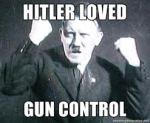
This picture couldn't be more inaccurate. Hitler was a strong advocate of gun deregulation.

This picture couldn’t be more inaccurate. Hitler was a strong advocate of gun deregulation.

It’s an unfortunate fact that many high-profile politicians only speak out about issues like gun control when devastating events like mass shootings hit the headlines. Suddenly, people shift to one side of the debate or the other; with conservative Republicans typically taking the defensive, pro-gun position.

Unfortunately, most of this issue is argued, not from factual evidence or statistics, but from the standpoint of emotion, religious dogma and political position. If that isn’t enough, conservative extremists hoping to insight fear seem to always cite Hitler’s Nazi Germany as an example of what could happen to America if guns are taken away. Sadly, people rarely do any research before they start spewing nonsense like this; again, why let facts get in the way of a good scare tactic?

In fact, Adolf  Hitler did have a gun control policy, one that many on both sides of the debate say looked a lot like that proposed by California Senator Dianne Feinstein. But Hitler’s policy was an addition to gun control acts set up by the Allied powers after World War I to prevent Germany from regaining a military presence.

Quoting Cris Miles, editor of PolyMic.com, “The German (gun control) regulation was in response to the Treaty of Versailles and the Weimar government passed the legislation (not the Nazis).” Article 169 of the Treaty of Versailles stated, “Within two months from the coming into force of the present Treaty, German arms, munitions, and war material, including anti-aircraft material, existing in Germany in excess of the quantities allowed, must be surrendered to the Governments of the Principal Allied and Associated Powers to be destroyed or rendered useless.

As Mr. Miles points out in his own article on the subject, the wording of this policy must sound like the nightmare of every pro-gun activist in the country. So far, there is no national legislation being proposed promoting confiscation of personal firearms. Keep in mind that the German regulations were put into effect nearly a decade and a half before Hitler’s Fascist party took control of the country in 1933. In a strange twist of irony, pro-gun advocates might be surprised to learn that they had something in common with the vile German dictator.

As it turns out, Hitler was a strong supporter of gun deregulation. In 1928, German citizens were granted the right to carry a firearm (applying only to handguns at that point) with a permit but where ownership was restricted to, “Persons whose trustworthiness is not in question and who can show a need for a (gun) permit.” (That had to be interesting to enforce before the days of the Internet).

The 1938 German Weapons Act effectively removed most other barriers to gun ownership, deregulating the acquisition of rifles, shotguns and ammunition. It also lowered the gun ownership age to 18 and forbid Jews from manufacturing or selling firearms. It wasn’t until the Nazi surrender after World War II in 1945 that the country was once again disarmed.

So, in effect, it was the United States and the Allies that disarmed Germany each time, not the Nazis. In 1956, German citizens were once again allowed to own firearms, but gun laws in that country are far more restrictive than those in America. The point is that America’s leaders are not trying to circumvent the Constitution but are desperately faced with the seemingly insurmountable problem of rampant gun violence against innocents.

Comparing President Obama, or any other U.S. leader, to one of the most notorious mass murderers in the history of the world is, to put it mildly, disrespectful and unpatriotic. Such statements only further demonstrate the ignorance of a few gun-obsessed people trying to make a point from an uneducated, feeble position.

Any fruitful debate on gun control must originate from facts and effective solutions will have to include some better method to keep deadly weapons from the hands of career criminals and the mentally ill. The idea that weak arguments can be made stronger simply by citing events from Nazi Germany is foolish, to say the least, and just weakens the position of the debater, particularly when the history being quoted is so inaccurate.

Harry S. Truman, the Accidental President

In Education, Media, National News, Opinion, Politics, Uncategorized on January 29, 2013 at 10:03 am

Deer In Headlines

By Gery L. Deer

Probably the most famous photo of Truman. (Photo by W. Eugene Smith//Time Life Pictures/Getty Images)

Probably the most famous photo of Truman. (Photo by W. Eugene Smith//Time Life Pictures/Getty Images)

I’ve always been interested in politics and, given how public I am in some ways it’s not unexpected to have people come up to me and ask why I don’t run for some public office. Given my work and family commitments, I don’t really see that as a viable option. If I did run, though, I know where my inspiration would come from.

While everyone else is quoting Lincoln and idolizing Thomas Jefferson, I would probably try my hardest to emulate Harry Truman. My generation probably doesn’t know much about our 33rd president. I know I didn’t until I watched a documentary about him recently. Then I did some research of my own.

Truman is featured in many pages of America’s history book but is most noted as the man who made the final decision to drop the atomic bombs on Japan, forcing their surrender to end World War II. Upon the death of President Franklin Roosevelt, Truman was sworn in on April 12, 1945, but the presidency was a job he never had any ambition to hold.

Harry was a man of short stature (5-foot, 8-inches in height) but big accomplishments. He didn’t even enter politics until he was 33 years old and, by that time, he had, in his own words, “failed at everything he tried.” As a young boy, he dreamed of becoming a concert pianist, practicing for hours on end. His mother was a college graduate, a music teacher who, to some, probably seemed a bit over protective of her small, bespectacled son.

Socially awkward, young Harry rarely roughhoused or played sports like the other boys his age and he was thoroughly terrified of girls. That is, until he summoned up the courage to talk to Elizabeth “Bess” Wallace, a girl he’d virtually grown up with and finally married many years later after numerous rejections to his courting.

His father held many jobs, finally tending his mother-in-law’s farm before being severely injured and incapacitated. Harry was forced to leave his job as a bank clerk and forget his dream of college to work the farm and help pay off the family’s mounting debt. Later, he joined the army during World War I, where he became an officer. After the war, he and an army buddy opened a haberdashery which later went bankrupt. But, as usual, Truman didn’t give up.

Shortly afterwards, Truman ran for the office of district judge, essentially a county commissioner, in Jackson County, Missouri. Though he weathered his share of scandal in the corrupt, good-old-boy system of Kansas City, his straight-forward honesty and no-nonsense demeanor seemed to resonate and he eventually won a seat for the Democratic Party in the U.S. Senate in 1934. His rise to the second-highest seat in the government came almost by accident and with great trepidation by many in the party.

When Roosevelt died, it was immediately apparent that Truman’s White House would be run quite differently. His “regular guy” persona was in stark contrast and a welcome change from FDR’s upper-class style. His impoverished upbringing probably had something to do with his detest of wasteful spending and Truman became known as the chief of all budget hawks. At one point, he even had the entire White House gutted and refurbished to protect it from further deterioration while also saving public money on excessive repair.

In the end, however, the simple clerk from Independence, Missouri proved to be much more than the accidental president. He had managed to create foreign policies that are still the basis of modern diplomacy, he was one of the first presidents to work towards equality in the workplace for African Americans and he helped restructure the country’s economy after World War II.

I could go on and on about this man, but you should look him up on your own. Harry S. Truman’s is a story of great struggle, fortitude and achievement from a man who many considered a lifetime failure with no focus or ambition. With today’s staggering level of corruption and waste in government, America certainly could use another, “Give ‘Em Hell Harry.”


Equal citizenry under the 14th Amendment

In Economy, Education, Opinion, Politics, psychology, Religion, sociology, Uncategorized on January 22, 2013 at 7:04 pm

14thAmDeer In Headlines

By Gery L. Deer

With a single sentence early in the text of the Declaration of Independence, Thomas Jefferson established the concept of human equality in a fledgling country. “We hold these truths to be self-evident,” Jefferson famously penned, “that all men are created equal, that they are endowed by their Creator with certain unalienable Rights, that among these are Life, Liberty and the pursuit of Happiness.”

Ironically, many of the men who signed the final version of the document were slave owners, with no acknowledgement of the hypocrisy they were about to go to war to protect. It took more than a century after John Hancock applied his prominent penmanship to the parchment to bring about a law that would provide the basis for the ultimate guarantee of a free and equal society.  But it didn’t exactly work out that way.

Passed on July 9, 1868, the 14th Amendment of the U.S. Constitution, in theory, sets equal status for each citizen. The wording clearly recognizes “citizens” as having either been born within the country or naturalized and goes on to grant equal privileges to each with no specifically stated restrictions based on gender, ethnicity, economic status, sexual preference or anything else.

At the time it was written, America was still experiencing shell shock following the Civil War, and it would be some time before full enforcement of the 14th would be widespread. Early on, even the government seemed to be choosing to ignore its own laws wherever it pleased to do so. A large part of the virtual annihilation of the Native American populations within the United States took place after the 14th was passed.

This legislation should have immediately equalized anyone born in the country, regardless of gender or race. But this was rarely the case. Some whites, particularly in the south, rejected the concept of overall equality. Racism and general prejudice ran high throughout the region, becoming violent on far too many occasions.

For those situations not expressly dealt with under the 14th, supplemental legislation has had to be passed to address those issues. But some people are offended that any subsequent legislation is required to enforce those “unalienable rights” already granted by the Constitution.  In their eyes, doing so only serves to solidify the idea that anyone other than the able-bodied, white male was somehow inferior and now needed ‘special’ legal considerations.

Sublime in their fortitude and thirst for liberty, America’s Founding Fathers are quoted by academics, politicians, world figureheads and even religious leaders. But in many ways that honorarium is less deserved because of staggering moral shortsightedness by not extending basic civil rights to everyone. Such a simple act in the beginning may have upended the economy of the new country, but it might also have helped preempt two hundred years of prejudice, war and bloodshed.

In the end, all rights are ‘civil,’ established and enforced by duly elected representatives of the people. Even with the country so divided over these issues, the government still has a chance to enforce the original purpose of the 14th Amendment.

People are always going to be frightened of change. But the opportunity remains to squelch old prejudice and make sure that all men, all citizens, are equal under the law no matter the color of their skin, to which god they pray, or whom they choose to marry.

It may be that no more laws need to be created. Each citizen is already endowed with the rights of life, liberty and the pursuit of happiness; not as much by their creator, as the 14th Amendment of the Constitution of the United States of America. If it really is the Supreme Law of the Land, it needs to be applied that way. If it doesn’t happen soon, Jefferson’s goal of an equal citizenry will never be much more than a pipe dream.

Is this your new site? Log in to activate admin features and dismiss this message
Log In