Local News & Commentary Since 1890.

Archive for the ‘National News’ Category

Daredevil Performances: Is the spectacle worth the risk?

In Education, Entertainment, history, Local News, Media, National News, Opinion, sociology, Technology, television, Theatre, Uncategorized, World News on June 25, 2013 at 6:27 pm

DIH LOGODanger as a spectacle has long been a past time of human culture. Death-defying stunts have graced stages of theatres and circus tents for centuries. Never has there been a more awe-inspiring sight, however, than the dramatic aerobatics of stunt pilots and wing walkers. On Saturday, June 22nd, wing walker Jane Wicker and her pilot Charlie Schwenker died in a fiery crash during a performance at the Dayton Vectren Air Show in Vandalia, Ohio.

Wicker, who had been involved with aerobatics for more than a quarter-century, was sitting on the wing of the inverted plane as it dove, nose-first, into the ground and exploded. The aftermath of the crash left a burning wreck, two people dead and hundreds of spectators horrified.

News of the accident quickly spread around the country, landing on the lead story of every print, broadcast and online media outlet from the New York Daily News to the Huffington Post. Preliminary investigations of the cause of the crash from the Federal Aviation Administration and the National Transportation Safety Board are as yet inconclusive.

The very next day, high wire performer Nik Wallenda spent his evening engaged in a heart-stopping, quarter-mile tightrope walk across a 1,500 foot deep section of the Grand Canyon. As a record number of viewers tuned in to the Discovery Channel to watch, they were treated to more than a half hour of listening to Wallenda continually pray or thank God and praising Jesus with nearly every successful step. One might wonder if they would think he’s crazy too.
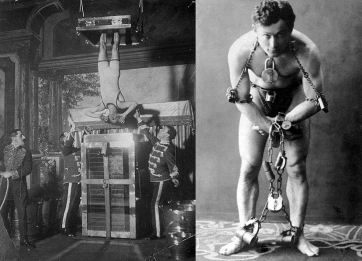
Harry Houdini

Harry Houdini

From escape artist Harry Houdini to motorcycle stunt rider Robert “Evil” Knievel, daredevils have long attracted crowds of spectators and generated millions upon millions of dollars for their promoters over the years. While Houdini eventually died of a ruptured appendix, he was nearly killed several times by his own hand as a result of escape attempts gone wrong. Many of his compatriots, like Wicker, were not so lucky; which begs the question, is the spectacle worth the risk? Apparently it is because the public keeps going to see them, like sadistic voyeurs almost hoping to see something go horribly wrong.

Local government, concerned about the staggering level of liability involved, does everything it can to discourage people from attempting these kinds of stunts by requiring miles of paperwork and expensive permits before allowing these kinds of activities on public lands. Some simply don’t allow it to happen at all.

Wallenda’s high wire walk, for example, didn’t actually cross over the Grand Canyon, but the gorge of the Little Colorado River Navajo Tribal Park. His 1,400 foot steel cable was actually suspended over land of the Navajo Nation, near Cameron, Arizona.

Could these daredevils have what Freud called a “death wish,” a desire, often deeply repressed, for self-destruction, accompanied by feelings of depression, hopelessness, and self-reproach? That might be said of Houdini, given his almost obsessive interest in death and the afterlife. But for most everyone else in this line of work, it’s about attention and a desire to push the envelope – that need for the adrenaline rush associated with doing what no one else is brave enough to do (or stupid enough, depending on your point of view).

In the end, there would be no market for these kinds of acts if the public wasn’t thoroughly fascinated by them. As for the performers themselves, it’s probably best to take into account Jane Wicker’s own words.

“Why do I do this? There is nothing that feels more exhilarating or freer to me than the wind and sky rushing by me as the earth rolls around my head,” Wicker once wrote. The day before the crash she told WDTN TV2, “I’m never nervous or scared because I know if I do everything as I usually do everything’s going to be fine.”

For those left behind, there is a great sense of loss when these daring entertainers pass doing what they love. But they will be remembered for their spirit and the smiles on the face of those who sat in awe of their skill and passion to defy the very fabric of nature.

Gery L. Deer is an independent columnist and business writer based in Jamestown, Ohio. More at http://www.deerinheadlines.com.


Is Big Brother watching too closely?

In National News, Opinion, Politics on June 19, 2013 at 2:06 pm

DIH LOGO

In his book, “1984,” author George Orwell noted, “If you want to keep a secret, you must also hide it from yourself.” Even though he published his most famous work in 1949, Orwell seems to have had a sixth sense about the future of government scrutiny.

Orwell’s dystopian society may seem too dark and ominous to be believable, but given the recent events surrounding the National Security Agency’s (NSA) surveillance operations, it may be more reality than fiction. As more information is revealed about these activities, congressional hearings are turning up little in the way of explanations by those in charge.

So why is it so offensive that the government would eaves drop on phone calls and emails to help prevent another 9-11 disaster? According to officials, hundreds of potential threats have been thwarted thanks to the tireless efforts of those who invade the privacy of law-abiding Americans. Unfortunately, since all of that information is classified, there is no evidence to show the public that corroborates their claim.

Civil liberties watchdog groups pounced on this story as soon as the information was leaked to the press. The question begs asking, however – under which rock were the leaders of these groups living where they didn’t think this was going on already? To the bigger point, who cares?

Modern society is full of surveillance cameras, listening devices and internet-based tracking systems, only a tiny fraction of which are used by government agencies. Most of them are operated privately to collect marketing or usage information or provide security. And people just accept it. It’s there, there’s nothing that can be done about it and just part of life in a technologically advancing society.

ringyIn the early 1900’s, “party lines” were the main method for which residential customers were provided with telephone service. Everyone on the same circuit would have to wait their turn to use the telephone and simply agree not to listen in on each other’s conversations. Of course, this was a source of great amusement in early radio and television comedy sketches. Today, it would be viewed as a huge invasion of privacy and thoroughly unacceptable.

Barreling through continually updated technology requires that people must adapt at a faster pace. Users of that technology should be aware that anything posted on the internet or passed through an electronic broadcast system (i.e.: cell phones, Wi-Fi, etc.) could be intercepted without their permission or knowledge. There’s no telling who is listening or reading any of it or what will become of that information.

If the NSA or other government agencies are tracking information, the assumption should be that there is something worth listening to. If they’re violating the law based on having no just cause for acting on that information then it’s probably best to let the courts iron it out, not congress. The last thing anyone wants is for the one group in America with the most detrimental secrets – and with the hardest time keeping them – to be in control of everyone else’s.

Whether there is legitimate cause for any branch of the U.S. government to spy on its own people is still debatable. As it is, President Obama now finds himself in defense of an administration whose platform for election included condemnation of the previous one for the same kinds of anti-privacy actions.

In a post-9/11 America, the Bush administration was constantly under fire for what liberals saw as a violation of privacy and infringement of civil liberties all in the name of national security. As it turns out, what’s good for the goose really does appear to be good for the gander. The truth is, Democrat or Republican, as long as terrorists threaten the free nations of the world there will always be some loss of personal privacy in the name of security.

In “1984,” Orwell presented a future devoid of personal freedoms and independent thought, not protected from terror but from free choice. America’s leaders have a choice – to be diligent or let history repeat itself in the name of popular opinion. In the meantime, the citizenry will have choices to make as well – in the next elections.

Gery L. Deer is an independent journalist and business writer from Jamestown, Ohio. More at the new website, http://www.deerinheadlines.com.

I pledge allegiance, on Flag Day

In Education, history, National News, Opinion, Politics, sociology on June 13, 2013 at 12:11 pm

DIH LOGO

“I pledge allegiance to the flag, of the United States of America and to the republic for which it stands, one nation, under God, indivisible, with liberty and justice for all.” This is how the Pledge of Allegiance is worded today. When it was originally penned in 1892, however, the author of the oath, socialist minister Francis Bellamy, included no references to America or God.

ros123Bellamy’s hope was that the pledge could be used by any citizen around the world to honor their own country’s flag. Later, it was adopted as a pledge to the American flag and the words, “under God,” were added in 1923.

To some Americans, there is no more powerful a symbol of liberty and freedom. To others, the flag is a symbol to be used in protest of government tyranny. Whatever the semiotics involved, the American flag has profound meaning around the world.

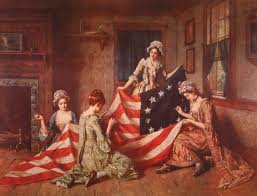
Legend has it that Betsy Ross, a Philadelphia seamstress who made flags for the navy, was commissioned by George Washington to create the first flag for the colonies. As charming a story as that may be, however, there is no verifiable information to support the tale.

What is known, historically, is that the first unofficial national flag, called the Grand Union Flag or the Continental Colours, was raised near George Washington’s headquarters outside Boston on January 1, 1776. It had 13 alternating red and white horizontal stripes and the complete British Union Flag in the canton (the upper corner, where the blue field and stars are located today). Another early flag included a rattlesnake and the motto “Don’t Tread on Me,” emblazoned on it; a design popular today with the conservative Tea Party movement.

The design of the Grand Union flag was altered about a year later to include the better known blue field in the canton with a circular pattern of stars representing each of the original 13 colonies. On June 14, 1777, the Second Continental Congress adopted this version as the flag of the United States. More than two centuries later, the date is still honored throughout the country as a holiday called, Flag Day.

Since its creation, the “Stars and Stripes” has been one of the single most recognized symbols in the world. Sadly, some people in America today believe that honoring the flag is no longer relevant, that it’s distasteful to fly or display the flag, or even offensive.

There is no question that our country is not perfect, and our leaders have made their share of mistakes. But the ideals of peace, justice and freedom are worth honoring, regardless of your political views, and that’s what Old Glory represents.

Today, children are no longer encouraged, sometimes even prohibited, to say the Pledge of Allegiance in school. The Pledge is seen by some as indoctrination to an ideology or worship of a false idol or some other such nonsense.

The truth is, indoctrination is everywhere and is usually voluntarily accepted without question. It’s in our social organizations, our schools, our businesses and especially in our political parties, churches, synagogues and mosques.

Each of these doctrines tend to divide us as a people, but getting behind a common symbol, the one that is intended to represent the best in us, the honor and sacrifice of those who came before, that is an indoctrination that can unite us in a way not found anywhere else on earth. It’s not forced, commanded or required – it’s our choice, each and every one of us.

Our flag has been burned, spat upon, dragged in the dirt, destroyed in battle, and shredded in conflict. It has withstood civil war, social unrest and political mudslinging. Far too many times, it has also covered the remains of those who died to defend it.

It may only be a red, white and blue piece of cloth, but it represents blood and sacrifice and signifies your right to find it distasteful, continuing to be a symbol of those rights whether or not you appreciate it. So happy Flag Day and may God (whoever your god happens to be) bless the United States of America.

Deer In Headlines is distributed by GLD Enterprises Commercial Writing. More information at http://www.gerydeer.com.

Science and the public benefit from storm chasers

In Education, Local News, Media, National News, Opinion, Science, Technology, Uncategorized on June 3, 2013 at 10:52 pm

Deer In Headlines

By Gery L. Deer

WHIO-TV's weather radar as it appeared on April 3, 1974 approximately 4:20PM as the Xenia Tornado touched down. Notice the "hook" echo indicating the twister.

WHIO-TV’s weather radar as it appeared on April 3, 1974 approximately 4:20PM as the Xenia Tornado touched down. Notice the “hook” echo indicating the twister.

In the 48 hour period between April 3rd and 4th, 1974, the Midwestern United States experienced one of the most devastating tornado outbreaks in history. Known as a “super outbreak,” 148 confirmed tornadoes touched down from Michigan to Alabama and Illinois to West Virginia, with 30 of them in the F4-F5 categories and resulting in the deaths of 300.

One of the most devastated towns was Xenia, Ohio, where a massive F5 funnel tore through the city leaving a mile-wide path of destruction, killing 33 and injuring more than 1,100. The low death toll is attributed to advanced warning provided by WHIO-TV weatherman, Gil Whitney using the first local weather radar system in the Dayton area.

Satellite, GPS and advanced warning networks, along with modern Doppler radar have all helped increase early warnings for tornado victims from less than 3 minutes to more than 15 minutes. Much advancement in severe weather detection might never have happened, however, without the work of the brave men and women who call themselves, storm chasers.

Storm chasers are serious scientists working to increase our knowledge of tornadoes and how they behave. Unlike those depicted in the 1996 movie, “Twister,” however, chasers experience little glory instead spending days and weeks in preparation that may result only in a few moments of tornado spotting.

As you might expect, purposely trying to outmaneuver the proverbial “finger of God” carries with it some inherent danger. Unfortunately, that danger can turn deadly at any moment.

On May 31st, revered storm chaser Tim Samaras, 55; his son, Paul, 24; and meteorologist Carl Young, 45, were killed near El Reno, Oklahoma as they tried to document one of several tornadoes moving through the area. Since their deaths, many have asked, “Is the data gathered from storm chasing worth the risk?” In my opinion, yes, it is.

I’ve always been fascinated by tornadoes. The day after the Xenia tornado of ’74, my parents took me along as they assisted with the cleanup efforts by using our grain trucks to help haul away debris. I never forgot what I saw there. Nor will I ever forget the darkened, green sky and the strange, coldness of the air as the monster storm was passing through. It marked my psyche for years to come.

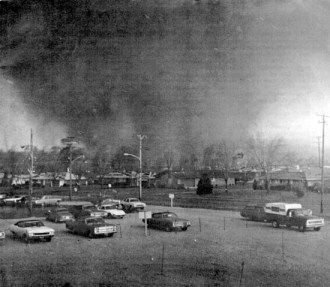
Possibly the most famous photo of the Xenia Ohio 1974 Tornado. Taken from Greene Memorial Hospital by Fred Stewart.

Possibly the most famous photo of the Xenia Ohio 1974 Tornado. Taken from Greene Memorial Hospital by Fred Stewart.

The experience left me nearly terrified of storms, until one day in 1988, when I was alone at our family farm and stepped outside after hearing tree branches break during a storm. I stood on our front porch, paralyzed, as I watched a small funnel cloud worm its way across the pasture in front of me, parallel to our house.

My ears popped as I stood motionless, surrounded by completely still air except for the slim tube descending from the sky into a swirling mass of dust. With almost no sound at all, it smashed the wooden sideboards of one of our old trucks, crossed the field about a half mile away and totally demolished a neighbor’s barn.

As quickly as it came, it was gone. That day, my fear gave way to a new respect for one of nature’s most dangerous, ephemeral phenomena. Since then, I’ve been within eye-shot of two more tornadoes and educated myself about them as best I could without taking to the road as a chaser.

But, I have the utmost respect – not to mention appreciation – for those who have. While there are probably some storm chasers who are just thrill-seekers, I have no doubt that most are in it for the science and the potential benefit that comes from the effort.

Early warning systems now broadcast through TV, Internet and cell phones, and most air raid sirens have been re-purposed for use as tornado warning systems. Everyone in and around Tornado Alley should remain diligent when severe weather approaches and heed warnings when they are issued.

It’s doubtful we’ll ever be able to fully predict when and where a tornado will strike but, thanks to the work done by storm chasers, scientists can give people a fighting chance to be better prepared.


Gery L. Deer is an independent columnist and business writer based in Jamestown, Ohio. More at http://www.gerydeer.com.

Money cannot buy eternal salvation

In Charities, Media, National News, Opinion, psychology, Religion, television, Uncategorized on April 30, 2013 at 10:55 am

EVANGDeer In Headlines

By Gery L. Deer

Have you ever turned on the TV early on a weekend morning and heard something like this, “Friends, dig deep for those green rockets of salvation. Help us to lead the sheep to His lovin’ care with your kind love offering. Operators are standing by to pray with you – all for just $49.99.” A cross between an infomercial and a bad Saturday Night Live parody, television evangelists have been conning millions from the pockets of the devout since the medium was invented.

These clergy-covered con men (and women) take the stage amidst gold-plated, throne-like chairs, religious statuary and acrylic podiums to convince us all that we’re damned to the fiery pits of Hell unless we give and give generously. Armani-suited, well-quaffed, jewel-bedazzled TV preachers spout dramatic sermons from a teleprompter while holding up a Bible as if it were the newly presented cub in the Lion King movie.

If that’s not enough drama, it’s is followed by repeated moments of squint-eyed, hand-raised prayer and Lord praising before thousands of onlookers in the audience who are doing the same. Without opening their eyes, the host preacher prays that God will direct the viewers to the telephone number that appears at the bottom of the screen and give generously to the ministry so that more souls can be saved.

At home, viewers dial quickly, handing over millions upon millions of dollars to what could easily be compared to a guy begging on a highway exit ramp. The difference is that at least you know the panhandler is exactly that. He’s not pretending to give you a direct phone line to eternal salvation at the same time.

Holier-than-thou in their demeanor and testimony, eventually they fall from their pedestals in some kind of sex scandal or tax evasion allegations. I’m sure everyone remembers the rise and fall of Jim and Tammy Baker, Oral Roberts and Jimmy Swaggart.

Religious panhandling – might as well call it by name – is a real problem in America and, unfortunately, it’s completely legal and largely tax-exempt. For the truly devout, there is a clear understanding that man is meant to be humble and kneel before God. That doesn’t mean we were meant to live in abject poverty, but we’re not supposed to use the Almighty as a way to dupe billions of dollars out of unsuspecting people searching for answers in a life full of uncertainty and hardship.

With multi-million-dollar homes, limousines and servants, there is nothing holy about these so-called “evangelists.” In fact, in my opinion, it’s just flat out criminal. These people soil the image and intentions of faithful, honest people all over the country who are genuinely trying to do some good in the world. Most live modestly, often with a second job or from a share of whatever comes in the offering on Sunday morning. There are no limousines, golden thrones or evangelical stadiums.

There is nothing to excuse the fact that some of the poorest people in America, the elderly, are the most common victims to this kind of nonsense. Looking for spiritual leadership and often lonely and shut-in, seniors often send money to these TV charlatans before even paying for food and medicine.

Of course, these religious phonies don’t care who they hurt because they can hide out in tax-sheltered mansions, go for a dip in their Olympic-sized swimming pools or jet off to vacation homes in the Cayman Islands.

Not convinced? According to CelebrityNetWorth.Com, one of the most popular TV evangelists, Benny Hinn, is worth more than $42 million; all from donations to his “ministry.” Another extremely popular – and rich – television pastor, Joel Osteen, is reportedly roughing it on only $40 million. And more money is still pouring in.

I don’t have a problem with people living prosperously and giving generously from hard work and the success built from that labor. I am deeply offended, however, when those claiming to be men and women of God live in luxury at the expense and from the charity of lost souls desperately searching for comfort. It would do them well to go read that book they’re always waiving around on TV; particularly the book of Matthew, Chapter 19, Verse 24.


Don’t Panic. Really, we mean it this time.

In Books, Literature, Media, National News, Opinion, Politics, psychology, sociology on April 17, 2013 at 7:00 am

Deer In Headlines

By Gery L. Deer

dontpanicIn 1978, a radio comedy called The Hitchhiker’s Guide to the Galaxy, written by Douglas Adams, aired as a series on the BBC. Hitchhiker’s was a wholly remarkable radio show that eventually became a wholly remarkable television program, and a series of wholly remarkable – not to mention lucrative – novels, five in the so-called trilogy. A sixth novel was completed by a different author in 2009, eight years after Adams’ untimely death.

Commonly known by fans as, “HG2G,” Hitchhiker’s was essentially a parody of age-old science fiction with a satirical spin. The story line is filled with political satire and a pinch of sarcastic banter, the focus of which was the “establishment,” whatever that meant to the reader.

The story begins with one ordinary man’s adjustment to being transported from Earth only moments before it is destroyed to make way for a bypass for space ships. Suddenly thrust into a galaxy of crazy characters and a manically depressed robot named Marvin, human Arthur Dent is dumbstruck by his complete lack of ability to adapt.

Arthur’s friend Ford, an intergalactic researcher who rescued Arthur from his doomed world, finds his way through the galaxy hitchhiking and following the advice of an electronic book, whose cover is inscribed, in large, friendly letters, with the words, “Don’t Panic.” As the pair travels through the stars, Arthur finds little comfort in his new life except for the constant search for a nice hot cup of tea and the friendly inscription on the cover of his electronic guidebook.

A prolific writer and avid environmentalist, Douglas Adams may be single-handedly responsible for inventing the concept of the e-reader (which is essentially what the “Guide” was) nearly three decades before Amazon, the iPad or even the Internet ever existed. Adams also managed to show us the world more as it really it is than how we’d rather it be. I think that’s where, “Don’t Panic,” came from in the first place.

As Adams’ character, Arthur Dent found out, there are simply things we cannot control so the best thing to do is try to keep our heads and move through it. By a curious coincidence, as I watched the tragic events of terrorism unfold in Boston this week, I found myself thinking about the cover of Adams’ book and those large, friendly letters. “Don’t Panic” seemed like just the kind of thing you’d want someone to say to you at a moment like that.

I’ve never been in a situation like a terrorist bombing, but I have had my share of life and death scrapes over the years. From a head-on truck crash that should have certainly killed me to dealing with the painful helplessness of watching my mother whither away from Alzheimer’s disease, I have learned which things I should panic about and what I should try to just push through. And I don’t believe I’m alone in that practice, by any stretch of the imagination.

Given the circumstances, there is no level of security that could have prevented what happened in Boston. But when it did, people clearly pushed their fear and panic aside, stepped up and did their best to help each other through a horrible situation. Human beings are resilient, even though some might seem like they’re not. We’ve managed around 15 million years of evolution so there must be something to us, right?

I had the good fortune to meet Douglas Adams in 1992 when he came to Dayton for a book signing. Thanks to a fortuitous hiccup in the autograph line, I found myself standing in front of the author for several minutes. He was as gracious and humble, kindly asking how I liked his work.

As we chatted, I asked him what it meant – Don’t Panic. He said simply, “Whatever you need it to.” He also told me I should continue writing and not let the problems of the world interfere with my creativity and positive outlook. I’ve tried hard to do both. So the next time you’re faced with a tough situation just remember the Hitchhiker’s cover line: Don’t Panic. After all, what doesn’t kill you will make you stronger.

Gery L. Deer is an independent columnist and business writer based in Jamestown, Ohio. More at http://www.gerydeer.com

Annette made it cool to be good.

In Entertainment, Local News, Media, National News, Opinion, psychology, sociology, television, Uncategorized on April 8, 2013 at 9:45 pm

Deer In Headlines

By Gery L. Deer

Frankie Avalon & Annette Funicello (1960s)

Frankie Avalon & Annette Funicello (1960s)

In 1955, Walt Disney personally selected, 12-year-old, Annette Funicello to become one of the first “Mouseketeers” on the original Mickey Mouse Club television series. She’d been discovered in a production of Swan Lake at the Starlight Bowl in Burbank California but quickly became one of America’s best known actresses.

A gifted actor, singer and dancer, Funicello’s formidable years were spent growing up in front of a camera. In 1960, she hung up her bowed mouse ears and signature white sweater bearing her name (reading simply, “Annette”) to take on a movie career, but never shook her “America’s sweetheart” image.

During the 1960’s, Funicello appeared in a series of beach party movies with singer Frankie Avalon. Though they lived very separate lives off-screen, the two were so successful and appeared so often together on screen, most people believed they were actually married.

Annette continued working through the next two decades in reunion beach movies, television appearances and as the ultimate “mom” figure in Skippy peanut butter commercials. Her death on April 8, from complications related to Multiple Sclerosis, saddened millions of fans around the world, but her “goody two shoes” image never faded, even at 70.

After the success of the Mickey Mouse Club, Disney tried to revamp the show; first with a syndicated version in 1977 and then on the Disney cable network for a healthy, seven-year run. While they did turn out some great talent, neither reboot had cast members with quite the same popular appeal of the original.

Many of the Mouseketeers from the first series went on to have long, successful careers, in front of and behind the camera. Likewise, several modern pop stars got their start with Mickey including Britney Spears, Justin Timberlake, and Christina Agulera, just to name a few.

There’s no question these talented people will leave their mark, but it’s hard to imagine anyone remembering Britney or Justin in the same way as the previous generations remember Annette and her fellow Mouseketeers. In those days, the standards for behavior, public and private, were far higher, although somewhat unrealistic.

Anyone in the public eye under the Disney logo had to be the model of the boy or girl next door, 24 hours a day, seven days a week. Any variation from that image meant a summary dismissal by Walt himself. The fact was, sometimes there were problems no one outside ever saw and those kids were discharged anyway. When scandal attached itself to a young actor, the “cute factor” could no longer be exploited and a replacement would have to be found in a quickly executed and masterful work of marketing sleight of hand.

Of course no one working on television in the 1950’s was as squeaky clean as they were made out to be on the air, but they did their best to maintain their image, at least enough to stay employed. In retrospect, it may not be such a bad thing if studios re-instituted Walt’s no-tolerance attitude so long as the performers are under contract. With justice and good sense taking a backseat to public demand for perpetuation of pop culture icons, it’s not right that celebrities wear bad behavior like a badge of honor.

What kind of example does that set for young people? Isn’t that the question that’s always being asked by the media “experts” who admonish someone out of one side of their mouths while out of the other side giving a pass to Lindsay Lohan for her latest drug-induced infraction? American society is riddled with double standards and a declining sense of integrity and self-worth.

It seems today that people are more likely to be ridiculed for staying clear of drugs, alcohol and other life-wrecking activities while others are honored for completing a 12-step program after the fact. Seems a bit backwards, doesn’t it? There should be more honor and reward in having avoided the problem in the first place than to have succumbed.

Who knows, maybe the Mickey Mouse Club’s day is done and the clubhouse should remain boarded up and dark until a new generation decides it’s cool to be good again.


It’s time to end the Korean War.

In Education, National News, Opinion, Politics, sociology, State News, World News on April 1, 2013 at 3:21 pm

Deer In Headlines

By Gery L. Deer

North Korea's leader is a kid having a tantrum; a tantrum that needs to end in a spanking the the world's leaders.

North Korea’s leader is a kid having a tantrum; a tantrum that needs to end in a spanking the the world’s leaders. (Photo UK/Telegraph)

On June 12, 1987, while addressing people near the Berlin Wall, President Ronald Reagan said defiantly, “Mr. Gorbachev, tear down this wall.” Shortly thereafter, down it came, marking the collapse of communist Russia and the end of the Cold War. For the first time in nearly 40 years, back yard bomb shelters were being graded over and civil defense drills became a thing of the past.

Now, more than 25 years later, Americans are facing the real possibility of both conventional and nuclear attack from a power-happy “kid,” revitalizing fears that created the pointless duck-and-cover drills of the 1950’s and 60’s. Over the last several weeks, North Korean leader Kim Jong Un has made repeated threats about ending the sixty-year peace marked by the neutral zone of the 38th parallel and restarting the Korean War.

Though an armistice was signed in 1953, it did not officially end the Korean War, or what the U.S. Government laughingly termed a “police action.”  While America was involved in the conflict for only three years, North and South Korea are technically still at war. At the time, China and the Soviet Union supported the aggression of North Korean troops, but today, the political lines are less well defined.

With the dissolution of the Soviet Union and China’s economic, not to mention capitalistic, successes in the west, North Korea stands very much alone in its saber rattling. Any attempt to launch missiles or re-invade South Korea would most likely be met with resistance of a level that the young, blustering North Korean leader is clearly not taking into account.

Even so, North Korean officials have insisted the country is going ahead with the development of nuclear weapons and missile technology necessary to carry them to the continental United States, among other targets. As the U.S. military continues its show of strength over South Korea, well in view of the northern leaders, tensions are growing and Kim Jong Un has ordered rockets to be readied to strike.

Most experts agree the young communist leader cannot possibly believe he has any hope of prevailing in such an aggressive action. But, with so many American-allied territories within striking distance, the damage and loss of life could still be considerable if he carries out his threats. Perhaps now is the time for a decisive and joint action by China, Japan, Russia, South Korea and the protectorates of the United Nations, including America? It might be time to finally put an end to the Korean War.

Kim Jong Un has made it apparent he wants to start a war – with someone – and if America is his target, he’s doomed to lose such a conflict. He’s obviously suicidal and doesn’t seem to care who or how many he kills for his own ego boost.

One could argue that this maniac is really China’s problem. But, if that’s the case, why don’t they just shut him down now? They certainly have the manpower to do it and, for the first time in recent history, they’d have the support of Russia, South Korea and the other surrounding countries. With a little patience, on the other hand, the country could go bankrupt before military action is even necessary.

Kim Jong Un has spent North Korea’s money on high-end living and the development of a few mass-attack weapons and missiles, activities that will shortly bankrupt the country. Once that happens, he will either be overthrown or forced out by his opposition or the Chinese. Either way, his long-term outlook is not promising – bad for him, good for the rest of the world. It could be that the best thing to do is wait him out; match his threats with equal vehemence until he goes away.

Unfortunately, patience is expensive, costing the American taxpayer millions of dollars a day in military operations stepped up to meet potential hostility. Once again, it seems the best alternative is to assemble allies against him and shut him down before he can do something that costs the lives of millions.


For small business owners, image is everything.

In Business, Economy, National News, Opinion, Uncategorized on March 31, 2013 at 9:32 am

Deer In Headlines

Gery L. Deer

frabizOne of the reasons that many small and home-based business people are not taken as seriously by mainstream professionals is because they don’t take themselves seriously enough. Remember, you are no less important than any other business leader, no matter how large the company. But you have to believe it yourself before others will and show your confidence in your appearance and behavior.

Regardless of your workspace or the size of your business, your value is no less than that of someone working in a Fortune 100 company on the 26th floor of a skyscraper. But, how you are perceived by the outside world can make or break your livelihood. If, for example, you show up for a meeting with a new customer looking like you just rolled out of bed or stepped off the treadmill at the gym, people are less likely to give you the outward credibility you may be due.

Working from home has something of a stigma attached to it, put there by the mainstream professional world. Some business people believe that if you built your business from home, rather than tossing in thousands in overhead to have a posh office somewhere, you must be unprofessional and not be worth your weight. That, of course, is nonsense.

Unless you need retail space or a specific kind of work environment where people would be coming to you, build your business from home, have pride in what you do, and work your way up. Keep in mind that, at least for the last couple of hundred years, one of the most powerful people on earth has worked from home – 1600 Pennsylvania Avenue, to be precise. But, with the exception of Thomas Jefferson, who is said to have met dignitaries in a bathrobe and slippers, most American presidents conduct themselves professionally and dress in contemporary business attire for their workday.

Unlike the concept of having a single kind of outfit when dressing for a job interview, work attire should become a staple of your wardrobe. Be consistent with what you wear so whenever you are out in a business-related situation you present an image of professionalism and you don’t look uncomfortable in the role.

We are talking more about basics here, not so much style. Style is a secondary level altogether and I am the last person to be able to offer that kind of advice. For men, you can’t go wrong with a navy blue business suit, white shirt and a tie. Ladies, keep it conservative. Knee-length skirt or slacks with a blazer, something along those lines.

You don’t need to shell out a lot of cash, either. Forget the $5,000 Armani suit. Local thrift stores hold a treasure trove of business attire, but it might take some legwork to find something modern and in the right size.

Professionals in the skilled trades like plumbers, electricians and contractors, aren’t immune to this problem, but full business dress might be overkill in most cases – except in specific circumstances. You will still want to put on a shirt and tie when attending important meetings or talking with finance or investment personnel.

It’s not just about clothing, however. The number one complaint I get about small business owners, particularly home-based professionals is a lack of punctuality. Nothing makes you look less professional than arriving late to an appointment, particularly if it’s the first time you’ve met with someone or when your presence is essential to the activity. And trust me when I say this, no one cares about your excuses.

My high school band director had a saying he used to drum into us on a daily basis, “To be early is to be on time; to be on time is to be late; and to be late is to be left behind.” What he meant was, be early to your appointments so you’re always prepared if you happen to have a delay or need to adjust for an unexpected change in the agenda. I recommend arriving at least 15 minutes early for any business appointment. Be brief, be bright, be consistent, be professional and you’ll find the success you are working toward.


Avoiding sequestration may depend on back room deals

In Business, Economy, Jobs, Media, National News, Opinion, Politics, State News, Uncategorized on March 8, 2013 at 9:38 am

DEER IN HEADLINES

By Gery L. Deer

Over the last several weeks, political bloggers and cable news talking heads have tormented their mush-brained followers with frightening tales of the pending budget sequestration. As the media spreads yet another horror story of fiscal disintegration, the real efforts to solve these problems probably won’t be broadcast by CSPAN or anyone else for that matter. Actually, it’s unlikely anyone will know how the deals were actually reached or by whom.

Washington seems to be consumed in a cloud of congestion caused and perpetuated by power-hungry narcissists who go relatively untouched by their own actions. More than $85 billion will be cut reaching virtually every part of government infrastructure from soup to nuts.

For those not schooled in political fiscal jargon, sequestration probably sounds less like an economic term and more like something a proctologist might diagnose. Instead the word refers to a series of pre-arranged and unilateral budget cuts to government agencies. The plan was laid out as part of the Budget Control Act of 2011which extended the government’s ability to borrow money.

Preventing the process from going forward is essential if the recent economic growth in the country is to continue. Despite exaggerated job growth numbers, the economy really is improving, albeit at a snail’s pace for those down in the real world. As the clock ticks down to the self-imposed fiscal doomsday, all sides profess that progress is being made but officials never sound too optimistic.

Somewhere in Washington, however, in some dark, smoke-filled room, lesser known but equally powerful political operatives are working the real deals that will settle the budget crisis. These quiet, back-room bargains are a mainstay of politics at every level of government and are often where the real work gets done.

Bob Greene is a noted Washington journalist, author and CNN contributing writer. In a recent CNN.com editorial, he mentions a South Michigan Avenue hotel in Chicago called the Blackstone. More than a century old, the Blackstone was where the political phrase “smoke-filled room” originated, referring to the back-room deals made by politicians to hammer out solutions to issues out of view of the public and the press.

Greene writes, “In 1920, Warren G. Harding was chosen as the Republican candidate for president by a group of leaders meeting there to hammer out a consensus, even as the official convention was in session in a different part of town. A wire-service reporter wrote that the choice had been worked out “in a smoke-filled room,” and it became part of the language.”

Put another way, there are two things no one wants to see made – sausages and laws. The fact is, for the most part, the public only sees what Washington wants exposed. Even though most government buildings are now smoke-free, there are still plenty of back room deals and, oddly, that’s probably how it should happen.

Sometimes legislators and their associates are charged to get the job done and keep the public out of it, that’s why there are elected representatives of the people. But for the last few years, very little of substance has been accomplished because of a Washington steeped in a self-induced state of perpetual crisis.

Millions of Americans will be affected by sequestration if a deal cannot be reached soon. Yet, a bitter irony surrounds the group of people who go unaffected by the cuts – congress and the president. While layoffs and furloughs create havoc for millions of families, Mr. Obama, Mr. Boehner and the rest of their Beltway buds sleep comfortably in luxury unwilling to give an inch of political ground.

Whatever they might say during election season, a more disconnected group of legislators never existed. Stocked with millionaires drawing six-figure salaries, federal leaders have no comprehension of how their actions affect their tax-paying benefactors.  The only thing left to do now is hope the smoke-filled room has an “occupied” sign on the door.